 Скачать презентацию Saudi Arabia telecoms market report 2013 Country Report
e6540e7d2658dda9e9603a9f89323279.ppt
- Количество слайдов: 40



Saudi Arabia telecoms market report 2013 Country Report Saudi Arabia telecoms market report 2013 November 2013 Karim Yaici © Analysys Mason Limited 2013
Saudi Arabia telecoms market report 2013 Executive summary and KPIs Operator profiles Mobile and fixed infrastructure plans and status Mobile market: operational and financial KPIs Fixed market: operational and financial KPIs Regulatory information Recent and forthcoming key market developments About the author and Analysys Mason © Analysys Mason Limited 2013 2
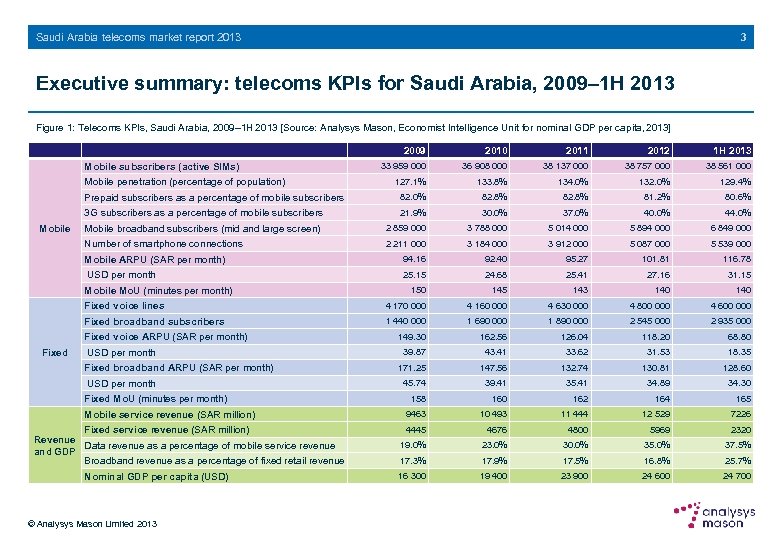
3 Saudi Arabia telecoms market report 2013 Executive summary: telecoms KPIs for Saudi Arabia, 2009– 1 H 2013 Figure 1: Telecoms KPIs, Saudi Arabia, 2009– 1 H 2013 [Source: Analysys Mason, Economist Intelligence Unit for nominal GDP per capita, 2013] 2009 2010 2011 2012 1 H 2013 33 959 000 36 908 000 38 137 000 38 757 000 38 561 000 127. 1% 133. 8% 134. 0% 132. 0% 129. 4% Prepaid subscribers as a percentage of mobile subscribers 82. 0% 82. 8% 81. 2% 80. 6% 3 G subscribers as a percentage of mobile subscribers 21. 9% 30. 0% 37. 0% 40. 0% 44. 0% Mobile broadband subscribers (mid and large screen) 2 859 000 3 788 000 5 014 000 5 894 000 6 849 000 Number of smartphone connections 2 211 000 3 184 000 3 912 000 5 087 000 5 539 000 Mobile ARPU (SAR per month) 94. 16 92. 40 95. 27 101. 81 116. 78 USD per month 25. 15 24. 68 25. 41 27. 16 31. 15 150 145 143 140 Fixed voice lines 4 170 000 4 160 000 4 630 000 4 800 000 4 600 000 Fixed broadband subscribers 1 440 000 1 690 000 1 890 000 2 545 000 2 935 000 149. 30 162. 56 126. 04 118. 20 68. 80 39. 87 43. 41 33. 62 31. 53 18. 35 171. 25 147. 56 132. 74 130. 81 128. 60 45. 74 39. 41 35. 41 34. 89 34. 30 158 160 162 164 165 9463 10 493 11 444 12 529 7226 4445 4676 4800 5969 2320 19. 0% 23. 0% 30. 0% 35. 0% 37. 5% 17. 3% 17. 9% 17. 5% 16. 8% 25. 7% 16 300 19 400 23 900 24 600 24 700 Mobile subscribers (active SIMs) Mobile penetration (percentage of population) Mobile Mo. U (minutes per month) Fixed voice ARPU (SAR per month) Fixed USD per month Fixed broadband ARPU (SAR per month) USD per month Fixed Mo. U (minutes per month) Mobile service revenue (SAR million) Fixed service revenue (SAR million) Revenue Data revenue as a percentage of mobile service revenue and GDP Broadband revenue as a percentage of fixed retail revenue Nominal GDP per capita (USD) © Analysys Mason Limited 2013
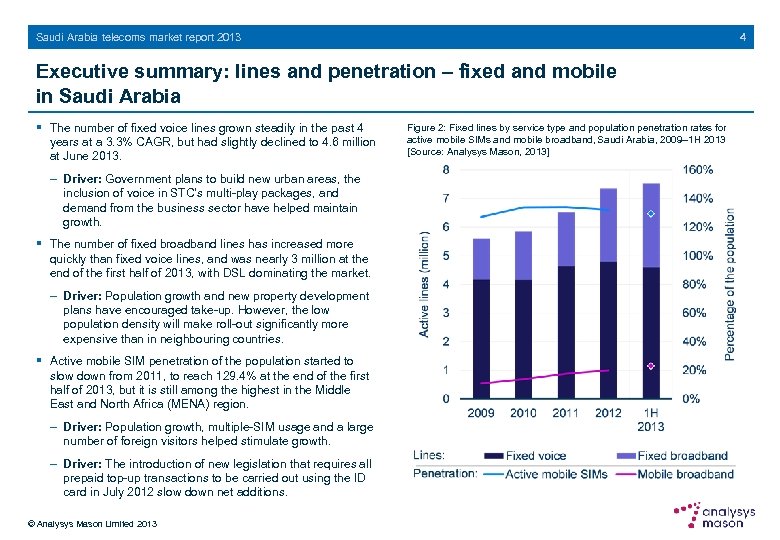
4 Saudi Arabia telecoms market report 2013 Executive summary: lines and penetration – fixed and mobile in Saudi Arabia § The number of fixed voice lines grown steadily in the past 4 years at a 3. 3% CAGR, but had slightly declined to 4. 6 million at June 2013. - Driver: Government plans to build new urban areas, the inclusion of voice in STC’s multi-play packages, and demand from the business sector have helped maintain growth. § The number of fixed broadband lines has increased more quickly than fixed voice lines, and was nearly 3 million at the end of the first half of 2013, with DSL dominating the market. - Driver: Population growth and new property development plans have encouraged take-up. However, the low population density will make roll-out significantly more expensive than in neighbouring countries. § Active mobile SIM penetration of the population started to slow down from 2011, to reach 129. 4% at the end of the first half of 2013, but it is still among the highest in the Middle East and North Africa (MENA) region. - Driver: Population growth, multiple-SIM usage and a large number of foreign visitors helped stimulate growth. - Driver: The introduction of new legislation that requires all prepaid top-up transactions to be carried out using the ID card in July 2012 slow down net additions. © Analysys Mason Limited 2013 Figure 2: Fixed lines by service type and population penetration rates for active mobile SIMs and mobile broadband, Saudi Arabia, 2009– 1 H 2013 [Source: Analysys Mason, 2013]
Saudi Arabia telecoms market report 2013 5 Executive summary: recent and forthcoming key market developments in Saudi Arabia § MNOs’ strong role in the mobile market will limit the impact of new MVNOs. Saudi Arabia’s regulator, the Communications and Information Technology Commission (CITC), announced on 23 June 2013 that it had awarded three MVNO licences. This could result in more-affordable mobile pricing in Saudi Arabia’s highly penetrated mobile market, in which prices have remained flat in recent years. However, we anticipate that the impact of MVNOs will be small because they will still depend on established international gateways of MNOs, be subject to fixed rates, and limited to target pre-agreed segments. § Operators have launched FD-LTE to accelerate LTE adoption. STC, Mobily and Zain launched LTE services in the third quarter of 2011. However, the service was mostly available on USB modems since the number of compatible handsets that support TDLTE – the LTE technology initially adopted by STC and Mobily and the frequencies on which these operators have launched LTE – is low. In 2013, both operators took steps to increase the number of compatible handsets by refarming 1800 MHz spectrum and augmenting TD-LTE networks with FD-LTE. Operators are also keen to ensure the 700– 800 MHz band is free for mobile usage as soon as possible. We anticipate operators bidding for the ‘digital dividend 2’ spectrum in 2016. § Smaller operators have ambitious plans for FTTx, but STC will dominate the fibre market. Fixed-line competition is limited, but the large size of the country, relatively low population density and lower proportion of new-build housing makes nationwide rollout of FTTx a less attractive commercial prospect. For this reason, fibre deployment is expected to be focused in demand-dense areas in major cities and government support will be necessary. STC and its main competitor Bayanat al Oula have ambitious plans; Etihad Atheeb Telecom (branded ‘GO Telecom’) had announced plans to deploy fibre, but its financial problems put its plans in jeopardy. Other competitors include Integrated Telecoms Company (ITC) and Saudi Electric Company (SEC). § Fixed-line competition is set to increase, and there are early signs of consolidation. STC has long been the dominant player in the fixed-line market. Three new licences were awarded in 2007 but only Etihad Atheeb Telecom has launched commercial services since then. The outlook for effective fixed-line competition looks more positive than a year ago because of Mobily’s plans to strengthen its position in the fixed market, and CITC considering introducing unified licensing. For detailed discussion of these trends, see the ‘Recent and forthcoming key market developments’ section. © Analysys Mason Limited 2013

Saudi Arabia telecoms market report 2013 Executive summary and KPIs Operator profiles Mobile and fixed infrastructure plans and status Mobile market: operational and financial KPIs Fixed market: operational and financial KPIs Regulatory information Recent and forthcoming key market developments About the author and Analysys Mason © Analysys Mason Limited 2013 6
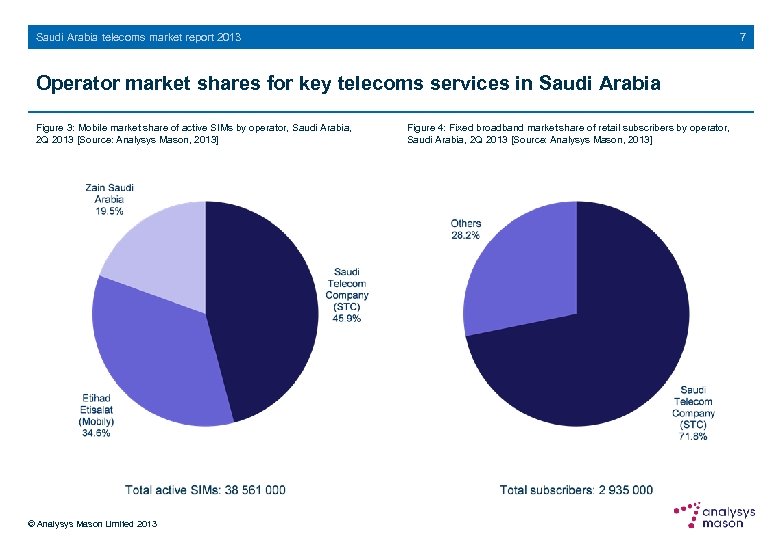
7 Saudi Arabia telecoms market report 2013 Operator market shares for key telecoms services in Saudi Arabia Figure 3: Mobile market share of active SIMs by operator, Saudi Arabia, 2 Q 2013 [Source: Analysys Mason, 2013] © Analysys Mason Limited 2013 Figure 4: Fixed broadband market share of retail subscribers by operator, Saudi Arabia, 2 Q 2013 [Source: Analysys Mason, 2013]
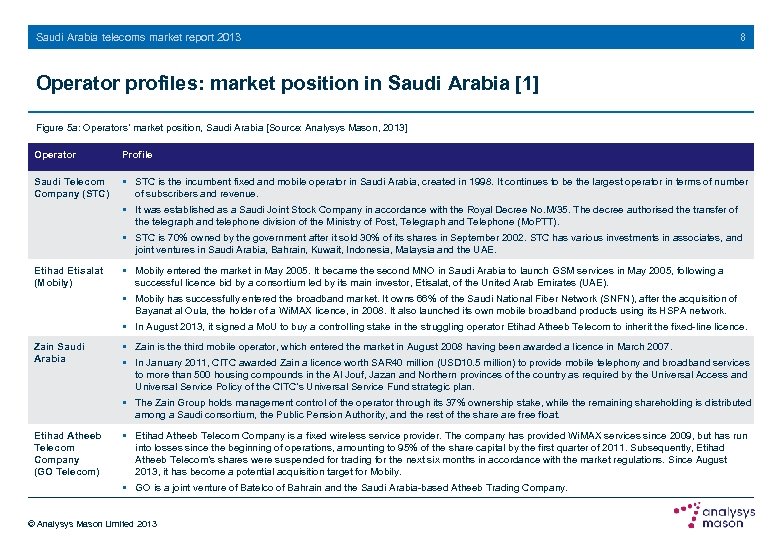
Saudi Arabia telecoms market report 2013 8 Operator profiles: market position in Saudi Arabia [1] Figure 5 a: Operators’ market position, Saudi Arabia [Source: Analysys Mason, 2013] Operator Profile Saudi Telecom Company (STC) § STC is the incumbent fixed and mobile operator in Saudi Arabia, created in 1998. It continues to be the largest operator in terms of number of subscribers and revenue. § It was established as a Saudi Joint Stock Company in accordance with the Royal Decree No. M/35. The decree authorised the transfer of the telegraph and telephone division of the Ministry of Post, Telegraph and Telephone (Mo. PTT). § STC is 70% owned by the government after it sold 30% of its shares in September 2002. STC has various investments in associates, and joint ventures in Saudi Arabia, Bahrain, Kuwait, Indonesia, Malaysia and the UAE. Etihad Etisalat (Mobily) § Mobily entered the market in May 2005. It became the second MNO in Saudi Arabia to launch GSM services in May 2005, following a successful licence bid by a consortium led by its main investor, Etisalat, of the United Arab Emirates (UAE). § Mobily has successfully entered the broadband market. It owns 66% of the Saudi National Fiber Network (SNFN), after the acquisition of Bayanat al Oula, the holder of a Wi. MAX licence, in 2008. It also launched its own mobile broadband products using its HSPA network. § In August 2013, it signed a Mo. U to buy a controlling stake in the struggling operator Etihad Atheeb Telecom to inherit the fixed-line licence. Zain Saudi Arabia § Zain is the third mobile operator, which entered the market in August 2008 having been awarded a licence in March 2007. § In January 2011, CITC awarded Zain a licence worth SAR 40 million (USD 10. 5 million) to provide mobile telephony and broadband services to more than 500 housing compounds in the Al Jouf, Jazan and Northern provinces of the country as required by the Universal Access and Universal Service Policy of the CITC’s Universal Service Fund strategic plan. § The Zain Group holds management control of the operator through its 37% ownership stake, while the remaining shareholding is distributed among a Saudi consortium, the Public Pension Authority, and the rest of the share free float. Etihad Atheeb Telecom Company (GO Telecom) § Etihad Atheeb Telecom Company is a fixed wireless service provider. The company has provided Wi. MAX services since 2009, but has run into losses since the beginning of operations, amounting to 95% of the share capital by the first quarter of 2011. Subsequently, Etihad Atheeb Telecom’s shares were suspended for trading for the next six months in accordance with the market regulations. Since August 2013, it has become a potential acquisition target for Mobily. § GO is a joint venture of Batelco of Bahrain and the Saudi Arabia-based Atheeb Trading Company. © Analysys Mason Limited 2013
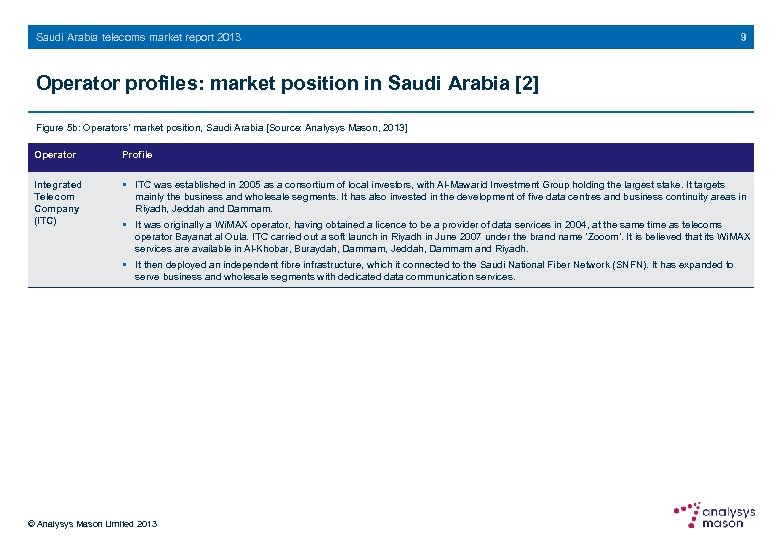
Saudi Arabia telecoms market report 2013 9 Operator profiles: market position in Saudi Arabia [2] Figure 5 b: Operators’ market position, Saudi Arabia [Source: Analysys Mason, 2013] Operator Profile Integrated Telecom Company (ITC) § ITC was established in 2005 as a consortium of local investors, with Al-Mawarid Investment Group holding the largest stake. It targets mainly the business and wholesale segments. It has also invested in the development of five data centres and business continuity areas in Riyadh, Jeddah and Dammam. § It was originally a Wi. MAX operator, having obtained a licence to be a provider of data services in 2004, at the same time as telecoms operator Bayanat al Oula. ITC carried out a soft launch in Riyadh in June 2007 under the brand name 'Zooom’. It is believed that its Wi. MAX services are available in Al-Khobar, Buraydah, Dammam, Jeddah, Dammam and Riyadh. § It then deployed an independent fibre infrastructure, which it connected to the Saudi National Fiber Network (SNFN). It has expanded to serve business and wholesale segments with dedicated data communication services. © Analysys Mason Limited 2013
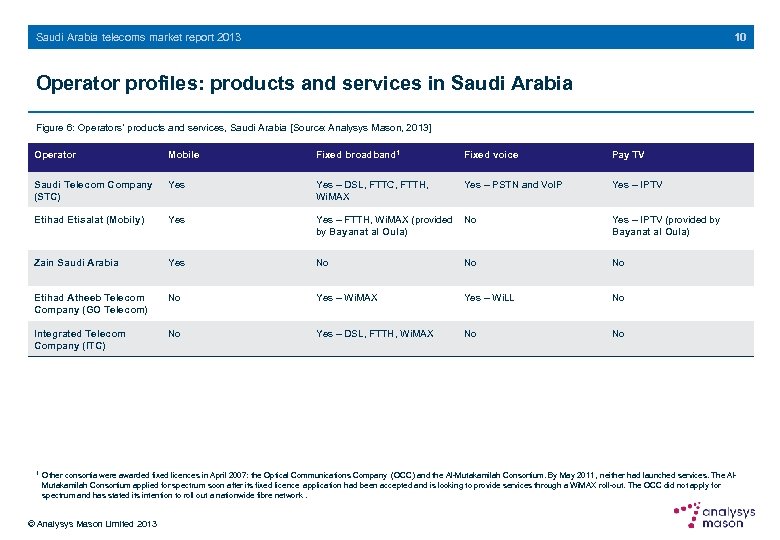
10 Saudi Arabia telecoms market report 2013 Operator profiles: products and services in Saudi Arabia Figure 6: Operators’ products and services, Saudi Arabia [Source: Analysys Mason, 2013] Operator Mobile Fixed broadband 1 Fixed voice Pay TV Saudi Telecom Company (STC) Yes – DSL, FTTC, FTTH, Wi. MAX Yes – PSTN and Vo. IP Yes – IPTV Etihad Etisalat (Mobily) Yes – FTTH, Wi. MAX (provided No by Bayanat al Oula) Yes – IPTV (provided by Bayanat al Oula) Zain Saudi Arabia Yes No No No Etihad Atheeb Telecom Company (GO Telecom) No Yes – Wi. MAX Yes – Wi. LL No Integrated Telecom Company (ITC) No Yes – DSL, FTTH, Wi. MAX No No 1 Other consortia were awarded fixed licences in April 2007: the Optical Communications Company (OCC) and the Al-Mutakamilah Consortium. By May 2011, neither had launched services. The Al. Mutakamilah Consortium applied for spectrum soon after its fixed licence application had been accepted and is looking to provide services through a Wi. MAX roll-out. The OCC did not apply for spectrum and has stated its intention to roll out a nationwide fibre network. © Analysys Mason Limited 2013
Saudi Arabia telecoms market report 2013 Executive summary and KPIs Operator profiles Mobile and fixed infrastructure plans and status Mobile market: operational and financial KPIs Fixed market: operational and financial KPIs Regulatory information Recent and forthcoming key market developments About the author and Analysys Mason © Analysys Mason Limited 2013 11
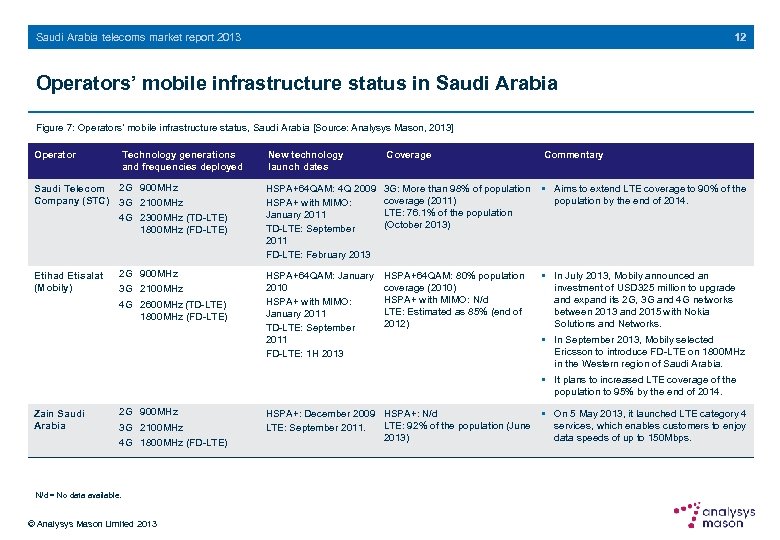
12 Saudi Arabia telecoms market report 2013 Operators’ mobile infrastructure status in Saudi Arabia Figure 7: Operators’ mobile infrastructure status, Saudi Arabia [Source: Analysys Mason, 2013] Operator Technology generations and frequencies deployed Saudi Telecom 2 G 900 MHz Company (STC) 3 G 2100 MHz 4 G 2300 MHz (TD-LTE) 1800 MHz (FD-LTE) Etihad Etisalat (Mobily) 2 G 900 MHz 3 G 2100 MHz 4 G 2600 MHz (TD-LTE) 1800 MHz (FD-LTE) New technology launch dates Coverage Commentary HSPA+64 QAM: 4 Q 2009 HSPA+ with MIMO: January 2011 TD-LTE: September 2011 FD-LTE: February 2013 3 G: More than 98% of population § Aims to extend LTE coverage to 90% of the coverage (2011) population by the end of 2014. LTE: 76. 1% of the population (October 2013) HSPA+64 QAM: January 2010 HSPA+ with MIMO: January 2011 TD-LTE: September 2011 FD-LTE: 1 H 2013 HSPA+64 QAM: 80% population coverage (2010) HSPA+ with MIMO: N/d LTE: Estimated as 85% (end of 2012) § In July 2013, Mobily announced an investment of USD 325 million to upgrade and expand its 2 G, 3 G and 4 G networks between 2013 and 2015 with Nokia Solutions and Networks. § In September 2013, Mobily selected Ericsson to introduce FD-LTE on 1800 MHz in the Western region of Saudi Arabia. § It plans to increased LTE coverage of the population to 95% by the end of 2014. Zain Saudi Arabia 2 G 900 MHz 3 G 2100 MHz 4 G 1800 MHz (FD-LTE) N/d = No data available. © Analysys Mason Limited 2013 HSPA+: December 2009 HSPA+: N/d § On 5 May 2013, it launched LTE category 4 LTE: 92% of the population (June services, which enables customers to enjoy LTE: September 2011. 2013) data speeds of up to 150 Mbps.
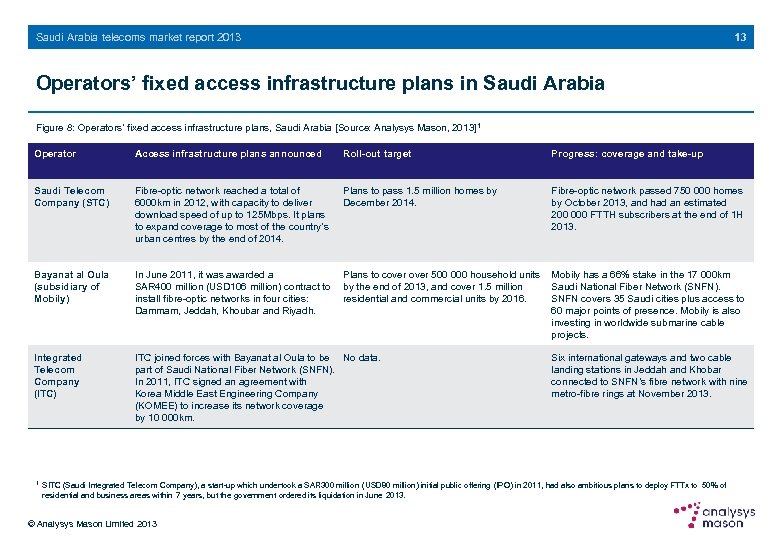
13 Saudi Arabia telecoms market report 2013 Operators’ fixed access infrastructure plans in Saudi Arabia Figure 8: Operators’ fixed access infrastructure plans, Saudi Arabia [Source: Analysys Mason, 2013]1 Operator Access infrastructure plans announced Roll-out target Progress: coverage and take-up Saudi Telecom Company (STC) Fibre-optic network reached a total of 6000 km in 2012, with capacity to deliver download speed of up to 125 Mbps. It plans to expand coverage to most of the country’s urban centres by the end of 2014. Plans to pass 1. 5 million homes by December 2014. Fibre-optic network passed 750 000 homes by October 2013, and had an estimated 200 000 FTTH subscribers at the end of 1 H 2013. Bayanat al Oula (subsidiary of Mobily) In June 2011, it was awarded a Plans to cover 500 000 household units Mobily has a 66% stake in the 17 000 km SAR 400 million (USD 106 million) contract to by the end of 2013, and cover 1. 5 million Saudi National Fiber Network (SNFN). install fibre-optic networks in four cities: residential and commercial units by 2016. SNFN covers 35 Saudi cities plus access to Dammam, Jeddah, Khoubar and Riyadh. 60 major points of presence. Mobily is also investing in worldwide submarine cable projects. Integrated Telecom Company (ITC) ITC joined forces with Bayanat al Oula to be No data. part of Saudi National Fiber Network (SNFN). In 2011, ITC signed an agreement with Korea Middle East Engineering Company (KOMEE) to increase its network coverage by 10 000 km. 1 Six international gateways and two cable landing stations in Jeddah and Khobar connected to SNFN’s fibre network with nine metro-fibre rings at November 2013. SITC (Saudi Integrated Telecom Company), a start-up which undertook a SAR 300 million (USD 80 million) initial public offering (IPO) in 2011, had also ambitious plans to deploy FTTx to 50% of residential and business areas within 7 years, but the government ordered its liquidation in June 2013. © Analysys Mason Limited 2013
Saudi Arabia telecoms market report 2013 Executive summary and KPIs Operator profiles Mobile and fixed infrastructure plans and status Mobile market: operational and financial KPIs Fixed market: operational and financial KPIs Regulatory information Recent and forthcoming key market developments About the author and Analysys Mason © Analysys Mason Limited 2013 14
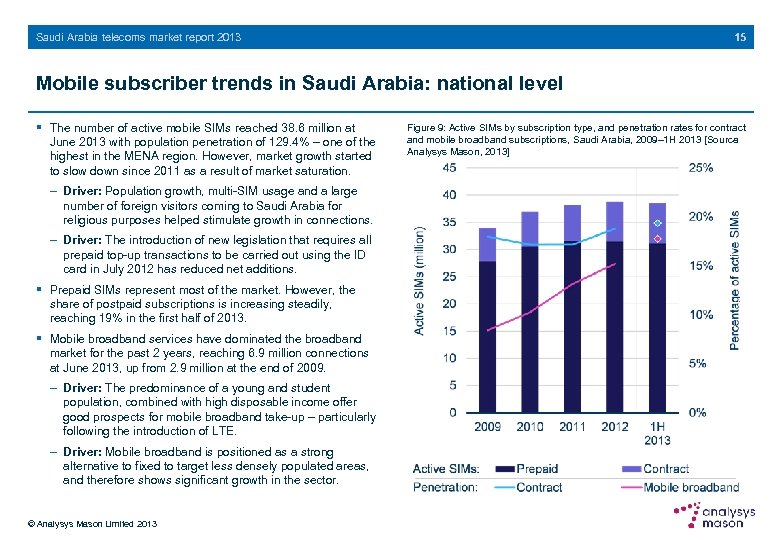
15 Saudi Arabia telecoms market report 2013 Mobile subscriber trends in Saudi Arabia: national level § The number of active mobile SIMs reached 38. 6 million at June 2013 with population penetration of 129. 4% – one of the highest in the MENA region. However, market growth started to slow down since 2011 as a result of market saturation. - Driver: Population growth, multi-SIM usage and a large number of foreign visitors coming to Saudi Arabia for religious purposes helped stimulate growth in connections. - Driver: The introduction of new legislation that requires all prepaid top-up transactions to be carried out using the ID card in July 2012 has reduced net additions. § Prepaid SIMs represent most of the market. However, the share of postpaid subscriptions is increasing steadily, reaching 19% in the first half of 2013. § Mobile broadband services have dominated the broadband market for the past 2 years, reaching 6. 9 million connections at June 2013, up from 2. 9 million at the end of 2009. - Driver: The predominance of a young and student population, combined with high disposable income offer good prospects for mobile broadband take-up – particularly following the introduction of LTE. - Driver: Mobile broadband is positioned as a strong alternative to fixed to target less densely populated areas, and therefore shows significant growth in the sector. © Analysys Mason Limited 2013 Figure 9: Active SIMs by subscription type, and penetration rates for contract and mobile broadband subscriptions, Saudi Arabia, 2009– 1 H 2013 [Source : Analysys Mason, 2013]

16 Saudi Arabia telecoms market report 2013 Mobile subscriber trends in Saudi Arabia: operator market share § STC dominated the market until 2004 when foreign investment in the Saudi telecoms sector was sanctioned. STC lost market share to the competition but maintained a comfortable 45. 9% share of the mobile market at the end of the first half of 2013. - Driver: STC has a traditional focus and strong brand presence, and dominates the high-ARPU business segment. § Mobily accounted for more than one third of the mobile market at the first half of 2013. - Driver: Mobily is Saudi-focused and enjoys a good reputation among the young and expat segments, and it offers reduced national and international call rates for these communities. § Zain accounts for the remaining 19. 5% of subscribers. It has regained market share since 2012, following a decline during 2010– 2011 because of intense competition. - Driver: Aggressive pricing and customised tariff plans enabled Zain to increase its share of the market at the expense of STC. However, it has been burdened with debt, which limits ability to invest or reduce product prices further. It has been struggling to find a lender to refinance its growing debts, and has had to turn to the parent company to cover costs in the past. © Analysys Mason Limited 2013 Figure 10: Mobile market share of active SIMs by operator, Saudi Arabia, 2009– 1 H 2013 [Source: Analysys Mason, 2013]

17 Saudi Arabia telecoms market report 2013 Mobile market revenue and ARPU in Saudi Arabia: national level § Revenue from the mobile voice segment has stabilised during the last 3 years at about SAR 30 billion (USD 8 billion). - Driver: Growth in Mobily’s service revenue since its entry into the market in 2007 has offset declining mobile revenue from STC and Zain. Mobily attributed the continued growth of its service revenue in 2013 to higher revenue from the prepaid segment. § Mobile APRU declined from SAR 108 (USD 29) in 2008 to SAR 92 (USD 25) in 2010, before increasing again from 2011 to reach SAR 116 (USD 31) at the end of the first half of 2013. - Driver: ARPU decline was the result of competition that stimulated subscriber growth. As revenue stabilised and the number of net additions slowed down, ARPU picked up again in 2011. However, the introduction of MVNOs in the market in 2013 will reignite price competition and negatively impact ARPU and revenue in the next 2 years. § Non-voice share of mobile revenue has increased from 13% in 2008 to 35% in 2012. - Driver: Demand for data services, and adoption of USB modems and smartphones, have driven growth in the nonvoice segment. Mobily reported that data accounted for 27% of its revenue in 2012, up from 22% in 2011, and is projected to reach 30% in 2 years. © Analysys Mason Limited 2013 Figure 11: Mobile voice and non-voice service revenue, and ARPU, Saudi Arabia, 2008– 2012 [Source: Analysys Mason, 2013]
Saudi Arabia telecoms market report 2013 Executive summary and KPIs Operator profiles Mobile and fixed infrastructure plans and status Mobile market: operational and financial KPIs Fixed market: operational and financial KPIs Regulatory information Recent and forthcoming key market developments About the author and Analysys Mason © Analysys Mason Limited 2013 18
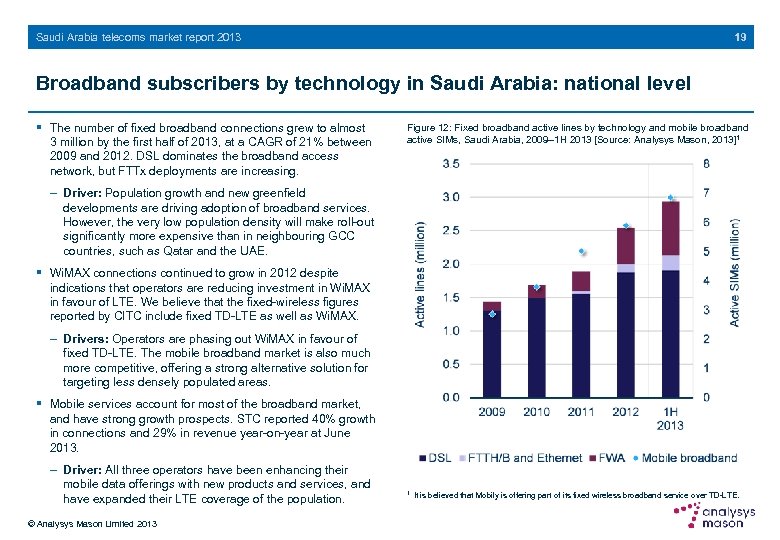
19 Saudi Arabia telecoms market report 2013 Broadband subscribers by technology in Saudi Arabia: national level § The number of fixed broadband connections grew to almost 3 million by the first half of 2013, at a CAGR of 21% between 2009 and 2012. DSL dominates the broadband access network, but FTTx deployments are increasing. Figure 12: Fixed broadband active lines by technology and mobile broadband active SIMs, Saudi Arabia, 2009– 1 H 2013 [Source: Analysys Mason, 2013]1 - Driver: Population growth and new greenfield developments are driving adoption of broadband services. However, the very low population density will make roll-out significantly more expensive than in neighbouring GCC countries, such as Qatar and the UAE. § Wi. MAX connections continued to grow in 2012 despite indications that operators are reducing investment in Wi. MAX in favour of LTE. We believe that the fixed-wireless figures reported by CITC include fixed TD-LTE as well as Wi. MAX. - Drivers: Operators are phasing out Wi. MAX in favour of fixed TD-LTE. The mobile broadband market is also much more competitive, offering a strong alternative solution for targeting less densely populated areas. § Mobile services account for most of the broadband market, and have strong growth prospects. STC reported 40% growth in connections and 29% in revenue year-on-year at June 2013. - Driver: All three operators have been enhancing their mobile data offerings with new products and services, and have expanded their LTE coverage of the population. © Analysys Mason Limited 2013 1 It is believed that Mobily is offering part of its fixed wireless broadband service over TD-LTE.
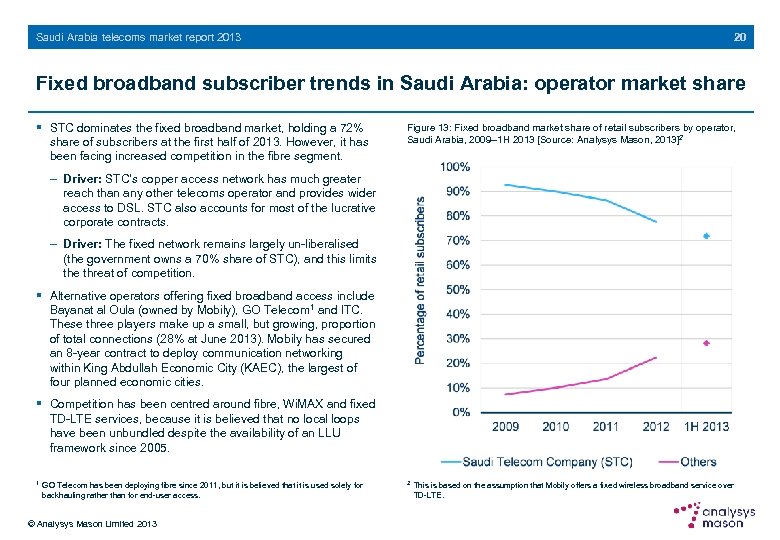
20 Saudi Arabia telecoms market report 2013 Fixed broadband subscriber trends in Saudi Arabia: operator market share § STC dominates the fixed broadband market, holding a 72% share of subscribers at the first half of 2013. However, it has been facing increased competition in the fibre segment. Figure 13: Fixed broadband market share of retail subscribers by operator, Saudi Arabia, 2009– 1 H 2013 [Source: Analysys Mason, 2013]2 - Driver: STC’s copper access network has much greater reach than any other telecoms operator and provides wider access to DSL. STC also accounts for most of the lucrative corporate contracts. - Driver: The fixed network remains largely un-liberalised (the government owns a 70% share of STC), and this limits the threat of competition. § Alternative operators offering fixed broadband access include Bayanat al Oula (owned by Mobily), GO Telecom 1 and ITC. These three players make up a small, but growing, proportion of total connections (28% at June 2013). Mobily has secured an 8 -year contract to deploy communication networking within King Abdullah Economic City (KAEC), the largest of four planned economic cities. § Competition has been centred around fibre, Wi. MAX and fixed TD-LTE services, because it is believed that no local loops have been unbundled despite the availability of an LLU framework since 2005. 1 GO Telecom has been deploying fibre since 2011, but it is believed that it is used solely for backhauling rather than for end-user access. © Analysys Mason Limited 2013 2 This is based on the assumption that Mobily offers a fixed wireless broadband service over TD-LTE.
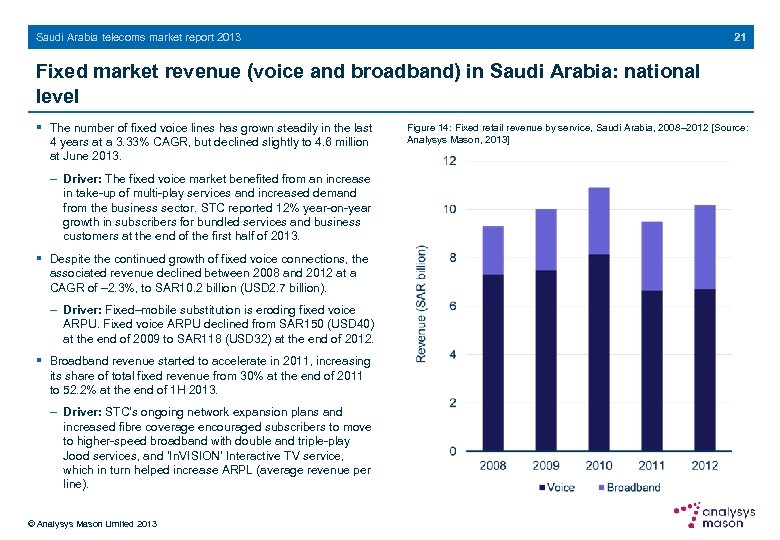
21 Saudi Arabia telecoms market report 2013 Fixed market revenue (voice and broadband) in Saudi Arabia: national level § The number of fixed voice lines has grown steadily in the last 4 years at a 3. 33% CAGR, but declined slightly to 4. 6 million at June 2013. - Driver: The fixed voice market benefited from an increase in take-up of multi-play services and increased demand from the business sector. STC reported 12% year-on-year growth in subscribers for bundled services and business customers at the end of the first half of 2013. § Despite the continued growth of fixed voice connections, the associated revenue declined between 2008 and 2012 at a CAGR of – 2. 3%, to SAR 10. 2 billion (USD 2. 7 billion). - Driver: Fixed–mobile substitution is eroding fixed voice ARPU. Fixed voice ARPU declined from SAR 150 (USD 40) at the end of 2009 to SAR 118 (USD 32) at the end of 2012. § Broadband revenue started to accelerate in 2011, increasing its share of total fixed revenue from 30% at the end of 2011 to 52. 2% at the end of 1 H 2013. - Driver: STC’s ongoing network expansion plans and increased fibre coverage encouraged subscribers to move to higher-speed broadband with double and triple-play Jood services, and ‘In. VISION’ Interactive TV service, which in turn helped increase ARPL (average revenue per line). © Analysys Mason Limited 2013 Figure 14: Fixed retail revenue by service, Saudi Arabia, 2008– 2012 [Source: Analysys Mason, 2013]
Saudi Arabia telecoms market report 2013 Executive summary and KPIs Operator profiles Mobile and fixed infrastructure plans and status Mobile market: operational and financial KPIs Fixed market: operational and financial KPIs Regulatory information Recent and forthcoming key market developments About the author and Analysys Mason © Analysys Mason Limited 2013 22
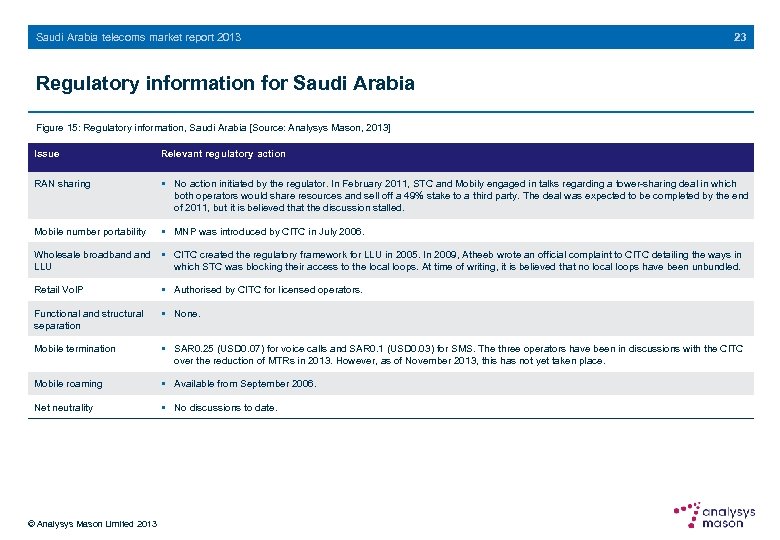
Saudi Arabia telecoms market report 2013 23 Regulatory information for Saudi Arabia Figure 15: Regulatory information, Saudi Arabia [Source: Analysys Mason, 2013] Issue Relevant regulatory action RAN sharing § No action initiated by the regulator. In February 2011, STC and Mobily engaged in talks regarding a tower-sharing deal in which both operators would share resources and sell off a 49% stake to a third party. The deal was expected to be completed by the end of 2011, but it is believed that the discussion stalled. Mobile number portability § MNP was introduced by CITC in July 2006. Wholesale broadband § CITC created the regulatory framework for LLU in 2005. In 2009, Atheeb wrote an official complaint to CITC detailing the ways in LLU which STC was blocking their access to the local loops. At time of writing, it is believed that no local loops have been unbundled. Retail Vo. IP § Authorised by CITC for licensed operators. Functional and structural separation § None. Mobile termination § SAR 0. 25 (USD 0. 07) for voice calls and SAR 0. 1 (USD 0. 03) for SMS. The three operators have been in discussions with the CITC over the reduction of MTRs in 2013. However, as of November 2013, this has not yet taken place. Mobile roaming § Available from September 2006. Net neutrality § No discussions to date. © Analysys Mason Limited 2013
Saudi Arabia telecoms market report 2013 Executive summary and KPIs Operator profiles Mobile and fixed infrastructure plans and status Mobile market: operational and financial KPIs Fixed market: operational and financial KPIs Regulatory information Recent and forthcoming key market developments About the author and Analysys Mason © Analysys Mason Limited 2013 24
Saudi Arabia telecoms market report 2013 Recent and forthcoming key market developments MNOs’ strong role in the mobile market will limit the impact of new MVNOs Operators have launched FD-LTE to accelerate LTE adoption Smaller operators have ambitious plans for FTTx, but STC will dominate the fibre market Fixed-line competition is set to increase, and there are early signs of consolidation © Analysys Mason Limited 2013 25
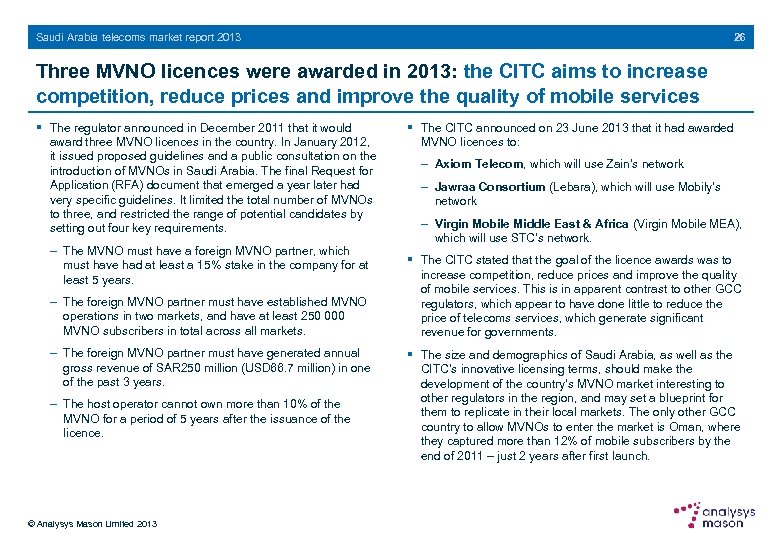
26 Saudi Arabia telecoms market report 2013 Three MVNO licences were awarded in 2013: the CITC aims to increase competition, reduce prices and improve the quality of mobile services § The regulator announced in December 2011 that it would award three MVNO licences in the country. In January 2012, it issued proposed guidelines and a public consultation on the introduction of MVNOs in Saudi Arabia. The final Request for Application (RFA) document that emerged a year later had very specific guidelines. It limited the total number of MVNOs to three, and restricted the range of potential candidates by setting out four key requirements. - The MVNO must have a foreign MVNO partner, which must have had at least a 15% stake in the company for at least 5 years. - The foreign MVNO partner must have established MVNO operations in two markets, and have at least 250 000 MVNO subscribers in total across all markets. - The foreign MVNO partner must have generated annual gross revenue of SAR 250 million (USD 66. 7 million) in one of the past 3 years. - The host operator cannot own more than 10% of the MVNO for a period of 5 years after the issuance of the licence. © Analysys Mason Limited 2013 § The CITC announced on 23 June 2013 that it had awarded MVNO licences to: - Axiom Telecom, which will use Zain’s network - Jawraa Consortium (Lebara), which will use Mobily’s network - Virgin Mobile Middle East & Africa (Virgin Mobile MEA), which will use STC’s network. § The CITC stated that the goal of the licence awards was to increase competition, reduce prices and improve the quality of mobile services. This is in apparent contrast to other GCC regulators, which appear to have done little to reduce the price of telecoms services, which generate significant revenue for governments. § The size and demographics of Saudi Arabia, as well as the CITC’s innovative licensing terms, should make the development of the country’s MVNO market interesting to other regulators in the region, and may set a blueprint for them to replicate in their local markets. The only other GCC country to allow MVNOs to enter the market is Oman, where they captured more than 12% of mobile subscribers by the end of 2011 – just 2 years after first launch.
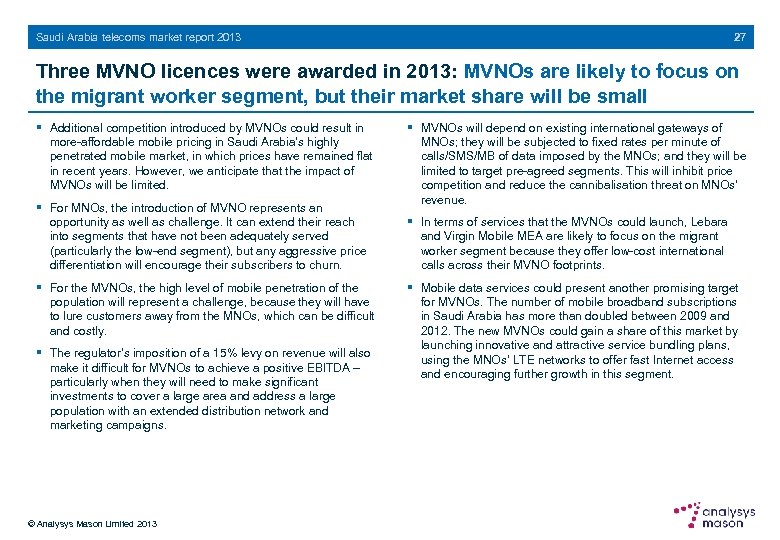
27 Saudi Arabia telecoms market report 2013 Three MVNO licences were awarded in 2013: MVNOs are likely to focus on the migrant worker segment, but their market share will be small § Additional competition introduced by MVNOs could result in more-affordable mobile pricing in Saudi Arabia’s highly penetrated mobile market, in which prices have remained flat in recent years. However, we anticipate that the impact of MVNOs will be limited. § For MNOs, the introduction of MVNO represents an opportunity as well as challenge. It can extend their reach into segments that have not been adequately served (particularly the low-end segment), but any aggressive price differentiation will encourage their subscribers to churn. § For the MVNOs, the high level of mobile penetration of the population will represent a challenge, because they will have to lure customers away from the MNOs, which can be difficult and costly. § The regulator’s imposition of a 15% levy on revenue will also make it difficult for MVNOs to achieve a positive EBITDA – particularly when they will need to make significant investments to cover a large area and address a large population with an extended distribution network and marketing campaigns. © Analysys Mason Limited 2013 § MVNOs will depend on existing international gateways of MNOs; they will be subjected to fixed rates per minute of calls/SMS/MB of data imposed by the MNOs; and they will be limited to target pre-agreed segments. This will inhibit price competition and reduce the cannibalisation threat on MNOs’ revenue. § In terms of services that the MVNOs could launch, Lebara and Virgin Mobile MEA are likely to focus on the migrant worker segment because they offer low-cost international calls across their MVNO footprints. § Mobile data services could present another promising target for MVNOs. The number of mobile broadband subscriptions in Saudi Arabia has more than doubled between 2009 and 2012. The new MVNOs could gain a share of this market by launching innovative and attractive service bundling plans, using the MNOs’ LTE networks to offer fast Internet access and encouraging further growth in this segment.
Saudi Arabia telecoms market report 2013 Recent and forthcoming key market developments MNOs’ strong role in the mobile market will limit the impact of new MVNOs Operators have launched FD-LTE to accelerate LTE adoption Smaller operators have ambitious plans for FTTx, but STC will dominate the fibre market Fixed-line competition is set to increase, and there are early signs of consolidation © Analysys Mason Limited 2013 28
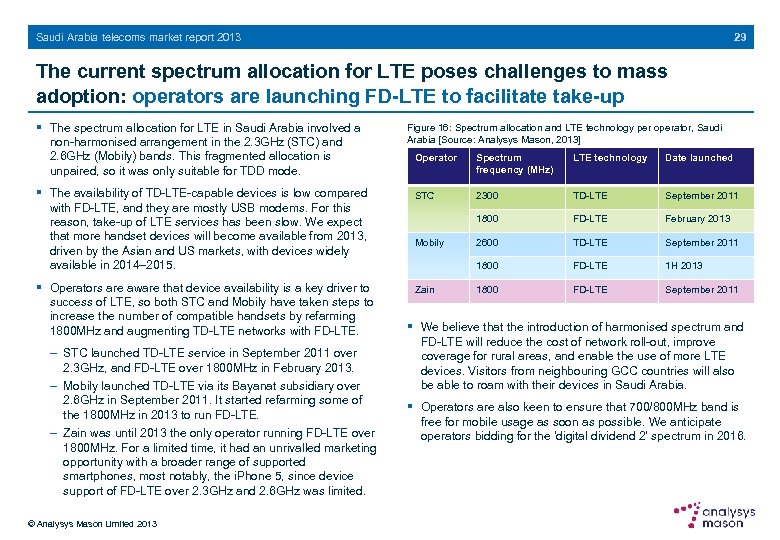
29 Saudi Arabia telecoms market report 2013 The current spectrum allocation for LTE poses challenges to mass adoption: operators are launching FD-LTE to facilitate take-up § The spectrum allocation for LTE in Saudi Arabia involved a non-harmonised arrangement in the 2. 3 GHz (STC) and 2. 6 GHz (Mobily) bands. This fragmented allocation is unpaired, so it was only suitable for TDD mode. Figure 16: Spectrum allocation and LTE technology per operator, Saudi Arabia [Source: Analysys Mason, 2013] Operator Spectrum frequency (MHz) LTE technology Date launched § The availability of TD-LTE-capable devices is low compared with FD-LTE, and they are mostly USB modems. For this reason, take-up of LTE services has been slow. We expect that more handset devices will become available from 2013, driven by the Asian and US markets, with devices widely available in 2014– 2015. STC 2300 TD-LTE September 2011 1800 FD-LTE February 2013 2600 TD-LTE September 2011 1800 FD-LTE 1 H 2013 § Operators are aware that device availability is a key driver to success of LTE, so both STC and Mobily have taken steps to increase the number of compatible handsets by refarming 1800 MHz and augmenting TD-LTE networks with FD-LTE. Zain 1800 FD-LTE September 2011 - STC launched TD-LTE service in September 2011 over 2. 3 GHz, and FD-LTE over 1800 MHz in February 2013. - Mobily launched TD-LTE via its Bayanat subsidiary over 2. 6 GHz in September 2011. It started refarming some of the 1800 MHz in 2013 to run FD-LTE. - Zain was until 2013 the only operator running FD-LTE over 1800 MHz. For a limited time, it had an unrivalled marketing opportunity with a broader range of supported smartphones, most notably, the i. Phone 5, since device support of FD-LTE over 2. 3 GHz and 2. 6 GHz was limited. © Analysys Mason Limited 2013 Mobily § We believe that the introduction of harmonised spectrum and FD-LTE will reduce the cost of network roll-out, improve coverage for rural areas, and enable the use of more LTE devices. Visitors from neighbouring GCC countries will also be able to roam with their devices in Saudi Arabia. § Operators are also keen to ensure that 700/800 MHz band is free for mobile usage as soon as possible. We anticipate operators bidding for the ‘digital dividend 2’ spectrum in 2016.
Saudi Arabia telecoms market report 2013 Recent and forthcoming key market developments MNOs’ strong role in the mobile market will limit the impact of new MVNOs Operators have launched FD-LTE to accelerate LTE adoption Smaller operators have ambitious plans for FTTx, but STC will dominate the fibre market Fixed-line competition is set to increase, and there are early signs of consolidation © Analysys Mason Limited 2013 30
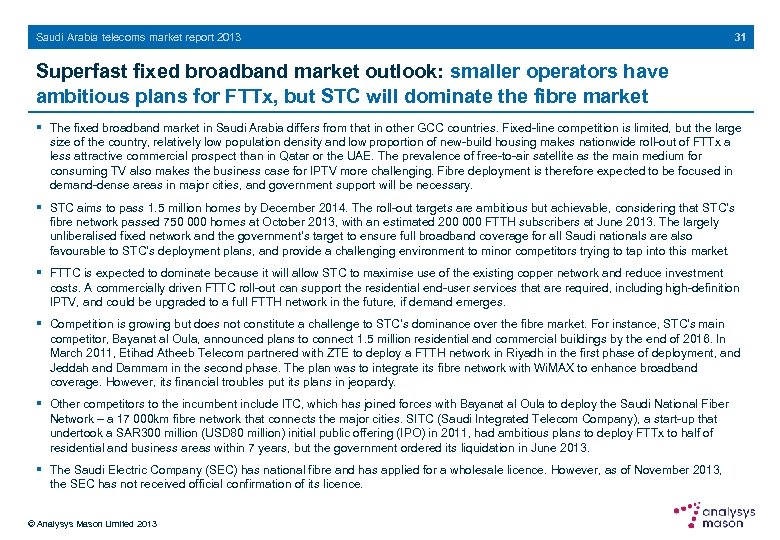
Saudi Arabia telecoms market report 2013 31 Superfast fixed broadband market outlook: smaller operators have ambitious plans for FTTx, but STC will dominate the fibre market § The fixed broadband market in Saudi Arabia differs from that in other GCC countries. Fixed-line competition is limited, but the large size of the country, relatively low population density and low proportion of new-build housing makes nationwide roll-out of FTTx a less attractive commercial prospect than in Qatar or the UAE. The prevalence of free-to-air satellite as the main medium for consuming TV also makes the business case for IPTV more challenging. Fibre deployment is therefore expected to be focused in demand-dense areas in major cities, and government support will be necessary. § STC aims to pass 1. 5 million homes by December 2014. The roll-out targets are ambitious but achievable, considering that STC’s fibre network passed 750 000 homes at October 2013, with an estimated 200 000 FTTH subscribers at June 2013. The largely unliberalised fixed network and the government’s target to ensure full broadband coverage for all Saudi nationals are also favourable to STC’s deployment plans, and provide a challenging environment to minor competitors trying to tap into this market. § FTTC is expected to dominate because it will allow STC to maximise use of the existing copper network and reduce investment costs. A commercially driven FTTC roll-out can support the residential end-user services that are required, including high-definition IPTV, and could be upgraded to a full FTTH network in the future, if demand emerges. § Competition is growing but does not constitute a challenge to STC’s dominance over the fibre market. For instance, STC’s main competitor, Bayanat al Oula, announced plans to connect 1. 5 million residential and commercial buildings by the end of 2016. In March 2011, Etihad Atheeb Telecom partnered with ZTE to deploy a FTTH network in Riyadh in the first phase of deployment, and Jeddah and Dammam in the second phase. The plan was to integrate its fibre network with Wi. MAX to enhance broadband coverage. However, its financial troubles put its plans in jeopardy. § Other competitors to the incumbent include ITC, which has joined forces with Bayanat al Oula to deploy the Saudi National Fiber Network – a 17 000 km fibre network that connects the major cities. SITC (Saudi Integrated Telecom Company), a start-up that undertook a SAR 300 million (USD 80 million) initial public offering (IPO) in 2011, had ambitious plans to deploy FTTx to half of residential and business areas within 7 years, but the government ordered its liquidation in June 2013. § The Saudi Electric Company (SEC) has national fibre and has applied for a wholesale licence. However, as of November 2013, the SEC has not received official confirmation of its licence. © Analysys Mason Limited 2013
Saudi Arabia telecoms market report 2013 Recent and forthcoming key market developments MNOs’ strong role in the mobile market will limit the impact of new MVNOs Operators have launched FD-LTE to accelerate LTE adoption Smaller operators have ambitious plans for FTTx, but STC will dominate the fibre market Fixed-line competition is set to increase, and there are early signs of consolidation in 2013 © Analysys Mason Limited 2013 32
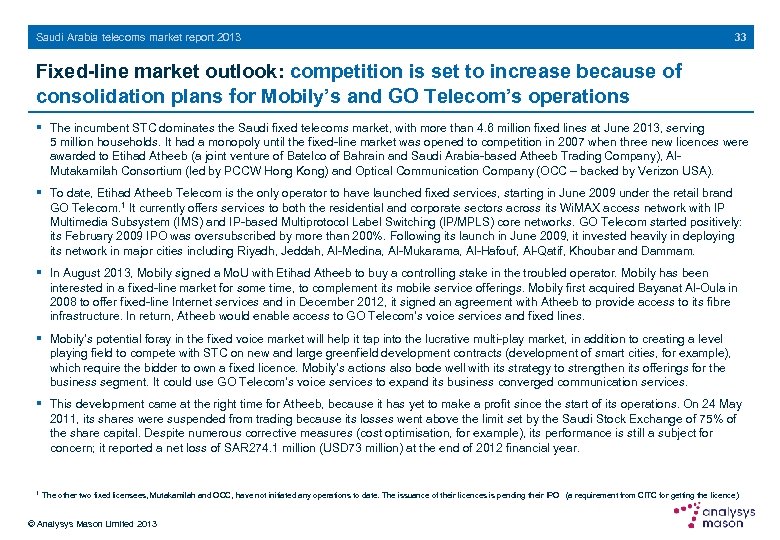
Saudi Arabia telecoms market report 2013 33 Fixed-line market outlook: competition is set to increase because of consolidation plans for Mobily’s and GO Telecom’s operations § The incumbent STC dominates the Saudi fixed telecoms market, with more than 4. 6 million fixed lines at June 2013, serving 5 million households. It had a monopoly until the fixed-line market was opened to competition in 2007 when three new licences were awarded to Etihad Atheeb (a joint venture of Batelco of Bahrain and Saudi Arabia-based Atheeb Trading Company), Al. Mutakamilah Consortium (led by PCCW Hong Kong) and Optical Communication Company (OCC – backed by Verizon USA). § To date, Etihad Atheeb Telecom is the only operator to have launched fixed services, starting in June 2009 under the retail brand GO Telecom. 1 It currently offers services to both the residential and corporate sectors across its Wi. MAX access network with IP Multimedia Subsystem (IMS) and IP-based Multiprotocol Label Switching (IP/MPLS) core networks. GO Telecom started positively: its February 2009 IPO was oversubscribed by more than 200%. Following its launch in June 2009, it invested heavily in deploying its network in major cities including Riyadh, Jeddah, Al-Medina, Al-Mukarama, Al-Hafouf, Al-Qatif, Khoubar and Dammam. § In August 2013, Mobily signed a Mo. U with Etihad Atheeb to buy a controlling stake in the troubled operator. Mobily has been interested in a fixed-line market for some time, to complement its mobile service offerings. Mobily first acquired Bayanat Al-Oula in 2008 to offer fixed-line Internet services and in December 2012, it signed an agreement with Atheeb to provide access to its fibre infrastructure. In return, Atheeb would enable access to GO Telecom’s voice services and fixed lines. § Mobily’s potential foray in the fixed voice market will help it tap into the lucrative multi-play market, in addition to creating a level playing field to compete with STC on new and large greenfield development contracts (development of smart cities, for example), which require the bidder to own a fixed licence. Mobily’s actions also bode well with its strategy to strengthen its offerings for the business segment. It could use GO Telecom’s voice services to expand its business converged communication services. § This development came at the right time for Atheeb, because it has yet to make a profit since the start of its operations. On 24 May 2011, its shares were suspended from trading because its losses went above the limit set by the Saudi Stock Exchange of 75% of the share capital. Despite numerous corrective measures (cost optimisation, for example), its performance is still a subject for concern; it reported a net loss of SAR 274. 1 million (USD 73 million) at the end of 2012 financial year. 1 The other two fixed licensees, Mutakamilah and OCC, have not initiated any operations to date. The issuance of their licences is pending their IPO (a requirement from CITC for getting the licence) © Analysys Mason Limited 2013
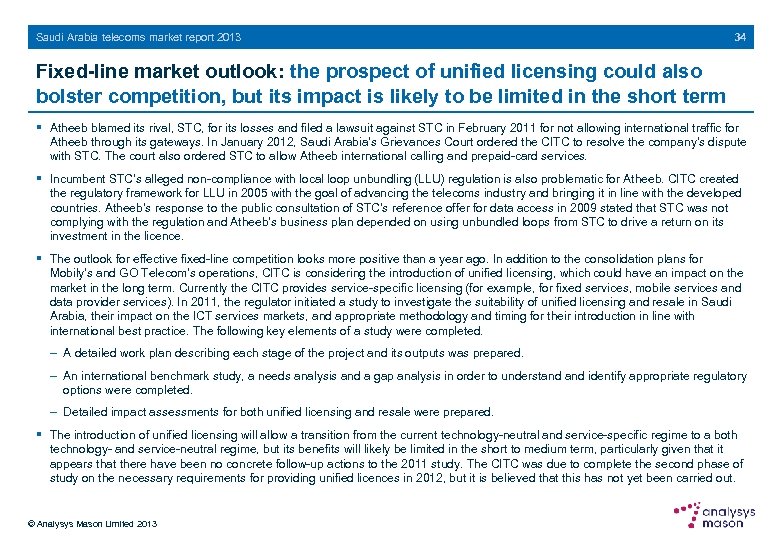
Saudi Arabia telecoms market report 2013 34 Fixed-line market outlook: the prospect of unified licensing could also bolster competition, but its impact is likely to be limited in the short term § Atheeb blamed its rival, STC, for its losses and filed a lawsuit against STC in February 2011 for not allowing international traffic for Atheeb through its gateways. In January 2012, Saudi Arabia’s Grievances Court ordered the CITC to resolve the company’s dispute with STC. The court also ordered STC to allow Atheeb international calling and prepaid-card services. § Incumbent STC’s alleged non-compliance with local loop unbundling (LLU) regulation is also problematic for Atheeb. CITC created the regulatory framework for LLU in 2005 with the goal of advancing the telecoms industry and bringing it in line with the developed countries. Atheeb’s response to the public consultation of STC’s reference offer for data access in 2009 stated that STC was not complying with the regulation and Atheeb’s business plan depended on using unbundled loops from STC to drive a return on its investment in the licence. § The outlook for effective fixed-line competition looks more positive than a year ago. In addition to the consolidation plans for Mobily’s and GO Telecom's operations, CITC is considering the introduction of unified licensing, which could have an impact on the market in the long term. Currently the CITC provides service-specific licensing (for example, for fixed services, mobile services and data provider services). In 2011, the regulator initiated a study to investigate the suitability of unified licensing and resale in Saudi Arabia, their impact on the ICT services markets, and appropriate methodology and timing for their introduction in line with international best practice. The following key elements of a study were completed. - A detailed work plan describing each stage of the project and its outputs was prepared. - An international benchmark study, a needs analysis and a gap analysis in order to understand identify appropriate regulatory options were completed. - Detailed impact assessments for both unified licensing and resale were prepared. § The introduction of unified licensing will allow a transition from the current technology-neutral and service-specific regime to a both technology- and service-neutral regime, but its benefits will likely be limited in the short to medium term, particularly given that it appears that there have been no concrete follow-up actions to the 2011 study. The CITC was due to complete the second phase of study on the necessary requirements for providing unified licences in 2012, but it is believed that this has not yet been carried out. © Analysys Mason Limited 2013
Saudi Arabia telecoms market report 2013 Executive summary and KPIs Operator profiles Mobile and fixed infrastructure plans and status Mobile market: operational and financial KPIs Fixed market: operational and financial KPIs Regulatory information Recent and forthcoming key market developments About the author and Analysys Mason © Analysys Mason Limited 2013 35
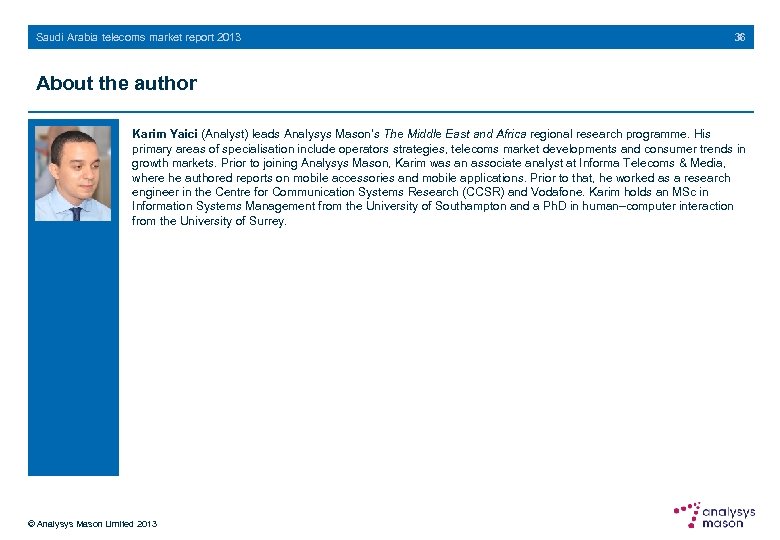
Saudi Arabia telecoms market report 2013 36 About the author Karim Yaici (Analyst) leads Analysys Mason’s The Middle East and Africa regional research programme. His primary areas of specialisation include operators strategies, telecoms market developments and consumer trends in growth markets. Prior to joining Analysys Mason, Karim was an associate analyst at Informa Telecoms & Media, where he authored reports on mobile accessories and mobile applications. Prior to that, he worked as a research engineer in the Centre for Communication Systems Research (CCSR) and Vodafone. Karim holds an MSc in Information Systems Management from the University of Southampton and a Ph. D in human–computer interaction from the University of Surrey. © Analysys Mason Limited 2013
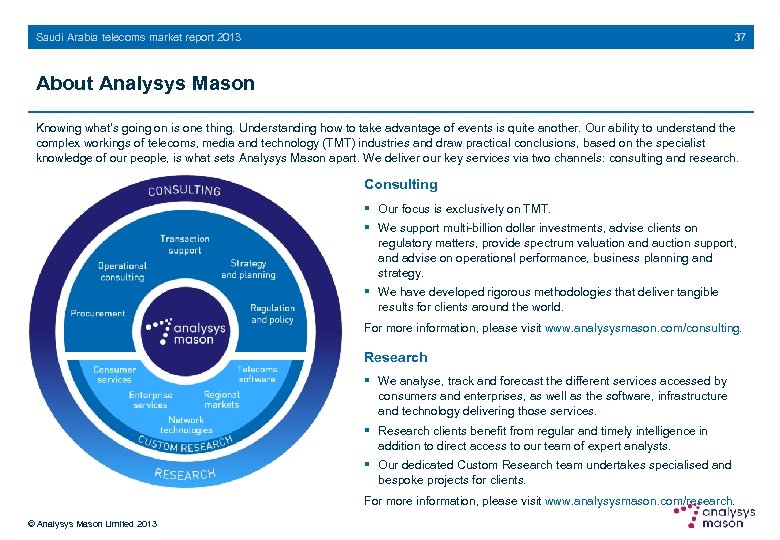
37 Saudi Arabia telecoms market report 2013 About Analysys Mason Knowing what’s going on is one thing. Understanding how to take advantage of events is quite another. Our ability to understand the complex workings of telecoms, media and technology (TMT) industries and draw practical conclusions, based on the specialist knowledge of our people, is what sets Analysys Mason apart. We deliver our key services via two channels: consulting and research. Consulting § Our focus is exclusively on TMT. § We support multi-billion dollar investments, advise clients on regulatory matters, provide spectrum valuation and auction support, and advise on operational performance, business planning and strategy. § We have developed rigorous methodologies that deliver tangible results for clients around the world. For more information, please visit www. analysysmason. com/consulting. Research § We analyse, track and forecast the different services accessed by consumers and enterprises, as well as the software, infrastructure and technology delivering those services. § Research clients benefit from regular and timely intelligence in addition to direct access to our team of expert analysts. § Our dedicated Custom Research team undertakes specialised and bespoke projects for clients. For more information, please visit www. analysysmason. com/research. © Analysys Mason Limited 2013
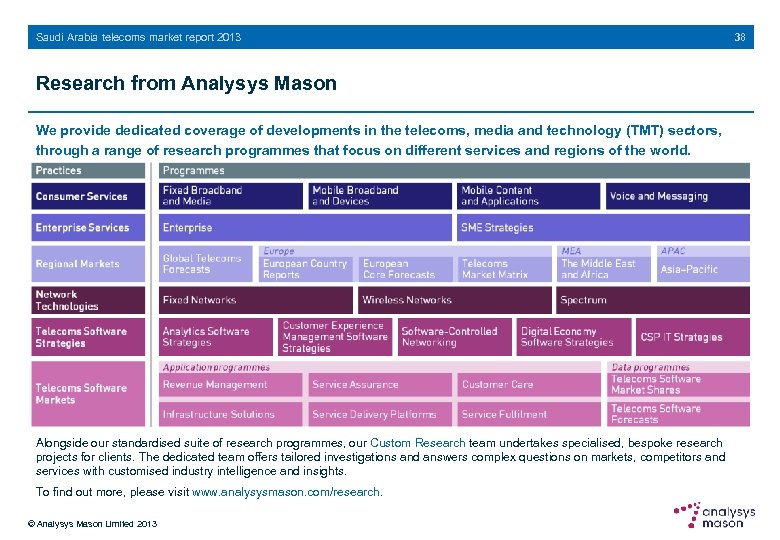
Saudi Arabia telecoms market report 2013 Research from Analysys Mason We provide dedicated coverage of developments in the telecoms, media and technology (TMT) sectors, through a range of research programmes that focus on different services and regions of the world. Alongside our standardised suite of research programmes, our Custom Research team undertakes specialised, bespoke research projects for clients. The dedicated team offers tailored investigations and answers complex questions on markets, competitors and services with customised industry intelligence and insights. To find out more, please visit www. analysysmason. com/research. © Analysys Mason Limited 2013 38
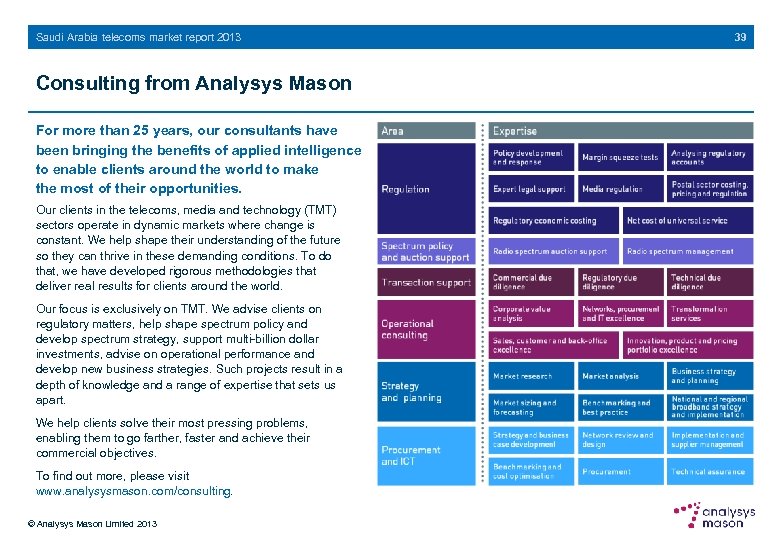
Saudi Arabia telecoms market report 2013 Consulting from Analysys Mason For more than 25 years, our consultants have been bringing the benefits of applied intelligence to enable clients around the world to make the most of their opportunities. Our clients in the telecoms, media and technology (TMT) sectors operate in dynamic markets where change is constant. We help shape their understanding of the future so they can thrive in these demanding conditions. To do that, we have developed rigorous methodologies that deliver real results for clients around the world. Our focus is exclusively on TMT. We advise clients on regulatory matters, help shape spectrum policy and develop spectrum strategy, support multi-billion dollar investments, advise on operational performance and develop new business strategies. Such projects result in a depth of knowledge and a range of expertise that sets us apart. We help clients solve their most pressing problems, enabling them to go farther, faster and achieve their commercial objectives. To find out more, please visit www. analysysmason. com/consulting. © Analysys Mason Limited 2013 39
Saudi Arabia telecoms market report 2013 Published by Analysys Mason Limited • Bush House • North West Wing • Aldwych • London • WC 2 B 4 PJ • UK Tel: +44 (0)20 7395 9000 • Fax: +44 (0)20 7395 9001 • Email: research@analysysmason. com • www. analysysmason. com/research • Registered in England No. 5177472 © Analysys Mason Limited 2013. All rights reserved. No part of this publication may be reproduced, stored in a retrieval system or transmitted in any form or by any means – electronic, mechanical, photocopying, recording or otherwise – without the prior written permission of the publisher. Figures and projections contained in this report are based on publicly available information only and are produced by the Research Division of Analysys Mason Limited independently of any clientspecific work within Analysys Mason Limited. The opinions expressed are those of the stated authors only. Analysys Mason Limited recognises that many terms appearing in this report are proprietary; all such trademarks are acknowledged and every effort has been made to indicate them by the normal UK publishing practice of capitalisation. However, the presence of a term, in whatever form, does not affect its legal status as a trademark. Analysys Mason Limited maintains that all reasonable care and skill have been used in the compilation of this publication. However, Analysys Mason Limited shall not be under any liability for loss or damage (including consequential loss) whatsoever or howsoever arising as a result of the use of this publication by the customer, his servants, agents or any third party. © Analysys Mason Limited 2013
Скачать презентацию Saudi Arabia telecoms market report 2013 Country Report
e6540e7d2658dda9e9603a9f89323279.ppt