 Скачать презентацию SATIF-13 October 10 -13 2012 Helmholtz-Zentrum Dresden-Rossendorf Dresden
d0f4928143ecaa84ce0d5c832db1609b.ppt
- Количество слайдов: 21



SATIF-13 October 10 -13, 2012, Helmholtz-Zentrum Dresden-Rossendorf, Dresden, Germany Analyses to Support Waste Disposition of SNS Inner Reflector Plug I. Popova, F. X. Gallmeier, S. Trotter, M. Dayton ORNL is managed by UT-Battelle for the US Department of Energy
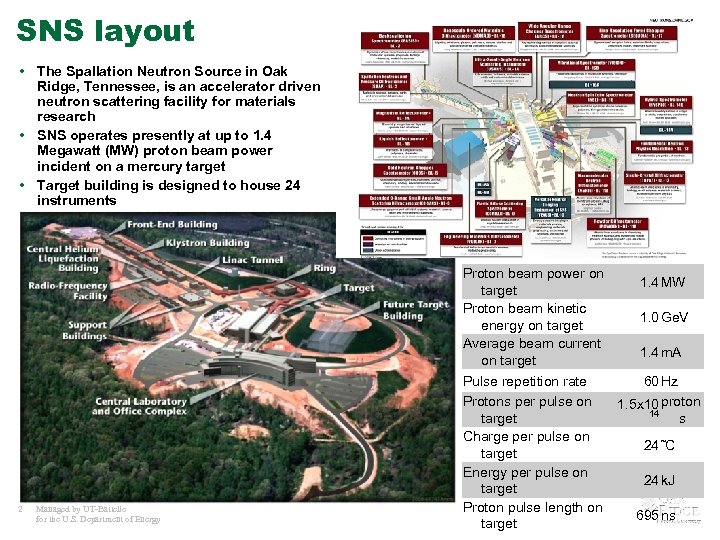
SNS layout • The Spallation Neutron Source in Oak Ridge, Tennessee, is an accelerator driven neutron scattering facility for materials research • SNS operates presently at up to 1. 4 Megawatt (MW) proton beam power incident on a mercury target • Target building is designed to house 24 instruments • Presently 19 instruments are operating • 10 years beam on target 2 Managed by UT-Battelle for the U. S. Department of Energy Proton beam power on 1. 4 MW target Proton beam kinetic 1. 0 Ge. V energy on target Average beam current 1. 4 m. A on target Pulse repetition rate 60 Hz Protons per pulse on 1. 5 x 10 proton 14 target s Charge per pulse on 24 ˜C target Energy per pulse on 24 k. J target Proton pulse length on 695 ns target
Introduction According to the SNS operations plan Target System components are replaced: ØTo avoid excessive degradation of components materials – target vessels and proton beam windows; ØWhen beam line optical components are ready to be installed Core Vessel Insert (CVI) plugs are extracted; ØWhen reach planned end-of-life – Inner Reflector Plug (IRP). Components must be: ØSafely removed; ØPlaced in containers for storage on site in order to 3 cool down; ØPlaced into shipping container packages to transport off-site. Managed by UT-Battelle for the U. S. Department of Energy
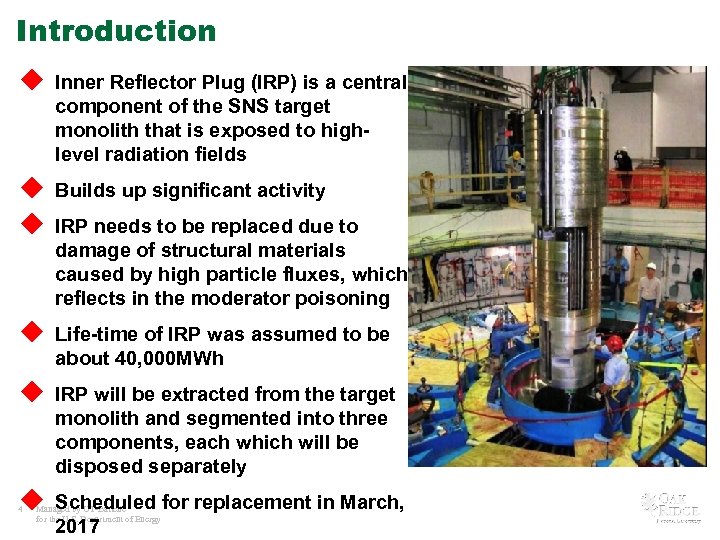
Introduction u Inner Reflector Plug (IRP) is a central component of the SNS target monolith that is exposed to highlevel radiation fields u u Builds up significant activity u Life-time of IRP was assumed to be about 40, 000 MWh u IRP will be extracted from the target monolith and segmented into three components, each which will be disposed separately u Scheduled for replacement in March, 2017 4 IRP needs to be replaced due to damage of structural materials caused by high particle fluxes, which reflects in the moderator poisoning Managed by UT-Battelle for the U. S. Department of Energy
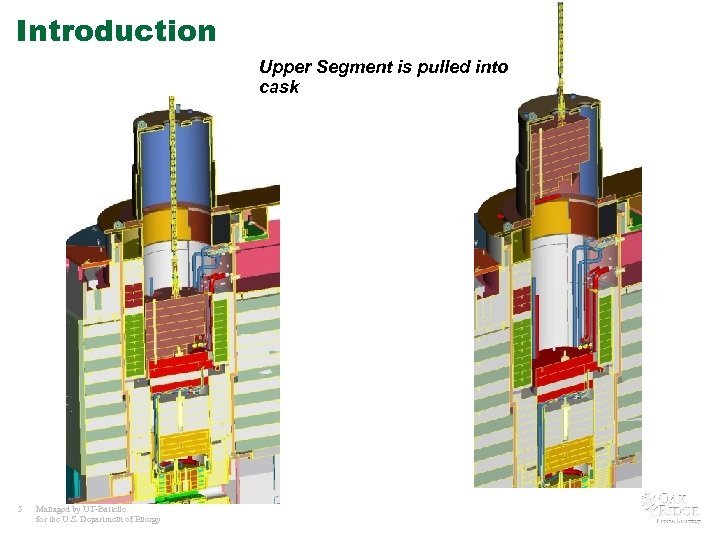
Introduction Upper Segment is pulled into cask 5 Managed by UT-Battelle for the U. S. Department of Energy
Introduction Neutronics analyses for IRP deposition are performed to: Ø Predict isotope composition for spent structures to support waste characterization and transportation analyses; Ø Predict dose rates after cool down; Ø Ensure choice of proper shipping container/package; Ø Develop shielding for container/package; Ø Perform transport analyses with real irradiation history for chosen container/package 6 Ø Analyses are performed for each segment Managed by UT-Battelle for the U. S. Department of Energy
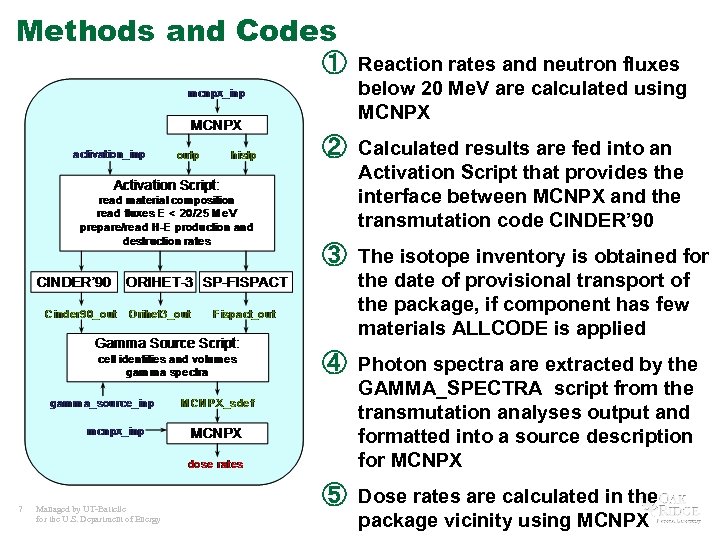
Methods and Codes ① Reaction rates and neutron fluxes below 20 Me. V are calculated using MCNPX ② Calculated results are fed into an Activation Script that provides the interface between MCNPX and the transmutation code CINDER’ 90 ③ The isotope inventory is obtained for the date of provisional transport of the package, if component has few materials ALLCODE is applied ④ Photon spectra are extracted by the GAMMA_SPECTRA script from the transmutation analyses output and formatted into a source description for MCNPX 7 Managed by UT-Battelle for the U. S. Department of Energy ⑤ Dose rates are calculated in the package vicinity using MCNPX
Methods and Codes ØThe latest 3 D as-built target station and proton beam window model in MCNPX language are used ØEffective dose rates are obtained by folding fluxes with flux-to-dose conversion coefficients, which are taken from standardized neutron and gamma flux-todose conversion coefficient libraries for the SNS Ø 2 D mesh-tallies were defined in the vertical and horizontal planes ØSurface tallies were set at requested key locations ØFor waste classification purposes a report containing isotope inventory, dose rates at specified locations is generated 8 Managed by UT-Battelle for the U. S. Department of Energy
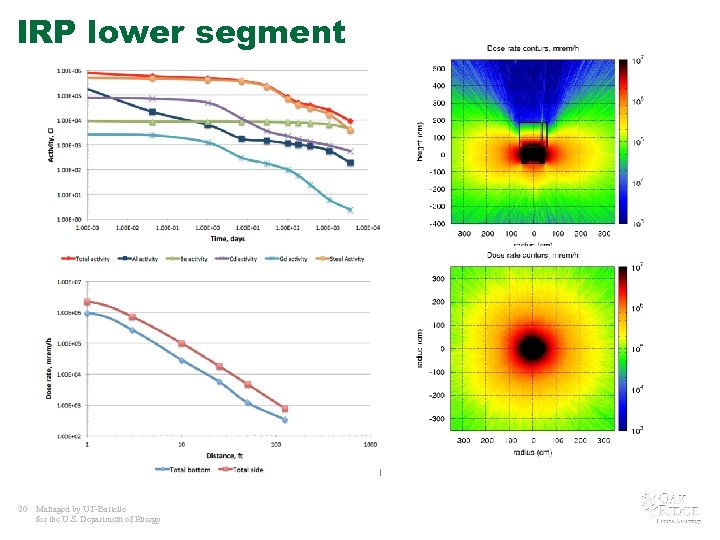
Waste characterization Report for waste management contains: ü History of irradiation; ü Radionuclide inventory; ü Time line of component activity after beam termination; ü Gamma dose rate contour plots; ü Predicted dose rates at locations required by the U. S. Department of Transportation (DOT); ü Distances from the side and the bottom of the spent component package for which the dose rates fall below 100 mrem/hr and 5 mrem/hr 9 Managed by UT-Battelle for the U. S. Department of Energy
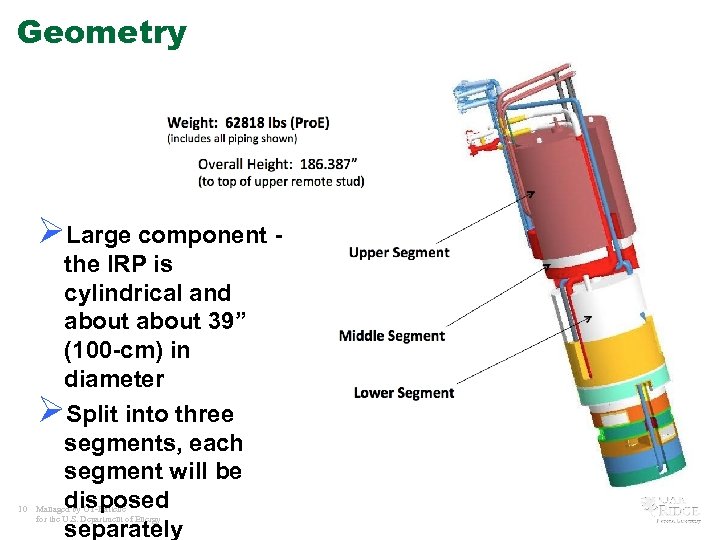
Geometry ØLarge component - 10 the IRP is cylindrical and about 39” (100 -cm) in diameter ØSplit into three segments, each segment will be disposed separately Managed by UT-Battelle for the U. S. Department of Energy
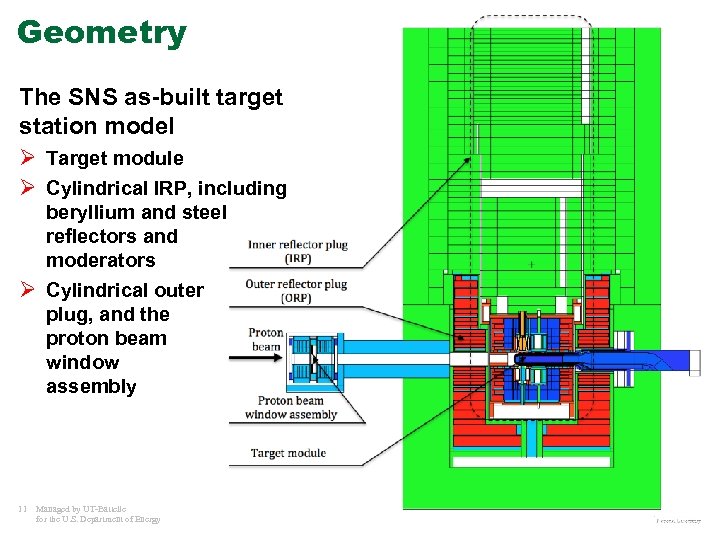
Geometry The SNS as-built target station model Ø Target module Ø Cylindrical IRP, including beryllium and steel reflectors and moderators Ø Cylindrical outer plug, and the proton beam window assembly 11 Managed by UT-Battelle for the U. S. Department of Energy
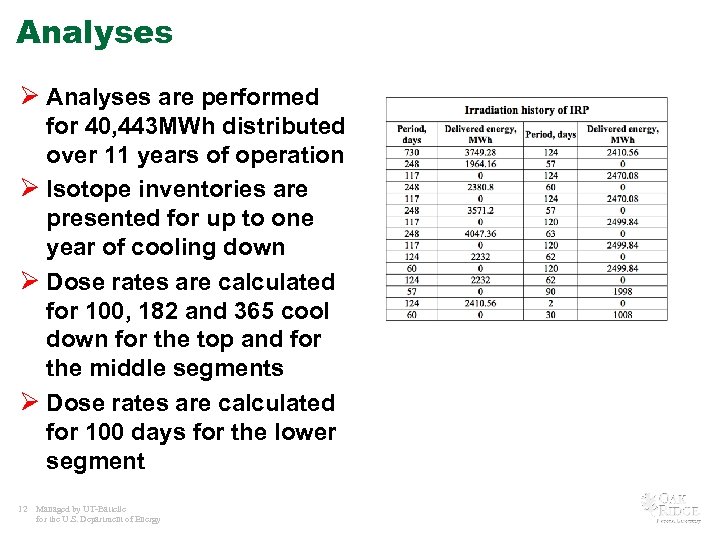
Analyses Ø Analyses are performed for 40, 443 MWh distributed over 11 years of operation Ø Isotope inventories are presented for up to one year of cooling down Ø Dose rates are calculated for 100, 182 and 365 cool down for the top and for the middle segments Ø Dose rates are calculated for 100 days for the lower segment 12 Managed by UT-Battelle for the U. S. Department of Energy
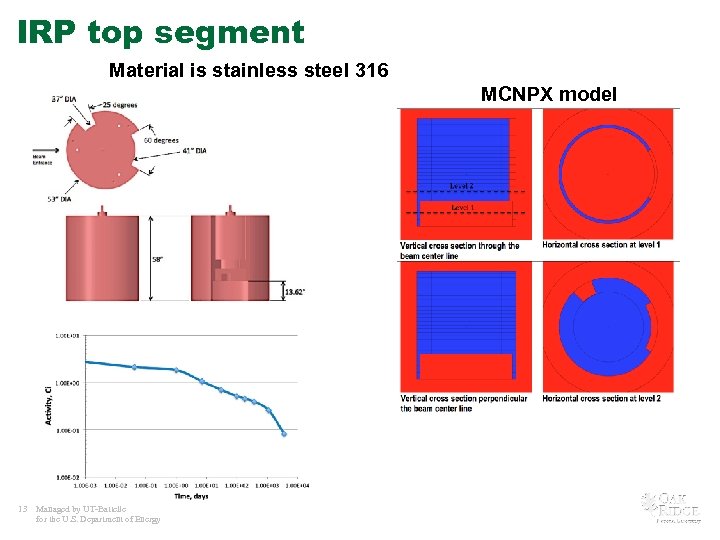
IRP top segment Material is stainless steel 316 MCNPX model 13 Managed by UT-Battelle for the U. S. Department of Energy
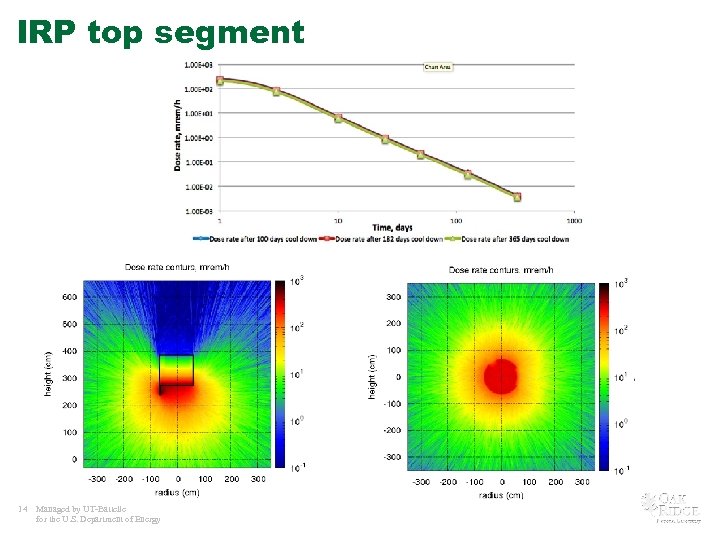
IRP top segment 14 Managed by UT-Battelle for the U. S. Department of Energy
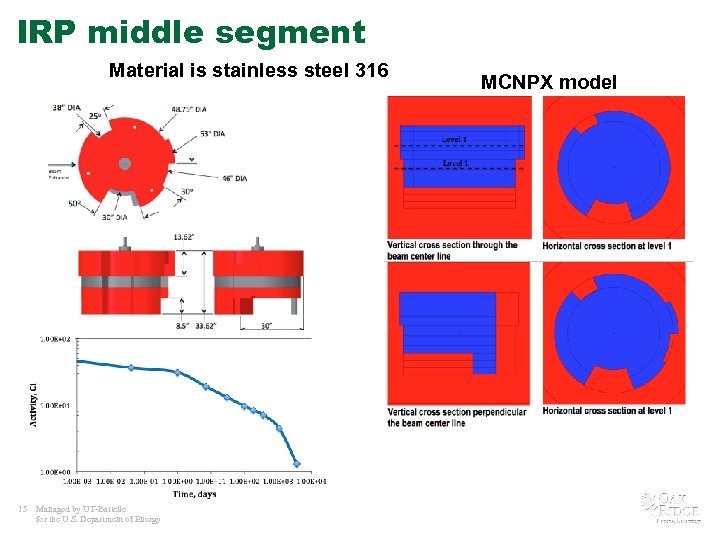
IRP middle segment Material is stainless steel 316 15 Managed by UT-Battelle for the U. S. Department of Energy MCNPX model
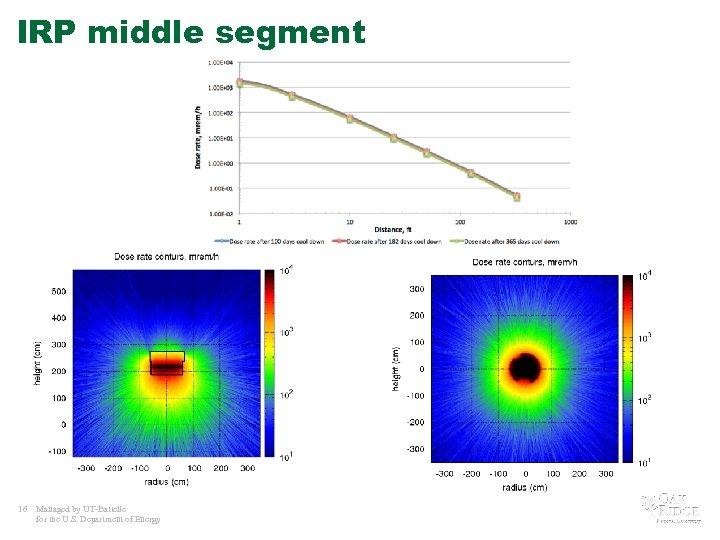
IRP middle segment 16 Managed by UT-Battelle for the U. S. Department of Energy
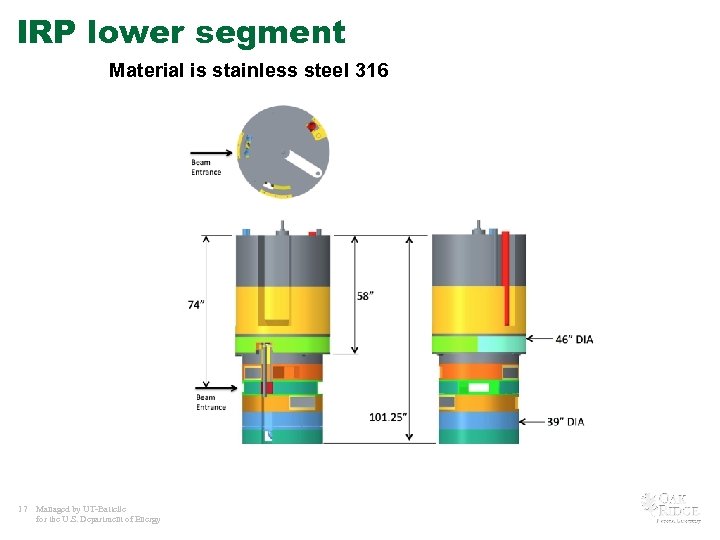
IRP lower segment Material is stainless steel 316 17 Managed by UT-Battelle for the U. S. Department of Energy
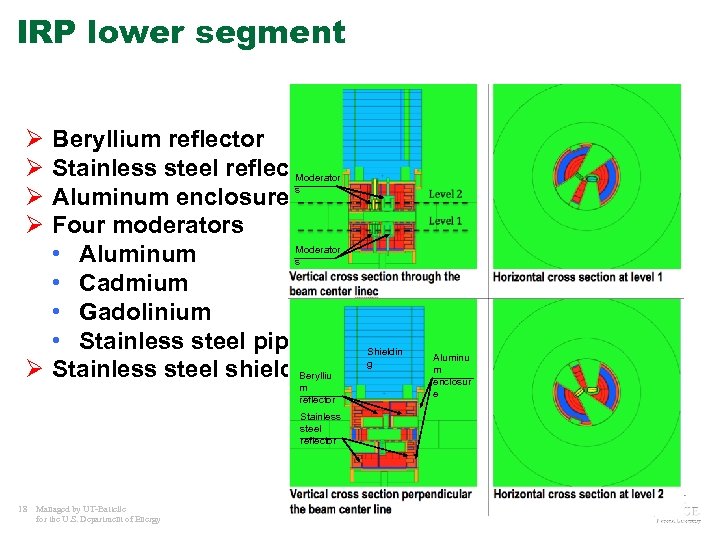
IRP lower segment Ø Ø Beryllium reflector Stainless steel reflector Moderator Aluminum enclosure s Four moderators Moderator • Aluminum s • Cadmium • Gadolinium • Stainless steel piping Ø Stainless steel shielding Berylliu m reflector Stainless steel reflector 18 Managed by UT-Battelle for the U. S. Department of Energy Shieldin g Aluminu m enclosur e
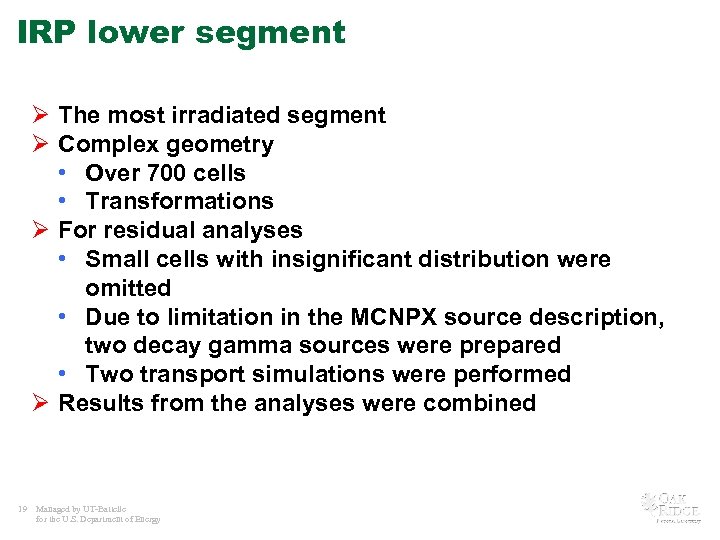
IRP lower segment Ø The most irradiated segment Ø Complex geometry • Over 700 cells • Transformations Ø For residual analyses • Small cells with insignificant distribution were omitted • Due to limitation in the MCNPX source description, two decay gamma sources were prepared • Two transport simulations were performed Ø Results from the analyses were combined 19 Managed by UT-Battelle for the U. S. Department of Energy
IRP lower segment 20 Managed by UT-Battelle for the U. S. Department of Energy
Conclusions u An accurate estimate of the radionuclide inventory and the dose rates associated with radiation fields of the spent IRP were performed u Awaiting characterization and classification of each segment and to determine the appropriate storage and transport package. u Radiation fields at 30 -cm from IRP lower segment after 100 days cool down are above 1000 Rem/h. 21 Managed by UT-Battelle for the U. S. Department of Energy
Скачать презентацию SATIF-13 October 10 -13 2012 Helmholtz-Zentrum Dresden-Rossendorf Dresden
d0f4928143ecaa84ce0d5c832db1609b.ppt