


 Скачать презентацию Satellite solutions for Telemedicine Nathalie Ricard Telecommunications Department
cd1bffad79b4b611ae401fbf60a3adb1.ppt
- Количество слайдов: 31
 Satellite solutions for Telemedicine Nathalie Ricard Telecommunications Department European Space Agency Seminar ETSI/Ministry of Health of Mexico, Tuxtla, 18 -19 May 2006 1
 ESA programmes All Member States participate in Space Science mandatory programmes. In addition, members chose the level of participation in optional programmes: • Human space flight and exploration • Microgravity research • Earth observation • Telecommunications • Satellite navigation • Launcher development 2
 Why is ESA involved with Applications? • Applications represent the ultimate good for which the End Users are willing to pay NO APPLICATIONS = NO BUSINESS • Beside the core activities of R&D and industrialisation of Technology, ESA Telecom is active to promote the development of Satcom based Applications 3
 ESA Telecom Applications projects 4
 ESA Telecom Applications Projects • Hosted in dedicated lines of the ARTES Programme (Advanced Research in Telecommunications Systems) • Driving idea: provide evidence of benefits and prepare for a commercial deployment • Over 110 Applications Pilot Projects since 1997 for a total value over 150 MEUR (most of them funded 50% by ESA) • 60% contracted to SMEs • 50% contracted to new entrant into ESA Telecom 5
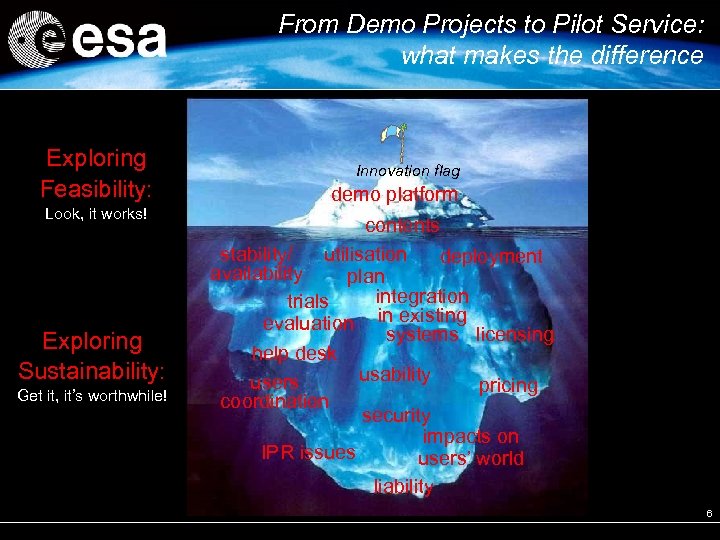 From Demo Projects to Pilot Service: what makes the difference Exploring Feasibility: Look, it works! Exploring Sustainability: Get it, it’s worthwhile! Innovation flag demo platform contents stability/ utilisation deployment availability plan integration trials evaluation in existing systems licensing help desk usability users pricing coordination security impacts on IPR issues users’ world liability 6
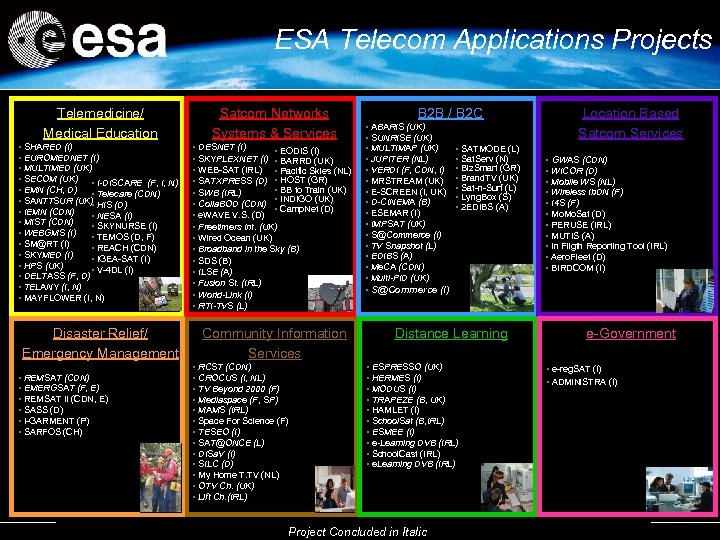 ESA Telecom Applications Projects Telemedicine/ Medical Education • • • • SHARED (I) EUROMEDNET (I) MULTIMED (UK) SECOM (UK) • I-DISCARE (F, I, N) EMN (CH, D) • Telecare (CDN) SANTTSUR (UK) • HIS (D) IEMN (CDN) • NESA (I) MIST (CDN) • SKYNURSE (I) WEBGMS (I) • TEMOS (D, F) SM@RT (I) • REACH (CDN) SKYMED (I) • IGEA-SAT (I) HPS (UK) • V-4 DL (I) DELTASS (F, D) TELANY (I, N) MAYFLOWER (I, N) Satcom Networks Systems & Services DESNET (I) • EODIS (I) SKYPLEXNET (I) • BARRD (UK) • WEB-SAT (IRL) • Pacific Skies (NL) • SATXPRESS (D) • HOST (GR) • BB to Train (UK) • SWB (IRL) • INDIGO (UK) • Colla. BOD (CDN) • Camp. Net (D) • e. WAVE V. S. (D) • Freetimers Int. (UK) • Wired Ocean (UK) • Broadband in the Sky (B) • SDS (B) • ILSE (A) • Fusion St. (IRL) • World-Link (I) • RTI-TVS (L) • • Disaster Relief/ Emergency Management • • • REMSAT (CDN) EMERGSAT (F, E) REMSAT II (CDN, E) SASS (D) I-GARMENT (P) SARFOS (CH) B 2 B / B 2 C • • • • ABARIS (UK) SUNRISE (UK) MULTIMAP (UK) JUPITER (NL) VERDI (F, CDN, I) MRSTREAM (UK) E-SCREEN (I, UK) D-CINEMA (B) ESEMAR (I) IMPSAT (UK) S@Commerce (I) TV Snapshot (L) EDIBS (A) Me. CA (CDN) Multi-PID (UK) • S@Commerce (I) Community Information Services • • • • RCST (CDN) CROCUS (I, NL) TV Beyond 2000 (F) Mediaspace (F, SP) MAMS (IRL) Space For Science (F) TESEO (I) SAT@ONCE (L) DISa. V (I) SILC (D) My Home T. TV (NL) OTV Ch. (UK) Lift Ch. (IRL) Location Based Satcom Services • • SATMODE (L) Sat. Serv (N) Biz. Smart (GR) Brand. TV (UK) Sat-n-Surf (L) Lyng. Box (S) 2 EDIBS (A) • GWAS (CDN) • • • Distance Learning • • • ESPRESSO (UK) HERMES (I) MODUS (I) TRAPEZE (B, UK) HAMLET (I) School. Sat (B, IRL) ESMEE (I) e-Learning DVB (IRL) School. Cast (IRL) e. Learning DVB (IRL) WICOR (D) Mobile WS (NL) Wireless Ib. DN (F) I 4 S (F) Mo. Sat (D) PERUSE (IRL) MUTIS (A) In Fligth Reporting Tool (IRL) Aero. Fleet (D) BIRDCOM (I) e-Government e-reg. SAT (I) • ADMi. Ni. STRA (I) • 7 Project Concluded in Italic
 Telemedicine 8
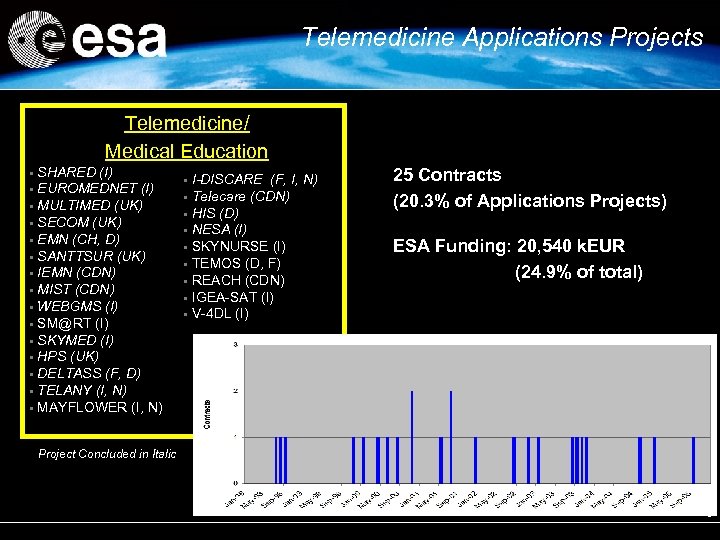 Telemedicine Applications Projects Telemedicine/ Medical Education SHARED (I) • EUROMEDNET (I) • MULTIMED (UK) • SECOM (UK) • EMN (CH, D) • SANTTSUR (UK) • IEMN (CDN) • MIST (CDN) • WEBGMS (I) • SM@RT (I) • SKYMED (I) • HPS (UK) • DELTASS (F, D) • TELANY (I, N) • MAYFLOWER (I, N) • I-DISCARE (F, I, N) • Telecare (CDN) • HIS (D) • NESA (I) • SKYNURSE (I) • TEMOS (D, F) • REACH (CDN) • IGEA-SAT (I) • V-4 DL (I) • 25 Contracts (20. 3% of Applications Projects) ESA Funding: 20, 540 k. EUR (24. 9% of total) Project Concluded in Italic 9
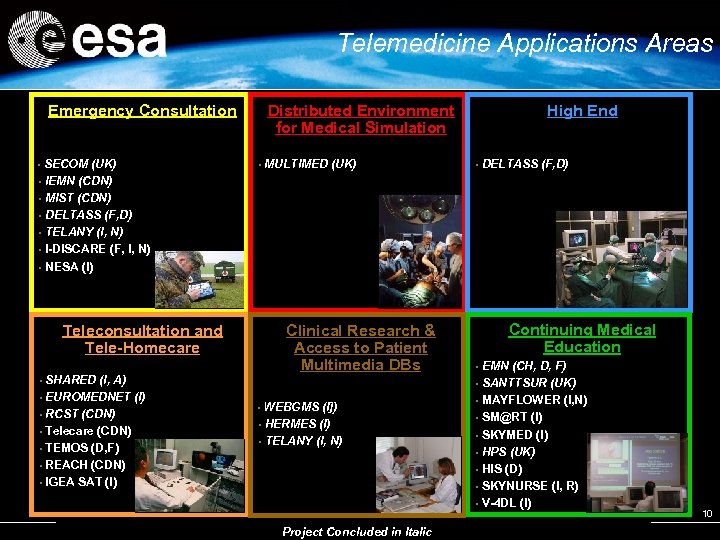 Telemedicine Applications Areas Emergency Consultation SECOM (UK) • IEMN (CDN) • MIST (CDN) • DELTASS (F, D) • TELANY (I, N) • I-DISCARE (F, I, N) • NESA (I) • Distributed Environment for Medical Simulation • Teleconsultation and Tele-Homecare SHARED (I, A) • EUROMEDNET (I) • RCST (CDN) • Telecare (CDN) • TEMOS (D, F) • REACH (CDN) • IGEA SAT (I) MULTIMED (UK) Clinical Research & Access to Patient Multimedia DBs • WEBGMS (I]) • HERMES (I) • TELANY (I, N) • Project Concluded in Italic High End • DELTASS (F, D) Continuing Medical Education EMN (CH, D, F) • SANTTSUR (UK) • MAYFLOWER (I, N) • SM@RT (I) • SKYMED (I) • HPS (UK) • HIS (D) • SKYNURSE (I, R) • V-4 DL (I) • 10
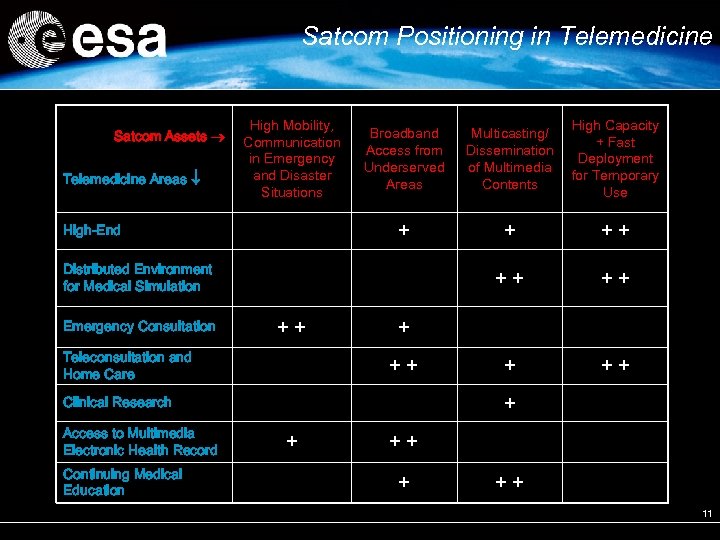 Satcom Positioning in Telemedicine Satcom Assets Telemedicine Areas High Mobility, Communication in Emergency and Disaster Situations Multicasting/ Dissemination of Multimedia Contents High Capacity + Fast Deployment for Temporary Use + + ++ ++ High-End Broadband Access from Underserved Areas ++ + ++ Distributed Environment for Medical Simulation Emergency Consultation ++ Teleconsultation and Home Care + ++ + Clinical Research Access to Multimedia Electronic Health Record Continuing Medical Education + ++ 11
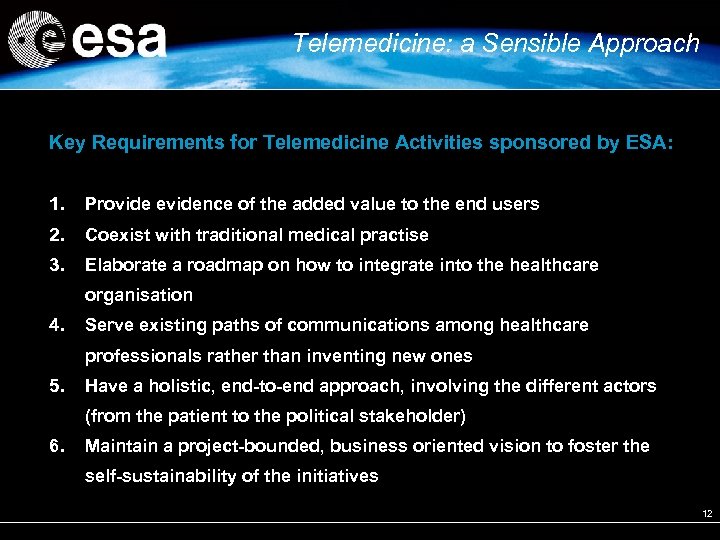 Telemedicine: a Sensible Approach Key Requirements for Telemedicine Activities sponsored by ESA: 1. Provide evidence of the added value to the end users 2. Coexist with traditional medical practise 3. Elaborate a roadmap on how to integrate into the healthcare organisation 4. Serve existing paths of communications among healthcare professionals rather than inventing new ones 5. Have a holistic, end-to-end approach, involving the different actors (from the patient to the political stakeholder) 6. Maintain a project-bounded, business oriented vision to foster the self-sustainability of the initiatives 12
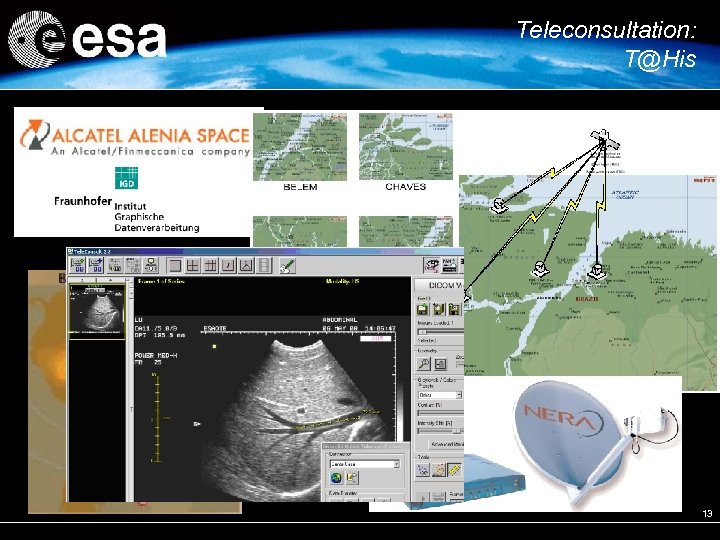 Teleconsultation: T@His 13
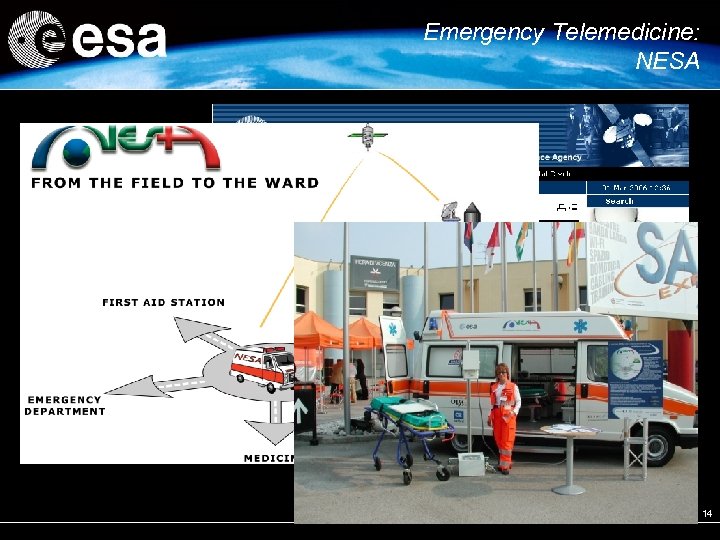 Emergency Telemedicine: NESA 14
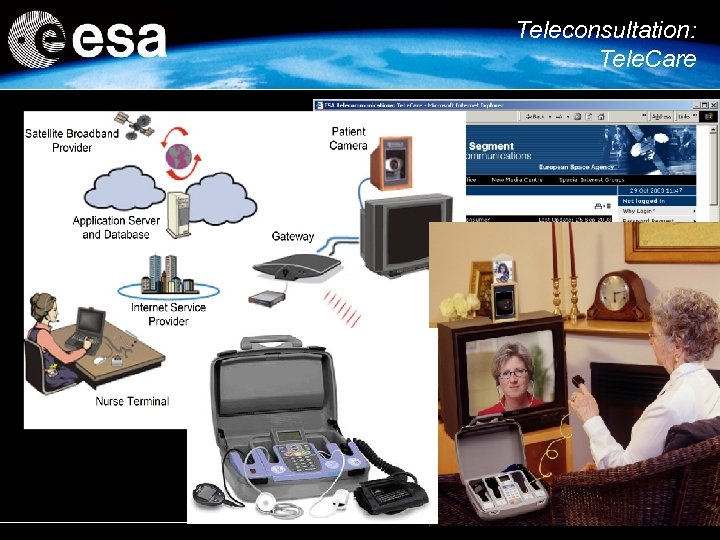 Teleconsultation: Tele. Care 15
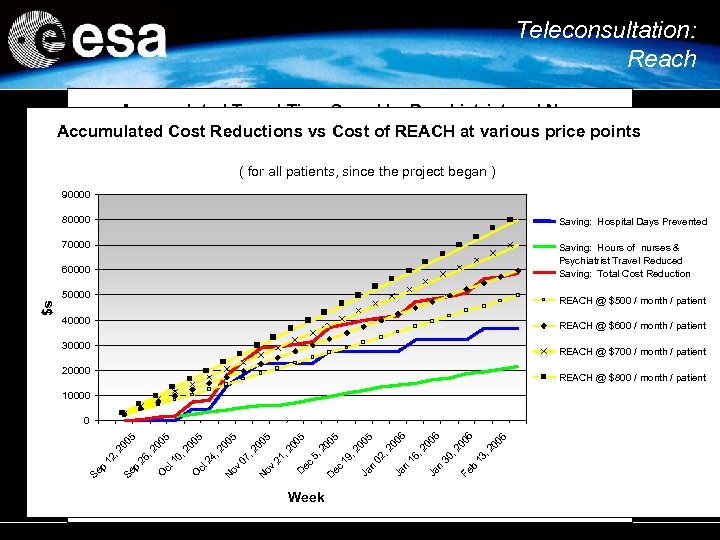 Teleconsultation: Reach Accumulated Travel Time Saved by Psychiatrist and Nurses Accumulated Cost Reductions vs Cost of REACH at various price points 380. 00 360. 00 340. 00 320. 00 300. 00 280. 00 260. 00 240. 00 220. 00 200. 00 180. 00 160. 00 140. 00 120. 00 100. 00 80. 00 60. 00 40. 00 20. 00 - 90000 80000 Hours 70000 50000 40000 30000 20000 REACH @ $500 / month / patient REACH @ $600 / month / patient REACH @ $700 / month / patient REACH @ $800 / month / patient Week p 0 Saving: Hours of nurses & Psychiatrist Travel Reduced Saving: Total Cost Reduction 12 S , 2 e 00 p 0 Se 5, p p 20 26 , 2 S 12 05 00 ep , 2 O 5 1 00 ct 10 Se 9, 2 5 , 2 p 2 00 00 6, 5 O O 5 ct 20 ct 24 O 03 05 , 2 c , 2 00 t 1 00 N 5 O 0, 5 ov ct 20 07 1 , 2 O 7, 05 00 ct 20 N 0 5 2 ov O 4, 2 5 21 ct , 2 3 00 0 No 1, 2 5 05 v D ec 0 00 N 7, 5 5, o 20 v 1 200 D 0 N 5 4, 5 ec ov 2 19 2 00 N 1, 5 , 2 o 00 v 20 Ja 5 28 05 n 02 De , 20 c 0 , 2 0 De 5, 2 5 06 c Ja 1 00 n 16 De 2, 5 , 2 c 20 0 D 19 05 0 e , Ja 6 c 2 n 30 2 00 , 2 Ja 6, 2 5 00 n 0 00 Fe 6 Ja 2, 5 b n 20 13 , 2 J 09 06 00 an , 2 6 1 00 Ja 6, 6 n 20 0 2 Ja 3, 6 n 20 0 3 Fe 0, 6 b 20 0 0 Fe 6, 6 b 20 13 06 , 2 00 6 10000 Saving: Hospital Days Prevented Se $s 60000 ( for all patients, since the project began ) Psychiatrist Week Total Linear (Nurses) Nurses Linear (Psychiatrist) Linear (Total) 16
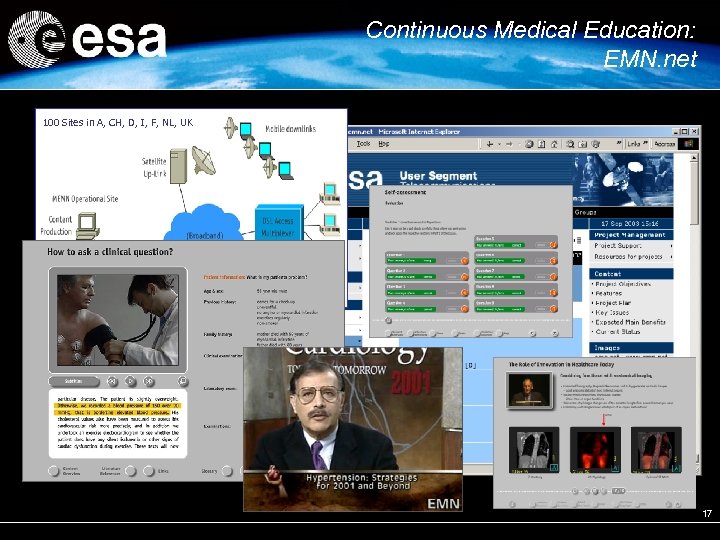 Continuous Medical Education: EMN. net 100 Sites in A, CH, D, I, F, NL, UK 17
 Market and Regulatory study of Telemedicine via Satellite in ESA Member States 1. Review the current market for Telemedicine 2. Identify the key actors, review the typical service value chains and compare with traditional healthcare 3. Assess the market potential for satcom-based telemedicine 4. Analyse the regulatory framework: current and foreseeable technical, operational and legal frameworks directly affecting Telemedicine in general and via satellite in particular (whenever such distinction is relevant) Ø Identify domains where satellite communications can bring added-value to telemedicine services 18
 Lessons learnt 19
 Telemedicine in Europe today • There a lot of Hardware and Software (“systems”) providers and many pilot services but few proper running services and very few service providers able to provide and end-to-end service, in a turn key integrated solution • State-of-the-Art: mainly tele-radiology, tele-pathology, general medical diagnosis, remote consultations, triage decision-making, and emergency evaluations. • Activities are mainly limited to the local level, which prevent them to reach the critical mass necessary to turn a pilot activity into an operational and profitable service. The market is thus very fragmented. • Highest number of running services is in the USA and Canada, rather than in Europe • Some barriers to widespread diffusion are related to the technology, but most can be attributed to other factors. 20
 Recurrent problems in ESA Telemedicine projects all face common problems: - Users are forced to find technical solutions on their own with 3 options: • build in-house expertise before taking decisions • define requirements and “blind trust” suppliers • partner with industry (which drives towards its own solutions) - Technical and operational issues absorb a lot of resources and disrupt the operations, leading to discover the same barriers again and again - Difficulty of providing generic evidence of viability beyond the specific context of the pilot project ESA’s initiatives to help: ØDe-risk the access to Satcom solutions with access to a set of facilities and associated services for initiatives not ready for the open market Ø Proxy between the supply side and the demand originated by projects Ø Encourage the use of Open Standards (DVB-RCS) 21
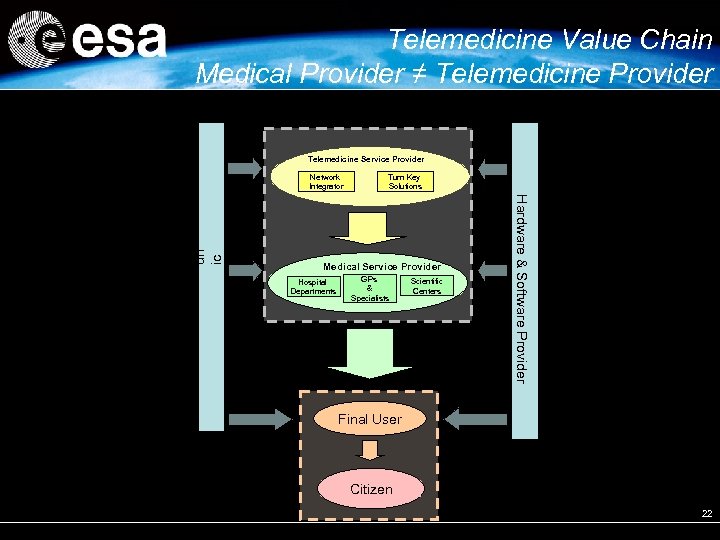 Telemedicine Value Chain Medical Provider ≠ Telemedicine Provider Telemedicine Service Provider Turn Key Solutions Medical Service Provider Hospital Departments GPs & Specialists Scientific Centers Hardware & Software Provider Te le co m m un ic ati on s Pr ov id er Network Integrator Final User Citizen 22
 Role & position of key players Telemedicine Service Provider: Perform the telemedicine service between two or more physically separated parties. Its main skills are to Integrate Networks and provide Turnkey Solutions Coordinate all system integration tasks Intervene as “one-stop-shop” access point for the customer and the user Provide round-the-clock technical support, hotline and user training support Ensure the continuity of the service, quality assurance measures, integrity and confidentiality of data in full compliance with the applicable regulations Organize user feedback and continuous maintenance of the proposed applications Medical Service Provider Supply professional expertise in the field of medicine Usually is a healthcare institution specialized in a specific area 23
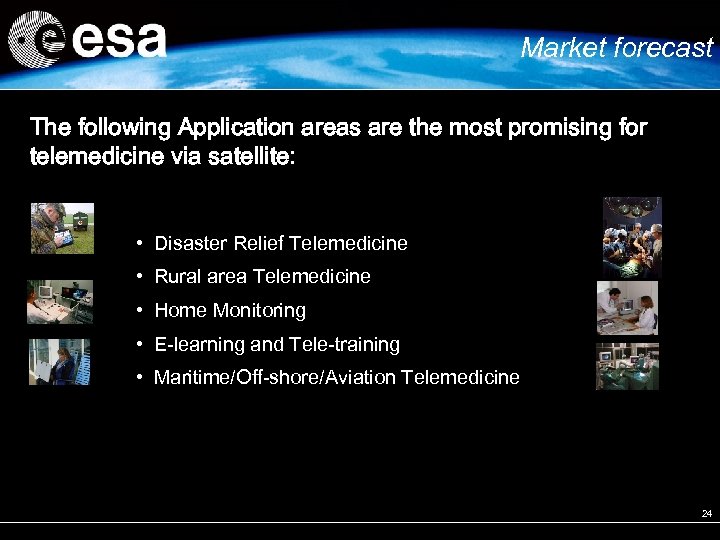 Market forecast The following Application areas are the most promising for telemedicine via satellite: • Disaster Relief Telemedicine • Rural area Telemedicine • Home Monitoring • E-learning and Tele-training • Maritime/Off-shore/Aviation Telemedicine 24
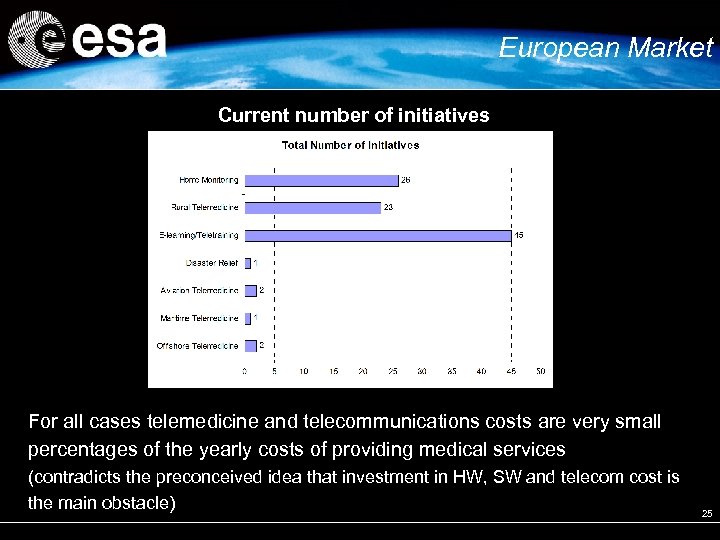 European Market Current number of initiatives For all cases telemedicine and telecommunications costs are very small percentages of the yearly costs of providing medical services (contradicts the preconceived idea that investment in HW, SW and telecom cost is the main obstacle) 25
 European Market Home monitoring, rural telemedicine and e-learning/teletraining are led by regional and/or national governments, so funding is partially available • E-learning/teletraining shows greatest promise for wide-scale market uptake • Home monitoring is currently not the most attractive application in terms of revenues but is seen by experts as having very strong development prospects, driven by demographics, the increase in preventive medicine and the adoption of cost-containment measures by national health authorities. • Rural telemedicine uptake is hampered by poor reimbursement status and perceptions of high telecom cost where broadband access is not available Disaster relief, aviation, maritime and offshore telemedicine are still to be implemented on a wide scale. 26
 Key issues for telemedicine via satellite in Europe today 27
 Key issues in Europe today: sustainability • Investment is limited to narrow healthcare activities when application to a wider scale could yield a financial and economic return: ability to be expanded on a large scale is key • Economic and financial case studies become available but do not seem to deal with factors such as patient benefits, health outcomes or health status • Costs of project management, procurement processes, change management, develop new clinical and working practices, implementation, training etc. are often not taken into account but they are essential resources for the success of telemedicine • The benefits are not necessarily passed on to those that actually have to invest in the telemedicine service (e. g. cruise telemedicine: passengers benefit while investment comes from the ship owner) 28
 Key issues in Europe today: public funding vs commercial market In Europe the majority of telemedicine initiatives are funded by academic research, government subsidies, EU-level programmes or as part of local government development plans. Industry players across the market perceive that telemedicine is ‘on life-support’ through this public funding, which is a double-edged sword: It is a necessity to allow the benefits of telemedicine to be fully assessed and evaluated in what is a relative commercial vacuum, Ø but it is not allowing the laws of supply and demand to operate, postponing the ‘reality check’ that the level of demand for telemedicine remains low and dissimulating the real difficulties associated with implementing self-sustaining business models in this market. Ø … Nevertheless, major industry players and key opinion leaders interviewed are in majority very optimistic about the future of telemedicine 29
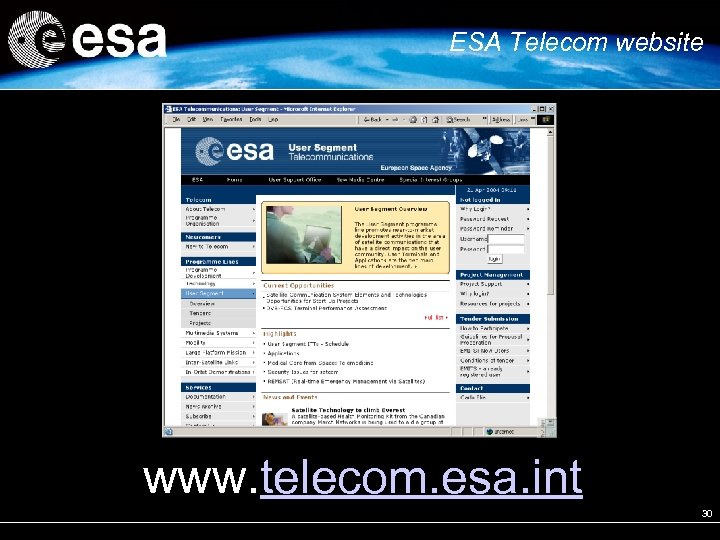 ESA Telecom website www. telecom. esa. int 30
 ESA Telecom Contact Points Nathalie. Ricard@esa. int Giovanni. Garofalo@esa. int Francesco. Feliciani@esa. int ESA - ESTEC Telecommunications Department Directorate of EU and Industrial Programmes 31