


 Скачать презентацию SART logo Aquatic Animal Diseases State Agricultural
a9fa41b4513b9acfc99b67d9775136e9.ppt
- Количество слайдов: 40
 SART logo
 Aquatic Animal Diseases State Agricultural Response Team 02
 Aquatic Animal Diseases Prepared by Kathleen Hartman, D. V. M. , Ph. D. Aquaculture Epidemiologist, USDA-APHIS-VS Denise Petty, D. V. M. Assistant, Professor, LACS, CVM, UF State Agricultural Response Team 03
 Learning Objectives • Identify the difference between an emerging and an endemic disease • Provide examples and characteristics of emerging aquatic affecting finfish, crustaceans and molluscs • Provide examples and characteristics of endemic aquatic diseases affecting finfish, crustaceans and molluscs • Identify key resources avaialble for additional linformation State Agricultural Response Team 04
 Aquatic Disease Categories • Emerging – Exotic disease with potentially significant impact – Exist in finfish, crustaceans, and molluscs • Endemic – Common in United States – Exist in finfish, crustaceans, and molluscs State Agricultural Response Team 05
 Emerging Diseases for Florida Aquaculture • Finfish – Spring Viremia of Carp (SVC) • Crustaceans – White Spot Virus – Taura Syndrome – Yellowhead Virus • Molluscs – Bonamiosis (Bonamia exitiosus, B. ostrea, Mikrocytos roughleyi) State Agricultural Response Team 06
 Endemic Diseases for Florida Aquaculture • Finfish – Koi Herpesvirus (KHV) – Largemouth Bass Virus (LMBV) – Other parasitic, fungal and bacterial diseases • Molluscs – Perkinsosis – Multinucleate Sphere X (MSX) State Agricultural Response Team 07
 Emerging Diseases State Agricultural Response Team 08
 Finfish • “True” fish with fins and permament gills – Term distinguishes true fish from crayfish, jellyfish, starfish, etc. • Groups include – Cyprinids (e. g. , common grass and bighead carps) – Centrarchids (e. g. , largemouth and smallmouth bass) • Species harvested or in culture include – Common carp (Cyprinus carpio) – Goldfish (Carassius auratus) – Largemouth bass (Micropterus salmoides) State Agricultural Response Team 09
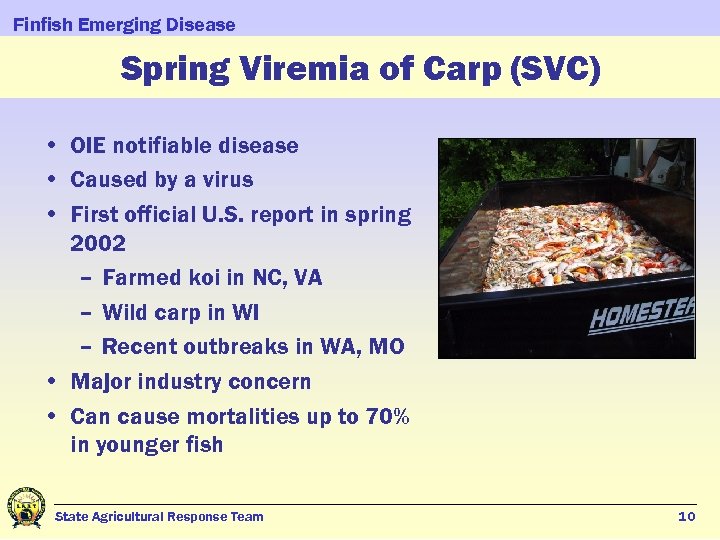 Finfish Emerging Disease Spring Viremia of Carp (SVC) • OIE notifiable disease • Caused by a virus • First official U. S. report in spring 2002 – Farmed koi in NC, VA – Wild carp in WI – Recent outbreaks in WA, MO • Major industry concern • Can cause mortalities up to 70% in younger fish State Agricultural Response Team 10
 Finfish Emerging Disease Spring Viremia of Carp (SVC) General Facts • One of several Rhabdoviruses that cause diseases in fish • Distribution – Reported in Europe, Middle East, Russia, North and South America, Asia • Species affected – Koi/Common carp, Grass carp, Bighead carp, Silver carp, Crucian carp, goldfish (C. auratus) State Agricultural Response Team 11
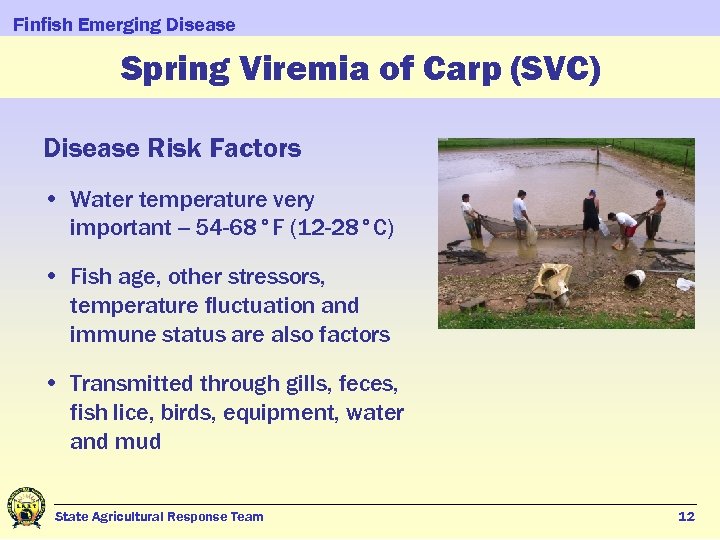 Finfish Emerging Disease Spring Viremia of Carp (SVC) Disease Risk Factors • Water temperature very important -- 54 -68°F (12 -28°C) • Fish age, other stressors, temperature fluctuation and immune status are also factors • Transmitted through gills, feces, fish lice, birds, equipment, water and mud State Agricultural Response Team 12
 Finfish Emerging Disease Spring Viremia of Carp (SVC) • Treatment – No treatment available – Virus infective in mud for up to 42 days • Depopulate infected fish, then disinfect tank/pond • Disinfection agents/techniques – Gamma/UV radiation – Chlorination at 500 ppm for 10 minutes – p. H less than 4. 0 or greater than 10. 0 – Heating to 140°F (60°C) for 15 minutes State Agricultural Response Team 13
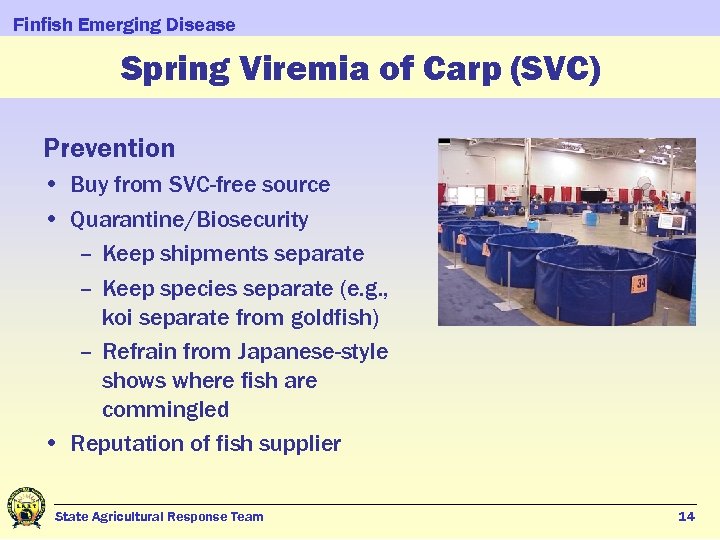 Finfish Emerging Disease Spring Viremia of Carp (SVC) Prevention • Buy from SVC-free source • Quarantine/Biosecurity – Keep shipments separate – Keep species separate (e. g. , koi separate from goldfish) – Refrain from Japanese-style shows where fish are commingled • Reputation of fish supplier State Agricultural Response Team 14
 Crustaceans • Invertebrates characterized by a hard outer shell and jointed appendages and bodies • Two major classes – Malacostracans (i. e. , crab, shrimp, lobster) – Entomostracans (i. e. , fairy shrimp, water fleas, barnacles) • Species harvested or in culture include – Pacific White shrimp (Litopenaeus vannamei) – Blue shrimp (Litopenaeus stylirostris) – Giant Tiger shrimp (Penaeus monodon) State Agricultural Response Team 15
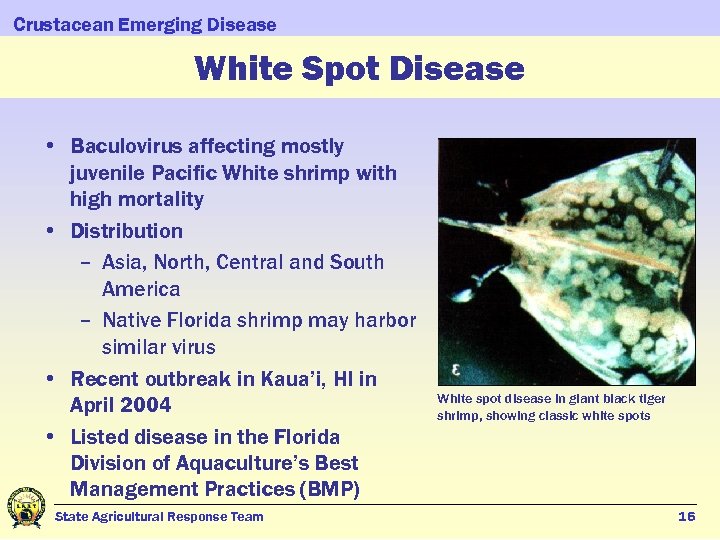 Crustacean Emerging Disease White Spot Disease • Baculovirus affecting mostly juvenile Pacific White shrimp with high mortality • Distribution – Asia, North, Central and South America – Native Florida shrimp may harbor similar virus • Recent outbreak in Kaua’i, HI in April 2004 • Listed disease in the Florida Division of Aquaculture’s Best Management Practices (BMP) State Agricultural Response Team White spot disease in giant black tiger shrimp, showing classic white spots 16
 Crustacean Emerging Disease Taura Syndrome Virus • Affects the Pacific White shrimp – Affects post-larval, juvenile, sub-adult life stages • Mortality rate for these life stages 40 to 90% • Survivors may become carrier for life • Distribution – Asia, Central, South and North America – Infected Central and South American shrimp introduced disease into Asia – Outbreaks in Texas and South Carolina in late 1990 s State Agricultural Response Team 17
 Crustacean Emerging Disease Taura Syndrome Virus • Risk factors – Seagulls feeding on infected/dead shrimp may carry virus pond to pond, farm to farm • Listed disease in the Florida Division of Aquaculture’s BMP State Agricultural Response Team 18
 Crustacean Emerging Disease Yellow Head Virus • Affects juvenile Giant Tiger shrimp – High mortality in early and late juvenile life stages • Afflicted shrimp show signs of gross yellowing of the cephalothorax • Distribution – Asia – Americas – Possible, however not yet documented • Listed disease in the Florida Division of Aquaculture’s BMP State Agricultural Response Team 19
 Molluscs • Invertebrate animals with soft unsegmented bodies, a muscular foot and a body enclosed in a mantle • Groups include – Cephalopods (e. g. , squid, octopus) – Gastropods (e. g. , abalone) – Bivalves (e. g. , clams, mussels, oysters) • Species harvested or in culture include – Eastern oyster (Crassostrea virginica) – Pacific oyster (Crassostrea gigas) – Flat oyster (Ostrea equestris) – Hard clams (Mercenaria mercenaria) State Agricultural Response Team 20
 Mollusc Emerging Disease Bonamiosis • Caused by Bonamia ostrea (Northern hemisphere), a protozoan parasite • Affects flat oysters – 2 new species affect the Asian oyster (Crassostrea ariakensis) and Flat oysters – Most infected oysters appear normal • Distribution – France, Ireland, Italy, the Netherlands, Spain, the united Kingdom (excluding Scotland), and the United States (CA, ME and WA) – Confirmed cases in VA and NC in 2003 and 2004 State Agricultural Response Team 21
 Mollusc Emerging Disease Seaside Organism Disease (SSO) • Caused by the protist, Haplosporidium costale • Affects the Eastern oyster • Seasonal, complex life cycle ending in final sporulation killing the host • Distribution on east coast of United States and Canada (from Virginia to Nova Scotia) in water with a salinity over 25 ppt – Outbreaks in Canada in 2003 State Agricultural Response Team 22
 Mollusc Emerging Disease Quahog Parasite X (QPX) • Net slime mold in phylum, Labyrinthulomycota • Affects Hard clams • Can be found from Virginia’s east coast to Canada – Recent outbreaks in Massachusetts • Clams entering Florida must be QPX free • Listed disease in the Florida Division of Aquaculture’s BMP document State Agricultural Response Team 23
 Endemic Diseases State Agricultural Response Team 24
 Finfish Endemic Disease Koi Herpesvirus (KHV) • Highly contagious – Transmitted from infected fish, water and/or mud – Water temperature important 64 - 81°F (17 - 27°C) • High mortalities – 80 to 100% mortality (higher in younger fish) – Can occur as soon as 24 to 48 hours after signs of disease onset • Not transmissible to humans – Affects koi and common carp • Worldwide distribution – Reported in Europe, United States and Asia • Not reportable to OIE State Agricultural Response Team 25
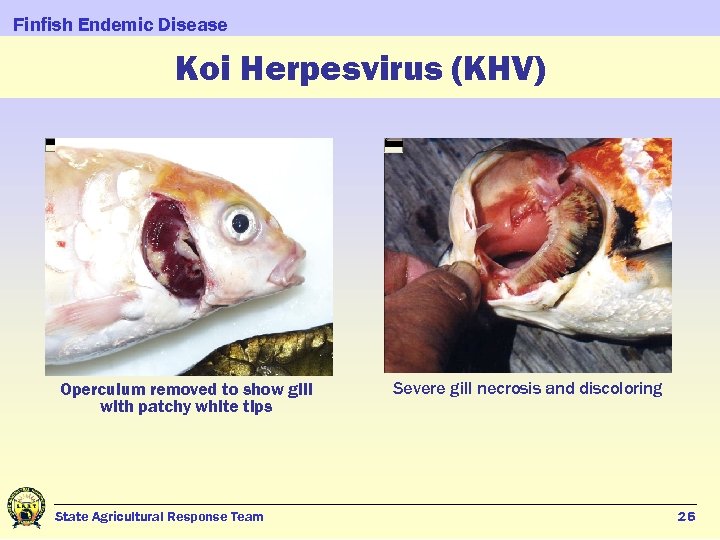 Finfish Endemic Disease Koi Herpesvirus (KHV) Operculum removed to show gill with patchy white tips State Agricultural Response Team Severe gill necrosis and discoloring 26
 Finfish Endemic Disease Koi Herpesvirus (KHV) Treatment • None -- Virus can live in water for up to four hours • Depopulation, then disinfect • Disinfection techniques – Chlorine at 200 ppm for one hour – Quaternary ammonium compounds at 500 ppm for one hour (for nets) Prevention • Quarantine/Biosecurity – Keep shipments separate – Keep species separate – Avoid Japanese-style shows where fish are commingled – Reputation of fish supplier State Agricultural Response Team 27
 Finfish Endemic Disease Largemouth Bass Virus (LMBV) • Iridovirus frequently present in healthy largemouth bass – Bass test positive, but show no clinical signs of infection – No LMBV infected fish in Florida State Agricultural Response Team 28
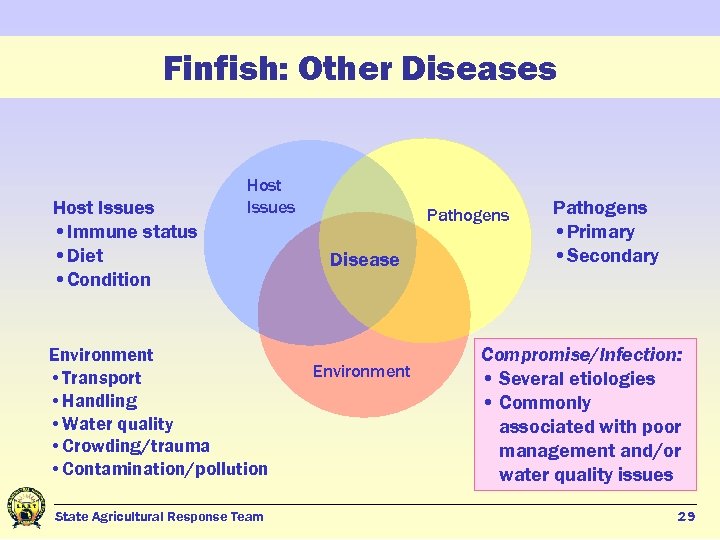 Finfish: Other Diseases Host Issues • Immune status • Diet • Condition Host Issues Environment • Transport • Handling • Water quality • Crowding/trauma • Contamination/pollution State Agricultural Response Team Pathogens Disease Environment Pathogens • Primary • Secondary Compromise/Infection: • Several etiologies • Commonly associated with poor management and/or water quality issues 29
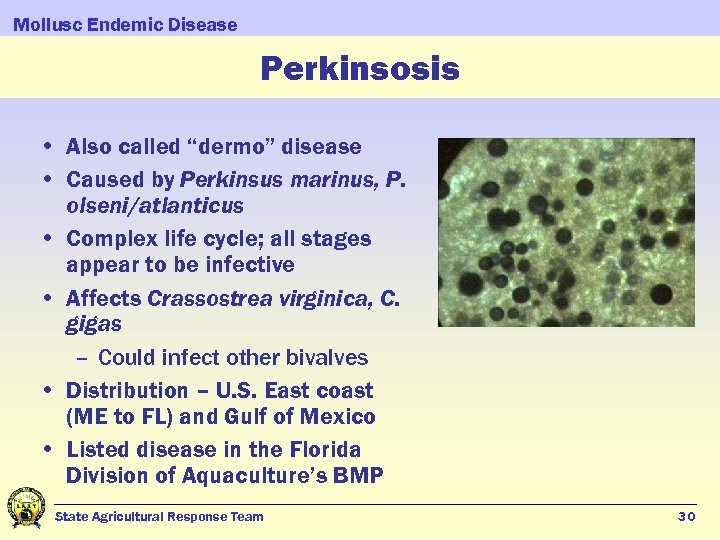 Mollusc Endemic Disease Perkinsosis • Also called “dermo” disease • Caused by Perkinsus marinus, P. olseni/atlanticus • Complex life cycle; all stages appear to be infective • Affects Crassostrea virginica, C. gigas – Could infect other bivalves • Distribution – U. S. East coast (ME to FL) and Gulf of Mexico • Listed disease in the Florida Division of Aquaculture’s BMP State Agricultural Response Team 30
 Mollusc Endemic Disease Multinucleate Sphere X (MSX) • Caused by protist, Haplosporidium nelsoni – Does not survive low salinities • Affects Crassostrea virginica, Crassostrea gigas – Oysters are aberrant hosts • Distribution – East coast of North America, California, France, Korea and Japan • Listed disease in the Florida Division of Aquaculture’s BMP State Agricultural Response Team 31
 Things to Remember… • Carriers and vectors – Survivors of viral diseases may be life-long carriers – Vectors can include fish, birds, parasites, equipment and personnel (i. e. , YOU!) • Viral diseases do not have treatments • Make biosecurity/quarantine a habit – Personnel and equipment may be sources of disease and/or modes of transmission – Prevention is the best treatment in many cases State Agricultural Response Team 32
 Things to Remember… Zoonotic potential • People with compromised immune systems are most susceptible • Examples: – Atypical mycobacteriosis – bacterial infection – Streptococcus iniae – food handlers infected from handling live fish – Erysipelothrix – parasite, “fish rose” – Vibriosis – bacterial infection, especially risky for those with liver disease – Edwardsiella tarda – bacteria – Improper cooking practices can pass on infection State Agricultural Response Team 33
 Key Resources • USDA-APHIS fact sheets for various animal diseases http: //www. aphis. usda. gov/lpa/pubs/fsheet_faq_notice/fsfaqnot_animalhe alth. html • APHIS’s Center for Emerging Issues (CEI) has various worksheets available on animal health and diseases of concern http: //www. aphis. usda. gov/vs/ceah/cei/worksheets. htm • Aquatext. com -- a free, online aquaculture dictionary http: //www. pisces-aqua. co. uk/aquatext/dicframe. htm State Agricultural Response Team 34
 Key Resources • Florida Department of Community Affairs, Division of Emergency Management http: //www. floridadisaster. org • United States Department of Agriculture (USDA) http: //www. usda. gov • Florida Department of Agriculture and Consumer Services (FDACS) http: //www. doacs. state. fl. us State Agricultural Response Team 35
 Key Resources • Florida Division of Aquaculture home page http: //www. floridaaquaculture. com • Aquaculture Best Management Practices manual can be accessed directly at http: //www. floridaaquaculture. com/BAD/BMP%20 Rule%20%20 Manual%206 -9 -04. pdf • Aquaculture Network Information Center http: //aquanic. org State Agricultural Response Team 36
 Key Resources • USDA Animal and Plant Health Inspection Service (APHIS) http: //www. aphis. usda. gov • World Organisation for Animal Health (OIE) http: //www. oie. int • Safety for Fish Farm Workers video on the National Ag Safety Database (NASD), English and Spanish versions available from the following link http: //www. cdc. gov/nasd/videos/v 001401 -v 001500/v 001433. html State Agricultural Response Team 37
 Key Resources • Spawn, Spat, and Sprains book produced by the Alaska Sea Grant College Program. The entire book can be downloaded from the following link http: //www. uaf. edu/seagrant/Pubs_Videos/pubs/AN-17. pdf • University of Florida Institute of Food and Agricultural Sciences Electronic Data Information Source (EDIS) fact sheets for aquaculture, including diseases, can be found at the following links http: //edis. ifas. ufl. edu/DEPARTMENT_VETERINARY_MEDICINE http: //edis. ifas. ufl. edu/DEPARTMENT_FISHERIES_AND_AQUATIC_SCIENCES State Agricultural Response Team 38
 Summary • Identified the two categories of diseases in Florida • Provided examples and characteristics of emerging diseases affecting finfish, crustaceans and molluscs • Provided examples and characteristics of endemic diseases affecting finfish and molluscs • Listed key resources available for additional information on aquatic animal health and disease State Agricultural Response Team 39
 Thank You! State Agricultural Response Team 40