 Скачать презентацию Сarbon Сontracting in Uncertain Conditions NIS perspectives Alexei
39fa0a72b7e7d90225e9ea883604a84e.ppt
- Количество слайдов: 9



Сarbon Сontracting in Uncertain Conditions: NIS perspectives Alexei Sankovski ICF International April 2008 www. icfi. com
Outline 1. Origins of our perspective 2. Factors affecting carbon contracting in NIS 3. Contracting options 4. Conclusions www. icfi. com 1
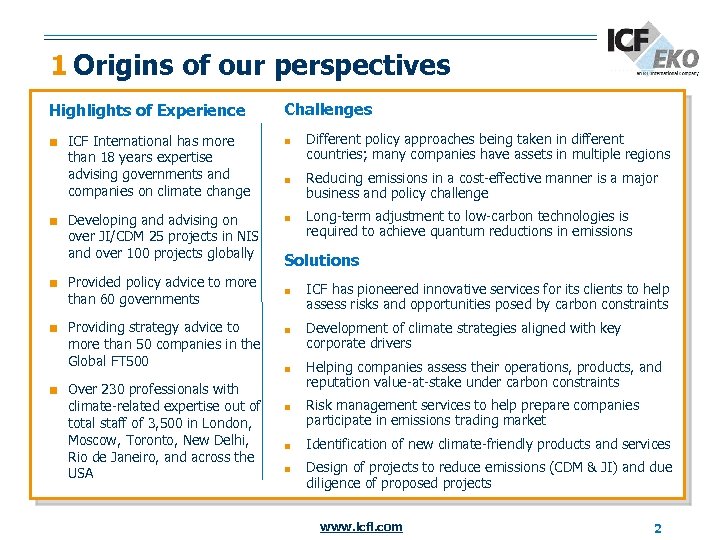
1 Origins of our perspectives Highlights of Experience Challenges ■ ICF International has more than 18 years expertise advising governments and companies on climate change ■ Different policy approaches being taken in different countries; many companies have assets in multiple regions ■ Reducing emissions in a cost-effective manner is a major business and policy challenge ■ Developing and advising on over JI/CDM 25 projects in NIS and over 100 projects globally ■ Long-term adjustment to low-carbon technologies is required to achieve quantum reductions in emissions ■ Provided policy advice to more than 60 governments ■ Providing strategy advice to more than 50 companies in the Global FT 500 ■ Over 230 professionals with climate-related expertise out of total staff of 3, 500 in London, Moscow, Toronto, New Delhi, Rio de Janeiro, and across the USA Solutions ■ ICF has pioneered innovative services for its clients to help assess risks and opportunities posed by carbon constraints ■ Development of climate strategies aligned with key corporate drivers ■ Helping companies assess their operations, products, and reputation value-at-stake under carbon constraints ■ Risk management services to help prepare companies participate in emissions trading market ■ Identification of new climate-friendly products and services ■ Design of projects to reduce emissions (CDM & JI) and due diligence of proposed projects www. icfi. com 2
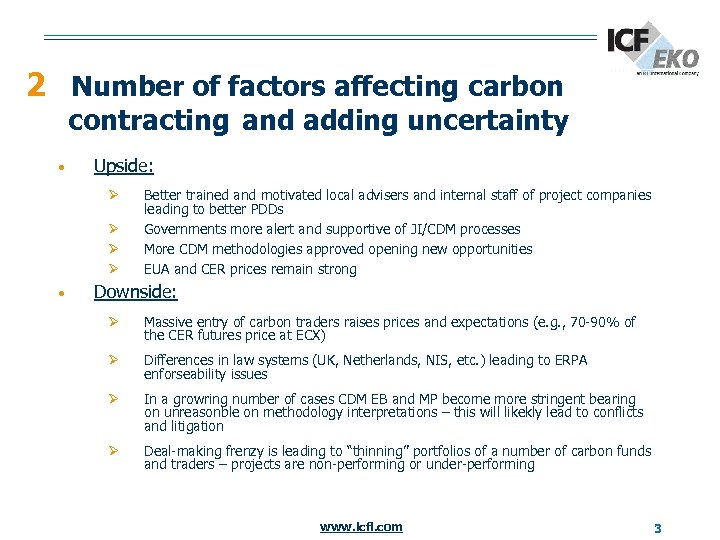
2 Number of factors affecting carbon contracting and adding uncertainty • Upside: Ø Ø • Better trained and motivated local advisers and internal staff of project companies leading to better PDDs Governments more alert and supportive of JI/CDM processes More CDM methodologies approved opening new opportunities EUA and CER prices remain strong Downside: Ø Massive entry of carbon traders raises prices and expectations (e. g. , 70 -90% of the CER futures price at ECX) Ø Differences in law systems (UK, Netherlands, NIS, etc. ) leading to ERPA enforseability issues Ø In a growring number of cases CDM EB and MP become more stringent bearing on unreasonble on methodology interpretations – this will likekly lead to conflicts and litigation Ø Deal-making frenzy is leading to “thinning” portfolios of a number of carbon funds and traders – projects are non-performing or under-performing www. icfi. com 3
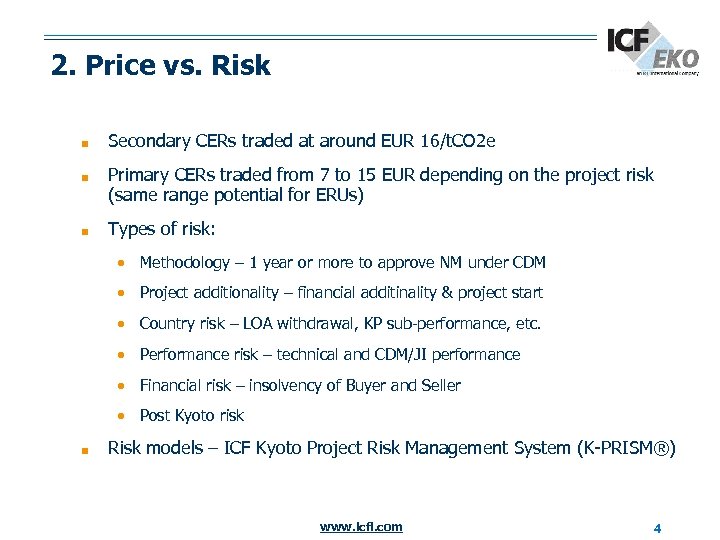
2. Price vs. Risk ■ Secondary CERs traded at around EUR 16/t. CO 2 e ■ Primary CERs traded from 7 to 15 EUR depending on the project risk (same range potential for ERUs) ■ Types of risk: · Methodology – 1 year or more to approve NM under CDM · Project additionality – financial additinality & project start · Country risk – LOA withdrawal, KP sub-performance, etc. · Performance risk – technical and CDM/JI performance · Financial risk – insolvency of Buyer and Seller · Post Kyoto risk ■ Risk models – ICF Kyoto Project Risk Management System (K-PRISM®) www. icfi. com 4
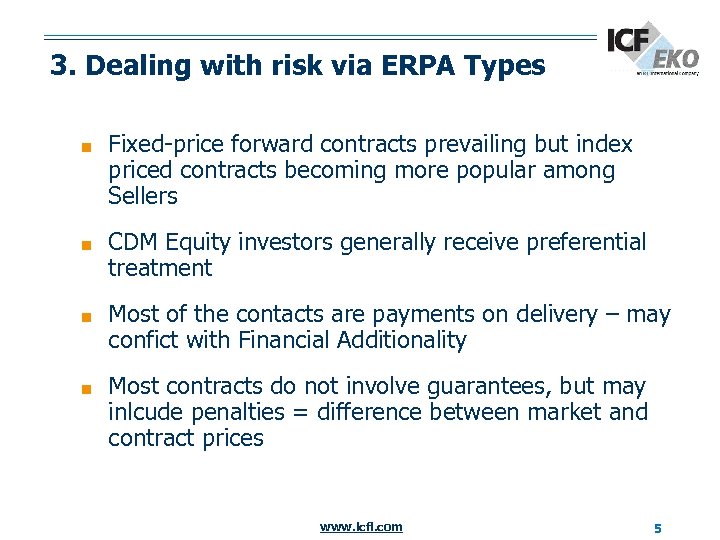
3. Dealing with risk via ERPA Types ■ Fixed-price forward contracts prevailing but index priced contracts becoming more popular among Sellers ■ CDM Equity investors generally receive preferential treatment ■ Most of the contacts are payments on delivery – may confict with Financial Additionality ■ Most contracts do not involve guarantees, but may inlcude penalties = difference between market and contract prices www. icfi. com 5
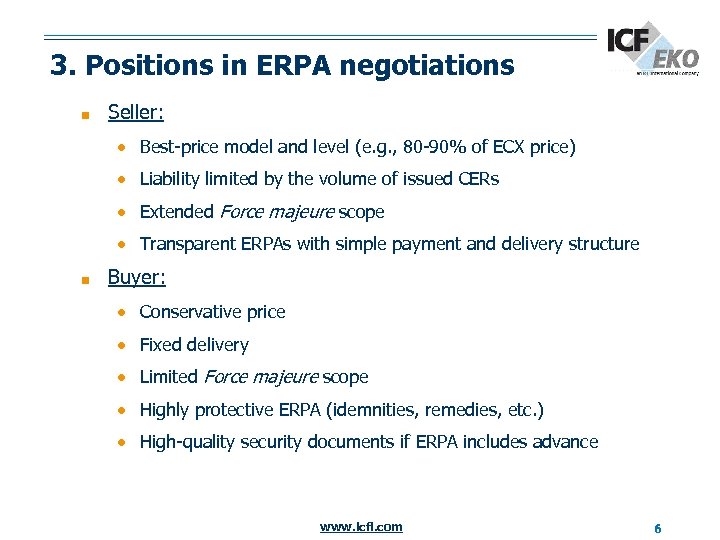
3. Positions in ERPA negotiations ■ Seller: · Best-price model and level (e. g. , 80 -90% of ECX price) · Liability limited by the volume of issued CERs · Extended Force majeure scope · Transparent ERPAs with simple payment and delivery structure ■ Buyer: · Conservative price · Fixed delivery · Limited Force majeure scope · Highly protective ERPA (idemnities, remedies, etc. ) · High-quality security documents if ERPA includes advance www. icfi. com 6
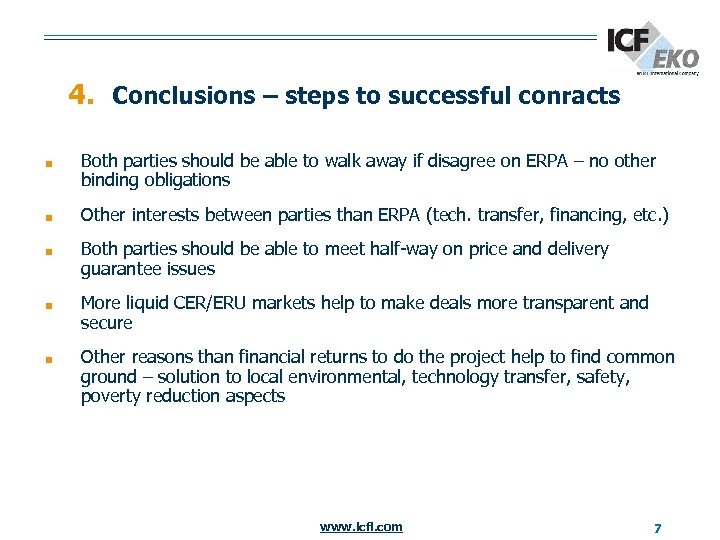
4. Conclusions – steps to successful conracts ■ Both parties should be able to walk away if disagree on ERPA – no other binding obligations ■ Other interests between parties than ERPA (tech. transfer, financing, etc. ) ■ Both parties should be able to meet half-way on price and delivery guarantee issues ■ More liquid CER/ERU markets help to make deals more transparent and secure ■ Other reasons than financial returns to do the project help to find common ground – solution to local environmental, technology transfer, safety, poverty reduction aspects www. icfi. com 7
■ For More Information: ■ Alexei Sankovski Principal, Moscow Office +7 495 250 4136 asankovski@icfi. com ■ ■ ■
Скачать презентацию Сarbon Сontracting in Uncertain Conditions NIS perspectives Alexei
39fa0a72b7e7d90225e9ea883604a84e.ppt