


 Скачать презентацию Sarah E Shannon Ph D RN Ethics
3afa8704b375df5b2dafc606d9a10fae.ppt
- Количество слайдов: 27
 Sarah E. Shannon, Ph. D, RN
 Ethics: DNR Decisions History of CPR & DNR Orders • The “Birth” of CPR – First study in 1960 found 80% success rate. – Consent presumed. • AMA call for written DNR orders by 1974. • Defining 1976 events: – Karen Ann Quinlan Supreme Court ruling. – Massachusetts General and Beth Israel Hospital formal guidelines published. – First Natural Death Act passed in California. TNEEL-NE Slide 2
 Ethics: DNR Decisions Current Status of CPR & DNR Orders • More recent studies show success rates for in-hospital CPR of 19%-57%. • DNR, Code Blue, DNAR orders, etc. are more common. • 1995 Study: Only 13% of hospitalized patients have CPR attempted at time of death. • Success rates of in-hospital CPR will increase as number of attempts drop. TNEEL-NE Slide 3
 Ethics: DNR Decisions CPR: Legal and Ethical Issues Does CPR require consent? Can a patient refuse CPR? Is CPR a treatment or a right? TNEEL-NE Slide 4
 Ethics: DNR Decisions Legal Basis for Performing or Withholding CPR • CPR falls between the cracks in terms of anticipated treatment for which we would obtain informed consent and emergency treatment where informed consent is presumed. • Obtaining informed consent necessitates dialog about death and dying which may be difficult for providers, patients and surrogates. • DNR orders are generally regulated by informed consent legislation, but patient preferences (as in an advance directive) may also need to be considered. • CPR performed against a patient’s wishes can potentially result in legal problems for providers. TNEEL-NE Slide 5
 Ethics: DNR Decisions Current Issues: DNAR Orders • Many institutions are now using the term Do-Not-Attempt-Resuscitation (DNAR) instead of Do-Not-Resuscitate (DNR) The word “Attempt” is intended to emphasize that CPR is often not successful X DNR TNEEL-NE DNAR Slide 6
 Ethics: DNR Decisions Current Issues: “Slow Codes” Definition I Not responding efficiently or urgently to a code situation thus “going through the motions, ” but without meeting the standard of care for resuscitation attempts. TNEEL-NE Slide 7
 Ethics: DNR Decisions Current Issues: “Show Codes” Definition II Rapidly responding to a code situation but not aggressively pursuing resuscitation efforts thus not meeting the standard of care for resuscitation attempts. TNEEL-NE Slide 8
 Ethics: DNR Decisions Current Issues: “Slow Codes” & “Show Codes” • Reasons why “Slow Codes” or “Show Codes” exist: – Providers don’t wish to discuss withholding CPR with a patient or legal surrogate due to cultural, racial, religious, or other differences. – Providers have been unsuccessful in obtaining agreement from the patient or the family to withhold CPR. Both codes are unethical and represent fraud because typically institutions bill the patient or insurance carrier. TNEEL-NE Slide 9
 Ethics: DNR Decisions Current Issues: Futility • What if health care professionals believe CPR would be futile? • Is CPR a medical treatment or a right? • Do patients or their families have the right to demand CPR even if medical opinion is that it would not be successful, or produce the desired benefit? TNEEL-NE Slide 10
 Ethics: DNR Decisions Current Issues: Quantitative Futility Definition Where research suggests that a therapy will have a less than 1% chance of producing the desired physiological effect; e. g. with CPR, of restoring cardiac function. TNEEL-NE Slide 11
 Ethics: DNR Decisions Current Issues: Qualitative Futility Definition Where personal, professional, or public opinion suggests that while a therapy can achieve a desired effect, it will not produce the desired benefit. e. g. , a situation such as persistent vegetative state (PVS) where CPR is expected to be successful in restoring cardiac function, but the individual will not and cannot regain neurological function or meaningful consciousness. TNEEL-NE Slide 12
 Ethics: DNR Decisions Current Issues: “Portable” DNR Orders I • About half the US states have legislation providing for out-of-hospital or "portable" DNR orders. • Portable DNR orders allow EMS personnel to not start CPR, but allow them to provide. . . – – – TNEEL-NE assessment assistance with choking including airway clearance oxygen and medications for dyspnea aggressive pain management grief counseling other appropriate services to patient and family Slide 13
 Ethics: DNR Decisions Current Issues: “Portable” DNR Orders II • Some states limit to only terminal or elderly patients, others allow for any competent adult. • Both the health care provider’s signature and the patient’s or surrogate’s signature is required. • Patients receive a copy of the original order and also some form of wearable identification. • Most states allow EMS personnel to by-pass the DNR order if the patient’s family strongly insists. TNEEL-NE Slide 14
 Ethics: DNR Decisions Current Issues: “Portable” DNR Orders III • Ideally the provisions and expectations of a portable DNR order are discussed in an in-patient setting. • Many states are working to make the portable DNR order the standard for nursing homes and other community-based care facilities so that medics who respond to calls in those facilities can honor them. • A portable DNR order is not an advance directive. It is a physicians order to withhold a therapy and requires the patient’s signature as proof of informed consent. TNEEL-NE Slide 15
 Ethics: DNR Decisions Systems Issues I • Policies that protect a patient’s right to accept or refuse CPR should be written to include provision for: – DNR orders to follow patients across settings/services. – Patients or legal surrogates to be informed when a DNR order is written. – An appeal process in case the physician in charge is unwilling to write the DNR order. – Policies that recognize portable or community-based DNR orders in specific situations or settings. TNEEL-NE Slide 16
 Ethics: DNR Decisions Systems Issues II • Hospital policies should allow patients or their surrogates to refuse CPR even in the absence of a written or verbal order from a physician, in cases where: – The patient or their surrogate clearly refuse CPR. – The provider has no evidence to suggest that the request is not made in good faith. – The physician cannot be reached or refuses to write a formal DNR order in spite of the patient’s or surrogate’s wishes. TNEEL-NE Slide 17
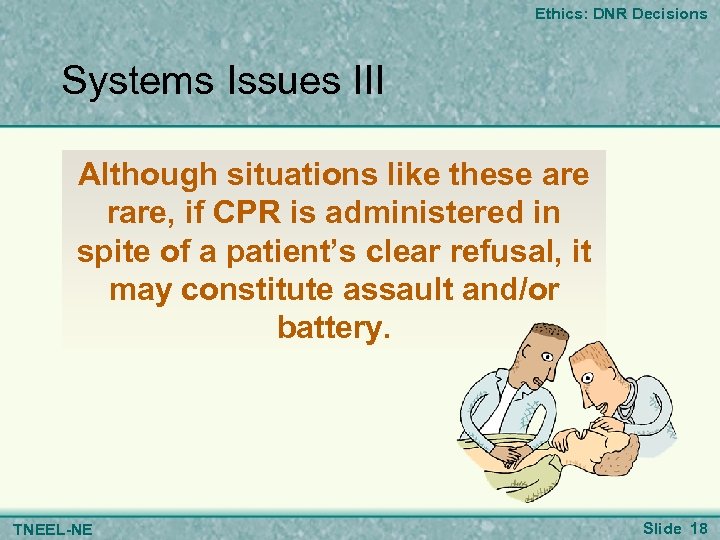 Ethics: DNR Decisions Systems Issues III Although situations like these are rare, if CPR is administered in spite of a patient’s clear refusal, it may constitute assault and/or battery. TNEEL-NE Slide 18
 Ethics: DNR Decisions Patient Care Scenarios Types of Patients with DNR orders • The Classic Scenario • The Critical Care Scenario • The Patient Autonomy Scenario • Community-based or Portable DNR Scenario TNEEL-NE Slide 19
 Ethics: DNR Decisions The Classic Scenario I The “Comfort Care Only” patient • Death is anticipated • Goal: Alleviate suffering • CPR and other treatments withheld TNEEL-NE Slide 20
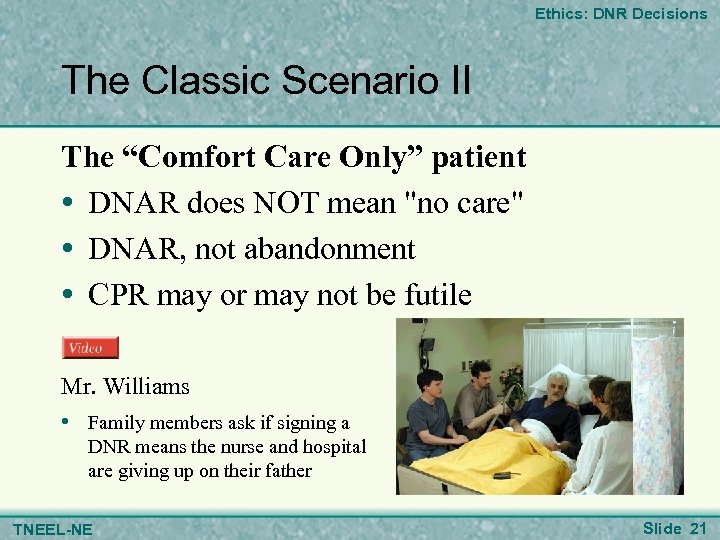 Ethics: DNR Decisions The Classic Scenario II The “Comfort Care Only” patient • DNAR does NOT mean "no care" • DNAR, not abandonment • CPR may or may not be futile Mr. Williams • Family members ask if signing a DNR means the nurse and hospital are giving up on their father TNEEL-NE Slide 21
 Ethics: DNR Decisions The Critical Care Scenario I The “Do Everything BUT CPR” patient • Reasonable hope of recovery • Goal: Prolonging life, etc. • CPR withheld, but nothing else TNEEL-NE Slide 22
 Ethics: DNR Decisions The Critical Care Scenario II The “Do Everything BUT CPR” patient • Need to reassess situation often • DNAR, not "slow care” • CPR may or may NOT be futile TNEEL-NE Slide 23
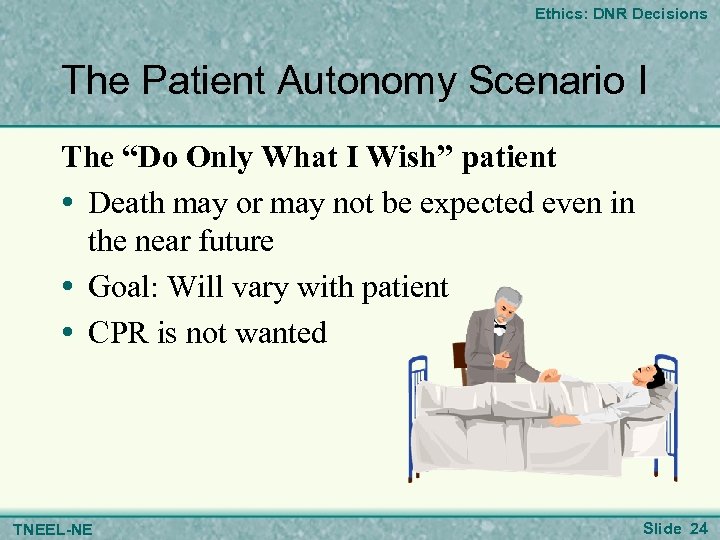 Ethics: DNR Decisions The Patient Autonomy Scenario I The “Do Only What I Wish” patient • Death may or may not be expected even in the near future • Goal: Will vary with patient • CPR is not wanted TNEEL-NE Slide 24
 Ethics: DNR Decisions The Patient Autonomy Scenario II The “Do Only What I Wish” patient • “No CPR" means ONLY “No CPR” • Need to clarify patient's wishes • CPR may or may not be futile TNEEL-NE Slide 25
 Ethics: DNR Decisions Community-based or Portable DNR Scenario I The “Help Me but Don’t Save Me” patient • Death may or may not be expected even in the near future • Goal: Will vary with patient • CPR is not wanted TNEEL-NE Slide 26
 Ethics: DNR Decisions Community-based or Portable DNR Scenario II The “Help Me but Don’t Save Me” patient • Requires signature of patient or patient’s surrogate and physician • “No CPR" means ONLY “No CPR” • Need to clarify patient's wishes • CPR may or may not be futile TNEEL-NE Slide 27