


 Скачать презентацию Saragusti I Sharon I Smilansky U
97ed8e66835bedaae0c32b20d886876e.ppt
- Количество слайдов: 1
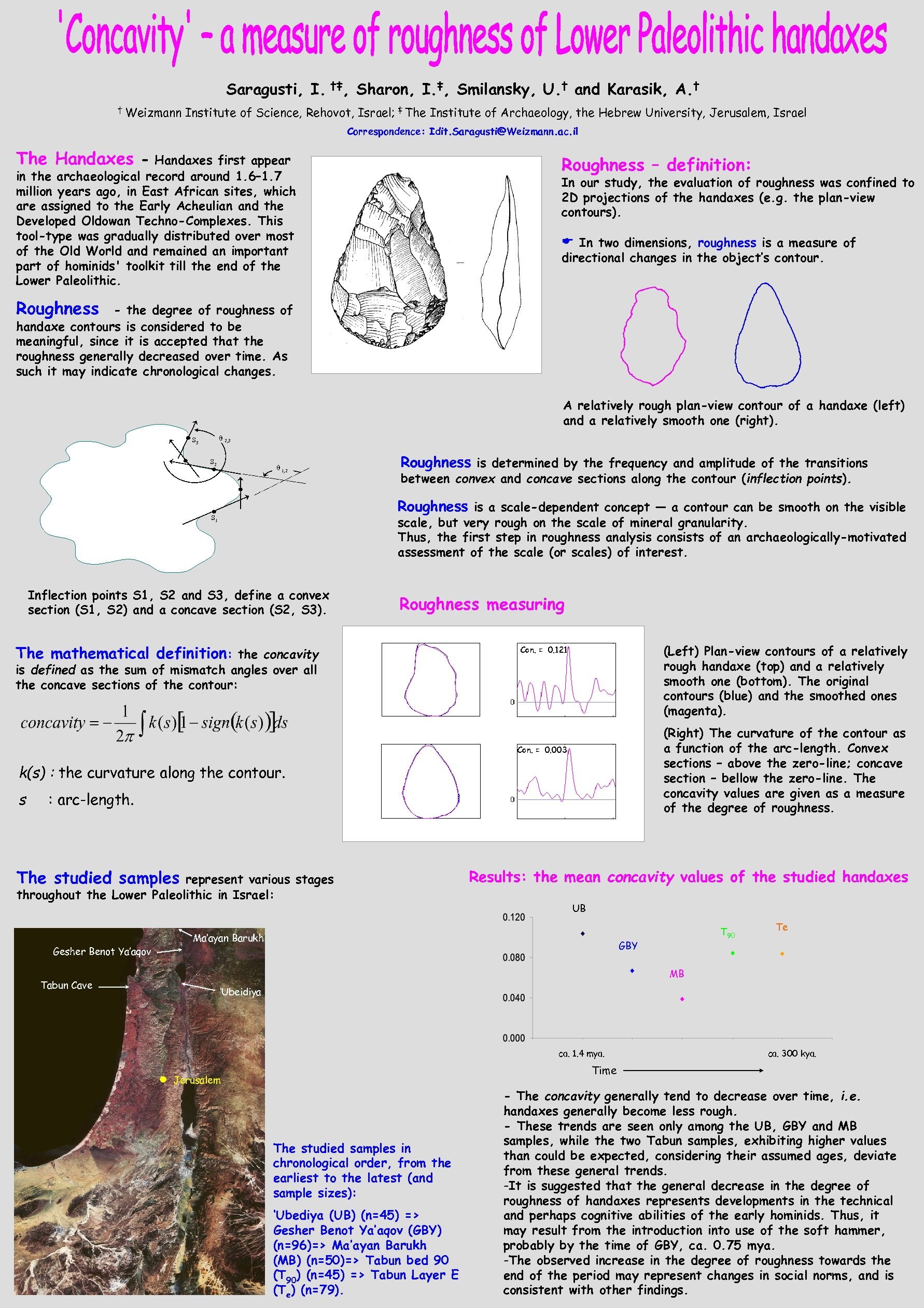 Saragusti, I. †‡, Sharon, I. ‡, Smilansky, U. † and Karasik, A. † † Weizmann Institute of Science, Rehovot, Israel; ‡ The Institute of Archaeology, the Hebrew University, Jerusalem, Israel Correspondence: Idit. Saragusti@Weizmann. ac. il The Handaxes - Handaxes first appear in the archaeological record around 1. 6– 1. 7 million years ago, in East African sites, which are assigned to the Early Acheulian and the Developed Oldowan Techno-Complexes. This tool-type was gradually distributed over most of the Old World and remained an important part of hominids' toolkit till the end of the Lower Paleolithic. Roughness – definition: In our study, the evaluation of roughness was confined to 2 D projections of the handaxes (e. g. the plan-view contours). In two dimensions, roughness is a measure of directional changes in the object’s contour. Roughness - the degree of roughness of handaxe contours is considered to be meaningful, since it is accepted that the roughness generally decreased over time. As such it may indicate chronological changes. A relatively rough plan-view contour of a handaxe (left) and a relatively smooth one (right). 2, 3 S 2 1, 2 Roughness is determined by the frequency and amplitude of the transitions between convex and concave sections along the contour (inflection points). Roughness is a scale-dependent concept — a contour can be smooth on the visible scale, but very rough on the scale of mineral granularity. Thus, the first step in roughness analysis consists of an archaeologically-motivated assessment of the scale (or scales) of interest. S 1 Inflection points S 1, S 2 and S 3, define a convex section (S 1, S 2) and a concave section (S 2, S 3). Roughness measuring The mathematical definition: the concavity is defined as the sum of mismatch angles over all the concave sections of the contour: (Left) Plan-view contours of a relatively rough handaxe (top) and a relatively smooth one (bottom). The original contours (blue) and the smoothed ones (magenta). Con. = 0. 121 (Right) The curvature of the contour as a function of the arc-length. Convex sections – above the zero-line; concave section – bellow the zero-line. The concavity values are given as a measure of the degree of roughness. Con. = 0. 003 k(s) : the curvature along the contour. s : arc-length. The studied samples represent various stages throughout the Lower Paleolithic in Israel: Gesher Benot Ya’aqov Tabun Cave Results: the mean concavity values of the studied handaxes UB Ma’ayan Barukh T 90 GBY Te MB ‘Ubeidiya ca. 1. 4 mya. ca. 300 kya. Time Jerusalem The studied samples in chronological order, from the earliest to the latest (and sample sizes): ‘Ubediya (UB) (n=45) => Gesher Benot Ya’aqov (GBY) (n=96)=> Ma’ayan Barukh (MB) (n=50)=> Tabun bed 90 (T 90) (n=45) => Tabun Layer E (Te) (n=79). - The concavity generally tend to decrease over time, i. e. handaxes generally become less rough. - These trends are seen only among the UB, GBY and MB samples, while the two Tabun samples, exhibiting higher values than could be expected, considering their assumed ages, deviate from these general trends. -It is suggested that the general decrease in the degree of roughness of handaxes represents developments in the technical and perhaps cognitive abilities of the early hominids. Thus, it may result from the introduction into use of the soft hammer, probably by the time of GBY, ca. 0. 75 mya. -The observed increase in the degree of roughness towards the end of the period may represent changes in social norms, and is consistent with other findings.