


 Скачать презентацию SAPRAA-2013 Dr P Vassie Naidoo SAPC UKZN
e78f6f4e3acbf672e43382e6d008642b.ppt
- Количество слайдов: 50
 SAPRAA-2013 Dr P (Vassie) Naidoo SAPC UKZN
 CPD BACKGROUND: Definition Evolution of CE/CPD CPD: Barriers. CPD in other countries CPD IN SA SAPC: Its CPD journey Guidance document (Process) CPD cycle Competence Stds Interns 2
 Definition-Pharmacy Act ‘Continuing professional development means the process by which natural persons registered with Council continuously enhance their competence throughout their professional careers, and encompasses a range of activities including continuing education and supplementary training’. 1 3
 Definition-HPCSA It can involve any activity that is relevant to a persons practice and can take the form of formal and structured or informal and self directed learning. CPD is crucial and necessary to ensure that HP remain current and competent at all times. (HPCSA) 4
 Definition-Rouse defines CPD for pharmacist as: “an ongoing, self-directed, structured, outcomes focused cycle of learning and personal improvement. ” 2 The International Federation of Pharmacists (FIP) directly linked CPD to maintenance of competence in their 2002 statement- where they state that CPD is 5
 Definition-FIP “the responsibility of individual pharmacists for systematic maintenance, development and broadening of knowledge, skills and attitudes, to ensure continuing competence as a professional, throughout their careers. ” 3 6
 Definition-HCPC-UK Health and Care Professionals Council (HCPC-UK) define continuing professional development (CPD) as ‘a range of learning activities through which health and care professionals maintain and develop throughout their career to ensure that they retain their capacity to practice safely, effectively and legally within their evolving scope of practice’ 4 7
 CPD Model-WHO 1988 There is no ideal (CPD) model to adopt, each country should design its own system by taking into account the way in which healthcare is organised, the local cultural and economic situation, the demand for continuing education, and the constraints and resources available. 5 8
 Evolution of CE Historically regulatory authorities protected the public by ensuring that pharmacists were competent at the time of entry to practice. 6 Parallel to this a system was developed to ensure the continuing provision of safe and effective care by practitioners. 9
 Evolution of CE However as the discovery of health-related information grew, new methods were needed to ensure that practitioners' knowledge was continuously updated and incorporated into practice. 6 10
 Evolution: CE Continuing education (CE) was introduced to address this need. Many countries introduced mandatory CE as a requirement to maintain licensure or certification. 6 The goal of mandatory CE was to assure the public of the continuing quality of care provided by practitioners. 6 11
 Evolution: CPD As experience was gained with mandatory CE, evidence-research documented that mandatory CE was ineffective at influencing practice performance. 6 This led the professions, including pharmacy, to pose questions such as: “Is a better system possible? 12
 Evolution: CPD Suggestion- better method of ensuring maintenance of competence relative to mandatory CE is CPD. Many international, and provincial pharmacy organizations, have supported CPD programs for this purpose. 6 13
 CPD CPD is a process usually thought of as a circle connecting the stages of : Reflection, Planning, Action, Evaluation. 7 It involves a cycle in which individual practitioners 14
 THE CYCLE OF CPD Reflect –practice; assess knowledge and skills, identify learning needs. Create a personal learning plan. Implement the plan. Evaluate the effectiveness Documentation-an integral aspect of CPD, and a personal portfolio is used for this purpose. 8 15
 CPD vs CE can be seen as one part of CPD process which involves traditional methods such as: Lectures, Workshops, Distance learning courses CPD- focus- on individual, CE structured to address learning needs of majority of practitioners. 7 Study : CPD –better than CE-9 16
 Barriers to CPD engagement. Nurses Study -SA with nurses-following barriers Family and Social commitments Time constraints Employers restrictions Other –not defined. 10 17
 Barriers to CPD engagement. Pharmacists Perception that CPD is time consuming. Misunderstanding of the CPD process and what is involved for the pharmacist. Difficulties in identifying learning needs and evaluating CPD activities. 18
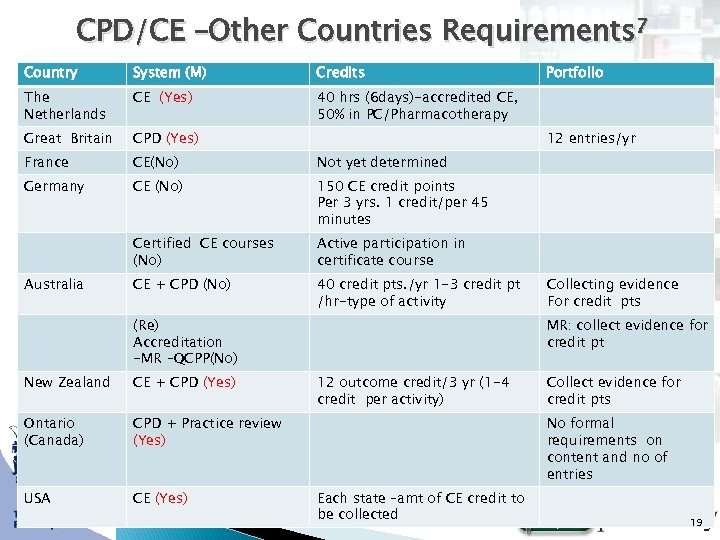 CPD/CE –Other Countries Requirements 7 Country System (M) Credits The Netherlands CE (Yes) 40 hrs (6 days)-accredited CE, 50% in PC/Pharmacotherapy Great Britain CPD (Yes) France CE(No) Not yet determined Germany CE (No) 150 CE credit points Per 3 yrs. 1 credit/per 45 minutes Certified CE courses (No) Active participation in certificate course CE + CPD (No) 40 credit pts. /yr 1 -3 credit pt /hr-type of activity Australia 12 entries/yr (Re) Accreditation -MR –QCPP(No) New Zealand CE + CPD (Yes) Ontario (Canada) CE (Yes) Collecting evidence For credit pts MR: collect evidence for credit pt CPD + Practice review (Yes) USA Portfolio 12 outcome credit/3 yr (1 -4 credit per activity) Collect evidence for credit pts No formal requirements on content and no of entries Each state –amt of CE credit to be collected 19
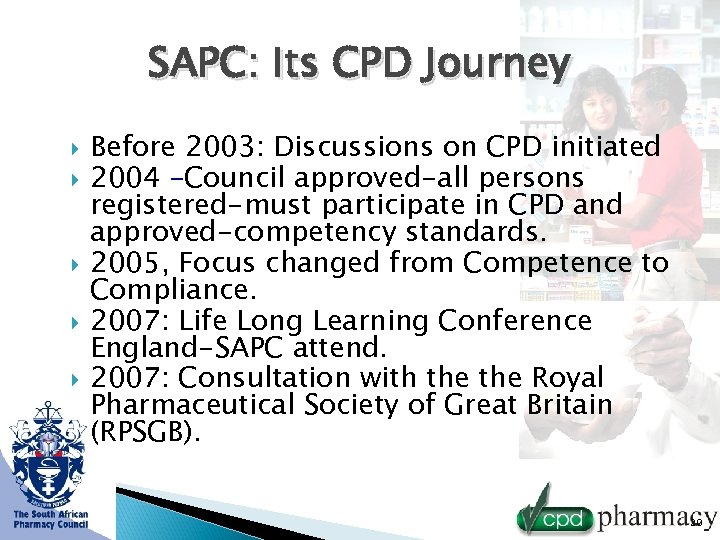 SAPC: Its CPD Journey Before 2003: Discussions on CPD initiated 2004 –Council approved-all persons registered-must participate in CPD and approved-competency standards. 2005, Focus changed from Competence to Compliance. 2007: Life Long Learning Conference England-SAPC attend. 2007: Consultation with the Royal Pharmaceutical Society of Great Britain (RPSGB). 20
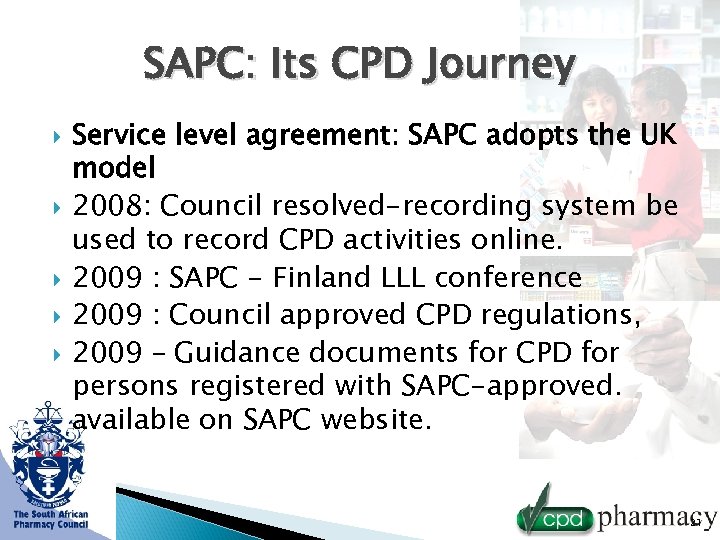 SAPC: Its CPD Journey Service level agreement: SAPC adopts the UK model 2008: Council resolved-recording system be used to record CPD activities online. 2009 : SAPC - Finland LLL conference 2009 : Council approved CPD regulations, 2009 – Guidance documents for CPD for persons registered with SAPC-approved. available on SAPC website. 21
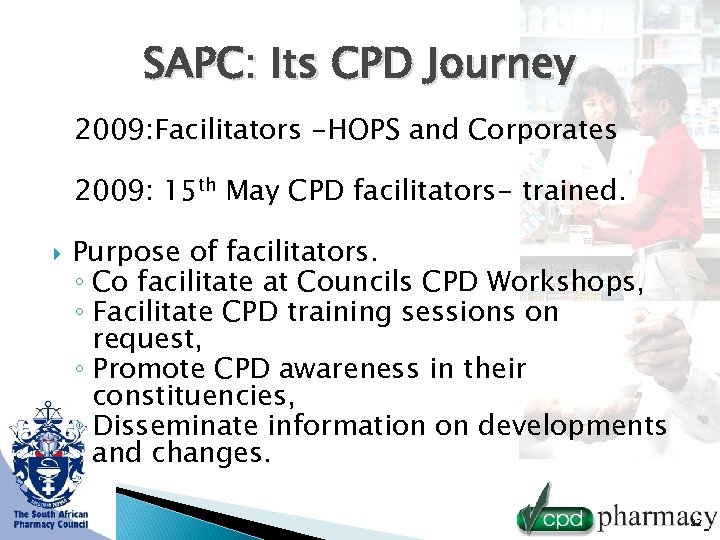 SAPC: Its CPD Journey 2009: Facilitators -HOPS and Corporates 2009: 15 th May CPD facilitators- trained. Purpose of facilitators. ◦ Co facilitate at Councils CPD Workshops, ◦ Facilitate CPD training sessions on request, ◦ Promote CPD awareness in their constituencies, ◦ Disseminate information on developments and changes. 22
 SAPC: Its CPD Journey Pilot: Used UK software Pilot study participants Prior to Pilot study, pre pilot survey questionnaire administered Recording of CPD : 4 th Nov 2009 --30 th Sept 2010 Post pilot survey—from 1 st Oct 2010 Results obtained-customised—SA 23
 SAPC: Its CPD Journey 2010 regulations published for comments. 2013 – Council awaits- Regulations relating to CPD for persons registered with Council to be published by the Minister of Health for implementation. Mandatory after publication and training. Road-shows in all provinces –after publication to create awareness of CPD and to clarify issues relating to SAPC CPD requirements. 24
 Designations 1 Practising pharmacist. All first time applicants, registered persons January 2014, until Declare they are non-practising or fail to comply with the requirement relating to CPD. Community service pharmacists, tutors, responsible pharmacists, Council inspectors, assessors, examiners, moderators and any pharmacist involved in training of any category of registered person, -- not be permitted to be non-practising. All issued with a 'practising' registration card. 25
 Designations 1 Non-practising The following will apply to persons who have been designated or who have declared themselves as non-practising: (i) they will have access to the online annual declaration (ii) they will not be able to record any CPD activities online (iii) they will be issued with a registration card. 26
 Process: Change of designations 1 Change-practising to non-practising (online Change from non-practising to practising: (i) Submit application form to the Registrar (ii) payment of the prescribed fee (iii) Apply 30 days prior to commencement (iv) Registrar-not approve-appeal-Council (v) Evaluated and treated on its own merit. Change of designations may be required to comply with certain conditions that the Council may determine. 27
 Annual Declaration 1 Annual declaration –online-all reg personspractising or non-practising status The online declaration must be completed: (i) Annual basis-payment of the annual fee (ii) First time registered-particular category (iii) Restored to the Council register. The annual declaration will provide Council with an indication of who will be practising or non-practising and who will need to comply with CPD requirements. 28
 CPD REQUIREMENTS 1 (i) completion of the online annual declaration (ii) participation in CPD and recording CPD activities annually on a web-based system provided by Council (iii) recording CPD activities online following the CPD cycle in the format approved by Council (iv) maintaining an electronic portfolio of evidence. 29
 CPD Process 1 5 year assessment plan. Proposed-20% of pharmacists be sampled each year until all pharmacists are assessed. System –automate-random selection of 20% pharmacists for the purpose of assessment. Selected pharmacists-informed, assessors will be appointed and trained. System will then automate the allocation of the sampled pharmacists to appointed assessors. 30
 CPD Process 1 Pharmacist-flagged-register-assess. Assessment-all 6 submitted entries. Provision -submission on CD Feedback-pharmacist-office of Registrar Assessment of the quality- submitted in terms of ◦ Whether the training need is related to the title ◦ Whethere is a relationship between the title and what has been learned ◦ What extent has the learning made the registered person better in what he/she is doing. ◦ The primary mode of assessment of CPD activity will be a review of the record of CPD activities. 31
 COMPLIANCE TO CPD 1 Submit min. no. of 6 CPD entries-annually – review annually. Excluding interns, can begin one third of the CPD entries anywhere on the cycle. Keep own personal electronic portfolio of evidence, not upload on the online system. Council may require evidence anytime during the assessment -request registered persons individually to electronically upload their evidence. 32
 Non-Compliance 1 Registered in categories -Section 14 of Act, designated as practising on the register, changed by Council from practising to nonpractising -not comply relating to participation& recording thereof in the format approved by Council. Non compliance to CPD requirements-managed in terms of regulation 6(1) of the regulations relating to CPD. Right to appeal 33
 Deferment 1 Submit-application-deferment- compliance Reasons acceptable to Council will consider reasons such as: (i) Temporary incapacity as defined in the Labour Relations Act, maternity leave (ii)No access - online being suspended (iii)Deployed-risk-national security (iv)Deployment-country-no internet conn. (v) Other reasons substantiated by the applicant and deemed fit by Council. 34
 Deferment 1 Person registered with council-apply for deferment – if such a person is practicing in a country where CPD is mandatory-submit evidence that he/she is compliant with CPD requirement of that country. In countries where CPD is not mandatory registered persons practicing in those countries will be required to comply with SAPC CPD requirement. 35
 CPD CYCLE-PROCESS 1 All registered persons who are designated as practising will be required to participate in CPD by following the CPD cycle. The CPD cycle is a process that involves four steps, namely: 36
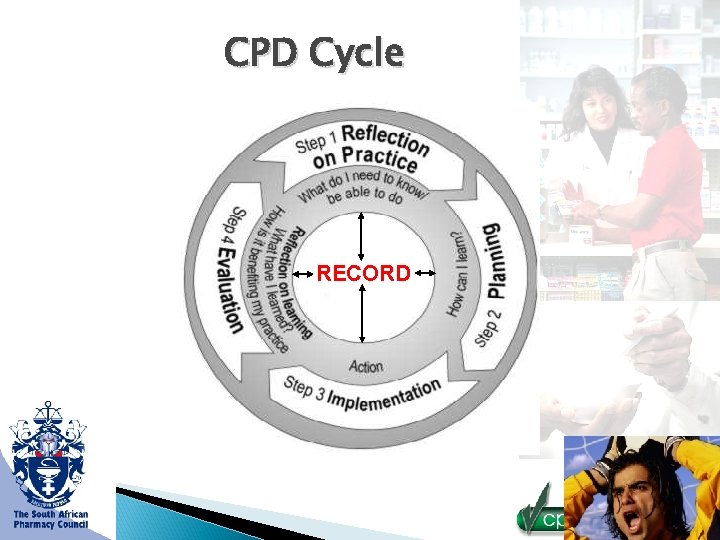 CPD Cycle RECORD 37
 REFLECTION Reflection on practice, Assess your knowledge and skills. SELF DIAGNOSE a learning need by asking questions such as - What do I need to know? What do I need to be able to do? ); What services do I want to deliver, what are my development needs in this area, If there are many, learning needs identified, then you need to prioritise them for your next step which is 38
 PLANNING Plan what learning activities you can undertake or-steps - address the gaps in knowledge and skills identified. Here , areas in your practice - that need to improve can also be identified and addressed. Learning activities -informal and formal dist. educ. work shadowing, study groups, coaching, attendance of formal lectures, conferences , workgroups, sp. projects and assignments, computer-aided learning and the reading of articles/journals. 39
 Implementation The third step -implementing plans that have been selected during the planning stage Specific plans-carried out within the defined time limit-summary-what has been achieved. Learning activities -changes made-practice must be documented in your portfolio. Once the planned activity has taken place it time to move onto the next stage. 40
 Evaluation 4 th step-reflect on-assess-impact -both development as a person and pharmacist, and impact -practice of the profession. This stage -questions -asked such as Has my learning objective been met Tested –what- learnt -applied to practice Am I now able to work differently Problems with the reflection, planning or action parts. Eg. learning need identified correctly and the objective specific enough. 41
 Competence standard-Tool 1 Competence standards-developed- toolassess -learning needs. Gaps in your knowledge and skills-compare with those required by the standards. Structured –help-identify areas –practice- be modified and/or improved. Based -7 unit standards-entry level pharm. accepted by SAPC as the minimum competencies required for entry into the profession 42
 Competence Standard-Tool 1 3 additional sections-added, ◦ facilitating the development of pharmaceutical personnel, ◦ practising pharmacy professionally and ethically, ◦ management -pharmacy/pharmaceutical service. Diverse practice-provision – made-to check whether or not the standard applies to you. This provision should be used in instances where the aspect of practice identified does not relate to your particular practice setting. Eg comm pharm vs manufact, compounding, repackaging—daily bases. Please take time to use this tool 43
 Competence Std: Example 1 Ensure systems and procedures are adhered to (manufacturing, community, hospital) A person who has achieved this outcome is capable of: (a) Adhering to and applying standard operating procedures during pharmaceutical operations Assessment (Tick appropriate box) Does this outcome form part of my current practice of pharmacy? Yes No IF YES, on the basis of the evidence I have identified I can do this 44
 Competence Std: Example 1 Ensure documents are completed and records maintained (manufacturing) A person who has achieved this outcome is capable of: (a) Demonstrating and understanding the application and importance of documentation (b) Assisting in the compilation, control and maintenance of documentation (c) Controlling record keeping and the application of documentation in the pharmaceutical processes Assessment (Tick appropriate box) Does this outcome form part of my current practice of pharmacy? Yes No IF YES, on the basis of the evidence I have identified I can do this 45
 Lead and participate in the work team 1 (a) Planning and organising the work team to optimise output, quality and cost (b) Identifying, clarifying, responding to and resolving work-related problems within the team to achieve optimum performance (c) Training team members in the implementation of standard operating procedures (d) Identifying and responding to industrial relations issues timeously in a way that balances the interests of worker and management within the legal requirements (e) Organising and conducting regular meetings with team members to determine courses of action to deal with problems affecting productivity (f) Evaluating staff performance in key performance areas against agreed outcomes (g) Establishing and maintaining effective lines of communication within the team 46
 Intern: CPD Regulations not published-implementation, the following are pertinent 1. SAPC criteria-tutor approval-CPD participat 2. 12/13 Oct 2011 -resolution-intern –CPD entries on SAPC website 3. All interns-Jan 2012 -CPD entries online and were assessed for competency. 4. CPD website-presented in –tutor intern workshops : Feb to Apr every year. 47
 Acknowledgement The Registrar and the Staff of the South African Pharmacy Council. 48
 References 1. SAPC, Pharmacy Act 53 of 1974; CPD and Regulations, Guidance Document 2. Rouse MJ. Continuing professional development in pharmacy. Am J Health-Syst Pharm. 200461: 2069– 76. http: //www. hpc-uk. org/registrants/cpd/ 3, Statement of Professional Standards on Continuing Professional Development. International Pharmaceutical Federation. Nice, 2002. Available at: http: //www. fip. org/www 2/uploads/database_file. php? id=221&table_id= 4. Health and Care Professions Council (HCPC), Continuing Professional Development, www. hpc-uk. org/registrants/cpd/ Accessed 14. 6. 2013 5. WHO (World Health Organisation, 1988 Continuing education of Health Workers, Geneva 6. Winslade NE, Tamblyn RM, Taylor LK, Schuwirth LWT, Van der Vleuten CPM. Integrating Performance Assessment, Maintenance of Competence, and Continuing Professional Development of Community Pharmacists. Am J Pharm Educ. 2007 February 15; 71(1): 15. 7. Driesen A, Verbeke K, Simeons S, Laekeman G, International Trends in Lifelong Learning for Pharmacists Am J Pharm Educ. 2007 June 15; 71(3): 52. 8. Rouse MJ, Continuing professional development in pharmacy. J Am Pharm Assoc. 2004; 44: 517– 520. 9. Mc Connell KJ, Newlon CL, Delate T, The impact of continuing professional development versus traditional continuing pharmacy education on pharmacy practice. Ann Pharmacother, 2010 Oct; 44(10): 1585 -95. doi: 10. 1345/aph. 1 P 161. Epub 2010 Sep 14 10. S. Arunachallam, Faculty of community and Health Sciences, UWC. The development of a model for CPD for professional nurses in SA. http: //etd. uwc. ac. za/usrfiles/modules/etd/docs/etd_gen 8 Srv 25 Nme 4_2073_1298613623. pdf--UWC. 49
 THANK YOU 50