


 Скачать презентацию Sandeep Gokhale 1 References Financial Management Authors
c3183a123d4eb359b10c7132f1e4a0b3.ppt
- Количество слайдов: 92
 Sandeep Gokhale 1
 References Financial Management Authors : • Khan & Jain • Prasanna Chandra • Myers • Van Horne 2
 Syllabus • Ratio Analysis • Fund & Cash flow analysis • Cost of Capital • Working Capital Mgmt. • Means of Financing • Capital Budgeting • Dividend Structuring • Bonus Shares • Share Holder Value Measurement 3
 FINANCIAL MANAGEMENT Objective: Create share holder value Methodology: Capturing of value at all Levels. Business Process restructuring Enterprise resource management. Vertically integrated operations. Customer relationship Management Sustained up scaling of operations Effectiveness: Proximity of gross profit to net profit Maximisation of EVA EV / EBIDTA multiple 4
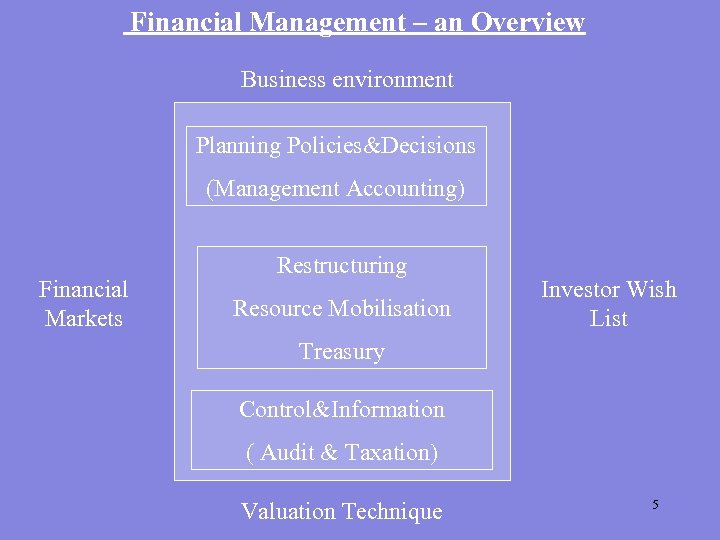 Financial Management – an Overview Business environment Planning Policies&Decisions (Management Accounting) Financial Markets Restructuring Resource Mobilisation Investor Wish List Treasury Control&Information ( Audit & Taxation) Valuation Technique 5
 Environmental scan Economy: Convertibility of Local Currency GDP / Industrial growth rate Scalability of Operations FDI – Incoming / outgoing Inflation rate / Fiscal deficit Trade surplus/deficits Balance of payment status WTO Implications Emerging markets scenario Gross national income distribution 6
 Government Policy: Industrial policy Government programmes and projects Tax regime Subsidies, incentives and concessions Exim policies / VAT Government Expenditure Lending considerations of financial institutions and commercial banks Infrastructure Development Rating of Govt paper Agricultural policies 7
 Technology: Emergence of new technologies. Access to technical Up gradation Level of obsolescence. Socio Demographic: Population trends Age shifts in population Educational profile. Attitudes toward consumption and investment 8
 Competition: Number of players in the industry and their market share. Duty barrier and status of international cost and volume positioning. Degree of homogeneity and differentiation among products. Entry barriers for new capacities. Comparison with substitute products. Unorganised sector operations. Marketing polices and practices. 9
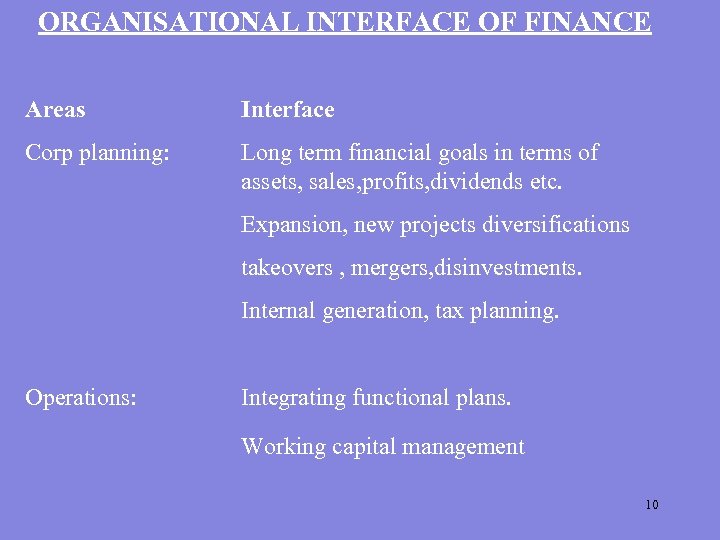 ORGANISATIONAL INTERFACE OF FINANCE Areas Interface Corp planning: Long term financial goals in terms of assets, sales, profits, dividends etc. Expansion, new projects diversifications takeovers , mergers, disinvestments. Internal generation, tax planning. Operations: Integrating functional plans. Working capital management 10
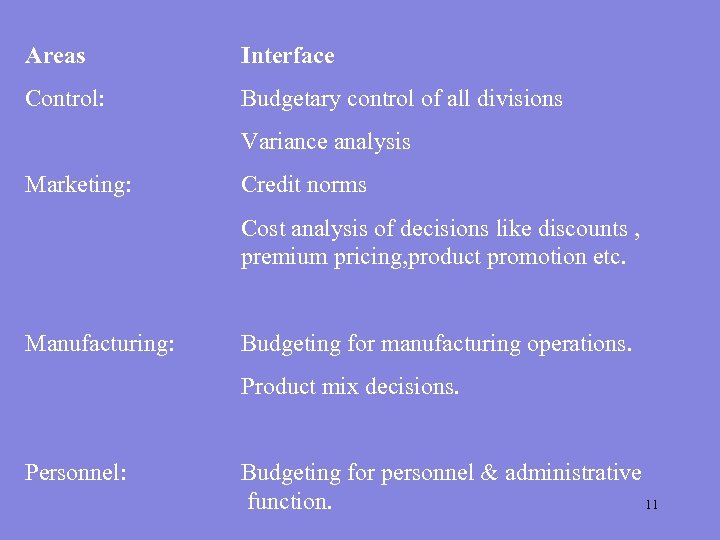 Areas Interface Control: Budgetary control of all divisions Variance analysis Marketing: Credit norms Cost analysis of decisions like discounts , premium pricing, product promotion etc. Manufacturing: Budgeting for manufacturing operations. Product mix decisions. Personnel: Budgeting for personnel & administrative 11 function.
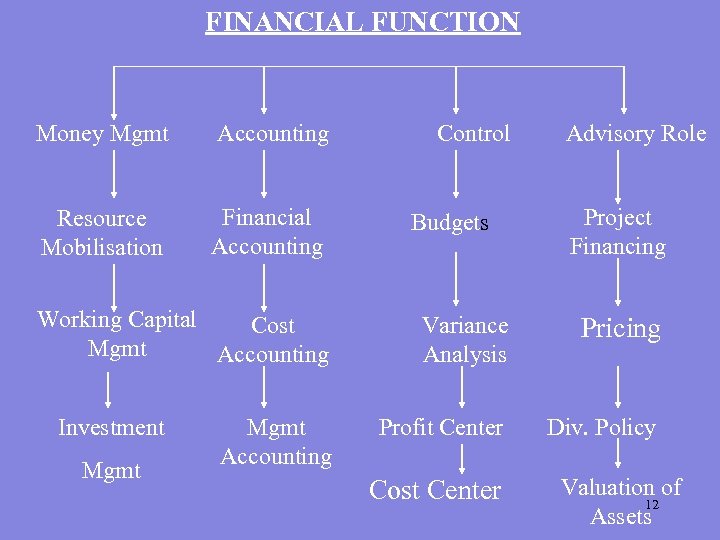 FINANCIAL FUNCTION Money Mgmt Accounting Resource Mobilisation Financial Accounting Working Capital Cost Mgmt Accounting Investment Mgmt Accounting Control Budgets Advisory Role Project Financing Variance Analysis Pricing Profit Center Div. Policy Cost Center Valuation of 12 Assets
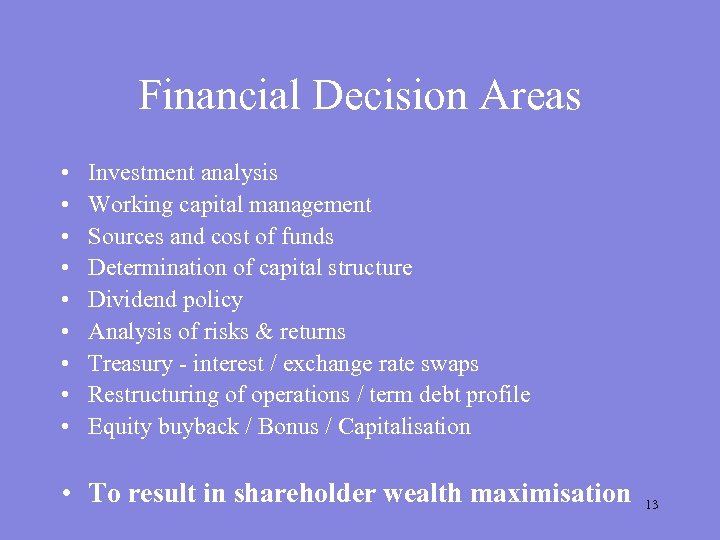 Financial Decision Areas • • • Investment analysis Working capital management Sources and cost of funds Determination of capital structure Dividend policy Analysis of risks & returns Treasury - interest / exchange rate swaps Restructuring of operations / term debt profile Equity buyback / Bonus / Capitalisation • To result in shareholder wealth maximisation 13
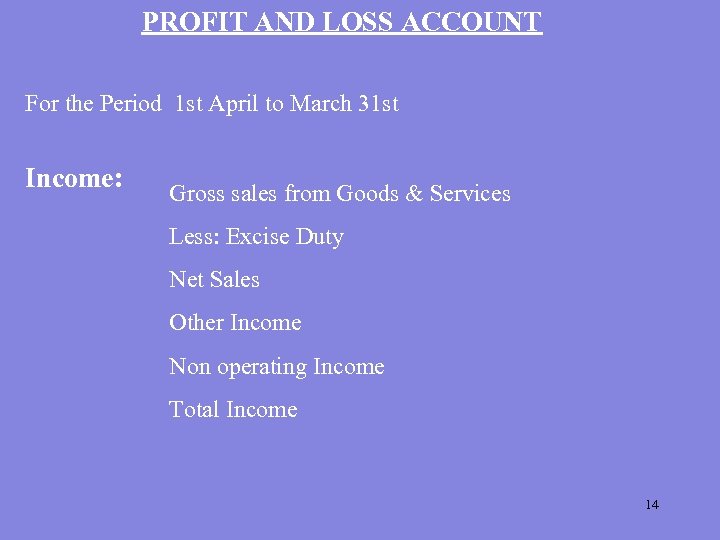 PROFIT AND LOSS ACCOUNT For the Period 1 st April to March 31 st Income: Gross sales from Goods & Services Less: Excise Duty Net Sales Other Income Non operating Income Total Income 14
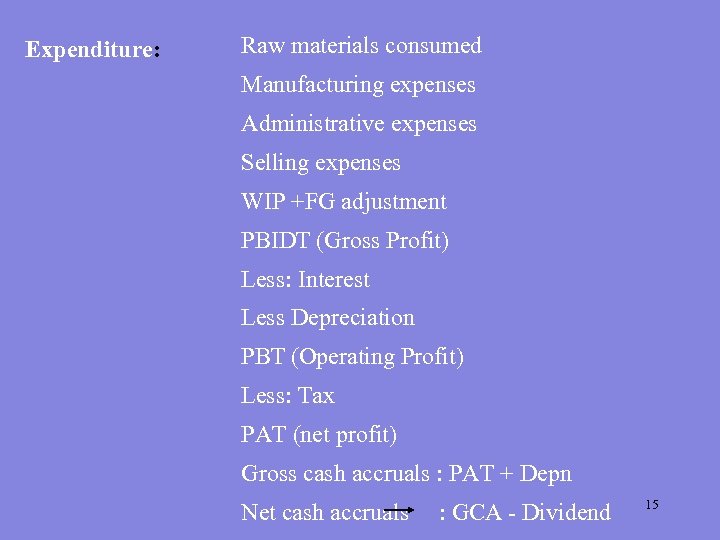 Expenditure: Raw materials consumed Manufacturing expenses Administrative expenses Selling expenses WIP +FG adjustment PBIDT (Gross Profit) Less: Interest Less Depreciation PBT (Operating Profit) Less: Tax PAT (net profit) Gross cash accruals : PAT + Depn Net cash accruals : GCA - Dividend 15
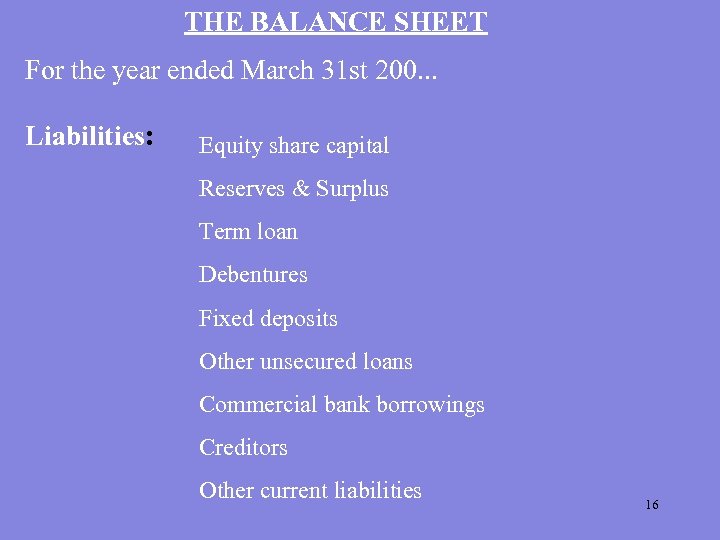 THE BALANCE SHEET For the year ended March 31 st 200. . . Liabilities: Equity share capital Reserves & Surplus Term loan Debentures Fixed deposits Other unsecured loans Commercial bank borrowings Creditors Other current liabilities 16
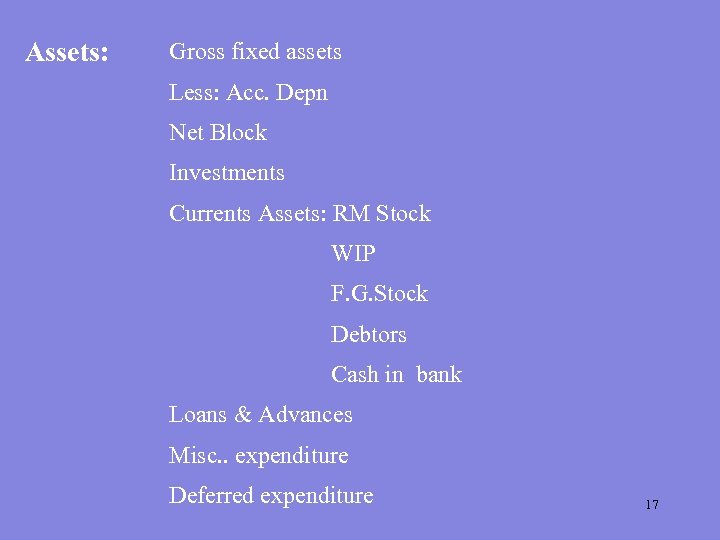 Assets: Gross fixed assets Less: Acc. Depn Net Block Investments Currents Assets: RM Stock WIP F. G. Stock Debtors Cash in bank Loans & Advances Misc. . expenditure Deferred expenditure 17
 RATIO ANALYSIS Principal tool for analysis Inter firm comparison Intra firm comparison Industry analysis Responsibility accounting 18
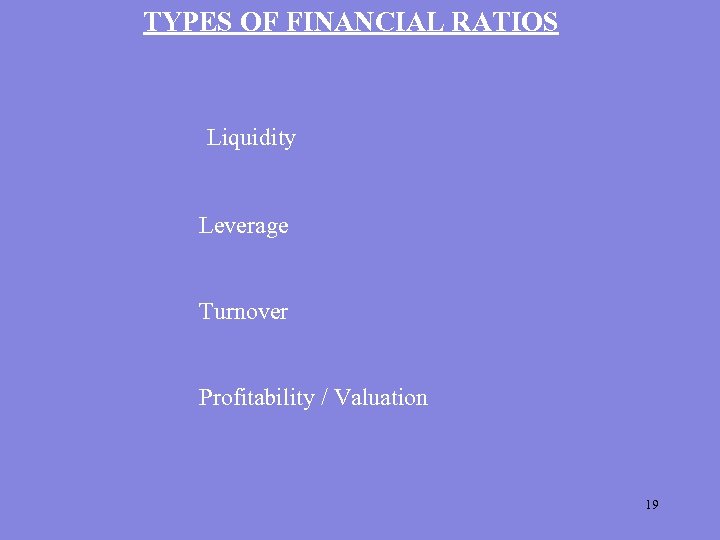 TYPES OF FINANCIAL RATIOS Liquidity Leverage Turnover Profitability / Valuation 19
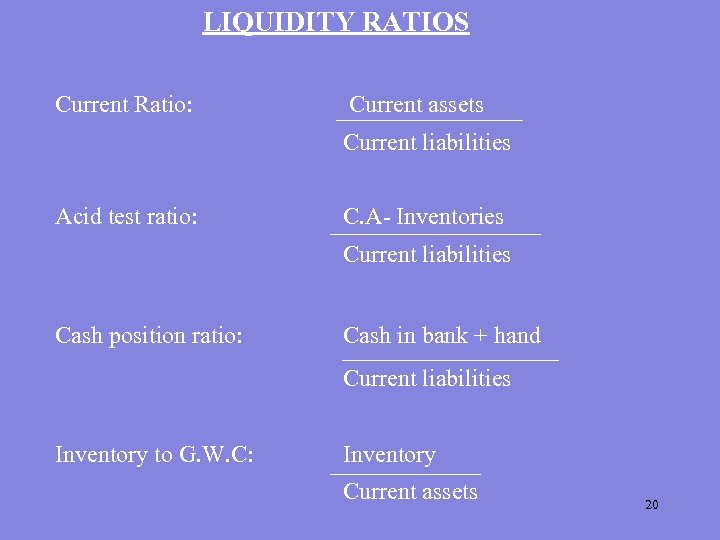 LIQUIDITY RATIOS Current Ratio: Current assets Current liabilities Acid test ratio: C. A- Inventories Current liabilities Cash position ratio: Cash in bank + hand Current liabilities Inventory to G. W. C: Inventory Current assets 20
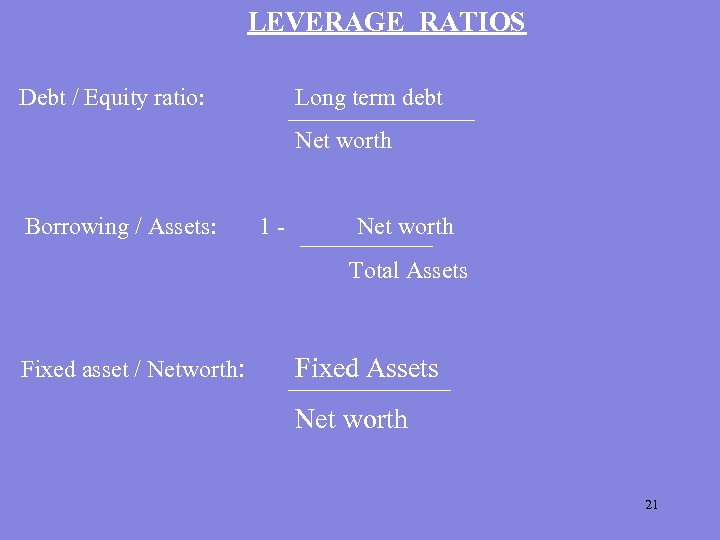 LEVERAGE RATIOS Debt / Equity ratio: Long term debt Net worth Borrowing / Assets: 1 - Net worth Total Assets Fixed asset / Networth: Fixed Assets Net worth 21
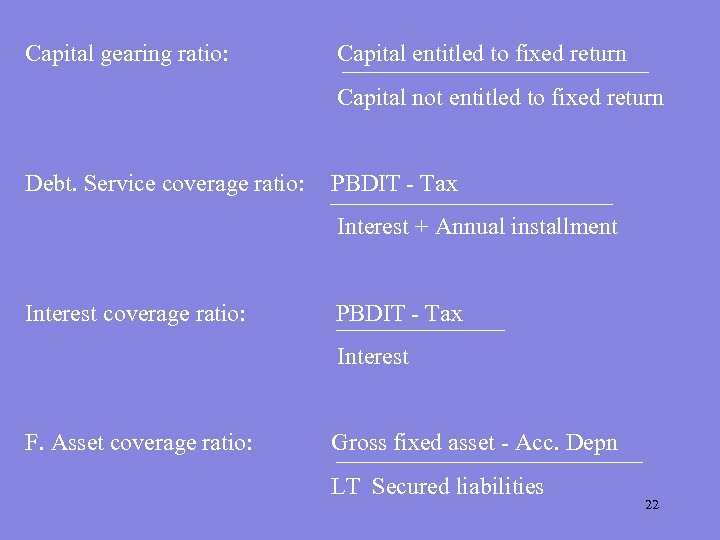 Capital gearing ratio: Capital entitled to fixed return Capital not entitled to fixed return Debt. Service coverage ratio: PBDIT - Tax Interest + Annual installment Interest coverage ratio: PBDIT - Tax Interest F. Asset coverage ratio: Gross fixed asset - Acc. Depn LT Secured liabilities 22
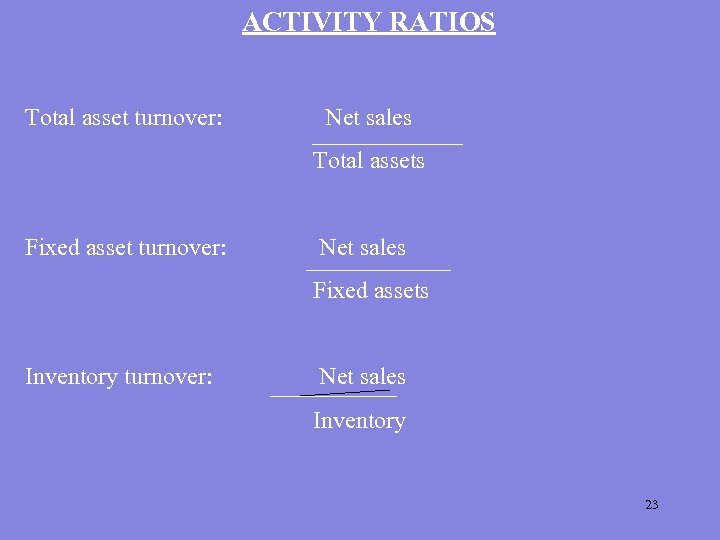 ACTIVITY RATIOS Total asset turnover: Net sales Total assets Fixed asset turnover: Net sales Fixed assets Inventory turnover: Net sales Inventory 23
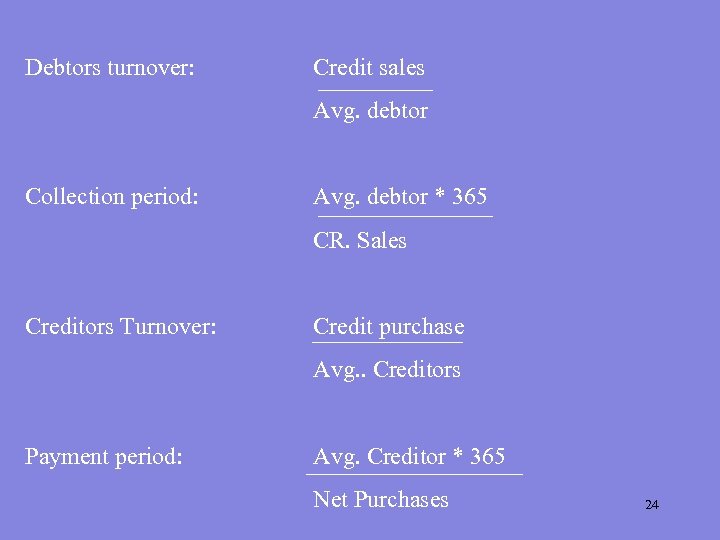 Debtors turnover: Credit sales Avg. debtor Collection period: Avg. debtor * 365 CR. Sales Creditors Turnover: Credit purchase Avg. . Creditors Payment period: Avg. Creditor * 365 Net Purchases 24
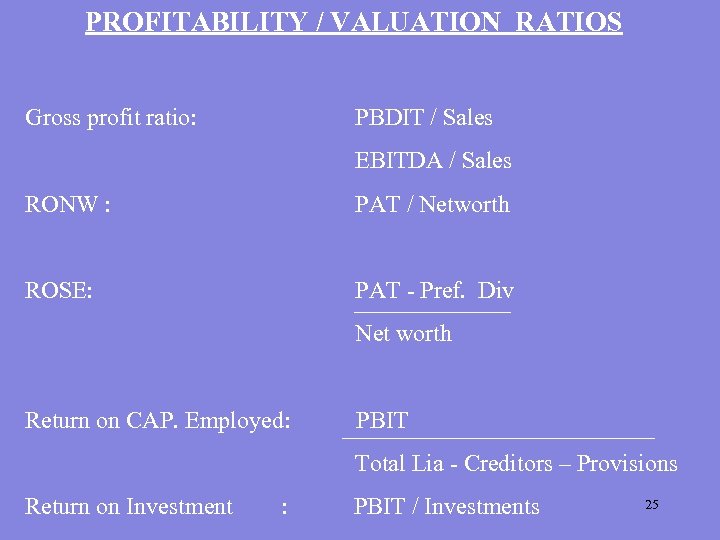 PROFITABILITY / VALUATION RATIOS Gross profit ratio: PBDIT / Sales EBITDA / Sales RONW : PAT / Networth ROSE: PAT - Pref. Div Net worth Return on CAP. Employed: PBIT Total Lia - Creditors – Provisions Return on Investment : PBIT / Investments 25
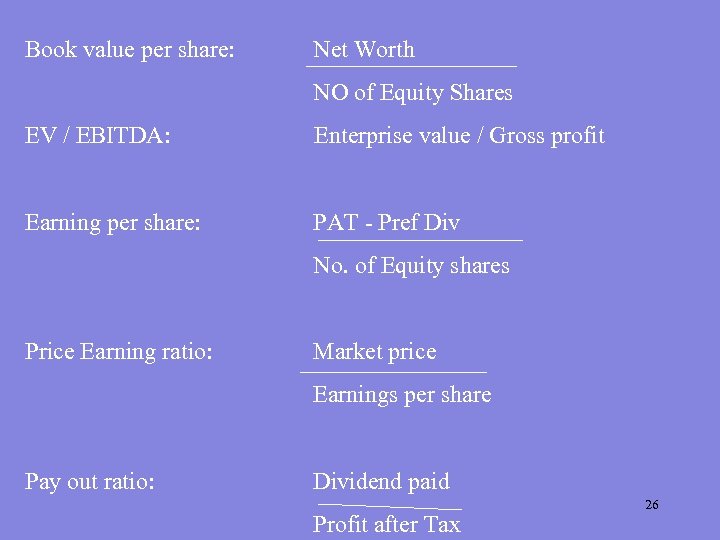 Book value per share: Net Worth NO of Equity Shares EV / EBITDA: Enterprise value / Gross profit Earning per share: PAT - Pref Div No. of Equity shares Price Earning ratio: Market price Earnings per share Pay out ratio: Dividend paid Profit after Tax 26
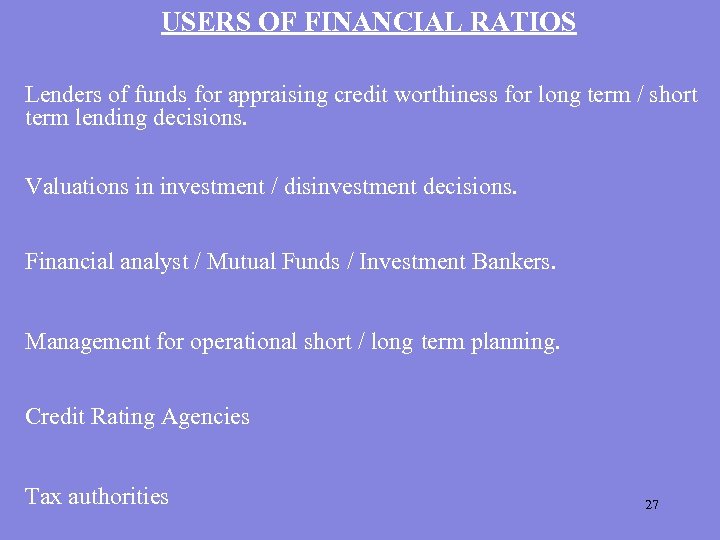 USERS OF FINANCIAL RATIOS Lenders of funds for appraising credit worthiness for long term / short term lending decisions. Valuations in investment / disinvestment decisions. Financial analyst / Mutual Funds / Investment Bankers. Management for operational short / long term planning. Credit Rating Agencies Tax authorities 27
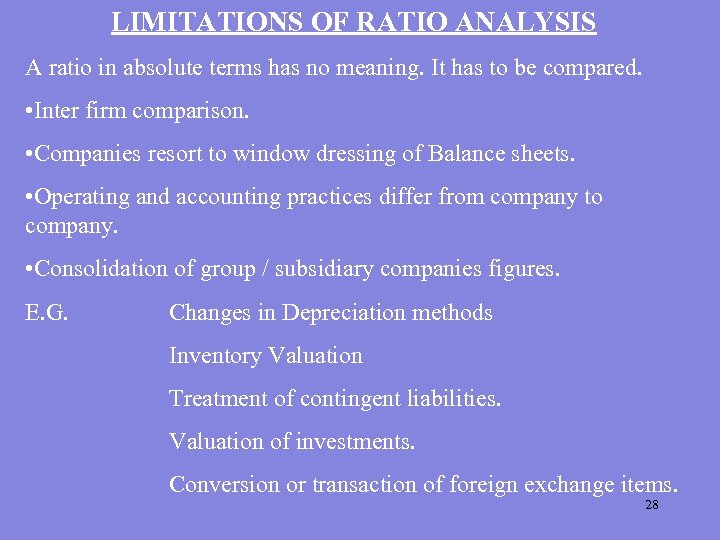 LIMITATIONS OF RATIO ANALYSIS A ratio in absolute terms has no meaning. It has to be compared. • Inter firm comparison. • Companies resort to window dressing of Balance sheets. • Operating and accounting practices differ from company to company. • Consolidation of group / subsidiary companies figures. E. G. Changes in Depreciation methods Inventory Valuation Treatment of contingent liabilities. Valuation of investments. Conversion or transaction of foreign exchange items. 28
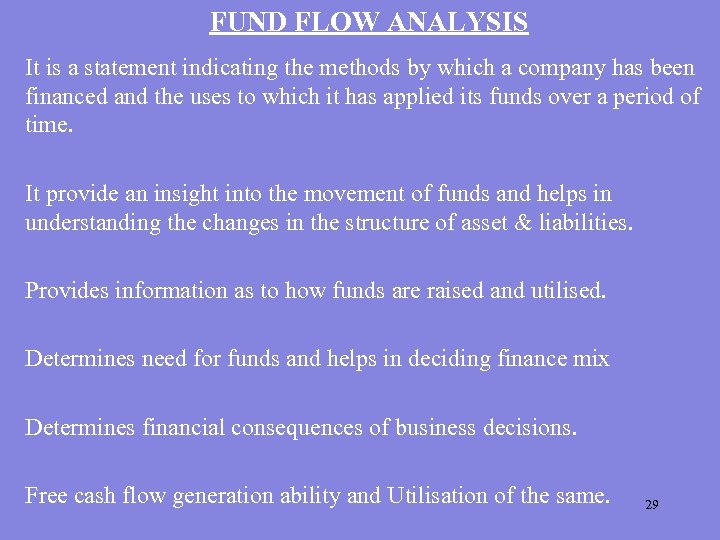 FUND FLOW ANALYSIS It is a statement indicating the methods by which a company has been financed and the uses to which it has applied its funds over a period of time. It provide an insight into the movement of funds and helps in understanding the changes in the structure of asset & liabilities. Provides information as to how funds are raised and utilised. Determines need for funds and helps in deciding finance mix Determines financial consequences of business decisions. Free cash flow generation ability and Utilisation of the same. 29
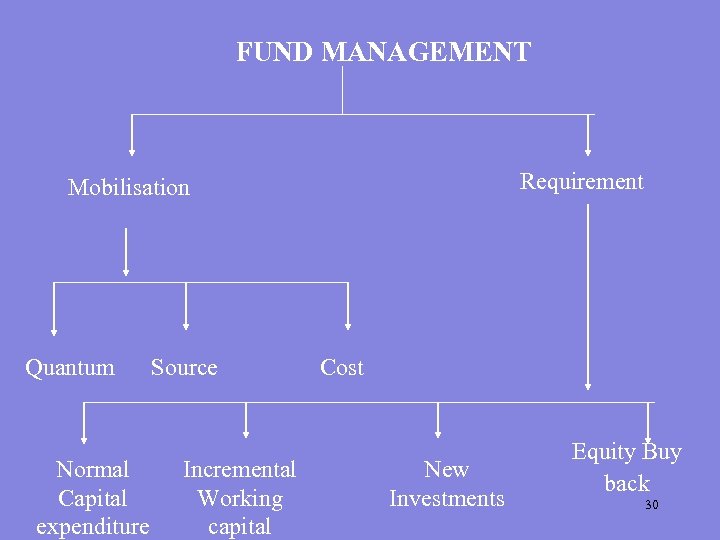 FUND MANAGEMENT Requirement Mobilisation Quantum Normal Capital expenditure Source Incremental Working capital Cost New Investments Equity Buy back 30
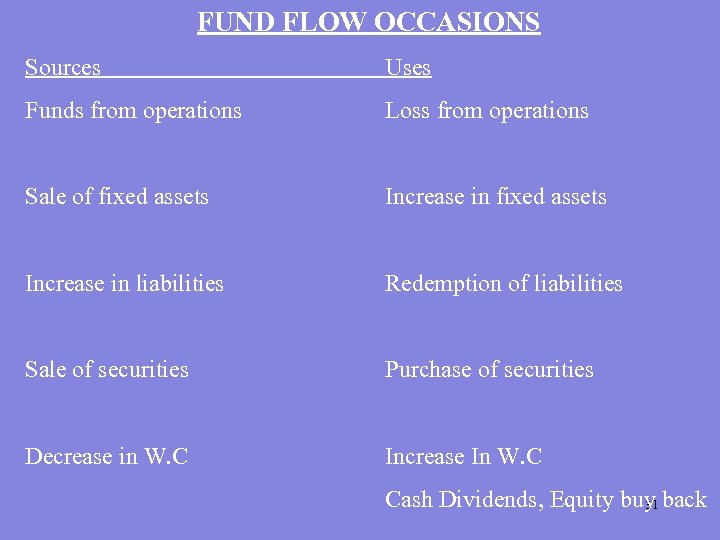 FUND FLOW OCCASIONS Sources Uses Funds from operations Loss from operations Sale of fixed assets Increase in liabilities Redemption of liabilities Sale of securities Purchase of securities Decrease in W. C Increase In W. C Cash Dividends, Equity buy back 31
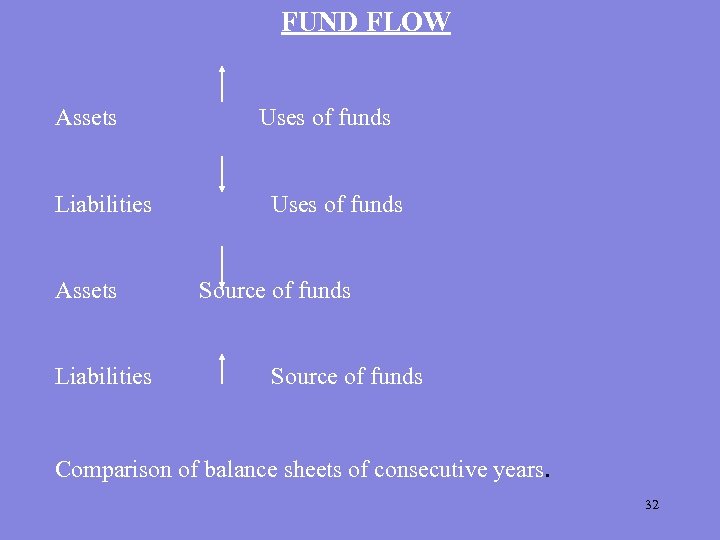 FUND FLOW Assets Liabilities Uses of funds Source of funds Comparison of balance sheets of consecutive years. 32
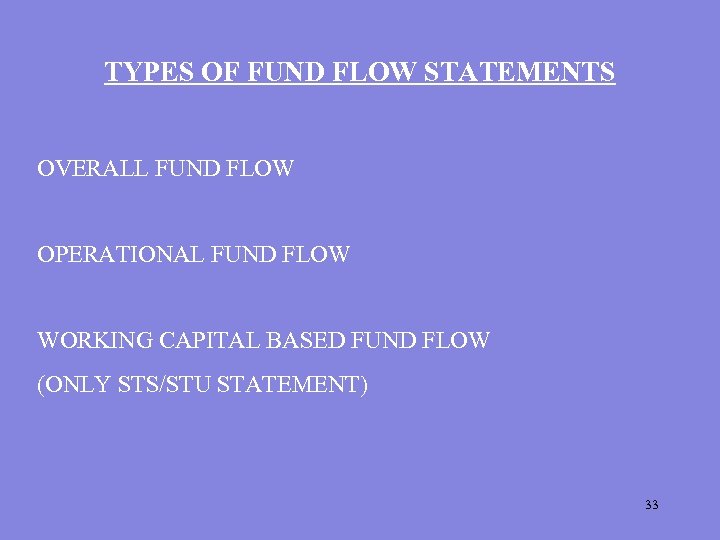 TYPES OF FUND FLOW STATEMENTS OVERALL FUND FLOW OPERATIONAL FUND FLOW WORKING CAPITAL BASED FUND FLOW (ONLY STS/STU STATEMENT) 33
 COST OF CAPITAL Aggregate of the liabilities raised by a company is the total capital employed in business. Different sources have different cost and tax implications. Cost of capital It is a single rate (weighted average ) for a finance mix. It is computed on a post - tax basis since cost of different sources have different tax implications E. g. . Interest on debt capital enjoys tax shield while dividend paid on equity has no tax shield. COC is used as a discounting rate in DCF analysis. 34
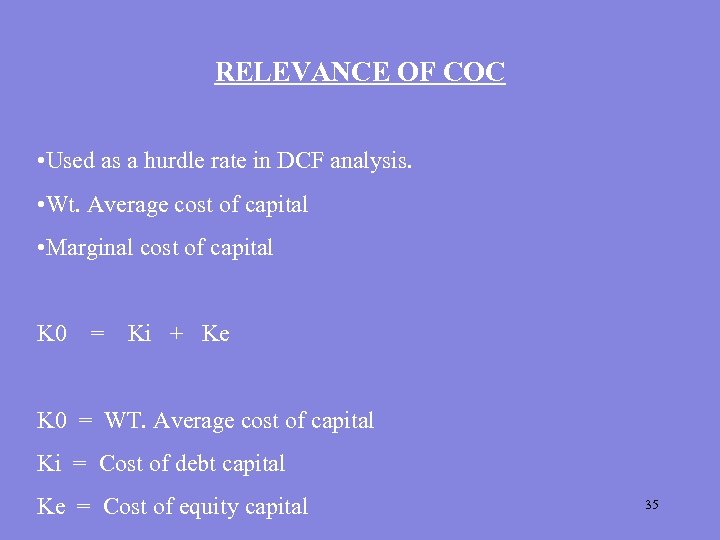 RELEVANCE OF COC • Used as a hurdle rate in DCF analysis. • Wt. Average cost of capital • Marginal cost of capital K 0 = Ki + Ke K 0 = WT. Average cost of capital Ki = Cost of debt capital Ke = Cost of equity capital 35
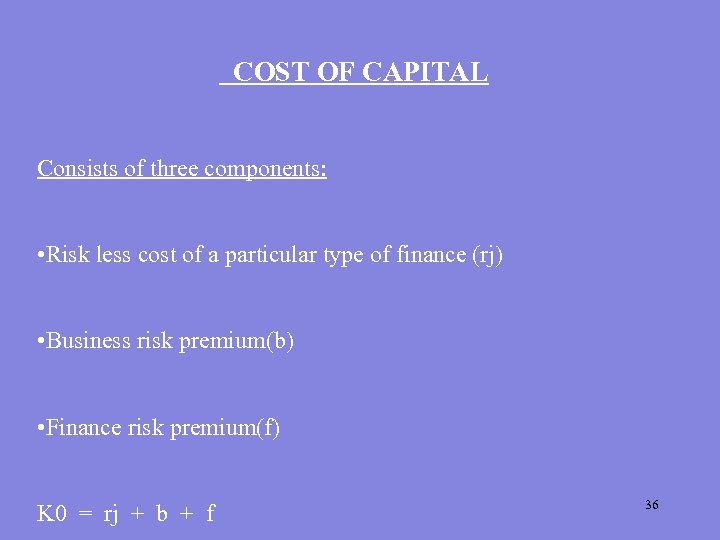 COST OF CAPITAL Consists of three components: • Risk less cost of a particular type of finance (rj) • Business risk premium(b) • Finance risk premium(f) K 0 = rj + b + f 36
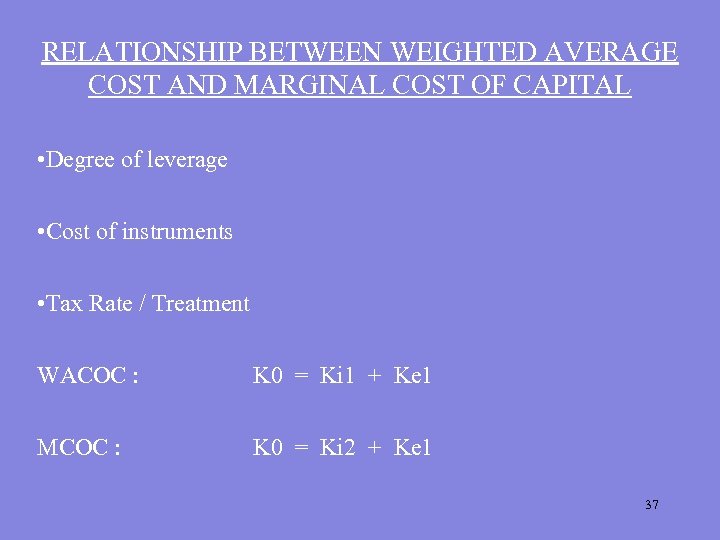 RELATIONSHIP BETWEEN WEIGHTED AVERAGE COST AND MARGINAL COST OF CAPITAL • Degree of leverage • Cost of instruments • Tax Rate / Treatment WACOC : K 0 = Ki 1 + Ke 1 MCOC : K 0 = Ki 2 + Ke 1 37
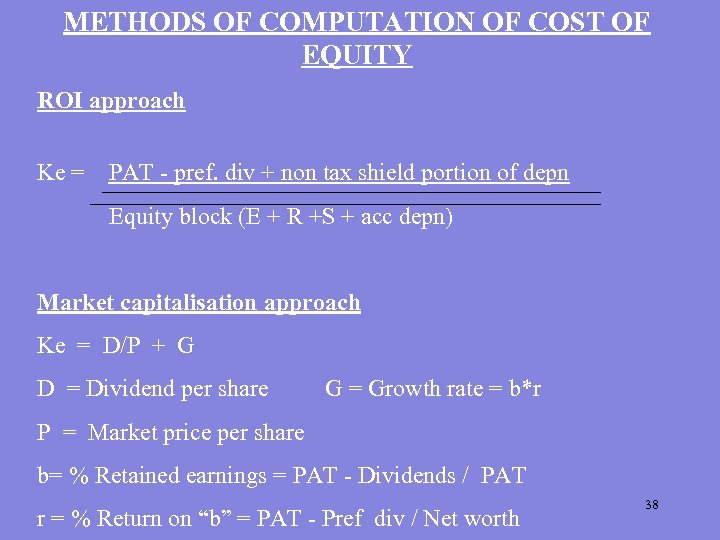 METHODS OF COMPUTATION OF COST OF EQUITY ROI approach Ke = PAT - pref. div + non tax shield portion of depn Equity block (E + R +S + acc depn) Market capitalisation approach Ke = D/P + G D = Dividend per share G = Growth rate = b*r P = Market price per share b= % Retained earnings = PAT - Dividends / PAT r = % Return on “b” = PAT - Pref div / Net worth 38
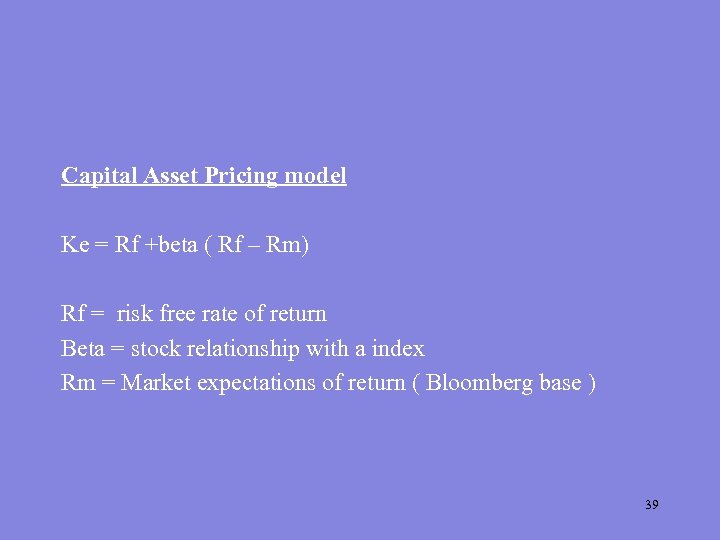 Capital Asset Pricing model Ke = Rf +beta ( Rf – Rm) Rf = risk free rate of return Beta = stock relationship with a index Rm = Market expectations of return ( Bloomberg base ) 39
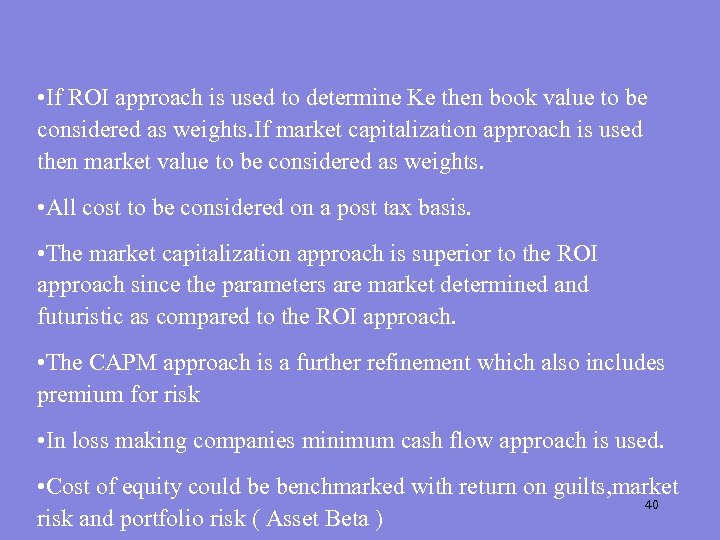 • If ROI approach is used to determine Ke then book value to be considered as weights. If market capitalization approach is used then market value to be considered as weights. • All cost to be considered on a post tax basis. • The market capitalization approach is superior to the ROI approach since the parameters are market determined and futuristic as compared to the ROI approach. • The CAPM approach is a further refinement which also includes premium for risk • In loss making companies minimum cash flow approach is used. • Cost of equity could be benchmarked with return on guilts, market 40 risk and portfolio risk ( Asset Beta )
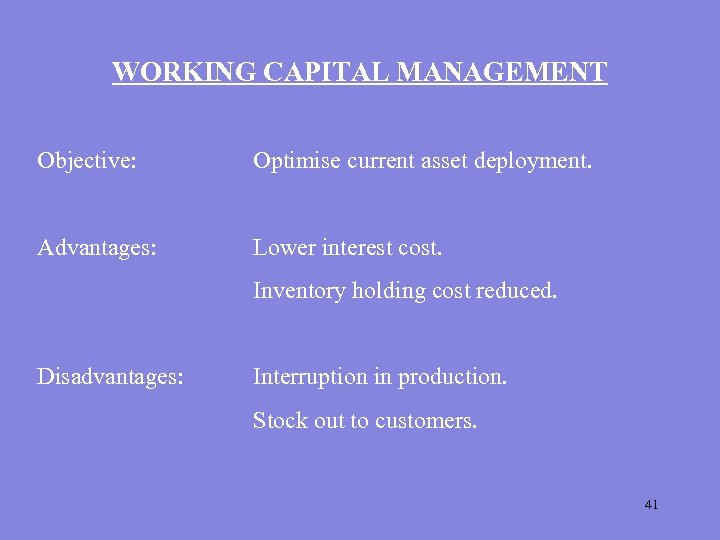 WORKING CAPITAL MANAGEMENT Objective: Optimise current asset deployment. Advantages: Lower interest cost. Inventory holding cost reduced. Disadvantages: Interruption in production. Stock out to customers. 41
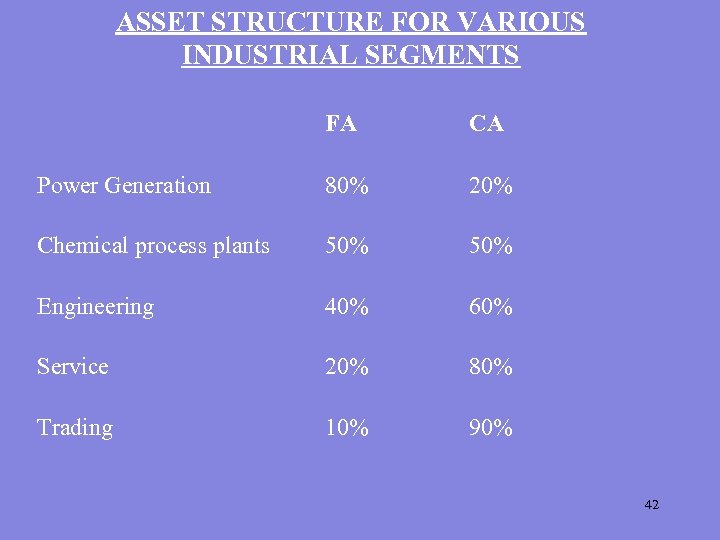 ASSET STRUCTURE FOR VARIOUS INDUSTRIAL SEGMENTS FA CA Power Generation 80% 20% Chemical process plants 50% Engineering 40% 60% Service 20% 80% Trading 10% 90% 42
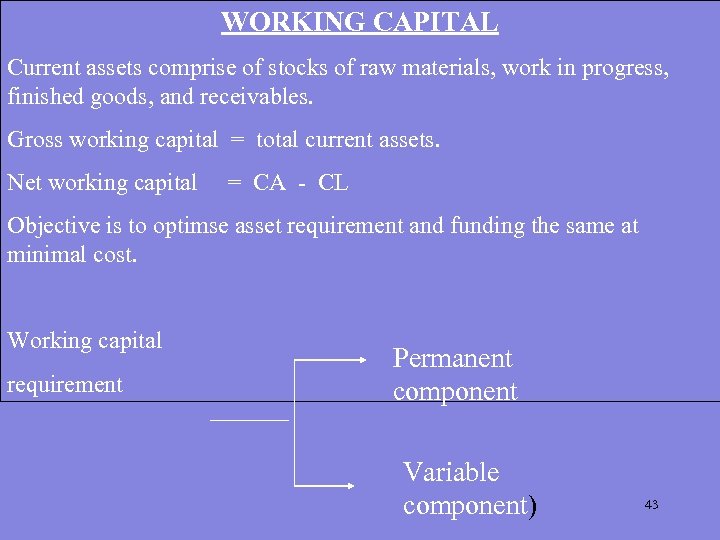 WORKING CAPITAL Current assets comprise of stocks of raw materials, work in progress, finished goods, and receivables. Gross working capital = total current assets. Net working capital = CA - CL Objective is to optimse asset requirement and funding the same at minimal cost. Working capital requirement Permanent component Variable component) 43
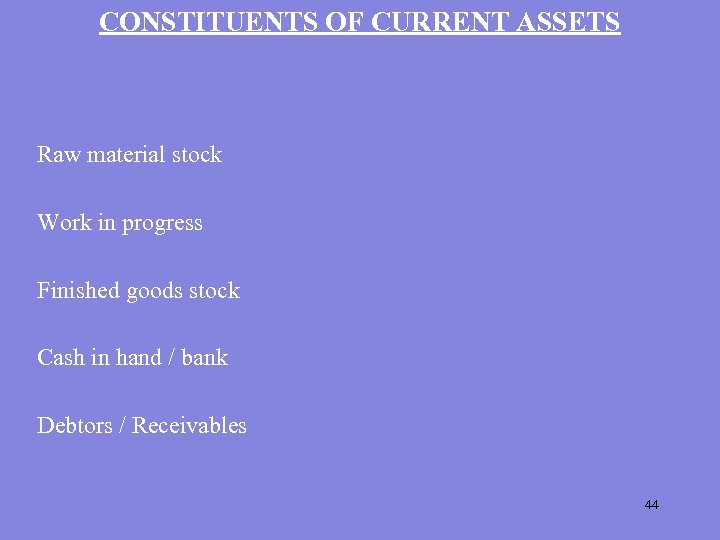 CONSTITUENTS OF CURRENT ASSETS Raw material stock Work in progress Finished goods stock Cash in hand / bank Debtors / Receivables 44
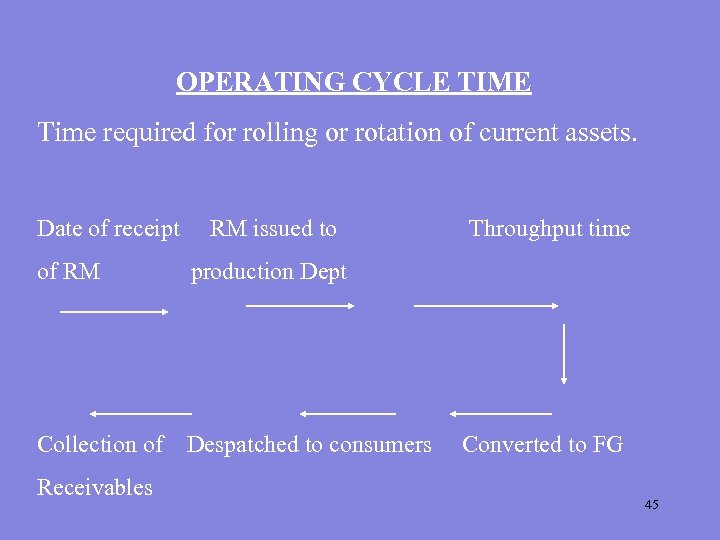 OPERATING CYCLE TIME Time required for rolling or rotation of current assets. Date of receipt RM issued to of RM production Dept Collection of Despatched to consumers Throughput time Receivables Converted to FG 45
 FACTORS INFLUENCING WORKING CAPITAL REQUIREMENTS • Nature of business • Manufacturing process • Competitive forces in raw material & finished goods segment. • Infrastructural support. • Through put time • Seasonality in demand • Shelf life of RM / Finished product • Customer relationship management 46
 CREDIT MANAGEMENT • Terms of payment Cash against delivery Consignee basis Proforma invoice Letter of credit Advances Suppliers / Buyers LOC • Credit policy variables Credit standards Credit period Cash Discounts 47
 • Credit evaluation Character Capacity Capital Collateral Macro conditions • Control of accounts receivables Days sales outstanding Ageing schedule (in days) Collection matrix Average collection period 48
 RECEIVABLES MANAGEMENT • Credit standards Collection cost Average collection period Bad debts Level of incremental sale • Credit terms • Collection policies • Factoring 49
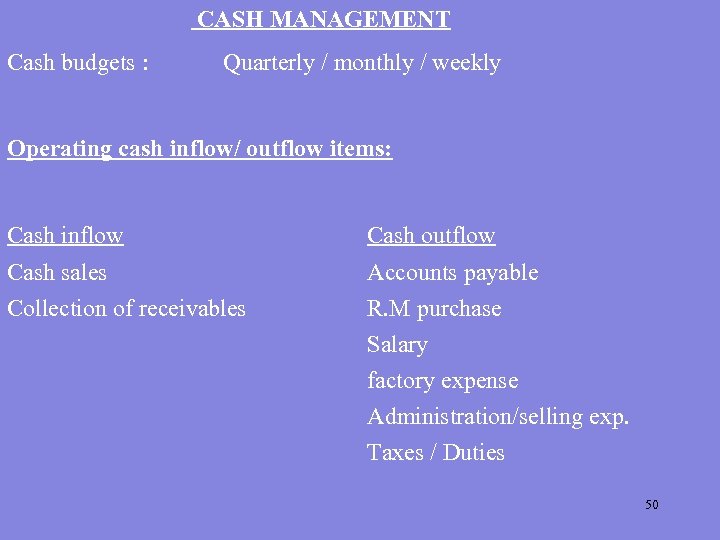 CASH MANAGEMENT Cash budgets : Quarterly / monthly / weekly Operating cash inflow/ outflow items: Cash inflow Cash outflow Cash sales Collection of receivables Accounts payable R. M purchase Salary factory expense Administration/selling exp. Taxes / Duties 50
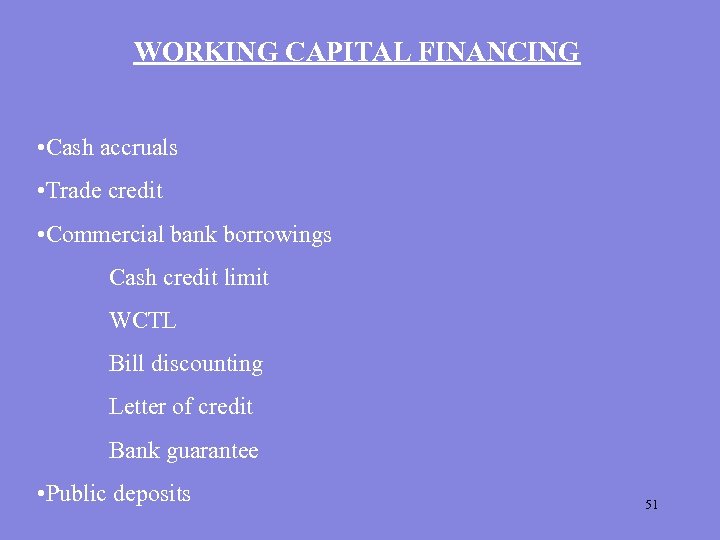 WORKING CAPITAL FINANCING • Cash accruals • Trade credit • Commercial bank borrowings Cash credit limit WCTL Bill discounting Letter of credit Bank guarantee • Public deposits 51
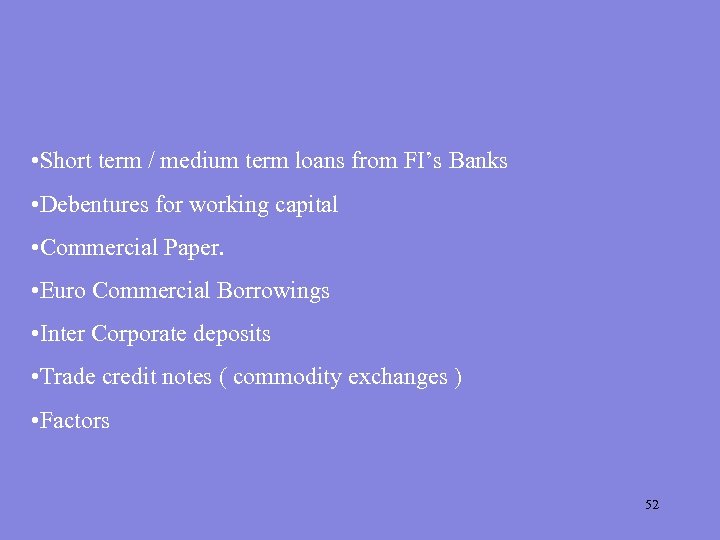 • Short term / medium term loans from FI’s Banks • Debentures for working capital • Commercial Paper. • Euro Commercial Borrowings • Inter Corporate deposits • Trade credit notes ( commodity exchanges ) • Factors 52
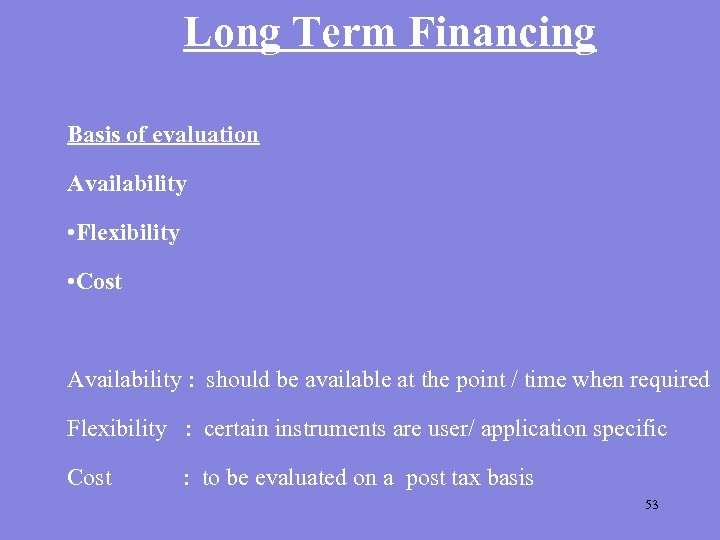 Long Term Financing Basis of evaluation Availability • Flexibility • Cost Availability : should be available at the point / time when required Flexibility : certain instruments are user/ application specific Cost : to be evaluated on a post tax basis 53
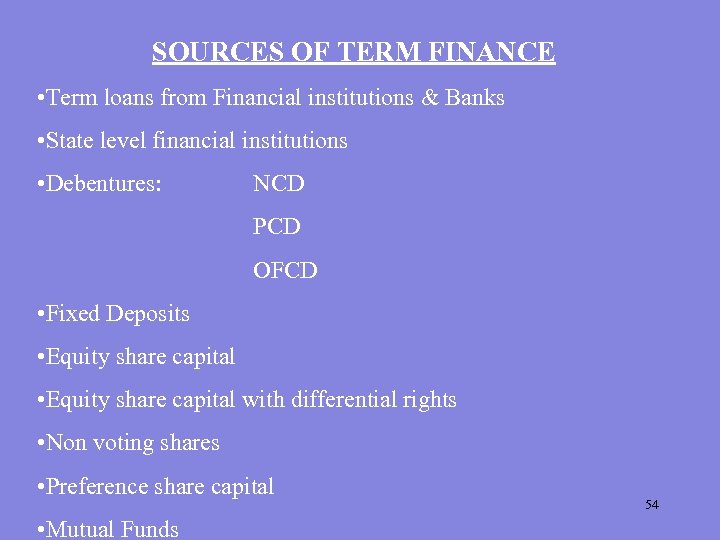 SOURCES OF TERM FINANCE • Term loans from Financial institutions & Banks • State level financial institutions • Debentures: NCD PCD OFCD • Fixed Deposits • Equity share capital with differential rights • Non voting shares • Preference share capital • Mutual Funds 54
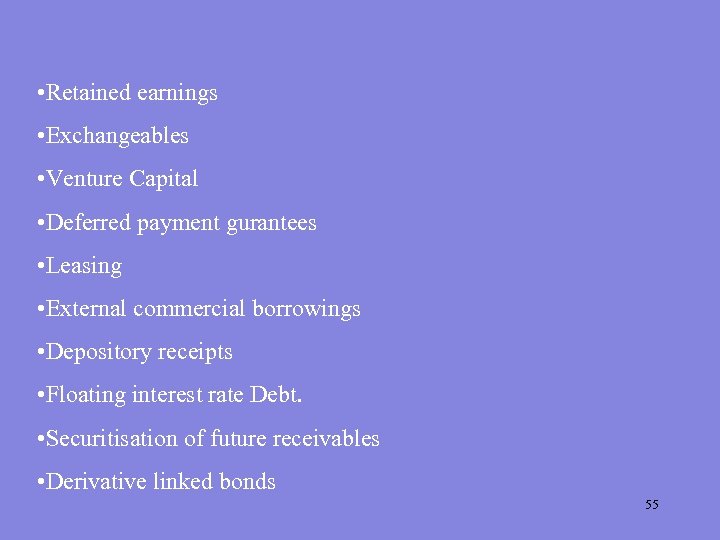 • Retained earnings • Exchangeables • Venture Capital • Deferred payment gurantees • Leasing • External commercial borrowings • Depository receipts • Floating interest rate Debt. • Securitisation of future receivables • Derivative linked bonds 55
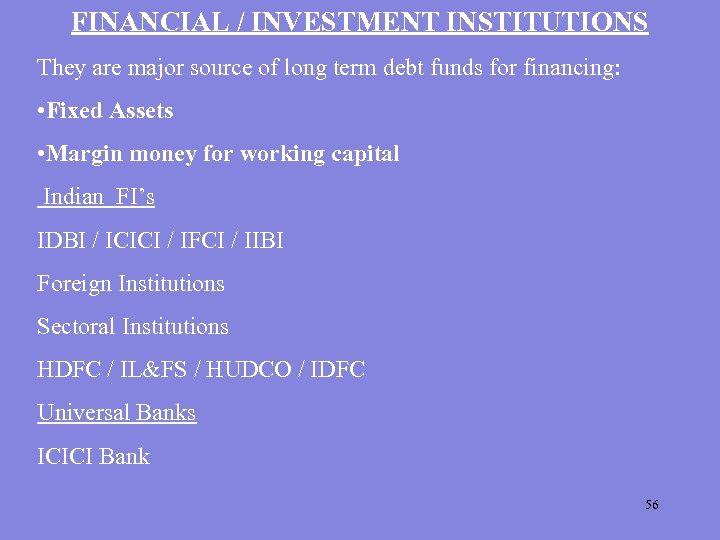 FINANCIAL / INVESTMENT INSTITUTIONS They are major source of long term debt funds for financing: • Fixed Assets • Margin money for working capital Indian FI’s IDBI / ICICI / IFCI / IIBI Foreign Institutions Sectoral Institutions HDFC / IL&FS / HUDCO / IDFC Universal Banks ICICI Bank 56
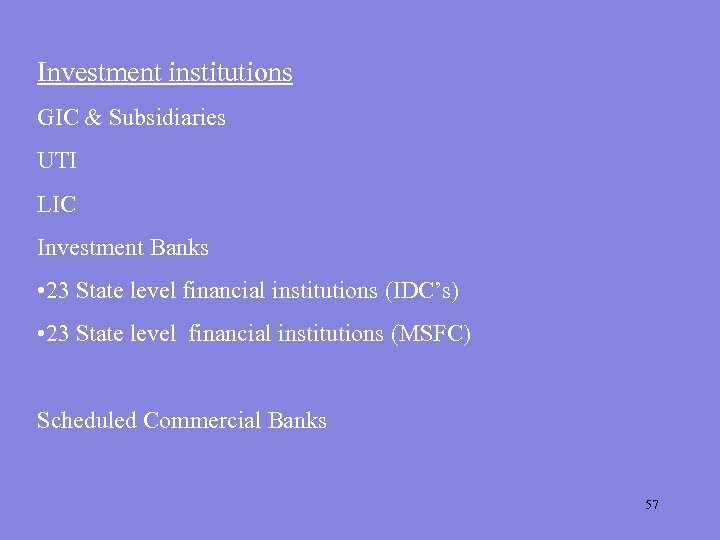 Investment institutions GIC & Subsidiaries UTI LIC Investment Banks • 23 State level financial institutions (IDC’s) • 23 State level financial institutions (MSFC) Scheduled Commercial Banks 57
 Features: Interest rate is based upon the prime lending rate + project risk. Basic interest rate linked to inflation rate Linked to G-Sec rate or Sub - SBAR ( SBI PLR ) Security Hypothecation & mortgage Collateral Covenants Moratorium period Amortisation schedule Door to Door tenure 58
 GUIDE LINES FOR KEY RATIOS DCSR > 1. 8 TIMES D/E 1: 5: 1 Promoters contribution : 20 - 25% CR: > 1. 33 ADDITIONAL FEATURES : -Interest rate re-set clause - Tapering of interest rate post project risk 59
 Debentures: • Approval from SEBI mandatory if public issue is proposed • Debentures used to finance margin money not to exceed more than 20% of N. W. C • Convertibility clause terms to be specified at issuance time. • Credit rating mandatory 60
 • Types of Debentures: NCD FCD PCD OCD • Coupon rate depends on terms of issue. Other features • No TDS for interest paid upto Rs 2500 per annum • Redemption premium • Listing on stock exchanges • Fully secured • Call and put options 61
 Advantages from Issuer’s point of view: • Lower cost due to low risk and tax deductibility of interest payment. • No / limited dilution of control • Offer stable return to investors having fixed maturity and subsequently redemption/ conversion to equity • No increase in equity base during non conversion period Fixed deposits • Limit on quantum : 25% of networth • Cost : 8 -10 % depending on maturity period & risk • unsecured 62
 EQUITY SHARE CAPITAL • Authorised , issued, subscribed and paid up • Par value, issue price, book value, market value • Residual claims on Income /Assets • No upper limit • Costliest sources of finance • Entails permanent servicing by way of dividends without tax shield • Voting rights/ Control in management/ Limited liability • Under preview of SEBI and SEB guidelines • Buy Back allowed 63
 Equity investments in foreign cos allowed to resident indian shareholder in the event foregin co has 10% stake in indian co. • For Listing on exchanges atleast 10% to be offered to the public by way of a prospectus Issuance of Non-Voting & differential rights shares allowed • Debentures on conversion becomes equity share capital. • Listed / Unlisted shares • Sweat Equity / Employee Stock Options 64
 EVALUATION OF ESC Company’s point of view Advantages Represents almost permanent capital Does not involve any fixed obligation for servicing Enhances credit worthiness of the company to secure additional debt. Disadvantages High cost of capital Dividends paid on profit after tax further subjected to dividend distribution tax of 15% High flotation cost Dilution of control (Treasury issue) 65
 Investors point of view Advantages Enjoy voting right in the company with limited liability. Short term capital gains tax reduced to 10% Long term Capital gains tax abolished. ( Exchange traded securities ) Indexation benefit available under 54 E. Disadvantages Controlling power could be notional Turn over tax at 15 basis points on sale of the security on an exchange Have residual claim to income / assets Vide fluctuations in stock price Dividend’s subjected to distribution tax of 15% 66
 Retained earnings Made up of Accumulated depreciation and retained profits. Represent the internal sources of finance available to the company. Availability : Level of profitability / payout ratio Cost : Identical to ESC. Flexibility : High 67
 Advantages Reinvestment of profit may be convenient to many shareholders. No dilution of control since Co. Relies on retained earnings No flotation cost/ Losses on account of underpricing. Proceeds could be used in a subsequent buyback. Disadvantages High opportunity cost. Limitation on amount Bonus issue may capitalise reserves 68
 Preference share capital Fixed minimum dividend rate No voting rights Prior claim on income / assets Redeemable at issuer’s & investor’s discretion Features: No dilution of control Provision to skip dividend in absence of profits 69
 CAPTAL BUDGETING 70
 • Capital investment decision Capital investments involve increase in the fixed assets of a company. (Expansion / diversification / Green field / takeover / merger) • Characteristics of investments Capital outlay needs to be made up front returns come later Certain amount of risk is involved Capital investment tend to be indivisible. (difficult to phase out). • Financial techniques The purpose of financial techniques is to enable the making of investment acceptance / rejection decisions. 71
 Non financial factors in project appraisal Market Technical Infrastructure Ecological Economic Influence of non - financial factors Financial projections Gestation period Profitability Life of project / Terminal value Sensitivity analysis 72
 NON FINANCIAL FACTORS DETERMINING FINANCIAL VIABILITY OF PROJECTS Market factors Present and future size of the market Present and future demand supply situation Achievable market share Selling & distribution channels Technical factors Level of Technological obsolence Plant location Scales of operation Raw material & utilities consumption norms 73
 Ecological factors Pollutant levels Treatment of effluent Environmental impact of the project Economic factors Social cost benefit analysis Economic rate of protection Domestic resource cost Protection enjoyed by industry. 74
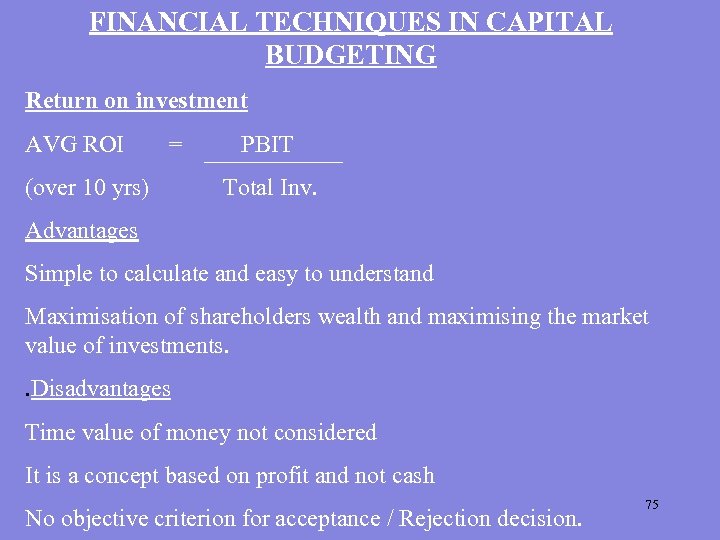 FINANCIAL TECHNIQUES IN CAPITAL BUDGETING Return on investment AVG ROI = (over 10 yrs) PBIT Total Inv. Advantages Simple to calculate and easy to understand Maximisation of shareholders wealth and maximising the market value of investments. . Disadvantages Time value of money not considered It is a concept based on profit and not cash No objective criterion for acceptance / Rejection decision. 75
 Payback period It is the time required to get back the original investment companies going through liquidity crisis /for small investments will use the pay back period method. Disadvantages Cash inflows / Outflows after payback Period are ignored. Time value for money is ignored 76
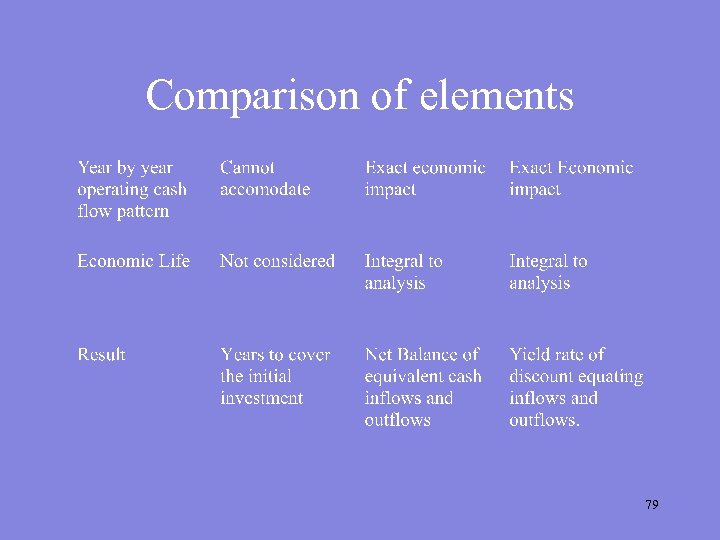
 Discounted cash flow (DCF) Cash inflow and outflow for the entire life of the project is considered. It considers time value for money as a result earnings in earlier years have higher value than earned in later years. IRR Method IRR is that rate of discount at which the net present value of cash flows equals net present value of cash outflows. If IRR > COC Investment is support worthy. NPV method Using COC discount the netflows If NPV is + VE investment is support worthy. . 77
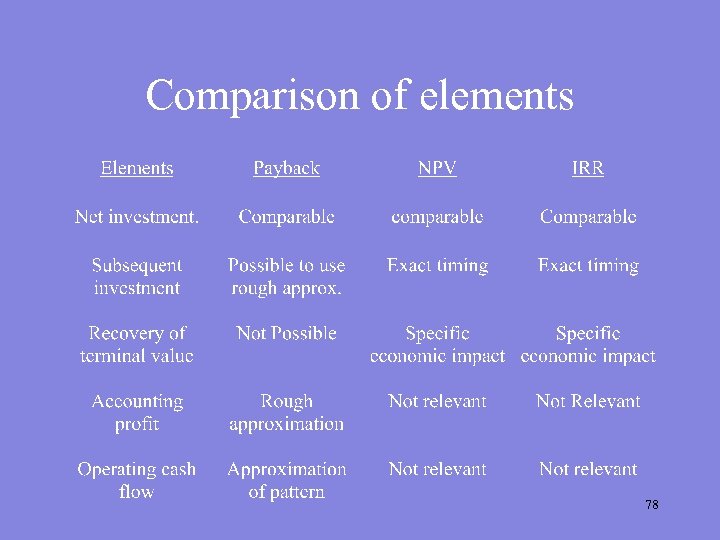 Comparison of elements 78
 Comparison of elements 79
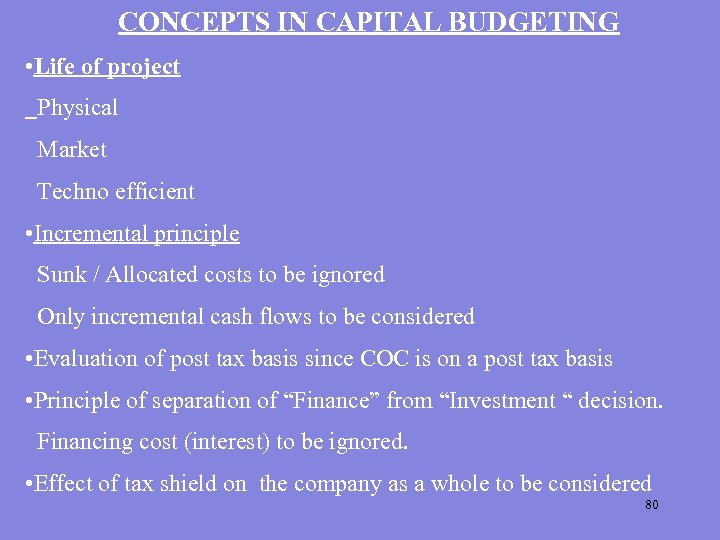 CONCEPTS IN CAPITAL BUDGETING • Life of project Physical Market Techno efficient • Incremental principle Sunk / Allocated costs to be ignored Only incremental cash flows to be considered • Evaluation of post tax basis since COC is on a post tax basis • Principle of separation of “Finance” from “Investment “ decision. Financing cost (interest) to be ignored. • Effect of tax shield on the company as a whole to be considered 80
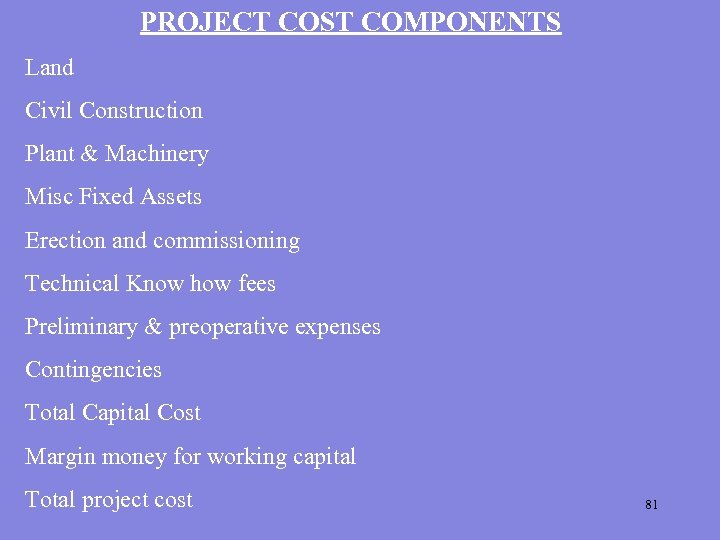 PROJECT COST COMPONENTS Land Civil Construction Plant & Machinery Misc Fixed Assets Erection and commissioning Technical Know how fees Preliminary & preoperative expenses Contingencies Total Capital Cost Margin money for working capital Total project cost 81
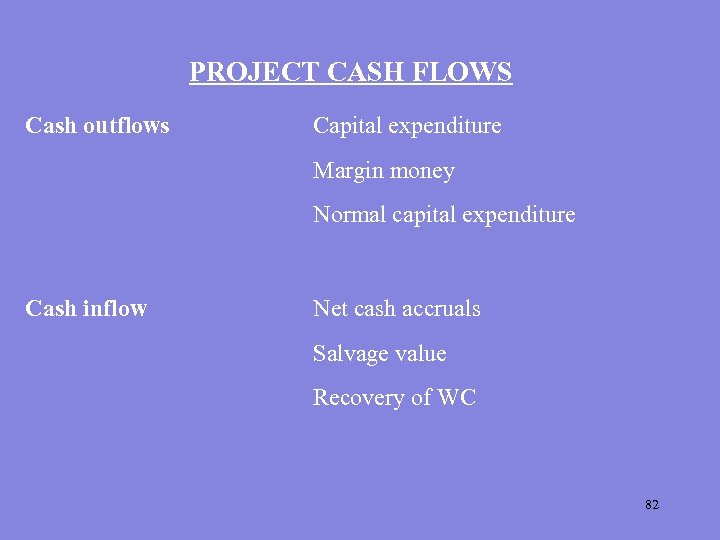 PROJECT CASH FLOWS Cash outflows Capital expenditure Margin money Normal capital expenditure Cash inflow Net cash accruals Salvage value Recovery of WC 82
 NPV vs IRR conflict • NPV is technically superior to IRR and is also able to handle selection of mutually exclusive projects. • The decision rule for the NPV assumes that cash flows resulting during the life cycle of the project have an opportunity cost equal to the discount rate used. • The decision rule for the IRR assumes that such resulting cash flows have an opportunity cost equal to IRR which generated them. • NPV approach provides an absolute measure that fully represents the value from the project to a company. • IRR by contrast provides a % figure from which the 83 benefits in terms of wealth creation cannot be grasped.
 Capital Budgeting Sensitivity Analysis • Monte Carlo Simulation • Break even analysis • Decision tree analysis • Expected value Criterion • Alternate buisness plans 84
 Share holder value creation • • • Cash Dividends Stock Dividends Bonus Shares Bonus Debentures-issued from free reserves Equity Buy back / Secondary Listing Stock Split Synergic Investments Synergic Acquisitions Disinvest out of unrelated businesses Shares of holding co. with fungibility 85
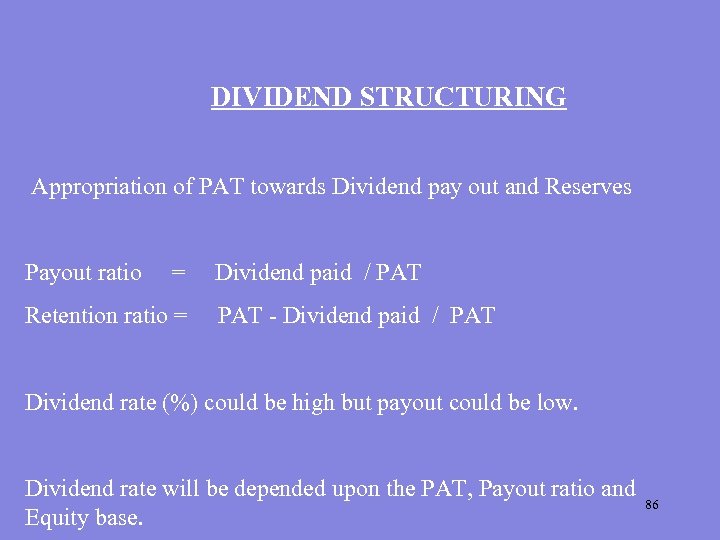 DIVIDEND STRUCTURING Appropriation of PAT towards Dividend pay out and Reserves Payout ratio = Retention ratio = Dividend paid / PAT - Dividend paid / PAT Dividend rate (%) could be high but payout could be low. Dividend rate will be depended upon the PAT, Payout ratio and Equity base. 86
 Dividend Structuring 100% retention scenario For some shareholders dividend acts as a regular income source EX: investor’s for whom it is a regular source of income, mutual funds, investment companies. Declaration of dividend is perceived as an indication that the companies operations are profitable. 100% payout scenario Repeated raising of capital increases floatation cost Companies requirement for expansion / margin money / new investment. Tax inefficient due to 15% distribution tax. 87
 Factors influencing dividend policy • If the appetite for funds is high due to increase in level of exsisting operation or due to major capital investment plan then a high retention policy will be adopted. • A closely held company having major capital investment plans will follow a low pay out policy so that internal accruals could act as a major source of finance in the future thereby reducing dependence on infusion of fresh equity. • Tax implications Company has to pay 12. 5% distribution tax. Recipient of dividend tax exempted in the shareholders hands. . 88 Section 80 -M exemption at 100%
 • Restriction in loan agreement / government regulations / FI’s on on payment of dividend during the currency of the loan. • Legal requirement under Companies act. • Liquidity position : Higher PAT does not necessarily mean healthy liquidity. A strained liquidity position would force a policy of low payout. • Stability in the rate of dividend : companies usually follow a policy of gradually rising or stable dividend policy and not directly link it with PAT. • Generally the Indian corporate sector follows a payout policy of 30%. The retention ratio keeps increasing so as to counter inflation, floatation cost, help in Equity buyback etc. 89
 BONUS SHARES Bonus share issued to existing share holders as a result of capitalization of reserves. In the wake of a bonus issue The shareholders proportional ownership remains unchanged The book value, market price, E. P. S decreases. Fallout of a bonus issue • Normally the Ex-bonus price comes down by the proportion of bonus given with a mark up of approximately 30 - 35% • More active trading in stock exchanges. • The nominal rate of dividend tends to decline this may dispel the impression of profiteering. • Shareholders regard a bonus issue as a firm indication that the prospects for the company are good. • Capital gains tax exemptions with indexation available for bonus 90 issue
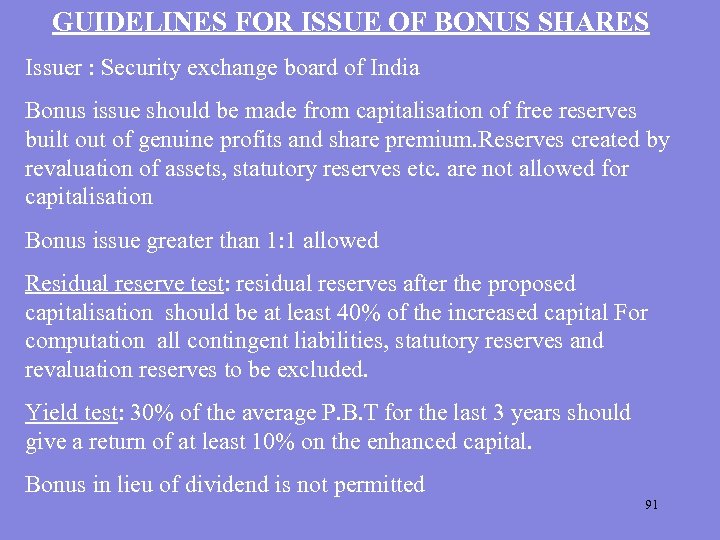 GUIDELINES FOR ISSUE OF BONUS SHARES Issuer : Security exchange board of India Bonus issue should be made from capitalisation of free reserves built out of genuine profits and share premium. Reserves created by revaluation of assets, statutory reserves etc. are not allowed for capitalisation Bonus issue greater than 1: 1 allowed Residual reserve test: residual reserves after the proposed capitalisation should be at least 40% of the increased capital For computation all contingent liabilities, statutory reserves and revaluation reserves to be excluded. Yield test: 30% of the average P. B. T for the last 3 years should give a return of at least 10% on the enhanced capital. Bonus in lieu of dividend is not permitted 91
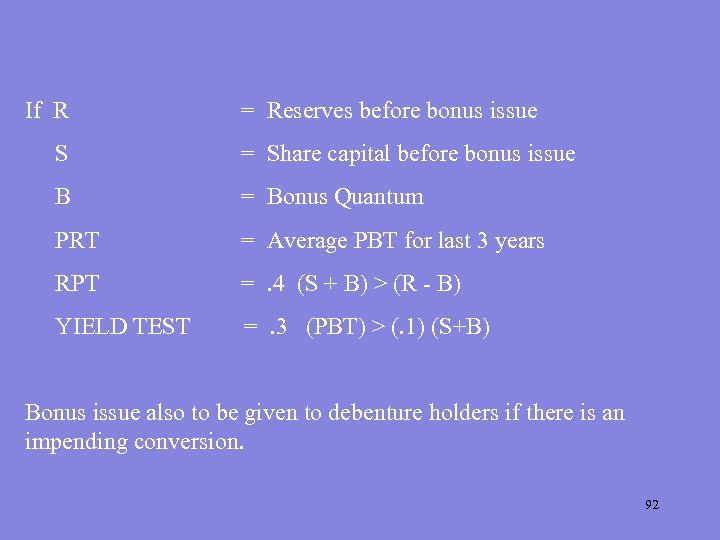 If R = Reserves before bonus issue S = Share capital before bonus issue B = Bonus Quantum PRT = Average PBT for last 3 years RPT =. 4 (S + B) > (R - B) YIELD TEST =. 3 (PBT) > (. 1) (S+B) Bonus issue also to be given to debenture holders if there is an impending conversion. 92