


 Скачать презентацию SAND 2007 -7237 C New Teuchos Utility Classes
4769f5168654daf36f2ba23a7fe15e23.ppt
- Количество слайдов: 47
 SAND 2007 -7237 C New Teuchos Utility Classes for Safer Memory Management in C++ Roscoe A. Bartlett Department of Optimization & Uncertainty Estimation Sandia National Laboratories Trilinos Users Group Meeting, November 7 th, 2007 Sandia is a multiprogram laboratory operated by Sandia Corporation, a Lockheed Martin Company, for the United States Department of Energy under contract DE-AC 04 -94 AL 85000.
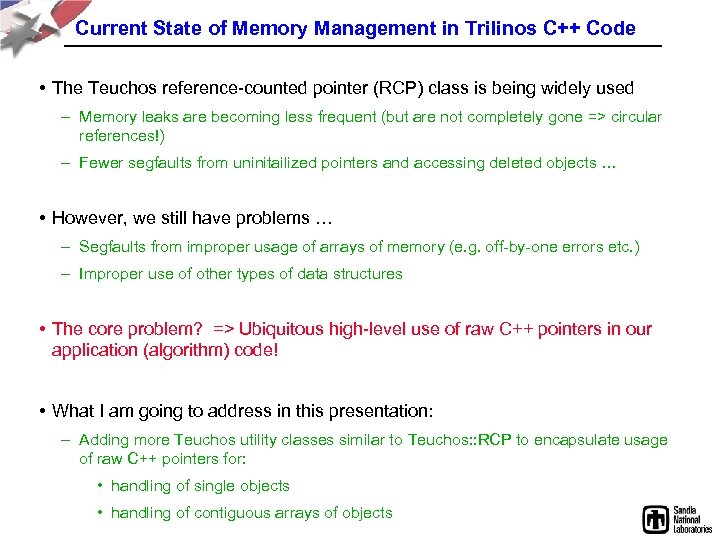 Current State of Memory Management in Trilinos C++ Code • The Teuchos reference-counted pointer (RCP) class is being widely used – Memory leaks are becoming less frequent (but are not completely gone => circular references!) – Fewer segfaults from uninitailized pointers and accessing deleted objects … • However, we still have problems … – Segfaults from improper usage of arrays of memory (e. g. off-by-one errors etc. ) – Improper use of other types of data structures • The core problem? => Ubiquitous high-level use of raw C++ pointers in our application (algorithm) code! • What I am going to address in this presentation: – Adding more Teuchos utility classes similar to Teuchos: : RCP to encapsulate usage of raw C++ pointers for: • handling of single objects • handling of contiguous arrays of objects
 Outline • Background • High-level philosophy for memory management • Existing STL classes • Overview of Teuchos Memory Management Utility Classes • Challenges to using Teuchos memory management utility classes • Wrap up
 Outline • Background – Background on C++ – Problems with using raw C++ pointers at the application programming level • High-level philosophy for memory management • Existing STL classes • Overview of Teuchos Memory Management Utility Classes • Challenges to using Teuchos memory management utility classes • Wrap up
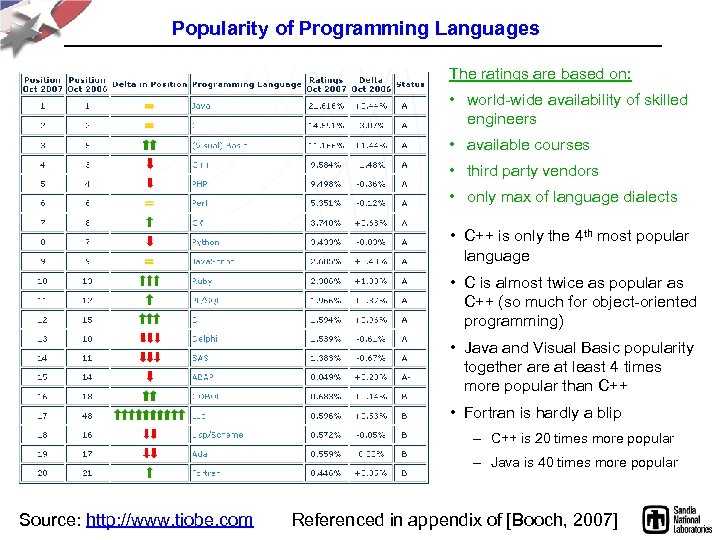 Popularity of Programming Languages The ratings are based on: • world-wide availability of skilled engineers • available courses • third party vendors • only max of language dialects • C++ is only the 4 th most popular language • C is almost twice as popular as C++ (so much for object-oriented programming) • Java and Visual Basic popularity together are at least 4 times more popular than C++ • Fortran is hardly a blip – C++ is 20 times more popular – Java is 40 times more popular Source: http: //www. tiobe. com Referenced in appendix of [Booch, 2007]
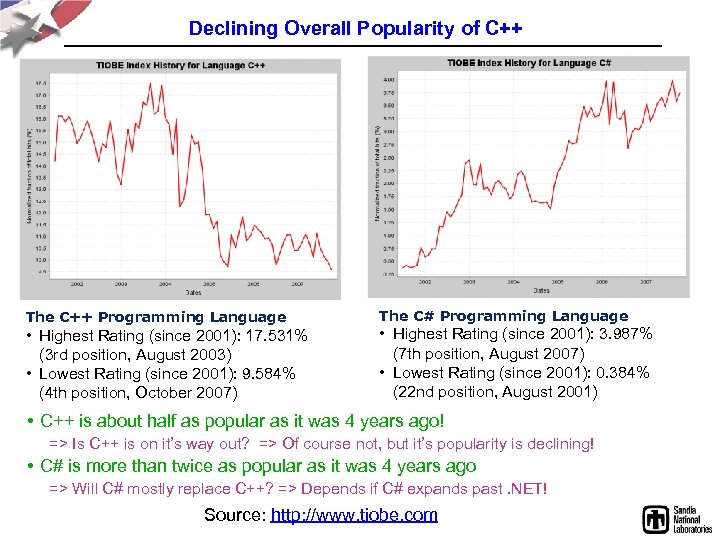 Declining Overall Popularity of C++ The C++ Programming Language • Highest Rating (since 2001): 17. 531% (3 rd position, August 2003) • Lowest Rating (since 2001): 9. 584% (4 th position, October 2007) The C# Programming Language • Highest Rating (since 2001): 3. 987% (7 th position, August 2007) • Lowest Rating (since 2001): 0. 384% (22 nd position, August 2001) • C++ is about half as popular as it was 4 years ago! => Is C++ is on it’s way out? => Of course not, but it’s popularity is declining! • C# is more than twice as popular as it was 4 years ago => Will C# mostly replace C++? => Depends if C# expands past. NET! Source: http: //www. tiobe. com
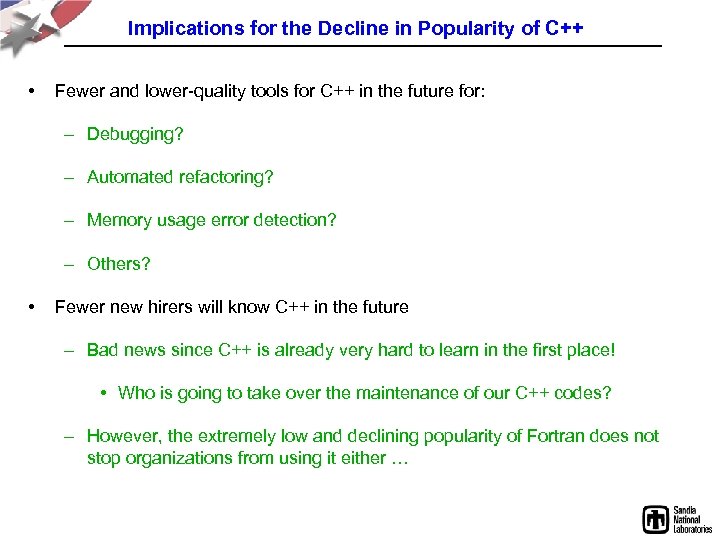 Implications for the Decline in Popularity of C++ • Fewer and lower-quality tools for C++ in the future for: – Debugging? – Automated refactoring? – Memory usage error detection? – Others? • Fewer new hirers will know C++ in the future – Bad news since C++ is already very hard to learn in the first place! • Who is going to take over the maintenance of our C++ codes? – However, the extremely low and declining popularity of Fortran does not stop organizations from using it either …
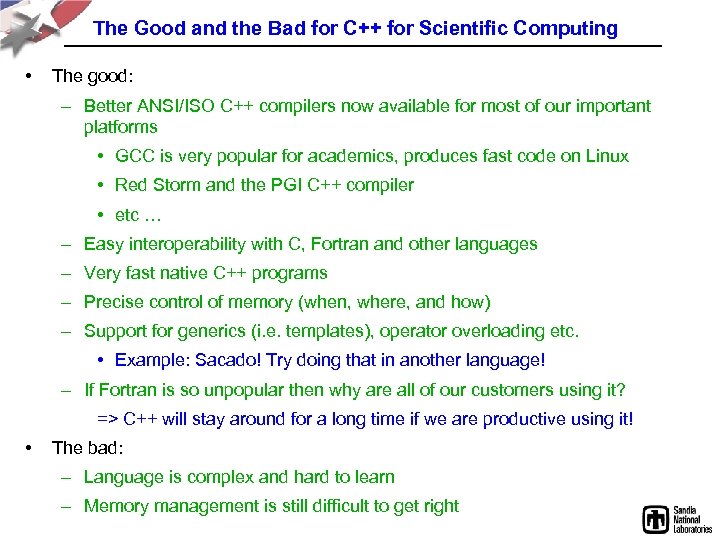 The Good and the Bad for C++ for Scientific Computing • The good: – Better ANSI/ISO C++ compilers now available for most of our important platforms • GCC is very popular for academics, produces fast code on Linux • Red Storm and the PGI C++ compiler • etc … – Easy interoperability with C, Fortran and other languages – Very fast native C++ programs – Precise control of memory (when, where, and how) – Support for generics (i. e. templates), operator overloading etc. • Example: Sacado! Try doing that in another language! – If Fortran is so unpopular then why are all of our customers using it? => C++ will stay around for a long time if we are productive using it! • The bad: – Language is complex and hard to learn – Memory management is still difficult to get right
 Preserving our Productivity in C++ in Modern Times • Support for modern software engineering methodologies • Test Driven Development (easy) • Other modern software engineering practices (code reviews supported by coding standards, etc. ) • Refactoring => No automated refactoring tools! • Safe memory management • Avoiding memory leaks • Avoiding segmentation faults from improper memory usage • Training and Mentoring? • There is not silver bullet here!
 Refactoring Support: The Pure Nonmember Function Interface Idiom SAND 2007 -4078 • Unifies the two idoms: – Non -Virtual Interface (NVI) idiom [Meyers, 2005], [Sutter & Alexandrescu, 2005] – Non-member Non-friend Function idiom [Meyers, 2005], [Sutter & Alexandrescu, 2005] • Uses a uniform nonmember function interface for very “stable” classes (see [Martin, 2003] for this definition of “stable”) • Allows for refactorings to virtual functions without breaking client code • Doxygen relates feature attaches link to nonmember functions to the classes they are used with.
 Outline • Background – Background on C++ – Problems with using raw C++ pointers at the application programming level • High-level philosophy for memory management • Existing STL classes • Overview of Teuchos Memory Management Utility Classes • Challenges to using Teuchos memory management utility classes • Wrap up
 Problems with using Raw Pointers at the Application Level • The C/C++ Pointer: Type *ptr; • Problems with C/C++ Pointers – No default initialization to null => Leads to segfaults int *ptr; ptr[20] = 5; // BANG! – Using to handle memory of single objects int *ptr = new int; // No good can ever come of: ptr++, ptr--, ++ptr, --ptr, ptr+i, ptr-i, ptr[i] – Using to handle arrays of memory: int *ptr = new int[n]; // These are totally unchecked: *(ptr++), *(ptr--), ptr[i] – Creates memory leaks when exceptions are thrown: int *ptr = new int; function. That. Throws(ptr); delete ptr; // Will never be called if above function throws! • How do we fix this? – Memory leaks? => Reference-counted smart pointers (not a 100% guarantee) – Segfaults? => Memory checkers like Valgrind and Purify? (far from a 100% guarantee)
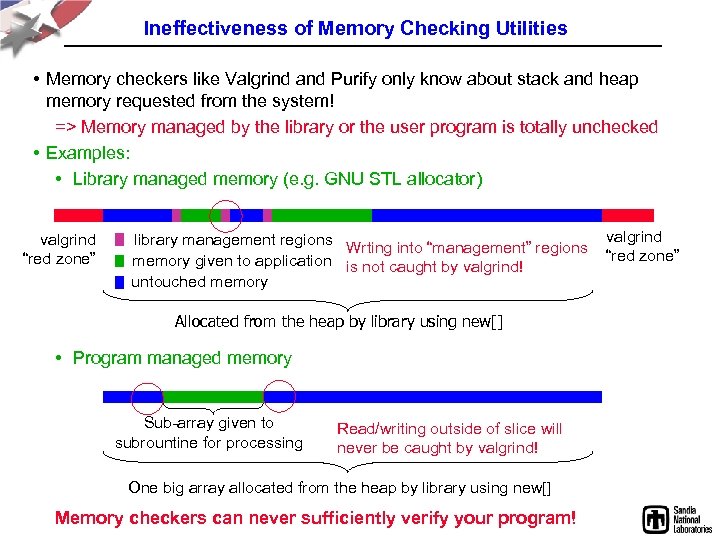 Ineffectiveness of Memory Checking Utilities • Memory checkers like Valgrind and Purify only know about stack and heap memory requested from the system! => Memory managed by the library or the user program is totally unchecked • Examples: • Library managed memory (e. g. GNU STL allocator) valgrind “red zone” library management regions Wrting into “management” regions memory given to application is not caught by valgrind! untouched memory Allocated from the heap by library using new[] • Program managed memory Sub-array given to subrountine for processing Read/writing outside of slice will never be caught by valgrind! One big array allocated from the heap by library using new[] Memory checkers can never sufficiently verify your program! valgrind “red zone”
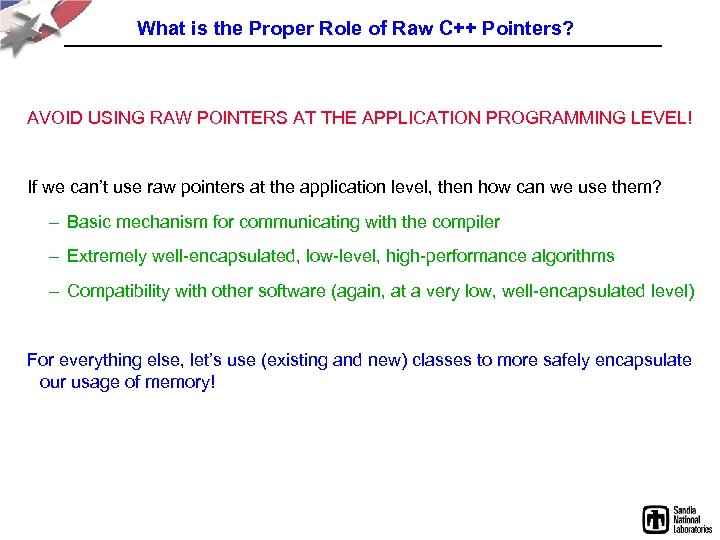 What is the Proper Role of Raw C++ Pointers? AVOID USING RAW POINTERS AT THE APPLICATION PROGRAMMING LEVEL! If we can’t use raw pointers at the application level, then how can we use them? – Basic mechanism for communicating with the compiler – Extremely well-encapsulated, low-level, high-performance algorithms – Compatibility with other software (again, at a very low, well-encapsulated level) For everything else, let’s use (existing and new) classes to more safely encapsulate our usage of memory!
 Outline • Background • High-level philosophy for memory management • Existing STL classes • Overview of Teuchos Memory Management Utility Classes • Challenges to using Teuchos memory management utility classes • Wrap up
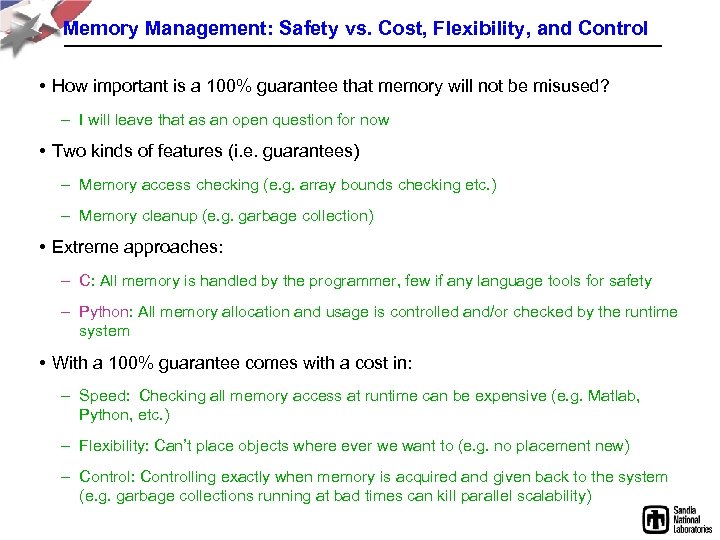 Memory Management: Safety vs. Cost, Flexibility, and Control • How important is a 100% guarantee that memory will not be misused? – I will leave that as an open question for now • Two kinds of features (i. e. guarantees) – Memory access checking (e. g. array bounds checking etc. ) – Memory cleanup (e. g. garbage collection) • Extreme approaches: – C: All memory is handled by the programmer, few if any language tools for safety – Python: All memory allocation and usage is controlled and/or checked by the runtime system • With a 100% guarantee comes with a cost in: – Speed: Checking all memory access at runtime can be expensive (e. g. Matlab, Python, etc. ) – Flexibility: Can’t place objects where ever we want to (e. g. no placement new) – Control: Controlling exactly when memory is acquired and given back to the system (e. g. garbage collections running at bad times can kill parallel scalability)
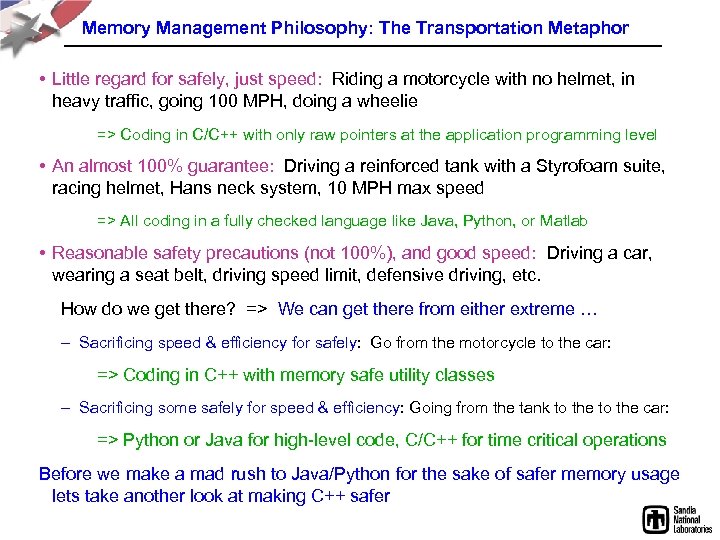 Memory Management Philosophy: The Transportation Metaphor • Little regard for safely, just speed: Riding a motorcycle with no helmet, in heavy traffic, going 100 MPH, doing a wheelie => Coding in C/C++ with only raw pointers at the application programming level • An almost 100% guarantee: Driving a reinforced tank with a Styrofoam suite, racing helmet, Hans neck system, 10 MPH max speed => All coding in a fully checked language like Java, Python, or Matlab • Reasonable safety precautions (not 100%), and good speed: Driving a car, wearing a seat belt, driving speed limit, defensive driving, etc. How do we get there? => We can get there from either extreme … – Sacrificing speed & efficiency for safely: Go from the motorcycle to the car: => Coding in C++ with memory safe utility classes – Sacrificing some safely for speed & efficiency: Going from the tank to the car: => Python or Java for high-level code, C/C++ for time critical operations Before we make a mad rush to Java/Python for the sake of safer memory usage lets take another look at making C++ safer
 Outline • Background • High-level philosophy for memory management • Existing STL classes – What about std: : vector? • Overview of Teuchos Memory Management Utility Classes • Challenges to using Teuchos memory management utility classes • Wrap up
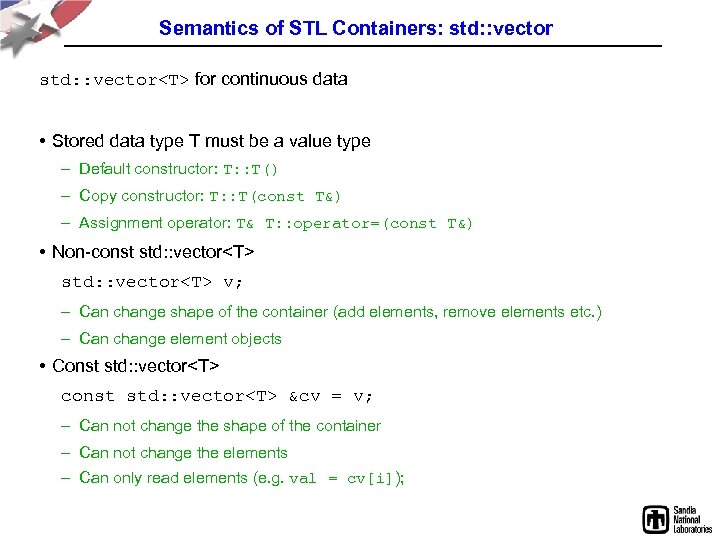 Semantics of STL Containers: std: : vector
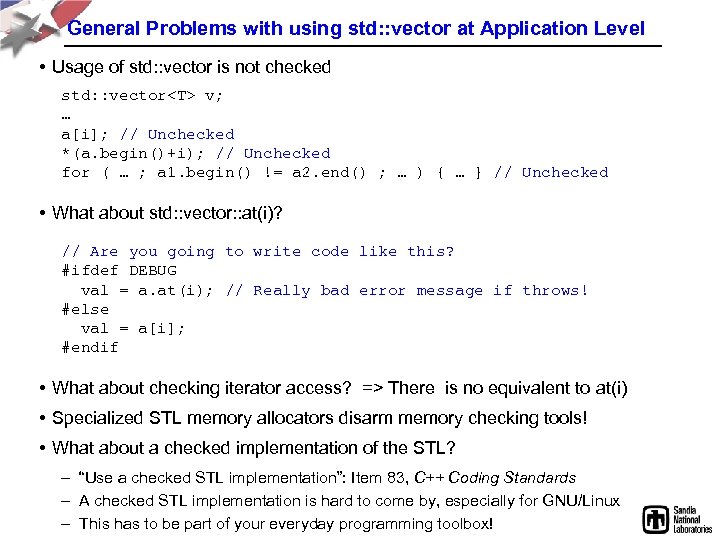 General Problems with using std: : vector at Application Level • Usage of std: : vector is not checked std: : vector
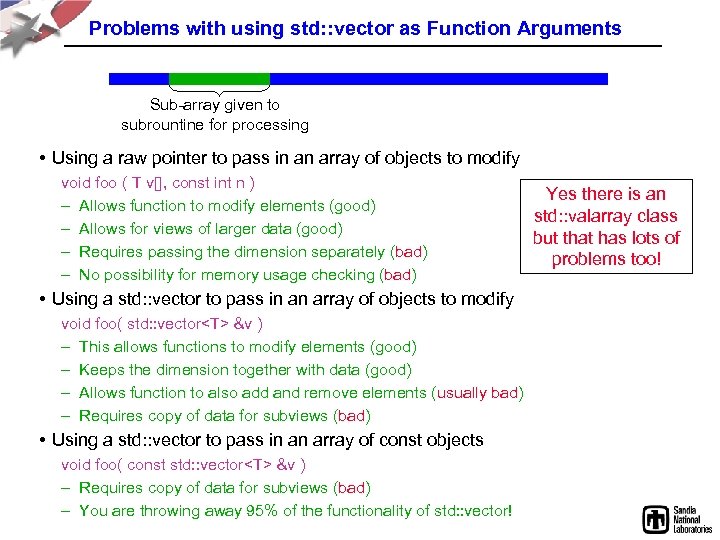 Problems with using std: : vector as Function Arguments Sub-array given to subrountine for processing • Using a raw pointer to pass in an array of objects to modify void foo ( T v[], const int n ) – Allows function to modify elements (good) – Allows for views of larger data (good) – Requires passing the dimension separately (bad) – No possibility for memory usage checking (bad) • Using a std: : vector to pass in an array of objects to modify void foo( std: : vector
 Outline • Background • High-level philosophy for memory management • Existing STL classes • Overview of Teuchos Memory Management Utility Classes – Introduction – Management of single objects – Management for arrays of objects – Usage of Teuchos utility classes as data objects and as function arguments • Challenges to using Teuchos memory management utility classes • Wrap up
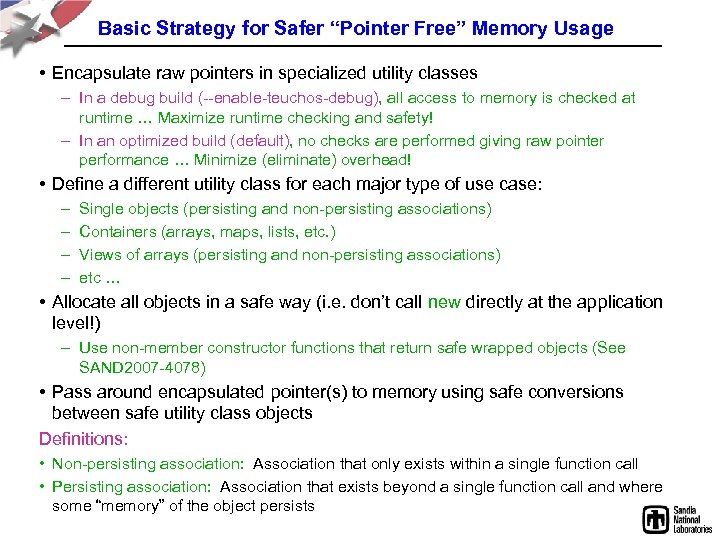 Basic Strategy for Safer “Pointer Free” Memory Usage • Encapsulate raw pointers in specialized utility classes – In a debug build (--enable-teuchos-debug), all access to memory is checked at runtime … Maximize runtime checking and safety! – In an optimized build (default), no checks are performed giving raw pointer performance … Minimize (eliminate) overhead! • Define a different utility class for each major type of use case: – – Single objects (persisting and non-persisting associations) Containers (arrays, maps, lists, etc. ) Views of arrays (persisting and non-persisting associations) etc … • Allocate all objects in a safe way (i. e. don’t call new directly at the application level!) – Use non-member constructor functions that return safe wrapped objects (See SAND 2007 -4078) • Pass around encapsulated pointer(s) to memory using safe conversions between safe utility class objects Definitions: • Non-persisting association: Association that only exists within a single function call • Persisting association: Association that exists beyond a single function call and where some “memory” of the object persists
 Outline • Background • High-level philosophy for memory management • Existing STL classes • Overview of Teuchos Memory Management Utility Classes – Introduction – Management of single objects – Management for arrays of objects – Usage of Teuchos utility classes as data objects and as function arguments • Challenges to using Teuchos memory management utility classes • Wrap up
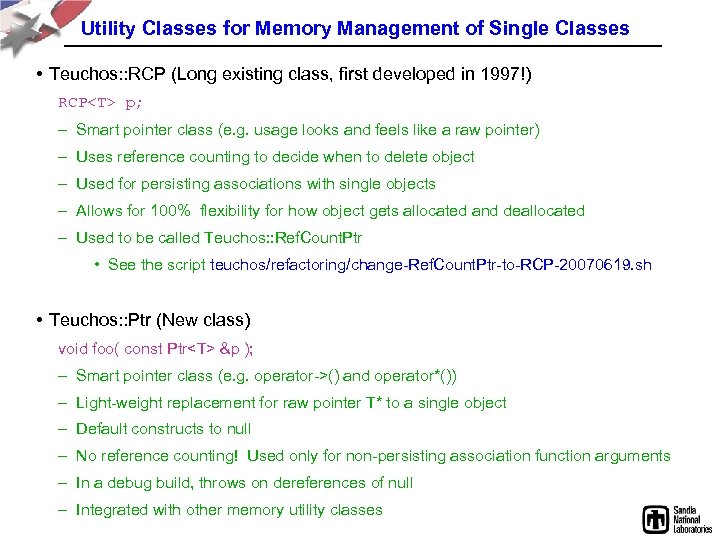 Utility Classes for Memory Management of Single Classes • Teuchos: : RCP (Long existing class, first developed in 1997!) RCP
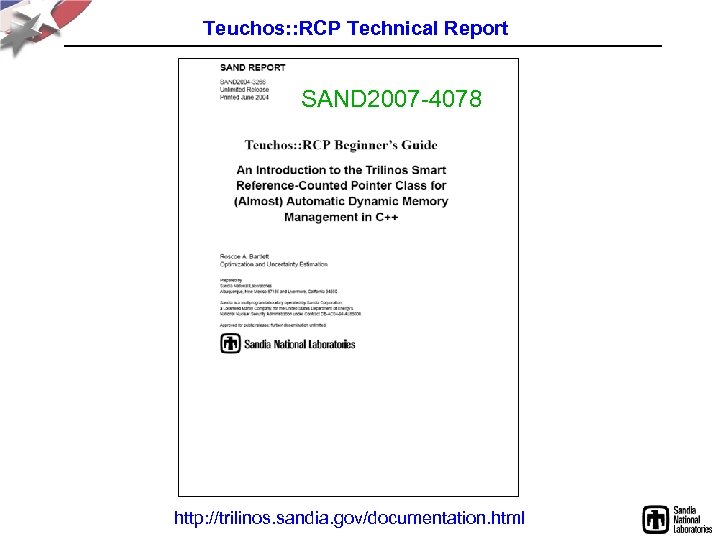 Teuchos: : RCP Technical Report SAND 2007 -4078 http: //trilinos. sandia. gov/documentation. html
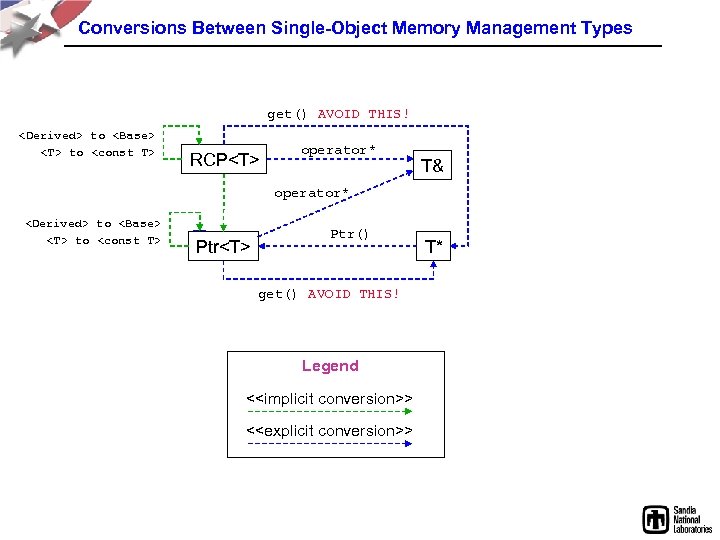 Conversions Between Single-Object Memory Management Types get() AVOID THIS!
 Outline • Background • High-level philosophy for memory management • Existing STL classes • Overview of Teuchos Memory Management Utility Classes – Introduction – Management of single objects – Management for arrays of objects – Usage of Teuchos utility classes as data objects and as function arguments • Challenges to using Teuchos memory management utility classes • Wrap up
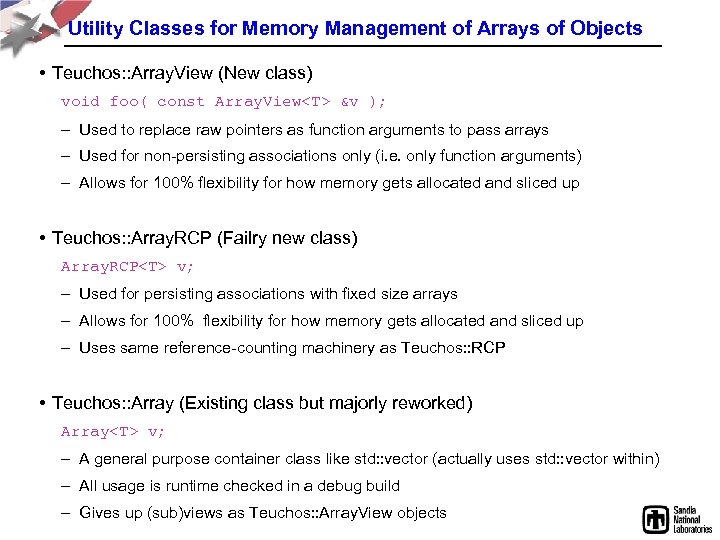 Utility Classes for Memory Management of Arrays of Objects • Teuchos: : Array. View (New class) void foo( const Array. View
![Raw Pointers and [Array]RCP : const and non-const Example: A a; A* a_ptr =](https://present5.com/presentation/4769f5168654daf36f2ba23a7fe15e23/image-30.jpg "Raw Pointers and [Array]RCP : const and non-const Example: A a; A* a_ptr =") Raw Pointers and [Array]RCP : const and non-const Example: A a; A* a_ptr = &a; an address A’s data a_ptr Important Point: A pointer object a_ptr of type A* is an object just like any other object with value semantics and can be const or non-const a Raw C++ Pointers RCP typedef A* ptr_A; typedef const A* ptr_const_A; an address A’s data ptr_A A * an address const ptr_A A * const an address RCP a_ptr; equivalent to const RCP a_ptr; non-const pointer to const object A’s data a_ptr; equivalent to RCP
Raw Pointers and [Array]RCP : const and non-const Example: A a; A* a_ptr = &a; an address A’s data a_ptr Important Point: A pointer object a_ptr of type A* is an object just like any other object with value semantics and can be const or non-const a Raw C++ Pointers RCP typedef A* ptr_A; typedef const A* ptr_const_A; an address A’s data ptr_A A * an address const ptr_A A * const an address RCP a_ptr; equivalent to const RCP a_ptr; non-const pointer to const object A’s data a_ptr; equivalent to RCP
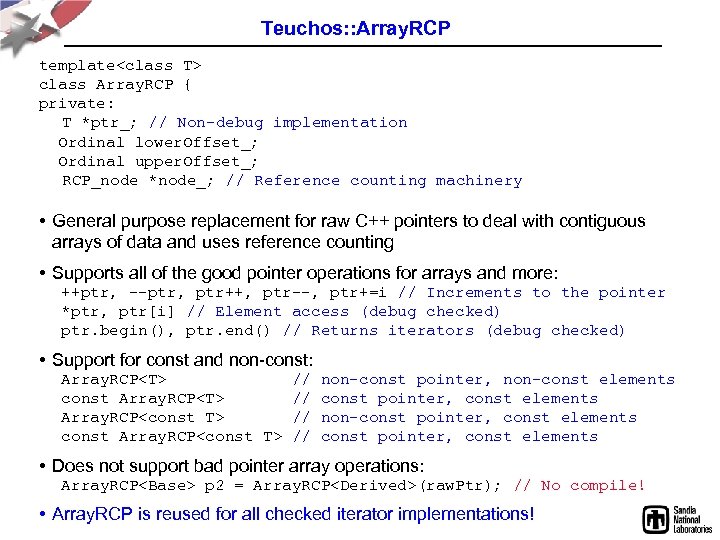 Teuchos: : Array. RCP template
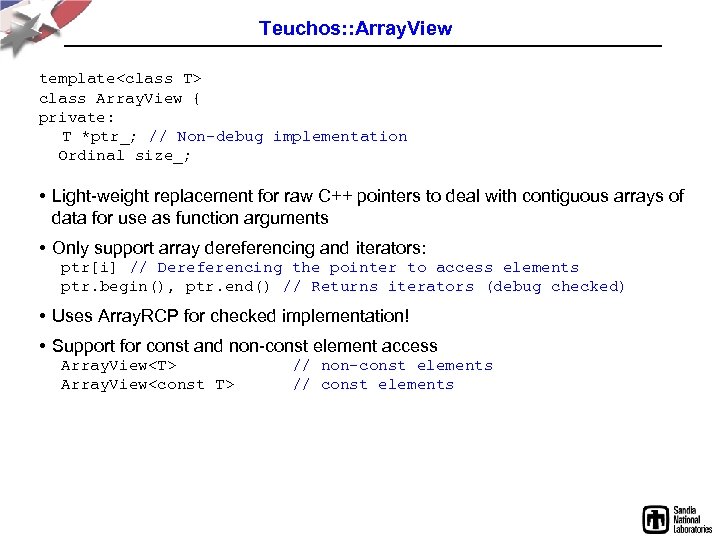 Teuchos: : Array. View template
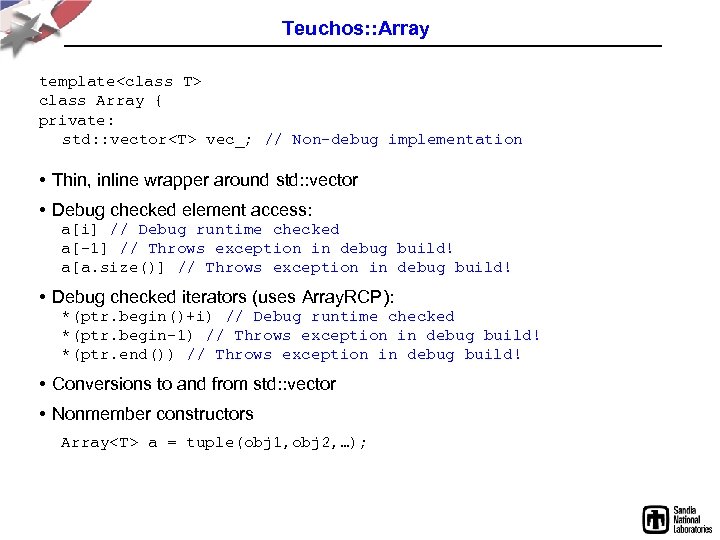 Teuchos: : Array template
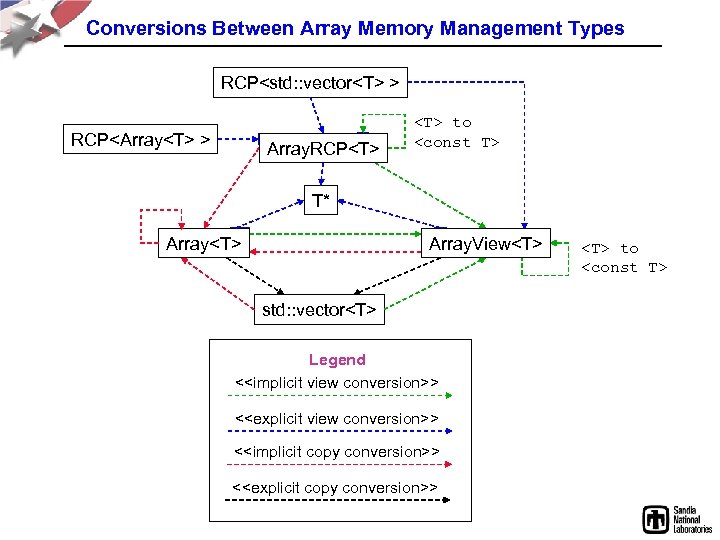 Conversions Between Array Memory Management Types RCP
 Outline • Background • High-level philosophy for memory management • Existing STL classes • Overview of Teuchos Memory Management Utility Classes – Introduction – Management of single objects – Management for arrays of objects – Usage of Teuchos utility classes as data objects and as function arguments • Challenges to using Teuchos memory management utility classes • Wrap up
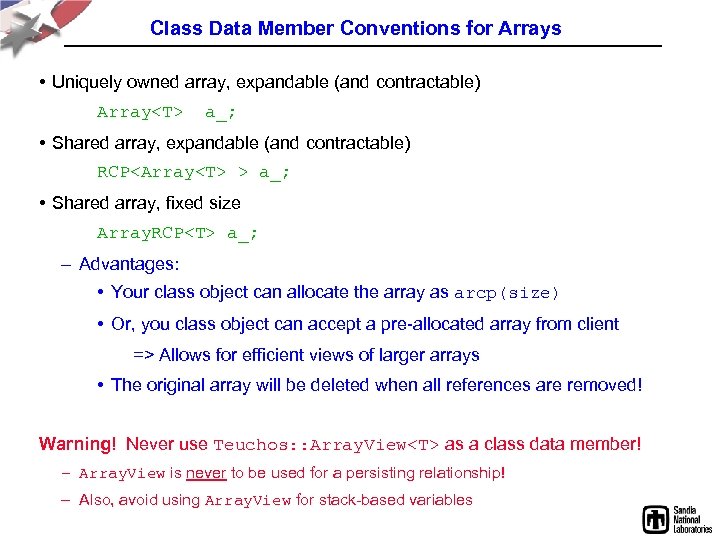 Class Data Member Conventions for Arrays • Uniquely owned array, expandable (and contractable) Array
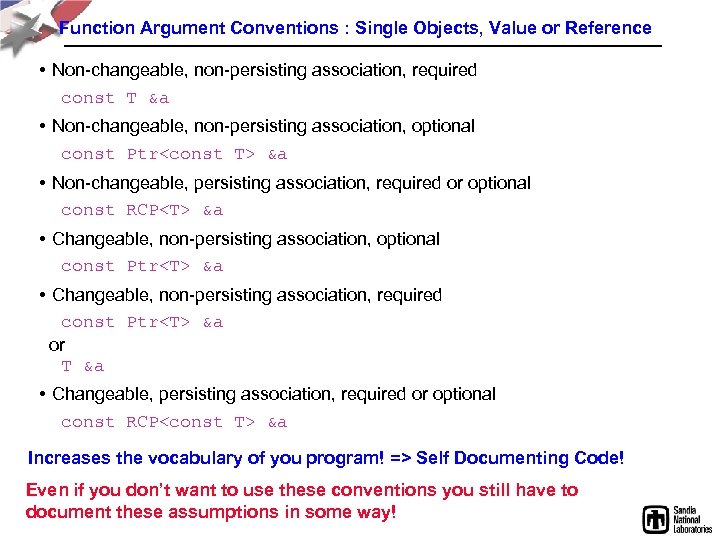 Function Argument Conventions : Single Objects, Value or Reference • Non-changeable, non-persisting association, required const T &a • Non-changeable, non-persisting association, optional const Ptr
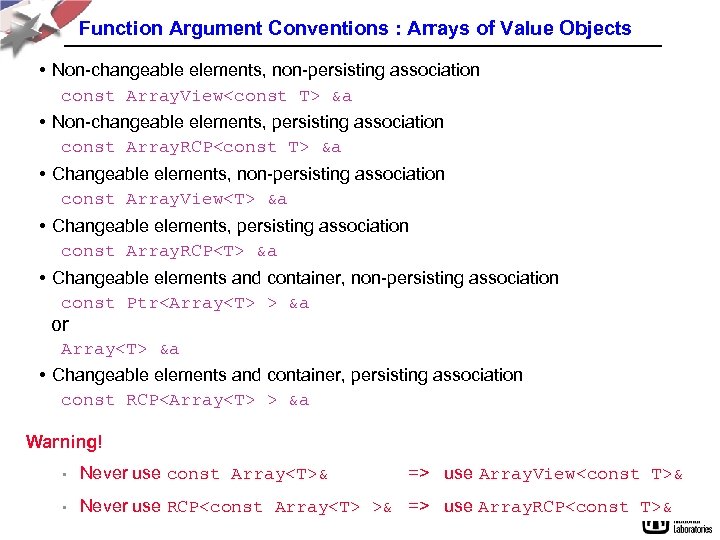 Function Argument Conventions : Arrays of Value Objects • Non-changeable elements, non-persisting association const Array. View
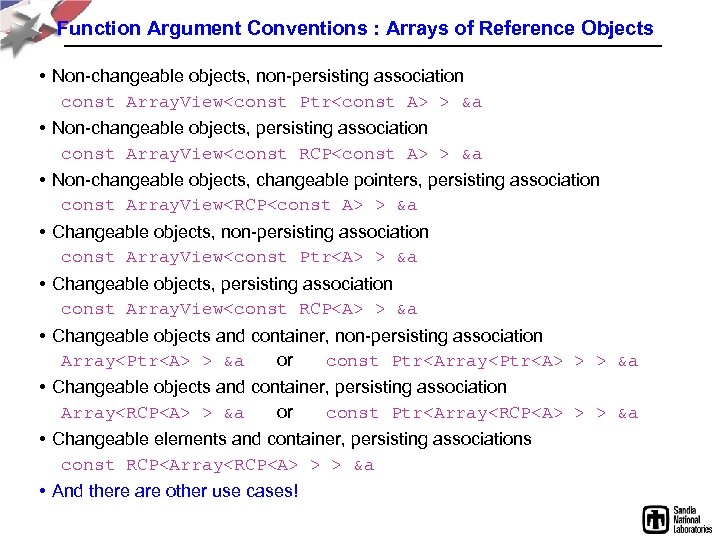 Function Argument Conventions : Arrays of Reference Objects • Non-changeable objects, non-persisting association const Array. View
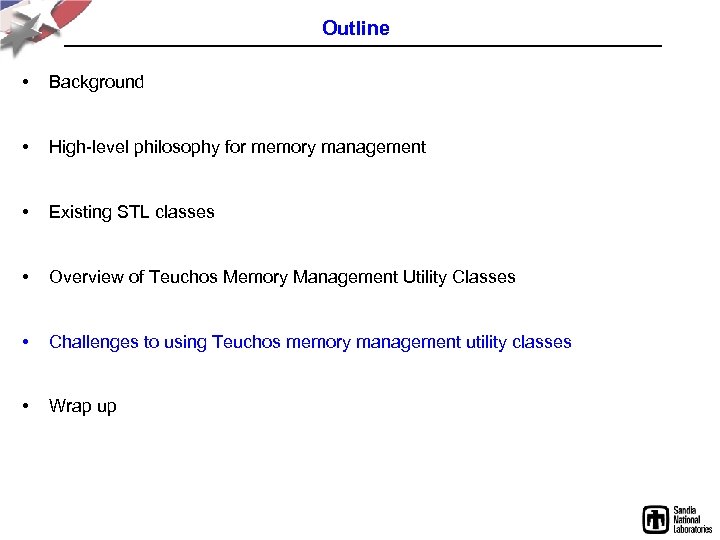 Outline • Background • High-level philosophy for memory management • Existing STL classes • Overview of Teuchos Memory Management Utility Classes • Challenges to using Teuchos memory management utility classes • Wrap up
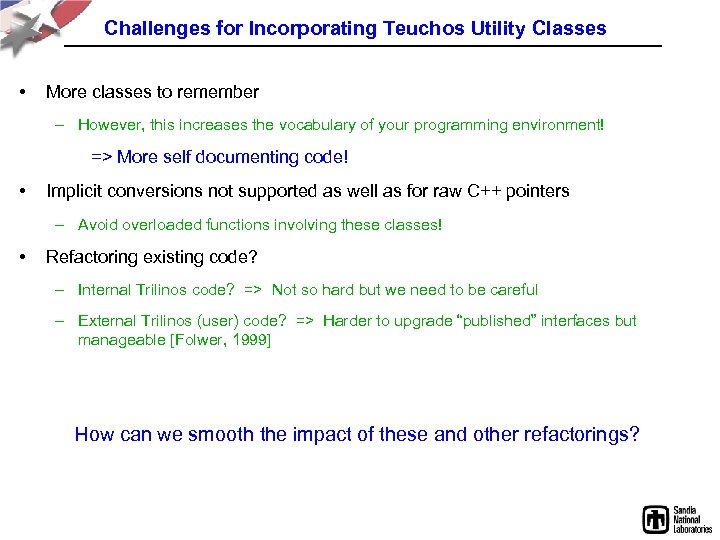 Challenges for Incorporating Teuchos Utility Classes • More classes to remember – However, this increases the vocabulary of your programming environment! => More self documenting code! • Implicit conversions not supported as well as for raw C++ pointers – Avoid overloaded functions involving these classes! • Refactoring existing code? – Internal Trilinos code? => Not so hard but we need to be careful – External Trilinos (user) code? => Harder to upgrade “published” interfaces but manageable [Folwer, 1999] How can we smooth the impact of these and other refactorings?
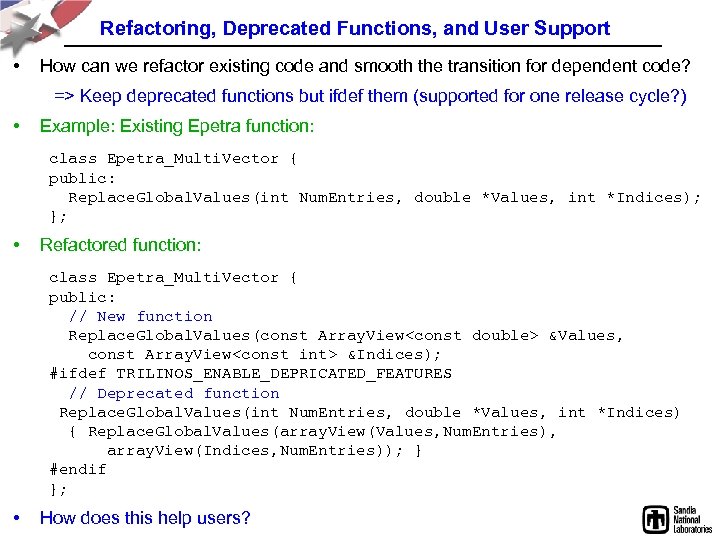 Refactoring, Deprecated Functions, and User Support • How can we refactor existing code and smooth the transition for dependent code? => Keep deprecated functions but ifdef them (supported for one release cycle? ) • Example: Existing Epetra function: class Epetra_Multi. Vector { public: Replace. Global. Values(int Num. Entries, double *Values, int *Indices); }; • Refactored function: class Epetra_Multi. Vector { public: // New function Replace. Global. Values(const Array. View
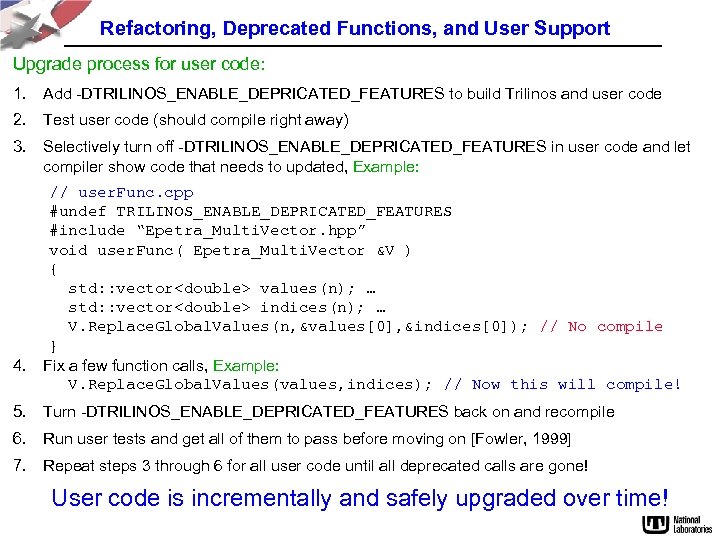 Refactoring, Deprecated Functions, and User Support Upgrade process for user code: 1. Add -DTRILINOS_ENABLE_DEPRICATED_FEATURES to build Trilinos and user code 2. Test user code (should compile right away) 3. Selectively turn off -DTRILINOS_ENABLE_DEPRICATED_FEATURES in user code and let compiler show code that needs to updated, Example: 4. // user. Func. cpp #undef TRILINOS_ENABLE_DEPRICATED_FEATURES #include “Epetra_Multi. Vector. hpp” void user. Func( Epetra_Multi. Vector &V ) { std: : vector
 Outline • Background • High-level philosophy for memory management • Existing STL classes • Overview of Teuchos Memory Management Utility Classes • Challenges to using Teuchos memory management utility classes • Wrap up
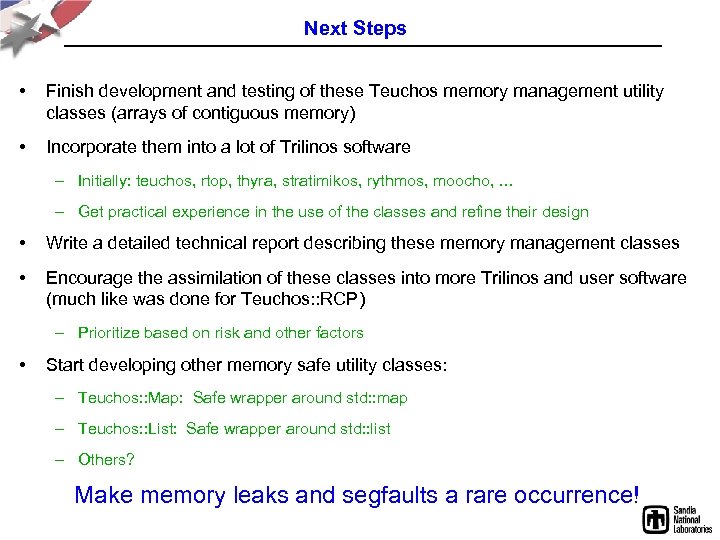 Next Steps • Finish development and testing of these Teuchos memory management utility classes (arrays of contiguous memory) • Incorporate them into a lot of Trilinos software – Initially: teuchos, rtop, thyra, stratimikos, rythmos, moocho, … – Get practical experience in the use of the classes and refine their design • Write a detailed technical report describing these memory management classes • Encourage the assimilation of these classes into more Trilinos and user software (much like was done for Teuchos: : RCP) – Prioritize based on risk and other factors • Start developing other memory safe utility classes: – Teuchos: : Map: Safe wrapper around std: : map – Teuchos: : List: Safe wrapper around std: : list – Others? Make memory leaks and segfaults a rare occurrence!
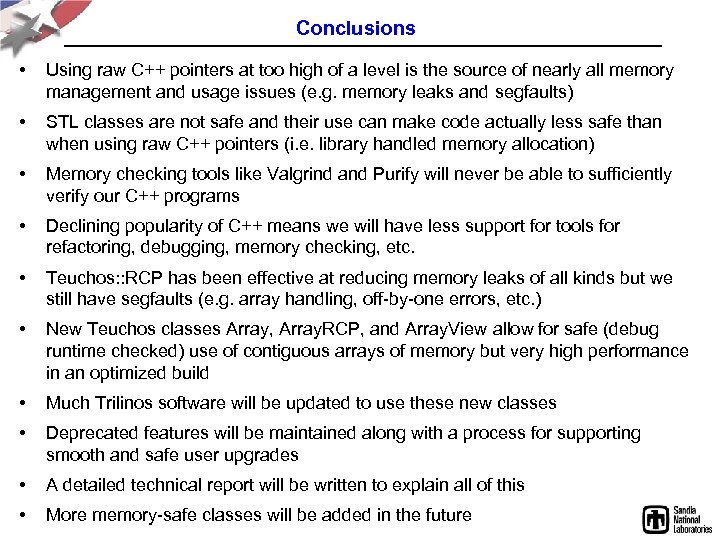 Conclusions • Using raw C++ pointers at too high of a level is the source of nearly all memory management and usage issues (e. g. memory leaks and segfaults) • STL classes are not safe and their use can make code actually less safe than when using raw C++ pointers (i. e. library handled memory allocation) • Memory checking tools like Valgrind and Purify will never be able to sufficiently verify our C++ programs • Declining popularity of C++ means we will have less support for tools for refactoring, debugging, memory checking, etc. • Teuchos: : RCP has been effective at reducing memory leaks of all kinds but we still have segfaults (e. g. array handling, off-by-one errors, etc. ) • New Teuchos classes Array, Array. RCP, and Array. View allow for safe (debug runtime checked) use of contiguous arrays of memory but very high performance in an optimized build • Much Trilinos software will be updated to use these new classes • Deprecated features will be maintained along with a process for supporting smooth and safe user upgrades • A detailed technical report will be written to explain all of this • More memory-safe classes will be added in the future
![The End THE END References: [Martin, 2003] Robert C. Martin, Agile Software Development: Principles,](https://present5.com/presentation/4769f5168654daf36f2ba23a7fe15e23/image-47.jpg "The End THE END References: [Martin, 2003] Robert C. Martin, Agile Software Development: Principles,") The End THE END References: [Martin, 2003] Robert C. Martin, Agile Software Development: Principles, Patterns, and Practices, Prentice Hall, 2003 [Meyers, 2005] Scott Meyers, Effective C++: Third Edition, Addison-Wesley, 2005 [Sutter & Alexandrescu, 2005], C++ Coding Standards, Addison-Wesley, 2005 [Fowler, 199] Martin Fowler, Refactoring, Addison-Wesley, 1999
The End THE END References: [Martin, 2003] Robert C. Martin, Agile Software Development: Principles, Patterns, and Practices, Prentice Hall, 2003 [Meyers, 2005] Scott Meyers, Effective C++: Third Edition, Addison-Wesley, 2005 [Sutter & Alexandrescu, 2005], C++ Coding Standards, Addison-Wesley, 2005 [Fowler, 199] Martin Fowler, Refactoring, Addison-Wesley, 1999