 Скачать презентацию Sanctify this holy day by blessing the first
e1418766d858dd05ce7a7000ece8acf0.ppt
- Количество слайдов: 46



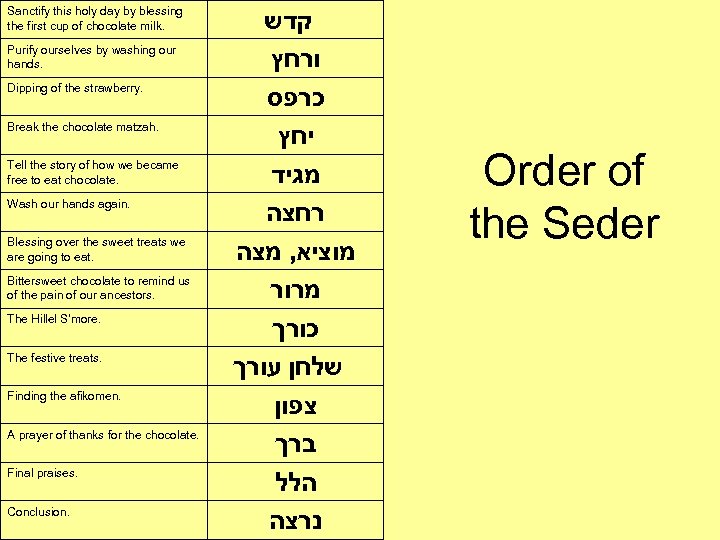
Sanctify this holy day by blessing the first cup of chocolate milk. Purify ourselves by washing our hands. Dipping of the strawberry. Break the chocolate matzah. Tell the story of how we became free to eat chocolate. Wash our hands again. Blessing over the sweet treats we are going to eat. Bittersweet chocolate to remind us of the pain of our ancestors. The Hillel S'more. The festive treats. Finding the afikomen. A prayer of thanks for the chocolate. Final praises. Conclusion. קדש ורחץ כרפס יחץ מגיד רחצה מוציא, מצה מרור כורך שלחן עורך צפון ברך הלל נרצה Order of the Seder
Greetings and Introductions • Now in the presence of loved ones and friends, old and new, before the emblems of festive rejoicing, we gather for a celebration. • Linking and bonding the past with the future, we heed once again the Divine call to service. Living our story that is told for all peoples, whose shining conclusion is yet to unfold, we gather to observe the Passover with our Chocolate Seder, for long ago it was written: • You shall keep the Feast of Unleavened Bread, for on this very day, I brought your hosts out of Egypt. You shall observe this day throughout the generations as a practice for all times (Exodus 12: 17). • Remember the day on which you went forth from Egypt, from the house of bondage, and how God freed you with a mighty hand an outstretched arm (Exodus 13: 3).
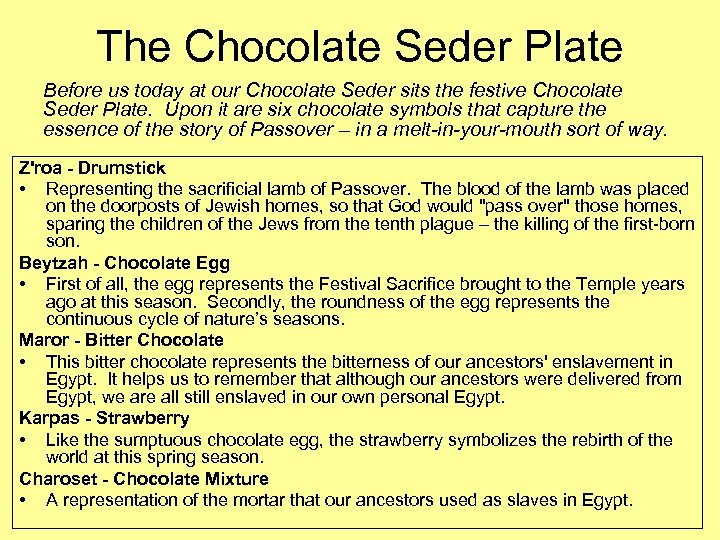
The Chocolate Seder Plate Before us today at our Chocolate Seder sits the festive Chocolate Seder Plate. Upon it are six chocolate symbols that capture the essence of the story of Passover – in a melt-in-your-mouth sort of way. Z'roa - Drumstick • Representing the sacrificial lamb of Passover. The blood of the lamb was placed on the doorposts of Jewish homes, so that God would "pass over" those homes, sparing the children of the Jews from the tenth plague – the killing of the first-born son. Beytzah - Chocolate Egg • First of all, the egg represents the Festival Sacrifice brought to the Temple years ago at this season. Secondly, the roundness of the egg represents the continuous cycle of nature’s seasons. Maror - Bitter Chocolate • This bitter chocolate represents the bitterness of our ancestors' enslavement in Egypt. It helps us to remember that although our ancestors were delivered from Egypt, we are all still enslaved in our own personal Egypt. Karpas - Strawberry • Like the sumptuous chocolate egg, the strawberry symbolizes the rebirth of the world at this spring season. Charoset - Chocolate Mixture • A representation of the mortar that our ancestors used as slaves in Egypt.
Why is there an orange on the Seder plate? • In the days long ago when women were just beginning to be rabbis, Susannah Heschel was traveling in Florida, the Land of Oranges. • One night she spoke at a synagogue about the emerging equality of women in Jewish life – as rabbis, teachers and students of Torah, synagogue presidents, and in all other ways. • After she spoke, a man arose in wrath, red with fury, and said, "A woman belongs on the bimah as much as an orange belongs on the Seder plate!" • So ever since that day, we place an orange on the Seder plate, for it belongs there as a symbol that women belong wherever Jews carry on a sacred life. • From "A Liberal Haggadah, " UC Berkeley Hillel
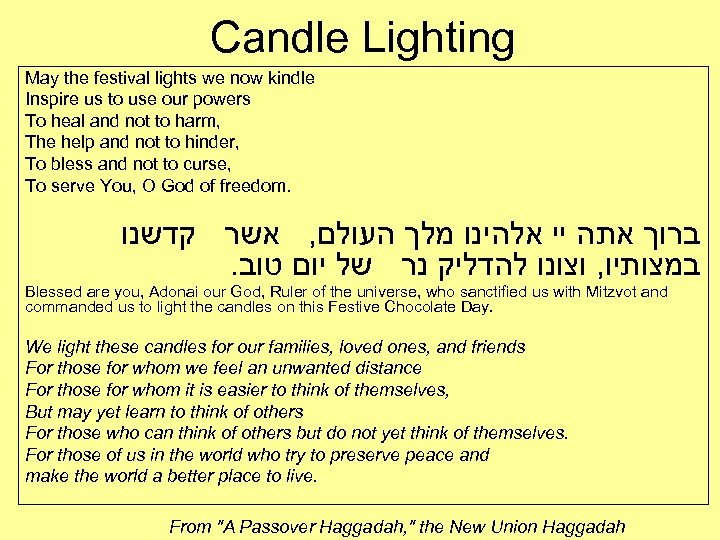
Candle Lighting May the festival lights we now kindle Inspire us to use our powers To heal and not to harm, The help and not to hinder, To bless and not to curse, To serve You, O God of freedom. ברוך אתה יי אלהינו מלך העולם, אשר קדשנו . במצותיו, וצונו להדליק נר של יום טוב Blessed are you, Adonai our God, Ruler of the universe, who sanctified us with Mitzvot and commanded us to light the candles on this Festive Chocolate Day. We light these candles for our families, loved ones, and friends For those for whom we feel an unwanted distance For those for whom it is easier to think of themselves, But may yet learn to think of others For those who can think of others but do not yet think of themselves. For those of us in the world who try to preserve peace and make the world a better place to live. From "A Passover Haggadah, " the New Union Haggadah
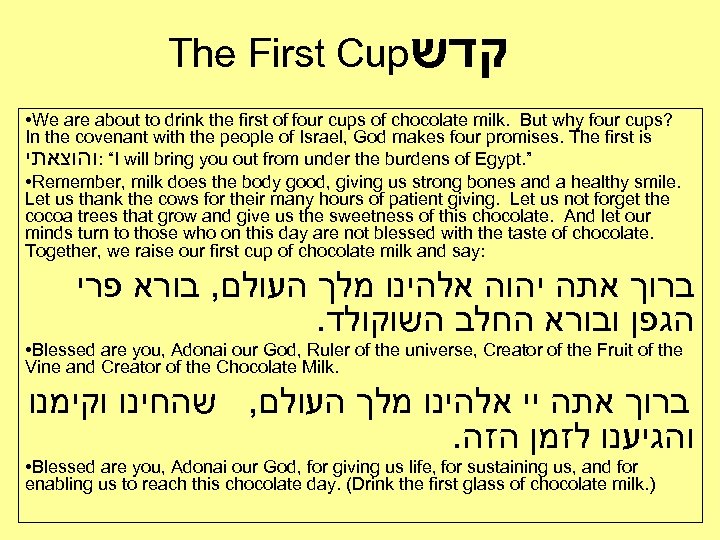
The First Cup קדש • We are about to drink the first of four cups of chocolate milk. But why four cups? In the covenant with the people of Israel, God makes four promises. The first is “ : והוצאתי I will bring you out from under the burdens of Egypt. ” • Remember, milk does the body good, giving us strong bones and a healthy smile. Let us thank the cows for their many hours of patient giving. Let us not forget the cocoa trees that grow and give us the sweetness of this chocolate. And let our minds turn to those who on this day are not blessed with the taste of chocolate. Together, we raise our first cup of chocolate milk and say: ברוך אתה יהוה אלהינו מלך העולם, בורא פרי . הגפן ובורא החלב השוקולד • Blessed are you, Adonai our God, Ruler of the universe, Creator of the Fruit of the Vine and Creator of the Chocolate Milk. ברוך אתה יי אלהינו מלך העולם, שהחינו וקימנו . והגיענו לזמן הזה • Blessed are you, Adonai our God, for giving us life, for sustaining us, and for enabling us to reach this chocolate day. (Drink the first glass of chocolate milk. )
ורחץ Washing of the Hands
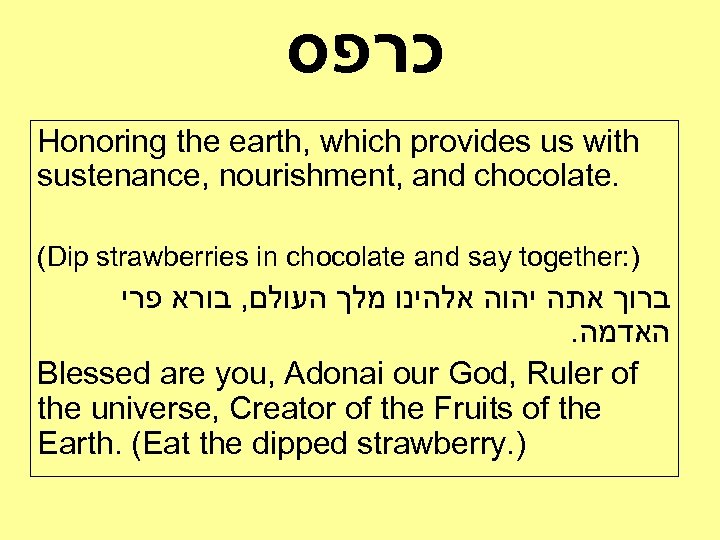
כרפס Honoring the earth, which provides us with sustenance, nourishment, and chocolate. (Dip strawberries in chocolate and say together: ) ברוך אתה יהוה אלהינו מלך העולם, בורא פרי . האדמה Blessed are you, Adonai our God, Ruler of the universe, Creator of the Fruits of the Earth. (Eat the dipped strawberry. )
Breaking of the Matzah יחץ • We have three chocolate matzot before us. • Now we break the middle matzah and conceal one half as the afikoman. • Later we will share it, as in days of old when the Passover offering was shared at this service in Jerusalem.
מגיד • Among people everywhere, sharing this bread forms a bond of fellowship. For the sake of our redemption, we say together ancient words that join us with our own people and with all who are in need, with the wrongly imprisoned and the beggar in the street. For our redemption is bound up with the deliverance from bondage of people everywhere. For all those who are unable to taste the chocolate this evening, we say together: This is the bread of affliction, the poor bread, which our ancestors ate in the land of Egypt. Let all who are hungry come and eat. Let all who are in want of chocolate share the hope of Passover. As we celebrate here, we join with our people everywhere. This year we celebrate here. Next year in the land of Israel. Now we are all still in bonds. Next year may all be free. Adapted from "A Passover Haggadah, " the New Union Haggadah
The Four Questions • • • The four questions reflect the curious paradox of servitude and redemption. The matzah, which is the subject of the first question, is a slave bread but also a symbol of freedom. We go on to bitter herbs in the second question. They are a symbol of servitude, but their use as hors d'oeuvres and their being dipped into another food is a sign of opulence. Similarly, the third and fourth questions. We eat karpas dipped in salt water, which is reminiscent of Jewish pain and tears, yet we recline as a show of redemption. In essence, the Four Questions touch upon the paradox of Seder night, when the symbols of servitude and suffering intertwine with those of redemption. From "A Modern Orthodox Haggadah" by Rabbi Shlomo Riskin
מה נשתנה ? מה נשתנה הלילה הזה מכל הלילות Why is this night different from all other nights? . שבכל הלילות אנו אוכלין חמץ ומצה, הלילה הזה - כולו מצה On all other nights we eat bread and matzah. Why on this night do we only eat matzah? On all other nights we eat chocolate chip cookies and chocolate covered matzah. Why on this night do we only eat chocolate matzah? . שבכל הלילות אנו אוכלין שאר ירקות, - הלילה הזה מרור On all other nights we eat all kinds of vegetables. Why on this night do we eat bitter herbs? On all other nights we eat all kinds of chocolate. Why on this night do we eat only bittersweet chocolate? שבכל הלילות אין אנו מטבילין אפילו פעם אחת, - הלילה הזה שתי . פעמים On all other nights we do not dip our vegetables even once. Why on this night do we dip them twice? שבכל הלילות אנו אוכלין בין יושבין ובין מסבין, - הלילה הזה כלנו . מסבין On all other nights, we eat our meals either sitting up or reclining.
More Questions • Why is it that with all our self-knowledge, there is still so much misunderstanding between parent and child, husband wife, employer and employee, friend and friend? • Why is it that so many people ignore their religion until their utmost time of need? • Why is it that there still must be slavery and oppression in the world around us? • Why is it that chocolate must be so bad for your body when it tastes so good? • FACT: Chocolate reaches a higher level of consciousness, in minutes, than the other leading analgesic.
The Four Children • Blessed is God, who bestowed chocolate upon all people. • The Torah speaks of four types of children: one who is wise, one who is wicked, one who is simple, and one who does not even know how to ask a question.
The Wise Child • The wise child asks, “What is the meaning of the laws which God has commanded us to keep? ” • You should explain all the laws of Passover, right down to the very last detail about chocolate afikoman.
The Wicked Child • The wicked child asks, “What is the meaning of this Chocolate Seder to you? ” • By saying “to you, ” this child excludes herself or himself from the group. • You should say to him or her, “I eat this chocolate because of what for me when I was in Egypt. • Had you been there, you would have been sent to your room after dinner with no chocolate to eat. ”
The Simple Child • The simple child asks, “What is this about? ” • You shall explain to this child the ingredients of the chocolate and teach him how to make such treats.
The Child Who Does Not Know How to Ask • For the child who does not even know how to ask a question, you shall give him or her vast quantities of chocolate. That should suffice.
Retelling the Story of the Exodus • Tonight is the night we remember the story of our ancestors who were slaves of Pharaoh in Egypt. By telling and retelling this story, we link ourselves back to these ancestors, imagining ourselves to be in their place. • We were slaves of Pharaoh for many years. But God brought us out of Egypt and out of slavery and oppression. Our God brought the ten plagues upon our oppressors and parted the Red Sea, allowing us to escape while the Egyptians drowned. • As we traveled in the desert forty years, God sustained us with manna, and at the end of our journey, God gave us Shabbat and the Torah, and brought us to the land of Israel.
• Tonight is also the night we remember the story of chocolate, which Columbus brought from the New World. By telling and retelling this story, we imagine ourselves to be in the place of our ancestors who did not know the true greatness of chocolate. • After it was introduced to Spain, God sent Cortez to Mexico to learn from the Aztecs about this precious gift of chocolate. God inspired us to add sugar, vanilla, and milk to the chocolate and to sip it as a drink. • God spread the wonders of chocolate to Italy, France, Holland, England, and of course, Switzerland. Finally, God gave us Milton Hershey, who made chocolate even better and more accessible to all.
• It should be emphasized that the real mitzvah of telling the tale is one of real communication. • The language and content of the tale as told must be understood both by the one who tells it and by its hearers. • Those who simply mumble through the Haggadah text in a Hebrew they do not understand are literally not fulfilling the commandment of the seder. • Arthur Green in "The Jewish Holidays: A Guide & Commentary"
• And God said, “I took your father, Abraham, across the river, and I led him into the land of Canaan. I increased his descendants, and I gave him Isaac, a son; and to Isaac, I gave Jacob. ” When Jacob went with his children down to Egypt, his son, Joseph, was already there and had emerged with power over the land. There was famine in all the lands, but in Egypt, there was chocolate. And so all the world came to Joseph in Egypt. • After Joseph and all his brothers died, there arose a new king of Egypt who knew not Joseph. And he said, “Look, the Israelite people are too numerous for us. Let us deal shrewdly with them, lest they increase, and in the event of war, join our enemies in fighting against us. ” • So the Egyptians set taskmasters over the Jewish people with forced labor. They embittered their lives with harsh labor at brick and mortar and all sorts of work in the fields. Worst of all, they denied them all access to chocolate. But the more the Jews were oppressed, the more they increased, and the Egyptians became more worried.
• Pharaoh decreed that every boy that was born would be thrown into the Nile, while every girl would live. We cried out unto God, and God heeded our plight, our misery, our hunger for chocolate, and our oppression. • God heard our moaning and remembered the covenant that had been made with Abraham, Isaac and Jacob. And God looked upon the Israelites and knew their pain. And God said, “I will go through the land of Egypt on that night, and I will mete out justice against all the gods of Egypt. • And God brought us out of Egypt with a mighty hand, an outstretched arm and awesome power. Not through a messenger did God act, but alone, in solitary glory.
(All raise their glass of chocolate milk. ) • And so we praise You, our God, the Holy One, who kept your promise to Israel, for you had told Abraham that his descendants would be strangers in a land not their own where they would be oppressed for 400 years. And you said, “The nation which they have served shall I judge, and afterwards, they shall go out with great substance. ” • This promise has stood fast for our fathers, for our mothers, and for us. For it is not just one person that has stood against us to destroy us, but rather in every generation there have arisen those peoples who wished to bring us down. Yet You, our God, continue to keep your promise, as you save us from their hands. • (Set down the glass of milk, but do not drink any of it. )
The Ten Plagues • We know that as the Israelites fled Egypt, Pharaoh recanted his decision to let the former slaves go, and he sent his armies after them. As the Israelites approached the Sea of Reeds, the Egyptians were in hot pursuit. But God parted the Sea of Reeds so that the Israelites could cross to safety, and as the Egyptians entered the path, the waters crashed down upon them, and they drowned. • It is said that when the Egyptians were drowning in the seas, the angels broke out into songs of jubilation. God silenced them and said, “My creatures are perishing, and you sing praises? ” • And so, though we benefited greatly from all the evils that befell the Egyptians with the plagues and the drowning at the Red Sea, our joy is diminished knowing that they suffered, too.
To remember their suffering, we remove ten drops of chocolate milk from our cup, one for each of the plagues that fell upon Egypt. • Each drop of milk we remove is a hope and a prayer that people everywhere will cast out the plagues that threaten us all, beginning with those in our own hearts. • The making of war • The teaching of hate and violence • The spoiling of the Earth • Corruption of justice and government • Instigating vice and crime • Neglect of human needs • Oppression of nations and peoples • Destruction of chocolate • Erosion of freedom
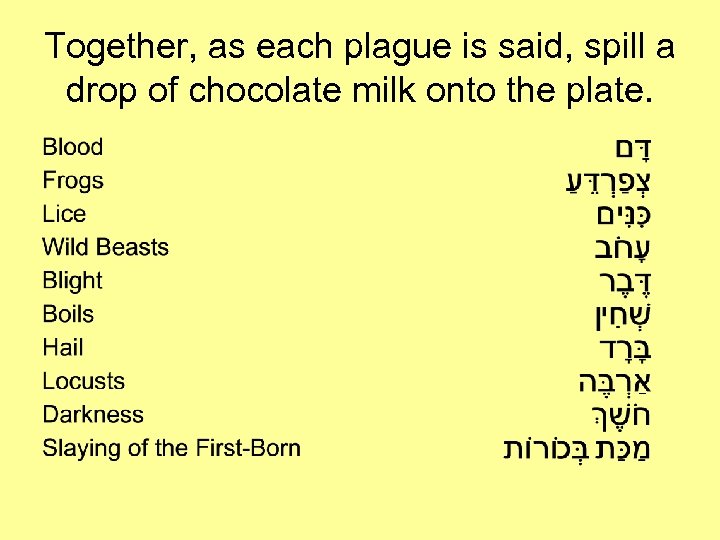
Together, as each plague is said, spill a drop of chocolate milk onto the plate.
It Would Have Been Enough דיינו • We are grateful that God kept the promise to deliver us from our oppressors, but we must remember that God went well beyond that promise. For everything above and beyond that pledge, we are grateful, for it would have been enough just to be brought out of Egypt. • • Had God brought us out of Egypt but not divided the sea for us, . דיינו Had God divided the sea for us and not permitted us to cross onto dry land, . דיינו Had God permitted us to cross the sea on dry land not sustained us forty years in the desert, . דיינו Had God sustained us forty years in the desert and not fed us with manna and chocolate, . דיינו • • • Had God fed us with manna and chocolate and not given us the Sabbath, • . דיינו Had God given us the Sabbath and not brought us to Mount Sinai, • . דיינו Had God brought us to Mount Sinai and not given us the Torah, . דיינו Had God given us the Torah and not led us into Israel, . דיינו Had God led us into Israel and not built for us the Temple, . דיינו • Had God built for us the Temple and not given us chocolate to eat there, • Had God given us chocolate and not made us a holy people, . דיינו • • . דיינו
דיינו אלו הוציאנו ממצרים דיינו. אלו נתן לנו את השבת, דיינו. אלו נתן לנו את התורה. דיינו.
The Passover Symbols • According to the sages, you can sit through a Chocolate Seder for six hours, but if you do not consider the meaning of the three Passover Symbols, you have not fulfilled the purpose of the Seder. Pesach • A “roasted” drumstick: Symbol of the Passover sacrifice eaten during the days of the Temple in Jerusalem to honor the fact that God “passed over” the houses of the Israelites in Egypt while at the same time striking down the firstborn in the Egyptian houses. Matzah • This chocolate matzah, which did not have time to rise and become bread as we generally know it, is a symbol of not being ready, but having to do something anyway. Maror • This Maror, this bitter chocolate is the symbol of the bitterness of servitude. It serves as a perpetual reminder, from generation to generation, that it is the duty of Jews, as the descendants of slaves, to do whatever can be done to lighten the load of those less fortunate and to have sympathy for all living creatures who are enslaved.
The Second Cup • The cup of chocolate milk that was poured as we began the Magid is now to be drunk as we conclude the telling of the story. • This cup has witnessed the tale of God’s deliverance of the Jews from Egypt – “ : והצלתי I will deliver you from their service. ” • It offers hope that we may be delivered from all the afflictions in this world, and that we all may someday be truly free.
Together, we raise our second glass of chocolate milk and say: , • ברוך אתה יהוה אלהינו מלך העולם בורא פרי הגפן ובורא החלב . השוקולד • Blessed are you, Adonai our God, Ruler of the universe, Creator of the Fruit of the Vine and Creator of the Chocolate Milk. • (Drink the second glass of chocolate milk. )
Washing the Hands Again רחצה • The priests in the Temple would wash their hands before approaching the altar. Similarly, we wash our hands at this stage to approach the table with clean hands and a pure heart. So that we may sanctify the act of eating. • Then we remain silent until the blessing for the matzah is said. ) • ברוך אתה יהוה אלהינו מלך העולם, אשר . קדשנו במצוותיו, וצונו על נטילת ידים • Blessed are you, Adonai our God, Ruler of the Universe, who sanctified us with mitzvot and commanded us to wash our hands. From "The Feast of Freedom, " A Conservative Haggadah
מוציא מצה • Thank you God for creating a world where we can bring forth the components of bread and chocolate, our sustenance, from the earth. • (The upper matzah is broken and distributed, and all say: ) • ברוך אתה יהוה אלהינו מלך העולם, המוציא לחם . ושוקולד מן הארץ • Blessed are you, Adonai our God, Ruler of the universe, • Who brings forth bread and chocolate from the earth. • ברוך אתה יהוה אלהינו מלך העולם, אשר קדשנו . במצוותיו, וצונו על אכילת מצה • Blessed are you, Adonai our God, Ruler of the Universe, Who sanctified us with mitzvot and commanded us to eat matzah.
Bitter Herbs מרור • God, we recognize your commandments and the ways in which we feel holy when we observe these commandments, especially one as difficult as eating this bittersweet chocolate. , • ברוך אתה יהוה אלהינו מלך העולם אשר קדשנו במצוותיו, וצונו על אכילת . מרור • Blessed are you, Adonai our God, Ruler of the Universe, who sanctifies us with mitzvot and commands us to eat bitter herbs and bittersweet chocolate. • (Dip some bittersweet chocolate into the chocolate mix and eat them together. )
The Hillel S'more כורך • This is what Hillel the Elder used to do in the time that the Holy Temple still stood. He would mix the Pesach offering with matzah and maror and eat them together, so as to properly carry out the Torah's injunction: "On matzah and bitters they shall eat it" (Numbers 9: 11). • (Combine matzah, chocolate mix, and bittersweet chocolate and eat them) • From "A Liberal Haggadah" UC Berkeley Hillel
The Festive Meal שלחן עורך Finding the Afikomen צפון
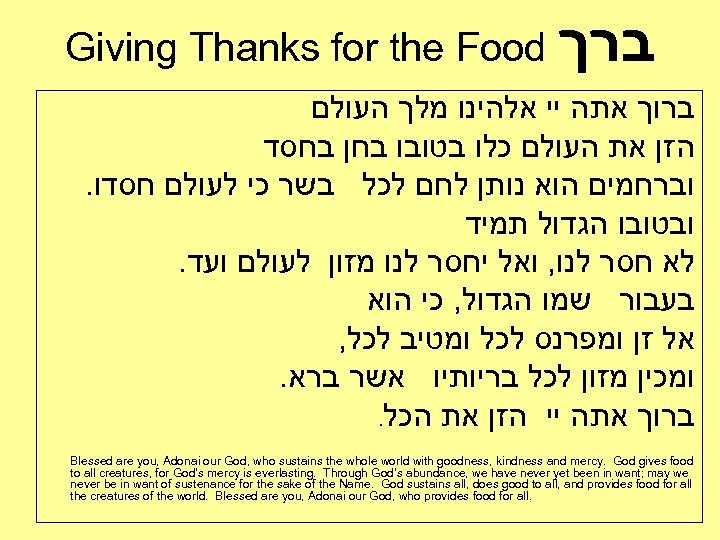
Giving Thanks for the Food ברך ברוך אתה יי אלהינו מלך העולם הזן את העולם כלו בטובו בחן בחסד . וברחמים הוא נותן לחם לכל בשר כי לעולם חסדו ובטובו הגדול תמיד . לא חסר לנו, ואל יחסר לנו מזון לעולם ועד בעבור שמו הגדול, כי הוא , אל זן ומפרנס לכל ומטיב לכל . ומכין מזון לכל בריותיו אשר ברא . ברוך אתה יי הזן את הכל Blessed are you, Adonai our God, who sustains the whole world with goodness, kindness and mercy. God gives food to all creatures, for God’s mercy is everlasting. Through God’s abundance, we have never yet been in want; may we never be in want of sustenance for the sake of the Name. God sustains all, does good to all, and provides food for all the creatures of the world. Blessed are you, Adonai our God, who provides food for all.
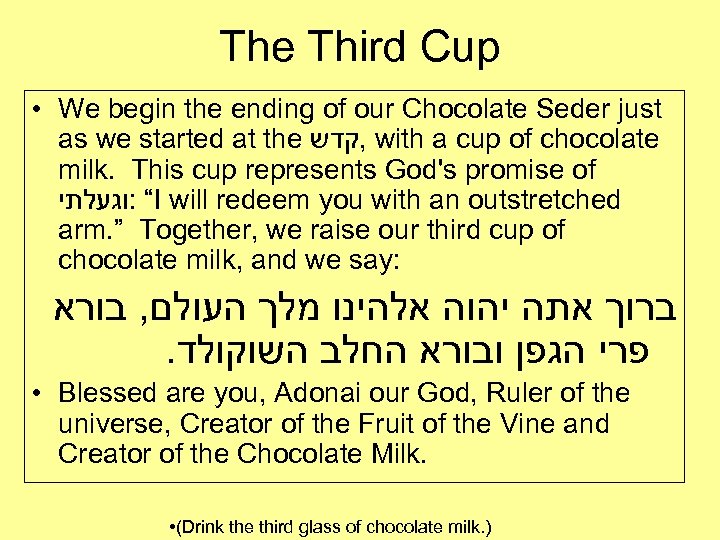
The Third Cup • We begin the ending of our Chocolate Seder just as we started at the , קדש with a cup of chocolate milk. This cup represents God's promise of “ : וגעלתי I will redeem you with an outstretched arm. ” Together, we raise our third cup of chocolate milk, and we say: ברוך אתה יהוה אלהינו מלך העולם, בורא . פרי הגפן ובורא החלב השוקולד • Blessed are you, Adonai our God, Ruler of the universe, Creator of the Fruit of the Vine and Creator of the Chocolate Milk. • (Drink the third glass of chocolate milk. )
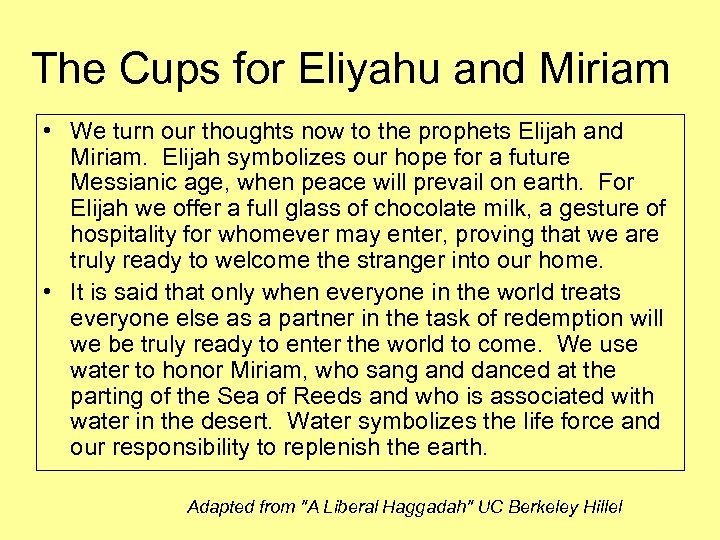
The Cups for Eliyahu and Miriam • We turn our thoughts now to the prophets Elijah and Miriam. Elijah symbolizes our hope for a future Messianic age, when peace will prevail on earth. For Elijah we offer a full glass of chocolate milk, a gesture of hospitality for whomever may enter, proving that we are truly ready to welcome the stranger into our home. • It is said that only when everyone in the world treats everyone else as a partner in the task of redemption will we be truly ready to enter the world to come. We use water to honor Miriam, who sang and danced at the parting of the Sea of Reeds and who is associated with water in the desert. Water symbolizes the life force and our responsibility to replenish the earth. Adapted from "A Liberal Haggadah" UC Berkeley Hillel
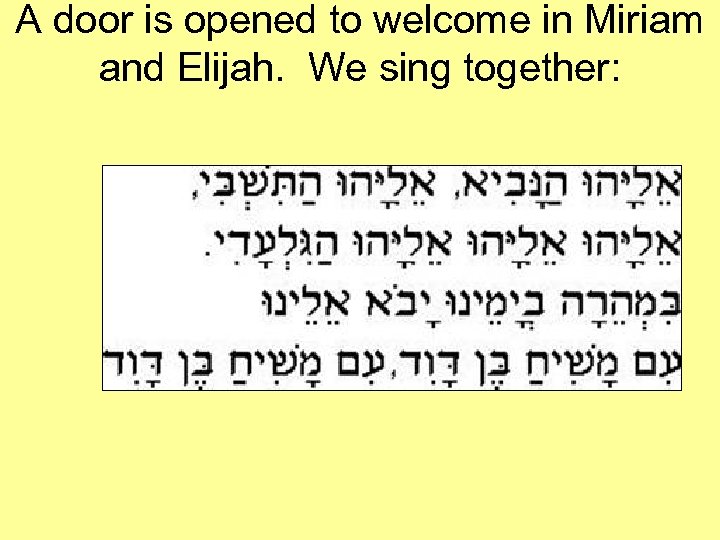
A door is opened to welcome in Miriam and Elijah. We sing together:
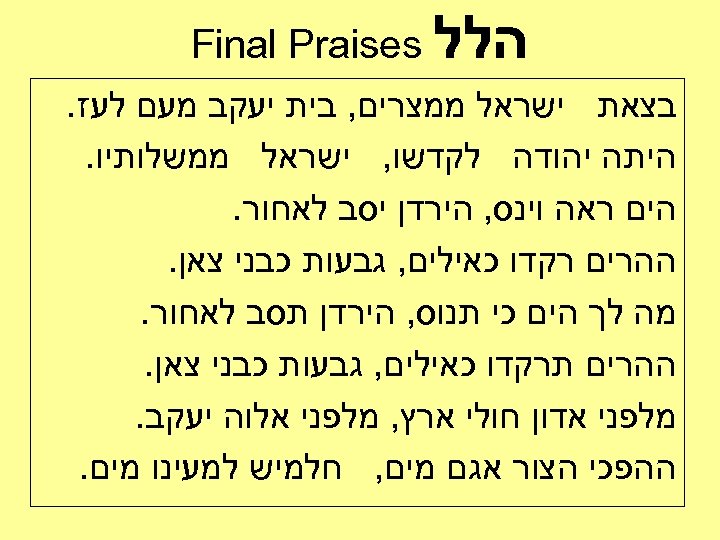
הלל Final Praises בצאת ישראל ממצרים, בית יעקב מעם לעז. היתה יהודה לקדשו, ישראל ממשלותיו. הים ראה וינס, הירדן יסב לאחור. ההרים רקדו כאילים, גבעות כבני צאן. מה לך הים כי תנוס, הירדן תסב לאחור. ההרים תרקדו כאילים, גבעות כבני צאן. מלפני אדון חולי ארץ, מלפני אלוה יעקב. ההפכי הצור אגם מים, חלמיש למעינו מים.
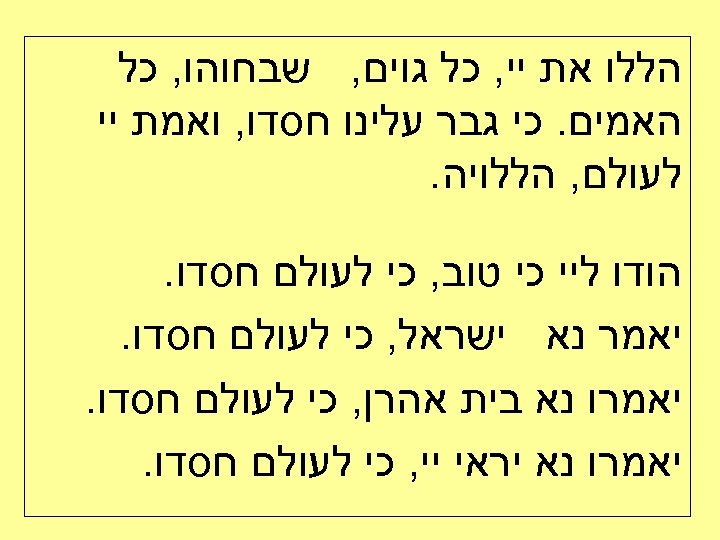
הללו את יי, כל גוים, שבחוהו, כל האמים. כי גבר עלינו חסדו, ואמת יי לעולם, הללויה. הודו ליי כי טוב, כי לעולם חסדו. יאמר נא ישראל, כי לעולם חסדו. יאמרו נא בית אהרן, כי לעולם חסדו. יאמרו נא יראי יי, כי לעולם חסדו.
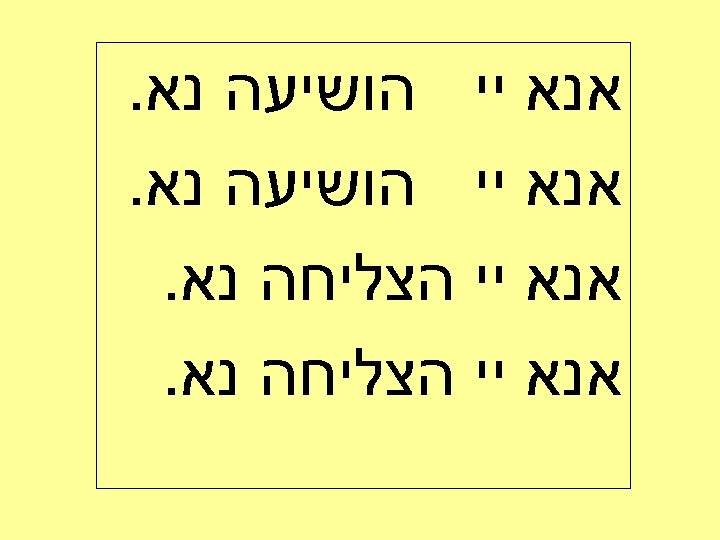
אנא יי הושיעה נא. אנא יי הצליחה נא.
The Fourth Cup • The fourth and final cup of chocolate milk celebrates the promise of “ , ולקחתי I shall take you to Me as a people, and I will become God for you. ” In this cup, we may see expressed the hope for our spiritual redemption. The more we act like God’s people and the more chocolate we consume, the more we can experience the Eternal One becoming God for each of us. Let us raise our cups one last time and celebrate that promise: ברוך אתה יהוה אלהינו מלך העולם, בורא . פרי הגפן ובורא החלב השוקולד • Blessed are you, Adonai our God, Ruler of the universe, Creator of the Fruit of the Vine and Creator of the Chocolate Milk. • (Drink the fourth glass of chocolate milk. )
• • Conclusion of The Seder נרצה The Pesach Seder, in proper form, is done. Faithful to its laws and customs one by one. As the privilege of observing it tonight we’ve won, May we be privileged again when another year is done. May the Pure One who dwells above incline To raise us up as numerous as the stars that shine Guiding us, plantings of your fruitful vine Redeemed and singing unto Zion’s shrine. . בירושלים לשנה הבאה Next year in Jerusalem!
Скачать презентацию Sanctify this holy day by blessing the first
e1418766d858dd05ce7a7000ece8acf0.ppt