 Скачать презентацию SAN ANTONIO AFFORDABLE HOUSING PRESERVATION EXPANSION PLAN
78a748f6d4f3dae856312517ce2f96a3.ppt
- Количество слайдов: 36



SAN ANTONIO AFFORDABLE HOUSING PRESERVATION & EXPANSION: PLAN & POLICIES January 13, 2011 Working Session with BOC
DISCUSSION FRAMEWORK & AGENDA I. SAHA’S MISSION AND AFFORDABLE HOUSING PRESERVATION & EXPANSION PLANNING PROCESS II. SAN ANTONIO AFFORDABLE HOUSING: DEMAND, SUPPLY AND NEED INDICATORS III. SAHA’S RECENT PRESERVATION AND EXPANSION ACTIVITIES AND STRATEGIC ASSETS IV. EXTERNAL PLANNING CONSIDERATIONS V. SAHA’S GO FORWARD PRESERVATION AND EXPANSION GUIDING PRINCIPLES, POLICIES, AND PRIORITIES 2
SAHA MISSION STATEMENT The San Antonio Housing Authority is committed to building and maintaining affordable housing for the citizens in our community. We seek to create safe neighborhoods by partnering with individuals and organizations to provide housing, education, and employment opportunities for families of modest means to become self-sufficient and improve their quality of life. We shall serve our clients and all citizens with the highest level of professionalism, compassion, and respect. 3
SAHA AFFORDABLE HOUSING PRESERVATION AND EXPANSION PLANNING PROCESS p Planning process built on foundation of fact based assessment of affordable housing demand, supply, and unmet need in the City of San Antonio p Significant communication and coordination with key external stakeholders including Mayor’s office, HUD, as well as key local public, for profit and non-profit leaders and organizations to maximize credibility, coordination, and success of planning and implementation work p Stakeholder retreats with non-profits, for-profits/developers and public agencies in summer 2010 (follow-up planned in 2011) p Discussions with Mayor’s office, City planning, and Trinity regarding integrated San Antonio housing planning and systematization of City’s affordable housing supply, demand need data tracking and analysis p Evaluation of external funding environment including funding challenges posed by San Antonio affordable housing needs assessment p Commitment to plan and act in coordination with City agencies and partners including Mayor’s office, City Manager, VIA, and SAISD p Alignment of strategies and approaches with HUD 4
SAHA AFFORDABLE HOUSING PRESERVATION AND EXPANSION PLANNING PROCESS (CONTD. ) p Internal research, analysis, discussion, and feedback p Bottom-up/Staff: Development and neighborhood revitalization/DNR department teams p Top-down/Management & Board: Senior team and Board p Analysis of SAHA’s housing preservation and expansion activities – including new development, redevelopment, acquisitions, voucher expansion and MTW –over the past 10 to 20 years p Evaluation of SAHA’s existing affordable housing stock and strategic assets from a physical needs, location, and local amenities standpoint p Discussions with innovative housing authorities (e. g. , Fort Worth, Atlanta) 5
DISCUSSION FRAMEWORK & AGENDA I. SAHA’S MISSION AND AFFORDABLE HOUSING PRESERVATION & EXPANSION PLANNING PROCESS II. SAN ANTONIO AFFORDABLE HOUSING: DEMAND, SUPPLY AND NEED INDICATORS III. SAHA’S RECENT PRESERVATION AND EXPANSION ACTIVITIES AND STRATEGIC ASSETS IV. EXTERNAL PLANNING CONSIDERATIONS V. SAHA’S GO FORWARD PRESERVATION AND EXPANSION GUIDING PRINCIPLES, POLICIES, AND PRIORITIES 6
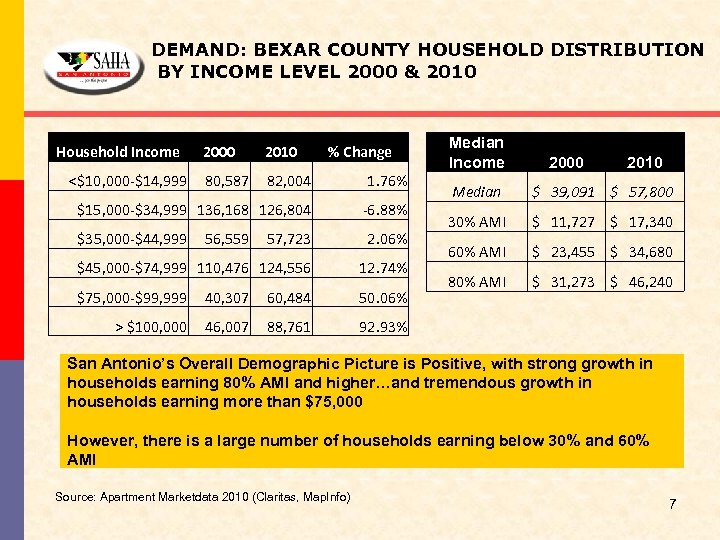
DEMAND: BEXAR COUNTY HOUSEHOLD DISTRIBUTION BY INCOME LEVEL 2000 & 2010 Household Income 2000 <$10, 000 -$14, 999 80, 587 2010 % Change 82, 004 1. 76% $15, 000 -$34, 999 136, 168 126, 804 -6. 88% $35, 000 -$44, 999 56, 559 57, 723 2. 06% $45, 000 -$74, 999 110, 476 124, 556 12. 74% $75, 000 -$99, 999 40, 307 60, 484 50. 06% > $100, 000 46, 007 88, 761 Median Income 2000 2010 Median $ 39, 091 $ 57, 800 30% AMI $ 11, 727 $ 17, 340 60% AMI $ 23, 455 $ 34, 680 80% AMI $ 31, 273 $ 46, 240 92. 93% San Antonio’s Overall Demographic Picture is Positive, with strong growth in households earning 80% AMI and higher…and tremendous growth in households earning more than $75, 000 However, there is a large number of households earning below 30% and 60% AMI Source: Apartment Marketdata 2010 (Claritas, Map. Info) 7
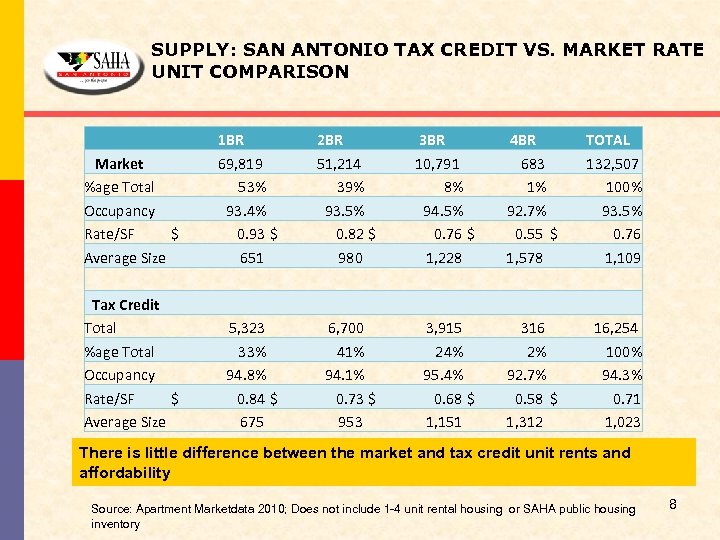
SUPPLY: SAN ANTONIO TAX CREDIT VS. MARKET RATE UNIT COMPARISON 1 BR 2 BR 3 BR 4 BR TOTAL Market 69, 819 51, 214 10, 791 683 132, 507 %age Total 53% 39% 8% 1% 100% Occupancy 93. 4% 93. 5% 94. 5% 92. 7% 93. 5% Rate/SF $ 0. 93 $ 0. 82 $ 0. 76 $ 0. 55 $ 0. 76 Average Size 651 980 1, 228 1, 578 1, 109 Tax Credit Total 5, 323 6, 700 3, 915 316 16, 254 %age Total 33% 41% 24% 2% 100% Occupancy 94. 8% 94. 1% 95. 4% 92. 7% 94. 3% Rate/SF $ 0. 84 $ 0. 73 $ 0. 68 $ 0. 58 $ 0. 71 Average Size 675 953 1, 151 1, 312 1, 023 There is little difference between the market and tax credit unit rents and affordability Source: Apartment Marketdata 2010; Does not include 1 -4 unit rental housing or SAHA public housing inventory 8
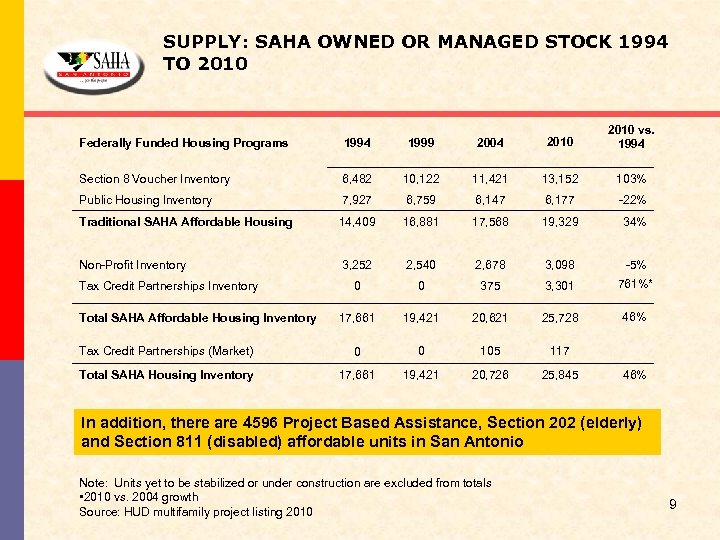
SUPPLY: SAHA OWNED OR MANAGED STOCK 1994 TO 2010 Federally Funded Housing Programs 1994 1999 2004 2010 vs. 1994 Section 8 Voucher Inventory 6, 482 10, 122 11, 421 13, 152 103% Public Housing Inventory 7, 927 6, 759 6, 147 6, 177 -22% Traditional SAHA Affordable Housing 14, 409 16, 881 17, 568 19, 329 34% Non-Profit Inventory 3, 252 2, 540 2, 678 3, 098 -5% 0 0 375 3, 301 761%* 17, 661 19, 421 20, 621 25, 728 46% Tax Credit Partnerships (Market) 0 0 105 117 Total SAHA Housing Inventory 17, 661 19, 421 20, 726 25, 845 Tax Credit Partnerships Inventory Total SAHA Affordable Housing Inventory 46% In addition, there are 4596 Project Based Assistance, Section 202 (elderly) and Section 811 (disabled) affordable units in San Antonio Note: Units yet to be stabilized or under construction are excluded from totals • 2010 vs. 2004 growth Source: HUD multifamily project listing 2010 9
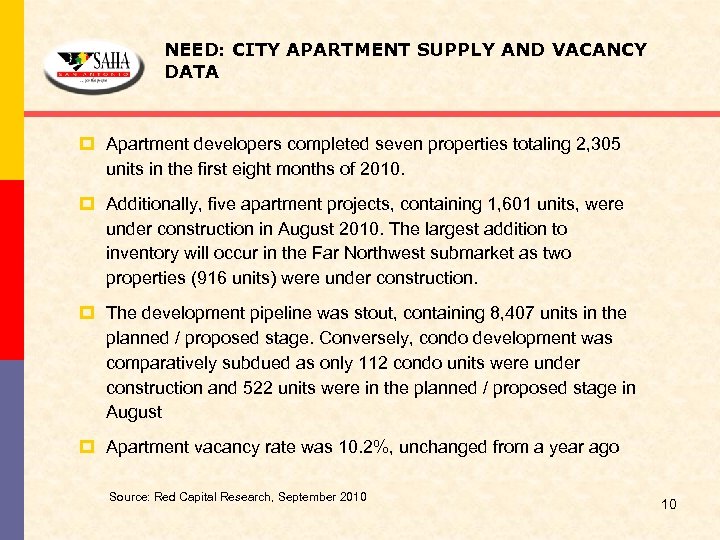
NEED: CITY APARTMENT SUPPLY AND VACANCY DATA p Apartment developers completed seven properties totaling 2, 305 units in the first eight months of 2010. p Additionally, five apartment projects, containing 1, 601 units, were under construction in August 2010. The largest addition to inventory will occur in the Far Northwest submarket as two properties (916 units) were under construction. p The development pipeline was stout, containing 8, 407 units in the planned / proposed stage. Conversely, condo development was comparatively subdued as only 112 condo units were under construction and 522 units were in the planned / proposed stage in August p Apartment vacancy rate was 10. 2%, unchanged from a year ago Source: Red Capital Research, September 2010 10
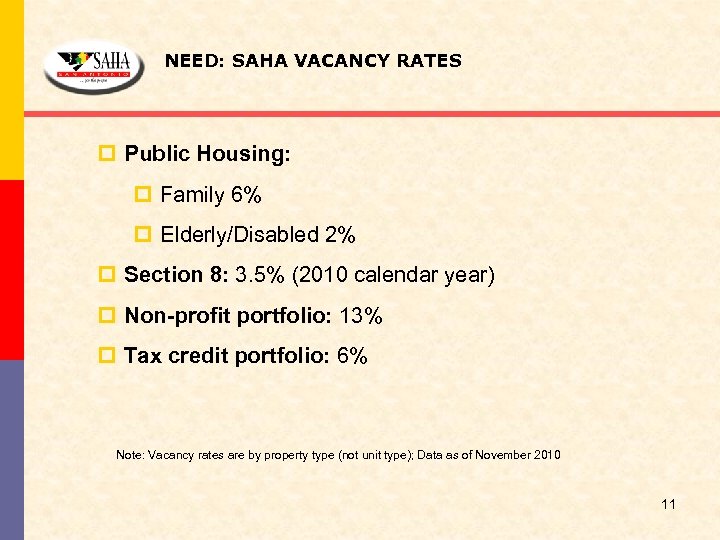
NEED: SAHA VACANCY RATES p Public Housing: p Family 6% p Elderly/Disabled 2% p Section 8: 3. 5% (2010 calendar year) p Non-profit portfolio: 13% p Tax credit portfolio: 6% Note: Vacancy rates are by property type (not unit type); Data as of November 2010 11
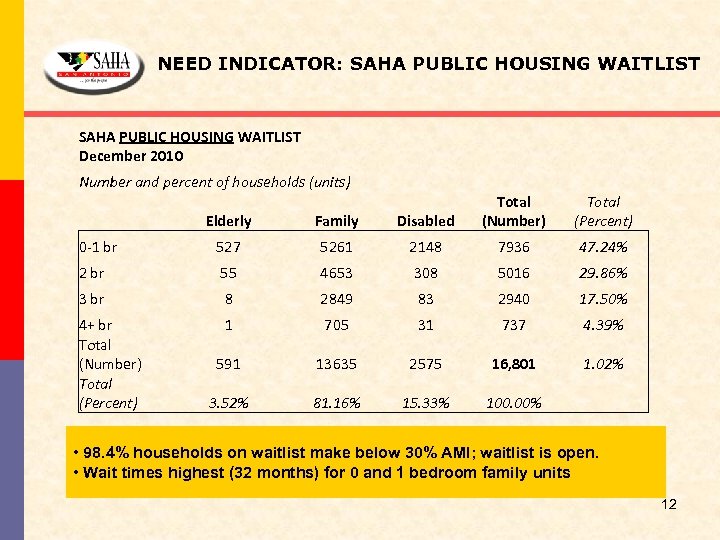
NEED INDICATOR: SAHA PUBLIC HOUSING WAITLIST December 2010 Number and percent of households (units) Elderly Family Disabled Total (Number) 0 -1 br 527 5261 2148 7936 47. 24% 2 br 55 4653 308 5016 29. 86% 3 br 8 2849 83 2940 17. 50% 4+ br Total (Number) Total (Percent) 1 705 31 737 4. 39% 591 13635 2575 16, 801 1. 02% 3. 52% 81. 16% 15. 33% 100. 00% Total (Percent) • 98. 4% households on waitlist make below 30% AMI; waitlist is open. • Wait times highest (32 months) for 0 and 1 bedroom family units 12
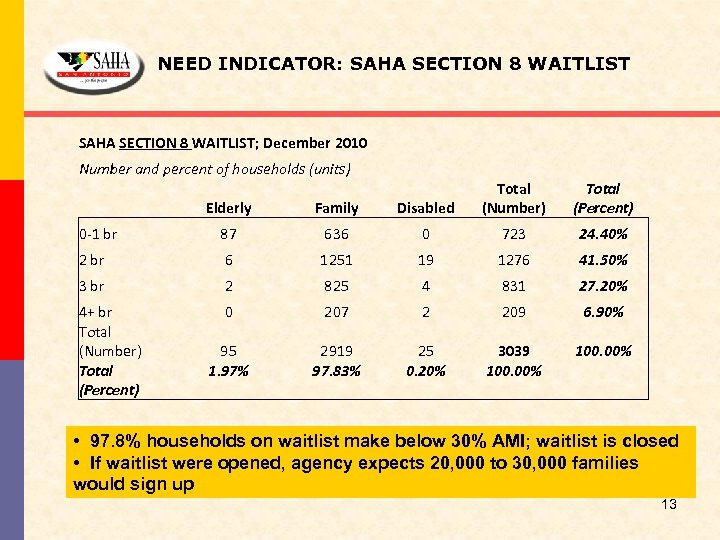
NEED INDICATOR: SAHA SECTION 8 WAITLIST; December 2010 Number and percent of households (units) Elderly Family Disabled Total (Number) 0 -1 br 87 636 0 723 24. 40% 2 br 6 1251 19 1276 41. 50% 3 br 2 825 4 831 27. 20% 4+ br Total (Number) Total (Percent) 0 207 2 209 6. 90% 95 1. 97% 2919 97. 83% 25 0. 20% 3039 100. 00% Total (Percent) • 97. 8% households on waitlist make below 30% AMI; waitlist is closed • If waitlist were opened, agency expects 20, 000 to 30, 000 families would sign up 13
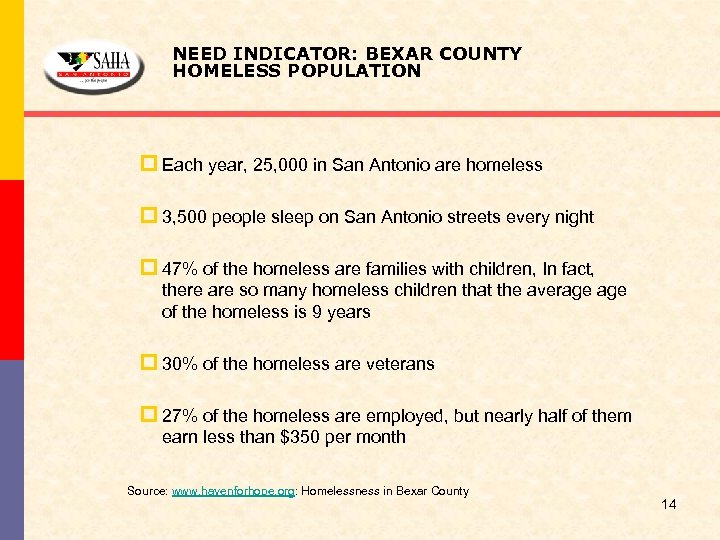
NEED INDICATOR: BEXAR COUNTY HOMELESS POPULATION p Each year, 25, 000 in San Antonio are homeless p 3, 500 people sleep on San Antonio streets every night p 47% of the homeless are families with children, In fact, there are so many homeless children that the average of the homeless is 9 years p 30% of the homeless are veterans p 27% of the homeless are employed, but nearly half of them earn less than $350 per month Source: www. havenforhope. org: Homelessness in Bexar County 14
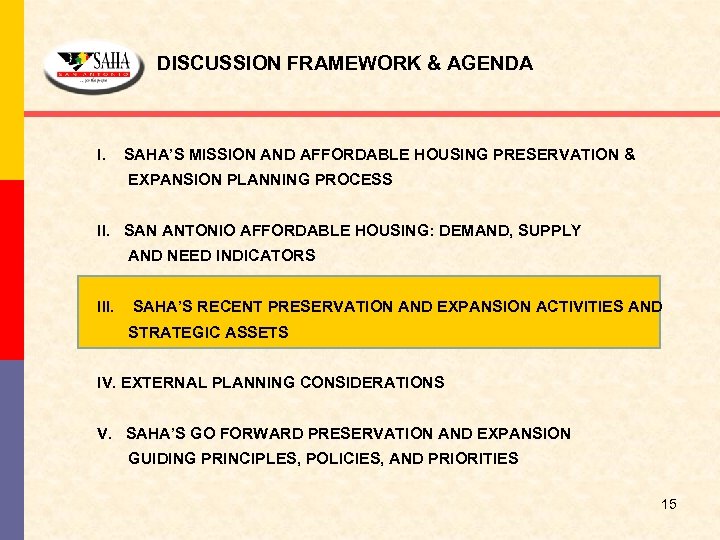
DISCUSSION FRAMEWORK & AGENDA I. SAHA’S MISSION AND AFFORDABLE HOUSING PRESERVATION & EXPANSION PLANNING PROCESS II. SAN ANTONIO AFFORDABLE HOUSING: DEMAND, SUPPLY AND NEED INDICATORS III. SAHA’S RECENT PRESERVATION AND EXPANSION ACTIVITIES AND STRATEGIC ASSETS IV. EXTERNAL PLANNING CONSIDERATIONS V. SAHA’S GO FORWARD PRESERVATION AND EXPANSION GUIDING PRINCIPLES, POLICIES, AND PRIORITIES 15
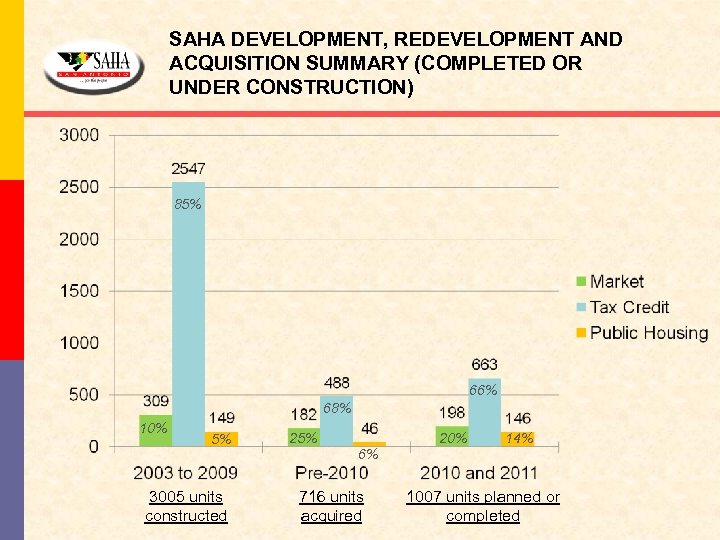
SAHA DEVELOPMENT, REDEVELOPMENT AND ACQUISITION SUMMARY (COMPLETED OR UNDER CONSTRUCTION) 85% 66% 68% 10% 5% 3005 units constructed 25% 20% 14% 6% 716 units acquired 1007 units planned or completed
SAHA COMPLETED, PLANNED AND IN PROCESS PRESERVATION ACTIVITIES Ø See attached summary 17
ASSESSMENT OF SAHA’S DEVELOPMENTS: PHYSICAL AND NEIGHBORING AMENITIES Ø See attached summary of physical condition rating (1 to 5 scale); nearby amenities (1 to 5 scale) and occupancy rate by portfolio: Ø Non-profit: 22 properties Ø Public Housing Family: 35 properties Ø Public Housing Elderly & Disabled: 36 properties Ø Amenities defined to include education, transportation, banking, grocery and jobs Ø Consider properties in poor physical condition with strong local amenities for redevelopment Ø Consider properties in poor physical condition and poor local amenities for disposition unless area is targeted for investment by multiple City agencies 18
DISCUSSION FRAMEWORK & AGENDA I. SAHA’S MISSION AND AFFORDABLE HOUSING PRESERVATION & EXPANSION PLANNING PROCESS II. SAN ANTONIO AFFORDABLE HOUSING: DEMAND, SUPPLY AND NEED INDICATORS III. SAHA’S RECENT PRESERVATION AND EXPANSION ACTIVITIES AND STRATEGIC ASSETS IV. EXTERNAL PLANNING CONSIDERATIONS V. SAHA’S GO FORWARD PRESERVATION AND EXPANSION GUIDING PRINCIPLES, POLICIES, AND PRIORITIES 19
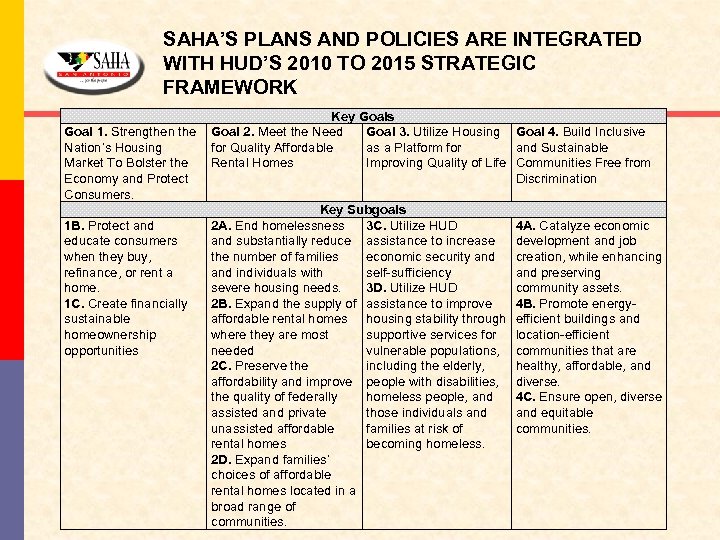
SAHA’S PLANS AND POLICIES ARE INTEGRATED WITH HUD’S 2010 TO 2015 STRATEGIC FRAMEWORK Key Goals Goal 1. Strengthen the Goal 2. Meet the Need Goal 3. Utilize Housing Goal 4. Build Inclusive Nation’s Housing for Quality Affordable as a Platform for and Sustainable Market To Bolster the Rental Homes Improving Quality of Life Communities Free from Economy and Protect Discrimination Consumers. Key Subgoals 1 B. Protect and 2 A. End homelessness 3 C. Utilize HUD 4 A. Catalyze economic educate consumers and substantially reduce assistance to increase development and job when they buy, the number of families economic security and creation, while enhancing refinance, or rent a and individuals with self-sufficiency and preserving home. severe housing needs. 3 D. Utilize HUD community assets. 1 C. Create financially 2 B. Expand the supply of assistance to improve 4 B. Promote energysustainable affordable rental homes housing stability through efficient buildings and homeownership where they are most supportive services for location-efficient opportunities needed vulnerable populations, communities that are 2 C. Preserve the including the elderly, healthy, affordable, and affordability and improve people with disabilities, diverse. the quality of federally homeless people, and 4 C. Ensure open, diverse assisted and private those individuals and equitable unassisted affordable families at risk of communities. rental homes becoming homeless. 2 D. Expand families’ choices of affordable rental homes located in a broad range of communities.
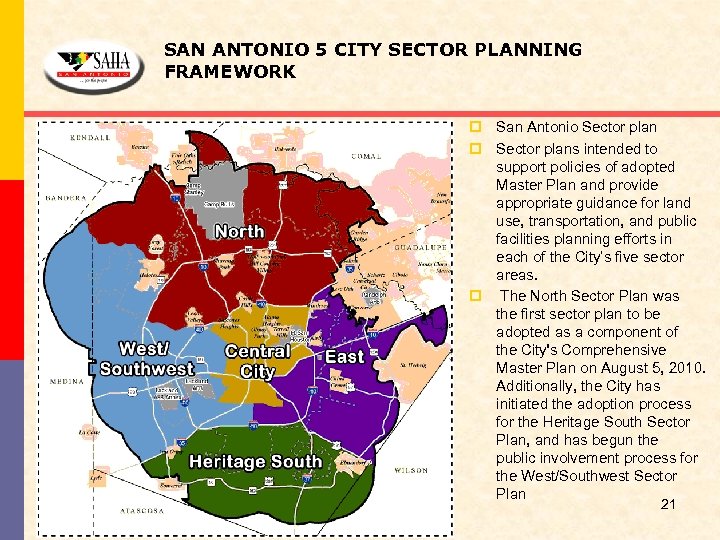
SAN ANTONIO 5 CITY SECTOR PLANNING FRAMEWORK p San Antonio Sector plan p Sector plans intended to support policies of adopted Master Plan and provide appropriate guidance for land use, transportation, and public facilities planning efforts in each of the City’s five sector areas. p The North Sector Plan was the first sector plan to be adopted as a component of the City's Comprehensive Master Plan on August 5, 2010. Additionally, the City has initiated the adoption process for the Heritage South Sector Plan, and has begun the public involvement process for the West/Southwest Sector Plan 21
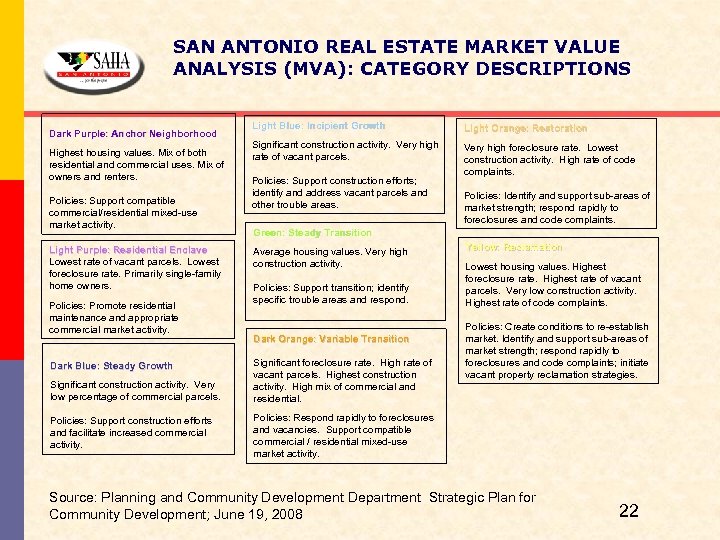
SAN ANTONIO REAL ESTATE MARKET VALUE ANALYSIS (MVA): CATEGORY DESCRIPTIONS Dark Purple: Anchor Neighborhood Highest housing values. Mix of both residential and commercial uses. Mix of owners and renters. Policies: Support compatible commercial/residential mixed-use market activity. Light Purple: Residential Enclave Lowest rate of vacant parcels. Lowest foreclosure rate. Primarily single-family home owners. Policies: Promote residential maintenance and appropriate commercial market activity. Dark Blue: Steady Growth Significant construction activity. Very low percentage of commercial parcels. Policies: Support construction efforts and facilitate increased commercial activity. Light Blue: Incipient Growth Light Orange: Restoration Significant construction activity. Very high rate of vacant parcels. Very high foreclosure rate. Lowest construction activity. High rate of code complaints. Policies: Support construction efforts; identify and address vacant parcels and other trouble areas. Policies: Identify and support sub-areas of market strength; respond rapidly to foreclosures and code complaints. Green: Steady Transition Average housing values. Very high construction activity. Policies: Support transition; identify specific trouble areas and respond. Dark Orange: Variable Transition Significant foreclosure rate. High rate of vacant parcels. Highest construction activity. High mix of commercial and residential. Yellow: Reclamation Lowest housing values. Highest foreclosure rate. Highest rate of vacant parcels. Very low construction activity. Highest rate of code complaints. Policies: Create conditions to re-establish market. Identify and support sub-areas of market strength; respond rapidly to foreclosures and code complaints; initiate vacant property reclamation strategies. Policies: Respond rapidly to foreclosures and vacancies. Support compatible commercial / residential mixed-use market activity. Source: Planning and Community Development Department Strategic Plan for Community Development; June 19, 2008 22
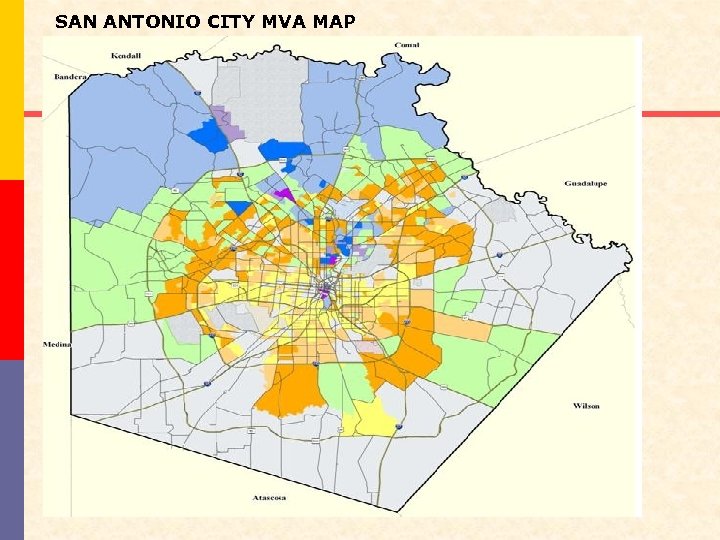
SAN ANTONIO CITY MVA MAP 23
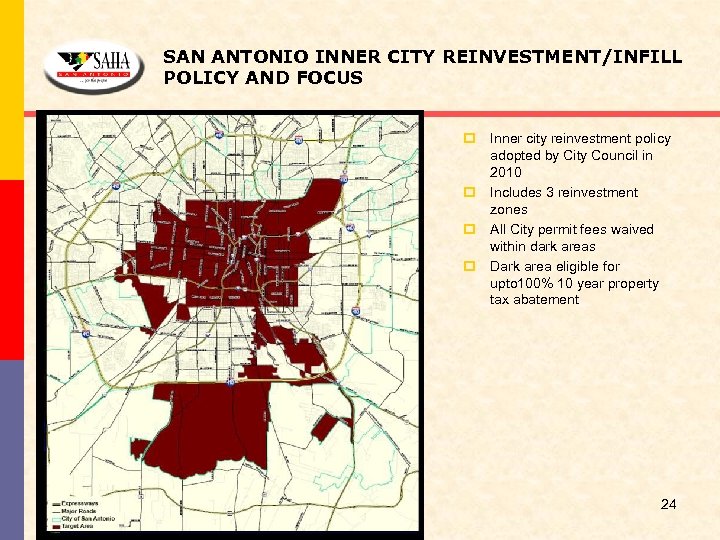
SAN ANTONIO INNER CITY REINVESTMENT/INFILL POLICY AND FOCUS p Inner city reinvestment policy adopted by City Council in 2010 p Includes 3 reinvestment zones p All City permit fees waived within dark areas p Dark area eligible for upto 100% 10 year property tax abatement 24
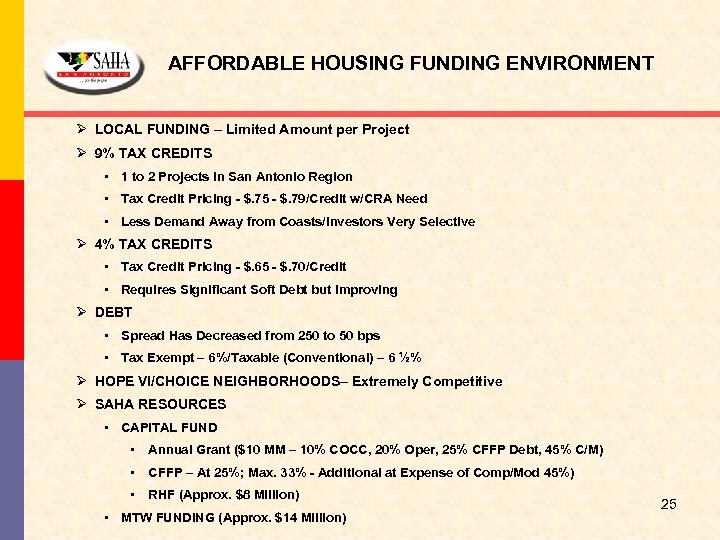
AFFORDABLE HOUSING FUNDING ENVIRONMENT Ø LOCAL FUNDING – Limited Amount per Project Ø 9% TAX CREDITS • 1 to 2 Projects in San Antonio Region • Tax Credit Pricing - $. 75 - $. 79/Credit w/CRA Need • Less Demand Away from Coasts/Investors Very Selective Ø 4% TAX CREDITS • Tax Credit Pricing - $. 65 - $. 70/Credit • Requires Significant Soft Debt but Improving Ø DEBT • Spread Has Decreased from 250 to 50 bps • Tax Exempt – 6%/Taxable (Conventional) – 6 ½% Ø HOPE VI/CHOICE NEIGHBORHOODS– Extremely Competitive Ø SAHA RESOURCES • CAPITAL FUND • Annual Grant ($10 MM – 10% COCC, 20% Oper, 25% CFFP Debt, 45% C/M) • CFFP – At 25%; Max. 33% - Additional at Expense of Comp/Mod 45%) • RHF (Approx. $8 Million) • MTW FUNDING (Approx. $14 Million) 25
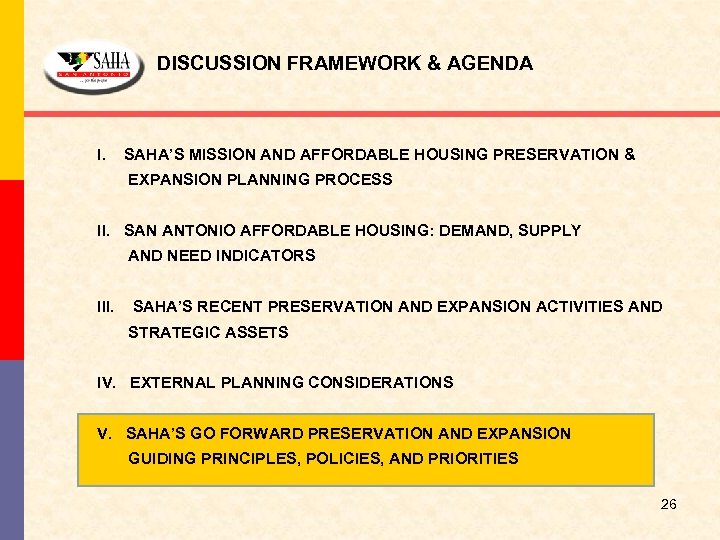
DISCUSSION FRAMEWORK & AGENDA I. SAHA’S MISSION AND AFFORDABLE HOUSING PRESERVATION & EXPANSION PLANNING PROCESS II. SAN ANTONIO AFFORDABLE HOUSING: DEMAND, SUPPLY AND NEED INDICATORS III. SAHA’S RECENT PRESERVATION AND EXPANSION ACTIVITIES AND STRATEGIC ASSETS IV. EXTERNAL PLANNING CONSIDERATIONS V. SAHA’S GO FORWARD PRESERVATION AND EXPANSION GUIDING PRINCIPLES, POLICIES, AND PRIORITIES 26
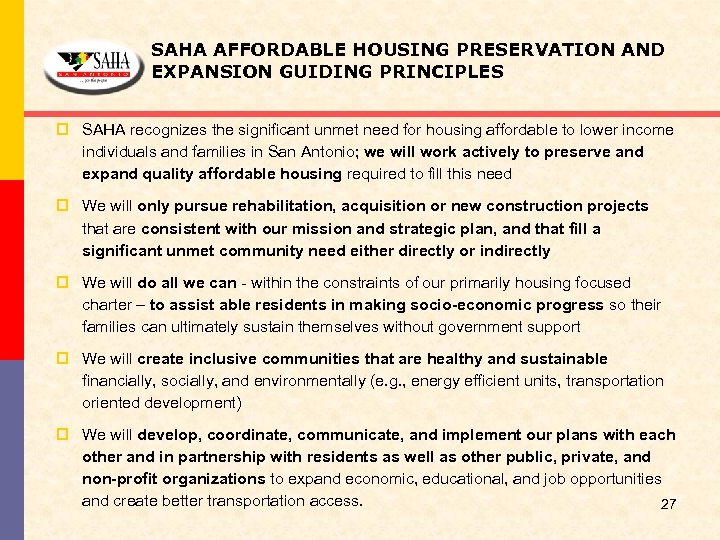
SAHA AFFORDABLE HOUSING PRESERVATION AND EXPANSION GUIDING PRINCIPLES p SAHA recognizes the significant unmet need for housing affordable to lower income individuals and families in San Antonio; we will work actively to preserve and expand quality affordable housing required to fill this need p We will only pursue rehabilitation, acquisition or new construction projects that are consistent with our mission and strategic plan, and that fill a significant unmet community need either directly or indirectly p We will do all we can - within the constraints of our primarily housing focused charter – to assist able residents in making socio-economic progress so their families can ultimately sustain themselves without government support p We will create inclusive communities that are healthy and sustainable financially, socially, and environmentally (e. g. , energy efficient units, transportation oriented development) p We will develop, coordinate, communicate, and implement our plans with each other and in partnership with residents as well as other public, private, and non-profit organizations to expand economic, educational, and job opportunities and create better transportation access. 27
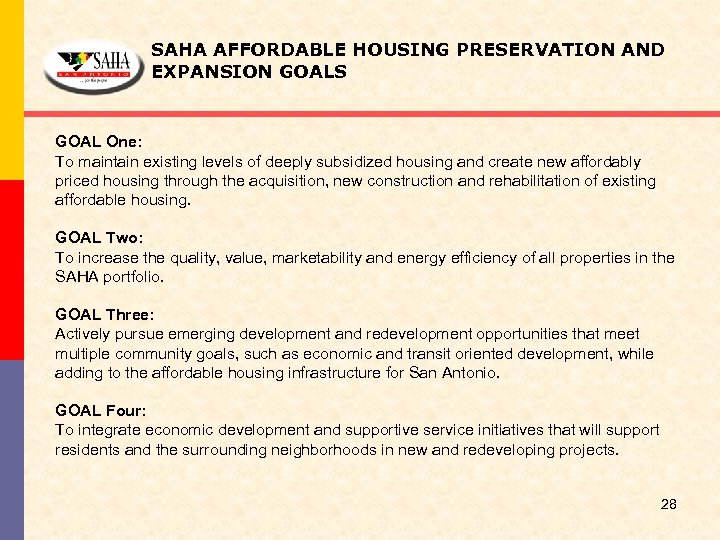
SAHA AFFORDABLE HOUSING PRESERVATION AND EXPANSION GOALS GOAL One: To maintain existing levels of deeply subsidized housing and create new affordably priced housing through the acquisition, new construction and rehabilitation of existing affordable housing. GOAL Two: To increase the quality, value, marketability and energy efficiency of all properties in the SAHA portfolio. GOAL Three: Actively pursue emerging development and redevelopment opportunities that meet multiple community goals, such as economic and transit oriented development, while adding to the affordable housing infrastructure for San Antonio. GOAL Four: To integrate economic development and supportive service initiatives that will support residents and the surrounding neighborhoods in new and redeveloping projects. 28
SAHA AFFORDABLE HOUSING PRESERVATION AND EXPANSION STRATEGIES p SAHA will pursue all available financially viable strategies to preserve and expand affordable housing in the City of San Antonio including: p Rehabilitation and maintenance (preservation) of existing affordable housing p Redevelopment of existing affordable housing p Development of new affordable housing p Acquisition of affordable housing projects or land p Disposition of developed or undeveloped land/assets p Expansion of housing choice voucher program p Execution of strategies designed to help current residents gain socioeconomic self sufficiency (so their place may be taken by a household in need) 29
DEVELOPMENT, REDEVELOPMENT & ACQUISITIONS POLICY p Project Need and Location p SAHA will only lead (by building) and/or support (by investing) projects which fulfill a community need for affordable housing, either directly or indirectly (i. e. , by generating significant capital and cash to help SAHA directly expand supply of needed affordable housing) p Community need must be determined and documented based on objective data e. g. , vacancy rates at or below ‘typical markets in equilibrium’ (e. g. , 5%), SAHA waiting list information, actual homeless counts p Project neighborhood must be stable or improving (e. g. , Choice/Promise) or SAHA and partners must commit resources p Key focus on transit oriented development and on proximity to jobs p Housing Type, Characteristics and Mix p SAHA will adopt a 1 -1 replacement policy for public housing redevelopment p 1 -1 replacement is defined as the replacement of a demolished unit with a unit or housing choice voucher affordable at an equivalent level (i. e. , based on ability to 30 pay). Replacement units are not required to be located on the same site as previous units.
DEVELOPMENT, REDEVELOPMENT & ACQUISITIONS POLICY (Contd. ) p We will continue developing mixed income communities because we believe such communities are healthier and provide better economic and social opportunities and role models for extremely, very low, and low income residents to gain socioeconomic self sufficiency p We will develop mixed income communities with at least 20 percent or more units affordable for extremely low income families and individuals p We will focus primarily on creating 1 and 2 bedroom family units, and on housing the homeless (including veterans) p Resident & Community Socio-Economic Support and Development p We will only develop properties located close to key amenities including schools, banking, grocery shopping, employers, and public transportation p Projects must maximize Section 3 resident employment opportunities, both short term and long term p We will increase business activities with minority and women owned businesses 31
DEVELOPMENT, REDEVELOPMENT & ACQUISITIONS POLICY (Contd. ) p Partner with residents and community based organizations to provide educational resources, job training, and supportive services to help families become economically stable p Partner with economic development organizations to create mixed use projects/mixed income developments and encourage/capture emerging economic development opportunities p Neighborhood Focus & Development Success Maximization p Invest in (and/or retain investments in) areas which are targeted for investment by other public, non-profit, or for-profit organizations (i. e. , we won’t be the ‘lone ranger’ investing in a troubled neighborhood) p Pursue acquisition opportunities adjacent or close to planned or ongoing redevelopment activities as strategic and supporting investments or to help eliminate negative influences to the success of redevelopment efforts p Building Design, Standards and Compliance p All development/redevelopment projects must follow SAHA’s construction and material standards (to be established by the DNR team) including a green building 32 standard to be selected by SAHA
DEVELOPMENT, REDEVELOPMENT & ACQUISITIONS POLICY (Contd. ) p Building design must be current and responsive to community needs/environment ; design must incorporate sustainable (not just green) concepts and practices p All development/redevelopment projects must include a replacement and compliance plan and funding set-aside upfront p All developments to adopt smoke-free policy p Resident and Community Input p Residents and community members must have the opportunity to contribute meaningfully and in advance to the design of any planned projects p Financial Viability and Sustainability p A realistic long term financial projection must be completed, including both the construction period and the lease out period. Rent and lease out/vacancy assumptions must incorporate an analysis of competing current and planned projects in the neighborhood p SAHA must value the economic contribution of its tax exempt status by comparing financial cash flows relative to a taxable market rate project and capture project economics commensurate with this value contribution p All projects must meet SAHA’s underwriting criteria 33
DEVELOPMENT, REDEVELOPMENT & ACQUISITIONS POLICY (Contd. ) p Financial analysis of acquisitions must incorporate input of DNR team upfront including: p Evaluation of rehab/improvement needs to ensure the project is financially sustainable long term p Estimated cost of bringing project up to SAHA standards p Physical condition review to support financial projections 34
SAHA’S CURRENT 3 -5 YEAR DEVELOPMENT AND REDEVELOPMENT PROJECT PIPELINE Ø VICTORIA COMMONS • Artisan Park Townhomes (98 Units) • Leigh Street Homes (24 Homes + 2) • Durango Street Tract (Vacant 2 acres) • VC Admin Building (Vacant 9000+ SF) Ø SAN JUAN SQUARE Ø SUTTON OAKS • Phase 1 Complete Dec. 2010 • Ø REX SITE • Vacant – 2. 5 Acres Ø WHEATLEY COURTS • Phase 3 (200 Units w/HOPE VI) • Phase 3 Phase 2 (252 Units) • • IH-35 Commercial Tract (1. 946 Acres) Redevelopment of 248 PH Units 35
NEXT STEPS Ø All of the input received today will be incorporated into this document, as well as the written affordable housing preservation and expansion policy document to be approved by the BOC in February Ø Once this plan and policy are approved by the BOC, the team will shift their focus on developing detailed work plans by City Sector and/or portfolio Ø These plans will prioritize projects or areas for redevelopment, new development, acquisition, and disposition Ø The team’s work-planning process will incorporate analysis of the current value of assets, strategic potential of assets, and cost to retain/maintain assets Ø The DNR team will collaborate with the Section 8 and MTW teams to both maximize preservation and expansion of needed affordable housing and increase the focus on resident socio-economic success 36
Скачать презентацию SAN ANTONIO AFFORDABLE HOUSING PRESERVATION EXPANSION PLAN
78a748f6d4f3dae856312517ce2f96a3.ppt