


 Скачать презентацию Samuel Taylor Coleridge 1772 1834 English lyrical
002bc69131ebb8df203eb69c1bef35a8.ppt
- Количество слайдов: 25
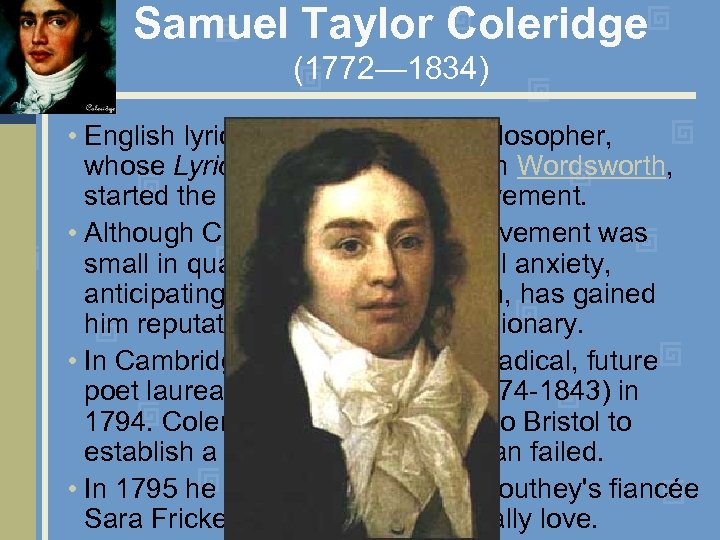 Samuel Taylor Coleridge (1772— 1834) • English lyrical poet, critic, and philosopher, whose Lyrical Ballads, written with Wordsworth, started the English Romantic movement. • Although Coleridge's poetic achievement was small in quantity, his metaphysical anxiety, anticipating modern existentialism, has gained him reputation as an authentic visionary. • In Cambridge Coleridge met the radical, future poet laureate Robert Southey (1774 -1843) in 1794. Coleridge moved with him to Bristol to establish a community, but the plan failed. • In 1795 he married the sister of Southey's fiancée Sara Fricker, whom he did not really love.
 Coleridge and Wordsworth • Coleridge's collection Poems On Various Subjects was published in 1796, and in 1797 appeared Poems. In the same year he began the publication of a short-lived liberal political periodical The Watchman. • He started a close friendship with Dorothy and William Wordsworth, one of the most fruitful creative relationships in English literature. • From it resulted Lyrical Ballads, which opened with Coleridge's 'Rime of the Ancient Mariner' and ended with Wordsworth's 'Tintern Abbey. ' • These poems set a new style by using everyday language and fresh ways of looking at nature.
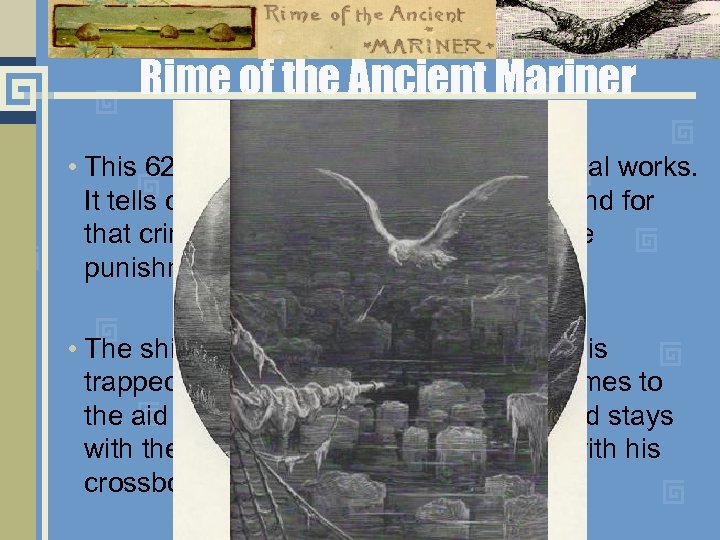 Rime of the Ancient Mariner • This 625 -line ballad is among his essential works. It tells of a sailor who kills an albatross and for that crime against nature endures terrible punishments. • The ship upon which the Mariner serves is trapped in a frozen sea. An albatross comes to the aid of the ship, it saves everyone, and stays with the ship until the Mariner shoots it with his crossbow.
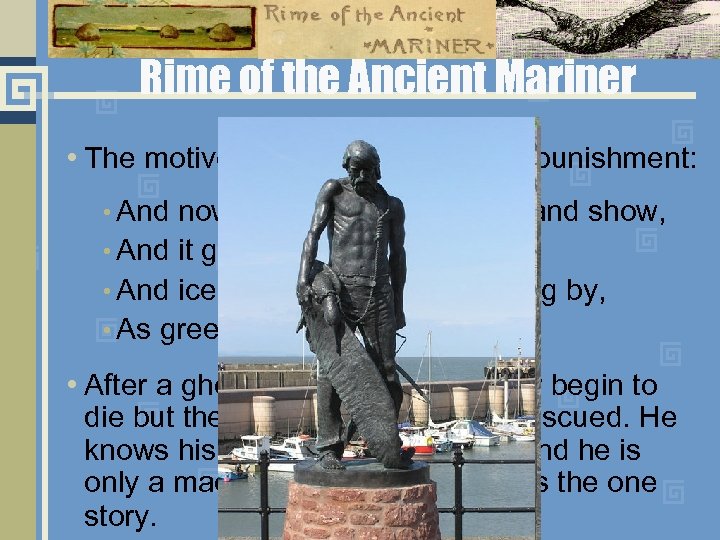 Rime of the Ancient Mariner • The motiveless malignity leads to punishment: • And now there came both mist and show, • And it grew wondrous cold; • And ice, mast high, came floating by, • As green as emerald. • After a ghost ship passes the crew begin to die but the mariner is eventually rescued. He knows his penance will continue and he is only a machine for dictating always the one story.
 Coleridge and Kant • Disenchanted with the political developments in France, he visited Germany in 1798 -99 with the Wordsworths, and became interested in the works of Immanuel Kant. He studied philosophy at Göttingen University and mastered German. • In 1799 Coleridge fell in love with Sara Hutchinson, the sister of Wordsworth's future wife, to whom he devoted his work Dejection: An Ode (1802). During these years Coleridge also began to compile his Notebooks, daily meditations of his life. • Suffering from neuralgic and rheumatic pains, Coleridge had became addicted to opium, freely
 Kubla Khan Or, a Vision in a Dream. A Fragment. • From 1808 to 1818 he he gave several lectures, chiefly in London, and was considered the greatest of Shakespearean critics. • “Kubla Khan” was inspired by a dream. In the summer of 1797 the author had retired to a lonely farm-house between Porlock and Linton. • He had taken anodyne and after three hours sleep he woke up with a clear image of the poem. Disturbed by a visitor, he lost the vision, with the exception of some eight or ten scattered lines and images. • Modern scholarship is skeptical of this story, but it reflects Coleridge's problems to manage practical
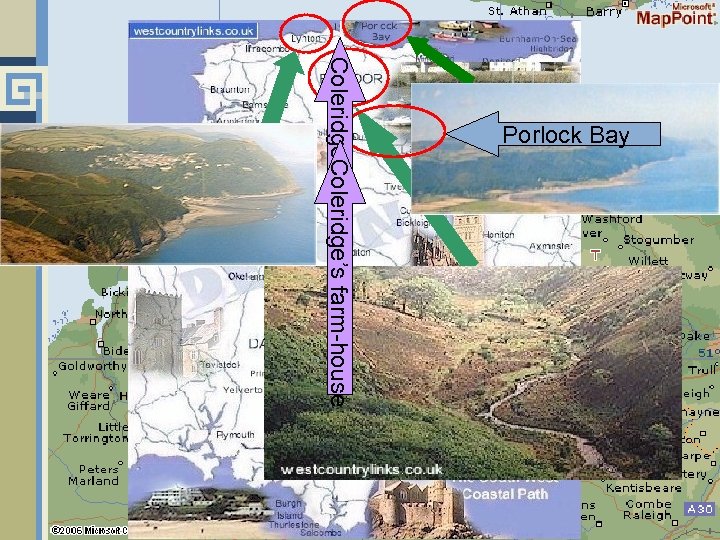 Coleridge’s farm-house Coleridge's note • The following fragment is here published at the Porlock Bay request of a poet of great and deserved celebrity [Lord Byron], and, as far as the Author's own opinions are concerned, rather as a psychological curiosity, than on the ground of any supposed poetic merits. • In the summer of the year 1797, the Author, then in ill health, had retired to a lonely farm-house between Porlock and Linton, on the Exmoor confines of Somerset and Devonshire. • In consequence of a slight indisposition, an anodyne had been prescribed, from the effects of which he fell asleep in his chair at the moment that he was reading the following sentence, or words of the same substance, in Purchas's Pilgrimage:
 Coleridge's note • The Author continued for about three hours in a profound sleep, at least of the external senses, during which time he has the most vivid confidence, that he could not have composed less than from two to three hundred lines; • if that indeed can be called composition in which all the images rose up before him as things, with a parallel production of the correspondent expressions, without any sensation or consciousness of effort. • On awakening he appeared to himself to have a distinct recollection of the whole, and taking
 • At this moment he was unfortunately called out by a person on business from Porlock, and detained by him above an hour, and on his return to his room, found, to his no small surprise and mortification, that though he still retained some vague and dim recollection of the general purport of the vision, yet, with the exception of some eight or ten scattered lines and images, all the rest had passed away like the images on the surface of a stream into which a stone has been cast, but, alas! without the after restoration of the latter!
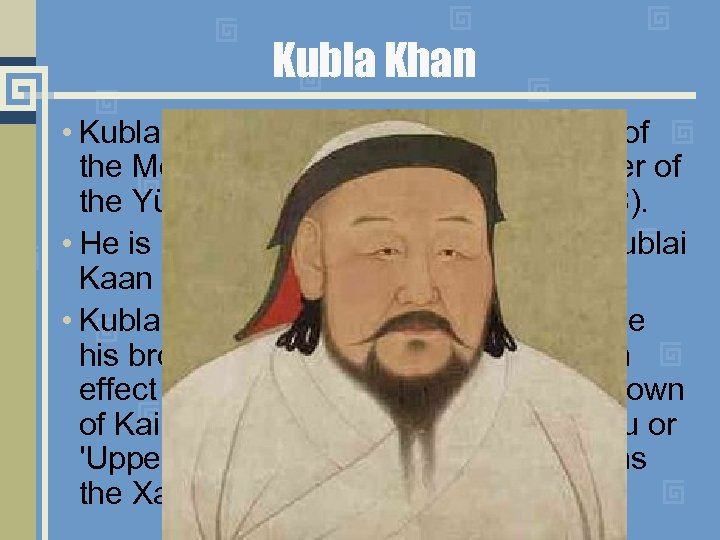 Kubla Khan • Kublai Khan (1215 -1294) was the fifth of the Mongol great khans and the founder of the Yüan Dynasty in China (1279 -1368). • He is best known in the West as the Cublai Kaan of Marco Polo. • Kublai founded what was intended to be his brother's new capital but became in effect his own summer residence, the town of Kaiping. It later was named Shang-tu or 'Upper Capital' and was immortalised as the Xanadu of Coleridge's poem.
 The Form of “Kubla Khan” • The chant-like, musical incantations of "Kubla Khan" result from Coleridge's masterful use of iambic tetrameter and alternating rhyme schemes. • The first stanza is written in tetrameter with a rhyme scheme of ABAABCCDEDE, alternating between staggered rhymes and couplets. • The second stanza expands into tetrameter and follows roughly the same rhyming pattern, also expanded-- ABAABCCDDFFGGHIIHJJ. • The third stanza tightens into tetrameter and rhymes ABABCC. • The fourth stanza continues the tetrameter of the
 Stanza 1 an introduction - the ruler, the place, the decree • In Xanadu did Kubla Khan Alpheus = the A stately pleasure-dome decree : classical Where Alph, the sacred river, ran underground river Through caverns measureless to man Down to a sunless sea. The Latin origin of the word sacred has 2 meanings: sacer caverns (caves etc. ) of = 'holy' or 'connected with a measureless, "superhuman" god of the is The river‘s final destination underworld'; the dimensions, i. e. of expanses surroundings a place of extreme darkness of the river which man (human skill or the perhaps suit and indefinite depth (down to the second powers of the human mind) is a sunless sea). meaning best: at least a not able to "fathom" both in a http: //englishromantics. com/kublakhan/inde
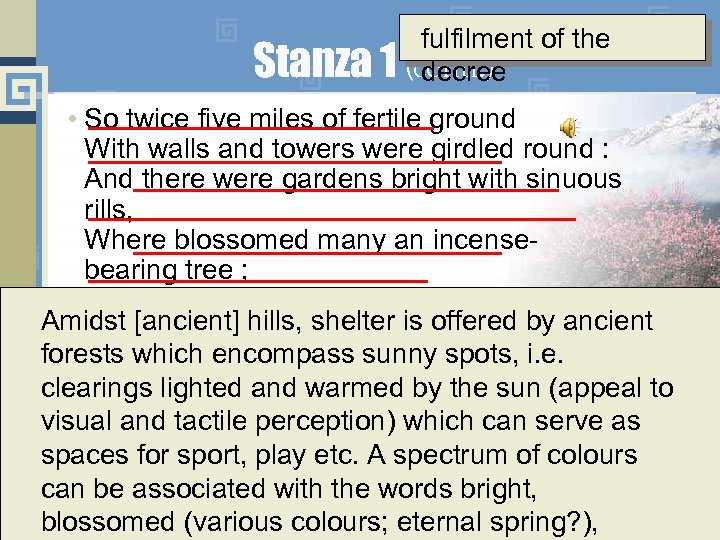 fulfilment of the Stanza 1 (conti. ) decree • So twice five miles of fertile ground With walls and towers were girdled round : And there were gardens bright with sinuous rills, Where blossomed many an incensebearing tree ; And here were forests ancient as the hills, Amidst [ancient] hills, shelter greenery. the landscape Aand theis offered artificial Enfolding sunny spots ofpicture of ofby ancient Natural conditions vivid results i. e. forests which encompass sunny spots, five miles of is given to an ideal kind of here: twice shaping seem to warmed by the sun clearings lighted andconnectare reserved(appeal to ground for the environment: fertile ground provides serve as an ideal visual and tactile perception) whicharea is girdled "project". The can e. g. of a basis for cultivation of A spectrum of spaces for sport, play etc. various kinds, colours (surrounded, confined) by walls park-like area: here were gardens bright with can be associated with the words bright, and towers. sinuous (various appeal to the eye is matched rills; the colours; eternal spring? ), blossomed
 • In "Kubla Khan, " Samuel Taylor Coleridge employs a superficially loose and disjointed construction which is actually carefully designed to trigger associations of imagery that produce mental echoes of juxtaposed impressions. • The lack of a consistent rhyme scheme, the uneven division of stanzas, and the use of iambic meter with a varying number of feet all contribute to a sense of disorientation, which in turn facilitates the process of mental echoing. The most important element of this effect, however, are the images themselves:
 Stanza 2 • But oh ! that deep romantic chasm which slanted Down the green hill athwart a cedarn cover ! A savage place ! as holy and enchanted As e'er beneath a waning moon was In one climactically Coleridge evokes a of Comparison lines, arranged sequence rush of mere five First, a peculiar. . . as) of a chasm with Onahaunted (as green hill the place , i. e. , a haunted impressions crevice etc. , place, crack, encompassing suchsinister light on adjectives casts a place visited frequently by mysterious or disparate subjects a deep here withwailing forruns demon-lover a the By or a woman's spirit, "qualifies" it as a ! her as sex, woman, nature, and religion. Unable to integrate this place: the through, deep (enhancing the downward chasm isor across, a thicket of meaning apposition (slantedproper; an ideal conscious cursed place and makes it s. a. ) , thesetting of the word chasm [/] down. . . ; romantic cedar trees of imagery rationally, athwart. . . for a mind givesespecially in a with mourning" (wailing), (associations: connected sloping "scene of "forbidden longing or beautiful, and wild, = across, way to the subconscious process of association, adventure, meaning and demonic and forbidden multipledanger, mystery, a series landscape, thus leaving the reader direction" ; notelove between humanswith love etc. ; of fantastic and of cover demon-lover). that wild, powers (the woman += savage (naturally are felt cf. following mysterious impressions connotations words) andthicket: roof, Classically,
 • And from this chasm, with ceaseless turmoil seething, As if this earth in fast thick pants were breathing, A mighty fountain momently was forced: Amid whose swift half-intermitted burst Huge fragments vaulted like rebounding hail, With the grain beneath the thresher'saflail: of illustrative comparisons, Or chaffyhelp with this eruption. A complex aps, Alph is the source offamiliar phenomena serve to The Comparisons breaksan eruption is(flung up) sacred river throws itself up violently given: graphic description of this The magma etc. dancing rocks at oncetraits of And 'middancing picture: Thewith shows place to e illustrates the phenomenon: forthearth very great at amidst these graphic rocks. Its eruption takes and createat short intervals, or continuously, with a these. . . A mighty rocks are[is] From chasm fountain likened speed, thisgod(dess), breathing. . . in fast thick fering human or simultaneously, or which hit the 1 st ever once, i. e. either hail, the grains of suddenly; the rebounding driven out of the ground by forced, i. e. increasing and decreasing intensitybringing up (swift s, i. e. fighting for breathoff, and fallsacred. Chaffy half-with meaning would rather etc. , and, finally, is identical suggest that Alph river. grain It flung up or supernatural forces, ground, bounce geological momently the again; the fountain, in a(cf. phlegm; form and quality, and is ause intermittedassuming a new this matter hugeterms: ofbehaves burst); among when, in order to the trouble similar way in supernatural momently, i. e. at fragments, erupt; thethat moment, or at rock, or i. e. enormous boulders of 2 nd the vil). continuing to the chaff frommeaning would imply that separate The gigantic and usable grain, wheat intervals. additional hurled powerful lumps of magma, are to that of thethe air (vault = into fountain, and this etc. is beaten beneath the thresher's flail, a stick eruption is ejection of water is seething with endless
 Running in bends, changing its direction as if moving through a labyrinth. • Five miles meandering with a mazy motion Through wood and dale the sacred river ran, Then reached the caverns measureless to man, And sank in tumult to a lifeless ocean : Amid this tumult, Kubla perceives Ancestral And 'mid this tumult Kubla heard from voices, i. e. the voices of (wise) forefathers, or far those of religious prophets etc. They come from Ancestral voices prophesying war ! etc. ), far (figurative meaning: from heaven Stanza 2 announcing the event of war, which implies the (conti. ) destruction of the pleasure-dome etc. and loss
 Repeating the contrasting images of the sunny pleasure-dome (connotations: warmth, brightness etc. ) and the caves of ice (= caverns, s. a. ; • The shadow darkness etc. ) pleasure connotations: cold, of the dome ofthe speaker gives his evaluation of the phenomenon depicted in the Floated midway on the waves ; preceding lines; he terms it as a miracle, i. e. an Where was heard the mingled measure unexpected event of a super- the caves. and, at the From the fountain and natural kind, same time, as based upon a very peculiar kind of It was a miracle of rare device, design or plan (of on device). Here one finds oneselfrarethe "dark" side of the pleasure- Stanza 3 A sunny pleasure-dome with caves of dome which! casts its shadow on the surface of the flowing ice lava and/or water where it is reflected and appears to be moving on the flow. In this way the material manifestation of too great human ambition or aspiration as the potential source of catastrophe, is associated with the disaster. Auditory impressions blend with the visual ones: at the same location, the mingled measure (mixed acoustic
 Stanza 4 • It is thought that the final stanza of the poem, thematizing the idea of the lost vision through the figure of the "damsel with a dulcimer" and the milk of Paradise, was written post-interruption. • The mysterious person from Porlock is one of the most notorious and enigmatic figures in Coleridge's biography; no one knows who he was or why he disturbed the poet or what he wanted or, indeed, whether any of Coleridge's story is actually true. • But the person from Porlock has become a metaphor for the malicious interruptions the world throws in the way of inspiration and genius, and "Kubla Khan, " strange and ambiguous as it is, has become what is perhaps the definitive statement on the obstruction and thwarting of the visionary
 Deeply impressed, the speaker voices a Stanza 4 complex wish, the first The imagination of this scenepart of which explicitly would give him, or • gain him, very intensive, profound pleasure. The A damsel with a dulcimer refers to the vision itself In a vision once I saw : In contrast not. Kubla's palace etc. the emotional speaker is to only conscious of and particular to which he would like It was of the vision (the delight) but also (sunny) an the features of. Abyssinian maid, this paradise-like place impact process landscape of Xanadu, thatof the The of "building" reproduce and re. And and those caves of played, domeon her dulcimer she ice would be built inthis be potential inspirational powersexperience in his air, connected with mind. would, according to the speaker's imagination, Singing of Mount an immaterial i. e. be founded on Abora. (cf. thebasis is and quality delight: as an "imaginative potential" it the accompanied by music nature Could I prerequisite vision, (associations: "lofty" ametheheavenbeautiful sight The speaker recalls sky or fulfilment of anotherto essentialrevive within to s. a. ; i. e. a as opposed of the damsel's music; celestial music, Her earth, the and own building or "low"symphony - his song, loudheavy element, ofis and/or his wish light versus the which, however, a part of a dreamlike experience, and designingof a harmony of the spheres) long, i. e. To such a deep delight 'twould over-all brightness versus (partial) darkness; the not restricted place. extensive (eternal? ) duration. paradise-like to visual impressions: a damsel, or great intensity and win me, poetic from Abyssinia (location of "Eden"), sings of maid, genius' immaterial, indestructible paradise That the commanding genius' versus Abora (high place, mountain of theparadise Mountwith music loud and long, doomed Gods I material gigantomania, air, of would build that dome inetc. ). where "Abassin", i. e. etc. ; "Mount Amara", the place That sunny dome those caves Abyssinian princes!were reared). She accompanies
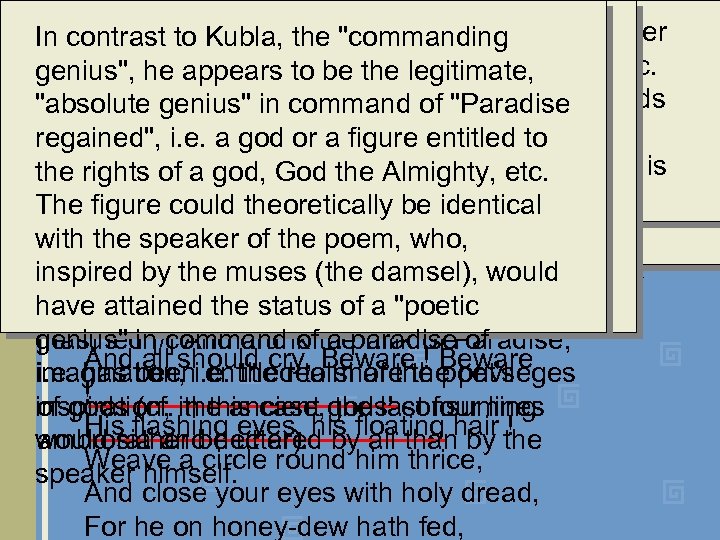 The second actimagination leaves reader speaker's is to close of the this In contrast to Kubla, the "commanding placelistener The speaker demandsyour eyes withor open to alldread, i. e. with to be the legitimate, who heard, Stanza 4 i. e. everybody who genius", he appears awe towards a has been etc. holy to perform acts of great reverence or awe able towards being. command act, which or willing genius" in The musicof the poem; "absolute to perceive thefigure representedreminds superhuman this figure: the first or"Paradise he of (should. . . ) or he performed during wishessymbolic and invites them to use regained", i. e. hisgod or ais characterised their own by the words a gestures figure entitled toby a religious god, them[selves] or etc. imagination and seemight have a there. The the rights of aor magic conjurationblinding flashing eyes which. God the Almighty, incantation, is to Weave a theoretically be thrice reaction humans, floating hair, all hair (Weave The figure could circle round (. . . i. e. should cry, a effect on he expects of them him identical Beware!speaker to or storm a fear, by with circle; thecries of warning, who, awesymbolic moving in. . . ), wind describe (cf. pictorial etc. , is the here: of the poem, circle gestures). directed towards the dominating and finally, inspired by the muses (the gods), figure of the last representations of ancient damsel), would • attained the part. And all who heard should see them haveofassumption that He on honey-dew by the poem. status of a "poetic there, genius" in[/] And drunk the milk of Paradise, [has] fed command of a paradise of And all should cry, Beware ! Beware imagination, i. e. the realm of the poet's i. e. has been entitled to share the privileges ! inspiration; in this case, gods' consuming of gods (cf. the ancient the last four lines His flashing eyes, his floating hair ! would rather be uttered by all than by the ambrosia and nectar). Weave a circle round him thrice, speaker himself. And close your eyes with holy dread, For he on honey-dew hath fed,
 Bitter Life • In 1810 Coleridge's friendship with Wordsworth came to crisis, and the two poets never fully returned to the relationship they had earlier. • During the following years Coleridge lived in London, on the verge of suicide. After a physical and spiritual crisis at Greyhound Inn, Bath, he submitted himself to a series of medical régimes to free himself from opium. • He found a permanent harbor in Highgate in the household of Dr. James Gillman, and enjoyed almost legendary reputation among the younger Romantics. During this time he rarely left the
 The End of his Life • In 1816 the unfinished poems “Christabel” and “Kubla Khan” were published, and next year appeared Sibylline Leaves. • After 1817 Coleridge devoted himself to theological and politico-sociological works - his final position was that of a Romantic conservative and Christian radical. • He also contributed to several magazines, among them Blackwood's Edinburgh Magazine. • Coleridge was elected a fellow of the Royal Society of Literature in 1824. • He died in Highgate, near Londonon July 25,
 Wordsworth & Coleridge • Wordsworth is clearly more entitled than Coleridge to be considered the leader in creating and also in expounding a new kind of poetry. • Until Coleridge met Wordsworth, which was probably in 1795, he wrote in the manner which had been fashionable since the death of Milton, employing without hesitation all those poetic licenses which constituted what he later termed `Gaudyverse, ' in contempt. • If one reads Coleridge's early poems in chronological order, one will perceive that Gaudyverse persists till about the middle of
 Coleridge’s Conversation Poems • Coleridge's shorter, meditative "conversation poems, " proved to be the most influential of his work. • Conversation poems are poems in which the speaker addresses his lines to a listener within the poem, generally a listener who has little voice of his own. • These include both quiet poems like This Lime. Tree Bower My Prison and Frost at Midnight and also strongly emotional poems like Dejection and The Pains of Sleep. • Wordsworth immediately adopted the model of these poems, and used it to compose several of