


 Скачать презентацию SAMS Review Povilas Palunas pp-1 02 18 2003 SAMS
168e073e40644962538b26a0701645fa.ppt
- Количество слайдов: 44
 SAMS Review Povilas Palunas pp-1 02/18/2003
 SAMS Outline • • pp-2 Review Specifications SAMS Architecture SAMS Control Theory Effect of Sensor Errors on Control In House Sensor Characterization Efforts Controlling Global Radius of Curvature Technical Plan 02/18/2003
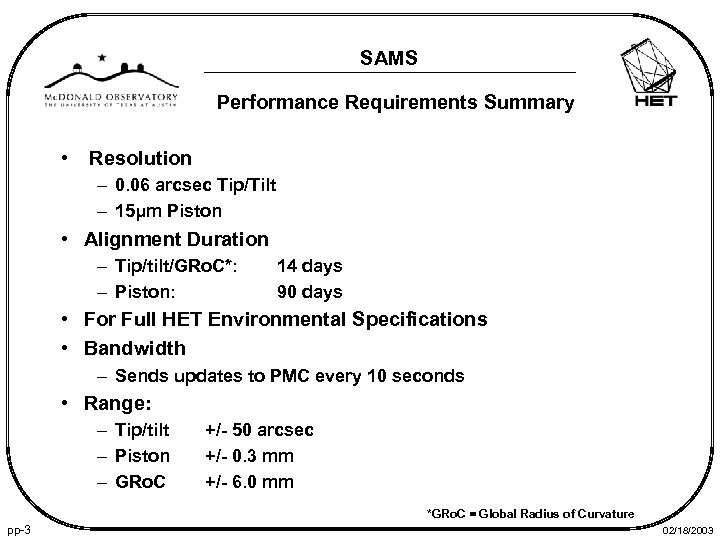 SAMS Performance Requirements Summary • Resolution – 0. 06 arcsec Tip/Tilt – 15μm Piston • Alignment Duration – Tip/tilt/GRo. C*: – Piston: 14 days 90 days • For Full HET Environmental Specifications • Bandwidth – Sends updates to PMC every 10 seconds • Range: – Tip/tilt – Piston – GRo. C +/- 50 arcsec +/- 0. 3 mm +/- 6. 0 mm *GRo. C = Global Radius of Curvature pp-3 02/18/2003
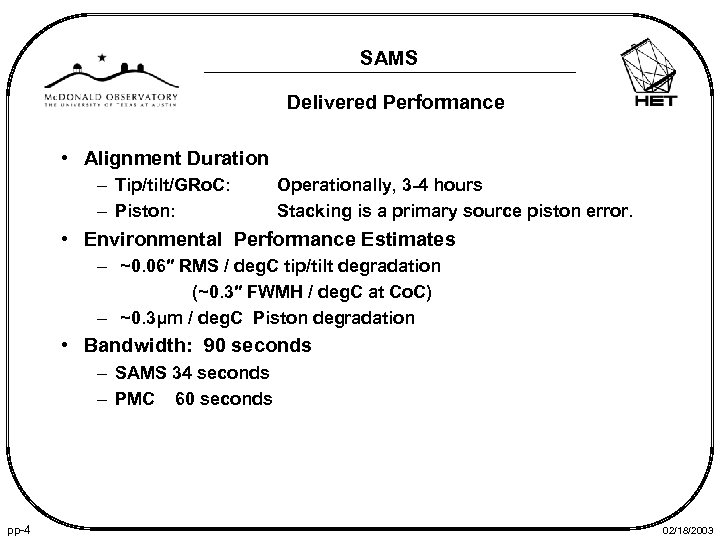 SAMS Delivered Performance • Alignment Duration – Tip/tilt/GRo. C: – Piston: Operationally, 3 -4 hours Stacking is a primary source piston error. • Environmental Performance Estimates – ~0. 06″ RMS / deg. C tip/tilt degradation (~0. 3″ FWMH / deg. C at Co. C) – ~0. 3μm / deg. C Piston degradation • Bandwidth: 90 seconds – SAMS 34 seconds – PMC 60 seconds pp-4 02/18/2003
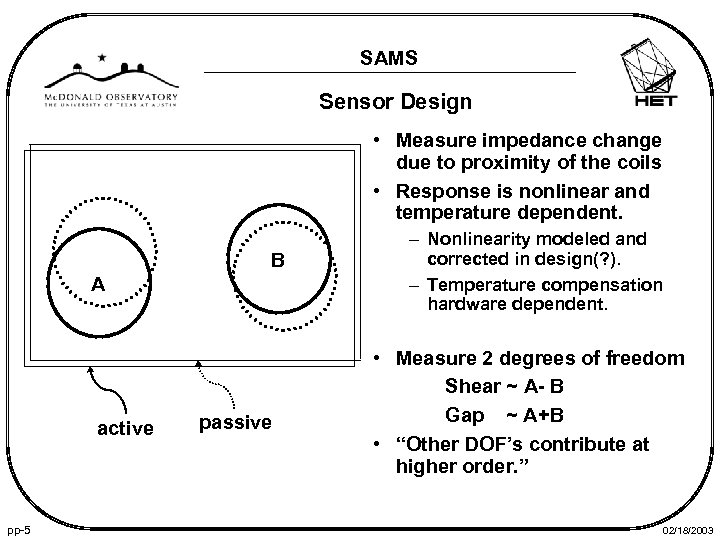 SAMS Sensor Design • Measure impedance change due to proximity of the coils • Response is nonlinear and temperature dependent. B A active pp-5 passive – Nonlinearity modeled and corrected in design(? ). – Temperature compensation hardware dependent. • Measure 2 degrees of freedom Shear ~ A- B Gap ~ A+B • “Other DOF’s contribute at higher order. ” 02/18/2003
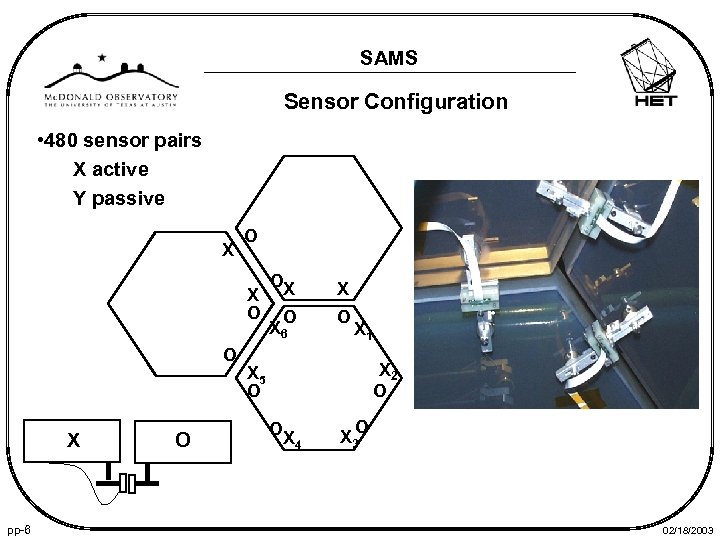 SAMS Sensor Configuration • 480 sensor pairs X active Y passive X O OX X O O X 6 O X pp-6 O X 1 X 2 O X 5 O O X 4 O X 3 02/18/2003
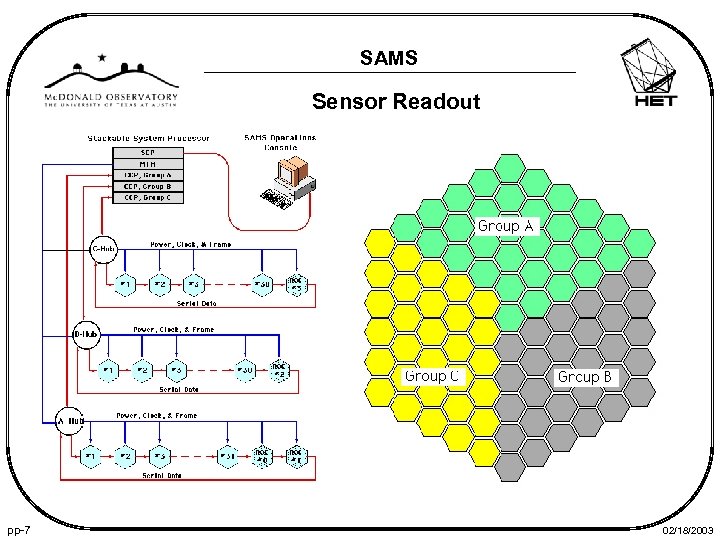 SAMS Sensor Readout pp-7 02/18/2003
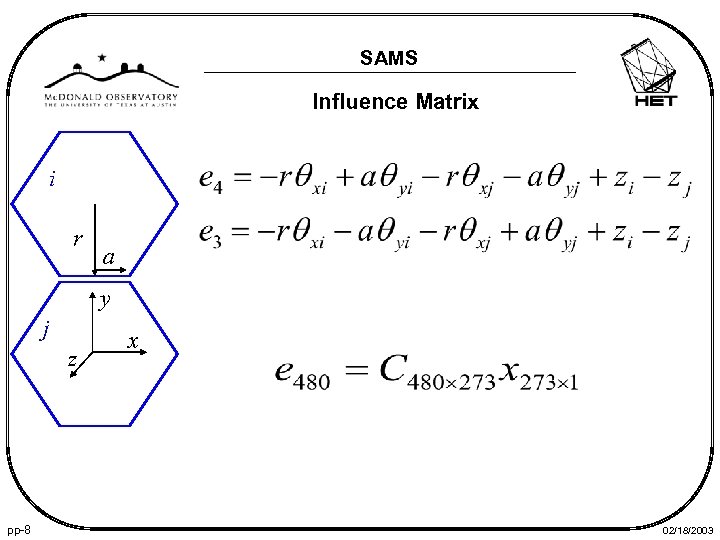 SAMS Influence Matrix i r a y j z pp-8 x 02/18/2003
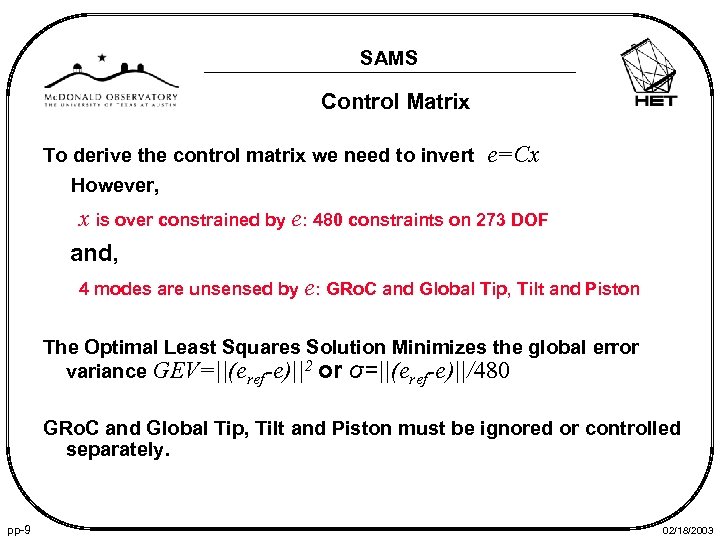 SAMS Control Matrix To derive the control matrix we need to invert However, e=Cx x is over constrained by e: 480 constraints on 273 DOF and, 4 modes are unsensed by e: GRo. C and Global Tip, Tilt and Piston The Optimal Least Squares Solution Minimizes the global error variance GEV=||(eref-e)||2 or σ=||(eref-e)||/480 GRo. C and Global Tip, Tilt and Piston must be ignored or controlled separately. pp-9 02/18/2003
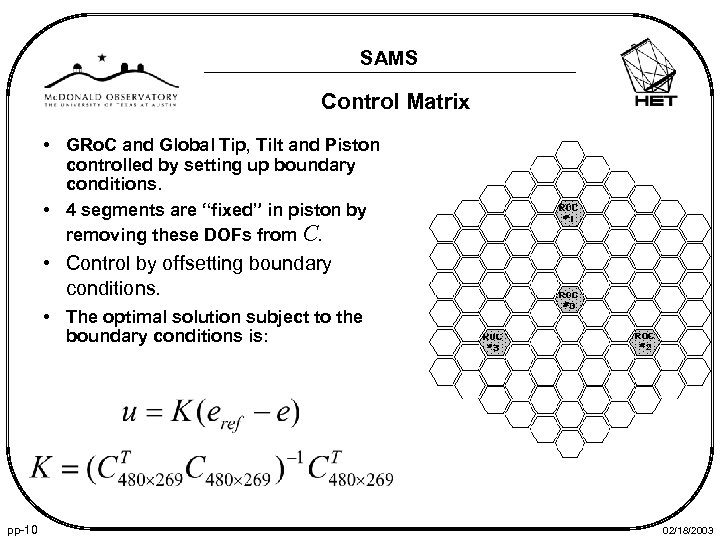 SAMS Control Matrix • GRo. C and Global Tip, Tilt and Piston controlled by setting up boundary conditions. • 4 segments are “fixed” in piston by removing these DOFs from C. • Control by offsetting boundary conditions. • The optimal solution subject to the boundary conditions is: pp-10 02/18/2003
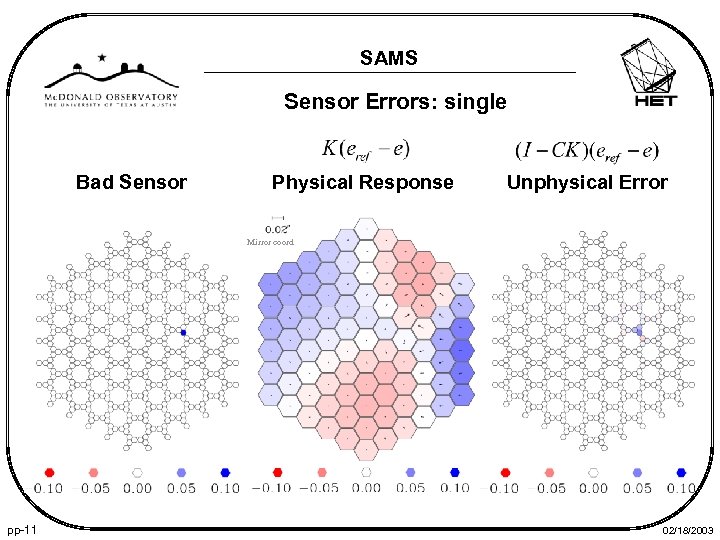 SAMS Sensor Errors: single Bad Sensor Physical Response Unphysical Error Mirror coord pp-11 02/18/2003
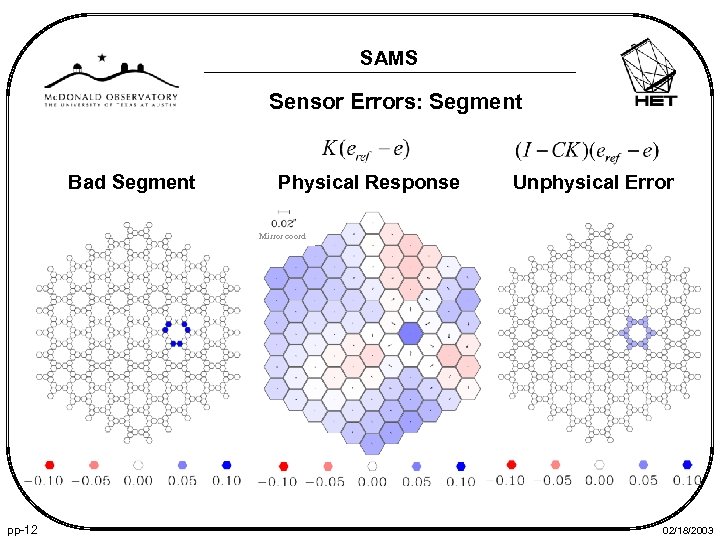 SAMS Sensor Errors: Segment Bad Segment Physical Response Unphysical Error Mirror coord pp-12 02/18/2003
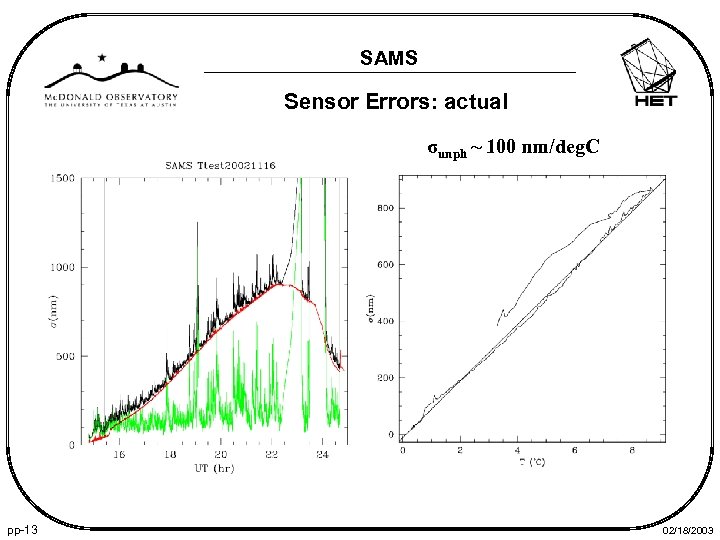 SAMS Sensor Errors: actual σunph ~ 100 nm/deg. C pp-13 02/18/2003
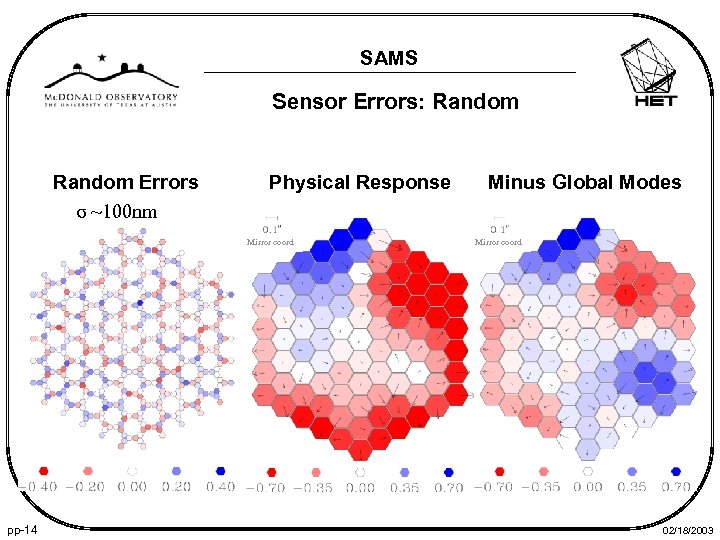 SAMS Sensor Errors: Random Errors σ ~100 nm Physical Response Mirror coord pp-14 Minus Global Modes Mirror coord 02/18/2003
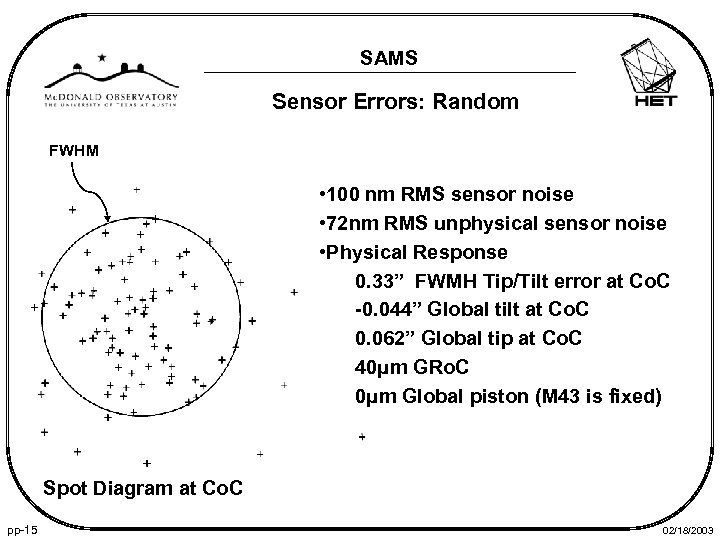 SAMS Sensor Errors: Random FWHM • 100 nm RMS sensor noise • 72 nm RMS unphysical sensor noise • Physical Response 0. 33” FWMH Tip/Tilt error at Co. C -0. 044” Global tilt at Co. C 0. 062” Global tip at Co. C 40μm GRo. C 0μm Global piston (M 43 is fixed) Spot Diagram at Co. C pp-15 02/18/2003
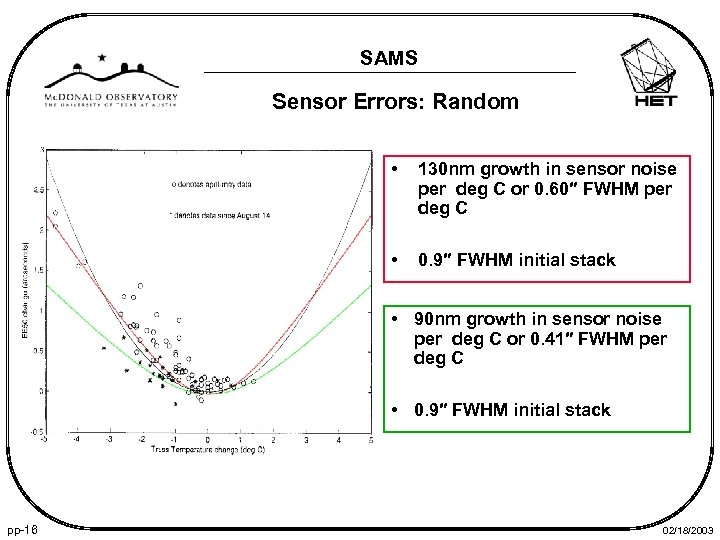 SAMS Sensor Errors: Random • 130 nm growth in sensor noise per deg C or 0. 60″ FWHM per deg C • 0. 9″ FWHM initial stack • 90 nm growth in sensor noise per deg C or 0. 41″ FWHM per deg C • 0. 9″ FWHM initial stack pp-16 02/18/2003
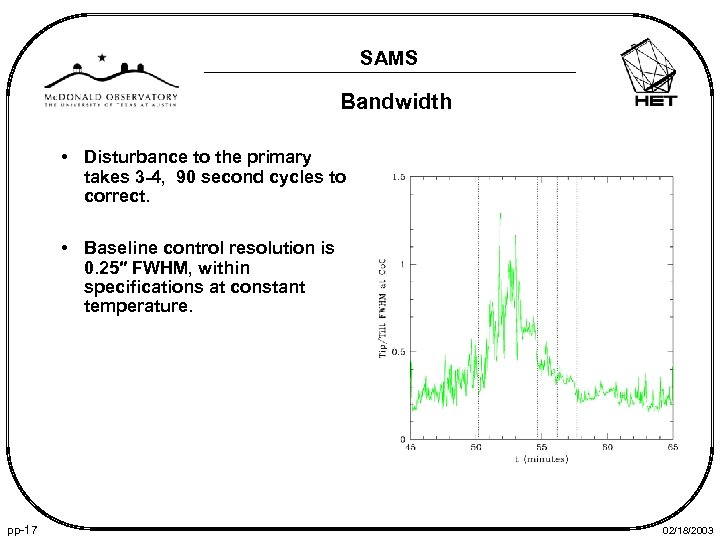 SAMS Bandwidth • Disturbance to the primary takes 3 -4, 90 second cycles to correct. • Baseline control resolution is 0. 25″ FWHM, within specifications at constant temperature. pp-17 02/18/2003
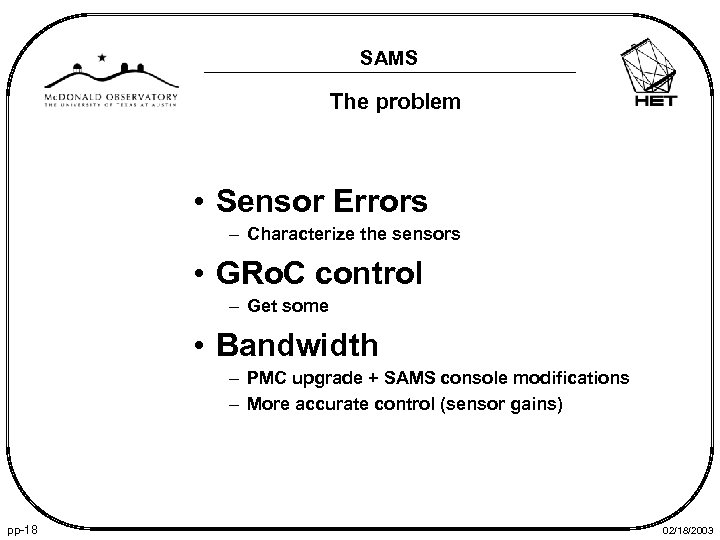 SAMS The problem • Sensor Errors – Characterize the sensors • GRo. C control – Get some • Bandwidth – PMC upgrade + SAMS console modifications – More accurate control (sensor gains) pp-18 02/18/2003
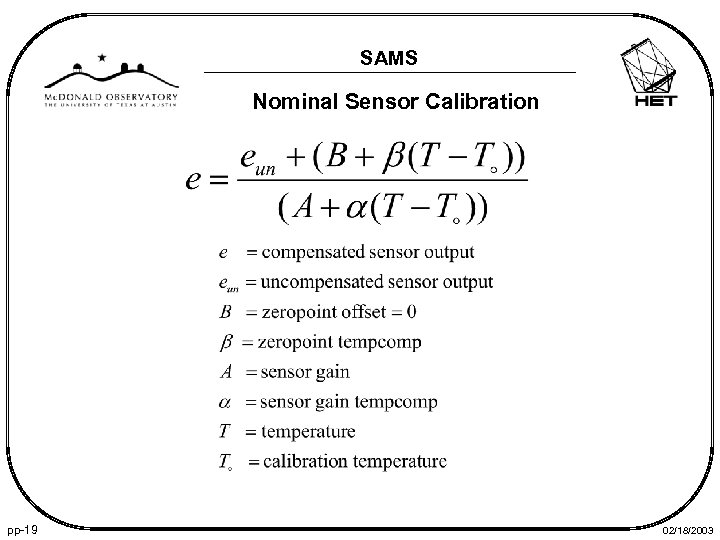 SAMS Nominal Sensor Calibration pp-19 02/18/2003
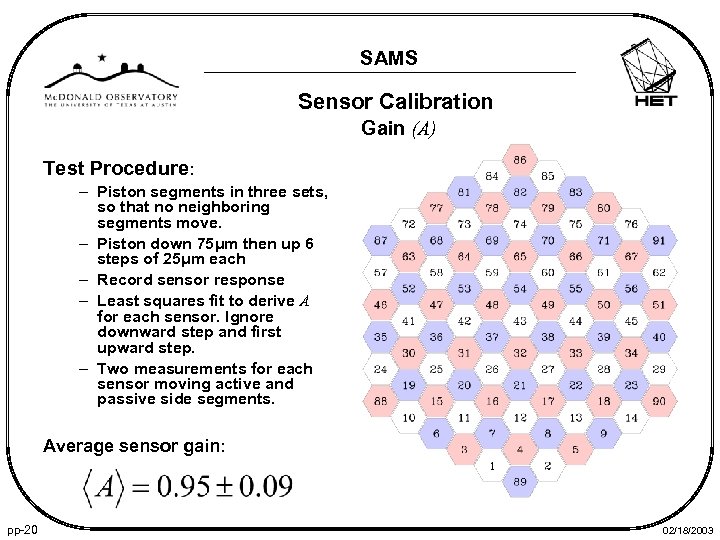 SAMS Sensor Calibration Gain (A) Test Procedure: – Piston segments in three sets, so that no neighboring segments move. – Piston down 75μm then up 6 steps of 25μm each – Record sensor response – Least squares fit to derive A for each sensor. Ignore downward step and first upward step. – Two measurements for each sensor moving active and passive side segments. Average sensor gain: pp-20 02/18/2003
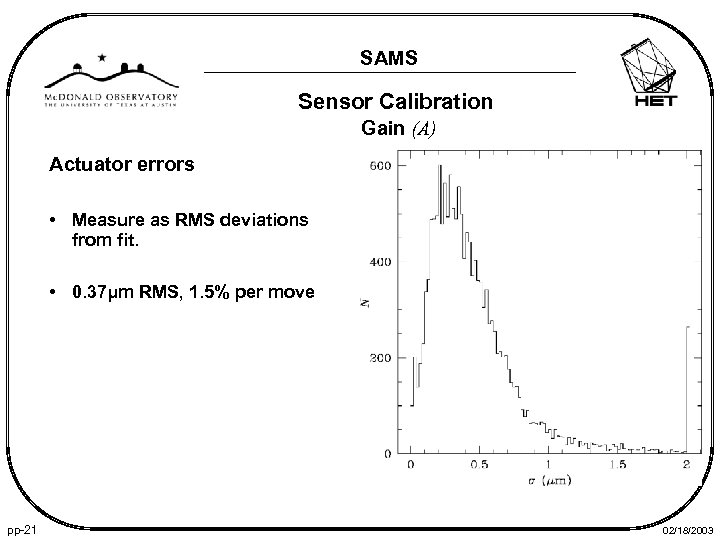 SAMS Sensor Calibration Gain (A) Actuator errors • Measure as RMS deviations from fit. • 0. 37μm RMS, 1. 5% per move pp-21 02/18/2003
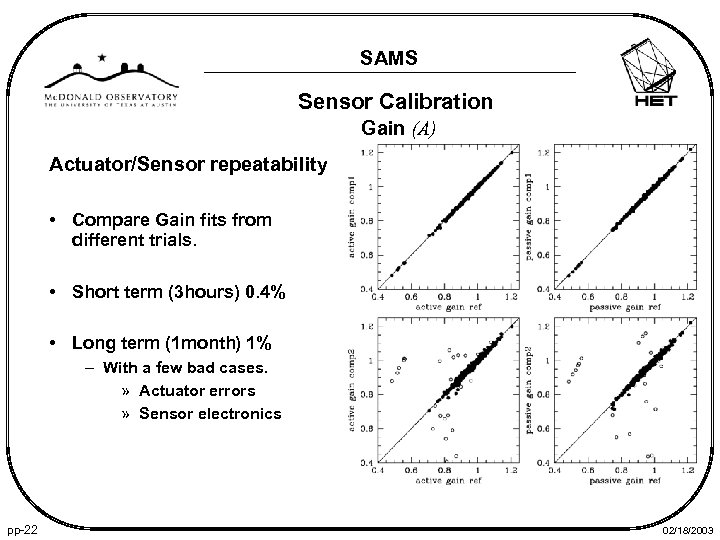 SAMS Sensor Calibration Gain (A) Actuator/Sensor repeatability • Compare Gain fits from different trials. • Short term (3 hours) 0. 4% • Long term (1 month) 1% – With a few bad cases. » Actuator errors » Sensor electronics pp-22 02/18/2003
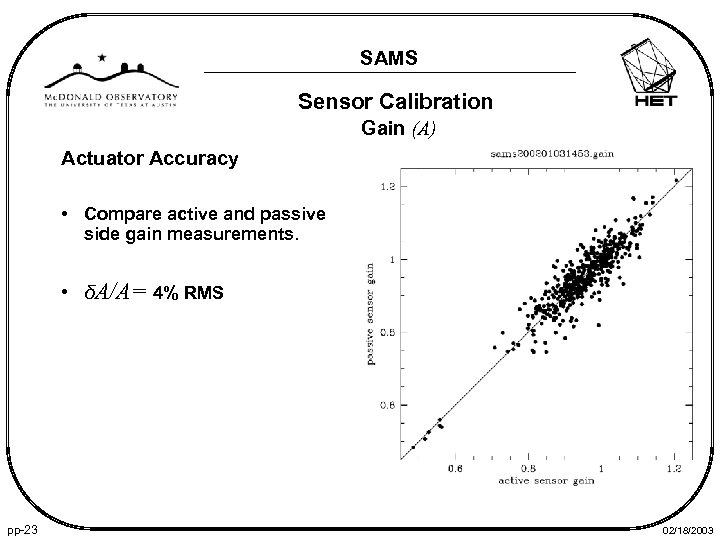 SAMS Sensor Calibration Gain (A) Actuator Accuracy • Compare active and passive side gain measurements. • δA/A= 4% RMS pp-23 02/18/2003
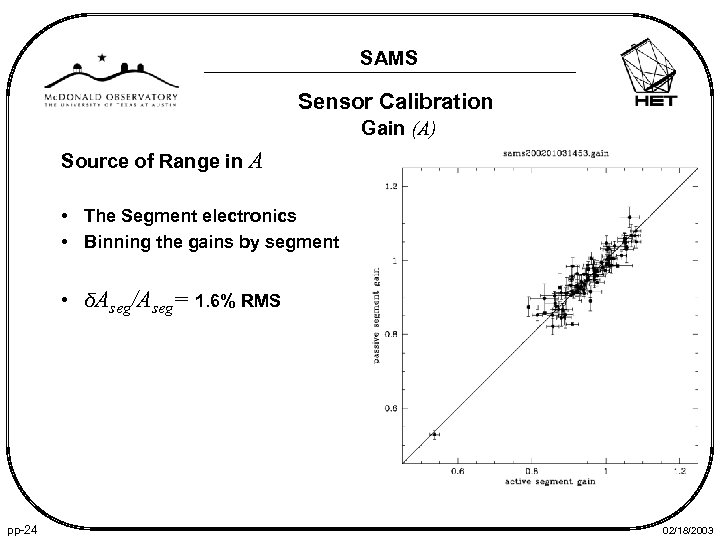 SAMS Sensor Calibration Gain (A) Source of Range in A • The Segment electronics • Binning the gains by segment • δAseg/Aseg= 1. 6% RMS pp-24 02/18/2003
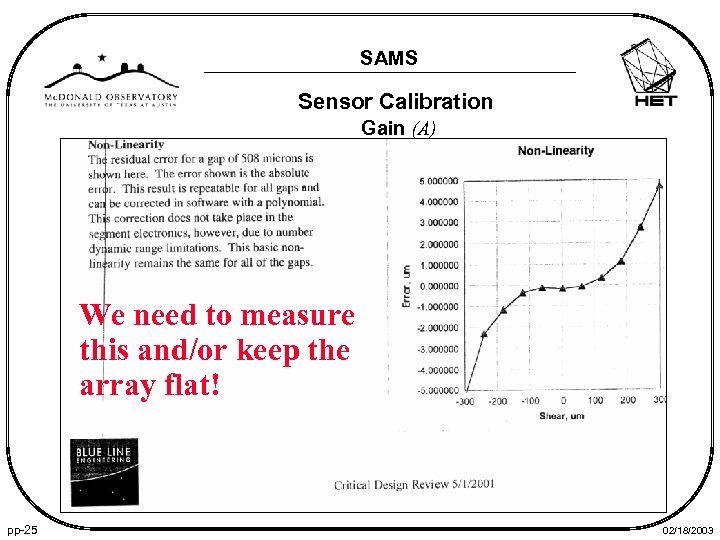 SAMS Sensor Calibration Gain (A) We need to measure this and/or keep the array flat! pp-25 02/18/2003
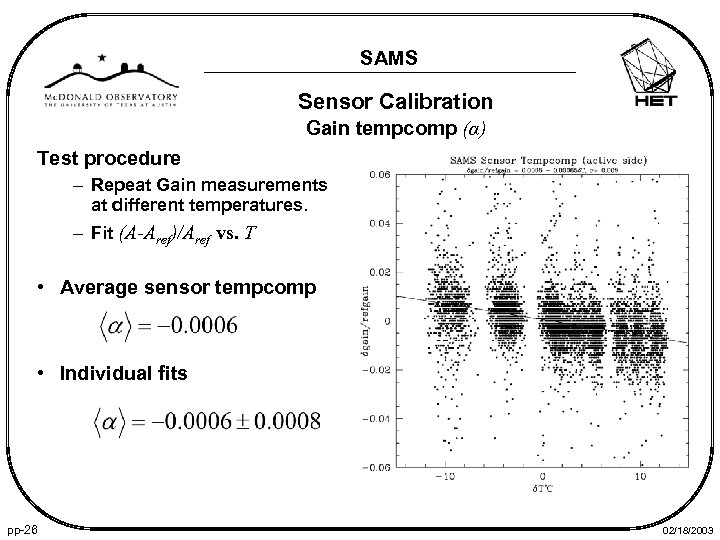 SAMS Sensor Calibration Gain tempcomp (α) Test procedure – Repeat Gain measurements at different temperatures. – Fit (A-Aref)/Aref vs. T • Average sensor tempcomp • Individual fits pp-26 02/18/2003
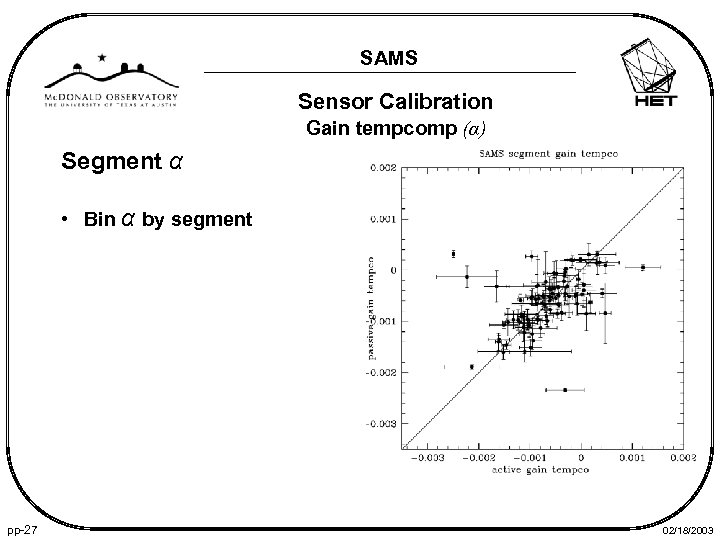 SAMS Sensor Calibration Gain tempcomp (α) Segment α • Bin α by segment pp-27 02/18/2003
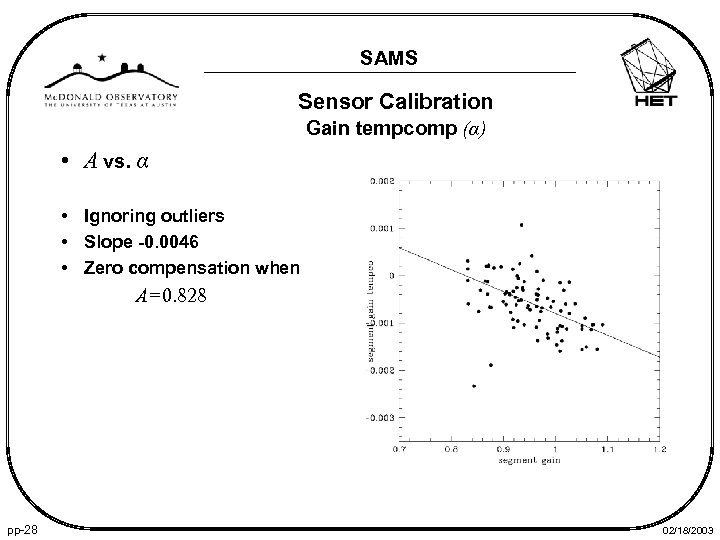 SAMS Sensor Calibration Gain tempcomp (α) • A vs. α • Ignoring outliers • Slope -0. 0046 • Zero compensation when A=0. 828 pp-28 02/18/2003
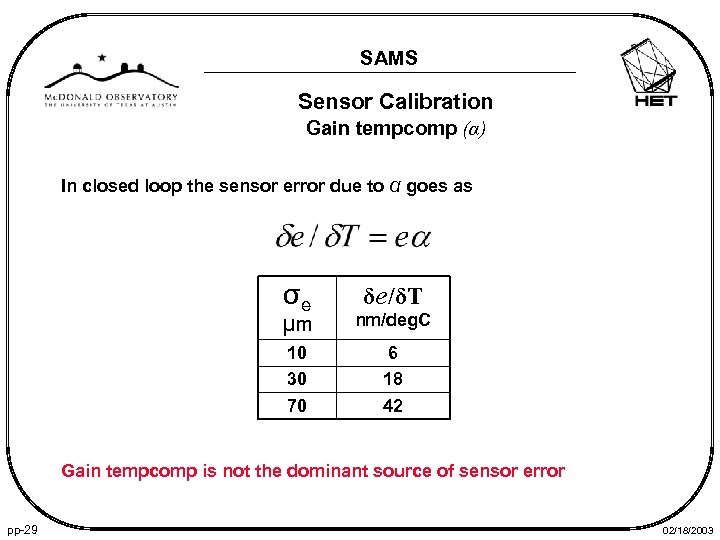 SAMS Sensor Calibration Gain tempcomp (α) In closed loop the sensor error due to α goes as σe δe/δT μm nm/deg. C 10 30 70 6 18 42 Gain tempcomp is not the dominant source of sensor error pp-29 02/18/2003
 SAMS Sensor Calibration Zeropoint tempcomp (β) • Zeropoint calibration is more difficult. It requires being able to set and maintain or measure accurate absolute offsets at the sensors. • We are pursuing 3 strategies: – Modeling eunph – Setting partial constraints (Tip/Tilt with HEFI/MARS) – Direct measurements with fixturing » Sandwich » Interferometer pp-30 02/18/2003
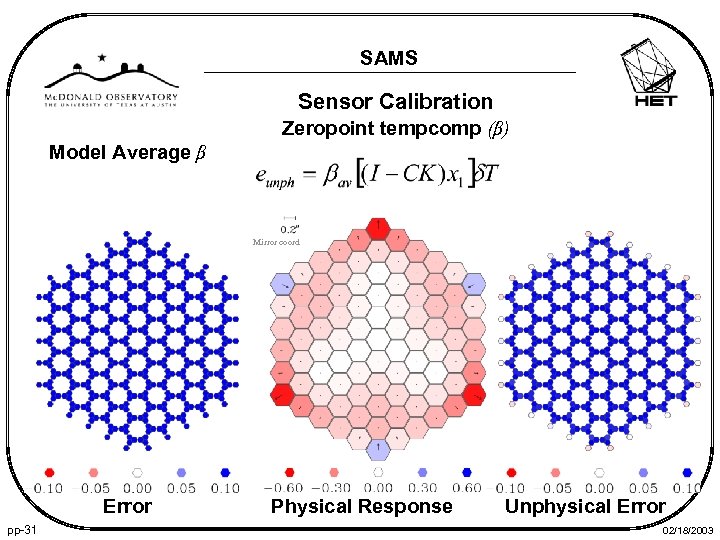 SAMS Sensor Calibration Zeropoint tempcomp (β) Model Average β Mirror coord Error pp-31 Physical Response Unphysical Error 02/18/2003
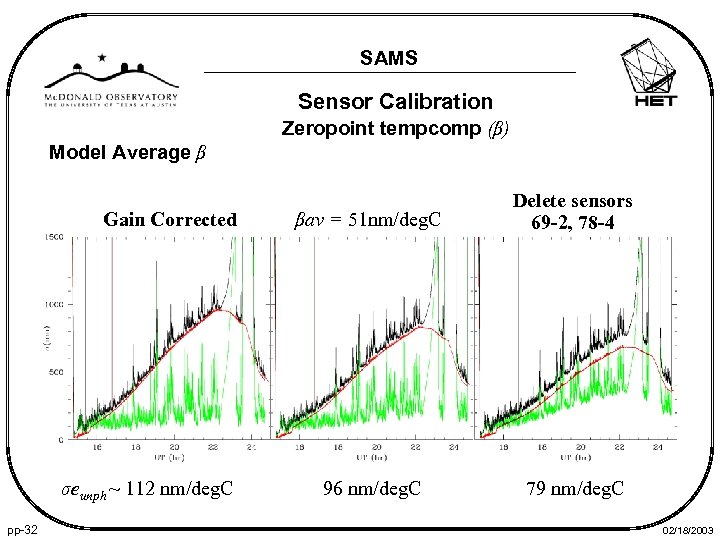 SAMS Sensor Calibration Zeropoint tempcomp (β) Model Average β Gain Corrected σeunph ~ 112 nm/deg. C pp-32 βav = 51 nm/deg. C Delete sensors 69 -2, 78 -4 96 nm/deg. C 79 nm/deg. C 02/18/2003
![SAMS Sensor Calibration Zeropoint tempcomp (β) Model Segment β [(I-CK)Xseg] is invertible after deleting](https://present5.com/presentation/168e073e40644962538b26a0701645fa/image-33.jpg "SAMS Sensor Calibration Zeropoint tempcomp (β) Model Segment β [(I-CK)Xseg] is invertible after deleting") SAMS Sensor Calibration Zeropoint tempcomp (β) Model Segment β [(I-CK)Xseg] is invertible after deleting 2 waffle like modes. Beginning on-sky verification pp-33 02/18/2003
SAMS Sensor Calibration Zeropoint tempcomp (β) Model Segment β [(I-CK)Xseg] is invertible after deleting 2 waffle like modes. Beginning on-sky verification pp-33 02/18/2003
 SAMS Sensor Calibration Zeropoint tempcomp (β) Reducing DOFs • Tip/Tilt – Measure segment Tip/Tilts under closed loop operation. This will allow us to correct for physical Tip/Tilt DOFs before solving for individual sensor β’s. – Errors in the derived β’s result in piston only modes. • Sandwich Test – Fix relative motion of the active and passive sides of a sensor with a sandwich fixture with a fixed gap spacer. Measure shear over a range of temperatures. – Test a minimum of one sensor per segment at several gap spacings. – The compensated response of these sensors will allow a measurement of the piston error remaining from the Tip/Tilt calibration. pp-34 02/18/2003
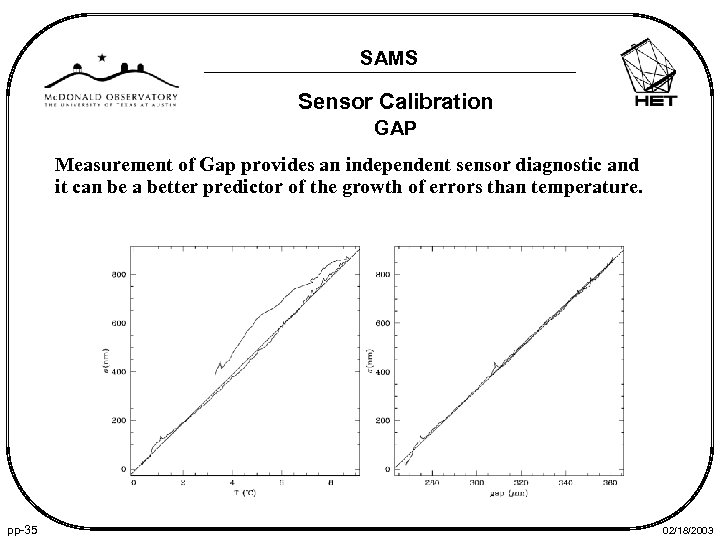 SAMS Sensor Calibration GAP Measurement of Gap provides an independent sensor diagnostic and it can be a better predictor of the growth of errors than temperature. pp-35 02/18/2003
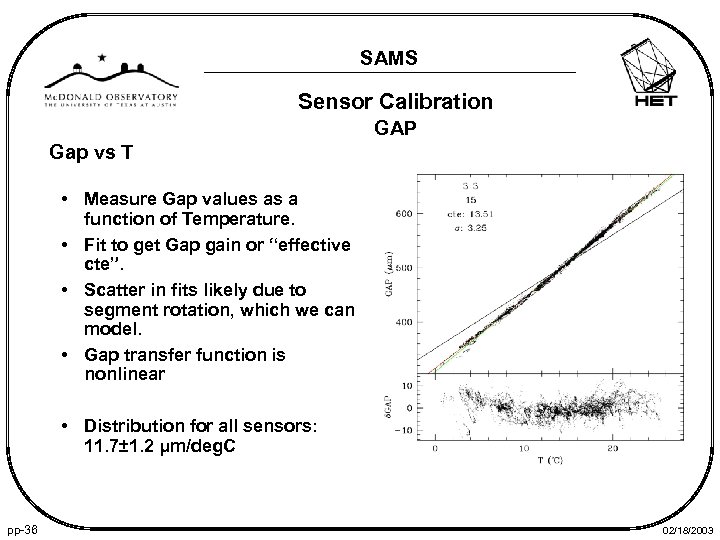 SAMS Sensor Calibration GAP Gap vs T • Measure Gap values as a function of Temperature. • Fit to get Gap gain or “effective cte”. • Scatter in fits likely due to segment rotation, which we can model. • Gap transfer function is nonlinear • Distribution for all sensors: 11. 7± 1. 2 μm/deg. C pp-36 02/18/2003
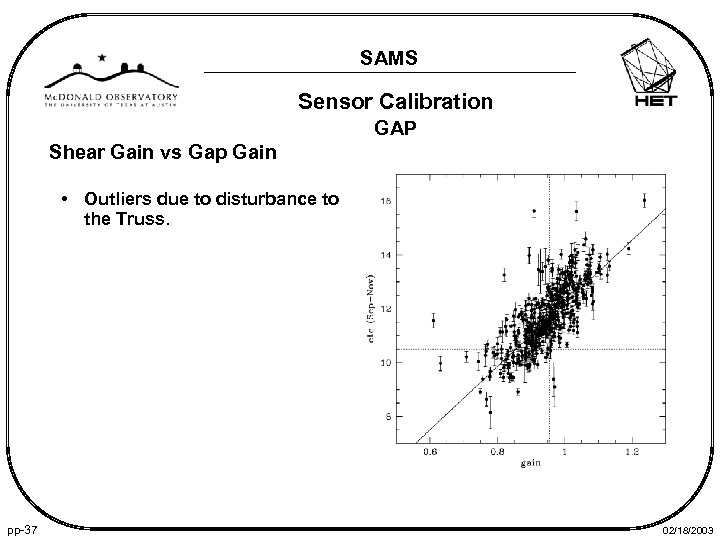 SAMS Sensor Calibration GAP Shear Gain vs Gap Gain • Outliers due to disturbance to the Truss. pp-37 02/18/2003
 SAMS Sensor Calibration Full Sensor Characterization • We have the tools in hand to characterize the SAMS sensors. However, • The SAMS sensor transfer function is complex and inadequately known. • The nominal sensor configuration in the truss keeps changing. We need To characterize a set of sensors/electronics with full and accurate control of shear/gap/(other sensor DOF) and temperature. pp-38 02/18/2003
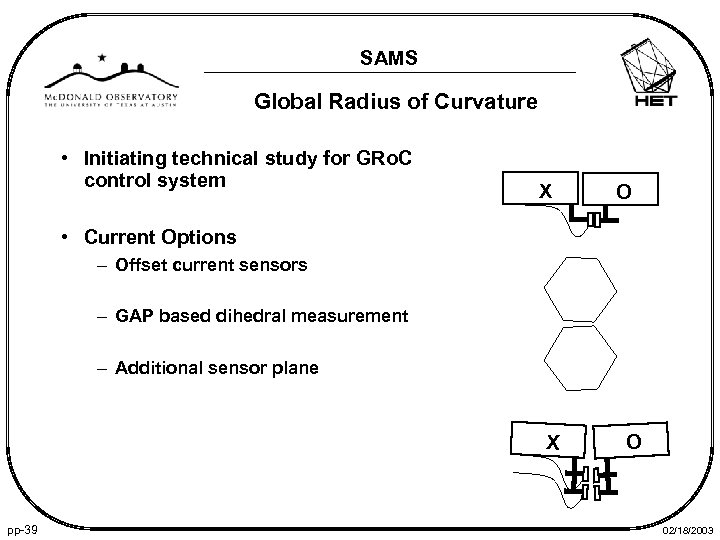 SAMS Global Radius of Curvature • Initiating technical study for GRo. C control system X O • Current Options – Offset current sensors – GAP based dihedral measurement – Additional sensor plane X pp-39 O 02/18/2003
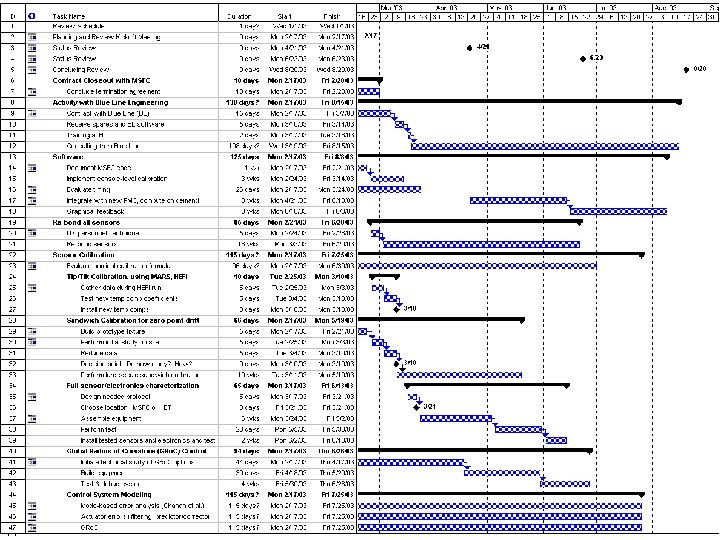
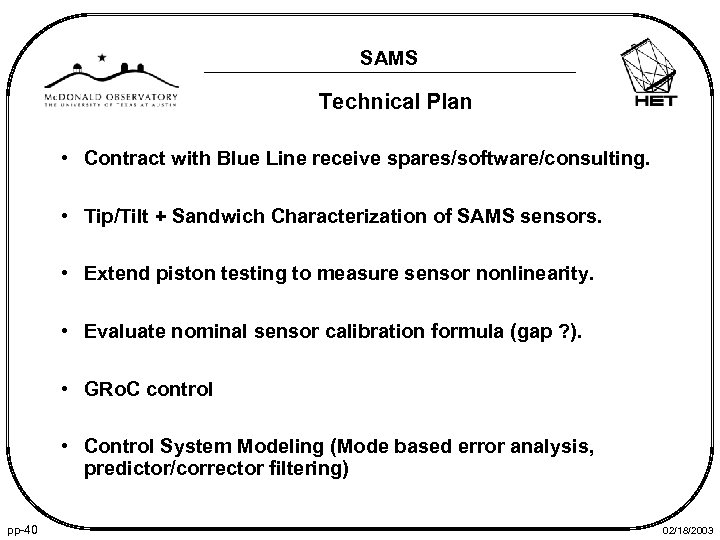 SAMS Technical Plan • Contract with Blue Line receive spares/software/consulting. • Tip/Tilt + Sandwich Characterization of SAMS sensors. • Extend piston testing to measure sensor nonlinearity. • Evaluate nominal sensor calibration formula (gap ? ). • GRo. C control • Control System Modeling (Mode based error analysis, predictor/corrector filtering) pp-40 02/18/2003
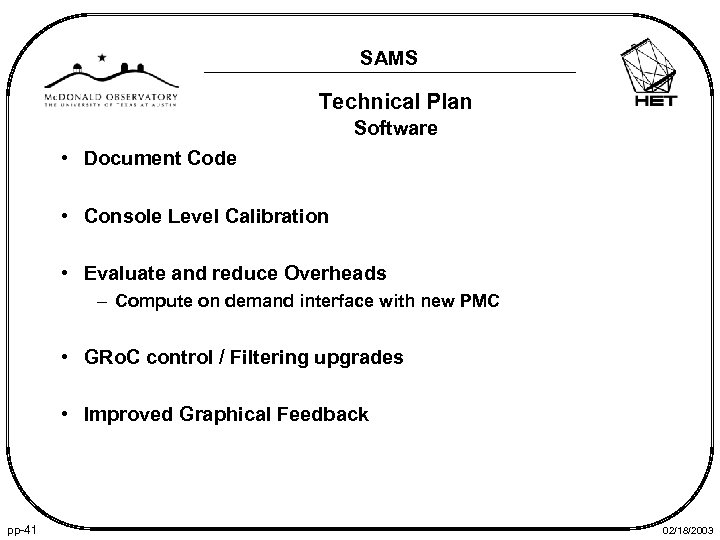 SAMS Technical Plan Software • Document Code • Console Level Calibration • Evaluate and reduce Overheads – Compute on demand interface with new PMC • GRo. C control / Filtering upgrades • Improved Graphical Feedback pp-41 02/18/2003
 SAMS pp-42 02/18/2003
 SAMS Budget BL Contract for Software Spares $50, 000 BL Contract for consulting $30, 000 BL Contract for additional spares, design documentation $20, 000 Equipment and instrumentation (laser interferometer) $80, 000 GRo. C System $70, 000 Total $250, 000 pp-43 02/18/2003
 SAMS Conclusions • SAMS is telling us a good part of what is wrong. – The average sensor error rises predictably with temperature. • Tip/Tilt + Sandwich will constrain all the DOF’s to determine zeropoint compensation. pp-44 02/18/2003