 Скачать презентацию SAMRC ANNUAL REPORT 2014 15 SUMMATIVE REPORT 13 October
8501d336f9c63ac990aca9ccb1637b5f.ppt
- Количество слайдов: 67



SAMRC ANNUAL REPORT 2014/15 –SUMMATIVE REPORT 13 October 2015 1
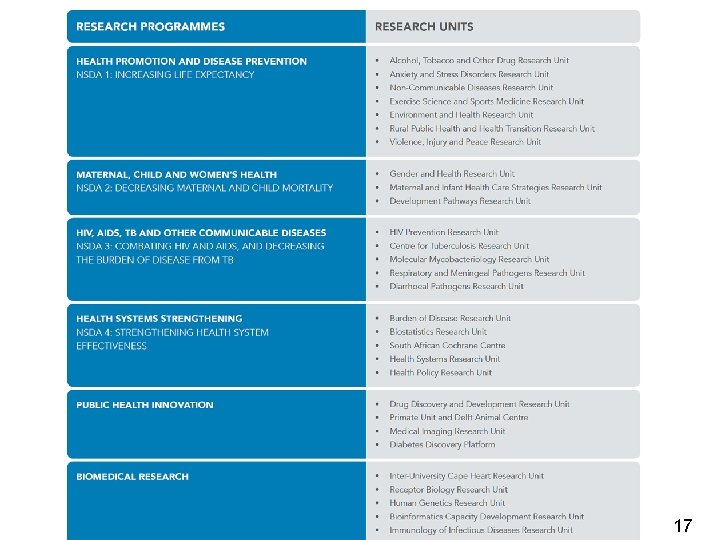
Scope of Presentation • Introduction: Prof Zodwa Dlamini DC • Performance against SAMRC strategic objectives: Prof Glenda Gray, President • Research Highlights: Prof Glenda Gray & Dr Richard Gordon (SHIP & GIPD) • HR: Prof Glenda Gray • Financial Report: Mr Philip du Plessis 2
STRATEGIC GOALS OF THE SAMRC • Administer Health Research effectively & efficiently • Lead the generation of new knowledge • Support innovation and technology development to improve health • Build capacity for the long term sustainability of the country’s health research 3
INTRODUCTION § SAMRC - funds & conducts medical research with the focus on the top 10 causes of death in SA § provides top tier funding opportunities to develop new knowledge in medical research that is innovative and technology driven § Is spearheading the NHSP & the training of medical and allied health professionals wrt medical research § Addressing transformation of external funding by introducing a number of new initiatives & re-evaluating its grant funding mechanism 4
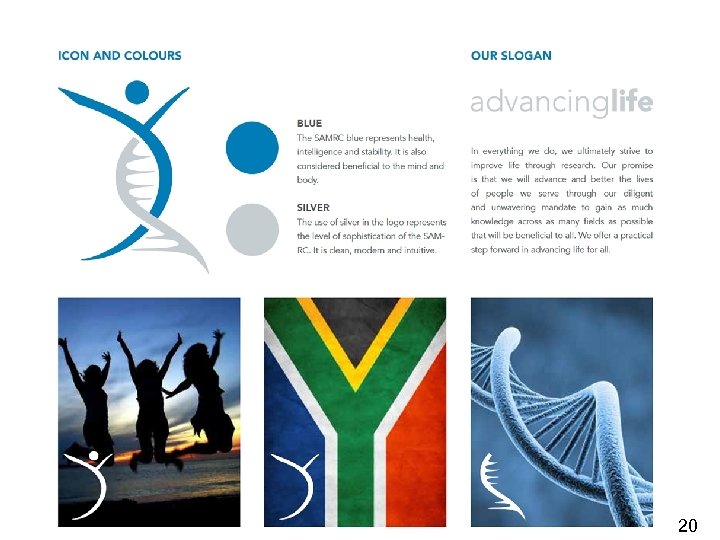
FINANCIAL YEAR IN REVIEW § Third consecutive clean audit! § 2 Vice Presidents appointed – stable executive team § 8 new extramural research units based at universities § 3 Cancer centres based at UKZN, Wits and UCT § The President & CEO of the SAMRC and her team has, through her collaborations with Gates Foundation, UKMRC-Newton Fund and PATH has secured R 100 million funding into the organisation for the next three years. § During the reporting period the SAMRC board approved the redesigning of the SAMRC Corporate Identity to improve the organisations’ communication and marketing ability. 5
TRANSFORMATION § R 30 Million awarded to five historically under resourced universities in South Africa to fund research projects that will contribute to the prevention, reduction and control of disease in the country. § Actively supporting WSU & SMU to augment research capacity § Self-initiated Research grants re-aligned to increase ESI grantees § In improving clinical research, the SAMRC collaborates with DOH and the private sector to facilitate National Health Scholarship with the aim of producing 1000 PHD graduates over the next 10 years. § 41 Employees were promoted to higher job levels across all categories, levels, race and gender. This includes employment of the first African female Unit Director. 6
RESEARCH HIGHLIGHTS & MEASURED DELIVERABLES § 481 Peer reviewed articles with an SAMRC affiliated author were published in the ISI journal § An additional 20 articles were published in peer reviewed articles with an SAMRC affiliated author in the top four journals – NEJM, Lancet, Science and Nature § 86 Bursaries, scholarships and fellowships were provided to post-graduate participants at different universities. § 101 Research grants were awarded by SAMRC during the reporting period § In promoting innovation and technology 31 invention projects were funded during the reporting period. 7
FINANCIAL HIGHLIGHTS § Third clean audit § Medium Term Expenditure Framework (MTEF), has confirmed an increase from 39. 8% to R 623 892 in funding allocations for the year 2014/15. § SAMRC remains financially strong with accumulated reserves of R 24 million. § During the reporting period an increase of 7. 1% to R 391 million was evident. 8
2014/15 Organizational Performance 9
STRATEGIC GOALS OF THE SAMRC • Administer Health Research effectively & efficiently • Lead the generation of new knowledge • Support innovation and technology development to improve health • Build capacity for the long term sustainability of the country’s health research 10
Objectives and Indicators 11
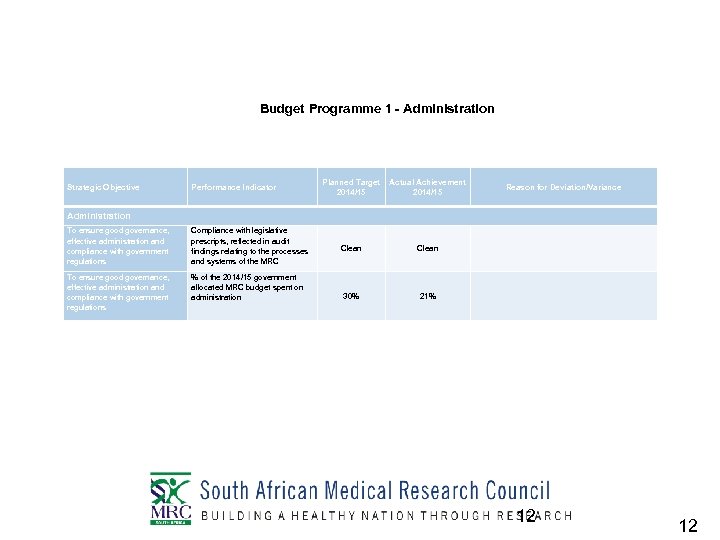
Budget Programme 1 - Administration Strategic Objective Performance Indicator Planned Target Actual Achievement 2014/15 Reason for Deviation/Variance Administration To ensure good governance, effective administration and compliance with government regulations Compliance with legislative prescripts, reflected in audit findings relating to the processes and systems of the MRC To ensure good governance, effective administration and compliance with government regulations % of the 2014/15 government allocated MRC budget spent on administration Clean 30% 21% 12 12
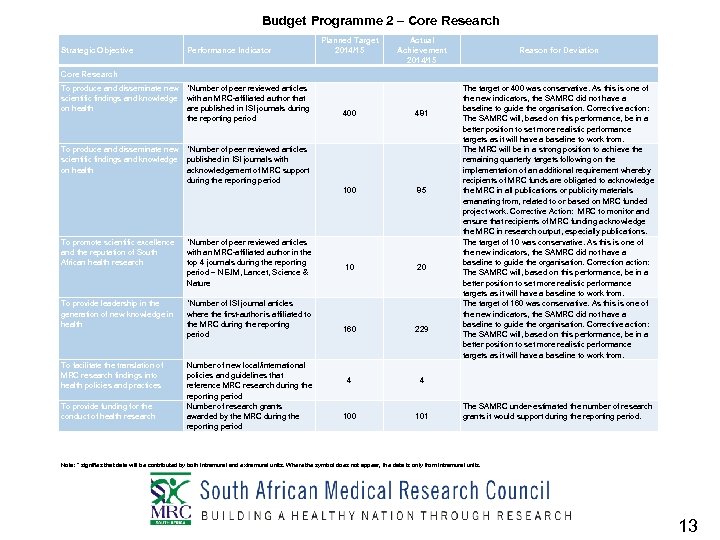
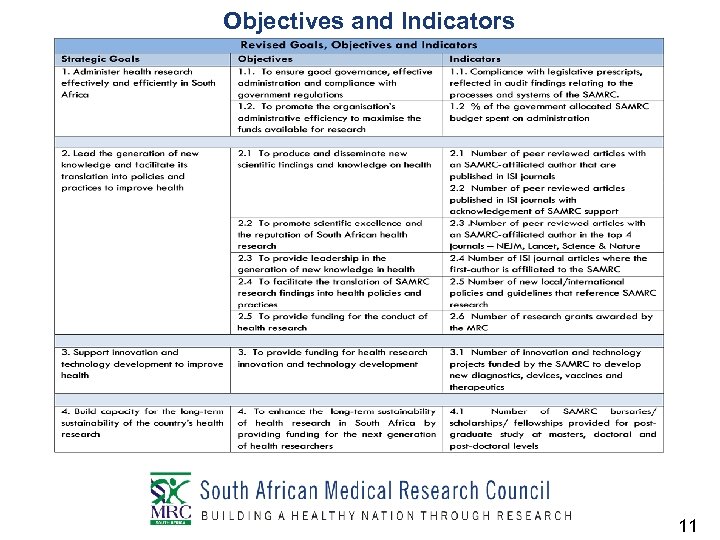
Budget Programme 2 – Core Research Strategic Objective Performance Indicator Planned Target 2014/15 Actual Achievement 2014/15 Reason for Deviation Core Research To produce and disseminate new *Number of peer reviewed articles scientific findings and knowledge with an MRC-affiliated author that on health are published in ISI journals during the reporting period 400 481 100 85 10 20 160 229 4 4 100 101 To produce and disseminate new *Number of peer reviewed articles scientific findings and knowledge published in ISI journals with on health acknowledgement of MRC support during the reporting period To promote scientific excellence and the reputation of South African health research *Number of peer reviewed articles with an MRC-affiliated author in the top 4 journals during the reporting period – NEJM, Lancet, Science & Nature To provide leadership in the generation of new knowledge in health *Number of ISI journal articles where the first-author is affiliated to the MRC during the reporting period To facilitate the translation of MRC research findings into health policies and practices Number of new local/international policies and guidelines that reference MRC research during the reporting period Number of research grants awarded by the MRC during the reporting period To provide funding for the conduct of health research The target or 400 was conservative. As this is one of the new indicators, the SAMRC did not have a baseline to guide the organisation. Corrective action: The SAMRC will, based on this performance, be in a better position to set more realistic performance targets as it will have a baseline to work from. The MRC will be in a strong position to achieve the remaining quarterly targets following on the implementation of an additional requirement whereby recipients of MRC funds are obligated to acknowledge the MRC in all publications or publicity materials emanating from, related to or based on MRC funded project work. Corrective Action: MRC to monitor and ensure that recipients of MRC funding acknowledge the MRC in research output, especially publications. The target of 10 was conservative. As this is one of the new indicators, the SAMRC did not have a baseline to guide the organisation. Correction action: The SAMRC will, based on this performance, be in a better position to set more realistic performance targets as it will have a baseline to work from. The target of 160 was conservative. As this is one of the new indicators, the SAMRC did not have a baseline to guide the organisation. Corrective action: The SAMRC will, based on this performance, be in a better position to set more realistic performance targets as it will have a baseline to work from. The SAMRC under-estimated the number of research grants it would support during the reporting period. Note: * signifies that data will be contributed by both intramural and extramural units. Where the symbol does not appear, the data is only from intramural units. 13
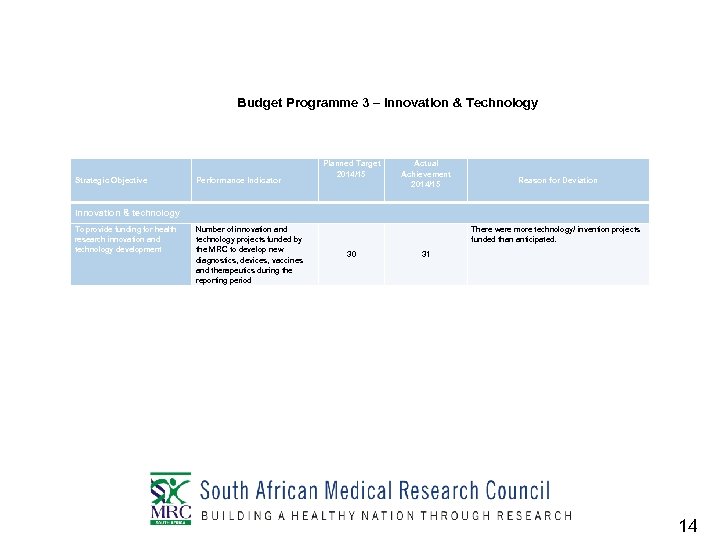
Budget Programme 3 – Innovation & Technology Strategic Objective Performance Indicator Planned Target 2014/15 Actual Achievement 2014/15 Reason for Deviation Innovation & technology To provide funding for health research innovation and technology development Number of innovation and technology projects funded by the MRC to develop new diagnostics, devices, vaccines and therapeutics during the reporting period There were more technology/ invention projects funded than anticipated. 30 31 14
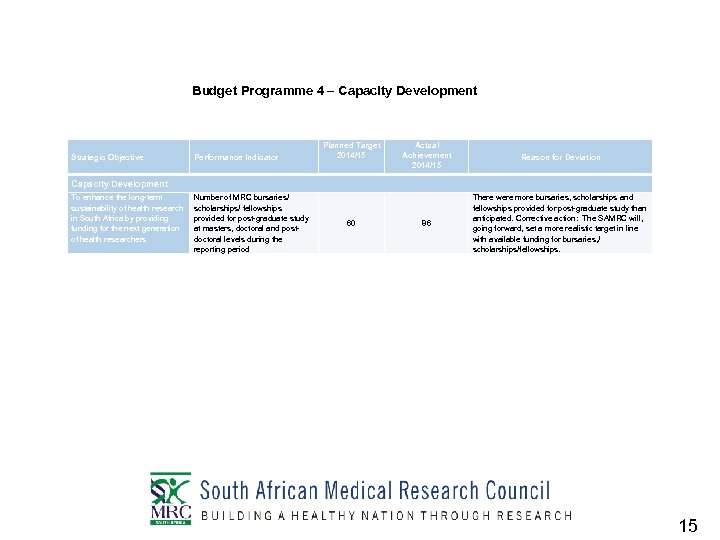
Budget Programme 4 – Capacity Development Strategic Objective Performance Indicator Planned Target 2014/15 Actual Achievement 2014/15 Reason for Deviation 86 There were more bursaries, scholarships and fellowships provided for post-graduate study than anticipated. Corrective action: The SAMRC will, going forward, set a more realistic target in line with available funding for bursaries, / scholarships/fellowships. Capacity Development To enhance the long-term sustainability of health research in South Africa by providing funding for the next generation of health researchers Number of MRC bursaries/ scholarships/ fellowships provided for post-graduate study at masters, doctoral and postdoctoral levels during the reporting period 60 15
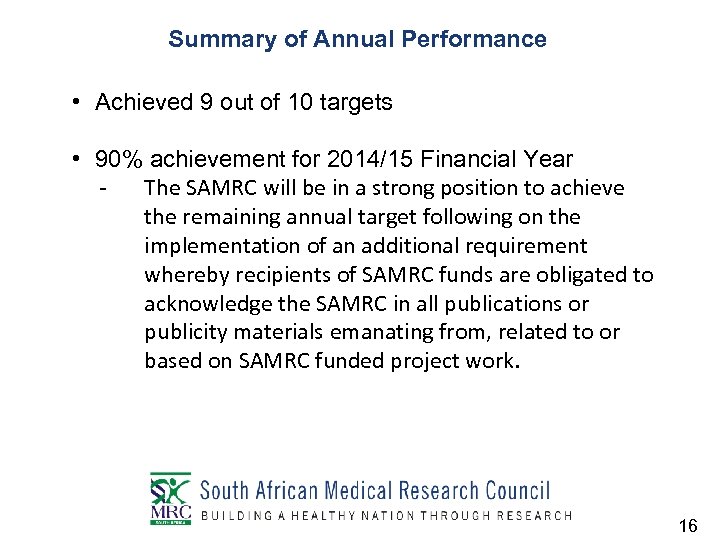
Summary of Annual Performance • Achieved 9 out of 10 targets • 90% achievement for 2014/15 Financial Year - The SAMRC will be in a strong position to achieve the remaining annual target following on the implementation of an additional requirement whereby recipients of SAMRC funds are obligated to acknowledge the SAMRC in all publications or publicity materials emanating from, related to or based on SAMRC funded project work. 16
17
ORGANISATIONAL HIGHLIGHTS 18
19
20
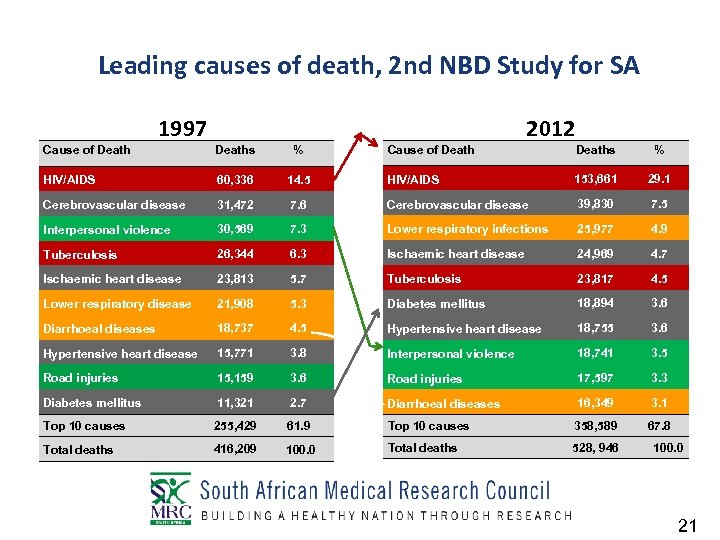
Leading causes of death, 2 nd NBD Study for SA 1997 2012 Cause of Deaths % HIV/AIDS 60, 336 14. 5 Cerebrovascular disease 31, 472 Interpersonal violence Cause of Deaths % HIV/AIDS 153, 661 29. 1 7. 6 Cerebrovascular disease 39, 830 7. 5 30, 569 7. 3 Lower respiratory infections 25, 977 4. 9 Tuberculosis 26, 344 6. 3 Ischaemic heart disease 24, 969 4. 7 Ischaemic heart disease 23, 813 5. 7 Tuberculosis 23, 817 4. 5 Lower respiratory disease 21, 908 5. 3 Diabetes mellitus 18, 894 3. 6 Diarrhoeal diseases 18, 737 4. 5 Hypertensive heart disease 18, 755 3. 6 Hypertensive heart disease 15, 771 3. 8 Interpersonal violence 18, 741 3. 5 Road injuries 15, 159 3. 6 Road injuries 17, 597 3. 3 Diabetes mellitus 11, 321 2. 7 Diarrhoeal diseases 16, 349 3. 1 Top 10 causes 255, 429 61. 9 Top 10 causes 358, 589 67. 8 Total deaths 416, 209 100. 0 Total deaths 528, 946 100. 0 21
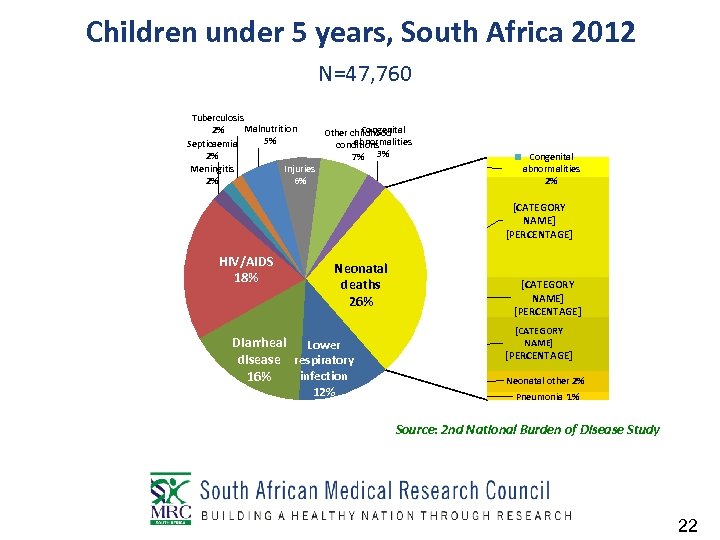
Children under 5 years, South Africa 2012 N=47, 760 Tuberculosis Malnutrition 2% Congenital Other childhood 5% abnormalities Septicaemia conditions 2% 7% 3% Meningitis Injuries 2% 6% Congenital abnormalities 2% [CATEGORY NAME] [PERCENTAGE] HIV/AIDS 18% Neonatal deaths 26% Diarrheal Lower disease respiratory infection 16% 12% [CATEGORY NAME] [PERCENTAGE] Neonatal other 2% Pneumonia 1% Source: 2 nd National Burden of Disease Study 22
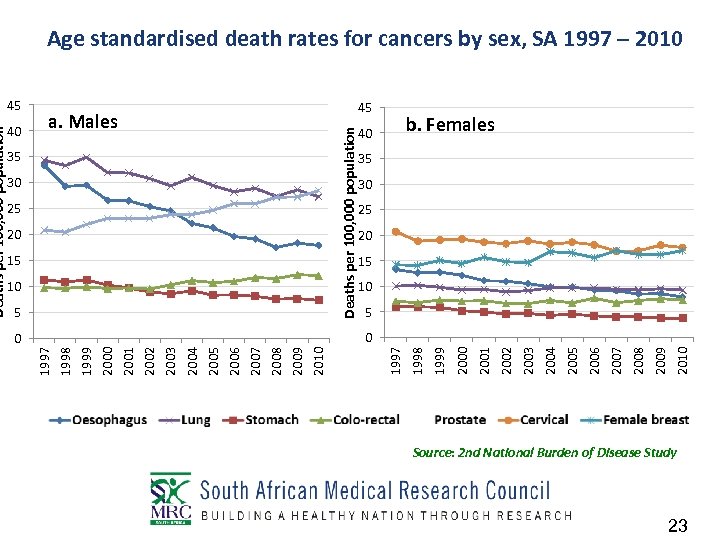
0 2010 2009 2008 2007 2006 2005 5 2004 10 2003 15 2002 20 2001 25 2000 30 40 1999 45 1998 35 Deaths per 100, 000 population a. Males 1997 2010 2009 2008 2007 2006 2005 2004 2003 2002 2001 2000 1999 40 1998 45 1997 Deaths per 100, 000 population Age standardised death rates for cancers by sex, SA 1997 – 2010 b. Females 35 30 25 20 15 10 5 0 Source: 2 nd National Burden of Disease Study 23
Research Highlights from 2014/2015 24
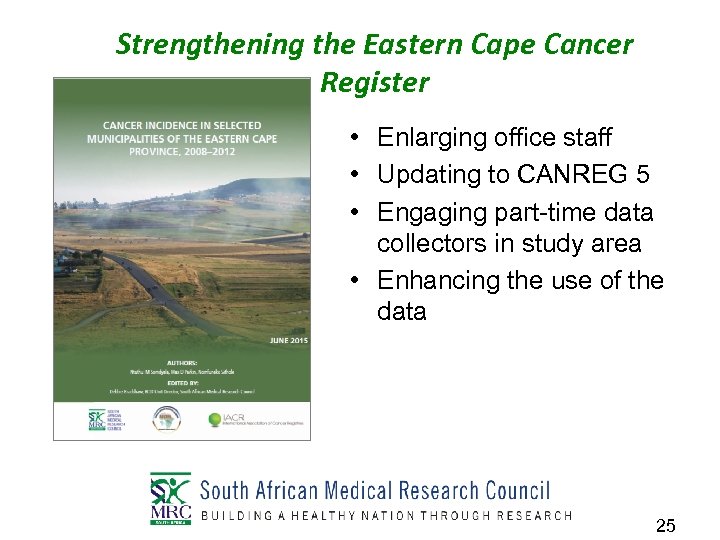
Strengthening the Eastern Cape Cancer Register • Enlarging office staff • Updating to CANREG 5 • Engaging part-time data collectors in study area • Enhancing the use of the data 25
GENDER BASED VIOLENCE BIG SCIENCE: STRATEGIC GOALS: • Building global evidence base on What Works to prevent GBV • Deepening understanding of the health impact of GBV • Building stronger responses to GBV in South Africa 26
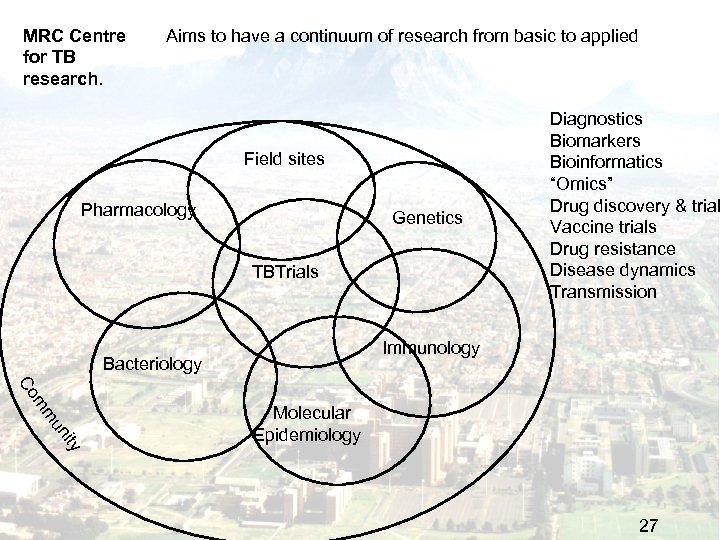
MRC Centre for TB research. Aims to have a continuum of research from basic to applied Field sites Pharmacology Genetics TBTrials Diagnostics Biomarkers Bioinformatics “Omics” Drug discovery & trial Vaccine trials Drug resistance Disease dynamics Transmission Immunology Bacteriology ity un m m Co Molecular Epidemiology 27
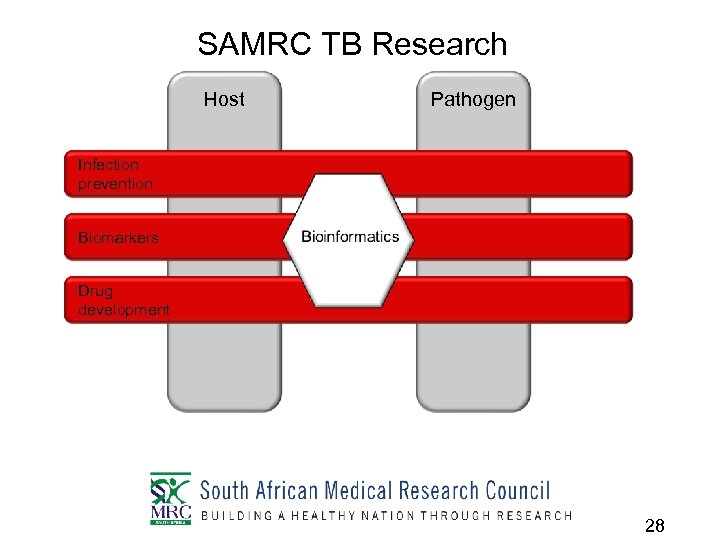
SAMRC TB Research Host Pathogen Infection prevention Biomarkers Drug development 28
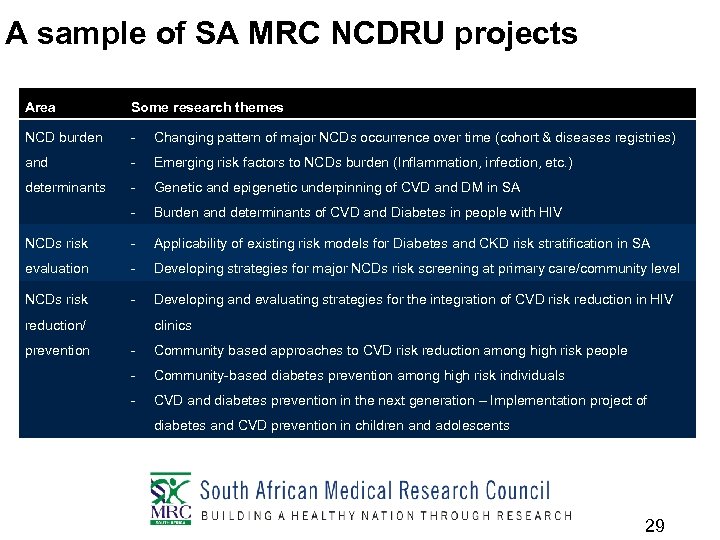
A sample of SA MRC NCDRU projects Area Some research themes NCD burden - Changing pattern of major NCDs occurrence over time (cohort & diseases registries) and - Emerging risk factors to NCDs burden (Inflammation, infection, etc. ) determinants - Genetic and epigenetic underpinning of CVD and DM in SA - Burden and determinants of CVD and Diabetes in people with HIV NCDs risk - Applicability of existing risk models for Diabetes and CKD risk stratification in SA evaluation - Developing strategies for major NCDs risk screening at primary care/community level NCDs risk - Developing and evaluating strategies for the integration of CVD risk reduction in HIV reduction/ prevention clinics - Community based approaches to CVD risk reduction among high risk people - Community-based diabetes prevention among high risk individuals - CVD and diabetes prevention in the next generation – Implementation project of diabetes and CVD prevention in children and adolescents 29
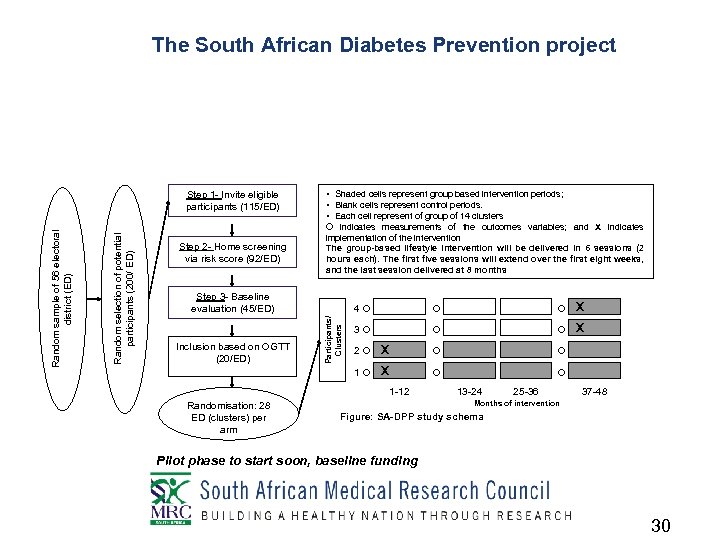
The South African Diabetes Prevention project Step 2 - Home screening via risk score (92/ED) • Shaded cells represent group based intervention periods; • Blank cells represent control periods. • Each cell represent of group of 14 clusters O indicates measurements of the outcomes variables; and X indicates implementation of the intervention The group-based lifestyle intervention will be delivered in 6 sessions (2 hours each). The first five sessions will extend over the first eight weeks, and the last session delivered at 8 months Step 3 - Baseline evaluation (45/ED) Inclusion based on OGTT (20/ED) 4 O Participants/ Clusters Random selection of potential participants (200/ ED) Random sample of 56 electoral district (ED) Step 1 - Invite eligible participants (115/ED) O O X 3 O O O X 2 O X O O 1 -12 Randomisation: 28 ED (clusters) per arm 13 -24 25 -36 37 -48 Months of intervention Figure: SA-DPP study schema Pilot phase to start soon, baseline funding 30
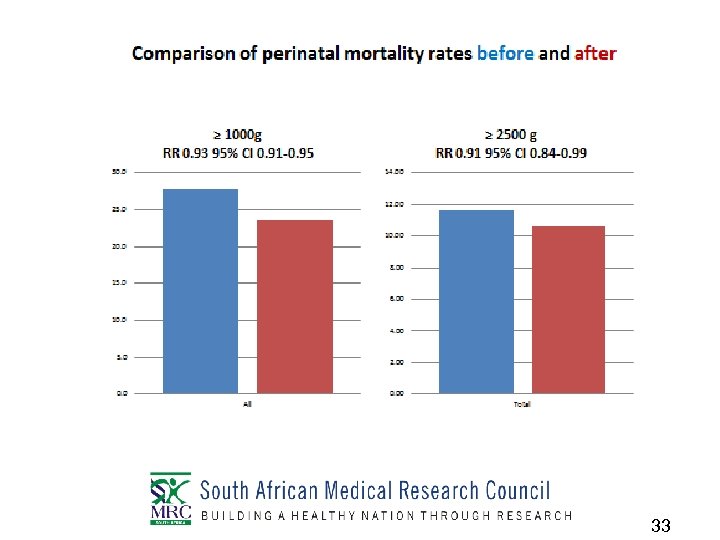
Maternal & Child Health The ESMOE-EOST scale-up programme has demonstrated an improvement in knowledge and skills of health care professionals and has been shown to reduce deaths of mothers and babies. 31
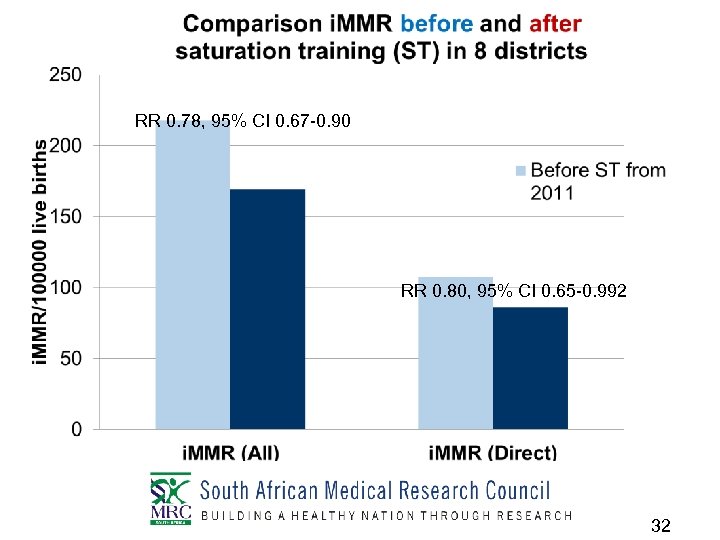
RR 0. 78, 95% CI 0. 67 -0. 90 RR 0. 80, 95% CI 0. 65 -0. 992 32
33
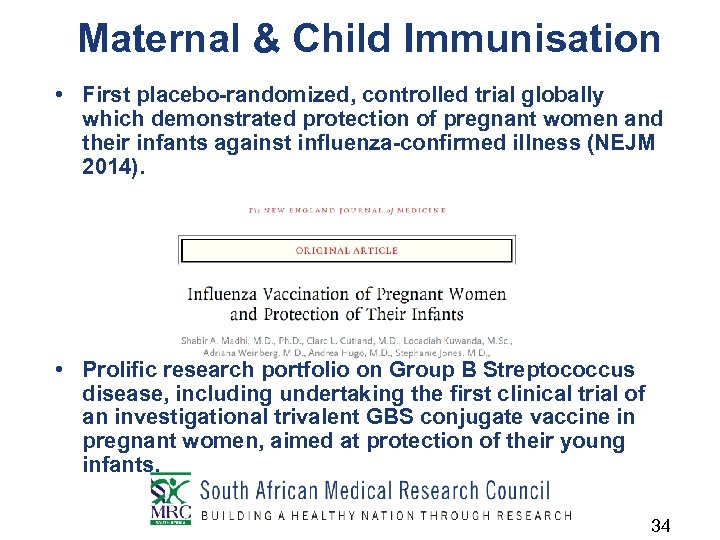
Maternal & Child Immunisation • First placebo-randomized, controlled trial globally which demonstrated protection of pregnant women and their infants against influenza-confirmed illness (NEJM 2014). • Prolific research portfolio on Group B Streptococcus disease, including undertaking the first clinical trial of an investigational trivalent GBS conjugate vaccine in pregnant women, aimed at protection of their young infants. 34
B 3 Africa • Bridging Biobanking and Biomedical Research across Europe and Africa – Create a harmonised ethical and legal framework between European and African partner institutions • Trustable informatics platform to allow sharing bio -resources and data – Provide an “out-of-the-box” informatics solution that facilitates data management, processing and sharing • context of limited resources 35
![2% G 1 P[8]s genomes seq. Mixed genotypes seq. 35% 37% G 9 P[8]](https://present5.com/presentation/8501d336f9c63ac990aca9ccb1637b5f/image-36.jpg "2% G 1 P[8]s genomes seq. Mixed genotypes seq. 35% 37% G 9 P[8]")
2% G 1 P[8]s genomes seq. Mixed genotypes seq. 35% 37% G 9 P[8] genomes seq. G 12 P[8] genomes seq. Other G-P-types seq. 7% 12% Untypeable genomes 7% 36
37
38
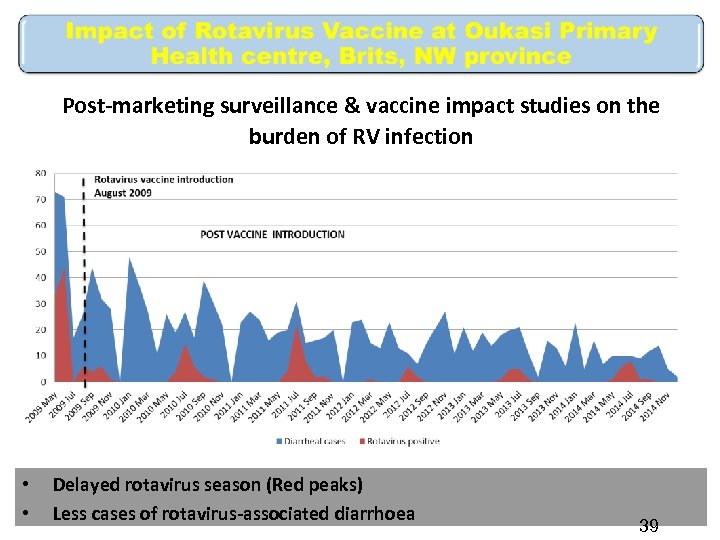
Post-marketing surveillance & vaccine impact studies on the burden of RV infection • • Delayed rotavirus season (Red peaks) Less cases of rotavirus-associated diarrhoea 39
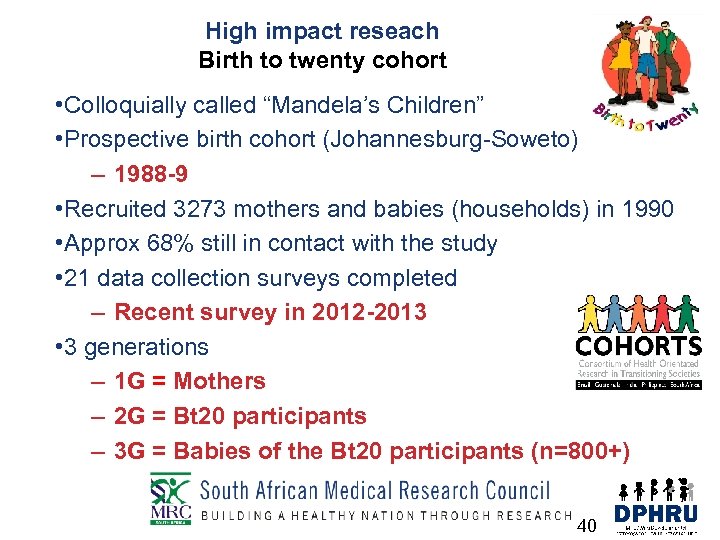
High impact reseach Birth to twenty cohort • Colloquially called “Mandela’s Children” • Prospective birth cohort (Johannesburg-Soweto) – 1988 -9 • Recruited 3273 mothers and babies (households) in 1990 • Approx 68% still in contact with the study • 21 data collection surveys completed – Recent survey in 2012 -2013 • 3 generations – 1 G = Mothers – 2 G = Bt 20 participants – 3 G = Babies of the Bt 20 participants (n=800+) 40
High impact reseach First 1000 days • Maternal pre-pregnancy weight (urban SA: 67% overweight or obese) • Gestational weight gain (urban SA: 9 kg) • Gestational diabetes (urban SA: 14%) • Pre-eclampsia (urban SA: 6%) • Anaemia (urban SA: 31%) • HIV (urban SA: 30%) • Maternal stress and depression risk (urban SA: high >30%) • Co-morbidities • Fetal growth; gestational age; • birth weight & length (programming) • Infant growth 41
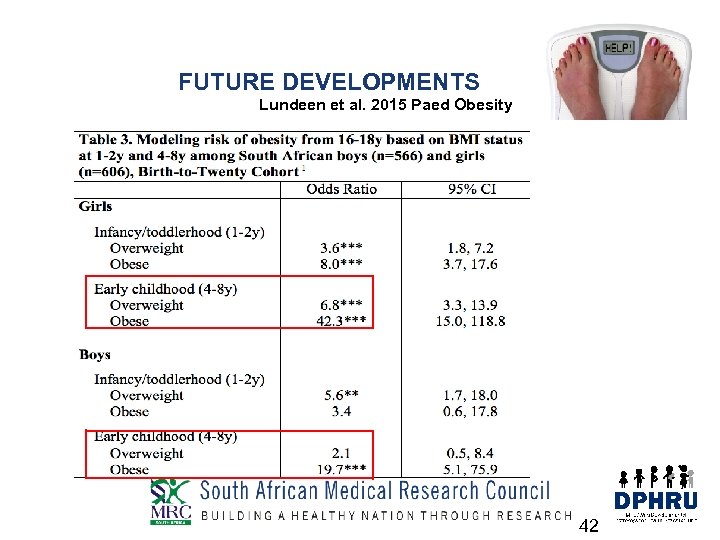
FUTURE DEVELOPMENTS Lundeen et al. 2015 Paed Obesity 42
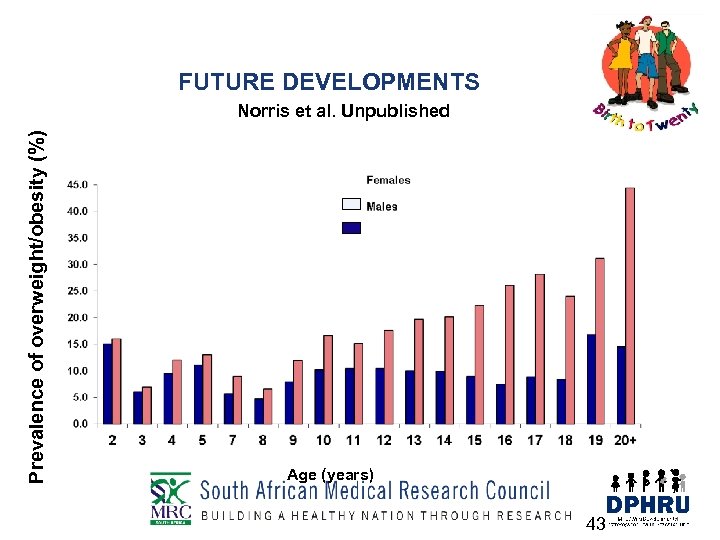
FUTURE DEVELOPMENTS Prevalence of overweight/obesity (%) Norris et al. Unpublished Age (years) 43
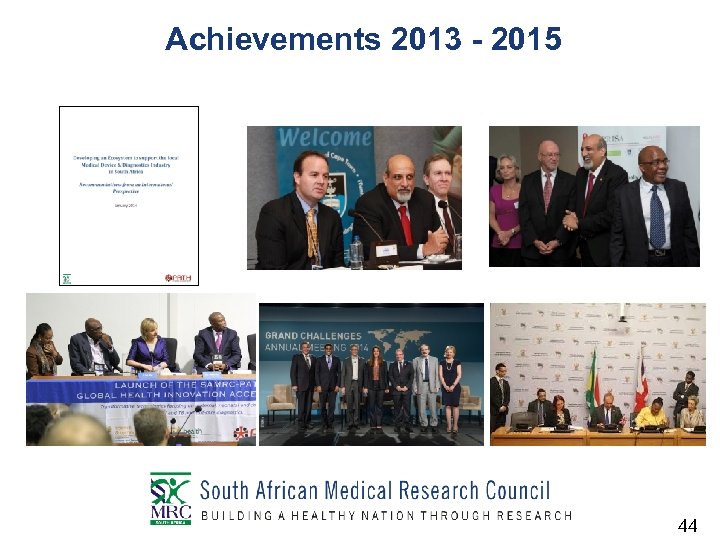
Achievements 2013 - 2015 44
Flagship Program • Sample projects • Evaluating a new drug regimen for patients with multi-drug resistant TB – a randomised controlled trial • Effectiveness of an alcohol-focused intervention in improving adherence to antiretroviral therapy (ART) and HIV treatment outcomes • A multi-disciplinary approach to understand the causes and consequences of HIV transmission and drug resistance in hyperepidemic setting in rural South Africa • The impact of rape in women on HIV acquisition and retention linkages to care: a longitudinal study 45
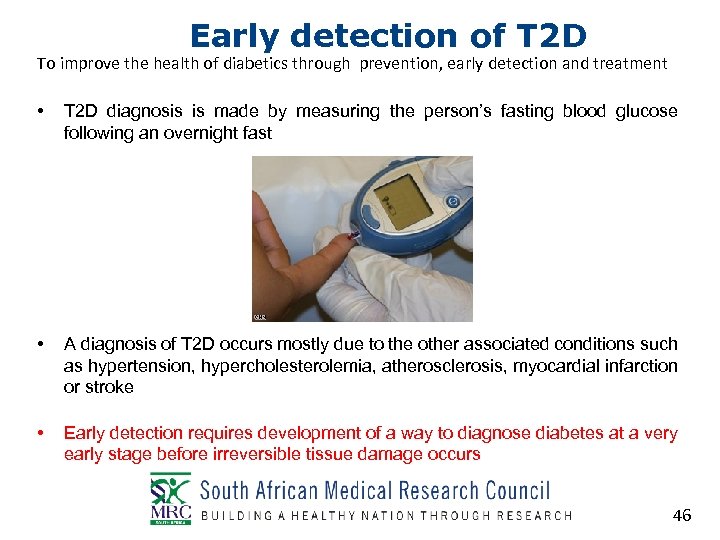
Early detection of T 2 D To improve the health of diabetics through prevention, early detection and treatment • T 2 D diagnosis is made by measuring the person’s fasting blood glucose following an overnight fast • A diagnosis of T 2 D occurs mostly due to the other associated conditions such as hypertension, hypercholesterolemia, atherosclerosis, myocardial infarction or stroke • Early detection requires development of a way to diagnose diabetes at a very early stage before irreversible tissue damage occurs 46
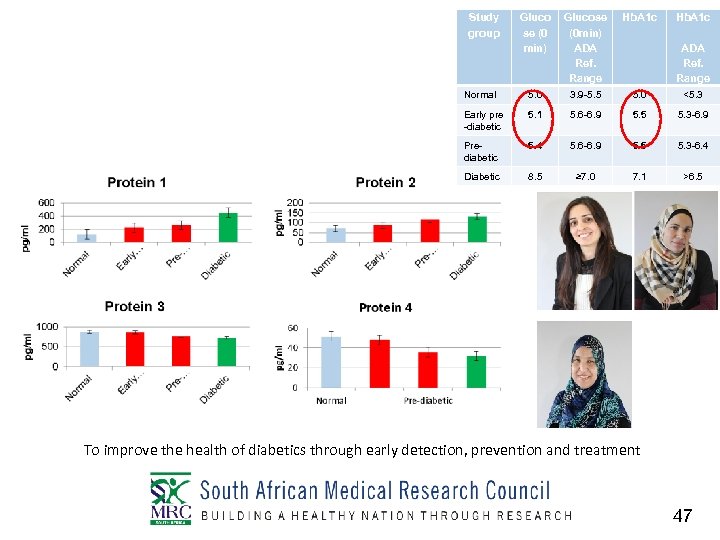
Gluco se (0 min) Glucose (0 min) ADA Ref. Range Hb. A 1 c ADA Ref. Range Normal 5. 0 3. 9 -5. 5 5. 0 <5. 3 Early pre -diabetic 5. 1 5. 6 -6. 9 5. 5 5. 3 -6. 9 Prediabetic 5. 4 5. 6 -6. 9 5. 5 5. 3 -6. 4 Diabetic Human Study: Protein expression in plasma Study group 8. 5 ≥ 7. 0 7. 1 >6. 5 To improve the health of diabetics through early detection, prevention and treatment 47
Impact of early markers identified • Earlier detection and screening of patients could prevent people of developing diabetes • Financial burden of diabetes Direct cost – 20% health budget related to the treatment and hospitalisation of diabetics – the treatment of long-term complications, such as heart disease and stroke, kidney failure, blindness and debilitating foot problems Indirect cost – Sickness, absence, disability, premature retirement or premature mortality causes loss of productivity – Costs of lost production may be as much as 5 times the direct health care cost 48
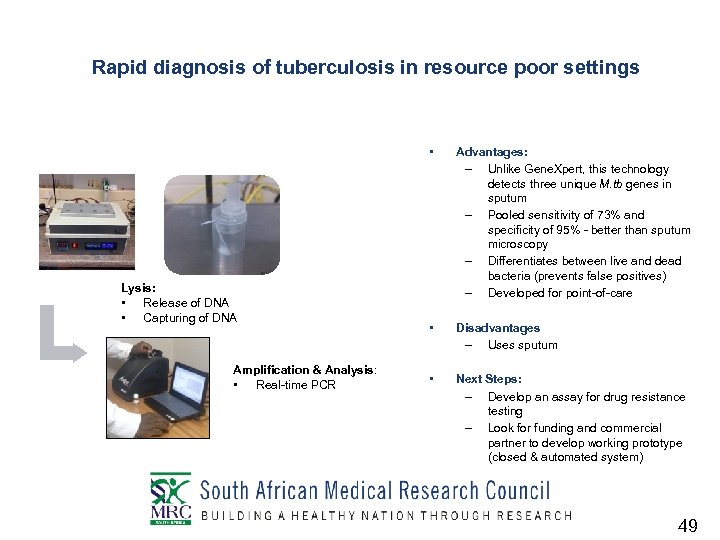
Rapid diagnosis of tuberculosis in resource poor settings • Advantages: – Unlike Gene. Xpert, this technology detects three unique M. tb genes in sputum – Pooled sensitivity of 73% and specificity of 95% - better than sputum microscopy – Differentiates between live and dead bacteria (prevents false positives) – Developed for point-of-care • Disadvantages – Uses sputum • Next Steps: – Develop an assay for drug resistance testing – Look for funding and commercial partner to develop working prototype (closed & automated system) Lysis: • Release of DNA • Capturing of DNA Amplification & Analysis: • Real-time PCR 49
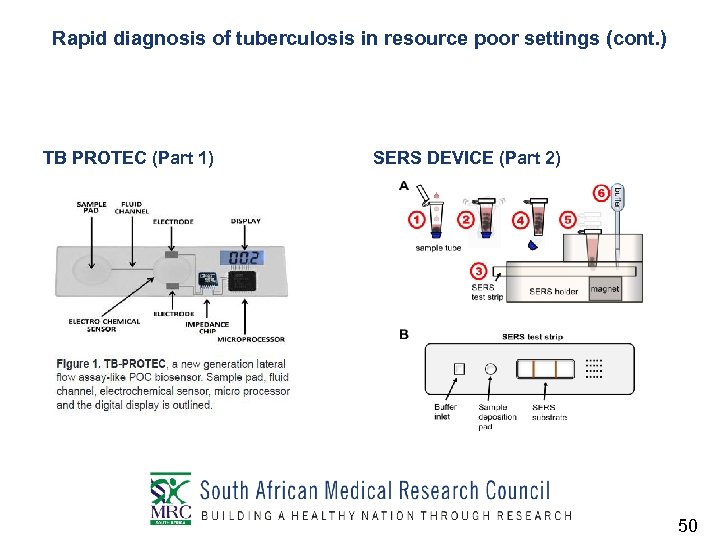
Rapid diagnosis of tuberculosis in resource poor settings (cont. ) TB PROTEC (Part 1) SERS DEVICE (Part 2) 50
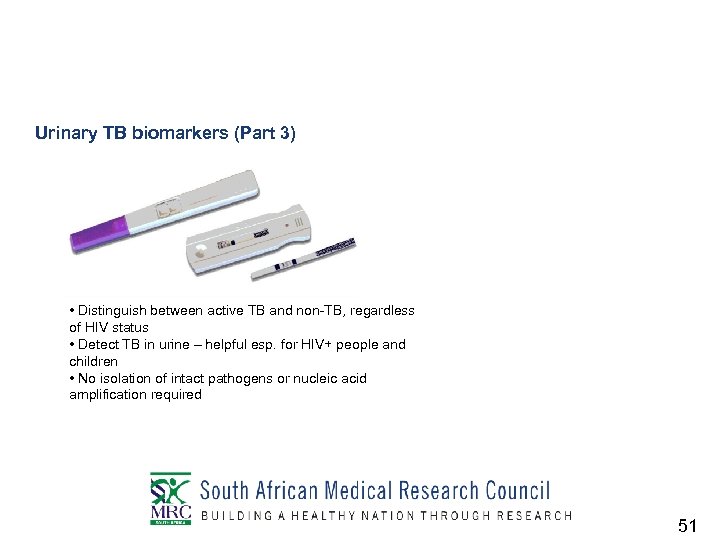
Urinary TB biomarkers (Part 3) • Distinguish between active TB and non-TB, regardless of HIV status • Detect TB in urine – helpful esp. for HIV+ people and children • No isolation of intact pathogens or nucleic acid amplification required 51
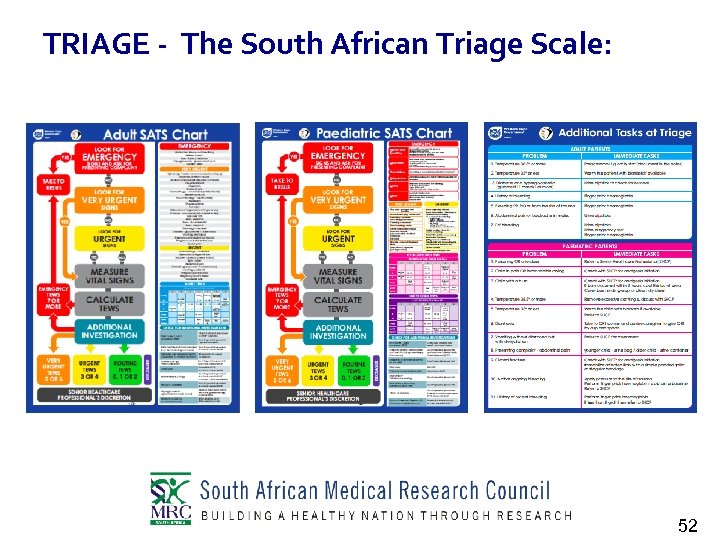
TRIAGE - The South African Triage Scale: 52
53
Human Resources • Transformation Strategy: Transformation Forum/Transformation targets • Employee Wellness • Unionisation • Low vacancy rate • Low turnover rate • Skills development 54
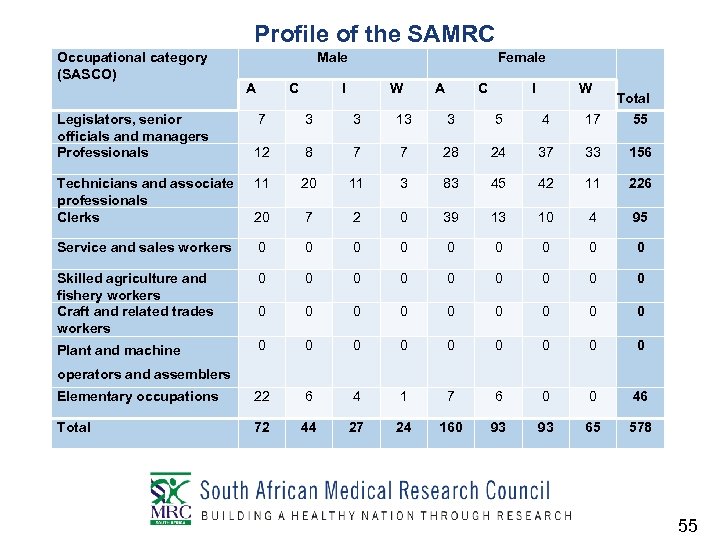
Profile of the SAMRC Occupational category (SASCO) Male A C Female I W A C I W 7 3 3 13 3 5 4 17 Total 55 12 8 7 7 28 24 37 33 156 Technicians and associate professionals Clerks 11 20 11 3 83 45 42 11 226 20 7 2 0 39 13 10 4 95 Service and sales workers 0 0 0 0 0 Skilled agriculture and fishery workers Craft and related trades workers 0 0 0 0 0 Plant and machine 0 0 0 0 0 Elementary occupations 22 6 4 1 7 6 0 0 46 Total 72 44 27 24 160 93 93 65 578 Legislators, senior officials and managers Professionals operators and assemblers 55
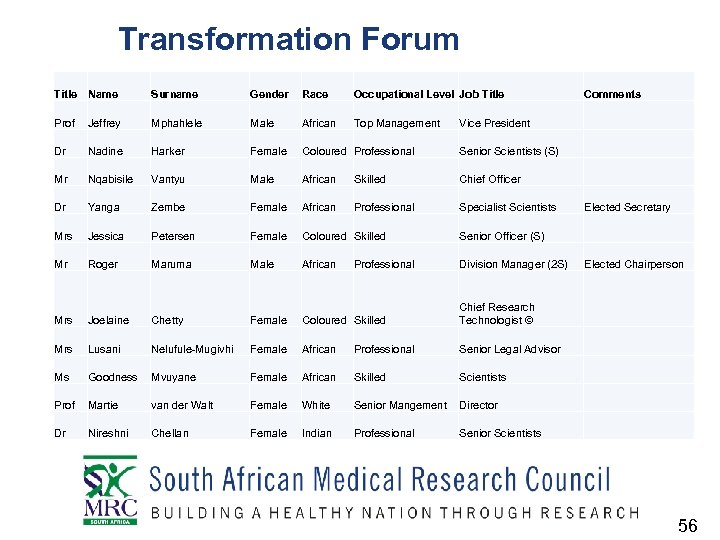
Transformation Forum Title Name Surname Gender Race Occupational Level Job Title Comments Prof Jeffrey Mphahlele Male African Top Management Vice President Dr Nadine Harker Female Coloured Professional Senior Scientists (S) Mr Nqabisile Vantyu Male African Skilled Chief Officer Dr Yanga Zembe Female African Professional Specialist Scientists Elected Secretary Mrs Jessica Petersen Female Coloured Skilled Senior Officer (S) Mr Roger Maruma Male African Division Manager (2 S) Elected Chairperson Professional Mrs Joelaine Chetty Female Coloured Skilled Chief Research Technologist © Mrs Lusani Nelufule-Mugivhi Female African Professional Senior Legal Advisor Ms Goodness Mvuyane Female African Skilled Scientists Prof Martie van der Walt Female White Senior Mangement Director Dr Nireshni Chellan Female Indian Professional Senior Scientists 56
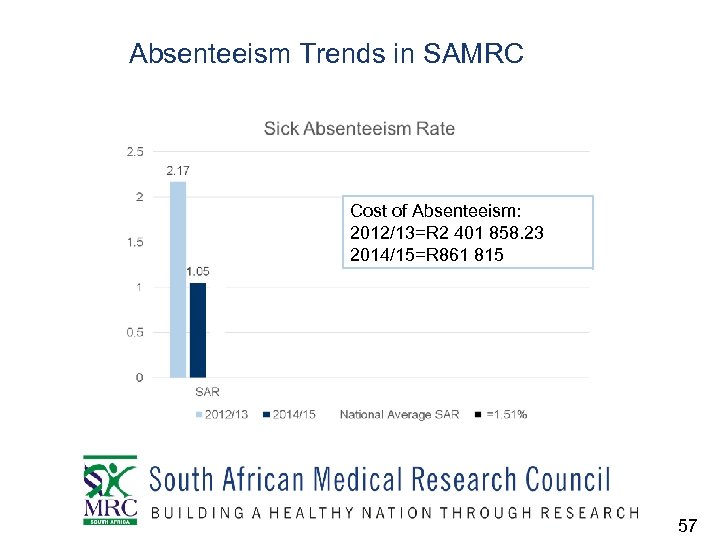
Absenteeism Trends in SAMRC Cost of Absenteeism: 2012/13=R 2 401 858. 23 2014/15=R 861 815 57
Reasons why people leave the SAMRC • • Death Resignation Expiry of contract Dismissal (misconduct) Retirement Terminations Retrenchment Total for 2014/15 (% of total employment): 93/587 (16%) 58
FINANCIAL PERFORMANCE 2014/15 59
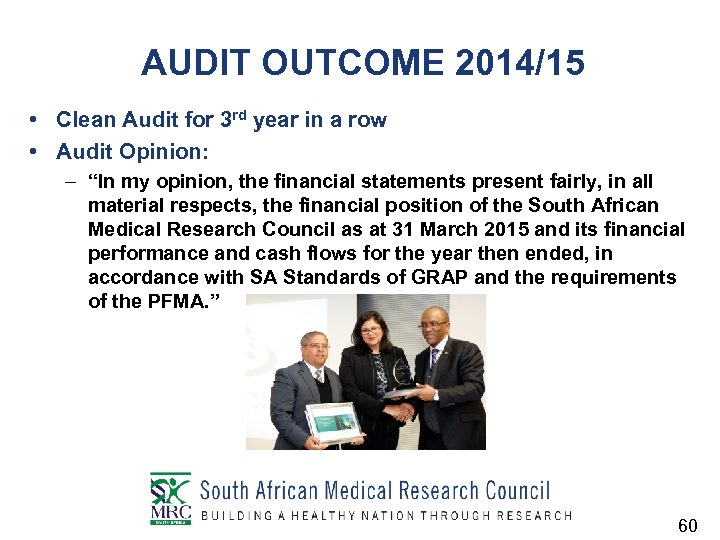
AUDIT OUTCOME 2014/15 • Clean Audit for 3 rd year in a row • Audit Opinion: – “In my opinion, the financial statements present fairly, in all material respects, the financial position of the South African Medical Research Council as at 31 March 2015 and its financial performance and cash flows for the year then ended, in accordance with SA Standards of GRAP and the requirements of the PFMA. ” 60
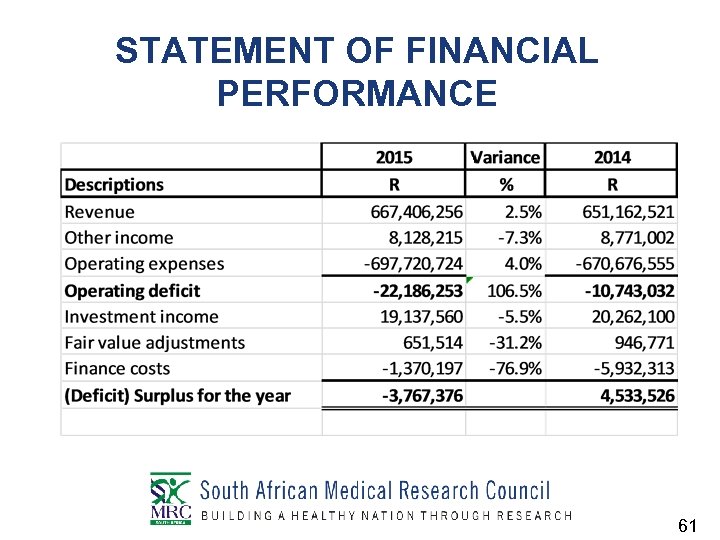
STATEMENT OF FINANCIAL PERFORMANCE 61
REVENUE • Total revenue increase by 2. 5% from R 651 m in 2013/14 to R 667 m in 2014/15 • Total Revenue consist of: – Government Grant increase by 7. 1% from R 365 m to R 391 m, and – Research Contract income decrease by 3. 5% from 285 m to R 276 m 62
EXPENDITURE • Operating Expenditure increased by 4% from R 670 to R 697 mainly due to: – Increase of R 37. 8% in Collaborative Research, from R 189 m to R 261 m • Due to continued growth in SHIP grants and 1 st payment of R 44 m to NIH as part of the MRC/NIH 3 year Collaboration – This increase off-set by decrease in: • Travel – 26%, from R 43 m to R 31 m • Staff costs – 7%, from R 298 m to R 277 m 63
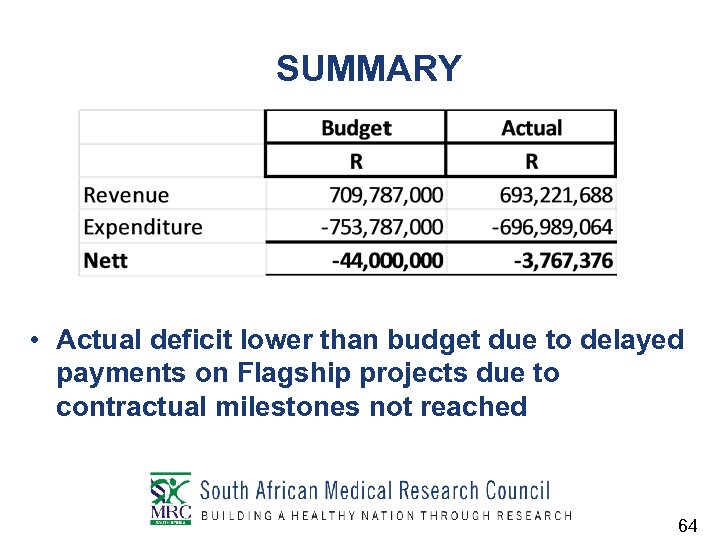
SUMMARY • Actual deficit lower than budget due to delayed payments on Flagship projects due to contractual milestones not reached 64
FINANCIAL POSITION • Reserves at 31 March 2015 was R 242 m, a decrease of R 3 m inline with the deficit • Assets decrease by 7. 3%, from R 509 m to R 471 m • Cash and Cash equivalent reduced by 6. 4% from R 335 m to R 313 m due to payment of creditors and capital expenditure 65
CONCLUSION • An increase in funding allocations of 39. 8% to R 623 892 for 2015/16 has been approved by Government through the MTEF process. This, together with accumulated reserves of R 242 124 and significant increases anticipated in grant income, will ensure that the SAMRC will continue to operate as a going concern. 66
National Things to worry about Lack of critical mass of bio-statisticians • Critical for the success of research • Need to work with DHE to look at short, mid and long term strategy Lack of support for post doc and career development support for recently qualified PHDS 67
Скачать презентацию SAMRC ANNUAL REPORT 2014 15 SUMMATIVE REPORT 13 October
8501d336f9c63ac990aca9ccb1637b5f.ppt