


 Скачать презентацию SAMPOL 204 Varieties of Political Regimes in Latin
90547fbf79560c28fa1ead2fa7041cce.ppt
- Количество слайдов: 72
 SAMPOL 204: Varieties of Political Regimes in Latin America Section 2: Competitive Oligarchy: Elections without Democracy. Wednesday 8 February 2017, 10. 15 -12. 00, Carl L. Godskes hus, auditorium 307 Einar Berntzen
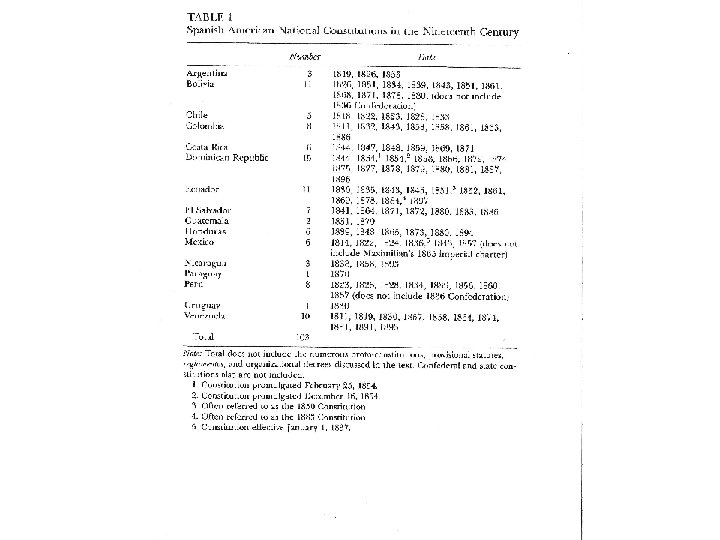
 Caudillo rule • From unstable caudillism (Bolivia’s Mariano Melgarejo (1864 -71); Mexico’s Santa Anna (1833 -55); Argentina’s Juan Manuel Rosas (1829 -32; 1835 -52) • to stable caudillism: ”Order and progress”dictatorships (Mexico’s Porfirio Díaz (18761911); Venezuela’s Antonio Guzmán Blanco (1870 -99) and Vicente Gómez (1908 -35); Guatemala’s Manuel Estrada Cabrera (1899 -1920)
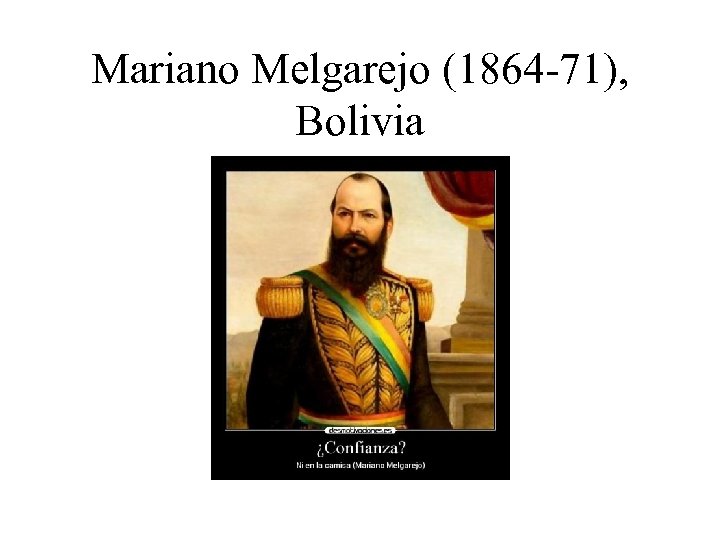 Mariano Melgarejo (1864 -71), Bolivia
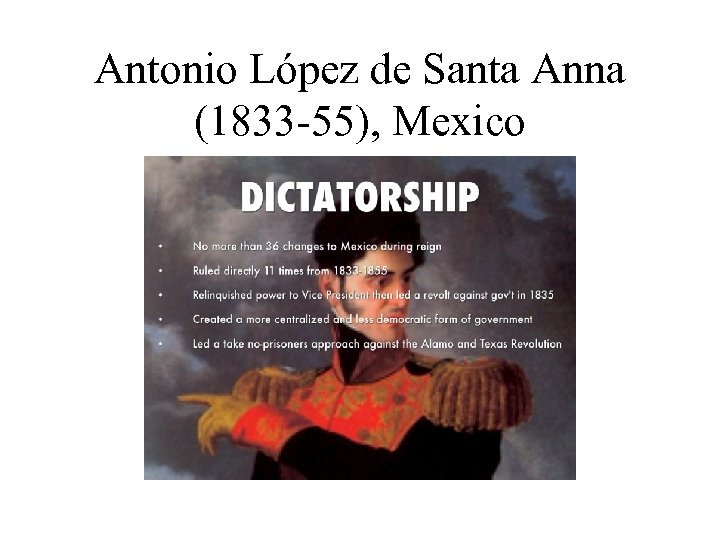 Antonio López de Santa Anna (1833 -55), Mexico
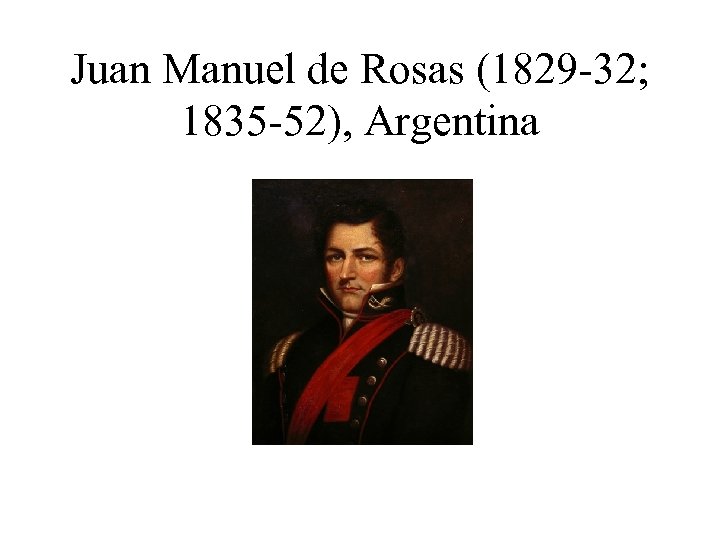 Juan Manuel de Rosas (1829 -32; 1835 -52), Argentina
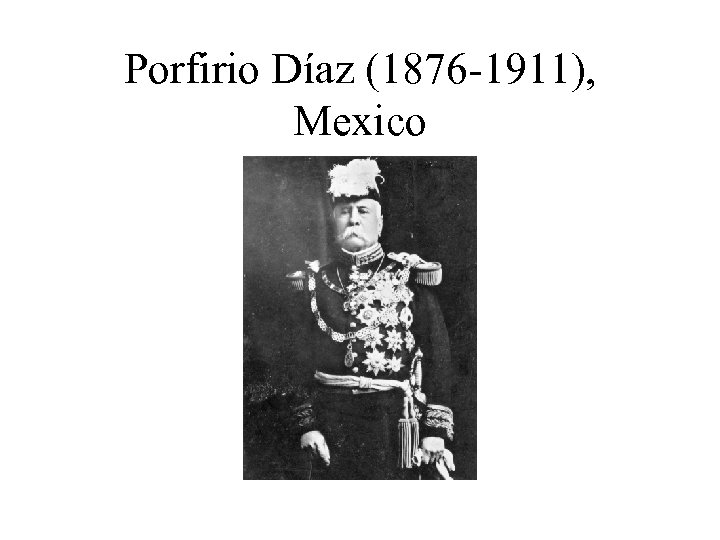 Porfirio Díaz (1876 -1911), Mexico
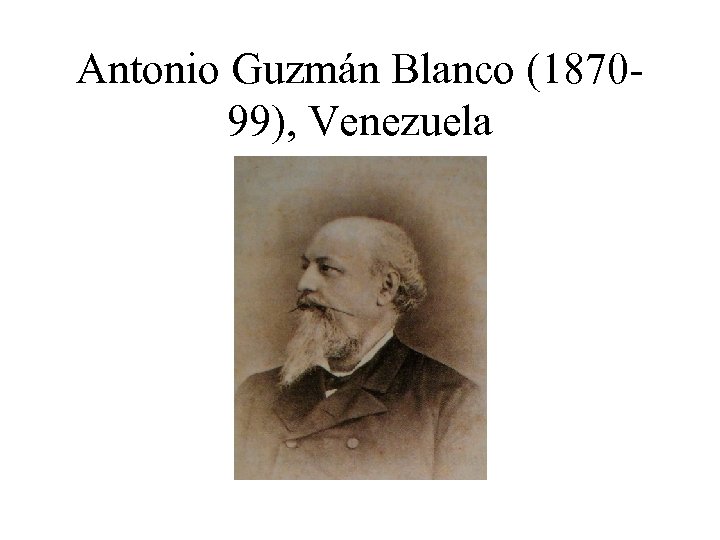 Antonio Guzmán Blanco (187099), Venezuela
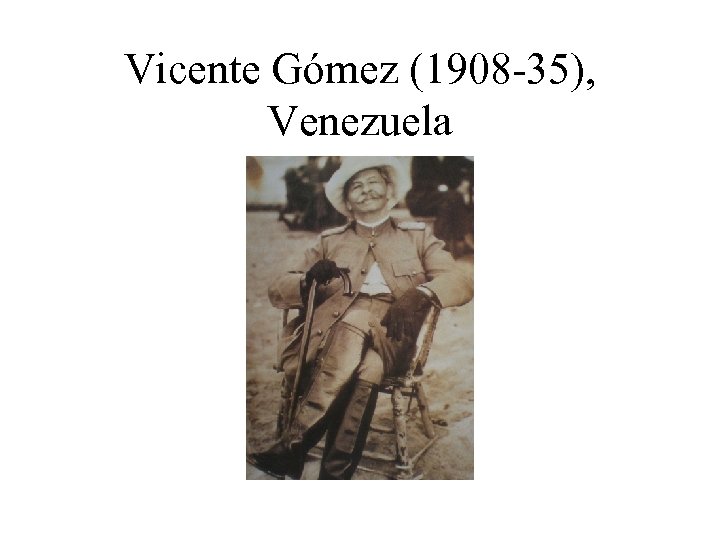 Vicente Gómez (1908 -35), Venezuela
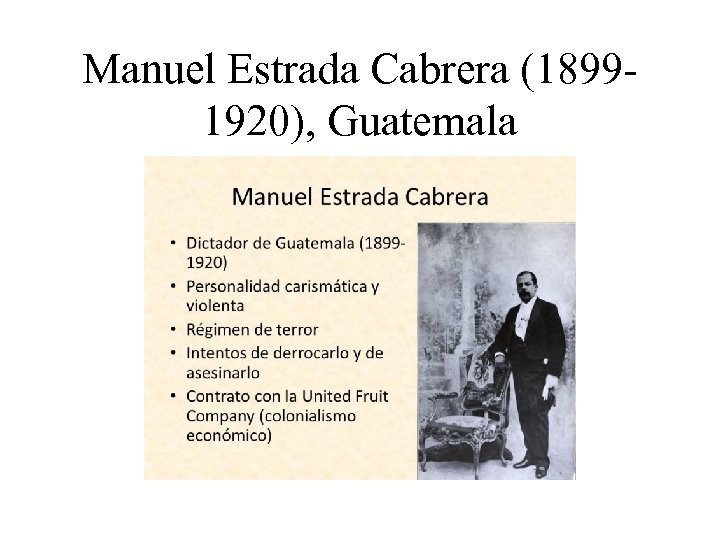 Manuel Estrada Cabrera (18991920), Guatemala
 Competitive oligarchies or Oligarchic ”democracies” • • Institutionalized elite contestation: Argentina (1880 -1916) Brazil (1889 -1930) Colombia (1903 -1936) Peru (1895 -1919) Ecuador (1916 -25) Bolivia (1899 -1920) Chile (1830 s-1920)
 Elections and Democracy • • Democracy: Participation (suffrage) & Contestation (competition) Clean elections: absence of electoral fraud Free elections: secret elections, abolition of control of the voters Democratic elections: the elections decide who obtains (governmental) power (Adam Przeworski: ”the process of establishing a democracy is a process of institutionalizing uncertainty”) • Sham democracy/facade democracy: the legitimacy function of elections • Democracy as the only game in town: absence of other games: force of arms (military coup, rebellion and revolution, partly as a reaction to corrupt elections and electoral fraud)
 Participation: Limited suffrage • Economic limitations: régime censitaire: suffrage rights only to those with a certain level of property and income (cens) • Literacy limitations: régime capacitaire (”sufragio capacitario”): suffrage rights should be based on certain qualifications among voters (e. g. literacy).
 Suffrage development in Latin America • Universal male suffrage during the 1850 s (long before most western democracies): • Colombia 1853 (300, 000 people went to the polls in the 1 rst elections in Colombia held under universal suffrage in 1853; 210, 000 voted in the 1856 presidential election (40% of the electorate) • Argentina 1853 • Mexico 1857 • Venezuela 1858 (the Federal Wars, 1858 -63: Federal Republic in the Constitution of 1864) • Universal suffrage in Bolivia (1952), Ecuador (1978), Peru (1979) and Brazil (1985).
 Suffrage extensions in Latin America • In contrast to the English experience, the expansion of suffrage in Latin America did not develop in a linear, gradual way, except in Chile (and Costa Rica) • From a relatively wide franchise during the 1 rst decades of the 19 th century, some countries later opted for a more restricted suffrage. Colombia reintroduced income restrictions to the vote in 1886. In Peru, literacy qualifications were brought back in 1896, reversing the generous suffrage that had been in place since 1860. In Brazil, the electoral reform in 1881 drastically reduced the size of the electorate.
 The English model: Gradual suffrage extensions • Chile: suffrage for literate men (capacitaire) in 1874, economic (censitaire) criteria abolished, universal suffrage in 1970 • Costa Rica: suffrage for literate men (capacitaire) in 1869, economic (censitaire) criteria abolished. Universal suffrage (men and women) in 1949
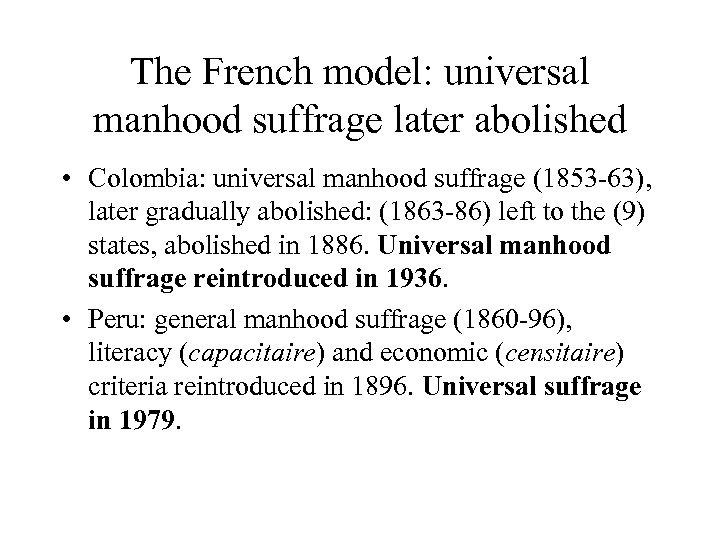 The French model: universal manhood suffrage later abolished • Colombia: universal manhood suffrage (1853 -63), later gradually abolished: (1863 -86) left to the (9) states, abolished in 1886. Universal manhood suffrage reintroduced in 1936. • Peru: general manhood suffrage (1860 -96), literacy (capacitaire) and economic (censitaire) criteria reintroduced in 1896. Universal suffrage in 1979.
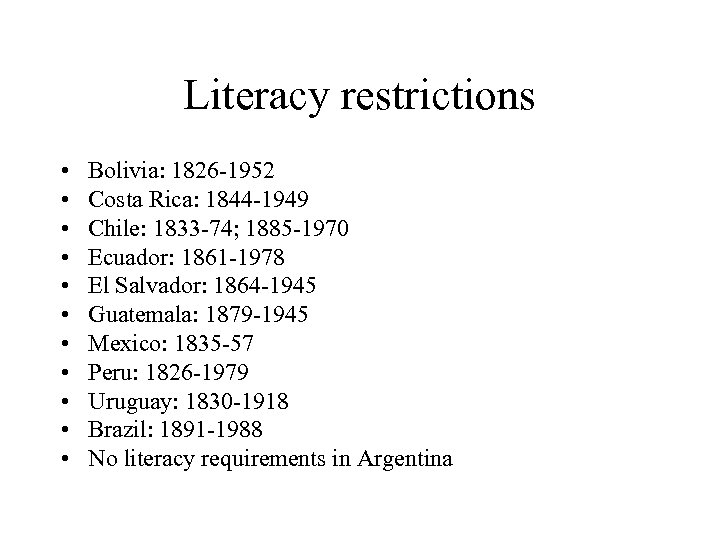 Literacy restrictions • • • Bolivia: 1826 -1952 Costa Rica: 1844 -1949 Chile: 1833 -74; 1885 -1970 Ecuador: 1861 -1978 El Salvador: 1864 -1945 Guatemala: 1879 -1945 Mexico: 1835 -57 Peru: 1826 -1979 Uruguay: 1830 -1918 Brazil: 1891 -1988 No literacy requirements in Argentina
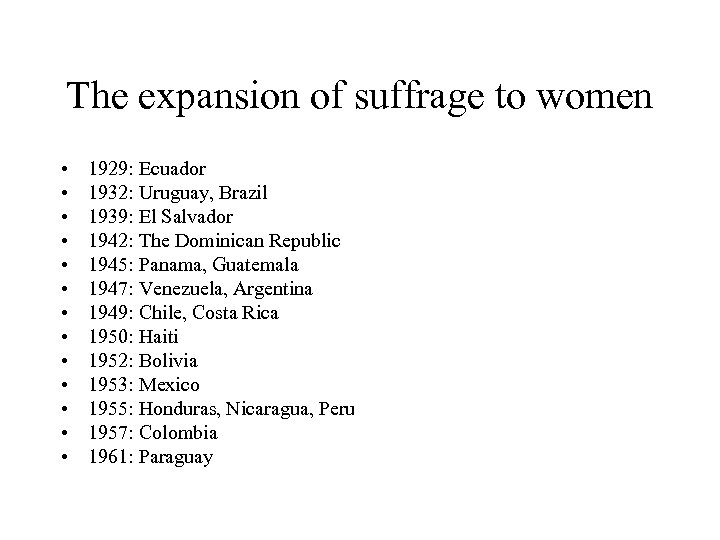 The expansion of suffrage to women • • • • 1929: Ecuador 1932: Uruguay, Brazil 1939: El Salvador 1942: The Dominican Republic 1945: Panama, Guatemala 1947: Venezuela, Argentina 1949: Chile, Costa Rica 1950: Haiti 1952: Bolivia 1953: Mexico 1955: Honduras, Nicaragua, Peru 1957: Colombia 1961: Paraguay
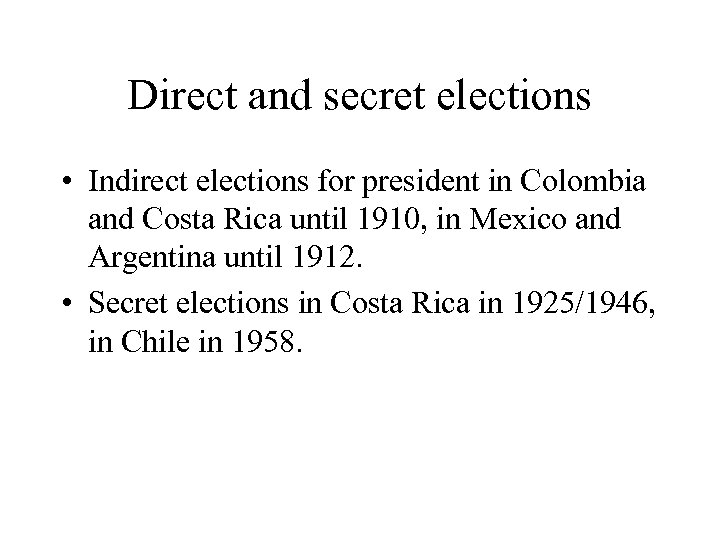 Direct and secret elections • Indirect elections for president in Colombia and Costa Rica until 1910, in Mexico and Argentina until 1912. • Secret elections in Costa Rica in 1925/1946, in Chile in 1958.
 Electoral corruption/fraud • It is important to identify the crudest mechanisms of electoral corruption, such as the falsification of the polls, the intimidation of voters and the bribery of electors, from electoral influence based on relationships of deference, patronage and clientelism. These latter phenomena should be treated as distinct categories.
 Electoral fraud • ”Las elecciones no se hacían, se escribían”: gobiernos electores, or fabricated elections under dictatorial control. • At one end of the spectrum, it is possible to identify regimes where the degree of government interference made elections quite uncompetitive, almost meaningless, beyond playing a ritual legitimising role. The caudillo regimes of Porfirio Díaz (1876 -1911) in Mexico and Juan Manuel de Rosas (1835 -52) in Argentina could be included among such extreme examples of gobiernos electores.
 Electoral fraud: a more competitive game of tricks open to all contestants • Argentina: Electoral competition was more notable after the fall of Rosas in 1852. • Chile: the Chilean system after 1833 developed higher levels of electoral competition than both Spain (1874 -1923) and Argentina (1852 -1912) • Colombia: high levels of electoral competition since 1836.
 Electoral fraud • Violence, fraud and bribery: all these expressions of electoral corruption were also present in other countries where electoral democracy developed, both in Europe and Latin America.
 A long tradition of electoral fraud • • • Vote buying Preventing the opposition from reaching the polling station by force Jailing the opposition’s candidates and voters Government supporters voting several times: carruseles Non-registered voters casting votes Legally disqualified persons casting votes (foreigners, minors, military men) • Casting votes on behalf of absent or dead persons (the graveyard vote) • Stuffing the ballot box • Falsifying the vote count: ”El que escruta, elige” (He who counts, elects) (Somoza: ”You won the election, but we won the count!”)
 Paradox • Massive electoral fraud means that those who fight for power depend on votes in order to secure victory and therefore seek to mobilize their supporters. But it also means that elections and voting have become the decisive means of obtaining power and has started to replace other forms of achieving power. At the same time blatant electoral fraud also had a pedagogical effect: since electoral fraud was so widespread, it led over time to protest and opposition against democratic charades (sham democracy) and to demands for clean elections. The slogan from the Mexican revolution: ”sufragio efectivo, no reelección”. Costa Rica: a democratic revolution against electoral fraud in 1948.
 COLOMBIA • Viceroyalty of New Granada (-), Ecuador & Venezuela = Gran Colombia (1819 -30) (President Simón Bolívar, dictator 1828, resigned 1830) • The Republic of New Granada (1830 -58), Constitution of 1832, 1843 (Conservative), 1853 (Liberal, more federal: elimination of property and literacy qualifications for voters), The Granadine Confederation (1858 -63) (Conservative), 1861(Provisional Pact of Union) • The United States of Colombia (1863 -86) • The Republic of Colombia (1886 -present) Constitutions of 1886, 1991.
 Civil wars in 19 th century Colombia • • La Guerra de los Supremos (1839 -42) Liberal revolution (1860 -62) Civil war of 1875 1876 -77: unsuccessful Conservative uprising • 1885: unsuccesful radical liberal uprising • 1895: liberal uprising • Guerra de los Mil Días (1899 -1902): liberal
 Colombia: New Granada • General Francisco de Paula Santander (1832 -37), José Ignacio de Márquez (1837 -41), revolt by general José María Obando, bloody civil war, government victory, Pedro Alcántara Herrán (1841 -45), imposed a new centralized constitution in 1843, presidents came to power via elections and completed their terms of office, Herrán succeeded by his father-in-law, Tomás Cipriano de Mosquera (1845 -49)
 Colombia: New Granada • In the 1849 elections, the two groups that would form the modern parties of Colombian politics emerged: Conservatives and Liberals, but with the government (Conservative) forces split, the Liberal candidate, General José Hilario López (1849 -53), took office in April 1849 after being selected in the 4 th ballot in Congress. Expecting defeat in the 1853 presidential elections, the Conservatives offered no candidate. General José María Obando (1853 -54), military coup d’état in April 1854: General José María Melo; José Obaldía (1854 -57), Mariano Ospina, Conservative (1857 -61), civil war (186062), Tomás Cipriano de Mosquera (president of Cauca state) took control of Bogotá in July 1861 (1861 -63)
 The United States of Colombia (1863 -86) • President of the US of Colombia: elected by state vote (9 states) to serve 2 year terms, ineligible for immediate reelection • 9 states: Panamá, Antioquia, Bolívar, Cauca, Cundinamarca, Magdalena, Santander, Boyacá and Tolima. • Each state, one vote. Absolute majority: 5 out of 9 states. If not, election deferred to Congress
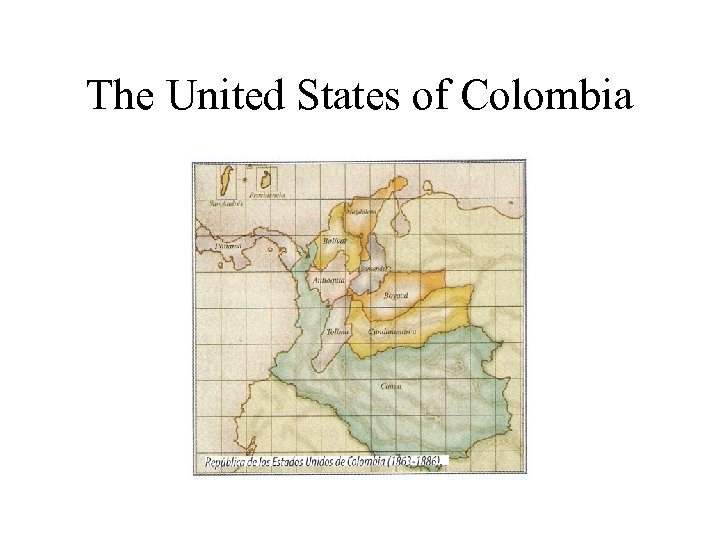 The United States of Colombia
 The electoral system for electing the President • The election of the President was indirect, each of the 9 states casting one single vote; the successful candidate required an absolute majority (5 out of 9 states), otherwise the final decision was left to Congress. • The individual states chose their candidates through different procedures
 Electoral regulations in the 9 States • Restricted and indirect: Antioquia and Tolima • Restricted but direct: Cundinamarca, Santander and Boyacá. • Male universal suffrage: Panama, Bolívar, Magdalena and Cauca
 The presidents of the US of Colombia (1863 -86) • • • • Tomás Cipriano de Mosquera (1863 -64) Manuel Murillo Toro (1864 -66) Tomás Cipriano de Mosquera (1866 -67) General Santiago Acosta (1867 -68) Santos Gutiérrez Prieto (1868 -70) Eustargio Salgar Moreno (1870 -72) Manuel Murillo Toro (1872 -74) Santiago Pérez de Manosalbas (1874 -76) Aquileo Parra Gómez (1876 -78) Julián Trujillo Largacha (1878 -80) Rafael Núñez (1880 -82) Francisco Javier Zaldúa y Racines (1882) José Eusebio Otálora (1882 -84) Rafael Núñez (1884 -86)
 The 1875 presidential election in the US of Colombia • In 1875 the Liberal dissidents, or independents, supported Rafael Núñez for the presidency against the radicals’ Aquileo Parra and Bartolomé Calvo for the Conservatives.
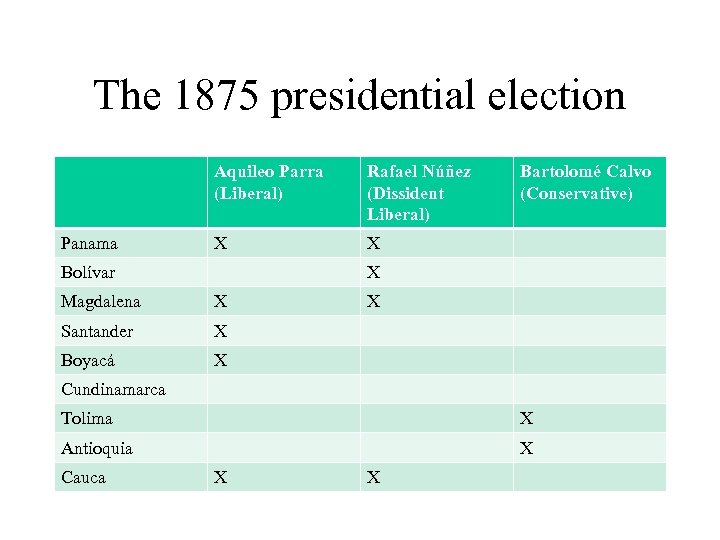 The 1875 presidential election Aquileo Parra (Liberal) Panama Rafael Núñez (Dissident Liberal) X X Bolívar Bartolomé Calvo (Conservative) X Magdalena X Santander X Boyacá X X Cundinamarca Tolima X Antioquia X Cauca X X
 The 1875 presidential election • None of the candidates won the support of an absolute majority (5) among the 9 states. • Hence, individual balloting by members of Congress: Alquileo Parra was elected with 48 votes, against 18 votes cast for Rafael Núñez.
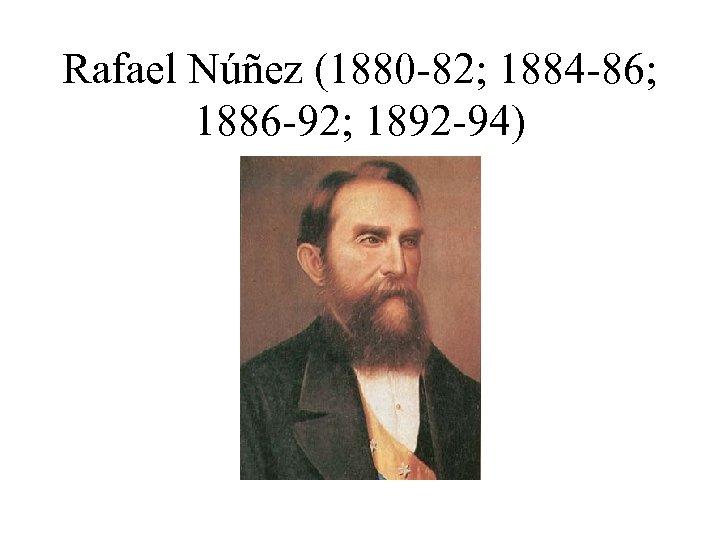 Rafael Núñez (1880 -82; 1884 -86; 1886 -92; 1892 -94)
 The Republic of Colombia • Constitution of 1886: Unitary state: departamentos • Less intense electoral calendar (presidential elections had taken place every two years between 1863 and 1886: the «biennial electionary fever» ): presidential term is 6 years (1886 -1910), and 4 years after 1910
 Electoral system • Male universal suffrage for municipal councillors and deputies in departmental assemblies. • Literacy and property requirements to elect representatives for the lower chamber and electores, who in turn elected the president. • Senators elected by departmental assemblies
 Colombia, 1886 -1936 • • • • Rafael Núñez (1886 -92; 1892 -94) died in office Miguel Antonio Caro Tobar (1894 -98) vice-president under Núñez Manuel Antonio Sanclemente (1898 -1900) deposed in a coup d’état. The War of a Thousand Days (1899 -1902) José Manuel Marroquín Ricuarte (1900 -04) Conservative who seized power in a coup d’état Rafael Reyes Prieto (1904 -09) Cons. Resigned Ramón González Valencia (1909 -10) elected by Congress to finish Reyes’ term Carlos Eugenio Restrepo (1910 -14) 4 -year terms, direct elections Cons. José Vicente Concha Ferreira (1914 -18) Cons. Marco Fidel Suárez (1918 -21) Cons. Resigned Jorge Holguín Mallarino (1921 -22) Pedro Nel Ospina (1922 -26) Cons. Miguel Abadía Méndez (1926 -30) Cons. Enrique Olaya Herrera (1930 -34) Liberal Alfonso López Pumarejo (1934 -38) Liberal Universal male suffrage 1936
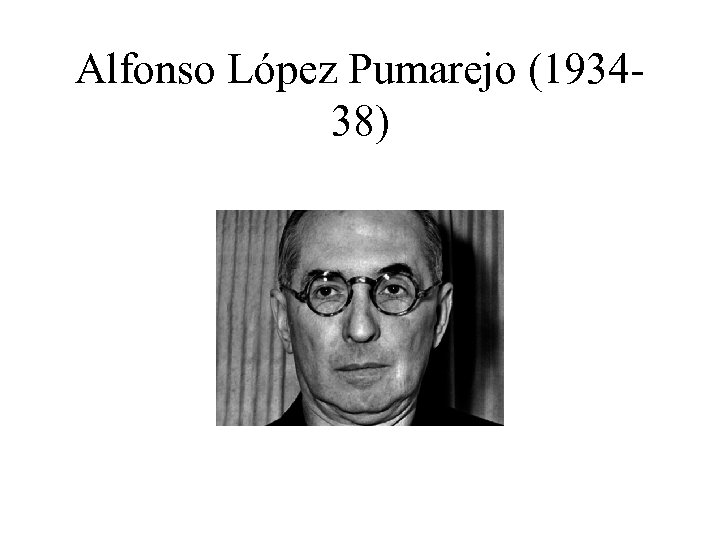 Alfonso López Pumarejo (193438)
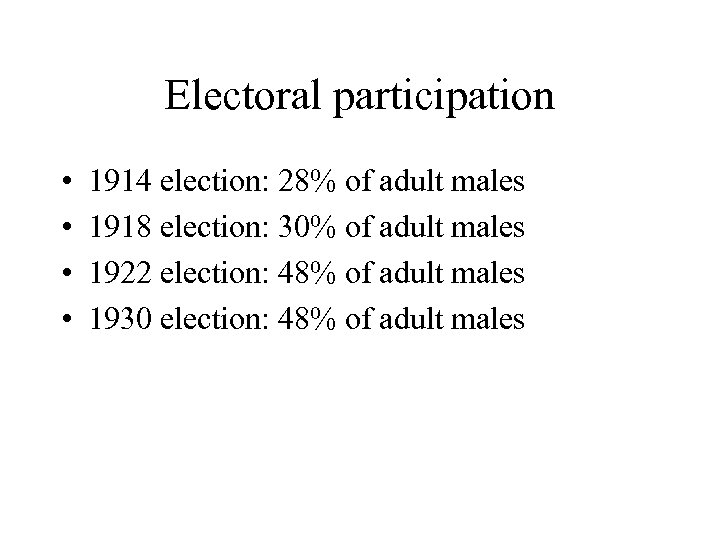 Electoral participation • • 1914 election: 28% of adult males 1918 election: 30% of adult males 1922 election: 48% of adult males 1930 election: 48% of adult males
 Contestation • Uncontested elections: 1892, 1910, and 1926 • Liberals abstained from presenting their own candidates: 1904 and 1918 • Liberals did field their own ticket: 1898, 1922 and 1930 • In 1930 the Liberal Enrique Olaya Herrera won over two Conservative candidates.
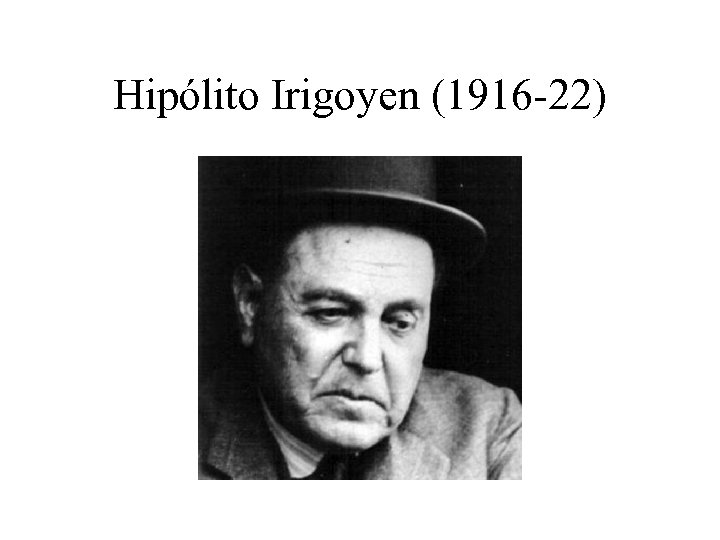
 Presidents of Argentina (18801916) • • • Julio Argentino Roca (1880 -86) National Autonomist Party (PAN) Miguel Juárez Celman (1886 -90) (PAN-PN) Resigned following the revolution of the Park Carlos Pellegrini (1890 -92) Vice-president under Juárez Celman Luis Sáenz Peña (1892 -95) (PAN) Resigned José Evaristo Uriburu (1895 -98) (PAN) Vice-president under Sáenz Peña Julio Argentino Roca (1898 -1904) PAN Manuel Quintana (1904 -06) (PAN) Resigned for health reasons José Figueroa (1906 -10) (PAN) Vice-president under Quintana Roque Sáenz Peña (1910 -14) (PAN-Modernist) Died in office Victorino de la Plaza (1914 -16) (PAN) Vice-president under Sáenz Peña Hipólito Yrigoyen (1916 -22) UCR
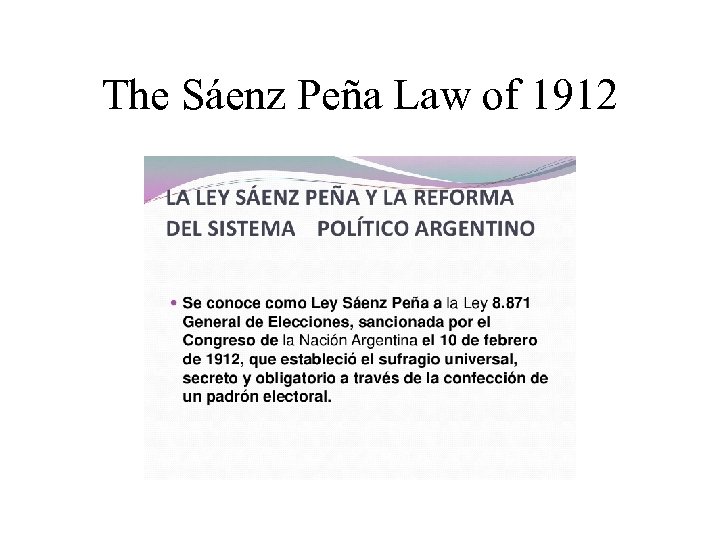
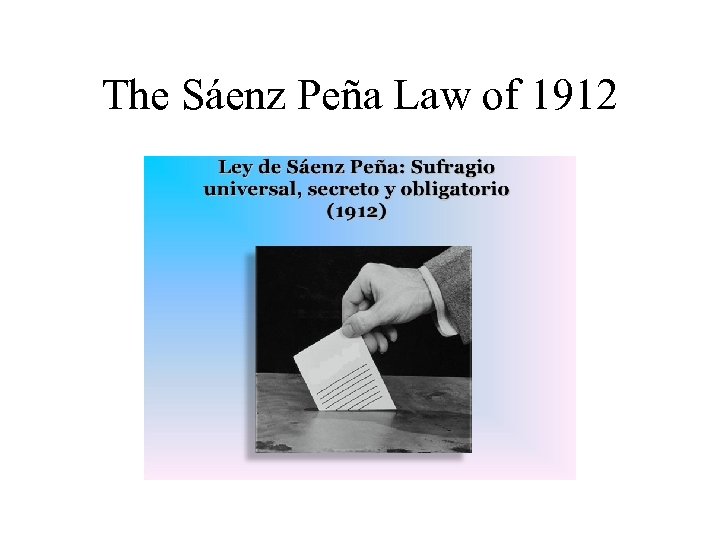
 Early breakthrough to democracy in Argentina • The Sáenz Peña law (1912): secret universal manhood suffrage. The presidential election of 1916: the opposition (UCR) wins: Hipólito Yrigoyen (1916 -22)
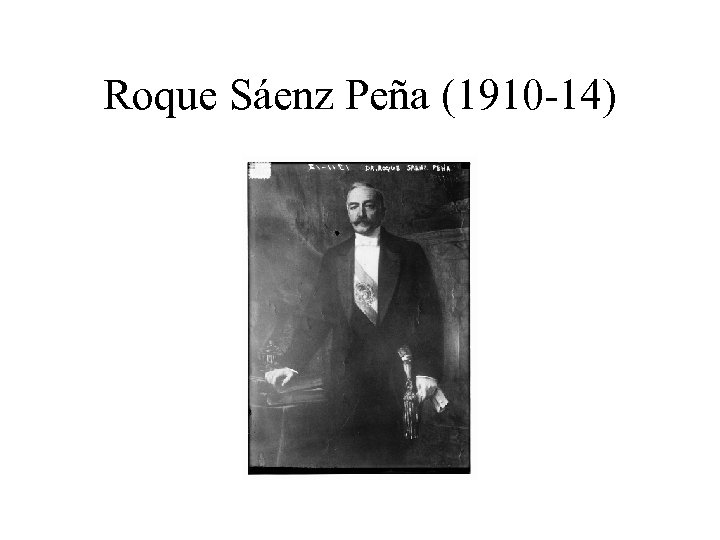 Roque Sáenz Peña (1910 -14)
 The Sáenz Peña Law of 1912
 The Sáenz Peña Law of 1912
 Hipólito Irigoyen (1916 -22)
 PERU • Mariano Ignacio Prado (1865 -68) • José Balta (1868 -executed 22 July 1872) • Tomás Gutiérrez (22 -26 July 1872) failed military coup d’état • Manuel Pardo (1872 -76) 1 rst civilian president of Peru
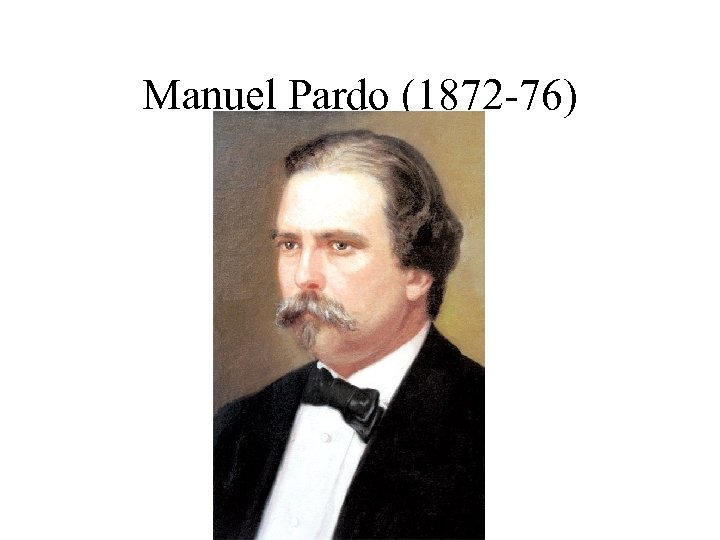 Manuel Pardo (1872 -76)
 Suffrage rights in Peru before 1895 • All men over 21 years of age who could read and write, or paid taxes, or owned a workshop, or some land. Thus, legally the majority of adult Peruvian men did have the right to vote. We don’t know how many people actually voted. Elections were held public and oral, not written and secret.
 Election procedures • Elections divided into 3 parts: • The people elected delegates • The delegates elected the new president (every 4 years) and new members of Congress (a third of them were replaced every two years) • Congress decided if the election of each new member and the president had been legal.
 The electoral calendar • In the 1870 s the people elected delegates in October; the delegates then elected the new members of Congress in November and the new president the following May. The Congress made its final decisions in July. This lengthy procedure was one important reason why elections led to prolonged political conflict.
 The 1871 -72 presidential election • The elections of October 1871 for delegates were very violent. According to the law the elections had to take place in the main square of the constituency. The electoral clubs for Pardo and Echenique fought for control over the main square of the constituencies. The defeated party moved to the second square of the constituency to hold its election.
 The 1871 -72 presidential election • Parallel electoral processes also occurred when the delegates assembled in the provincial capital to elect members of Congress (November) and the president (May) • The candidates showed their power in the streets and in the squares, not at the polls.
 The 1871 -72 presidential election • Police and army forces normally intervened to give victory to the candidate supported by the sitting president. This did not happen in Lima in 1871. The army remained in the barracks. José Balta did not want to kill dozens of Pardo’s followers assembled in the main squares. Too many of them belonged to Lima’s upper class.
 July 1872: The electoral result • Congress determined which assembly of delegates was the legal one in each constituency. President Balta opposed Pardo’s candidacy, but the majority in congress supported Pardo. According to congress, Pardo had won 69% of all the delegates’ votes.
 July 1872: Failed military coup • Tomás Gutiérrez attempted a military coup against Pardo’s election. But the navy opposed the coup and granted Pardo asylum on its most powerful warship. A rising of well-organized and armed civilians ended the coup on 27 July 1872. Six days later, Manuel Pardo took power as the first civilian president of Peru.
 The Aristocratic Republic (18951919) • Because of the War with Chile (1879 -82) and the civil wars, in the 1880 s elections were less important. But in the Aristocratic Republic (1895 -1919) elections were once again held regularly. But now people voted peacefully, because the new election law of 1896 gave only a small minority the right to vote: literate adult men
 Peru, 1895 -1919 • Between 1895 and 1919, a tenuous succession of civilian governments seemed to portend a gradual consolidation of the institutions of the 1860 constitution. A great increase in foreign investment, expansion of mining, and increased coastal export agriculture brought prosperity but also the beginnings of labor strife and Peru’s introduction to the politics of class conflict. In 1919, former president Augusto Leguía carried out a coup d’état, claiming that he came to office ”to liquidate the old order” and to ”detain the advance of communism”. To legitimate the new order, Leguía derogated the 1860 constitution and imposed a more liberal constitution in 1920. In practice, Leguía nullified the constitution and ruled as a dictator until he was deposed by a military coup in 1930.
 The Aristocratic Republic, 18951919 • • • Nicolás de Piérola (1895 -99) Eduardo López de Romaña (1899 -1903) Manuel Candamo (1903 -1904) Serapio Calderón (7/5 -24/9 1904) Interim caretaker José Pardo y Barreda (1904 -1908) Augusto B. Leguía y Salcedo (1908 -1912) Guillermo Billinghurst (1912 -1914) Oscar Benavides (4/2 1914 -18/8 1915) coup d’état José Pardo y Barreda (1915 -19) Augusto B. Leguía y Salcedo (1919 -30) Coup d’état
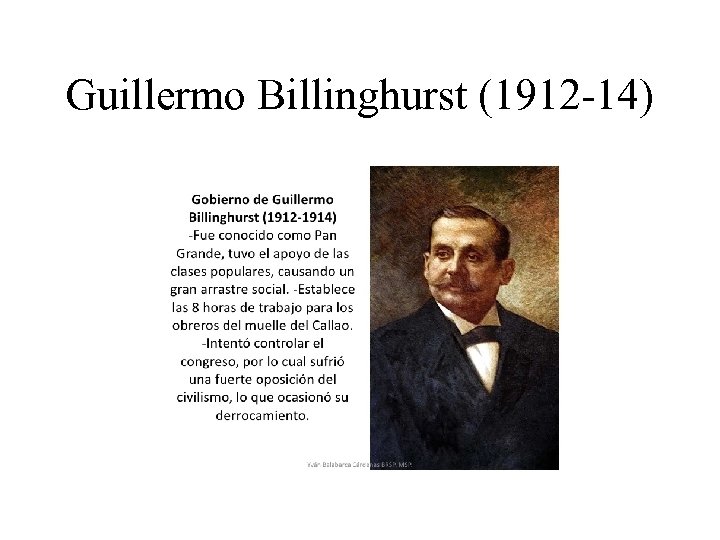 Guillermo Billinghurst (1912 -14)
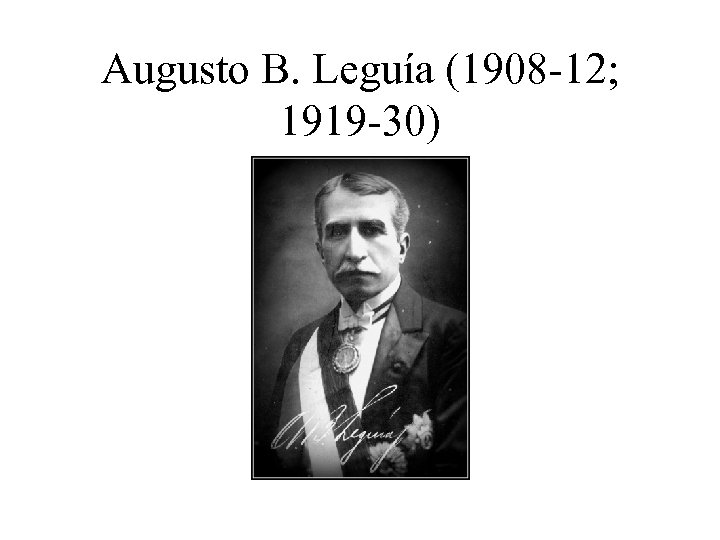 Augusto B. Leguía (1908 -12; 1919 -30)
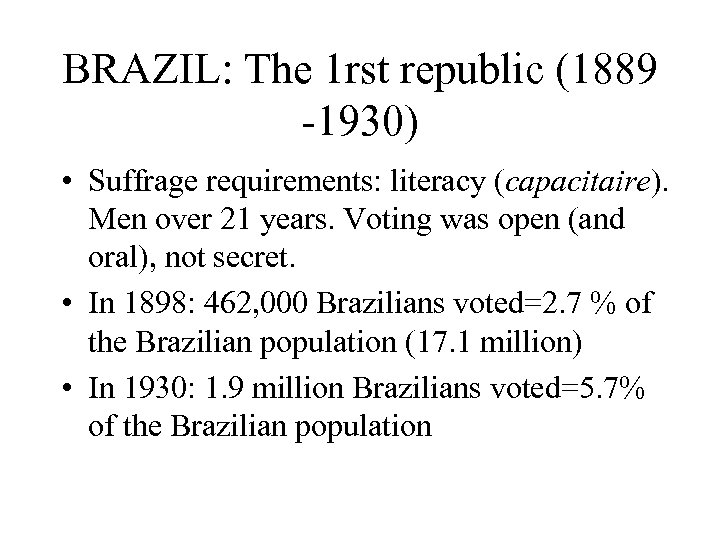 BRAZIL: The 1 rst republic (1889 -1930) • Suffrage requirements: literacy (capacitaire). Men over 21 years. Voting was open (and oral), not secret. • In 1898: 462, 000 Brazilians voted=2. 7 % of the Brazilian population (17. 1 million) • In 1930: 1. 9 million Brazilians voted=5. 7% of the Brazilian population
 Ricci & Zulini 2012: a particular type of electoral fraud • The practice of degola ( «beheading» ): electoral results were altered when Congress decided on which deputies to certify as duly elected • After the Constitutent Assembly of 1891, the first election of representatives to the lower house of the National Congress was held in 1894, with subsequent elections held every 3 years until the revolution of 1930.
 Degolas • Between 1894 and 1930, 260 candidates granted election certificates by the local election boards were subsequently beheaded in the Chamber: 8. 7%. • Presidential successions in the 1 rst Republic were based on relations between Brazil’s heavyweight states: São Paolo and Minas Gerais (café com leite politics)
 Café com leite politics • Café com leite (”coffee with milk”) was a term that referred to the domination of Brazilian politics under the Old Republic (1889 -1830) by the landed gentries of São Paulo (dominated by the coffee industry) and Minas Gerais (dominated by dairy interests), the largest states in terms of population and wealth. The first presidents of the republic were from São Paulo and thereafter succeeded by an alternation between the outgoing governors of these two states in the presidency. The politics of café com leite rested on an oligarchic system known as coronelismo, a boss system under which the control of patronage was centralized in the hands of locally dominant oligarchs (”coroneis”), who dispensed favors in return for loyalty.
 The 1 rst (”Old”) Brazilian Republic (1889 -1930) • • • • Marshal Deodoro da Fonseca (1889 -91) deposed Emperor Dom Pedro II in a military coup d’état, replaced the Empire with a federal republic and formed a Provisional Government. Elected 1 rst President of Brazil by the Constituent Congress, resigned after failed coup d’état (São Paulo) Marshal Floriano Peixoto (1891 -94) Vice-president under Deodoro da Fonseca (São Paulo) Prudente de Morais (1894 -98) 1 rst directly elected President, 1 rst civilian President (São Paulo) Campos Sales (1898 -1902) (São Paulo) Francisco de Paula Rodrigues Alves (1902 -1906) (São Paulo) Alfonso Pena (1906 -09) Died in office (Minas Gerais) Nilo Pecanha (1909 -10) Vice-president under Pena (Minas Gerais) Hermes da Fonseca (1910 -14) Nephew of Deodoro (São Paulo) Vencelau Brás (1914 -18) (Minas Gerais) Francisco de Paula Rodrigues Alves (1918) (São Paulo) died (Spanish flu epidemic) before assuming office Delfim Moreira (1918 -19) (São Paulo) Vice-president of president-elect Rodrigues Alves Epitácio Pessoa (1919 -22) (São Paulo) Artur Bernardes (1922 -26) (Minas Gerais) Washington Luís (1926 -30) (São Paulo) deposed (24 October) 3 weeks before the end of his term (15 November) Julio Prestes (1930) (São Paulo) president-elect who never took office because Getúlio Vargas (Rio Grande do Sul), the loser of the 1930 presidential election, seized power in a coup d’état THE VARGAS ERA (1930 -45)
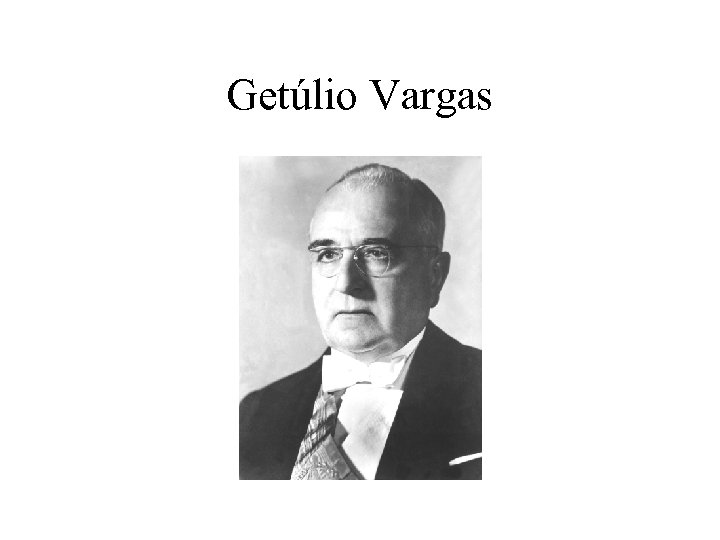 Getúlio Vargas