


 Скачать презентацию Sample Presentation Anglo-Saxon coins found in Southampton 1
8eb9561a5264d71fd375b7e5feac70d8.ppt
- Количество слайдов: 63
 Sample Presentation Anglo-Saxon coins found in Southampton 1
 REFERENCES 2
 The origins of Anglo-Saxon coinage 3
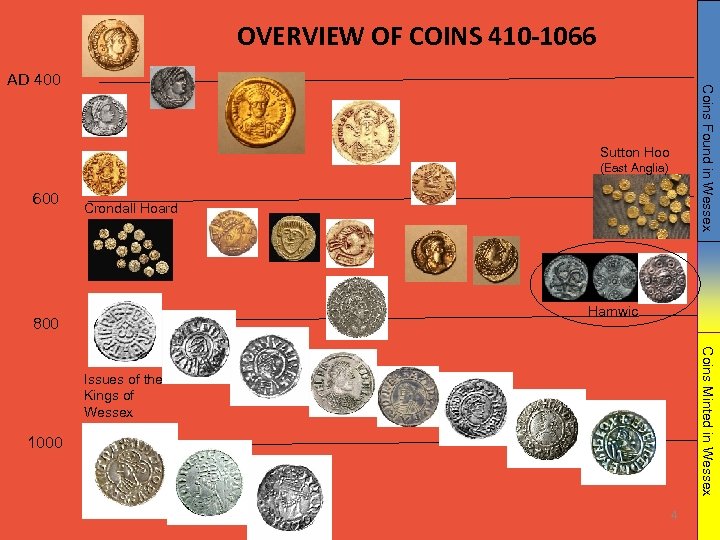 OVERVIEW OF COINS 410 -1066 Sutton Hoo (East Anglia) 600 Crondall Hoard Coins Found in Wessex AD 400 Hamwic 800 Coins Minted in Wessex Issues of the Kings of Wessex 1000 4
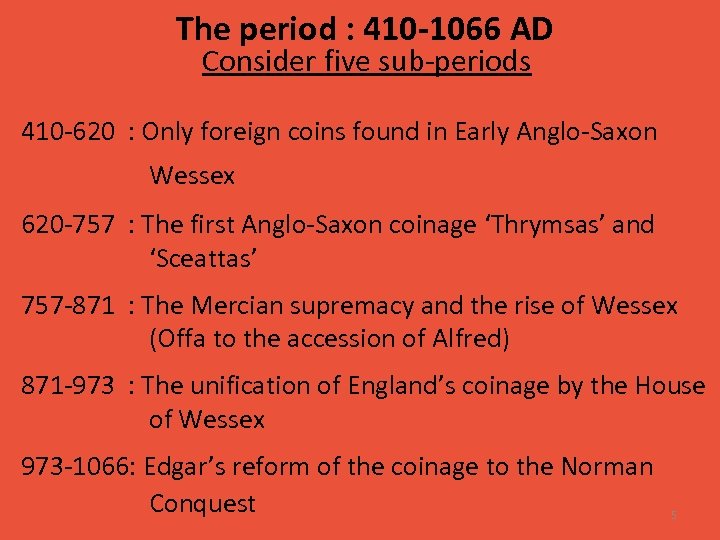 The period : 410 -1066 AD Consider five sub-periods 410 -620 : Only foreign coins found in Early Anglo-Saxon Wessex 620 -757 : The first Anglo-Saxon coinage ‘Thrymsas’ and ‘Sceattas’ 757 -871 : The Mercian supremacy and the rise of Wessex (Offa to the accession of Alfred) 871 -973 : The unification of England’s coinage by the House of Wessex 973 -1066: Edgar’s reform of the coinage to the Norman Conquest 5
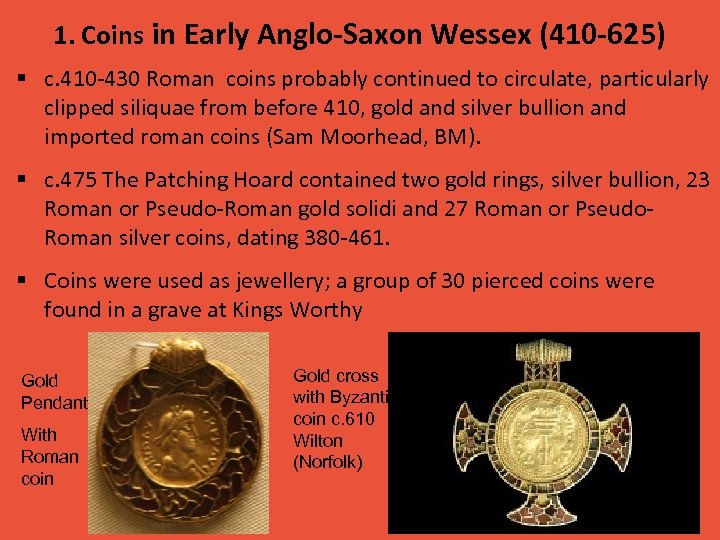 1. Coins in Early Anglo-Saxon Wessex (410 -625) § c. 410 -430 Roman coins probably continued to circulate, particularly clipped siliquae from before 410, gold and silver bullion and imported roman coins (Sam Moorhead, BM). § c. 475 The Patching Hoard contained two gold rings, silver bullion, 23 Roman or Pseudo-Roman gold solidi and 27 Roman or Pseudo. Roman silver coins, dating 380 -461. § Coins were used as jewellery; a group of 30 pierced coins were found in a grave at Kings Worthy Gold Pendant With Roman coin Gold cross with Byzantine coin c. 610 Wilton (Norfolk) 6
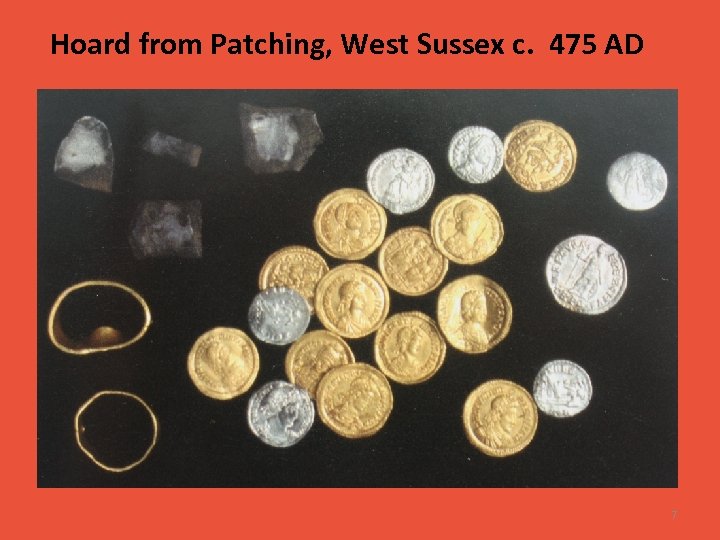 Hoard from Patching, West Sussex c. 475 AD 7
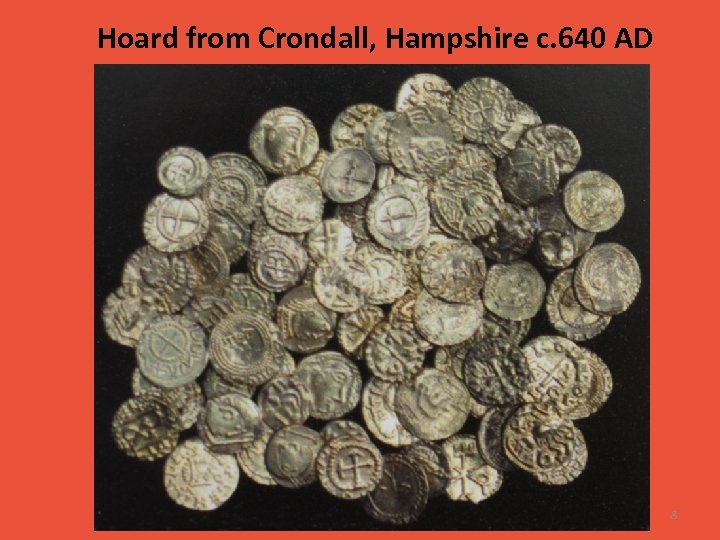 Hoard from Crondall, Hampshire c. 640 AD 8
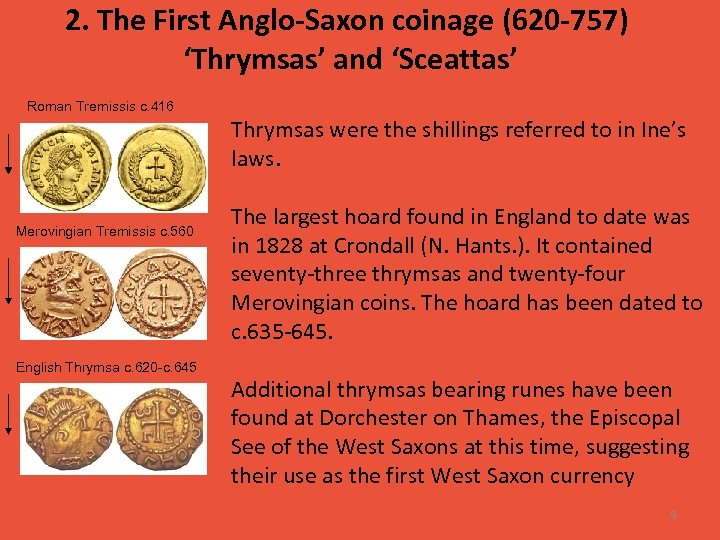 2. The First Anglo-Saxon coinage (620 -757) ‘Thrymsas’ and ‘Sceattas’ Roman Tremissis c. 416 Thrymsas were the shillings referred to in Ine’s laws. Merovingian Tremissis c. 560 English Thrymsa c. 620 -c. 645 The largest hoard found in England to date was in 1828 at Crondall (N. Hants. ). It contained seventy-three thrymsas and twenty-four Merovingian coins. The hoard has been dated to c. 635 -645. Additional thrymsas bearing runes have been found at Dorchester on Thames, the Episcopal See of the West Saxons at this time, suggesting their use as the first West Saxon currency 9
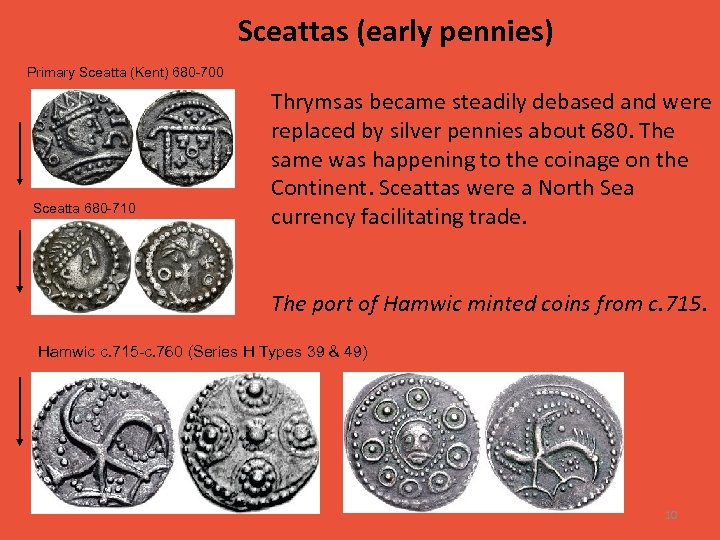 Sceattas (early pennies) Primary Sceatta (Kent) 680 -700 Sceatta 680 -710 Thrymsas became steadily debased and were replaced by silver pennies about 680. The same was happening to the coinage on the Continent. Sceattas were a North Sea currency facilitating trade. The port of Hamwic minted coins from c. 715. Hamwic c. 715 -c. 760 (Series H Types 39 & 49) 10
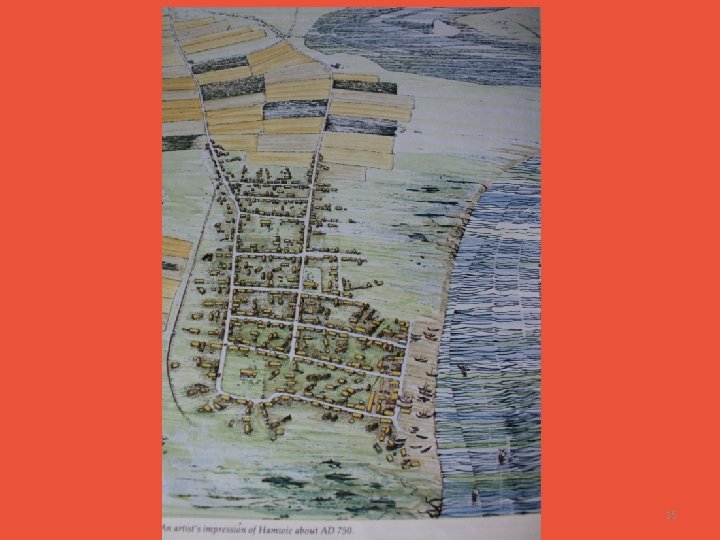
 (2) The Archaeology of Hamwic 11
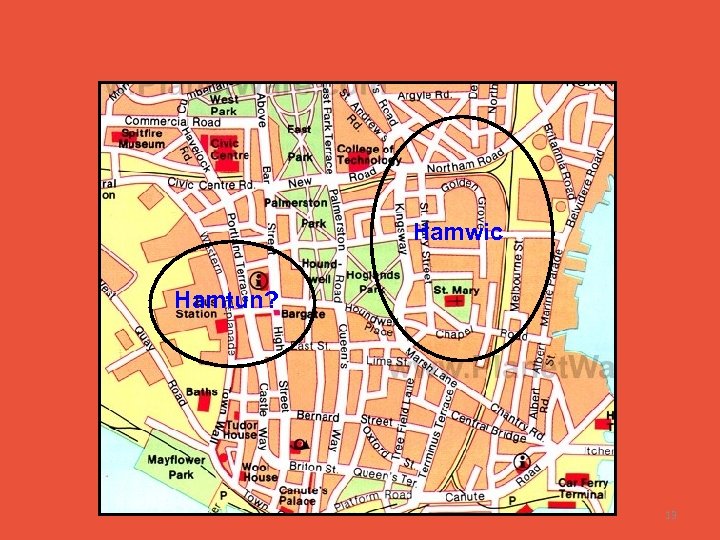
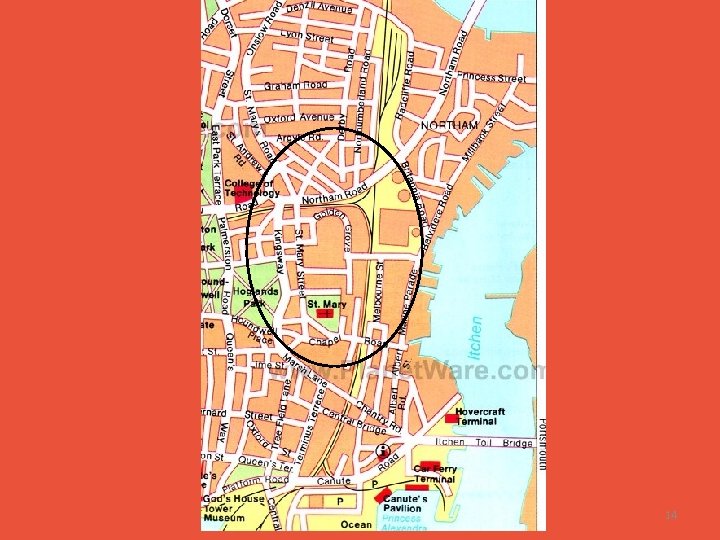
 Hamtun & Hamwic Hamtun – Royal estate, 6 -7 th. century; defensible site to the west Hamwic – Trading centre & port, late 7 th century (founded by King Ine) to the east 12
 Hamwic Hamtun? 13
 14
14
 15
15
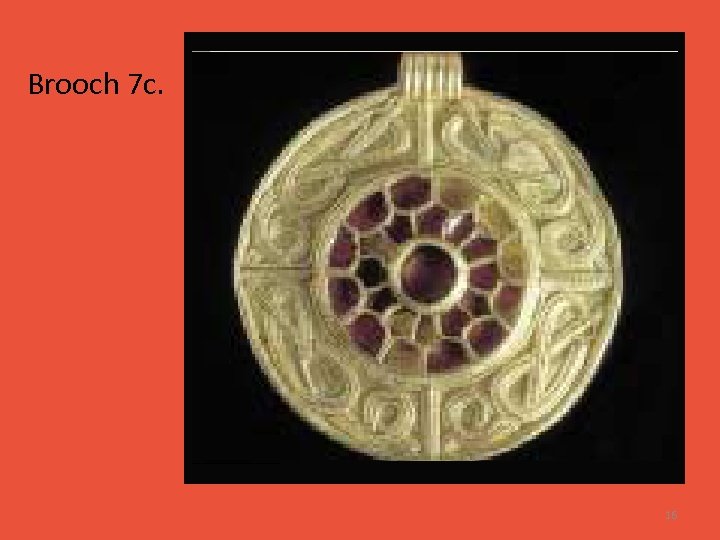 Brooch 7 c. 16
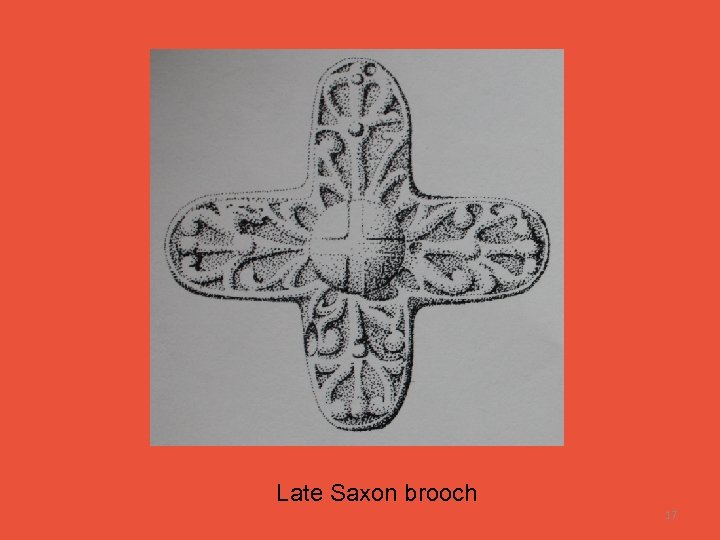 Late Saxon brooch 17
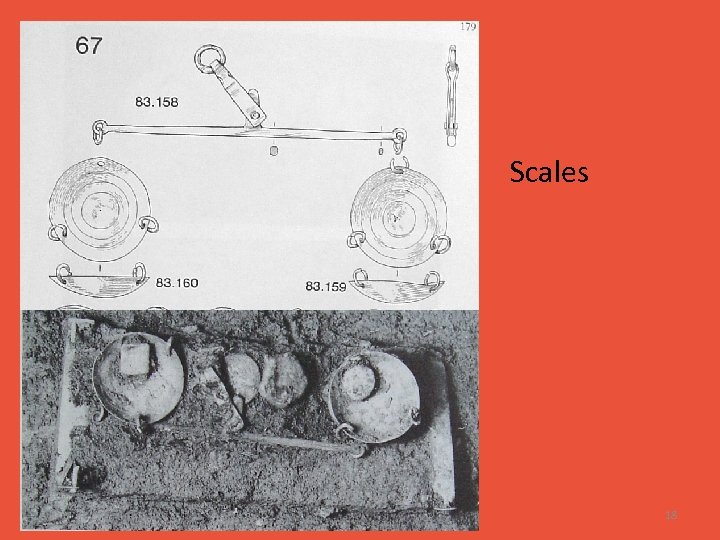 Scales 18
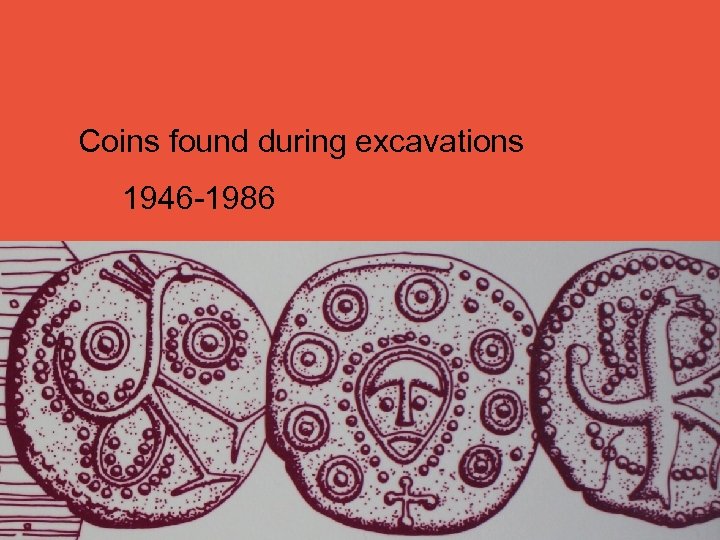 Coins found during excavations 1946 -1986 19
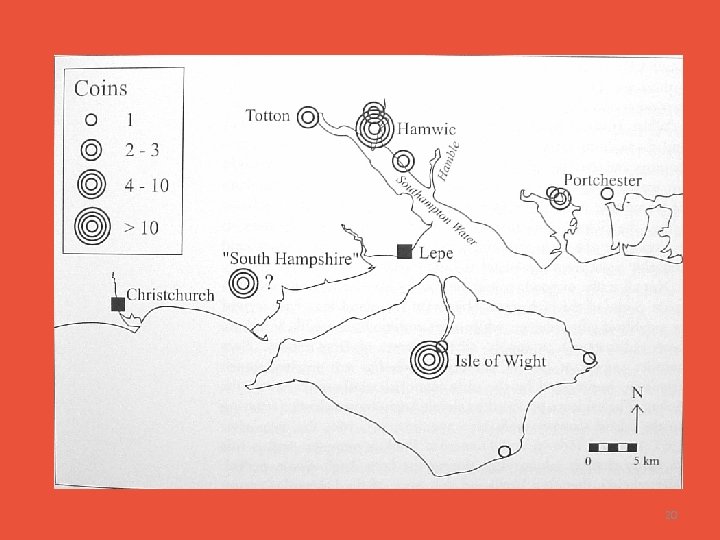 20
20
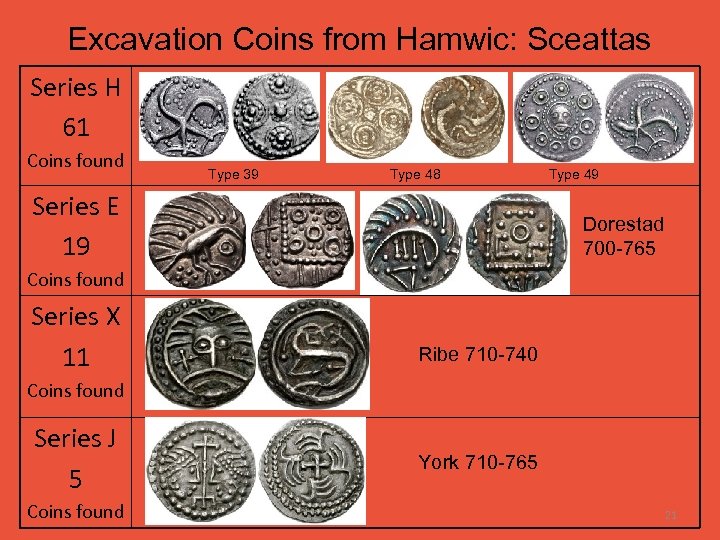 Excavation Coins from Hamwic: Sceattas Series H 61 Coins found Type 39 Type 48 Series E 19 Type 49 Dorestad 700 -765 Coins found Series X 11 Ribe 710 -740 Coins found Series J 5 Coins found York 710 -765 21
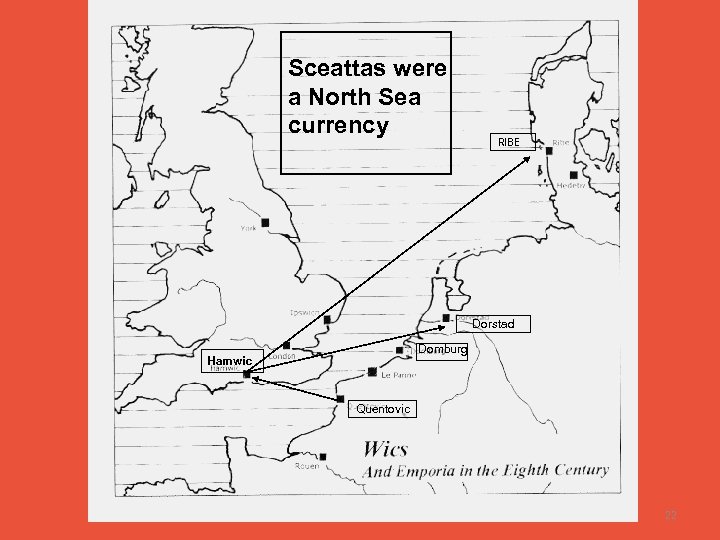 Sceattas were a North Sea currency RIBE Dorstad Domburg Hamwic Quentovic 22
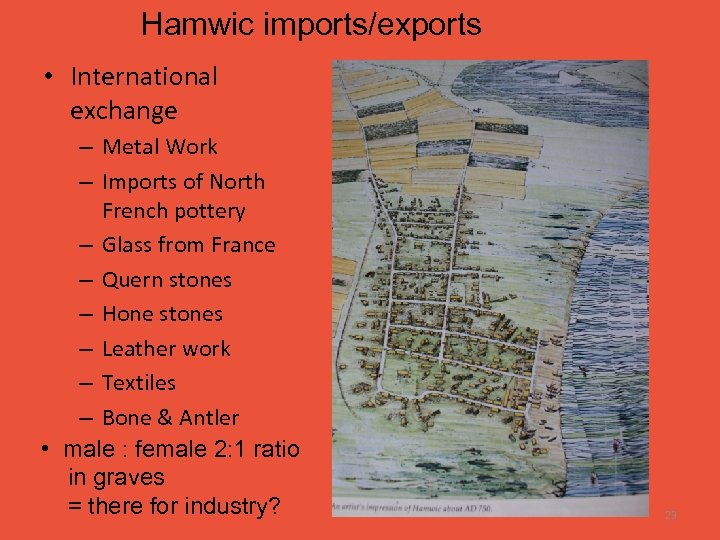 Hamwic imports/exports • International exchange – Metal Work – Imports of North French pottery – Glass from France – Quern stones – Hone stones – Leather work – Textiles – Bone & Antler • male : female 2: 1 ratio in graves = there for industry? 23
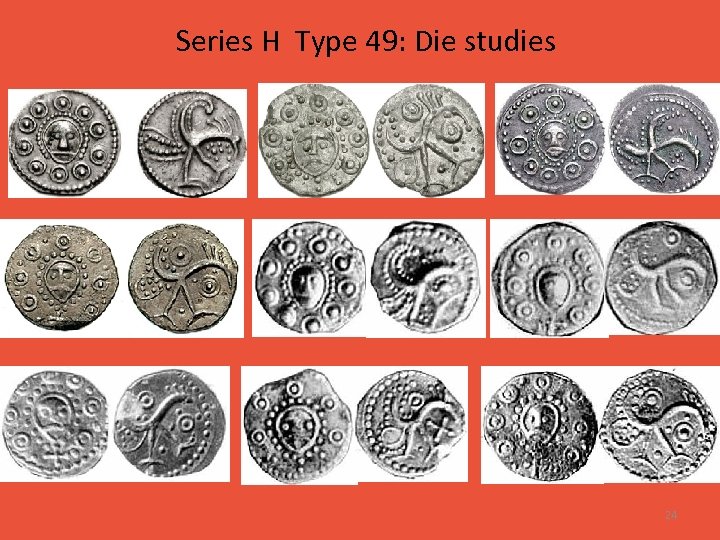 Series H Type 49: Die studies 24
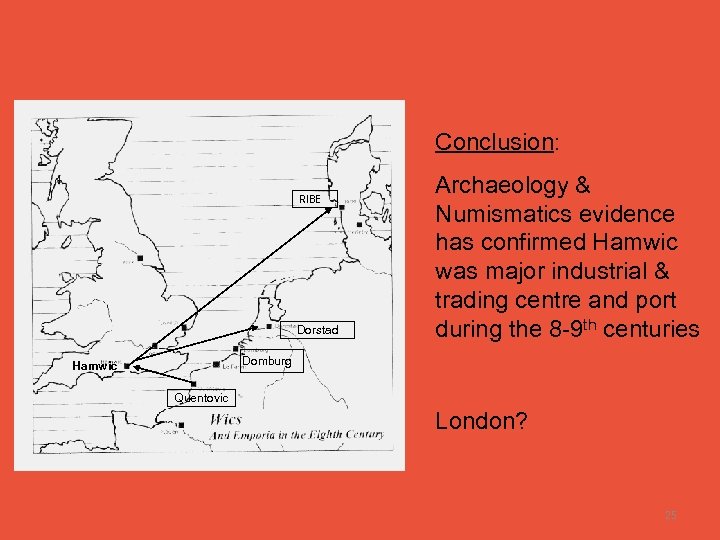 Conclusion: RIBE Dorstad Archaeology & Numismatics evidence has confirmed Hamwic was major industrial & trading centre and port during the 8 -9 th centuries Domburg Hamwic Quentovic London? 25
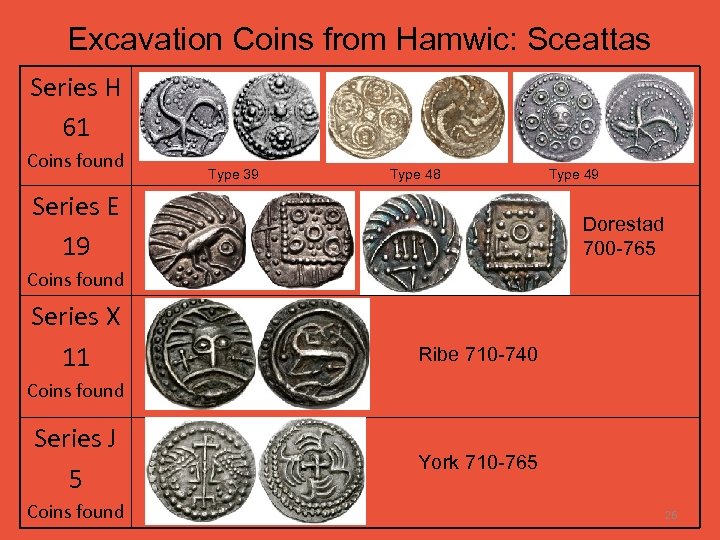 Excavation Coins from Hamwic: Sceattas Series H 61 Coins found Type 39 Type 48 Series E 19 Type 49 Dorestad 700 -765 Coins found Series X 11 Ribe 710 -740 Coins found Series J 5 Coins found York 710 -765 26
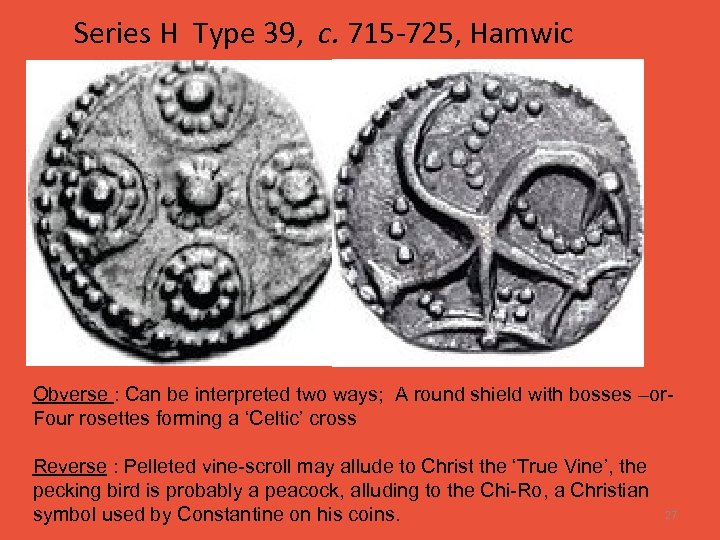 Series H Type 39, c. 715 -725, Hamwic Obverse : Can be interpreted two ways; A round shield with bosses –or. Four rosettes forming a ‘Celtic’ cross Reverse : Pelleted vine-scroll may allude to Christ the ‘True Vine’, the pecking bird is probably a peacock, alluding to the Chi-Ro, a Christian symbol used by Constantine on his coins. 27
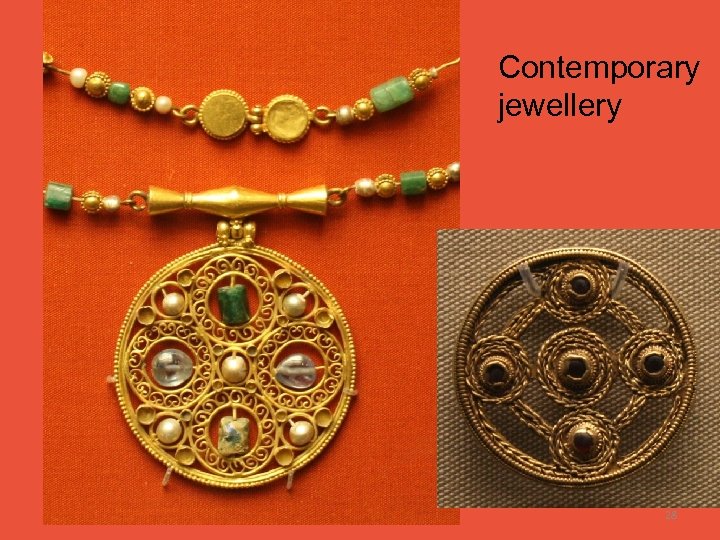 Contemporary jewellery 28
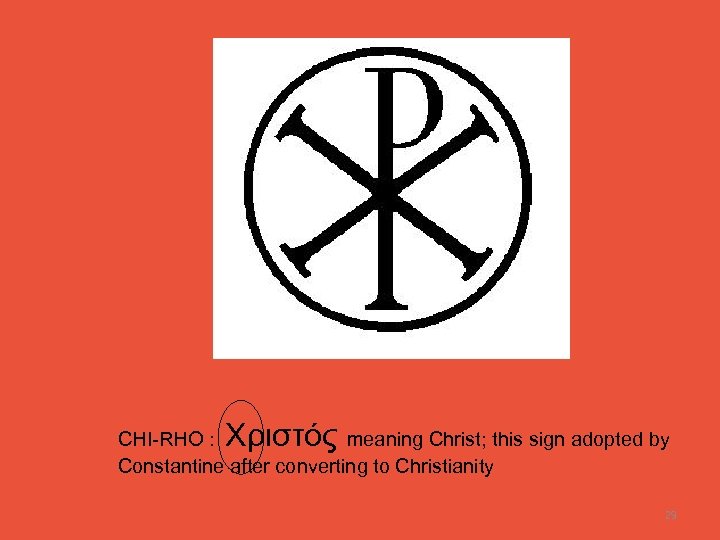 Χριστός CHI-RHO : meaning Christ; this sign adopted by Constantine after converting to Christianity 29
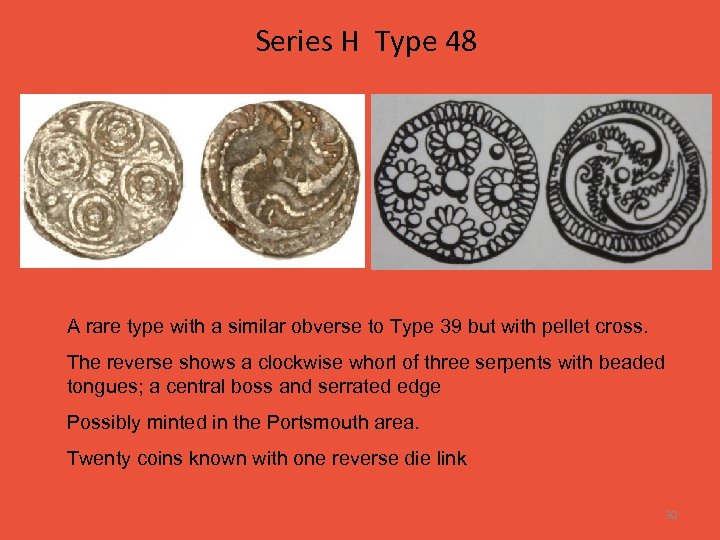 Series H Type 48 A rare type with a similar obverse to Type 39 but with pellet cross. The reverse shows a clockwise whorl of three serpents with beaded tongues; a central boss and serrated edge Possibly minted in the Portsmouth area. Twenty coins known with one reverse die link 30
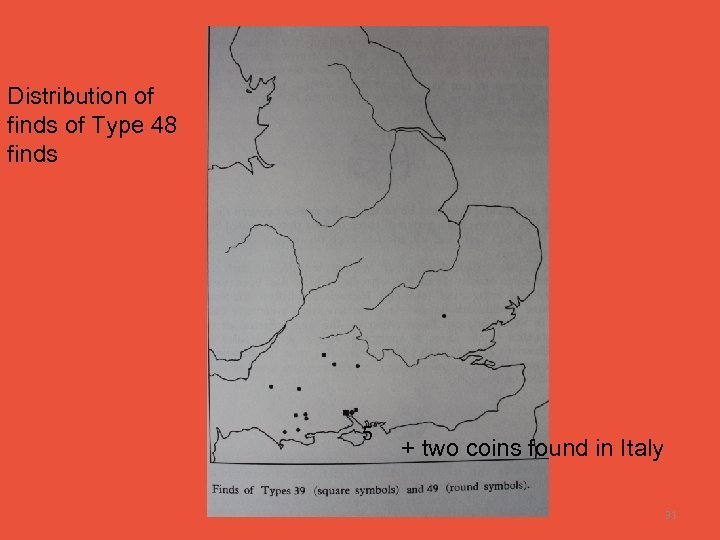 Distribution of finds of Type 48 finds 5 + two coins found in Italy 31
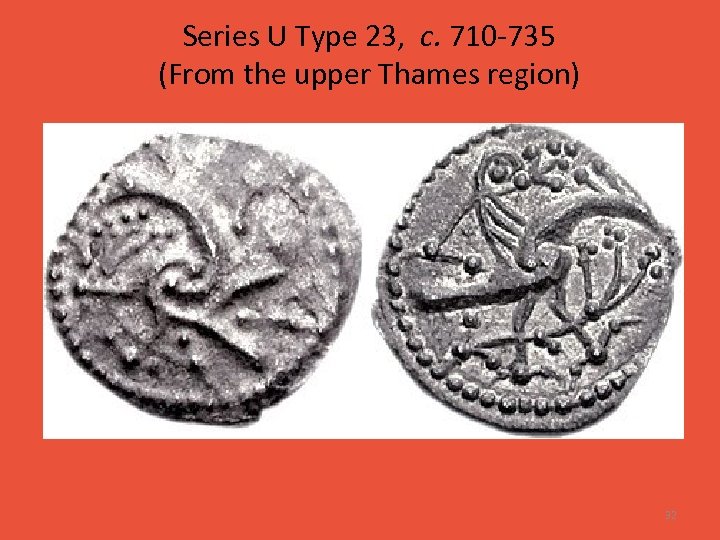 Series U Type 23, c. 710 -735 (From the upper Thames region) 32
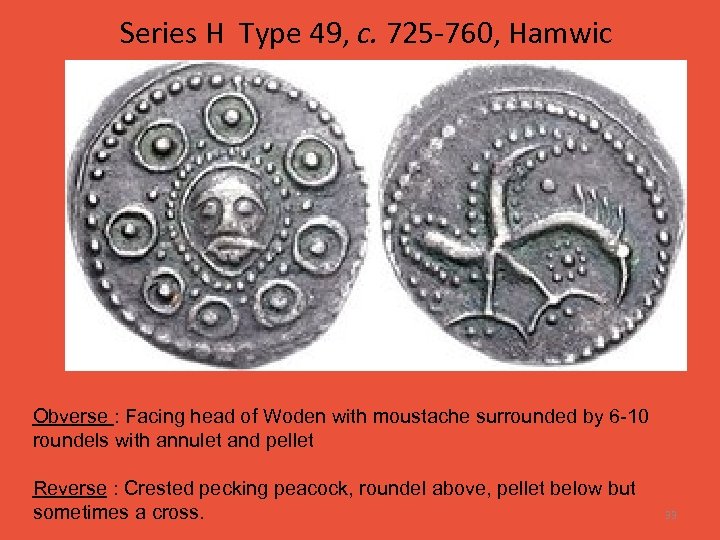 Series H Type 49, c. 725 -760, Hamwic Obverse : Facing head of Woden with moustache surrounded by 6 -10 roundels with annulet and pellet Reverse : Crested pecking peacock, roundel above, pellet below but sometimes a cross. 33
 Kingsland Hoard The only coin hoard from the period found during excavations was the ‘Kingsland Hoard’ located at the northern end of St. Mary’s Street. Only 23 coins out of a large number survived due to corrosion, leaching and burning. The contents are as follows: Series H Type 39 : 3 Series H Type 49 : 13 Uncertain : 7 Total no. of coins 23 34
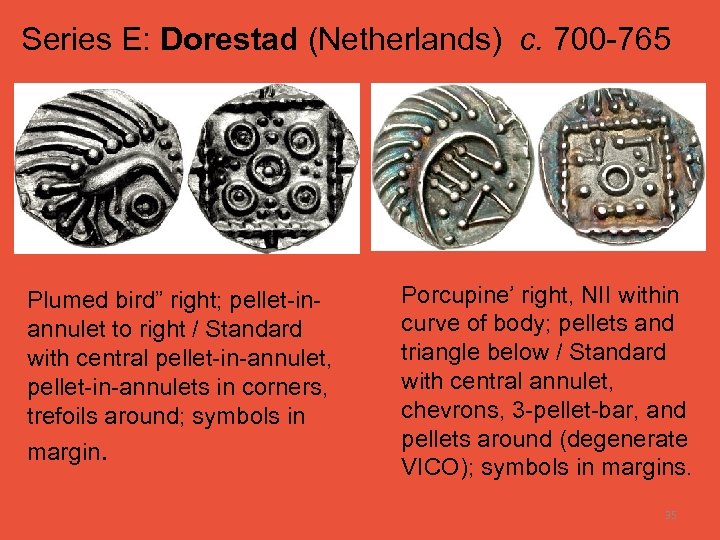 Series E: Dorestad (Netherlands) c. 700 -765 Plumed bird” right; pellet-inannulet to right / Standard with central pellet-in-annulet, pellet-in-annulets in corners, trefoils around; symbols in margin. Porcupine’ right, NII within curve of body; pellets and triangle below / Standard with central annulet, chevrons, 3 -pellet-bar, and pellets around (degenerate VICO); symbols in margins. 35
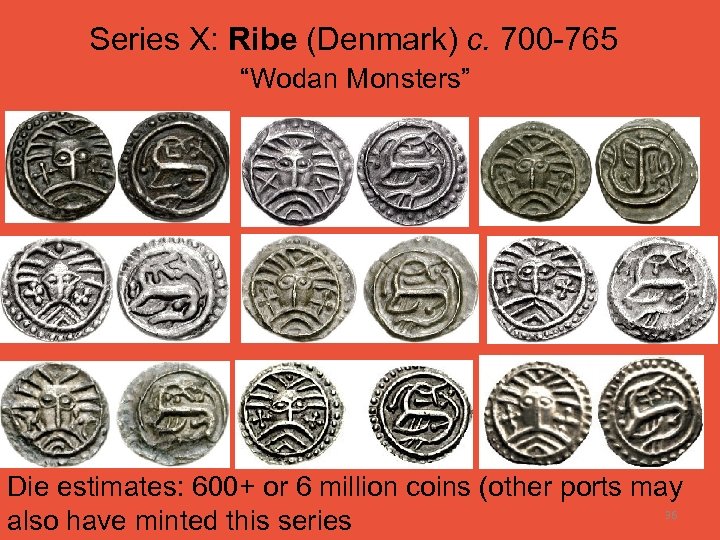 Series X: Ribe (Denmark) c. 700 -765 “Wodan Monsters” Die estimates: 600+ or 6 million coins (other ports may 36 also have minted this series
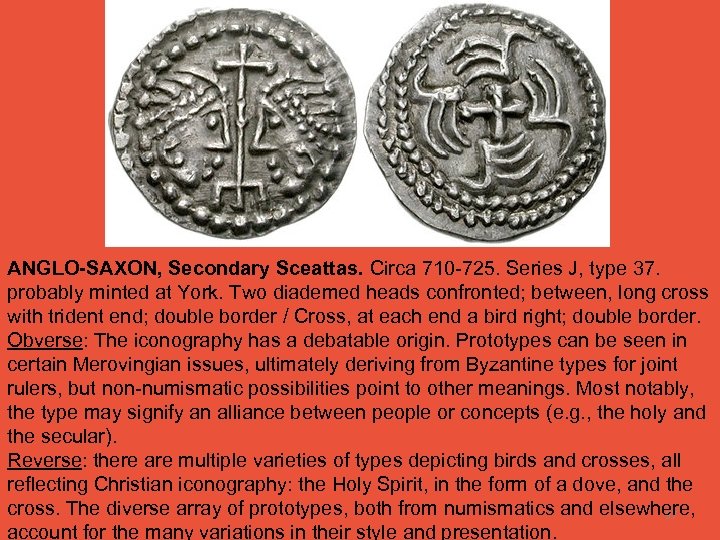 ANGLO-SAXON, Secondary Sceattas. Circa 710 -725. Series J, type 37. probably minted at York. Two diademed heads confronted; between, long cross with trident end; double border / Cross, at each end a bird right; double border. Obverse: The iconography has a debatable origin. Prototypes can be seen in certain Merovingian issues, ultimately deriving from Byzantine types for joint rulers, but non-numismatic possibilities point to other meanings. Most notably, the type may signify an alliance between people or concepts (e. g. , the holy and the secular). Reverse: there are multiple varieties of types depicting birds and crosses, all reflecting Christian iconography: the Holy Spirit, in the form of a dove, and the cross. The diverse array of prototypes, both from numismatics and elsewhere, 37 account for the many variations in their style and presentation.
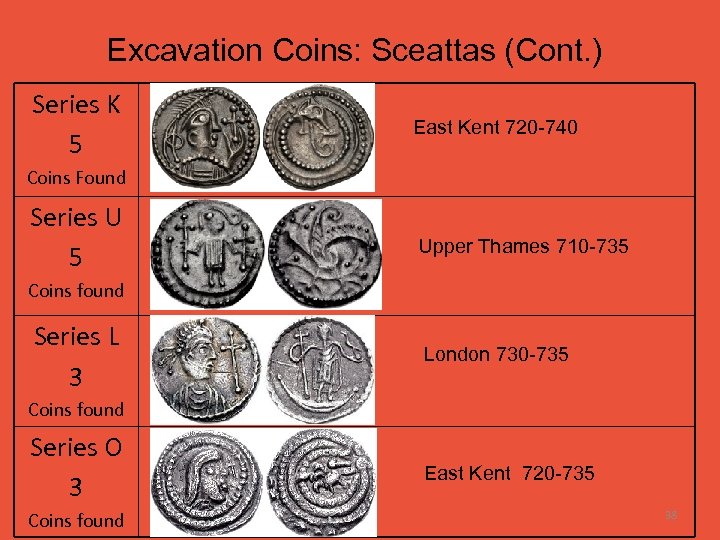 Excavation Coins: Sceattas (Cont. ) Series K 5 East Kent 720 -740 Coins Found Series U 5 Upper Thames 710 -735 Coins found Series L 3 London 730 -735 Coins found Series O 3 Coins found East Kent 720 -735 38
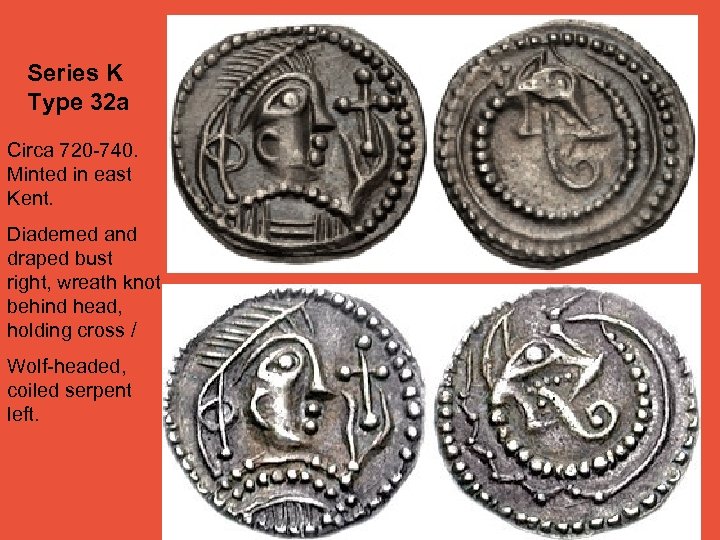 Series K Type 32 a Circa 720 -740. Minted in east Kent. Diademed and draped bust right, wreath knot behind head, holding cross / Wolf-headed, coiled serpent left. 39
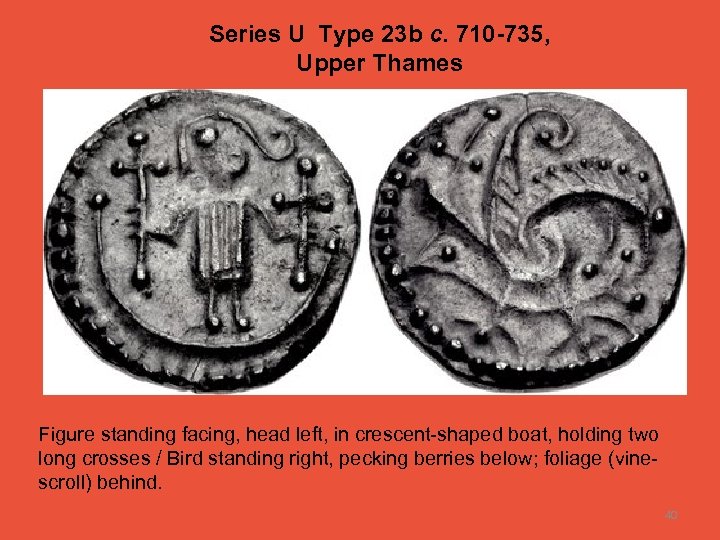 Series U Type 23 b c. 710 -735, Upper Thames Figure standing facing, head left, in crescent-shaped boat, holding two long crosses / Bird standing right, pecking berries below; foliage (vinescroll) behind. 40
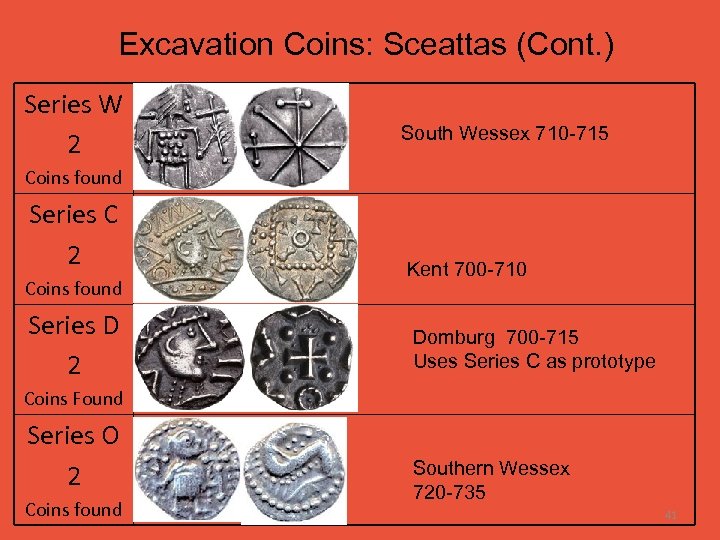 Excavation Coins: Sceattas (Cont. ) Series W 2 South Wessex 710 -715 Coins found Series C 2 Coins found Series D 2 Kent 700 -710 Domburg 700 -715 Uses Series C as prototype Coins Found Series O 2 Coins found Southern Wessex 720 -735 41
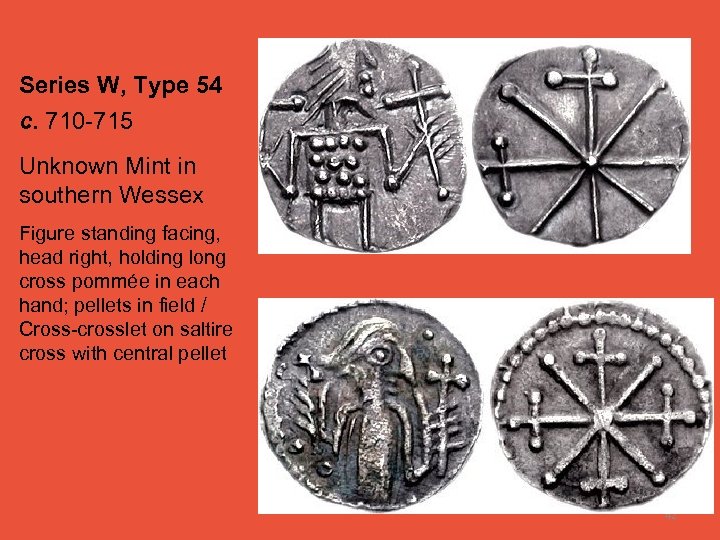 Series W, Type 54 c. 710 -715 Unknown Mint in southern Wessex Figure standing facing, head right, holding long cross pommée in each hand; pellets in field / Cross-crosslet on saltire cross with central pellet 42
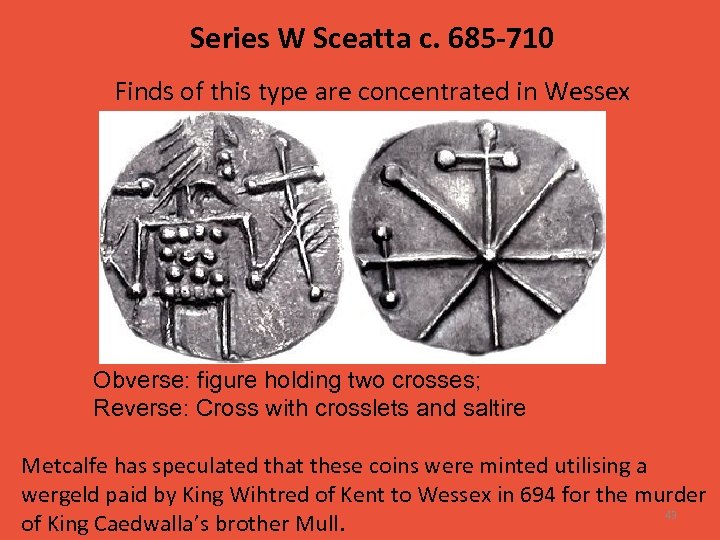 Series W Sceatta c. 685 -710 Finds of this type are concentrated in Wessex Obverse: figure holding two crosses; Reverse: Cross with crosslets and saltire Metcalfe has speculated that these coins were minted utilising a wergeld paid by King Wihtred of Kent to Wessex in 694 for the murder 43 of King Caedwalla’s brother Mull.
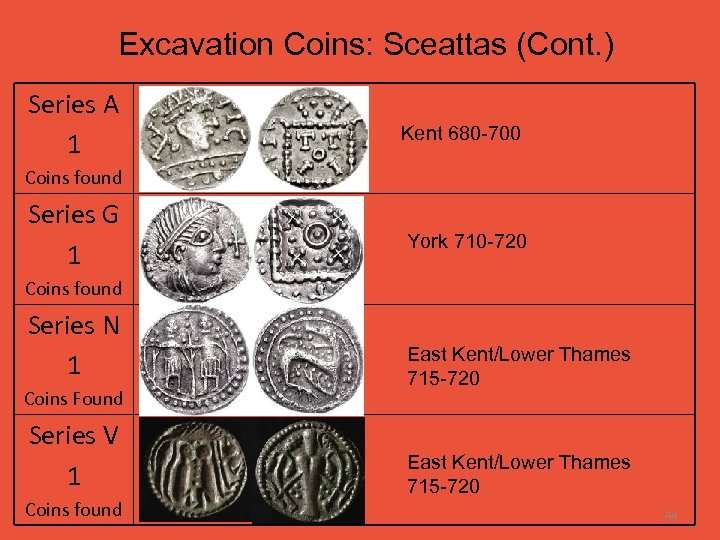 Excavation Coins: Sceattas (Cont. ) Series A 1 Kent 680 -700 Coins found Series G 1 York 710 -720 Coins found Series N 1 Coins Found Series V 1 Coins found East Kent/Lower Thames 715 -720 44
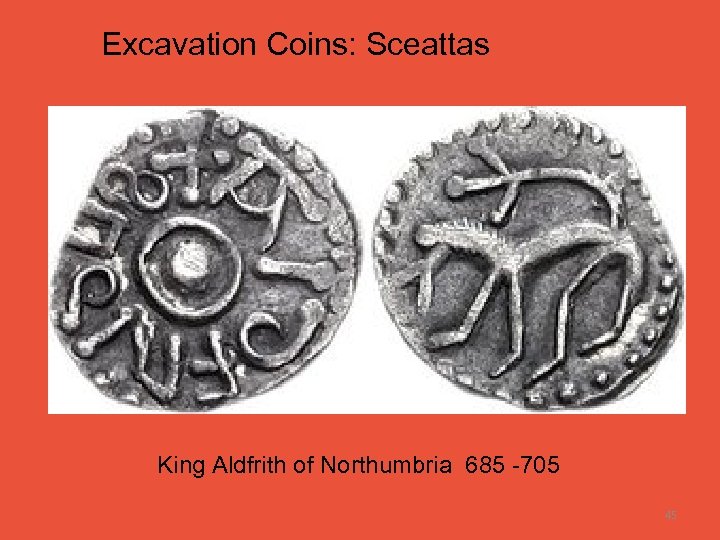 Excavation Coins: Sceattas King Aldfrith of Northumbria 685 -705 45
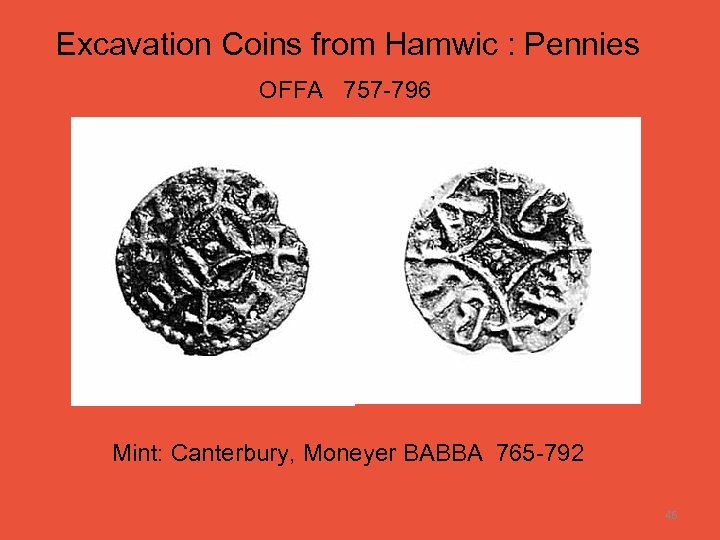 Excavation Coins from Hamwic : Pennies OFFA 757 -796 Mint: Canterbury, Moneyer BABBA 765 -792 46
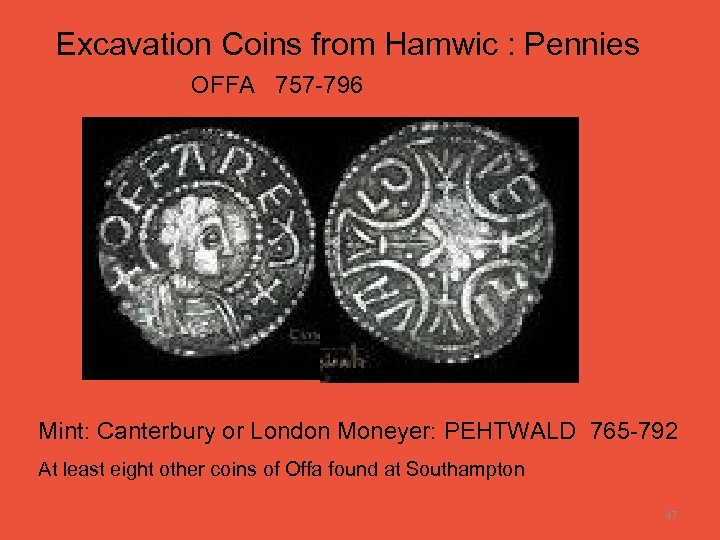 Excavation Coins from Hamwic : Pennies OFFA 757 -796 Mint: Canterbury or London Moneyer: PEHTWALD 765 -792 At least eight other coins of Offa found at Southampton 47
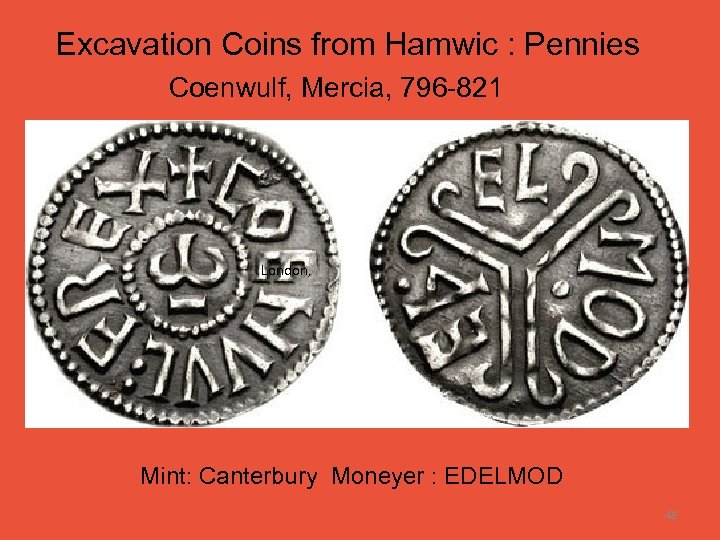 Excavation Coins from Hamwic : Pennies Coenwulf, Mercia, 796 -821 London, Mint: Canterbury Moneyer : EDELMOD 48
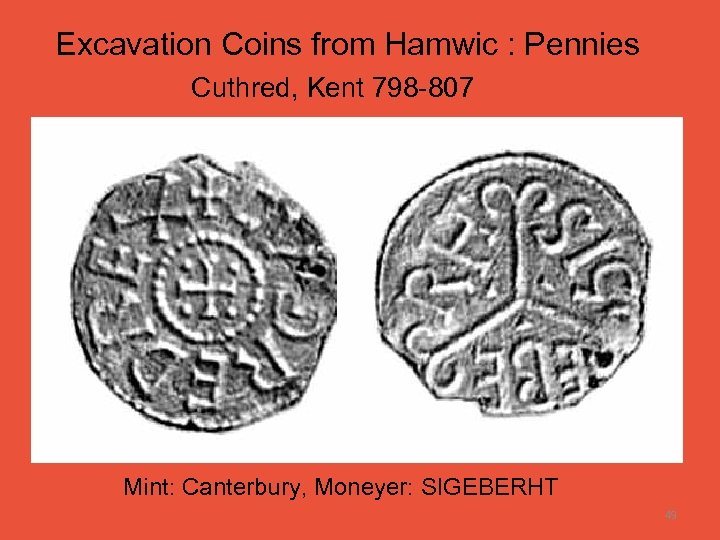 Excavation Coins from Hamwic : Pennies Cuthred, Kent 798 -807 Mint: Canterbury, Moneyer: SIGEBERHT 49
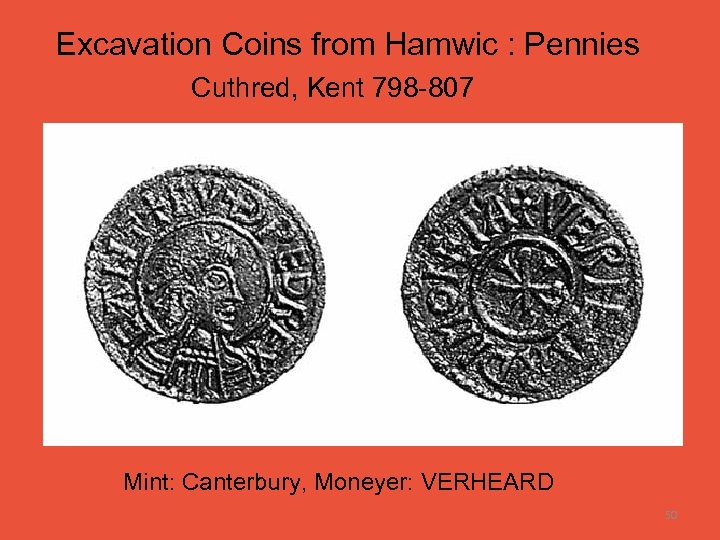 Excavation Coins from Hamwic : Pennies Cuthred, Kent 798 -807 Mint: Canterbury, Moneyer: VERHEARD 50
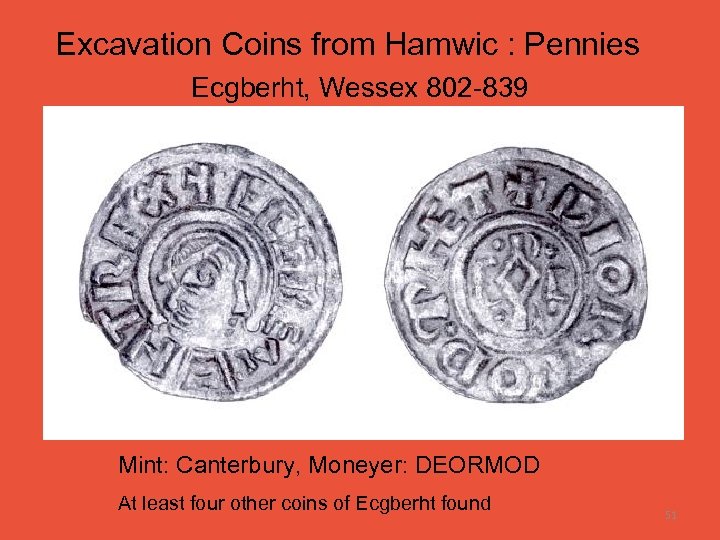 Excavation Coins from Hamwic : Pennies Ecgberht, Wessex 802 -839 Mint: Canterbury, Moneyer: DEORMOD At least four other coins of Ecgberht found 51
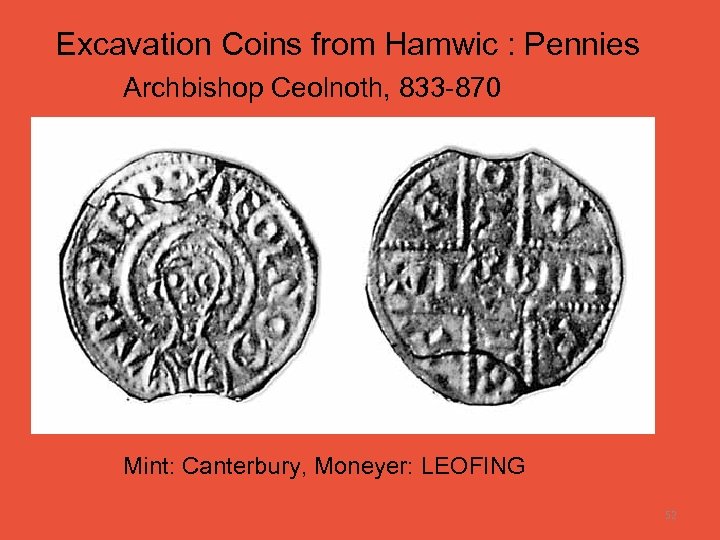 Excavation Coins from Hamwic : Pennies Archbishop Ceolnoth, 833 -870 Mint: Canterbury, Moneyer: LEOFING 52
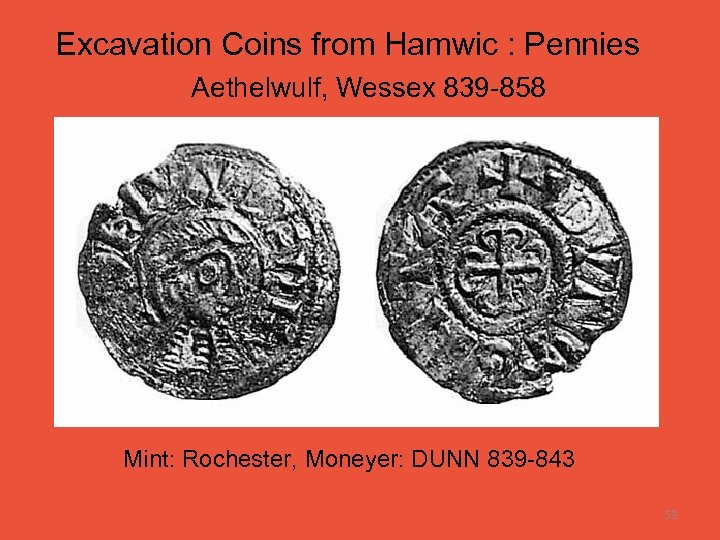 Excavation Coins from Hamwic : Pennies Aethelwulf, Wessex 839 -858 Mint: Rochester, Moneyer: DUNN 839 -843 53
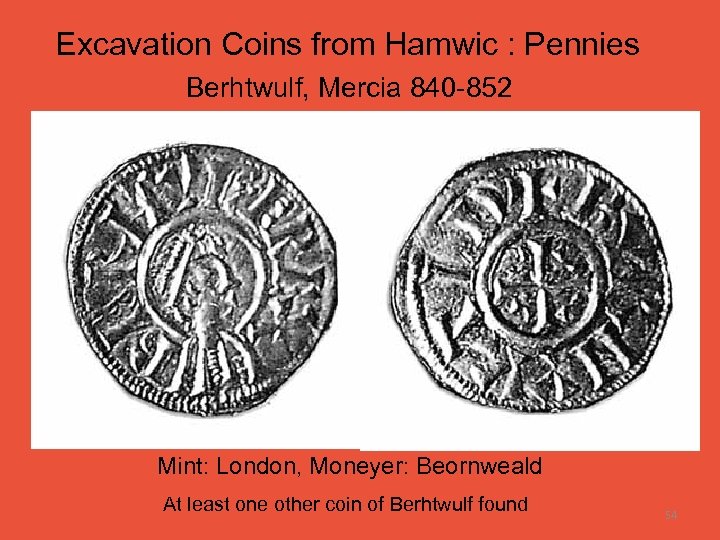 Excavation Coins from Hamwic : Pennies Berhtwulf, Mercia 840 -852 Mint: London, Moneyer: Beornweald At least one other coin of Berhtwulf found 54
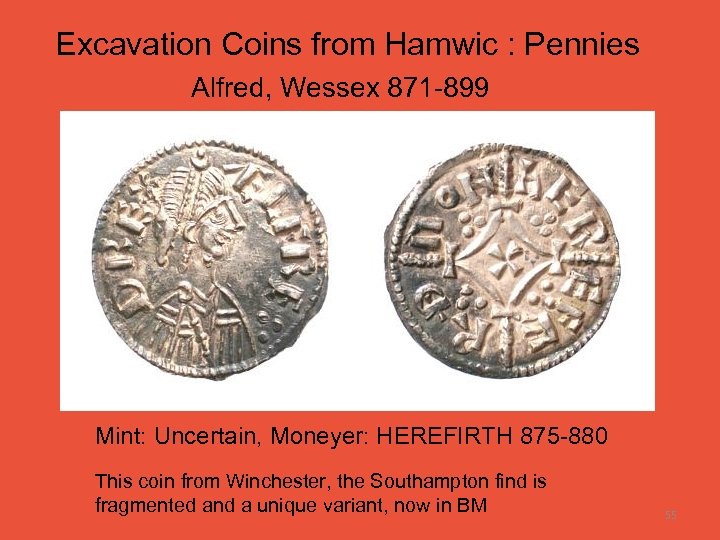 Excavation Coins from Hamwic : Pennies Alfred, Wessex 871 -899 Mint: Uncertain, Moneyer: HEREFIRTH 875 -880 This coin from Winchester, the Southampton find is fragmented and a unique variant, now in BM 55
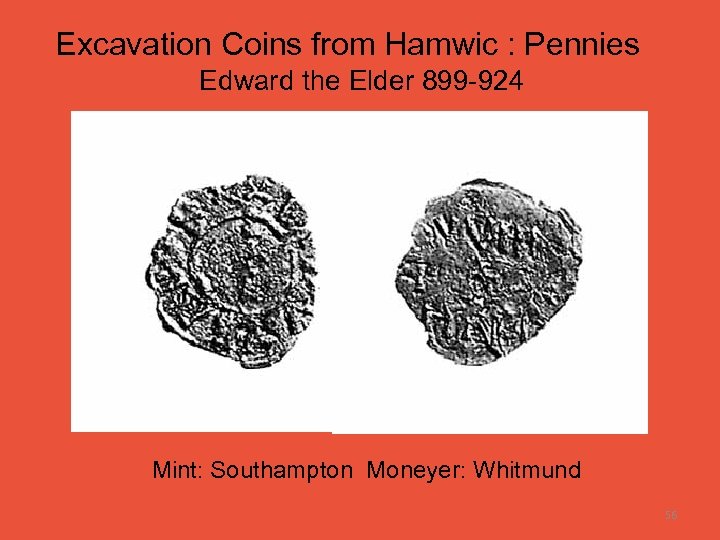 Excavation Coins from Hamwic : Pennies Edward the Elder 899 -924 Mint: Southampton Moneyer: Whitmund 56
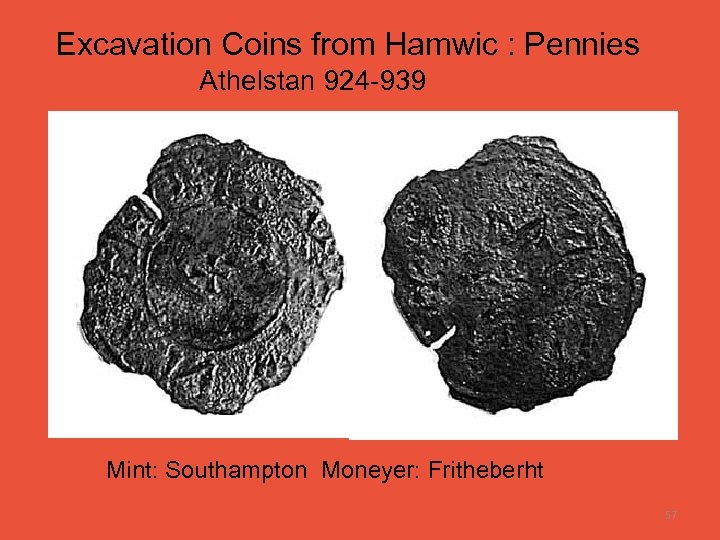 Excavation Coins from Hamwic : Pennies Athelstan 924 -939 Mint: Southampton Moneyer: Fritheberht 57
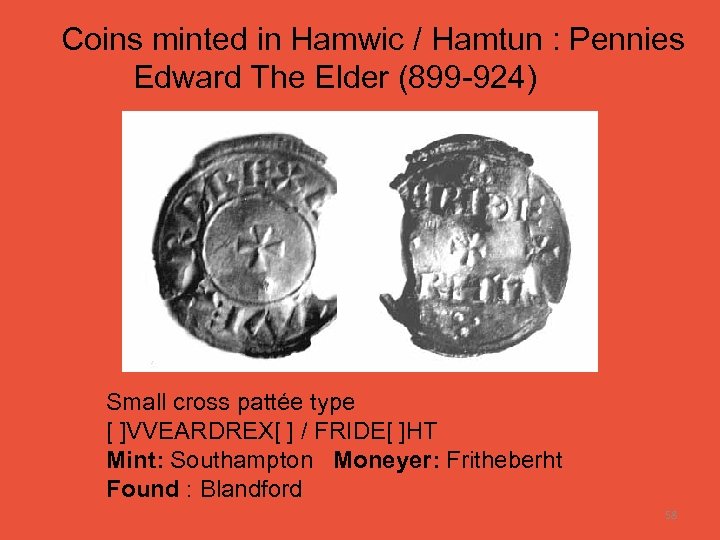 Coins minted in Hamwic / Hamtun : Pennies Edward The Elder (899 -924) Small cross pattée type [ ]VVEARDREX[ ] / FRIDE[ ]HT Mint: Southampton Moneyer: Fritheberht Found : Blandford 58
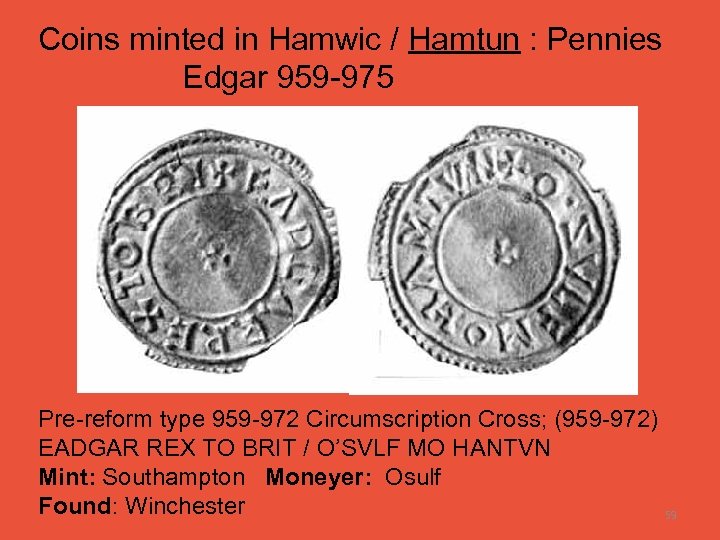 Coins minted in Hamwic / Hamtun : Pennies Edgar 959 -975 Pre-reform type 959 -972 Circumscription Cross; (959 -972) EADGAR REX TO BRIT / O’SVLF MO HANTVN Mint: Southampton Moneyer: Osulf Found: Winchester 59
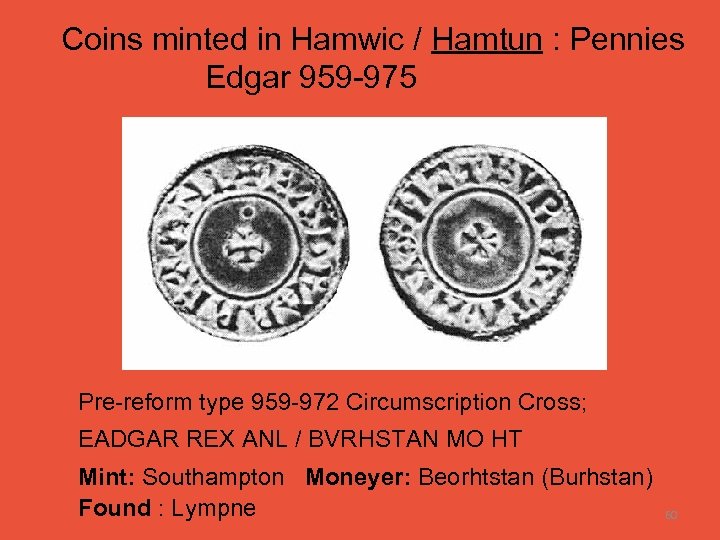 Coins minted in Hamwic / Hamtun : Pennies Edgar 959 -975 Pre-reform type 959 -972 Circumscription Cross; EADGAR REX ANL / BVRHSTAN MO HT Mint: Southampton Moneyer: Beorhtstan (Burhstan) Found : Lympne 60
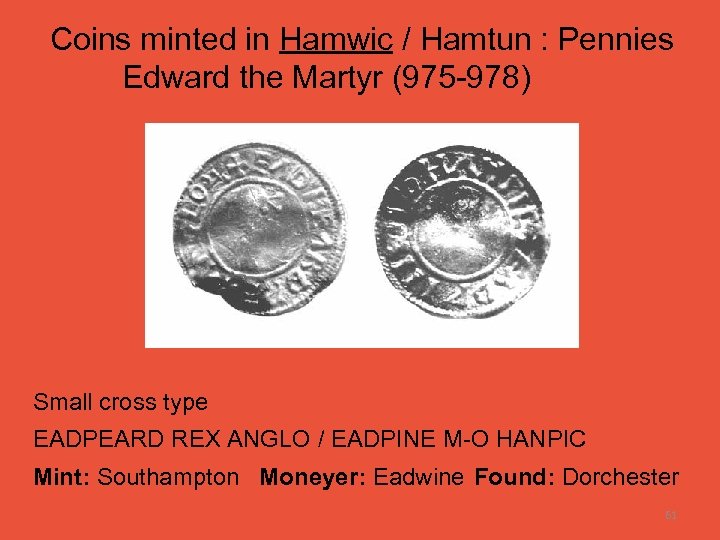 Coins minted in Hamwic / Hamtun : Pennies Edward the Martyr (975 -978) Small cross type EADPEARD REX ANGLO / EADPINE M-O HANPIC Mint: Southampton Moneyer: Eadwine Found: Dorchester 61
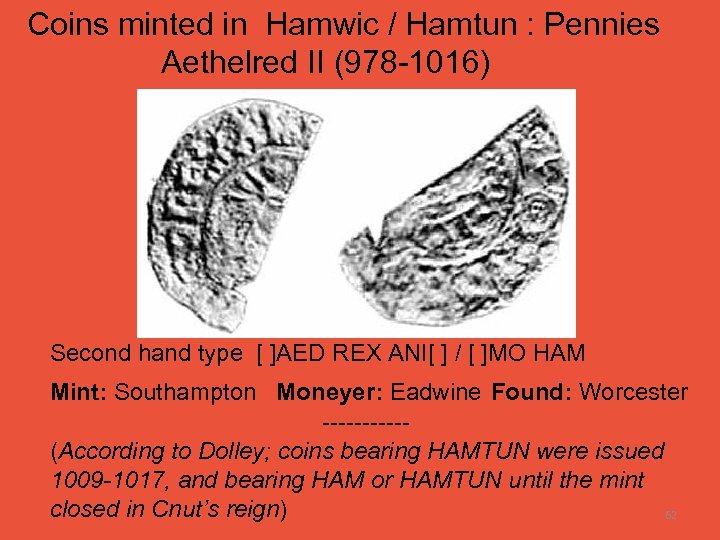 Coins minted in Hamwic / Hamtun : Pennies Aethelred II (978 -1016) Second hand type [ ]AED REX ANI[ ] / [ ]MO HAM Mint: Southampton Moneyer: Eadwine Found: Worcester -----(According to Dolley; coins bearing HAMTUN were issued 1009 -1017, and bearing HAM or HAMTUN until the mint closed in Cnut’s reign) 62
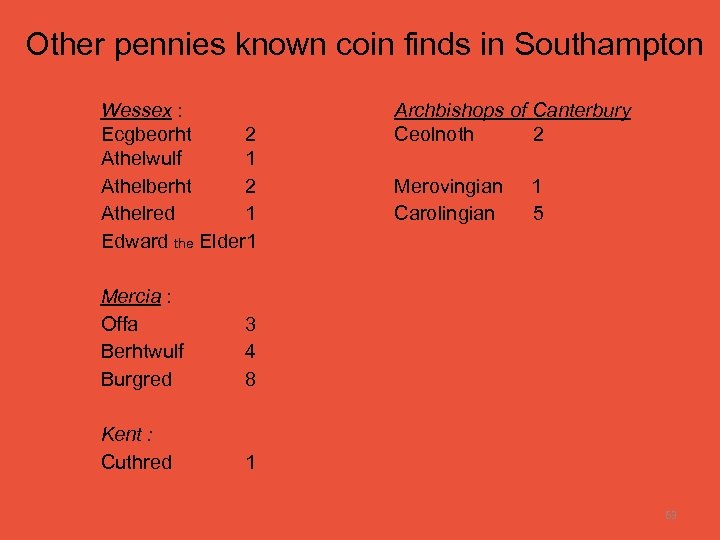 Other pennies known coin finds in Southampton Wessex : Ecgbeorht 2 Athelwulf 1 Athelberht 2 Athelred 1 Edward the Elder 1 Mercia : Offa Berhtwulf Burgred 3 4 8 Kent : Cuthred Archbishops of Canterbury Ceolnoth 2 Merovingian 1 Carolingian 5 1 63