


 Скачать презентацию SAMOS Metadata Architecture and Lessons Learned Shawn R
65ca012d7f39d90d8e4d79667677015f.ppt
- Количество слайдов: 11
 SAMOS Metadata: Architecture and Lessons Learned Shawn R. Smith and Jeremy Rolph smith@coaps. fsu. edu rolph@coaps. fsu. edu Center for Ocean-Atmospheric Prediction Studies The Florida State University, Tallahassee, Florida USA http: //samos. coaps. fsu. edu
 SAMOS Initiative • Current focus: Improving access to high-quality meteorological and near-surface oceanographic observations collected in-situ on research vessels (R/Vs) • Science Goals: • Creating quality estimates of the heat, moisture, momentum, and radiation fluxes at the air-sea interface • Improving our understanding of the biases and uncertainties in global air-sea fluxes • Benchmarking new satellite and model products • Providing high quality observations to support modeling activities, process studies, and global climate programs http: //samos. coaps. fsu. edu
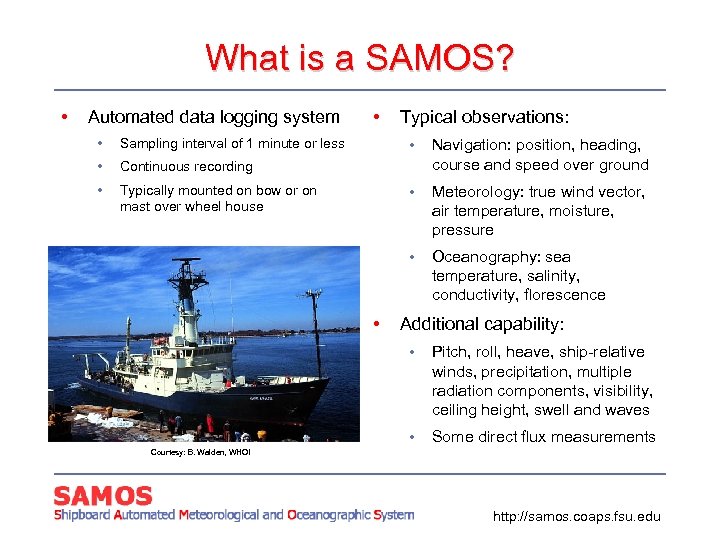 What is a SAMOS? • Automated data logging system • Sampling interval of 1 minute or less • Typically mounted on bow or on mast over wheel house Typical observations: Continuous recording • • Meteorology: true wind vector, air temperature, moisture, pressure • • Navigation: position, heading, course and speed over ground Oceanography: sea temperature, salinity, conductivity, florescence Additional capability: • Pitch, roll, heave, ship-relative winds, precipitation, multiple radiation components, visibility, ceiling height, swell and waves • Some direct flux measurements Courtesy: B. Walden, WHOI http: //samos. coaps. fsu. edu
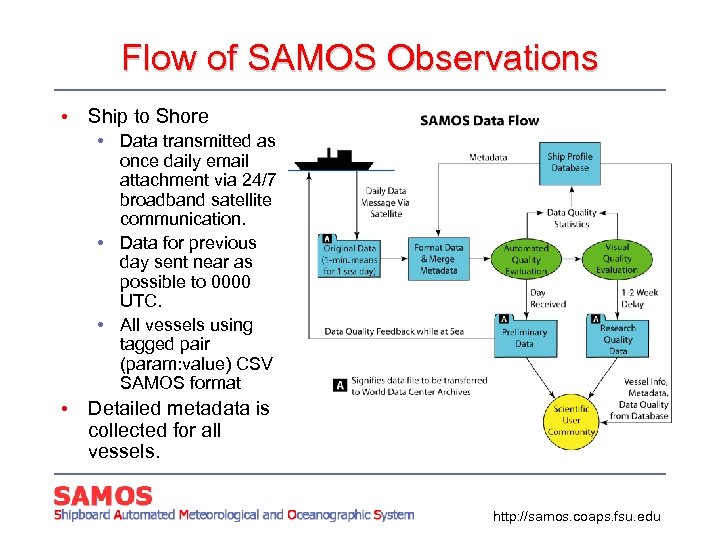 Flow of SAMOS Observations • Ship to Shore • Data transmitted as once daily email attachment via 24/7 broadband satellite communication. • Data for previous day sent near as possible to 0000 UTC. • All vessels using tagged pair (param: value) CSV SAMOS format • Detailed metadata is collected for all vessels. http: //samos. coaps. fsu. edu
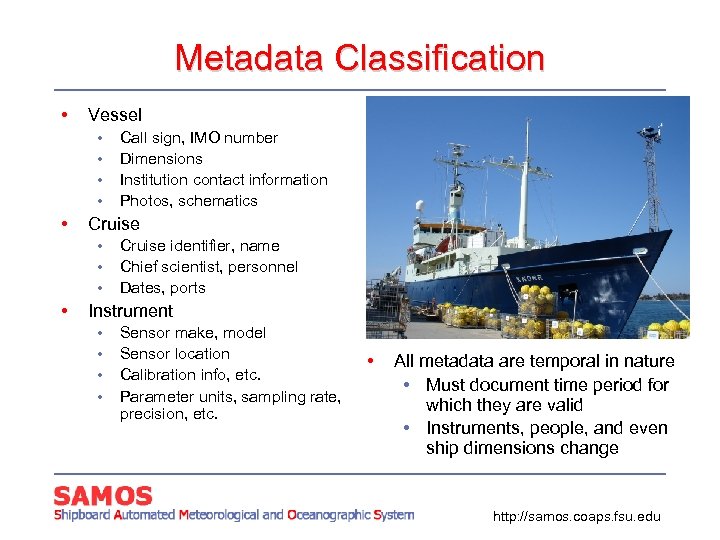 Metadata Classification • Vessel • • • Cruise • • Call sign, IMO number Dimensions Institution contact information Photos, schematics Cruise identifier, name Chief scientist, personnel Dates, ports Instrument • • Sensor make, model Sensor location Calibration info, etc. Parameter units, sampling rate, precision, etc. • All metadata are temporal in nature • Must document time period for which they are valid • Instruments, people, and even ship dimensions change http: //samos. coaps. fsu. edu
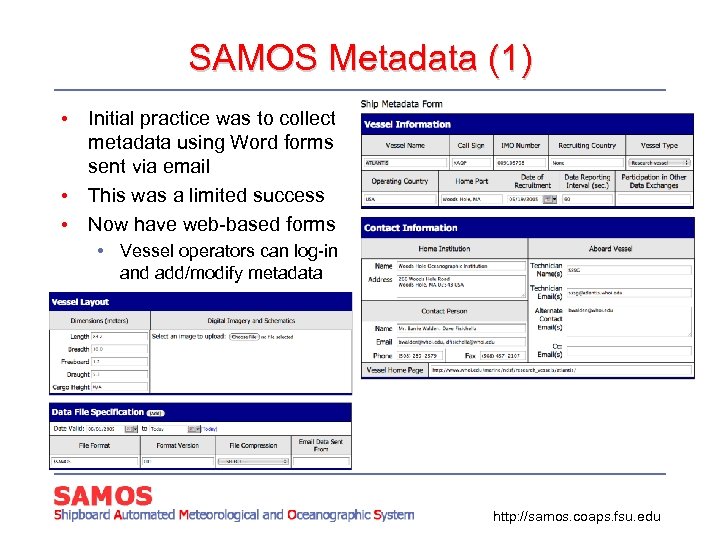 SAMOS Metadata (1) • Initial practice was to collect metadata using Word forms sent via email • This was a limited success • Now have web-based forms • Vessel operators can log-in and add/modify metadata http: //samos. coaps. fsu. edu
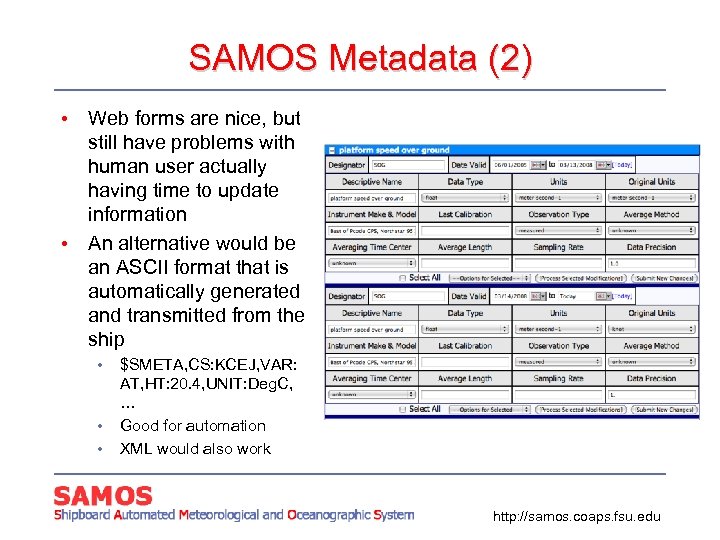 SAMOS Metadata (2) • Web forms are nice, but still have problems with human user actually having time to update information • An alternative would be an ASCII format that is automatically generated and transmitted from the ship • • • $SMETA, CS: KCEJ, VAR: AT, HT: 20. 4, UNIT: Deg. C, … Good for automation XML would also work http: //samos. coaps. fsu. edu
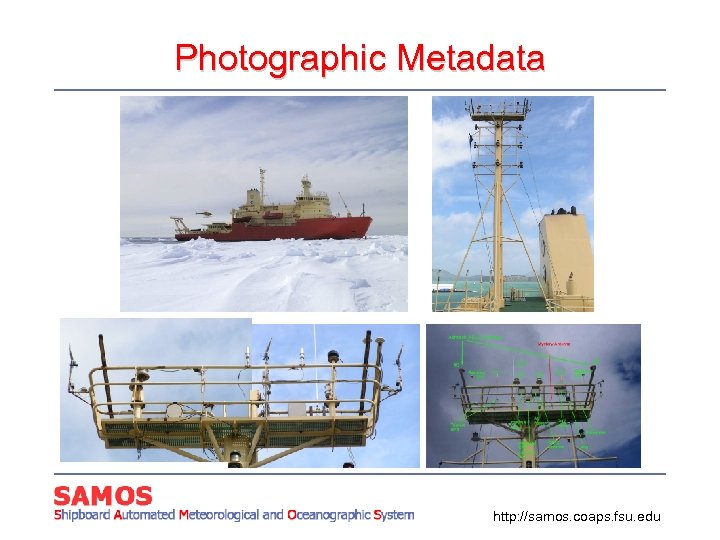
 Lessons • No one really likes to collect or distribute metadata • Systems that rely on human data entry are subject to delays and missing records • Why? Techs, others get busy and data collection takes priority to metadata • They may send you the first set of metadata, but getting updates as sensors/systems change is very hard • Importance of metadata is still not well understood • Why do we care if the anemometer is at 10 m or 20 m? • Does knowing the sampling rate of the sensor really matter? • There is no substitute for a good photograph • Digital imagery and schematics make all the difference for data application and QC http: //samos. coaps. fsu. edu
 Photographic Metadata http: //samos. coaps. fsu. edu
 Summary • Current technology will allow automated metadata transfers • Need a system-wide approach • UNOLS (as a start) and U. S. fleet (as a whole) needs a central repository for ship/cruise metadata • Need a person to focus on metadata collection system wide • Way forward: • Take advantage of groups currently working on on-line metadata management systems • SAMOS recently formed a task group to develop protocol for automated metadata transfer (ship to shore) • Build upon UNOLS efforts to automate cruise metadata collection • Ensure system will be accessible to large and small operators • THIS MUST BE A FUNDED TASK!!! http: //samos. coaps. fsu. edu
 http: //samos. coaps. fsu. edu