 Скачать презентацию Samir Ben Si Saïd tsamir 306 hotmail com Markéta
ad84ba4fb07f17f9f00f9ce056385a93.ppt
- Количество слайдов: 1



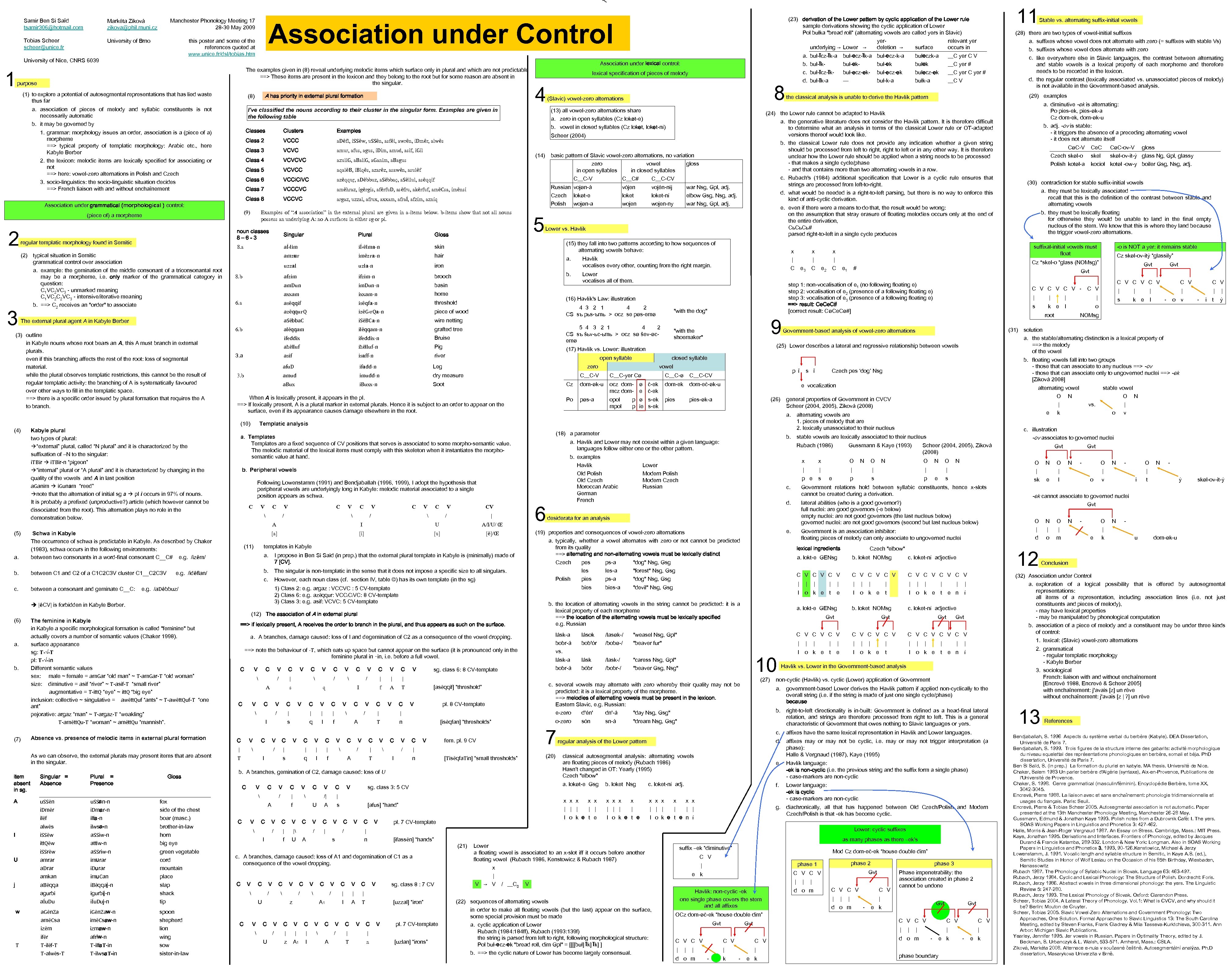
Samir Ben Si Saïd tsamir 306@hotmail. com Markéta Ziková zikova@phil. muni. cz Tobias Scheer scheer@unice. fr Manchester Phonology Meeting 17 28 -30 May 2009 University of Brno University of Nice, CNRS 6039 1 Association under Control this poster and some of the references quoted at www. unice. fr/dsl/tobias. htm A has priority in external plural formation (8) a. association of pieces of melody and syllabic constituents is not necessarily automatic Classes Clusters Class 2 VCCC Class 3 VCVC Class 4 VCVCVC azuli. G, a. Bali. G, a. Ganim, a. Bagus Class 5 VCVCC aqalêB, i. Biqês, azarêz, asawên, asulêf Class 6 VCCi. VC azêqquṛ, a. Dêbbuz, a. Sêbbaç, a. Sêllul, asêqqif C__C-V VCCVC Examples of “A association” in the external plural are given in a-items below. b-items show that not all nouns possess an underlying A: no A surfaces in either sg or pl. noun classes 8– 6 -3 Singular Plural Gloss 8. a aÍ‹lim iÍ‹êlma-n imêzra-n uzzal uzla-n a. example: the gemination of the middle consonant of a triconsonantal root may be a morpheme, i. e. only marker of the grammatical category in question: C 1 VC 2 VC 3 - unmarked meaning C 1 VC 2 C 2 VC 3 - intensive/iterative meaning ifzim-n am. Dun im. Dun-n axxam ixxam-n asêqqif isêqfa-n izêG‹r. Qa-n i. SêBCa-n alêqqam ilêqqam-n ifeddix-n b. (7) Absence vs. presence of melodic items in external plural formation As we can observe, the external plurals may present items that are absent in the singular. item Singular = Plural = Gloss absent Absence Presence in sg. A aħêlluf iħêlluf-n asif isaff-n river afu. D ifadd-n amud imudd-n a. Bux i. Buxx-n Soot / C V C / V i. Dmar-n boar (masc. ) alwês ilwsa-n brother-in-law i. SSêw a. SSiw-n V attiw-n / a. SSriw-n green vegetable amrar imurar cord a. Drar U i. Bêqqaj-n slap igurbij-n iÍu. Duj-n i. Gên. Zaw-n [i] [u] [ê]/Œ imêCsaw-n shepherd izêm izmaw-n lion ifêr afriw-n wing T-ilêf-T T-ilfa. T-in sow T-alwês-T T-ilwsa. T-in sister-in-law dom-øk-u ocz dom- ø č-ek mcz dom- e č-ek dom-eč-øk-u pøs-a opol mpol pies-øk-a V C V / C | A C V V / V V C | | | V C | | A C T q I f V C / | n A C V | | | s q I C f V C V / | T A C V C / V n fem. pl. 9 CV V C V V / C | A V C C A V / | | f C s U V C / V | V V C / A V V C / V C V / U C C V C / z | | [ifassên] “hands” bies-a l A V C U C V / V | | | z A 1 l C T V sg. class 8 : 7 CV [uzzal] “iron” V C / A V O N | | | s p s N p O N | e s Czech "elbow" C | | T n V pl. 7 CV-template [uzlan] “irons” e l o O N O | | | d o N m e | o k e t e l o k e t e n í b. loket NOMsg Gvt Gvt l o k e t e n í Havlík vs. Lower in the Government-based analysis non-cyclic (Havlík) vs. cyclic (Lower) application of Government government-based Lower derives the Havlík pattern if applied non-cyclically to the overall string (i. e. if the string is made of just one single cycle/phase) because b. right-to-left directionality is in-built: Government is defined as a head-final lateral relation, and strings are therefore processed from right to left. This is a general characteristic of Government that owes nothing to Slavic languages or yers. affixes have the same lexical representation in Havlík and Lower languages. d. affixes may or may not be cyclic, i. e. may or may not trigger interpretation (a phase): Halle & Vergnaud (1987), Kaye (1995) classical autosegmental analysis: alternating vowels are floating pieces of melody (Rubach 1986) Hasn’t changed in OT: Yearly (1995) Czech "elbow" e. Havlík language: -ek is non-cyclic (i. e. the previous string and the suffix form a single phase) - case-markers are non-cyclic a. lokøt-e Gsg b. loket Nsg c. loket-ní adj. f. x x x x Lower language: -ek is cyclic - case-markers are non-cyclic | | | | g. l o k e t e diachronically, all that has happened between Old Czech/Polish and Modern Czech/Polish is that -ek has become cyclic. as many phases as there –ek’s suffix –ek “diminutive” Mod Cz dom-eč-ek “house double dim” C V | | | d o m - e k - | d o m C V C V | Phase impenetrability: the association created in phase 2 cannot be undone | | | d o m - Gvt e k C V C V | Gvt C V | | phase 3 Gvt C V C V | phase 2 phase 1 Gvt N - | i t ý skøl-ov-it-ý N - k u dom‑øk‑u | | d o m - phase boundary e k - Conclusion 2. grammatical - regular templatic morphology - Kabyle Berber a. OCz dom-øč-ek “house double dim” O 1. lexical: (Slavic) vowel-zero alternations c. (22) sequences of alternating vowels - b. association of a piece of melody and a constituent may be under three kinds of control: | Havlík: non-cyclic -ek one single phase covers the stem and all affixes N a. exploration of a logical possibility that is offered by autosegmental representations: all items of a representation, including association lines (i. e. not just constituents and pieces of melody), - may have lexical properties - may be manipulated by phonological computation c. loket-ní adjective | | N | | | V i v v O | | | - Gvt | | l o k e t e n í o v -ek cannot associate to governed nuclei | | regular analysis of the Lower pattern ý | | | b. ==> the cyclic nature of Lower has become largely consensual. | | | "dream Nsg, Gsg" t - | O | | a. cyclic application of Lower Rubach (1984: 184 ff), Rubach (1993: 139 f) the string is parsed from left to right, following morphological structure: Pol buł‑ecz‑ek "bread roll, dim Gpl" = [[[[buł] ǐk] ] - | | e k / __C 0 N | | | V → V O | | x N | | sn-á l Gvt | | són k e -ov associates to governed nuclei | | "day Nsg, Gsg" | (32) Association under Control "beaver fur" dn'-á | c. illustration C V C V /bobø-/ d'én' | o C V C V bob'ór (27) | s k 12 Gvt 10 | vs. c. loket-ní adjective a. lokt-e GENsg "beaver Gsg, Nsg" | O b. loket NOMsg C V C V /bobr-/ C V N a. lokt-e GENsg C V C V Lower a floating vowel is associated to an x-slot iff it occurs before another floating vowel (Rubach 1986, Kenstowicz & Rubach 1987) C V C V bóbr C V lexical ingredients "caress Nsg, Gpl" C V C V stable vowel | sk "weasel Nsg, Gpl" /lask-/ Gvt NOMsg O | /lasøk-/ lásk Gvt o O Government is an association inhibitor: floating pieces of melody can only associate to ungoverned nuclei "devil" Nsg, Gsg in order to make all floating vowels (but the last) appear on the surface, some special provision must be made C | e N (21) l C V C V | A 1 O Lower: cyclic suffixes n V O x | s k e Gvt lateral abilities (who is a good governor? ) full nuclei: are good governors (-e below) empty nuclei: are not good governors (the last nucleus below) governed nuclei: are not good governors (second but last nucleus below) "dog" Nsg, Gsg Cz skøl-ov-itý “glassily” | Scheer (2004, 2005), Ziková (2008) C Gussmann & Kaye (1993) Government relations hold between syllabic constituents, hence x-slots cannot be created during a derivation. e. pl. 7 CV-template c. A branches, damage caused: loss of A 1 and degemination of C 1 as a consequence of the vowel dropping. V ps-a l o k e t e | e sg. class 3: 5 CV [afus] “hand” C pies -o is NOT a yer: it remains stable C V | | U C I V /| f V C b. they must be lexically floating for otherwise they would be unable to land in the final empty nucleus of the stem. We know that this is where they land because the trigger vowel-zero alternations. alternating vowel (20) [Tisêqfa. Tin] “small thresholds” b. A branches, gemination of C 2, damage caused: loss of U C lások 7 a. they must be lexically associated recall that this is the definition of the contrast between stable and alternating vowels a. the stable/alternating distinction is a lexical property of ==> the melody of the vowel c. "forest" Nsg, Gsg o-zero | I les-a e-zero V (30) contradiction for stable suffix-initial vowels b. floating vowels fall into two groups - those that can associate to any nucleus ==> -ov - those that can associate only to ungoverned nuclei ==> -ek [Ziková 2008] p e "dog" Nsg, Gsg gloss (31) solution | c. several vowels may alternate with zero whereby their quality may not be predicted: it is a lexical property of the morpheme. ==> melodies of alternating vowels must be present in the lexicon. Eastern Slavic, e. g. Russian: [isêqfan] “thresholds” kocioł kotøł ‑ow‑y boiler Gsg, Nsg, adj. l ps‑a bobr‑á pl. 8 CV-template Polish kotøł-a | pes lásk‑a [asêqqif] “threshold” skøl‑ov-it‑ý glass Ng, Gpl, glassy root Czech pes ‘dog’ Nsg Rubach (1986) vs. sg. class 6: 8 CV-template skel s bobr‑á | T V Czech skøl-o | lásk‑a | f V C / V | I V I C C / C q s C T C | I | V C / V C s C V CøC-ov-V C V C V - stable vowels are lexically associated to their nucleus b. the location of alternating vowels in the string cannot be predicted: it is a lexical property of each morpheme ==> the location of the alternating vowels must be lexically specified e. g. Russian ==> note the behaviour of -T, which eats up space but cannot appear on the surface (it is pronounced only in the feminine plural in ‑in, i. e. before a full vowel. C s ǐ Ce. C d. bies Polish CøC-V Gvt x les However, each noun class (cf. section IV, table ©) has its own template (in the sg) # alternating vowels are 1. pieces of melody that are 2. lexically unassociated to their nucleus b. Modern Polish Modern Czech Russian The singular is non-templatic in the sense that it does not impose a specific size to all singulars. e 1 general properties of Government in CVCV Scheer (2004, 2005), Ziková (2008) a. typically, whether a vowel alternates with zero or not cannot be predicted from its quality ==> alternating and non-alternating vowels must be lexically distinct a. A branches, damage caused: loss of I and degemination of C 2 as a consequence of the vowel dropping. C (26) Lower Czech C e vocalization (19) properties and consequences of vowel-zero alternations I propose in Ben Si Said (in prep. ) that the external plural template in Kabyle is (minimally) made of 7 [CV]. spoon amêCsa C__C-CV desiderata for an analysis ==> if lexically present, A receives the order to branch in the plural, and thus appears as such on the surface. tip a. Gên. Za C__C-ø Old Polish Old Czech Moroccan Arabic German French (12) The association of A in external plural shack aÍu. Du C__C-yer Cø b. examples A/I/U/ Œ place agurbi T imu. Can a. Bêqqa w mountain amkan j i. Durar p ǐ a. Havlík and Lower may not coexist within a given language: languages follow either one or the other pattern. 6 e 2 (18) a parameter | C a. 1) Class 2: e. g. argaz : VCCVC : 5 CV-template 2) Class 6: e. g. azêqqur: VCCi. VC: 8 CV-template 3) Class 3: e. g. asif: VCVC: 5 CV-template big eye i. SSrêw e 3 Government-based analysis of vowel-zero alternations vowel p ø s-ek p ie s-ek b. adj. -ov is stable: - it triggers the absence of a preceding alternating vowel - it does not alternate itself Cz *skel-o “glass (NOMsg)” closed syllable Po CV a. diminutive ‑ek is alternating: Po pies-ek, pies‑øk‑a Cz dom‑ek, dom‑øk‑u suffixal-initial vowels must float (25) Lower describes a lateral and regressive relationship between vowels Cz c. C 9 C__C-V b. horn itt. Qêw "with the shoemaker" open syllable templates in Kabyle side of the chest ilfa-n "with the dog" zero C (29) examples step 1: non-vocalisation of e 1 (no following floating e) step 2: vocalisation of e 2 (presence of a following floating e) step 3: vocalisation of e 3 (presence of a following floating e) ==> result: Ce. C# [correct result: CøCe. Cø#] (17) Havlík vs. Lower: illustration I a. __C V the classical analysis is unable to derive the Havlík pattern C Lower vocalises all of them. 5 4 3 2 1 4 2 CS sъ šьv-ьc-ьmь > ocz sø šev-øcemø [a] (11) bułk-a | Following Lowenstamm (1991) and Bendjaballah (1996, 1999), I adopt the hypothesis that peripheral vowels are underlyingly long in Kabyle: melodic material associated to a single position appears as schwa. V buł-k-a | b. Peripheral vowels C — | Havlík vocalises every other, counting from the right margin. Havlík V __C yer # x 4 3 2 1 4 2 CS sъ pьs-ъmь > ocz se pøs-emø a. Templates are a fixed sequence of CV positions that serves is associated to some morpho-semantic value. The melodic material of the lexical items must comply with this skeleton when it instantiates the morphosemantic value at hand. C bułecz-ek d. buł-ǐk-a Templatic analysis V buł-ecz-ek e. even if there were a means to do that, the result would be wrong: on the assumption that stray erasure of floating melodies occurs only at the end of the entire derivation, Cь. Cь# parsed right-to-left in a single cycle produces (16) Havlík's Law: illustration When A is lexically present, it appears in the pl. ==> If lexically present, A is a plural marker in external plurals. Hence it is subject to an order to appear on the surface, even if its appearance causes damage elsewhere in the root. C buł-ecz-ek- x dry measure 3. b __C yer # x Leg 3. a bułek d. what would be needed is a right-to-left parsing, but there is no way to enforce this kind of anti-cyclic derivation. Lower vs. Havlík Pig fox ilêf U u. SSan-n i. Dmêr I u. SSên war Nsg, Gpl, adj. Bruise |êCV| is forbidden in Kabyle Berber. a. wojen-ny grafted tree 6. b e. g. /a. Dêbbuz/ The feminine in Kabyle a specific morphological formation is called "feminine" but actually covers a number of semantic values (Chaker 1998). surface appearance sg: T-√-T pl: T-√-in Different semantic values sex: male ~ female = am. Gar “old man” ~ T-am. Gar-T “old woman” size: diminutive = asif “river” ~ T-asif-T “small river” augmentative = T-itt. Q “eye” ~ itt. Q “big eye” inclusion: collective ~ singulative = awêtt. Quf “ants” ~ T-awêtt. Quf-T “one ant” pejorative: argaz “man” ~ T-argaz-T “weakling” T-amêtt. Qu-T “woman” ~ amêtt. Qu “mannish”. wojen wire netting between C 1 and C 2 of a C 1 C 2 C 3 V cluster C 1__C 2 C 3 V e. g. /idêflan/ (6) wojøn-a piece of wood Kabyle plural two types of plural: “external” plural, called “N plural” and it is characterized by the suffixation of –N to the singular: i. TBir-n “pigeon” “internal” plural or “A plural” and it is characterized by changing in the quality of the vowels and A in last position a. Ganim i. Gunam “reed” note that the alternation of initial sg a pl i occurs in 97% of nouns. It is probably a prefixed (unproductive? ) article (which however cannot be dissociated from the root). This alternation plays no role in the demonstration below. between a consonant and geminate C__C: elbow Gsg, Nsg, adj. threshold Schwa in Kabyle The occurrence of schwa is predictable in Kabyle. As described by Chaker (1983), schwa occurs in the following environments: between two consonants in a word-final consonant C__C# e. g. /izêm/ c. loket-ní home (10) b. loket basin a. Sêbba. C a. lokøt-e brooch A (5) war Nsg, Gpl, adj. b. afzim 6. a buł-ek a. 8. b The external plural agent A in Kabyle Berber (3) outline in Kabyle nouns whose root bears an A, this A must branch in external plurals. even if this branching affects the rest of the root: loss of segmental material. while the plural observes templatic restrictions, this cannot be the result of regular templatic activity: the branching of A is systematically favoured over other ways to fill in the templatic space. ==> there is a specific order issued by plural formation that requires the A to branch. vojén-nɨj iron buł-ek- (15) they fall into two patterns according to how sequences of alternating vowels behave: azêqqur. Q b. ==> C 2 receives an "order" to associate vójen hair __C yer C V c. Rubach's (1984) additional specification that Lower is a cyclic rule ensures that strings are processed from left-to-right. C__C-CV skin amzur 5 C__C# Czech argaz, uzzal, afrux, axxam, afraÍ, afzim, azniq (2) typical situation in Semitic grammatical control over association gloss Russian vojøn-á amêhraz, igêrgis, afêrfu. D, asêfru, akêrfuf, amêCsa, imênsi (9) vowel in closed syllables Polish VCCCVC bułeczk-a b. the classical Lower rule does not provide any indication whether a given string should be processed from left to right, right to left or in any other way. It is therefore unclear how the Lower rule should be applied when a string needs to be processed - that makes a single cycle/phase - and that contains more than two alternating vowels in a row. basic pattern of Slavic vowel-zero alternations, no variation zero in open syllables Class 8 regular templatic morphology found in Semitic (4) (14) buł-ecz-ǐk-a buł-ecz-k-a a. the generative literature does not consider the Havlík pattern. It is therefore difficult to determine what an analysis in terms of the classical Lower rule or OT-adapted versions thereof would look like. Scheer (2004) Class 7 (piece of) a morpheme c. like everywhere else in Slavic languages, the contrast between alternating and stable vowels is a lexical property of each morpheme and therefore needs to be recorded in the lexicon. d. the regular contrast (lexically associated vs. unassociated pieces of melody) is not available in the Government-based analysis. b. suffixes whose vowel does alternate with zero (24) the Lower rule cannot be adapted to Havlík a. zero in open syllables (Cz lokøt-e) amur, afus, agus, i. Dim, amud, asif, i. Gil 2. the lexicon: melodic items are lexically specified for associating or not ==> here: vowel-zero alternations in Polish and Czech 3 (13) all vowel-zero alternations share a. Dêfl, i. SSêw, u. SSên, asfêl, awrên, i. Dmêr, alwês Association under grammatical (morphological ) control: 8 (Slavic) vowel-zero alternations Examples 3. socio-linguistics: the socio-linguistic situation decides ==> French liaison with and without enchaînement a. suffixes whose vowel does not alternate with zero (= suffixes with stable Vs) c. buł-ǐcz-ǐk- b. vowel in closed syllables (Cz loket, loket-ní) 1. grammar: morphology issues an order, association is a (piece of a) morpheme ==> typical property of templatic morphology: Arabic etc. , here Kabyle Berber 2 4 I’ve classified the nouns according to their cluster in the singular form. Examples are given in the following table b. it may be governed by surface relevant yer occurs in b. buł-ǐk- lexical specification of pieces of melody Stable vs. alternating suffix-initial vowels (28) there are two types of vowel-initial suffixes a. buł-ǐcz-ǐk-a The examples given in (8) reveal underlying melodic items which surface only in plural and which are not predictable ==> These items are present in the lexicon and they belong to the root but for some reason are absent in the singular. (1) to explore a potential of autosegmental representations that has lied waste thus far yerdeletion → underlying → Lower → Association under lexical control: purpose 11 (23) derivation of the Lower pattern by cyclic application of the Lower rule sample derivations showing the cyclic application of Lower Pol bułka "bread roll“ (alternating vowels are called yers in Slavic) e k 3. sociological French: liaison with and without enchaînement [Encrevé 1988, Encrevé & Scheer 2005] with enchaînement: j'avais [z] un rêve without enchaînement: j'avais [z | ʔ] un rêve 13 References Bendjaballah, S. 1996 Aspects du système verbal du berbère (Kabyle). DEA Dissertation, Université de Paris 7. Bendjaballah, S. 1999. Trois figures de la structure interne des gabarits: activité morphologique du niveau squelettal des représentations phonologiques en berbère, somali et béja. Ph. D dissertation, Université de Paris 7. Ben Si Saïd, S. (in prep. ) La formation du pluriel en kabyle. MA thesis. Université de Nice. Chaker, Salem 1983 Un parler berbère d'Algérie (syntaxe), Aix-en-Provence, Publications de l'Université de Provence. Chaker, S. 1998. Genre grammatical (masculin/féminin). Encyclopédie Berbère, tome XX, 3042 -3045. Encrevé, Pierre 1988. La liaison avec et sans enchaînement: phonologie tridimensionnelle et usages du français. Paris: Seuil. Encrevé, Pierre & Tobias Scheer 2005. Autosegmental association is not automatic. Paper presented at the 13 th Manchester Phonology Meeting, Manchester 26 -28 May. Gussmann, Edmund & Jonathan Kaye 1993. Polish notes from a Dubrovnik Café: I. The yers. SOAS Working Papers in Linguistics and Phonetics 3: 427 -462. Halle, Morris & Jean-Roger Vergnaud 1987. An Essay on Stress. Cambridge, Mass. : MIT Press. Kaye, Jonathan 1995. Derivations and Interfaces. Frontiers of Phonology, edited by Jacques Durand & Francis Katamba, 289 -332. London & New York: Longman. Also in SOAS Working Papers in Linguistics and Phonetics 3, 1993, 90 -126. Kenstowicz, Michael & Jerzy Lowenstamm, J. 1991. Vocalic length and syllable structure in Semitic, in Kaye A. S. (ed. ), Semitic Studies in Honor of Wolf Leslau on the Occasion of his 85 th Birthday, Wiesbaden, Harrassowitz Rubach 1987. The Phonology of Syllabic Nuclei in Slovak. Language 63: 463 -497. Rubach, Jerzy 1984. Cyclic and Lexical Phonology: The Structure of Polish. Dordrecht: Foris. Rubach, Jerzy 1986. Abstract vowels in three dimensional phonology: the yers. The Linguistic Review 5: 247 -280. Rubach, Jerzy 1993. The Lexical Phonology of Slovak. Oxford: Clarendon Press. Scheer, Tobias 2004. A Lateral Theory of Phonology. Vol. 1: What is CVCV, and why should it be? Berlin: Mouton de Gruyter. Scheer, Tobias 2005. Slavic Vowel-Zero Alternations and Government Phonology: Two Approaches, One Solution. Formal Approaches to Slavic Linguistics 13: The South Carolina Meeting, edited by Steven Franks, Frank Gladney & Mila Tasseva-Kurktchieva, 300 -311. Ann Arbor: Michigan Slavic Publications. Yearley, Jennifer 1995. Jer vowels in Russian. Papers in Optimality Theory, edited by J. Beckman, S. Urbanczyk & L. Walsh, 533 -571. Amherst, Mass. : GSLA. Ziková, Markéta 2008. Alternace e-nula v současné češtině. Autosegmentální analýza. Ph. D dissertation, Masarykova Univerzita v Brně.
Скачать презентацию Samir Ben Si Saïd tsamir 306 hotmail com Markéta
ad84ba4fb07f17f9f00f9ce056385a93.ppt