 Скачать презентацию SALSTICE the aircraft and ground based campaign in
2d2765593c5cb7e83c93421d914e513c.ppt
- Количество слайдов: 14



SALSTICE: the aircraft and ground based campaign in USA (May 2013) Stu Newman, Chawn Harlow and co-workers OBR conference, 13 December 2012 © Crown copyright Met Office
What is SALSTICE? Semi-Arid Land Surface Temperature and IASI Calibration Experiment Aim 1: investigations into processes controlling land surface temperatures over semi-arid terrain Aim 2: validation and calibration of the satellite instrument called Infrared Atmospheric Sounding Interferometer (IASI) © Crown copyright Met Office
Semi-Arid Land Surface Temperature and IASI Calibration Experiment (SALSTICE) • The JAIVEx campaign in 2007 was based out of Houston, Texas and coordinated ARA and NASA WB-57 with the newly launched Met. Op-A satellite • “IASI-2” was planned as a follow-on campaign following the launch of Met. Op-B in September 2012 • There is strong push from Met Office groups to make this more than just a satellite cal/val campaign: we now plan a large element focusing on land surface temperature (LST) • Campaign location is therefore preferred to be close to sites where model LST performs poorly (semi-arid southwestern USA) © Crown copyright Met Office
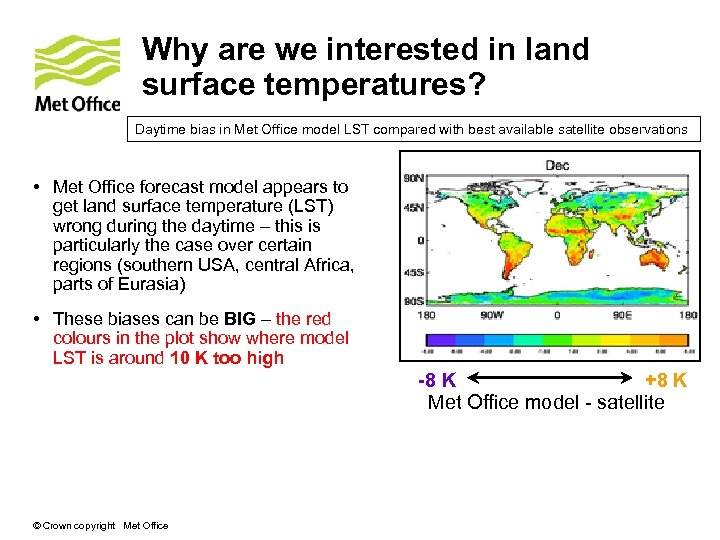
Why are we interested in land surface temperatures? Daytime bias in Met Office model LST compared with best available satellite observations • Met Office forecast model appears to get land surface temperature (LST) wrong during the daytime – this is particularly the case over certain regions (southern USA, central Africa, parts of Eurasia) • These biases can be BIG – the red colours in the plot show where model LST is around 10 K too high -8 K +8 K Met Office model - satellite © Crown copyright Met Office
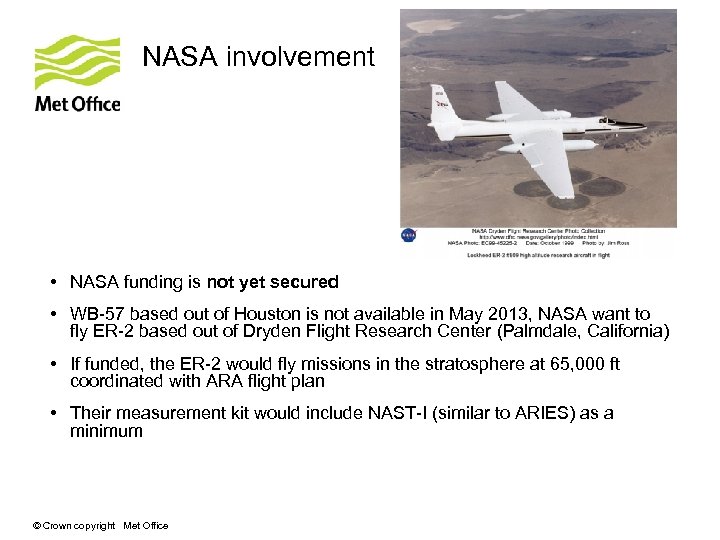
NASA involvement EUMETSAT • NASA funding is not yet secured • WB-57 based out of Houston is not available in May 2013, NASA want to fly ER-2 based out of Dryden Flight Research Center (Palmdale, California) • If funded, the ER-2 would fly missions in the stratosphere at 65, 000 ft coordinated with ARA flight plan • Their measurement kit would include NAST-I (similar to ARIES) as a minimum © Crown copyright Met Office
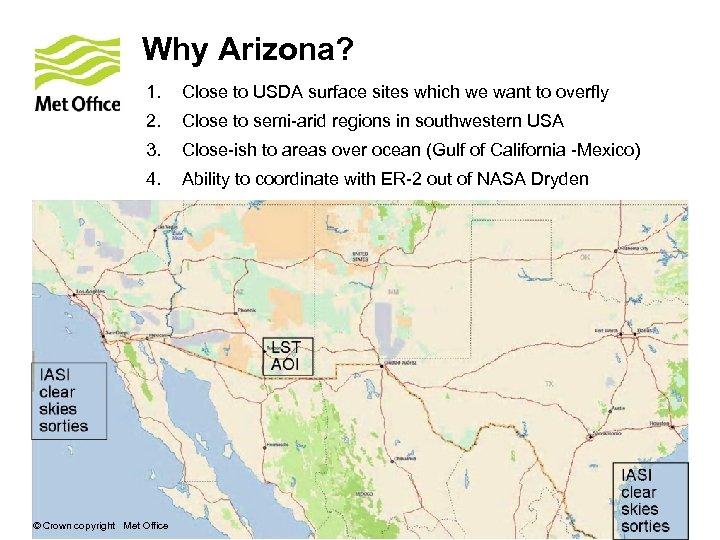
Why Arizona? 1. Close to USDA surface sites which we want to overfly 2. Close to semi-arid regions in southwestern USA 3. Close-ish to areas over ocean (Gulf of California -Mexico) 4. Ability to coordinate with ER-2 out of NASA Dryden © Crown copyright Met Office
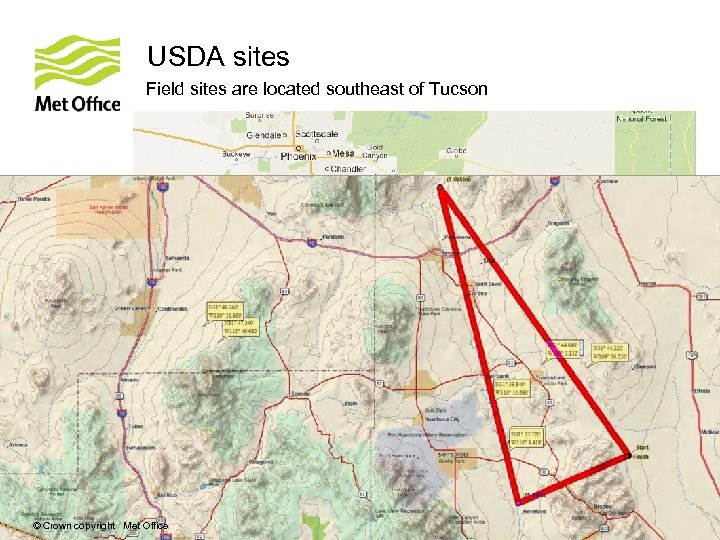
USDA sites Field sites are located southeast of Tucson EUMETSAT © Crown copyright Met Office
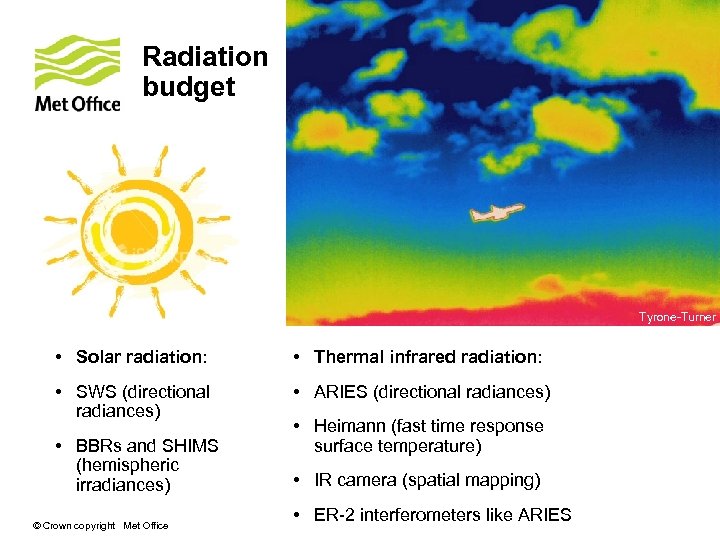
Radiation budget EUMETSAT Kiehl and Trenberth (2008) Tyrone-Turner • Solar radiation: • Thermal infrared radiation: • SWS (directional radiances) • ARIES (directional radiances) • BBRs and SHIMS (hemispheric irradiances) © Crown copyright Met Office • Heimann (fast time response surface temperature) • IR camera (spatial mapping) • ER-2 interferometers like ARIES
Fluxes • Aircraft fluxes of momentum, heat and moisture: • Need fast (32 Hz) humidity [Total water content TWC] EUMETSAT • Need fast temperature measurement [Rosemounts] • Need fast wind components [Turbulence probe / AIMMS] • Fluxes from the ground sites • Flux towers • Surface radiation measurements • Soil moisture and soil heat flux © Crown copyright Met Office Tyrone-Turner
Flight plans • Raster patterns and transects at mid- to high level to survey variability in LST over large areas to understand uncertainties in satellite-based EUMETSAT retrievals and within-grid variability • Flights over the ground-based sites at low level (~500 ft or MSA) for surveying turbulent fluxes and LST conditions near the field sites • Most flights will need to profile through the whole atmosphere to allow complete radiative transfer simulations and validation of satellite retrievals. Dropsondes will be released at high level to sample temperature and humidity profile variation. These profiles could be used to evaluate UM forecast or analysis fields • Straight and level runs coordinated with ER-2 (if participating) • Although LST flights will generally be in daytime, some satellite overpasses will be targeted at night • Satellite cal/val flights will include clear sky over ocean/land some flights with partially cloudy fields of view © Crown copyright Met Office
Suitcase detachment? • There is interest from modellers to overfly Atmospheric Radiation Measurement (ARM) Southern Great Plains surface site near Lamont, Oklahoma • This is about 800 nm from Tucson – candidate for a suitcase detachment? © Crown copyright Met Office
EUMETSAT funding • The European meteorological satellite agency (EUMETSAT) are part-funding the campaign for our work underflying IASI-2 on new Met. Op satellite • We will be contracted to provide datasets of atmospheric state (in situ temperature, humidity and trace gases, data from dropsondes) after each science flight • Good opportunity to test data processing capability on detachment © Crown copyright Met Office

Any questions? © Crown copyright Met Office
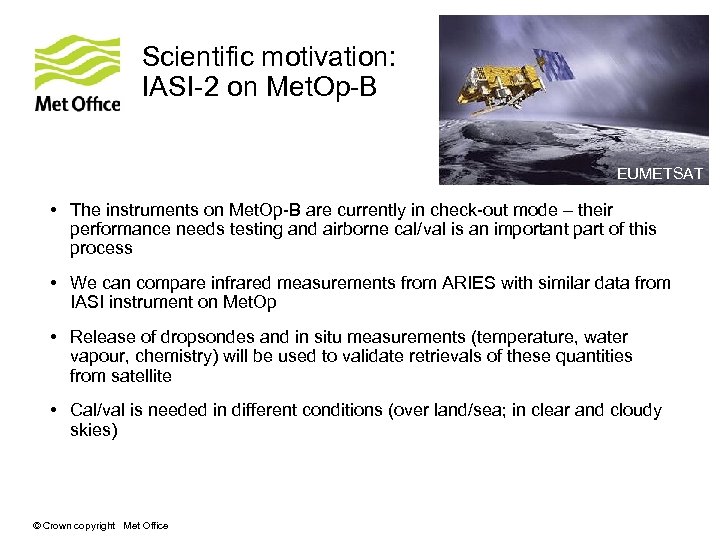
Scientific motivation: IASI-2 on Met. Op-B EUMETSAT • The instruments on Met. Op-B are currently in check-out mode – their performance needs testing and airborne cal/val is an important part of this process • We can compare infrared measurements from ARIES with similar data from IASI instrument on Met. Op • Release of dropsondes and in situ measurements (temperature, water vapour, chemistry) will be used to validate retrievals of these quantities from satellite • Cal/val is needed in different conditions (over land/sea; in clear and cloudy skies) © Crown copyright Met Office
Скачать презентацию SALSTICE the aircraft and ground based campaign in
2d2765593c5cb7e83c93421d914e513c.ppt