 Скачать презентацию Saint-Petersburg State University Institute of Earth Sciences FRESHWATER
Molluscs.pptx
- Количество слайдов: 8



Saint-Petersburg State University Institute of Earth Sciences FRESHWATER MOLLUSCS Mishchenko Anastasiia Master program: CORELIS 2016

Quaternary lacustrine sediments - wind-blown silt deposits - cave, sinkhole and fracture/fissure sediment accumulations - alluvial, floodplain and backwater channel deposits - lagoonal, littoral and deepwater lacustrine sediments - fen peat https: //e-a. d-cd. net
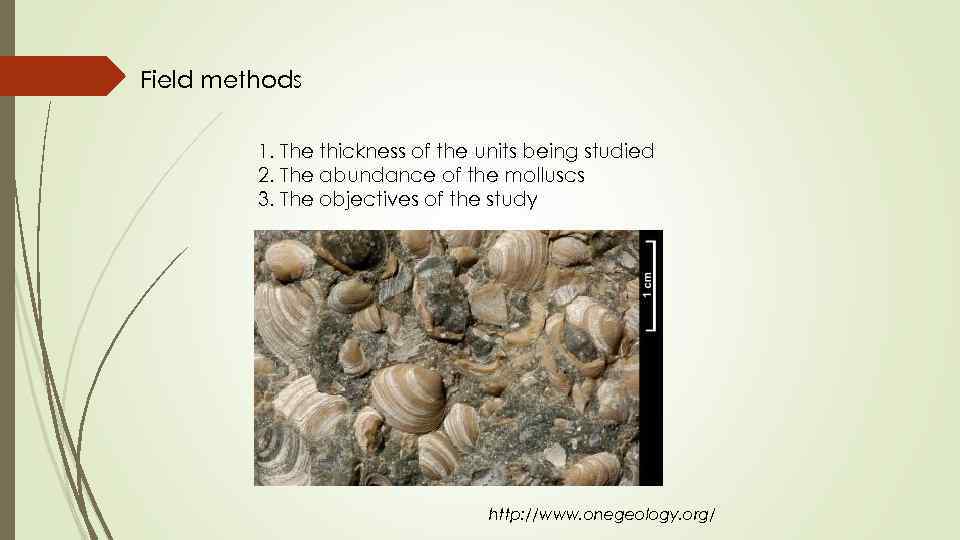
Field methods 1. The thickness of the units being studied 2. The abundance of the molluscs 3. The objectives of the study http: //www. onegeology. org/
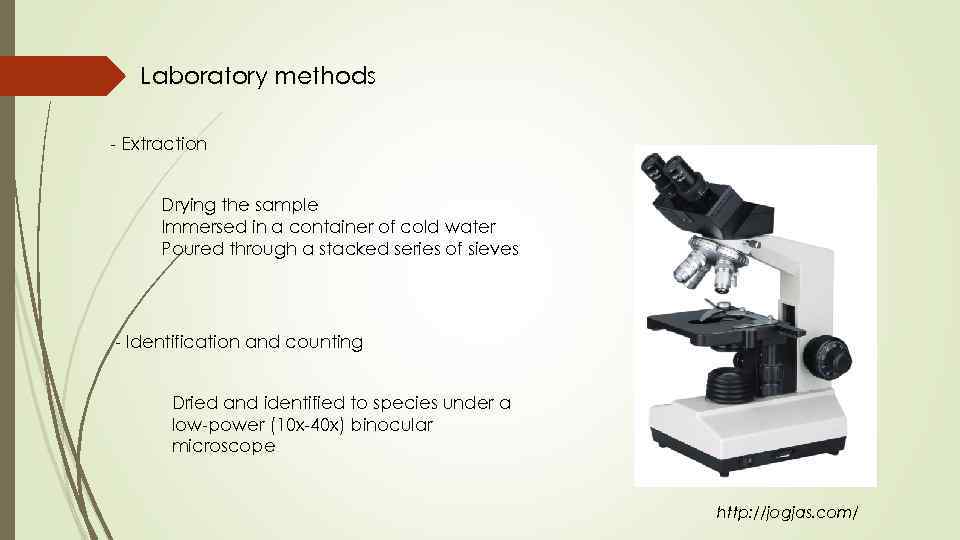
Laboratory methods - Extraction Drying the sample Immersed in a container of cold water Poured through a stacked series of sieves - Identification and counting Dried and identified to species under a low-power (10 x-40 x) binocular microscope http: //jogjas. com/
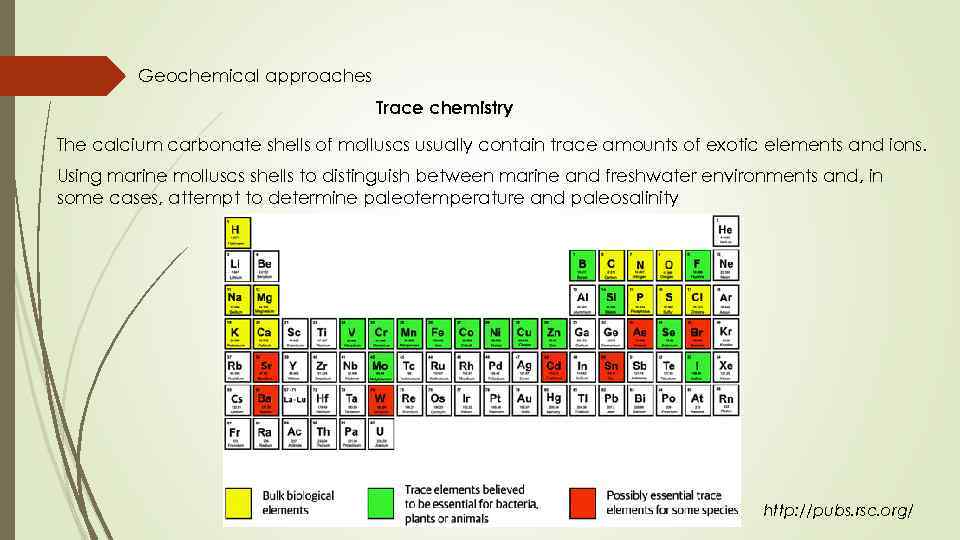
Geochemical approaches Trace chemistry The calcium carbonate shells of molluscs usually contain trace amounts of exotic elements and ions. Using marine molluscs shells to distinguish between marine and freshwater environments and, in some cases, attempt to determine paleotemperature and paleosalinity http: //pubs. rsc. org/
Stable carbon and oxygen isotope ratios The 18 O/16 O ratios and 13 С/12 С ratios: - to determine paleotemperatures, climatic trends, the amplitude of seasonal changes, and long term trends in the isotope composition of ocean and lake waters; - to distinguish marine from non-marine environments and determine paleosalinity - to measure rates of shell growth, estimate season of death, water depth, primary productivity, and polar ice volume
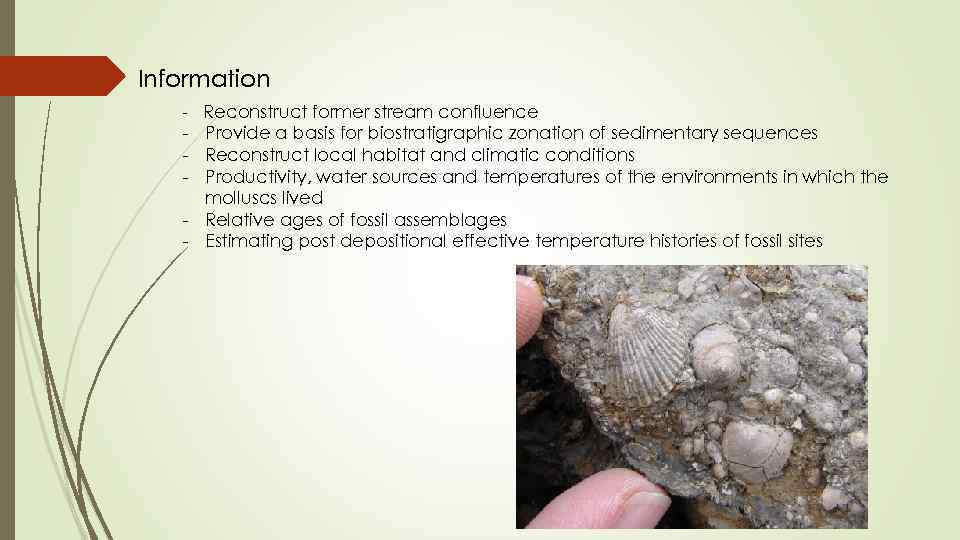
Information - Reconstruct former stream confluence Provide a basis for biostratigraphic zonation of sedimentary sequences Reconstruct local habitat and climatic conditions Productivity, water sources and temperatures of the environments in which the molluscs lived - Relative ages of fossil assemblages - Estimating post depositional effective temperature histories of fossil sites

Thank you for the attention!
Скачать презентацию Saint-Petersburg State University Institute of Earth Sciences FRESHWATER
Molluscs.pptx