


 Скачать презентацию Safety Risks with E-cigarettes accidents in the home
811288de82e4fbb1cad0a7a1d872738d.ppt
- Количество слайдов: 17
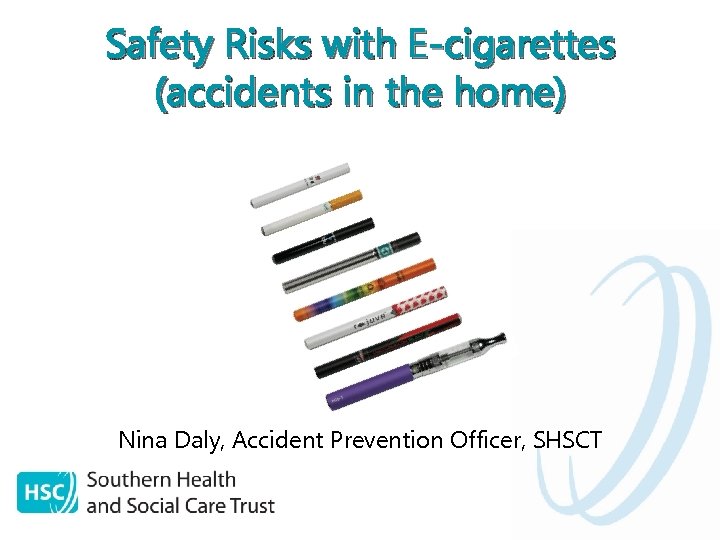 Safety Risks with E-cigarettes (accidents in the home) Nina Daly, Accident Prevention Officer, SHSCT
 E Cigarettes – licensing, regulation l E-cigarettes have grown in use by smokers as an aid to help them quit or reduce smoking. l Until May 2016 - were not fully regulated, not licensed and not as safe as established NRT therapies which are tightly controlled for product quality & safety. * l May 2016 - the EU’s revised Tobacco Products Directive (TPD) came into force with new regulations covering e-cigarettes. l Transitional arrangements in place - products that are not in compliance with the TPD can be released for sale on the UK market until 20 November 2016. l From 20 May 2017 all products sold to consumers must be fully compliant with the TPD. l Standards are included aimed at improving the quality of products & reducing the risk of accidents, particularly in relation to children.
 Tobacco & Related Products Regulations 2016 l Implements a new notification requirement for all producers* who intend to supply electronic cigarettes or refill containers. (* manufacturers/importers) l The notification body on behalf of the Secretary of State (UK) is the MHRA – The Medicines & Healthcare Products Regulatory Agency. Visit: www. gov. uk – search for MHRA a page will be established soon with more information, check if a product has been notified. Or Email info@mhra. gsi. gov. uk For more information on the regulatory framework, or to register for ongoing updates about the scheme.
 Going forward what to do/look for 1. Purchase e-cigarettes from reputable retailers who are compliant with the notification arrangements. 2. Check the pack has: • - a list of ingredients • - a nicotine content (the nicotine containing liquid must not contain in excess of 20 mg/ml - unless a medicine) & the delivery per dose is indicated. • - a batch number & keep out of reach of children marking. • - a health warning regarding nicotine as a highly addictive & is not recommended for non-smokers.
 Going forward what to do/look for 3. Check each unit packet of an electronic cigarette or refill container contains a warning leaflet with instructions for use – including the reference that the product is not recommended for use by young people & non-smokers, possible adverse effects, contact details of the producer, warnings for specific groups etc. 4. Check refill containers do not exceed 10 ml 5. Check single use cartridges don’t have a cartridge/tank that exceeds 2 ml 6. Product packaging must be child resistant & tamper evident 7. Product must be protected against breakage & leakage & re-filling must take place without leakage.
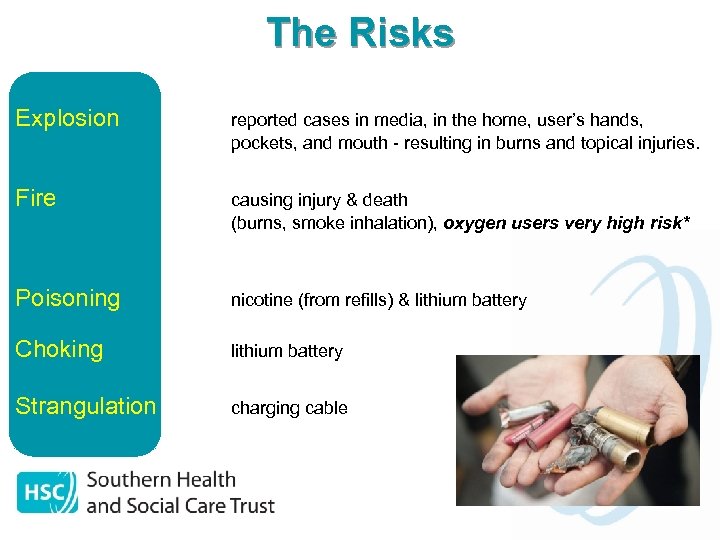 The Risks Explosion reported cases in media, in the home, user’s hands, pockets, and mouth - resulting in burns and topical injuries. Fire causing injury & death (burns, smoke inhalation), oxygen users very high risk* Poisoning nicotine (from refills) & lithium battery Choking lithium battery Strangulation charging cable
 E Cigarettes Fire Safety Advice l Never leave to charge for long periods of time/overnight or when unattended or in the vicinity of oxygen tanks, equipment used at home l Never charge near or on combustible/flammable materials l Always know your brand avoid counterfeits. Buy from a reputable source, read reviews, ask those in the know for advice if you need to. Some countries have poorer manufacturing standards than others as well as less stringent testing methods for electrical appliances. l Never mix components of different devices. l Do not plug into computers, or other USB-capable devices. l Find a device that has a battery you remove from the atomizer to charge, these may be safer than the models that stay attached when charging.
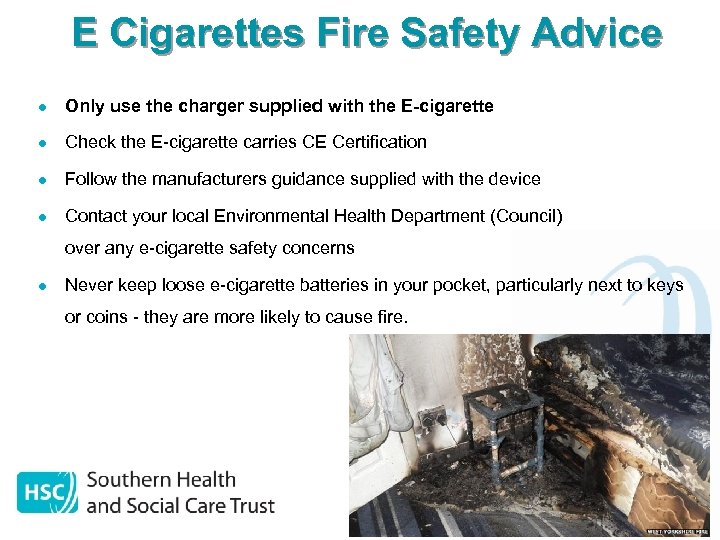 E Cigarettes Fire Safety Advice l Only use the charger supplied with the E-cigarette l Check the E-cigarette carries CE Certification l Follow the manufacturers guidance supplied with the device l Contact your local Environmental Health Department (Council) over any e-cigarette safety concerns l Never keep loose e-cigarette batteries in your pocket, particularly next to keys or coins - they are more likely to cause fire.
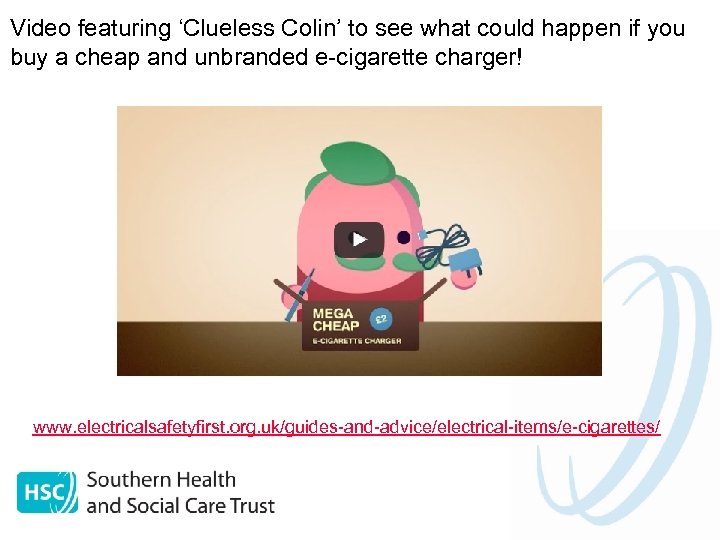 Video featuring ‘Clueless Colin’ to see what could happen if you buy a cheap and unbranded e-cigarette charger! www. electricalsafetyfirst. org. uk/guides-and-advice/electrical-items/e-cigarettes/
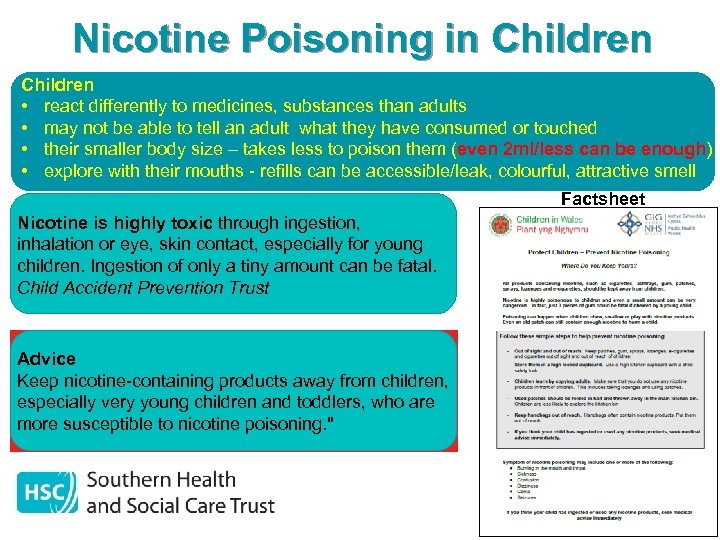 Nicotine Poisoning in Children • react differently to medicines, substances than adults • may not be able to tell an adult what they have consumed or touched • their smaller body size – takes less to poison them (even 2 ml/less can be enough) • explore with their mouths - refills can be accessible/leak, colourful, attractive smell Factsheet Nicotine is highly toxic through ingestion, inhalation or eye, skin contact, especially for young children. Ingestion of only a tiny amount can be fatal. Child Accident Prevention Trust Advice Keep nicotine-containing products away from children, especially very young children and toddlers, who are more susceptible to nicotine poisoning. "
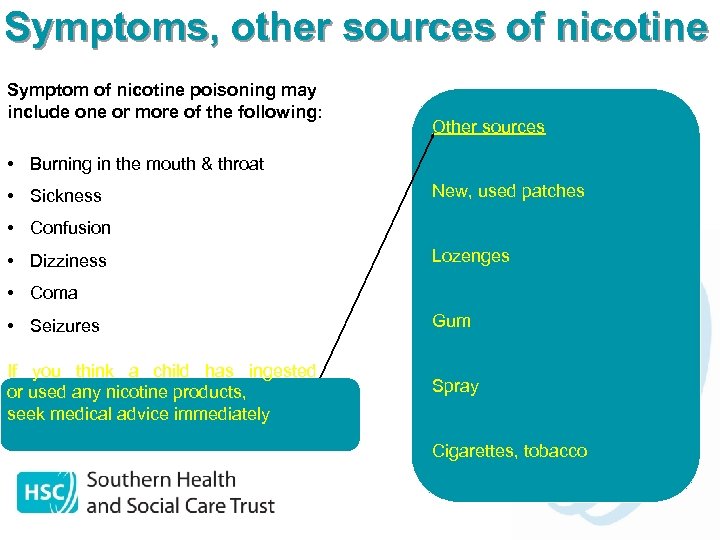 Symptoms, other sources of nicotine Symptom of nicotine poisoning may include one or more of the following: Other sources • Burning in the mouth & throat • Sickness New, used patches • Confusion • Dizziness Lozenges • Coma • Seizures Gum If you think a child has ingested or used any nicotine products, seek medical advice immediately Spray Cigarettes, tobacco
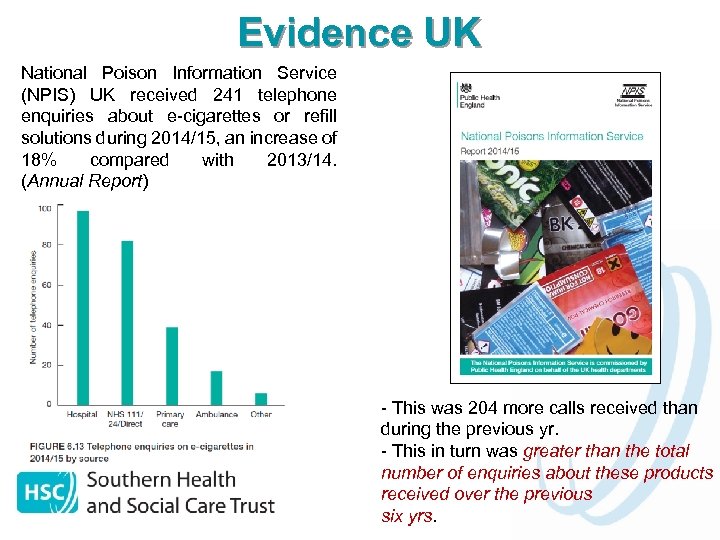 Evidence UK National Poison Information Service (NPIS) UK received 241 telephone enquiries about e-cigarettes or refill solutions during 2014/15, an increase of 18% compared with 2013/14. (Annual Report) - This was 204 more calls received than during the previous yr. - This in turn was greater than the total number of enquiries about these products received over the previous six yrs.
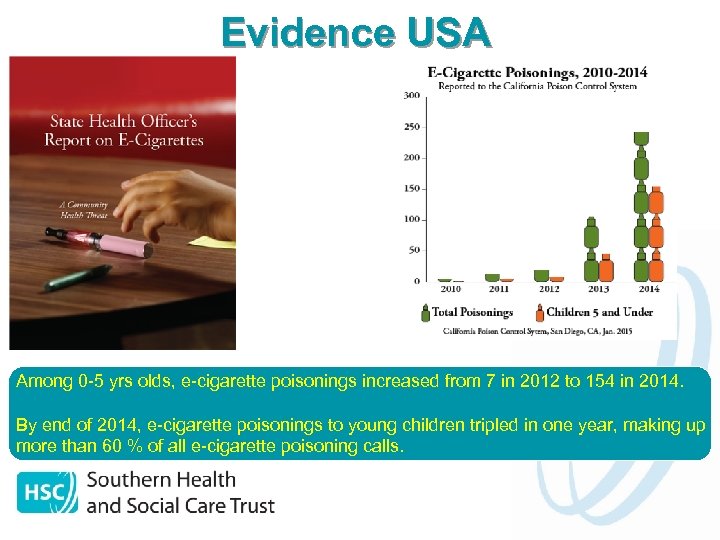 Evidence USA Among 0 -5 yrs olds, e-cigarette poisonings increased from 7 in 2012 to 154 in 2014. By end of 2014, e-cigarette poisonings to young children tripled in one year, making up more than 60 % of all e-cigarette poisoning calls.
 May 2016 The study examined poison center calls about exposure to nicotine and tobacco products among children under 6 yrs from Jan ‘ 12 through Apr ‘ 15. The results were published in the Journal Pediatrics. Findings Monthly calls about young children swallowing, inhaling or touching e-cigarettes climbed from 14, early on, to 223 by the end of the study. Calls totalled 4, 128 during the study. Most children were two years old or younger. Lead author, Dr Gary Smith, direct of the Center for Injury Research and Policy at Nationwide Children's Hospital in Ohio, said: 'This is an epidemic by any definition. ‘ ‘If you use these products, you need to treat them as medication or toxins and keep them closed, locked and out of reach of children. ’ Dr Joan Shook, Texas Children's Hospital
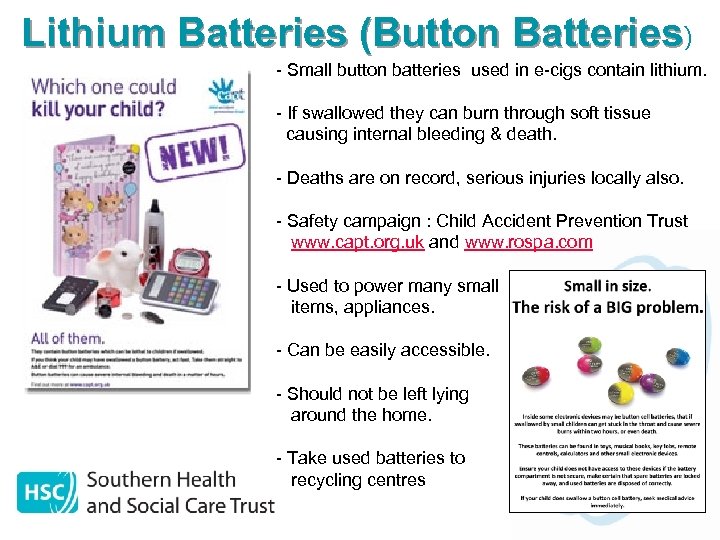 Lithium Batteries (Button Batteries) - Small button batteries used in e-cigs contain lithium. - If swallowed they can burn through soft tissue causing internal bleeding & death. - Deaths are on record, serious injuries locally also. - Safety campaign : Child Accident Prevention Trust www. capt. org. uk and www. rospa. com - Used to power many small items, appliances. - Can be easily accessible. - Should not be left lying around the home. - Take used batteries to recycling centres
 Strangulation, which can result in serious injury, brain damage, and death, can occur within minutes. Strangulation incidents can be caused by drawstrings, ribbons, and cords, and by entrapment in pieces of future, playground equipment, or strollers. Although strangulation is sometimes picked up in the news as a ‘freak’ accident, it is not uncommon. Further advice: www. capt. org. uk and www. rospa. com
 Finally ‘The Public Health Agency (PHA) recommends that people wishing to quit smoking attend Specialist Stop Smoking clinics and use Nicotine Replacement Therapy as this is the most effective way to stop smoking. Details of services can be found via: www. want 2 stop. info/stop-smoking-services Or in the Southern Trust area by : Contact the Trust Smoking Cessation Service on Tel: 028 3741 5333 (Monday to Friday 9 am-5 pm) Email: stop. smoking@southerntrust. hscni. net