


 Скачать презентацию SAFETY REPORT — SCOPE ELEMENTS REQUIREMENTS ENFORCEMENT 1
2470ca40840064d23cd5653d178e09ae.ppt
- Количество слайдов: 14
 SAFETY REPORT - SCOPE, ELEMENTS, REQUIREMENTS, ENFORCEMENT 1
 The Safety Report • Safety Report is concerned with “WHAT” and “WHY” • Report must include information detailed in Article 9 and Annex II • Report must meet the purpose of Seveso II, including the “demonstrations” – Article 5 2
 KEY PURPOSE To demonstrate that major accident hazards have been identified and that the necessary measures have been taken to prevent such accidents and to limit their consequences for persons and the environment 3
 Demonstration – – Points of detail can be pursued at inspection phase – The key demonstration is linking the measures taken and the major hazards identified – A sufficiently systematic, rigorous approach has been shown – Demonstration is proportionate – 4 Prima facie evidence that measures taken are appropriate to “Show”, or “Justify”, or “Make The Case” Relates to hazard, process and risk
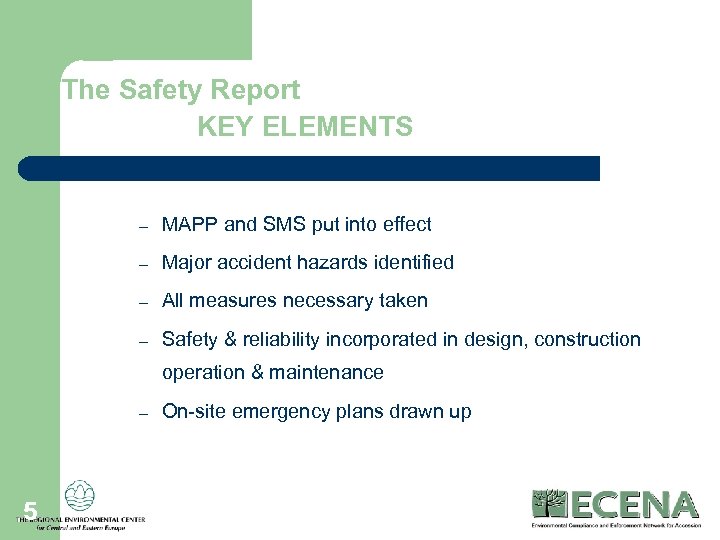 The Safety Report KEY ELEMENTS – MAPP and SMS put into effect – Major accident hazards identified – All measures necessary taken – Safety & reliability incorporated in design, construction operation & maintenance – 5 On-site emergency plans drawn up
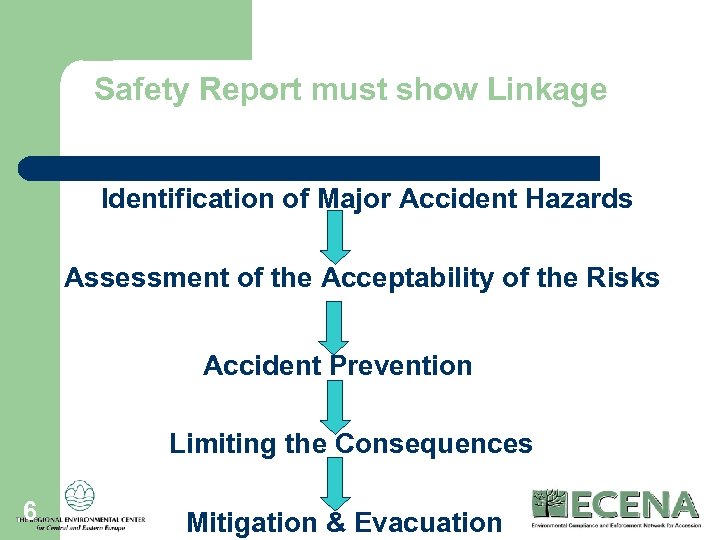 Safety Report must show Linkage Identification of Major Accident Hazards Assessment of the Acceptability of the Risks Accident Prevention Limiting the Consequences 6 Mitigation & Evacuation
 Assessment of a Safety Report Basic Criteria l Does the report contain – l Sufficient information for the purposes of Article 9 Is there – – l 7 A major accident prevention policy A safety management system for implementing it? Does the report demonstrate that the major accident hazards have been identified?
 Assessment of A Safety Report Basic Criteria Does the report demonstrate l That the necessary measures have been taken to prevent major accidents? l That the necessary measures have been taken to limit the consequences of major accidents? l That adequate safety and reliability have been incorporated into design, construction, operation, maintenance? 8
 Assessment of A Safety Report Basic Criteria l Does the report demonstrate that an internal emergency plan has been drawn up? l Does the information supplied enable the local emergency planners to draw up an off-site emergency plan l Is there evidence that there is a serious deficiency in the measures taken to prevent, mitigate a major accident? 9
 Assessment of A Safety Report Basic Criteria l Does the report provide sufficient information to the competent authority to enable decisions on siting of new activities and developments around existing establishments? l Does the report give sufficient information to identify establishments where the likelihood or consequence of a major accident may be increased by their proximity because of the “domino effect”? 10
 Assessment of A Safety Report Risk Assessment l Hazard analysis undertaken and full range of major accidents identified? l Consequence assessment – described in quantative terms – – 11 How far? – l How much? What effects? Adequate description of potential consequences?
 Assessment of A Safety Report Technical Criteria l The safety report should show that the establishment and installations have been designed to an appropriate standard – Including: l l Redundancy, diversity, separation and segregation l 12 Containment Single event with multiple effects
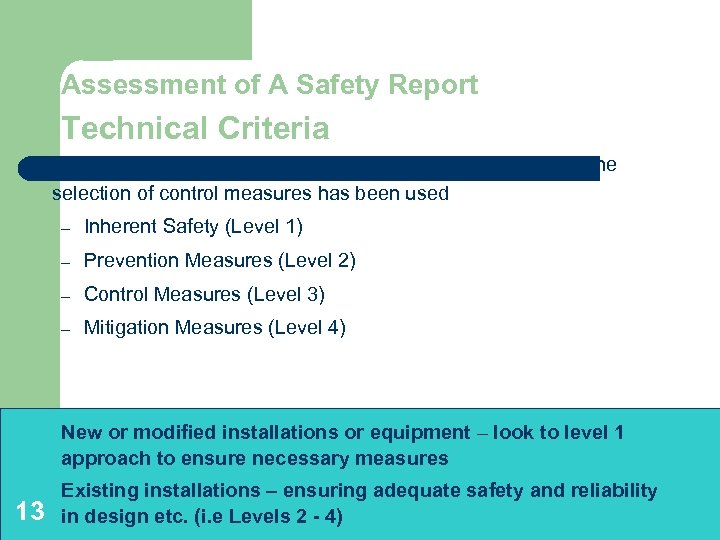 Assessment of A Safety Report Technical Criteria The safety report should show that a hierarchical approach to the selection of control measures has been used – Inherent Safety (Level 1) – Prevention Measures (Level 2) – Control Measures (Level 3) – Mitigation Measures (Level 4) New or modified installations or equipment – look to level 1 approach to ensure necessary measures 13 Existing installations – ensuring adequate safety and reliability in design etc. (i. e Levels 2 - 4)
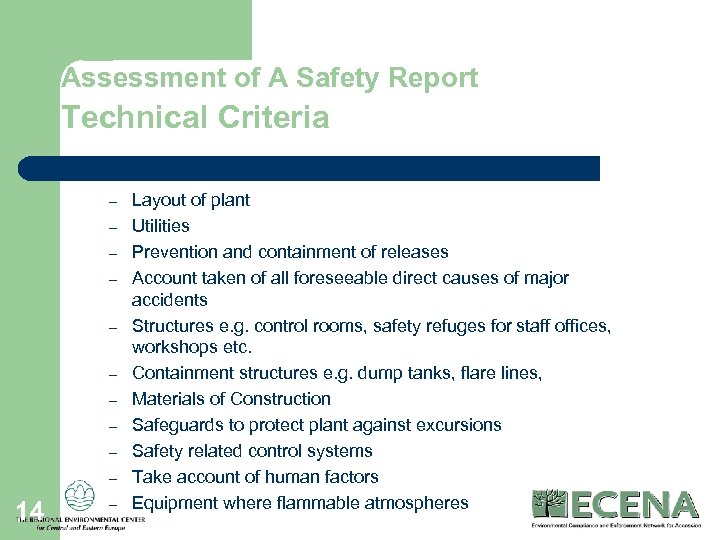 Assessment of A Safety Report Technical Criteria – – – – – 14 – Layout of plant Utilities Prevention and containment of releases Account taken of all foreseeable direct causes of major accidents Structures e. g. control rooms, safety refuges for staff offices, workshops etc. Containment structures e. g. dump tanks, flare lines, Materials of Construction Safeguards to protect plant against excursions Safety related control systems Take account of human factors Equipment where flammable atmospheres