


 Скачать презентацию Safety Appliance Standards Part 231 Specific Requirements
bc4cd46127006be923263ce0594c7c8a.ppt
- Количество слайдов: 74
 Safety Appliance Standards Part 231 Specific Requirements & TB’s Module 9
 Module Objectives • Apply FRA Safety Standards. • Recognize deviations from the standards. Module 9 2
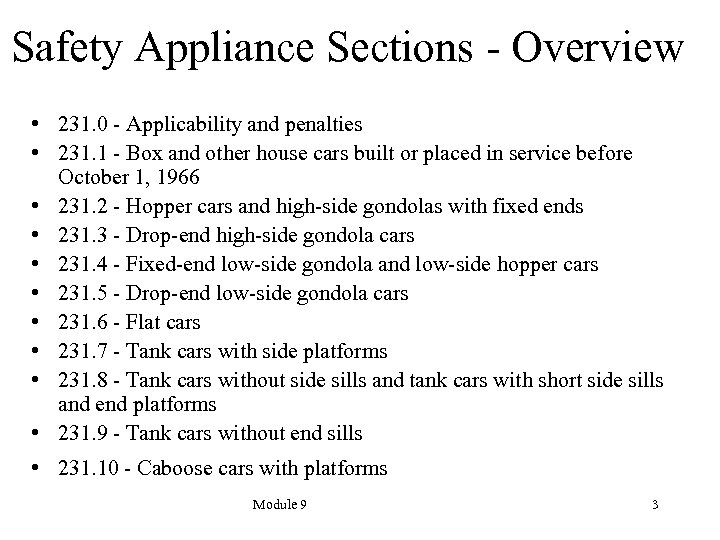 Safety Appliance Sections - Overview • 231. 0 - Applicability and penalties • 231. 1 - Box and other house cars built or placed in service before October 1, 1966 • 231. 2 - Hopper cars and high-side gondolas with fixed ends • 231. 3 - Drop-end high-side gondola cars • 231. 4 - Fixed-end low-side gondola and low-side hopper cars • 231. 5 - Drop-end low-side gondola cars • 231. 6 - Flat cars • 231. 7 - Tank cars with side platforms • 231. 8 - Tank cars without side sills and tank cars with short side sills and end platforms • 231. 9 - Tank cars without end sills • 231. 10 - Caboose cars with platforms Module 9 3
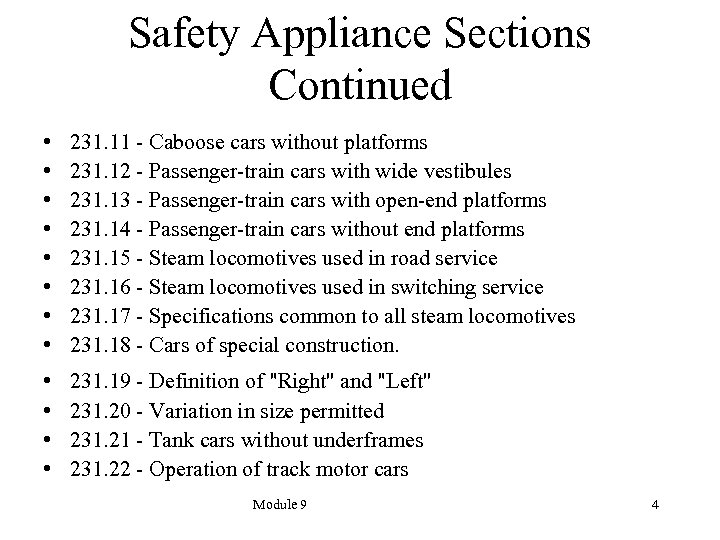 Safety Appliance Sections Continued • • 231. 11 - Caboose cars without platforms 231. 12 - Passenger-train cars with wide vestibules 231. 13 - Passenger-train cars with open-end platforms 231. 14 - Passenger-train cars without end platforms 231. 15 - Steam locomotives used in road service 231. 16 - Steam locomotives used in switching service 231. 17 - Specifications common to all steam locomotives 231. 18 - Cars of special construction. • • 231. 19 - Definition of "Right'' and "Left'' 231. 20 - Variation in size permitted 231. 21 - Tank cars without underframes 231. 22 - Operation of track motor cars Module 9 4
 Safety Appliance Sections Continued • 231. 23 - Unidirectional passenger-train cars adaptable to van-type semitrailer use • 231. 24 - Box and other house cars with roofs, 16 feet 10 inches or more above top of rail • 231. 25 - Track motorcars (self-propelled 4 -wheel cars which can be removed from the rails by men) • 231. 26 - Pushcars • 231. 27 - Box and other house cars without roof hatches or placed in service after October 1, 1966 • 231. 28 - Box and other house cars with roof hatches built or placed in service after October 1, 1966 • 231. 29 - Road locomotives with corner stairways • 231. 30 - Locomotives used in switching service • 231. 31 - Drawbars for freight cars; standard height Module 9 5
 Standard & Low Level Auto Racks Safety Appliance Arrangements • Refer to TB MP&E 98 -5. • Conflict currently exists between FRA & AAR on the dimensional requirements relating to this TB. • Consult with your specialist to ensure the car meets regulatory and AAR requirements. Module 9 6
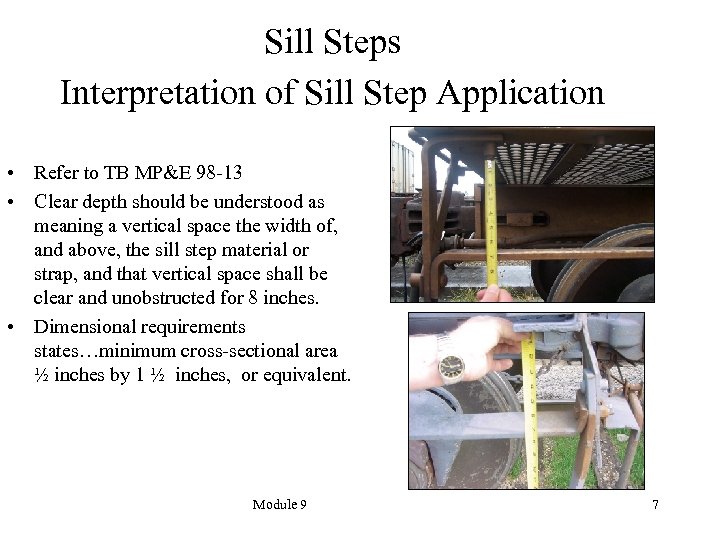 Sill Steps Interpretation of Sill Step Application • Refer to TB MP&E 98 -13 • Clear depth should be understood as meaning a vertical space the width of, and above, the sill step material or strap, and that vertical space shall be clear and unobstructed for 8 inches. • Dimensional requirements states…minimum cross-sectional area ½ inches by 1 ½ inches, or equivalent. Module 9 7
 Safety Appliances Welding & Fasteners • Refer to MP&E TB 98 -14. • All safety appliances are required to be mechanically fastened with ½ inch bolts, hucks or rivets. • In the case of bolts, thread of bolt nearest the fastener shall be chiseled checked c inch in depth at two locations, deform the thread, or apply weld. • Refer to TB for additional information and consult with specialist for list of additional and approved mechanical fasteners. Module 9 8
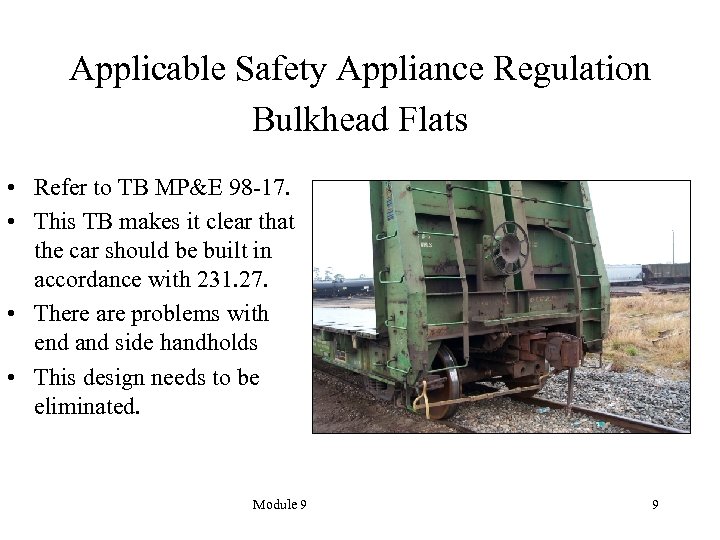 Applicable Safety Appliance Regulation Bulkhead Flats • Refer to TB MP&E 98 -17. • This TB makes it clear that the car should be built in accordance with 231. 27. • There are problems with end and side handholds • This design needs to be eliminated. Module 9 9
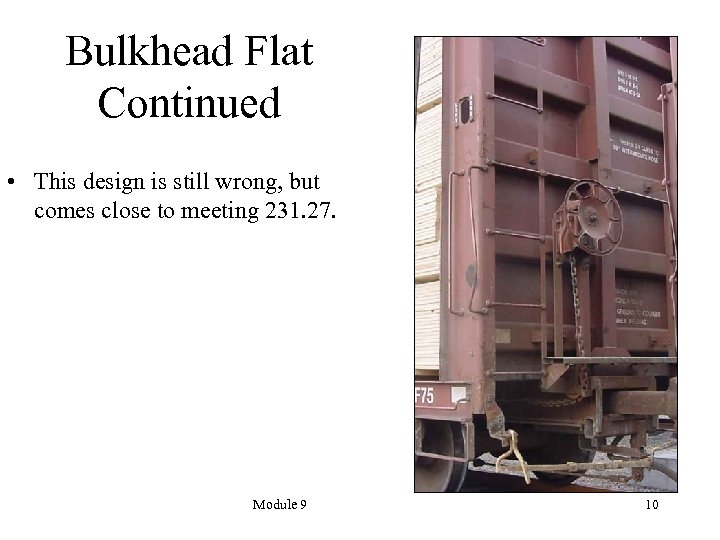 Bulkhead Flat Continued • This design is still wrong, but comes close to meeting 231. 27. Module 9 10
 Aluminum Safety Appliances • Refer to MP&E TB 98 -18. • FRA will not take exception to the application of safety appliances made from aluminum material (spec. 6061 -T 6), provided they comply with the dimensional requirements contained in the TB. Module 9 11
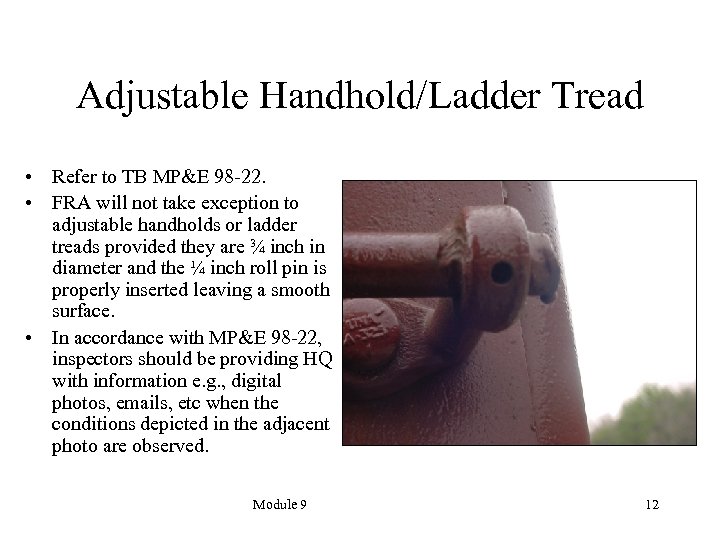 Adjustable Handhold/Ladder Tread • Refer to TB MP&E 98 -22. • FRA will not take exception to adjustable handholds or ladder treads provided they are ¾ inch in diameter and the ¼ inch roll pin is properly inserted leaving a smooth surface. • In accordance with MP&E 98 -22, inspectors should be providing HQ with information e. g. , digital photos, emails, etc when the conditions depicted in the adjacent photo are observed. Module 9 12
 Safety Appliance Judgment “Minor Deviations” • Refer to TB MP&E 98 -36. • Discretion is the message here…you have the discretion and the ability to determine what is safe and what isn’t. • Depending on the application, one inch can mean a 50 percent deviation from the regulatory requirements…would you consider that a “Minor Deviation!” • Don’t be intimidated by the language contained in the TB, make the call and stand by your decision. Module 9 13
 Iron or Steel Safety Appliances • Handholds and ladder treads shall have minimum diameters of e of an inch. • All handholds and ladder treads require a minimum clearance of 2 inches, preferably 2½ inches it’s clear length (360 degrees). Note: Certain exceptions apply on passenger, caboose and locomotives Module 9 14
 Handbrake All freight car handbrakes shall operate in harmony with the power brake installed on the car, and provide the same degree of safety as the design shown on plate A, or provide the same degree of safety as that specified in § 231. 27. Module 9 15
 Handbrake Wheel • The brake wheel may be flat or dished, not less than 15, preferably 16, inches in diameter, of malleable iron, wrought iron, or steel. • A brake lever may be used in lieu of a wheel on certain cars. • Vertical wheel handbrake (wheel) must be at least 22 inches in diameter, built after 10. 1. 66. Module 9 16
 Handbrake Location • All hand brakes shall be so located that it can be safely operated while car is in motion, but actual location may vary depending on car type. • Brake shaft shall be located on end of car, to the left of and not less than 17 nor more than 22 inches (for the majority of equipment), from center, and • If vertical wheel, not less than 26 nor more than 40 inches above top of end-platform tread. • Handbrakes mounted on side of car shall not be more than 36 inches from right-hand end. Module 9 17
 Handbrake Wheel Clearance • There shall be not less than 4 inches clearance around rim of brake wheel. • Outside edge of brake wheel shall be not less than 4 inches from a vertical plane parallel with end of car and passing through the inside face of knuckle when closed with coupler horn against the buffer block or end sill. Module 9 18
 Handbrake Wheel Fit & Operation • Brake shaft shall be arranged with a square fit at its upper end to secure the hand-brake wheel; said square fit shall be not less than seven-eighths of an inch square. • Square fit taper, nominally 2 in 12 inches. • Brake wheel and drum shall be arranged so that both will revolve when applying and gradually releasing the handbrake. • Handbrake shall be provided with means to prevent application of the brake by winding in a counterclockwise direction. Module 9 19
 Brake Wheel Securement • Brake wheel shall be held in position on brake shaft by a nut on a threaded extended end of brake shaft. • Thread portion shall be not less than ¾ of an inch in diameter. • Nut shall be secured by riveting over or by the use of a locknut or suitable cotter. Module 9 20
 Handbrake Chains • MP&E TB 98 -53 allows car builder to use handbrake chain material with dimensional characteristics less than required by the regulations. • Car builders may now use d inch alloy or ½ inch steel alloy chain. Module 9 21
 Brake Step • If brake step is used, it shall be not less than 28 inches in length. • Outside edge shall be not less than 8 inches from face of car and not less than 4 inches from a vertical plane parallel with end of car and passing through the inside face of knuckle when closed with coupler horn against the buffer block or end sill. • Brake step shall be supported by not less than two metal braces having a minimum cross-sectional area d inch by ½ inch or equivalent, which shall be securely fastened to body of car with not less than ½ inch bolts, hucks or rivets. Module 9 22
 End Platforms Cars Requiring • Box & other house cars with or w/o roof hatches Post Oct. 1, 1966. • High cube cars. • Tank cars w/o under-frames. • Certain cars of special construction (e. g. , Road. Railer, Rail. Runner, etc. ). Module 9 23
 End Platforms Number, Dimensions & Location Box & House Cars - Post Oct. 1, 1966 • Two ~ One centered on each end of car between inner ends of handholds not more than eight inches above top of center sill. • Each end platform shall be securely supported by not less than three metal braces having a minimum cross sectional area of d inch by 1½ inches or equivalent. • Width not less than eight inches, length, not less than 60 inches. Module 9 24
 End Platforms High Cube Car Requirements • Two ~ On each end of car not more than eight inches above center sill. • Each end-platform shall be securely supported by not less than four metal braces having a minimum cross sectional area d inch by 1 ½ inches or equivalent which shall be securely fastened to body of car. • The outside edge of each end-platform shall be not less than six inches from a vertical plane parallel with end of car and passing through the inside face of knuckle when closed with coupler horn against the buffer-block or end sill and cushioning device. • Width, not less than 10 inches, length, full width of car. Module 9 25
 End Platforms Tank w/o Under-frames • Two ~ One on each end extending across car a distance equal to or greater than any other portion of car, outside edge of end platform shall extend not less than seven inches beyond bulge of tank head and safety railing. • End platforms shall be securely fastened to the draft sills and be sufficiently rigid to prevent sagging. • Minimum width, ten inches, minimum thickness, 1¾ inches. Module 9 26
 End Platforms Draft System Considerations 231. 27 & 231. 28 • Where conventional draft gear or cushioning device having longitudinal travel less than six inches is used, the outside edge of each end platform shall be not less than 12 inches from a vertical plane parallel with end of car and passing through the inside face of knuckle when closed with coupler horn against buffer block. • Where cushioning device having longitudinal travel six inches or more is used the outside edge of each end platform shall be not less than six inches from a vertical plane parallel with end of car and passing through the inside face of knuckle when closed with end sill and cushioning device at full buff. Module 9 27
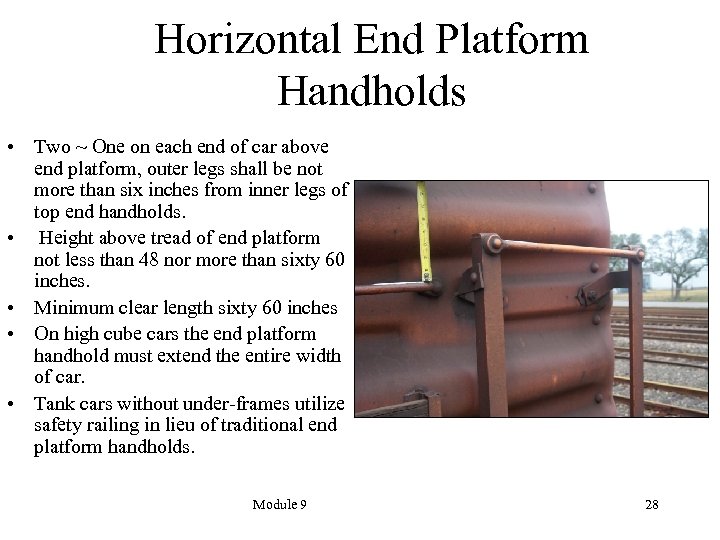 Horizontal End Platform Handholds • Two ~ One on each end of car above end platform, outer legs shall be not more than six inches from inner legs of top end handholds. • Height above tread of end platform not less than 48 nor more than sixty 60 inches. • Minimum clear length sixty 60 inches • On high cube cars the end platform handhold must extend the entire width of car. • Tank cars without under-frames utilize safety railing in lieu of traditional end platform handholds. Module 9 28
 Running Boards Number, Dimensions & Location Box & House Cars - Pre Oct 1, 1966 • One ~ Longitudinal running board. • Two ~ Latitudinal extensions on outside-metal roof cars. • Longitudinal running board shall be not less than 18 and preferably 20 inches in width. • Latitudinal extensions shall be not less than 24 inches in width. • Full length of car, center of roof. • On outside-metal roof cars there shall be two latitudinal extensions from longitudinal running board to ladder locations. Module 9 29
 Running Boards Number, Dimensions & Location Box & House Cars - Post Oct. 1, 1966 One ~ Same as the previous slide, but the end of longitudinal running board shall be not less than six inches from a vertical plane parallel with end of car and passing through the inside face of knuckle when closed with coupler horn against buffer block or end sill Module 9 30
 Running Boards Unique Requirements for Tanks w/o side sills or tanks with short side sills and end platforms One ~ Continuous running board around sides and ends, or two running full length of tank, one on each side, on tank cars having end platforms extending to bolsters, running boards shall extend from center to center of bolsters, one on each side. • Minimum width on sides, 10 inches, minimum width on ends, 6 inches. • If side running boards are applied below center of tank, outside edge of running boards shall extend not less than 7 inches beyond bulge of tank. • The running boards at ends of car shall be not less than 6 inches from a point vertically above the inside face of knuckle when closed with coupler horn against the buffer block, end sill or back stop. Module 9 31
 Running Boards Unique Requirements for Tanks w/o End Sills: • One ~ Continuous around sides and ends of tank • Minimum width on sides, 10 inches, minimum width on ends, 6 inches • If running boards are applied below center of tank, outside edge of running boards shall extend not less than 7 inches beyond bulge of tank • Running boards at ends of car shall be not less than 6 inches from a point vertically above the inside face of knuckle when closed with coupler horn against the buffer block, end sill or back stop. Module 9 32
 Running Board Clearance • The ends of longitudinal running board shall be not less than 6 (nor more than 10 inches - Pre Oct 1, 1966), from a vertical plane parallel with end of car and passing through the inside face of knuckle when closed with coupler-horn against the buffer block or end sill; and if more than 4 inches from edge of roof of car, shall be securely supported their full width by substantial metal braces. • Except, the end of longitudinal running board shall be not less than six inches from a vertical plane parallel with end of car and passing through the inside face of knuckle when closed with coupler horn against buffer block or end sill. • Running board extensions per TB MP&E 98 -23, if running board does not extend the entire length of the roof, a running Module 9 33 board extension is required.
 Sill Steps Number, Dimensions, & Location • Four ~ Near each end of each side of car, so that there shall be not more than 18 inches from end of car to center of tread of sill step. • Outside edge of tread of step shall be not more than 4 inches inside of face of side of car, preferably flush with side of car. • Tread shall be not more than 24, preferably not more than 22, inches above the top of rail. • Minimum clear depth, 8 inches (see MP&E TB 98 -13). • Minimum length of tread 10, preferably 12 inches. • Sill steps exceeding 21 inches in depth shall have additional tread. • Cars built after 10. 1. 66, the distance from the top sill step tread to the end and side bottom ladder tread/handhold shall not exceed 21 inches. Module 9 34
 Sill Steps Additional Requirements Unique to Certain Tank Cars • On tanks without side sills, or tanks with short side sills and end platforms, the sill step shall be located under the side handhold. • Sill steps exceeding 18 inches in depth on tank cars without end sills shall be laterally braced and have an additional tread. • On tanks without end sills, if equipped with high running boards, making ladders necessary, sill steps must meet ladder requirements. • On tanks without end sills, the sill step shall be flush with outside edge of running board as near end of car as practicable. Module 9 35
 Ladders Which Cars Require Ladders & How Many? Four ~ ü Box and other house cars built prior to Oct. 1, 1966. * ü Hopper and high side gondola with fixed ends. ü Tanks without side sills and tanks with short side sills and end platforms if equipped with side running boards. Two ~ ü Drop end high side gondola. ü Tanks without side sills and tanks with short side sills and end platforms if equipped with continuous running boards. ü Box and other house cars with roof hatches built or placed in service after Oct 1, 1966. *Unless car has been modified in accordance with the requirements. Module 9 36
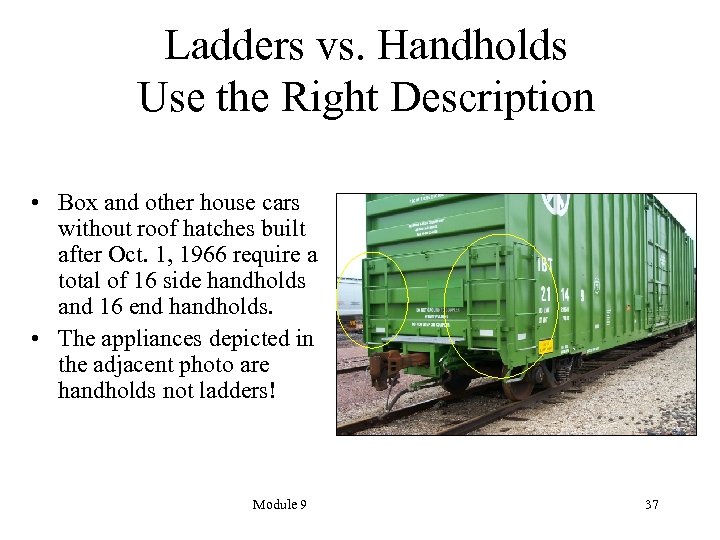 Ladders vs. Handholds Use the Right Description • Box and other house cars without roof hatches built after Oct. 1, 1966 require a total of 16 side handholds and 16 end handholds. • The appliances depicted in the adjacent photo are handholds not ladders! Module 9 37
 Ladders Number, Dimensions, & Location • Two ~ One on each end of car not more than eight inches from left-hand side minimum clear length of tread, 16 inches, (Post-Oct. 1, 1966 cars). • Four ~ One on each side, not more than 8 inches from right end of car; one on each end, not more than 8 inches from left side of car; measured from inside edge of ladder stile or clearance of ladder treads to corner of car minimum clear length of tread, side ladders 16 inches, end ladders 14 inches (Pre-Oct. 1, 1966 cars). * • Maximum spacing between ladder treads, 19 inches. • Top ladder tread shall be located not less than 12 nor more than 18 inches from roof at eaves. • Spacing of side ladder treads shall be uniform within a limit of 2 inches from top ladder tread to bottom tread of ladder. *Unless car has been modified in accordance with the requirements. Module 9 38
 Ladders Number, Dimensions, & Location Cont. • Maximum distance from bottom tread of side ladder to top tread of sill step, 21 inches. • End ladder treads shall be spaced to coincide with treads of side ladders, a variation of 2 inches being allowed. • Where construction of car will not permit the application of a tread of end ladder to coincide with bottom tread of side ladder, the bottom tread of end ladder must coincide with second tread from bottom of side ladder. • Metal ladders without stiles near corners of cars shall have foot guards or upward projections not less than 2 inches in height near inside end of bottom treads. • Stiles of ladders, projecting 2 or more inches from face of car, will serve as foot guards. Module 9 39
 End Ladder (Appliances) Clearance No part of car above end sills within 30 inches from side of car, except buffer block, brake shaft, brake wheel, brake step, running board or uncoupling lever shall extend to within 12 inches of a vertical plane parallel with end of car and passing through the inside face of knuckle when closed with coupler horn against the buffer block or end sill, and no other part of end of car or fixtures on same above end sills, other than exceptions herein noted, shall extend beyond the outer face of buffer block. Module 9 40
 Roof Handholds Number, Dimensions, & Location • One ~ Over each end ladder (Post Oct. 1, 1966), on roof of car parallel to treads of each ladder not less than 8 nor more than 15 inches from edge of roof. • Minimum clear length, 16 inches. • One right-angle handhold (Pre Oct. 1, 1966), may take the place of two adjacent specified roof handholds, provided the dimensions and locations coincide, and that an extra leg is securely fastened to car at point of angle. Module 9 41
 Side Handholds Number, Dimensions, & Location Box & House Cars - Pre Oct 1, 1966 • Four ~ Horizontal, one near each end on each side of car, not less than 24 nor more than 30 inches above center line of coupler, except where tread of ladder is considered a handhold. • Clearance of outer end of handhold shall be not more than 8 inches from end of car. • Minimum clear length, 16 inches, preferably 24 inches. Note: On certain cars, tread of side ladder is a side handhold. Module 9 42
 Side Handholds Number, Dimensions, & Location Box & House Cars - Post Oct. 1, 1966 • Sixteen ~ Horizontal, four near each end and on each side of car spaced not more than nineteen inches apart and with the bottom handhold located not more than 21 inches from top tread of sill step. • Top handhold shall coincide in height with top end handhold, a variation of two inches being allowed. • Spacing of side handholds shall be uniform within a limit of two inches from top handhold to bottom handhold. • Clearance of outer ends of handholds shall be not more than eight inches from end of car. • Each bottom handhold shall have foot guard or upward projection not less than two inches in height near inside end. Module 9 43
 Side Handholds Unique Requirements For Certain Cars • High-cube - Each bottom handhold shall have foot guard or upward projection not less than two inches in height near inside end. • Fixed-end low-side gondola and low-side hopper cars & Dropend low-side gondola cars - Handhold shall not project above top of side. • Flat cars - Clearance of outer end of handhold shall be not more than 12 inches from end of car. • Tank w/o under-frame - On face of end platform end, over sill step, projecting downward or outward, clearance of outer end of handhold shall be not more than twelve inches from end of car, vertical portion of end platform safety railing shall be considered as a side vertical handhold. Module 9 44
 Side Handholds Unique Requirements For Tank Cars with Side Platforms • Four or more ~ Horizontal, one on face of each side sill near each end, clearance of outer end of handhold shall be not more than 12 inches from end of car. • If side safety railings are attached to tank or tank bands, four additional vertical handholds shall be applied, one as nearly as possible over each sill step and securely fastened to tank or tank band. Module 9 45
 Side Handholds Unique Requirements For Tanks without side sills or tanks with short side sills and end platforms • Four or more ~ Horizontal, one on face of each side sill near each end on tank cars with short side sills, or one attached to top of running board projecting outward above sill steps or ladders on tank cars without side sills, clearance of outer end of handhold shall be not more than 12 inches from end of car. • If side safety railings are attached to tank or tank bands four additional vertical handholds shall be applied, one as nearly as possible over each sill step and securely fastened to tank or tank bands. Module 9 46
 Side Handholds Unique Requirements For Tank Cars w/o End Sills • Four or more ~ Horizontal, one near each end on each side of car over sill step on running board, not more than 2 inches back from outside edge of running board, projecting downward or outward. • Where such side handholds are more than 18 inches from end of car, an additional handhold must be placed near each end on each side not more than 30 inches above center line of coupler. • Clearance of outer end of handhold shall be not more than 12 inches from end of car. • If safety railings are on tank, four additional vertical handholds shall be applied, one over each sill step on tank. Module 9 47
 Horizontal End Handholds Number, Dimensions, & Location Box & House Cars - Pre Oct 1, 1966 • Eight or more ~ Horizontal, four on each end of car, one near each side on each end of car, not less than 24 nor more than 30 inches above CL of coupler, except tread of end ladder is an end handhold. • Clearance of outer end of handhold shall be not more than 8 inches from side of car for handholds 24 to 30 inches above CL of coupler. • Clearance of outer end of handhold shall be not more than 16 inches from side of car for handholds projecting outward or downward. • One near each side of each end of car on face of end sill or sheathing over end sill, projecting outward or downward. • On each end of cars with platform end sills 6 or more inches in width, measured from end post or siding and extending entirely across end of car, there shall be one additional end handhold not less than 24 inches in length, located near center of car, not less than 30 nor more than 60 inches above platform end sill. Note: On certain cars, tread of end ladder is an end handhold Module 9 48
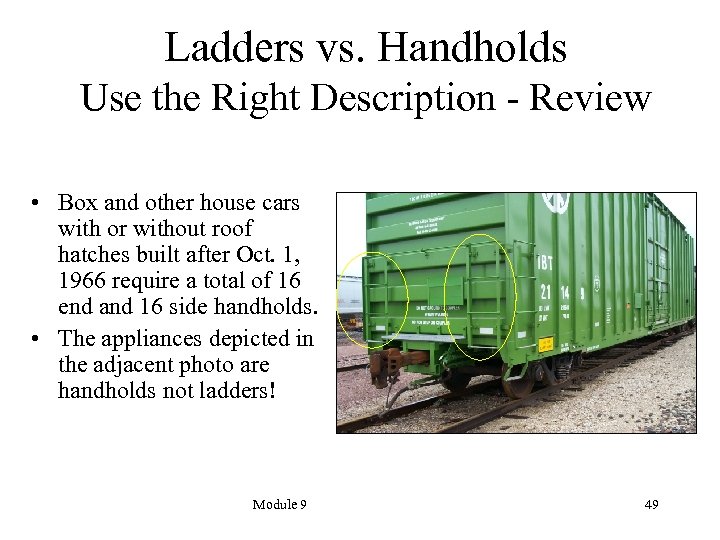 Ladders vs. Handholds Use the Right Description - Review • Box and other house cars with or without roof hatches built after Oct. 1, 1966 require a total of 16 end and 16 side handholds. • The appliances depicted in the adjacent photo are handholds not ladders! Module 9 49
 Horizontal End Handholds Number, Dimensions, & Location Box & House Cars – Post Oct 1, 1966 • 16 ~ Four, horizontal near each side and on each end of car spaced not more than 19 inches apart and with the bottom handhold located not more than 21 inches from top tread of sill step, and top handhold shall coincide in height with end platform handholds, a variation of two inches being allowed. • Minimum clear length, 16 inches, preferably 24 inches. • Clearance of outer ends of handholds shall be not more than eight inches from side of car. Module 9 50
 Horizontal End Handholds Requirements For All Other Cars Except High Cube Boxes & Tanks w/o End Sills • Four ~ Horizontal, one near each side of each end of car on face of end sill with clearance of outer end of handhold shall be not more than 16 inches from side of car. • Minimum clear length, 16 inches, preferably 24 inches. Module 9 51
 Horizontal End Handholds High Cube Boxes • Four ~ One near each side of each end of car on outer edge of end platform, projecting downward with clearance of outer end not more than sixteen inches from side of car. • Minimum clear length, 16 inches, preferably 24 inches. Module 9 52
 Horizontal End Handholds Tanks w/o End Sills • Four ~ Horizontal, one near each side on each end of car on running board, not more than 2 inches back from edge of running board projecting downward or outward, or on end of tank not more than 30 inches above center line of coupler. • Minimum clear length, 16 inches, preferably 24 inches. Module 9 53
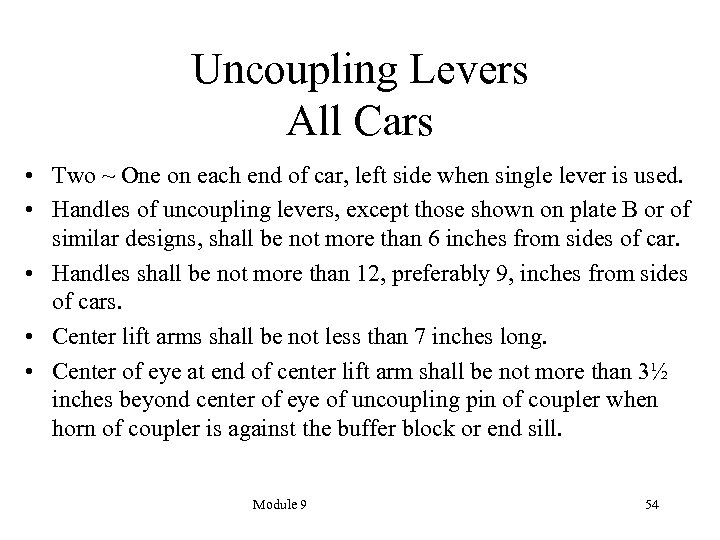 Uncoupling Levers All Cars • Two ~ One on each end of car, left side when single lever is used. • Handles of uncoupling levers, except those shown on plate B or of similar designs, shall be not more than 6 inches from sides of car. • Handles shall be not more than 12, preferably 9, inches from sides of cars. • Center lift arms shall be not less than 7 inches long. • Center of eye at end of center lift arm shall be not more than 3½ inches beyond center of eye of uncoupling pin of coupler when horn of coupler is against the buffer block or end sill. Module 9 54
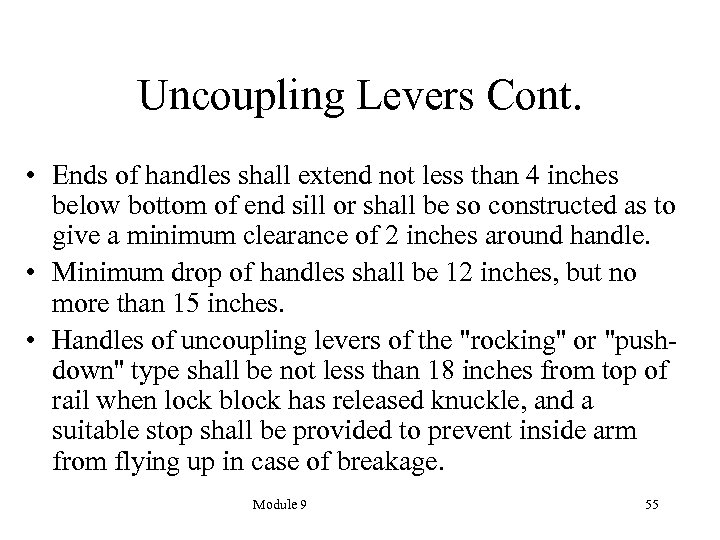 Uncoupling Levers Cont. • Ends of handles shall extend not less than 4 inches below bottom of end sill or shall be so constructed as to give a minimum clearance of 2 inches around handle. • Minimum drop of handles shall be 12 inches, but no more than 15 inches. • Handles of uncoupling levers of the "rocking'' or "pushdown'' type shall be not less than 18 inches from top of rail when lock block has released knuckle, and a suitable stop shall be provided to prevent inside arm from flying up in case of breakage. Module 9 55
 Safety Appliance Regulations Miscellaneous Regulations & Additional Unique Requirements
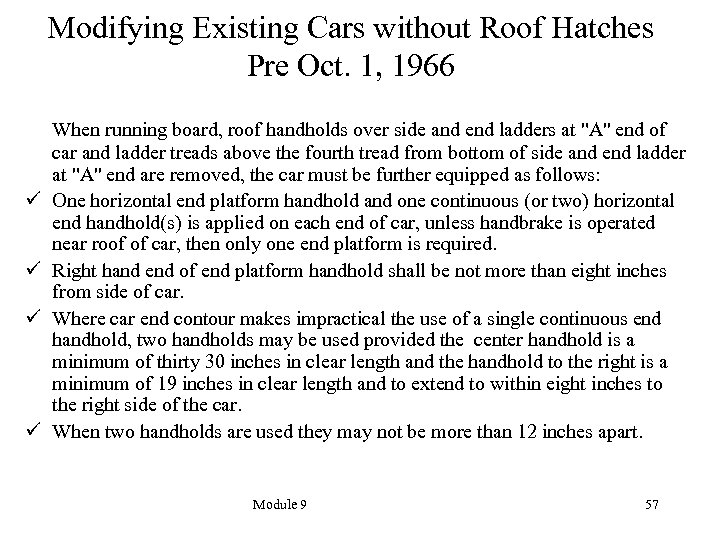 Modifying Existing Cars without Roof Hatches Pre Oct. 1, 1966 ü ü When running board, roof handholds over side and end ladders at "A'' end of car and ladder treads above the fourth tread from bottom of side and end ladder at "A'' end are removed, the car must be further equipped as follows: One horizontal end platform handhold and one continuous (or two) horizontal end handhold(s) is applied on each end of car, unless handbrake is operated near roof of car, then only one end platform is required. Right hand end of end platform handhold shall be not more than eight inches from side of car. Where car end contour makes impractical the use of a single continuous end handhold, two handholds may be used provided the center handhold is a minimum of thirty 30 inches in clear length and the handhold to the right is a minimum of 19 inches in clear length and to extend to within eight inches to the right side of the car. When two handholds are used they may not be more than 12 inches apart. Module 9 57
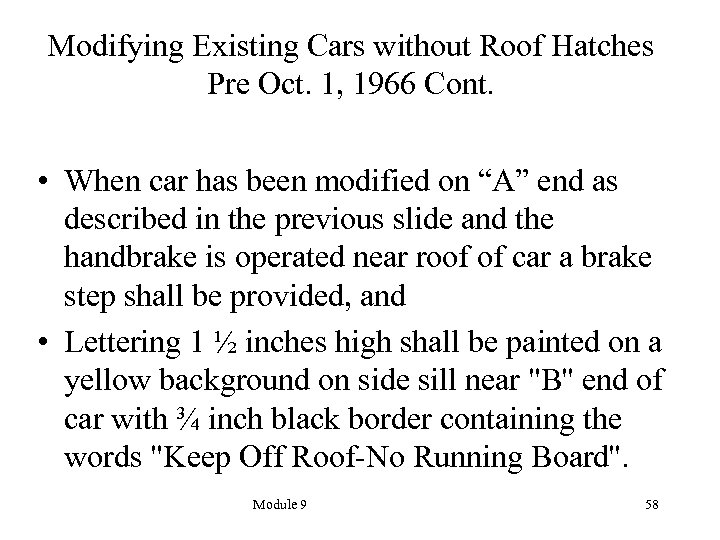 Modifying Existing Cars without Roof Hatches Pre Oct. 1, 1966 Cont. • When car has been modified on “A” end as described in the previous slide and the handbrake is operated near roof of car a brake step shall be provided, and • Lettering 1 ½ inches high shall be painted on a yellow background on side sill near "B'' end of car with ¾ inch black border containing the words "Keep Off Roof-No Running Board''. Module 9 58
 Modifying Existing Cars without Roof Hatches Pre Oct. 1, 1966 Cont. • When handbrake is operated from approximate level of top of end sill, roof handholds and side and end ladder treads above the fourth tread from the bottom of ladders at "B'' end of car shall be removed. • Brake step shall be provided with top of tread surface being level with or not more than four inches below adjacent end handhold. Module 9 59
 Painting & Marking Box and House Cars (High Cube) 16 feet 10 inches ATR • That portion of each end of the car which is more than 15 feet above top of rail shall be painted with contrasting reflectorized paint and bear the words "excess height car'' in lettering not less than three high, and • On each side sill near end corner there shall be painted or otherwise displayed a yellow rectangular area with a ¾ inch black border containing the words “This Car Excess Height'' in lettering not less than 1½ inches high. Module 9 60
 Fastening Appliances Tank Cars with Jackets On tanks covered with jackets, metal pads shall be securely attached to the shell proper, to which brackets shall be fastened for securing the safety appliances attached to the tanks; or, the safety appliances (with the exception of the operating platform brackets) may be secured to the jackets reinforced with metal pads at the point of attachment, which pads shall extend at least two inches from the center line of rivet holes. The operating platform brackets shall be secured to the jacket reinforced with suitable bands. When the safety appliances are attached to the jacket covering of the tank, the jacket shall be tightened so that there will be no danger of its slipping around. Module 9 61
 Tank Head Handholds All Tanks except Tanks w/o End Sills • Two ~ Horizontal, one across each head of tank not less than 30 nor more than 60 inches above platform. • Clear length of tank head handholds shall extend to within 6 inches of outer diameter of tank at point of application. Note: Tank head handholds not required if safety railing runs around ends of tank. Module 9 62
 Safety Railing Tanks with Side Platforms • One ~ Continuous safety railing running around sides and ends of tank, securely fastened to tank or tank bands at ends and sides of tank; or two running full length of tank at sides of cars supported by posts, extending the full length of tank either at side supported by posts or securely fastened to tank or tank bands, not less than 30 nor more than 60 inches above platform. • Safety railings may not be less than ¾ inch wrought iron or steel. Module 9 63
 Safety Railing Tanks w/o Side Sills or Tanks with Short Side Sills and End Platforms • One ~ Running around sides and ends of tank or two running full length of tank, not less than 30 nor more than 60 inches above platform or running board. • Minimum diameter, 7/8 inch wrought iron or steel. • Tanks w/o end sills must be equipped with safety railings as stated above, tank head handholds not allowed. Module 9 64
 Side Safety Railing Tanks w/o Under-frames • Two ~ One on each side of car, extending from end platform to end platform at a distance of not less than 51 inches from centerline of car, except that where break in side railing is necessary for side ladder or operating cabinet, the side railing shall be securely attached to such ladder and/or cabinet. • Minimum diameter 1 ¼ inch pipe with not less than 2½ inches of clearance. • Safety railings shall be securely attached to end platforms and supported from the car at intervals not exceeding ten feet. Module 9 65
 End Platform Safety Railing Tanks w/o Under-frames • Two ~ One at each end of car shall extending horizontally across car not less than 36 inches nor more than 54 inches above end platform and extend downward within three inches of the end of the platform. • Safety railing shall be located not more than six inches from the inside edge of the platform. • Minimum diameter 7/8 inch wrought iron or steel, or 1¼ inch with not less than 2½ inches clearance. • Safety railings shall be supported at center of car and at each end by extending downward at the ends and attaching to the platform. Module 9 66
 Operating Platform Tanks w/o Under-frames General Design Requirements • One ~ Operating platform, two ladders and safety railing. • Operating platform shall be of sufficient length to provide access to all operating fittings. • Ladders shall be located on sides of car at center. • The Safety railing shall enclose the operating platform, manway and fittings used in the loading and unloading of the tank, railing shall be open only at the ladders where it shall extend in a vertical direction down to, and be securely attached to the platform. • Maximum width of opening, twenty-four inches. Note: Operating platform not required if all fittings used in the loading and unloading of tank are accessible from the ground or end platform. Module 9 67
 Operating Platform Tanks w/o Under-frames Cont. Specific Design Characteristics • Ladder stiles, d x 2 inches or equivalent, wrought iron or steel or 1¼ inch extra strong pipe will be considered equivalent. • Minimum clear length of treads, 14 inches. • Maximum spacing of treads, nineteen inches. • Operating platform, minimum width, seven inches; minimum thickness, 1¾ inches. • Safety railing, 1¼ inch wrought iron or steel pipe. Module 9 68
 Operating Platform Tanks w/o Under-frames Cont. Specific Design Characteristics • The ladders shall be securely fastened to the operating platform and lower portion of ladder shall be braced in such a manner as to prevent any movement. • Operating platforms shall be supported to prevent sagging and be securely attached to the tank. • The safety railing shall be securely attached to four stanchions or corner posts, which shall be securely attached to the tank or operating platform. Module 9 69
 Safety Chains Tank Cars Refer to TB MP&E 98 -31. Module 9 70
 Vertical End Handholds Applies only to Box Cars built prior to Oct. 1, 1966, High Cube boxes and certain TOFC/COFC cars. Module 9 71
 Vertical End Handholds Pre Oct. 1, 1966 Two ~ One on each end of car opposite ladder, not more than 8 inches from side of car; clearance of bottom end of handhold shall be not less than 24 nor more than 30 inches above center line of coupler, on full-width platform end-sill cars. Module 9 72
 Vertical End Handholds High Cube Cars • Four ~ One on each side of each end of car, not more than four inches from side of car, extending downward from end of horizontal end-platform handhold to within eight inches above tread of end-platform. • One continuous handhold with two right angles, or two right angle handholds, may take the place of two specified vertical end-handholds and one horizontal end-platform handhold, provided the dimensions and locations coincide, and extra legs at points of angle and center are provided and securely fastened to car. Module 9 73
 End of Module 9 74