 Скачать презентацию Safety and Security in Waterbury Public Schools
2ddf628f2a2cb08579c2d18345f6e9cb.ppt
- Количество слайдов: 62



Safety and Security in Waterbury Public Schools
Situational Awareness *Is the ability to identify, process, and comprehend the critical elements of information about what is happening or knowing what is going on around you; Your gut instincts are telling you that something doesn’t seem right.
Situational Awareness • If it just doesn’t seem right, • If it doesn’t look right, • If it doesn’t feel right, • If it doesn’t smell right, • It isn’t right----- Say something! •
We are the Eyes and Ears • The November 2016 terrorist attack at Ohio State University demonstrates how the reporting process is key, but also imperfect. • Ohio State University police say 11 people were taken to local hospitals and a suspect was killed following an attack on campus Monday morning. • Columbus police say the attack started when 18 -year-old OSU student Abdul Razak Ali Artan drove his vehicle into a crowd of people outside of Watts Hall. • Artan, a Somali-born legal permanent resident of the U. S. , then exited his vehicle and began chasing students with a butcher knife. Several students were injured, including one critically. • Less than a minute after the attack began, an OSU police officer arrived on the scene and shot and killed Artan.
Eyes and Ears • A recently released series of email messages between the OSU terrorist attacker, and his academic advisor shows a gap in the school’s threat assessment process. • The Columbus Dispatch reports that Artan, a first-semester student, was concerned with failing grades and losing financial aid. He asked his academic advisor to drop his classes two weeks before driving a vehicle into a crowd on campus and then stabbing fellow students, faculty and staff. • The reply from the advisor was that “Abdul is feeling unmotivated right now … he’s feeling unmotivated in his current classes. ” Consequently, Artan replied that he was staying in school, but might or might not attend some classes.
Eyes and Ears • Standing alone, this simple email exchange raises no red flags. Yet given the totality of circumstances, even with hindsight, it begs the question as to what else might have been known or shared about Artan’s mental state with others. Who else might he have confided in on campus? A professor? A friend? • Following violent incidents, acquaintances, family members and co-workers often recall that “something was just not right” with the person responsible, but no one thought to tell this to someone in an official position. • The cornerstone and at the same time the Achilles’ heel of the school threat assessment process is the willingness to report if something might be amiss.
Social Media • “The proliferation and expansion of social media to target, exploit and recruit vulnerable individuals to become homegrown terrorists is increasing daily. ” F. B. I. Counterterrorism Unit • Be aware of actions, statements and changes of individuals within your classrooms and your school.
Cyberbullying • “The percentage of students who said they experienced cyberbullying jumped from 21. 2% to 27. 3% in a six year period ending in 2016” • U. S. Education Department’s National Center for Education Statistics. • “The percentage of girls reporting incidents of bullying and harassment on social media websites, increased 10%, while boys reported an increase of 3%”. Boston Globe 8/3/2015 • “It is most prevalent in Middle School”
Conversations, words, writings, etc. • Be aware of and openly monitor observations, conversations or statements about bullying, threats, attacks, terrorism or any other similar words uttered within your hearing. • Be aware of and gather written documents or threats that come to or are brought to your attention.
Response • Immediately bring the conversations, observations and writings to the attention of your supervisor or the building Principal. • The Principal will initiate a threat assessment team to determine the next steps.
Prevention • With your awareness and help WE can make great strides to prevent bullying, suicide or terrorist attacks from within our school community. • Please do not dismiss discussions, notes or observations as unimportant. Please let the Principal and the Threat Assessment team review and take appropriate action.
Team Approach • WE are all one team whose mission is to teach, mentor and maintain a SAFE environment for our students, our sister and brother educators, our support staff and any visitors within our schools. • None of us can do this alone, however the TEAM can succeed if we all pull in the same direction.
“Seconds Matter”* • Securing our buildings and classrooms will stall the forward progress of any intruder in our schools until the arrival of law enforcement. • 1 to 3 minutes here in Waterbury. • Sandy Hook • *Rich Klett, Newington Public Schools
“Lock Ready” Position • All exterior doors and interior classroom doors and areas of educational assembly shall be in “Lock Ready” position at all times. – No exterior doors shall be propped open or un-manned if left open: Please immediately secure any door found open*(Card access ID’s should prevent this from occurring)* – All classroom doors should be locked at all times and require key access to enter, if closed – During a “LOCKDOWN” or “Shelter in Place” simply shut the already locked door – Constant vigilance = saved seconds and “seconds matter!”
Building Access • Thirty schools have card access installed to allow, only, authorized access to all employees, utilizing your photo ID cards, at pre-designated doors during pre-set hours. • Do Not prop outside doors to get something from your car, use your badge to re-enter the school!
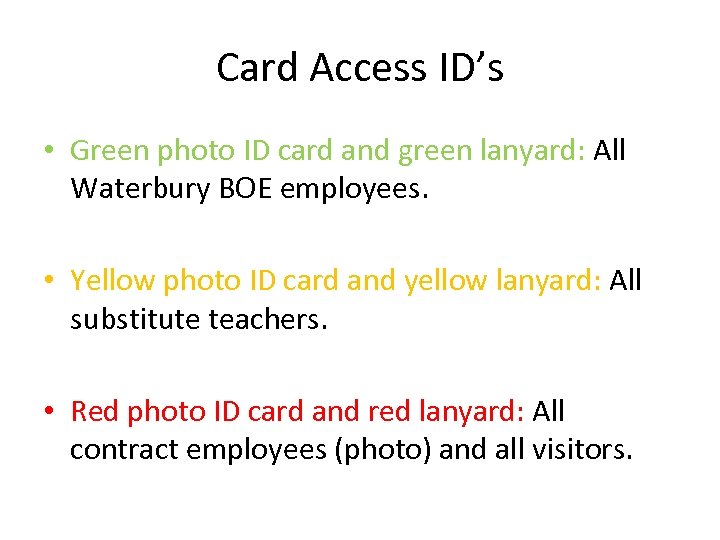
Card Access ID’s • Green photo ID card and green lanyard: All Waterbury BOE employees. • Yellow photo ID card and yellow lanyard: All substitute teachers. • Red photo ID card and red lanyard: All contract employees (photo) and all visitors.
Card Access ID’s • All employees will have access to their assigned school from 0600 am until 9: 00 pm*, Monday through Friday. • Other access levels are permitted with cause, job need and Principal’s authorization. • All employees are required to wear their ID’s and colored lanyards during all regular school hours. This provides an immediate visual verification of the staff during a crisis situation. It also provides Police, Fire and EMS an immediate contact person they may speak with. They will not speak to anyone without a colored WPS lanyard. *slight variation at some schools
Building Security • Each of us is responsible for building security so we may be mutually assured our buildings are secure during normal school hours. • Please be proactive in challenging anyone not wearing a colored ID within your school. Call a team member or an administrator to assist: (Those in a school who are un-escorted and without an ID have not been vetted at the main office and have no legitimate purpose for being in our schools. )
Security Improvements • 32 schools, count ‘em! • Elementary: Bucks Hill, Bunker Hill, Chase, Cross, Driggs, Generali, Hopeville, Kingsbury, Regan, Sprague, Tinker, Walsh, Washington, Wilson • K-8: Carrington, Duggan, Gilmartin, Reed • Magnet Schools: Maloney, Rotella, WAMS • MS: North End, Wallace, West Side • HS: Crosby, Kennedy, Wilby, Waterbury Career Academy • Alternative Schools: Bucks Hill Pre-K, Enlightenment, State Street • Adult Education: Day and Evening programs
Visitors ** “Any visitor who is not a District or City employee on official business, a State or Federal employee on official business, Board of Education Commissioner, or a student enrolled in the school, will be termed a “visitor” under Board Policy and is subject to the(se) procedures. ” B. O. E. policy # 1250
Visitors • All visitors must directly report to the Main Office upon arrival, provide photo identification (driver’s license) which will be kept by school staff during the visit (along with a photocopy to be kept in the student’s cumulative file), and sign in where designated. A Red Visitor Badge will be issued to the visitor which must be displayed at all times during the visit.
Visitors • No visitor, except a law enforcement officer duly authorized by the Waterbury Police Department, is allowed to bring a weapon of any kind into any school in the District or on school grounds. • 53 a-217 b: Possession of a weapon on school grounds: Class D felony
Visitors • In order to safeguard student privacy rights, videotaping, photography or use of recording devices or electronic equipment, including phones, is prohibited, by the visitor during the visit unless prior permission is given by the Superintendent and appropriate prior written consent of the student is obtained.
Visitors • Visitors may be escorted throughout the building by staff, at principal’s discretion. • Visitors must follow all school rules and administrative directives and minimize disruptions of the school’s learning environment. • Visitors must not disturb the students, teachers or disrupt classes in any way.
Visitors • Please challenge anyone who you do not recognize and who is not wearing a RED visitor’s identification badge, with Red colored lanyard or stick-on label. • Call a peer or building administrator for assistance. • Constant, team vigilance will make our schools, students and staff safe!
Incident Command System • A systematic tool used for the command, control, and coordination of an emergency response. • All Connecticut School districts are required to use this system during any school emergency or related emergency. P. A. 13 -3
Incident Commander • The Individual responsible for overall command of an incident, until relieved by a superior, police or fire commander – Principal or Vice-Principal – House Principal or SVP – TVP (Teaching Vice-Principal) – Department Head – Senior Staff member – School Secretary
Alternate Evacuation Site • Each school in Waterbury has a designated alternate evacuation site where the students and staff shall be temporarily re-located if the building becomes uninhabitable. • Please check with your school administrator to learn the location so you may become familiar with the quickest and safest route should it become necessary to evacuate the school.
Reunification Procedures • Student/Parent Reunification • Purpose: • To provide for the orderly and coordinated reunification of students and families of all or any part of the population of City of Waterbury Schools if an emergency situation occurs that warrants evacuating and/or closing the City of Waterbury Schools early.
Reunification • Waterbury schools will use a double-gate system. Student/Parent Reunification Team members will be located in two areas. The first area, the “holding area, ” where students can wait for their parents.
Reunification • The second area will include both the “report point” and the “student release point” where adult care givers will report and wait for their students to join them. • These will be two distinctly separate areas, but they will be in close proximity to one another.
Emergency Procedures • Lockdown • Shelter in Place • Evacuation
Lockdown
Lockdown • Immediate Internal Threat - Intruder • A lockdown is a process to secure and isolate the students, staff and visitors, from visibility and access by intruders, not authorized to be in the school building, until the arrival of law enforcement. (1 to 3 minutes) • The highest level of security!
Lockdown • When a Lock Down is ordered, we must remain locked in the office/classroom, with the students, until the authorities clear us to leave. This means no one can leave and no one can enter a office/classroom until the area is declared safe.
Lockdown • “LOCK DOWN” will be announced over the public address system/radios, multiple times by the administrator or a pre-recorded message. • No one enters or leaves the building until the “all clear” is given. • Remain calm: Your actions will lead your student’s actions.
Lockdown • Staff should 1 st, quickly check the halls directly outside their classrooms for any adults or children and bring them into the nearest “lock-ready” classroom. Any adults, observed in the hallways NOT wearing a colored badge/lanyard or stick-on paper ID, should be left in the hallway and the door secured. We don’t know who they are! • Those adjacent to restrooms should quickly check for students and bring them to the nearest classroom. • **Invite substitute teachers in adjacent classrooms into your class for support and direction. **
Lockdown • Close all lock-ready doors, no one moves in or out of any room until an “all clear” is given. • Close windows, shut off lights. Leave computers on to communicate with command center. • Cover the window on your door or interior glass facing the interior hallway with pre-cut or prepared paper to prevent visual access. (most windows should be pre-covered) • Keep students QUIET AND CALM!
Lockdown • Move students to an area in your room which is furthest from windows and doors. • Instruct students to sit on floor, cross-legged, hands at sides (depending upon age) – remain SILENT!!! • Take attendance and note any missing students, notify (computer or cellphone) command center of missing students. Use “ 2 schoolname” to communicate so all may see who is present and who may be missing. • Notify the command center if you have extra staff/students(s) in your classroom, aside from your own.
Lockdown • If students are at recess, or outside the building, immediately take them to the *alternate school evacuation site, and advise the command center via radio or cellphone. • DO NOT RETURN TO THE SCHOOL UNLESS DIRECTED BY THE INCIDENT COMMANDER! •
Lockdown • If your class is at lunch, (and you are in the teachers’ lounge), please remain or proceed to the nearest “lock-ready” office or classroom and notify the command center. • If you are out of the building, you will be unable to reenter. • Make sure you are signing in and out on a daily basis when leaving during school hours.
Shelter in Place
Shelter in Place • An External Threat: (police action in the neighborhood, weather or environmental) • Shelter in Place provides refuge for students, staff and public inside the secure school building during an emergency outside the school. • The primary shelter area is the classroom unless directed otherwise by the incident commander.
Shelter in Place • Shelter in Place is used when evacuation would put people at risk (i. e. external threat, tornado, environmental hazard, blocked evacuation route). • Shelter areas may change depending upon the situation or emergency • “SHELTER IN PLACE” will be announced over the public address system/radios in a normal tone.
Shelter in Place • Bring all students and staff inside the school to their classrooms and CLOSE the “lock ready” classroom door. • Close blinds and window shades, if so equipped. Extinguish lights, if so directed. • Take attendance, ensure that all students are accounted for, and report anyone missing or any extra students to the Incident Commander using “ 2 schoolname” email.
Shelter in Place Normal communications continue and updates are provided by the Incident Commander (IC). The first priority is to take attendance and report the class accountability to the office via “ 2 schoolname” email. After accountability, await the IC instruction to continue regular Class instruction, so not to disrupt the learning process. Only after clearance is authorized by the IC, students may transition between classes, library, tech ed. , computer and science laboratories, phys. Ed. , lunch waves and the lavatories as necessary. NO OUTSIDE ACTIVITIES SHALL OCCUR UNTIL THE “ALL-CLEAR” IS ANNOUNCED.
Shelter in Place • Staff should keep students safe inside the classroom/building until the scene is determined to be safe by the Incident Commander, fire or police department personnel. • No one should leave or enter the school. Visitors should stay for their safety. No new visitors shall be allowed in the building until the “All Clear” is given.
Evacuation
Evacuation Procedures: • General Emergency Evacuation Procedures including fire, earthquake, bomb or explosions: • Familiarize yourself with the Emergency Evacuation Exits and routes to the outdoors. – *Alternate School Evacuation Site: Ask your principal where the site is • The classroom emergency “backpack” shall be taken with the class, upon evacuation.
Evacuation • Upon hearing a fire alarm or upon direction from the Incident Commander: • Teachers will evacuate the students, using the *closest clear exit, from the building to a predesignated area or alternate evacuation site under the Incident Commander’s direction.
Earthquake/Evacuation For an earthquake, teachers will direct students to ‘drop and cover’ and wait until the shaking has stopped. Once the IC gives authorization and direction, then evacuation shall begin.
Evacuation • The teachers will take attendance and establish the class’s status: Report any missing students to the command center. Each Team Leader will utilize radio system to notify administration and medical staff to locate missing student(s). At least one teacher or paraprofessional will remain with a class at all times. • The building can be re-entered once the building has been declared safe by the incident commander, fire or law enforcement personnel or other school district official.
Evacuation • Personnel with radios, after receiving the instruction to reenter will relay the message that it is safe to re-enter the building. • Teachers with disabled student(s) will confer with a building administrator to arrange for additional assistance if necessary. • Teachers will remain with students until it is safe to re-enter the building or they are picked up by an authorized adult.
Fire and Crisis Drills • CT Gen Stat § 10 -231 (2012) • (a) Each local and regional board of education shall provide for a fire drill to be held in the schools of such board not later than thirty days after the first day of each school year and at least once each month thereafter, except as provided in subsection (b) of this section. • (b) Each such board shall substitute a crisis response drill for a fire drill once every three months and shall develop the format of such crisis response drill in consultation with the appropriate local law enforcement agency. A representative of such agency may supervise and participate in any such crisis response drill.
Crisis Drills • We will hold at least one drill each month that school is in session. We may hold additional drills as needed to test our protocols and to test new procedures. • All drills are unannounced to provide the proper assessment and assure all staff is prepared should a real situation occur.
Fire and Crisis Drills will happen when you least expect them!
Be Prepared for Successful Drills
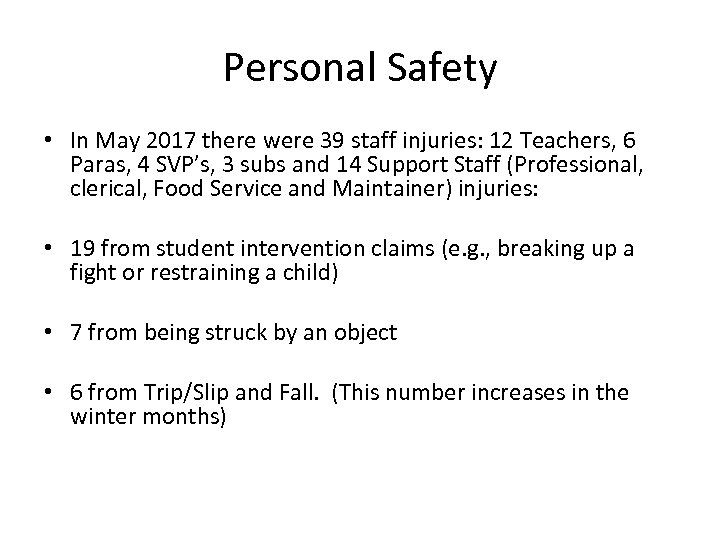
Personal Safety • In May 2017 there were 39 staff injuries: 12 Teachers, 6 Paras, 4 SVP’s, 3 subs and 14 Support Staff (Professional, clerical, Food Service and Maintainer) injuries: • 19 from student intervention claims (e. g. , breaking up a fight or restraining a child) • 7 from being struck by an object • 6 from Trip/Slip and Fall. (This number increases in the winter months)
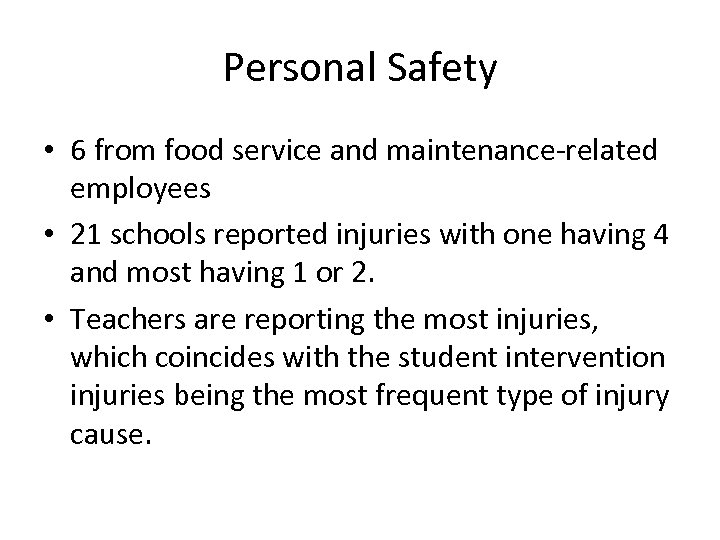
Personal Safety • 6 from food service and maintenance-related employees • 21 schools reported injuries with one having 4 and most having 1 or 2. • Teachers are reporting the most injuries, which coincides with the student intervention injuries being the most frequent type of injury cause.
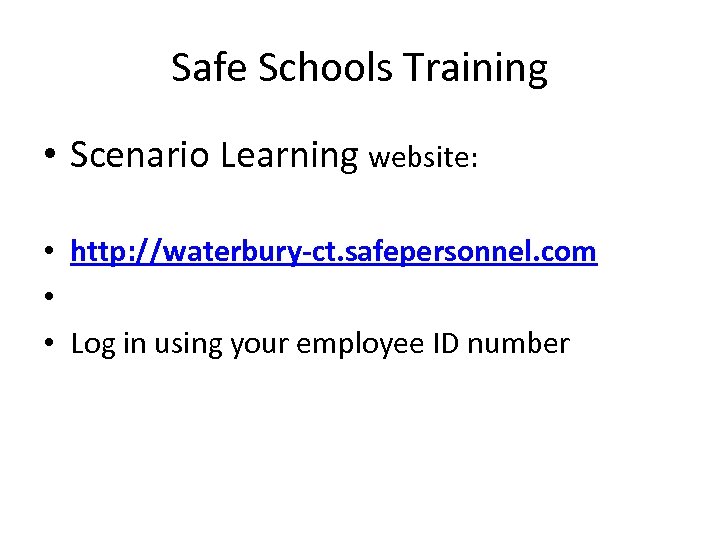
Safe Schools Training • Scenario Learning website: • http: //waterbury-ct. safepersonnel. com • • Log in using your employee ID number
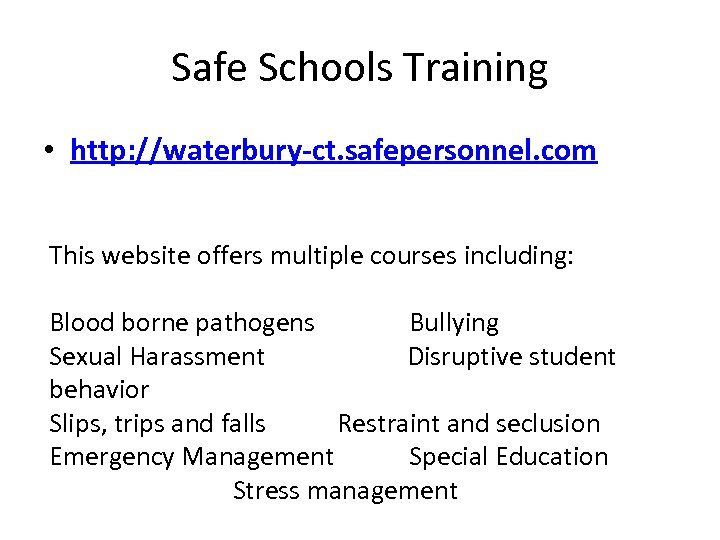
Safe Schools Training • http: //waterbury-ct. safepersonnel. com This website offers multiple courses including: Blood borne pathogens Bullying Sexual Harassment Disruptive student behavior Slips, trips and falls Restraint and seclusion Emergency Management Special Education Stress management
• Questions, Comments or Suggestions?
Скачать презентацию Safety and Security in Waterbury Public Schools
2ddf628f2a2cb08579c2d18345f6e9cb.ppt