 Скачать презентацию Safest Small Talk Topics Traveling Weather Accommodation Hobbies
56738337e149aa7eca160b4583fe4746.ppt
- Количество слайдов: 17



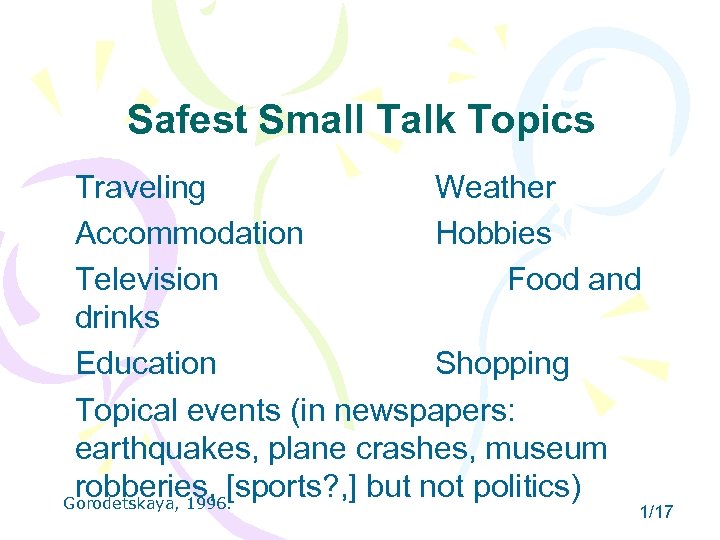
Safest Small Talk Topics Traveling Weather Accommodation Hobbies Television Food and drinks Education Shopping Topical events (in newspapers: earthquakes, plane crashes, museum robberies, [sports? , ] but not politics) Gorodetskaya, 1996. 1/17
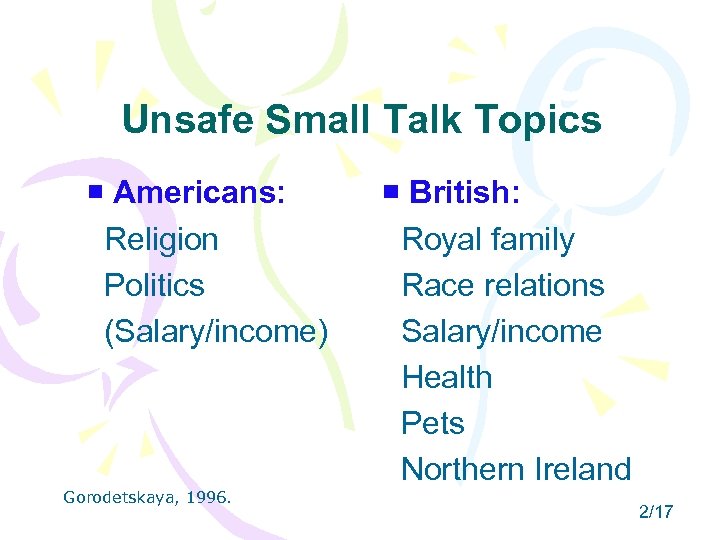
Unsafe Small Talk Topics Americans: Religion Politics (Salary/income) Gorodetskaya, 1996. British: Royal family Race relations Salary/income Health Pets Northern Ireland 2/17

Reasons to say Taiwanese and Mandarin are TWO different languages They are NOT mutually intelligible: (If you speak ONLY ONE of them you CANNOT understand the other) 3/17
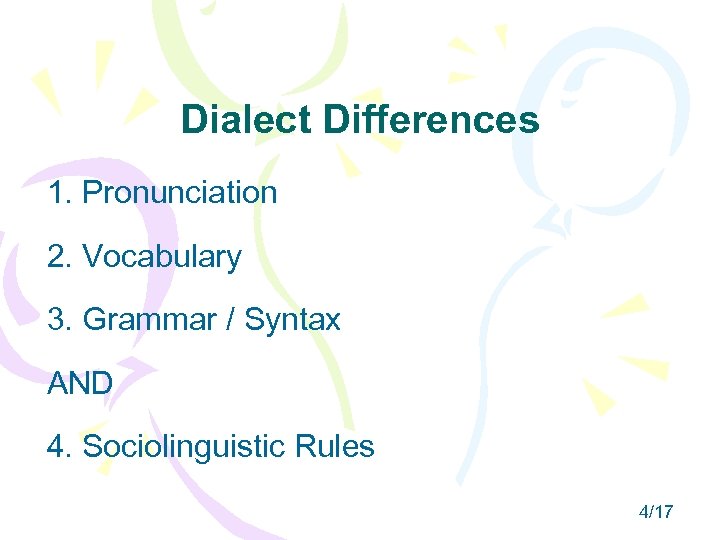
Dialect Differences 1. Pronunciation 2. Vocabulary 3. Grammar / Syntax AND 4. Sociolinguistic Rules 4/17
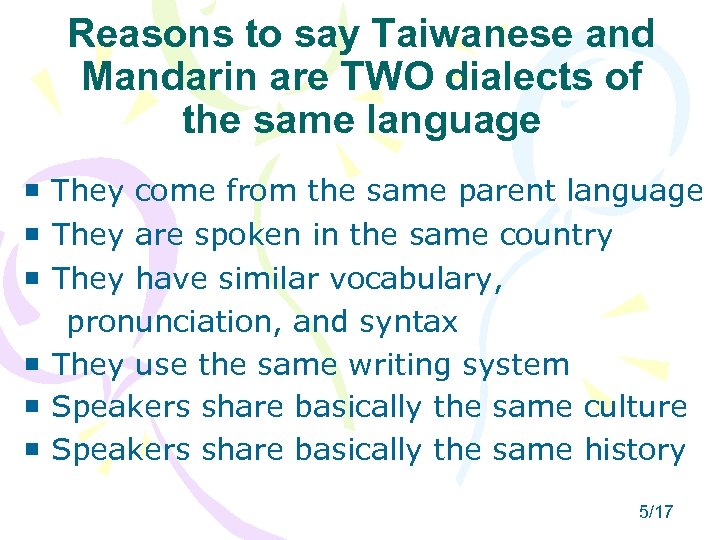
Reasons to say Taiwanese and Mandarin are TWO dialects of the same language They come from the same parent language They are spoken in the same country They have similar vocabulary, pronunciation, and syntax They use the same writing system Speakers share basically the same culture Speakers share basically the same history 5/17
Standard English— One of the Varieties of English What is printed in books and newspapers Taught in school to English-speaking children Taught to foreigners ‘Educated’ variety Used on TV and for Newscasts Trudgill, Peter. 2000. Sociolinguistics: An Introduction to Language and Society, 4 th edition. London: Penguin Books, pp. 5 -6. 6/17
Am. E and Brit. E Dialects differ in 1. Pronunciation: r-less; syncopate different syllables (military); a-vowel (bath) 2. Vocabulary: lift (elevator); braces (suspenders); bonnet (hood); pavement (sidewalk); SPELLING 3. Grammar / Syntax: got/gotten; have 7/17

Beijing and Taiwan Mandarin Dialects differ in 1. Pronunciation: 2. Vocabulary: 3. Grammar / Syntax: 8/17
British English RP Accent NON-LOCALIZED Learned in “public schools” Used on BBC Taught to foreigners Trudgill, Peter. 2000. Sociolinguistics: An Introduction to Language and Society, 4 th edition. London: Penguin Books, pp. 5 -6. 9/17
Prevocalic and Non-Prevocalic /r/ 1. rat rich /r/ 2. carry sorry /r/ 3. cart car /r/ vs. NO /r/ Trudgill, Peter. 2000. Sociolinguistics: An Introduction to Language and Society, 4 th edition. London: Penguin Books, p. 9. 10/17
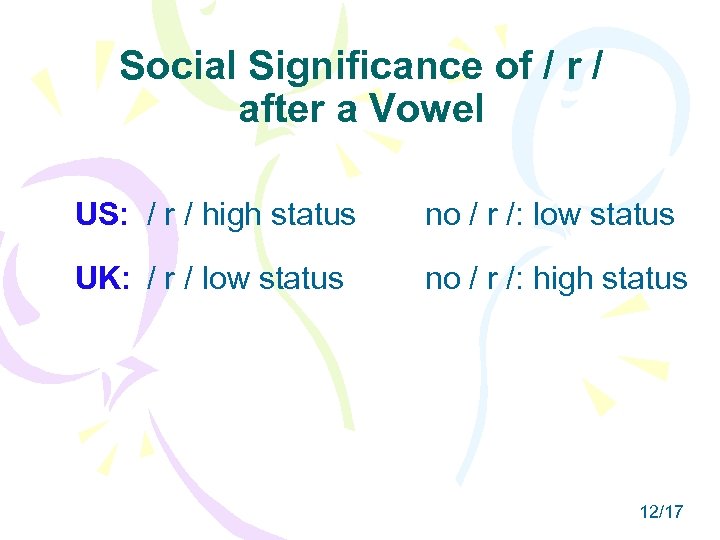
Social Significance of / r / after a Vowel US: / r / high status no / r /: low status UK: / r / low status no / r /: high status 12/17
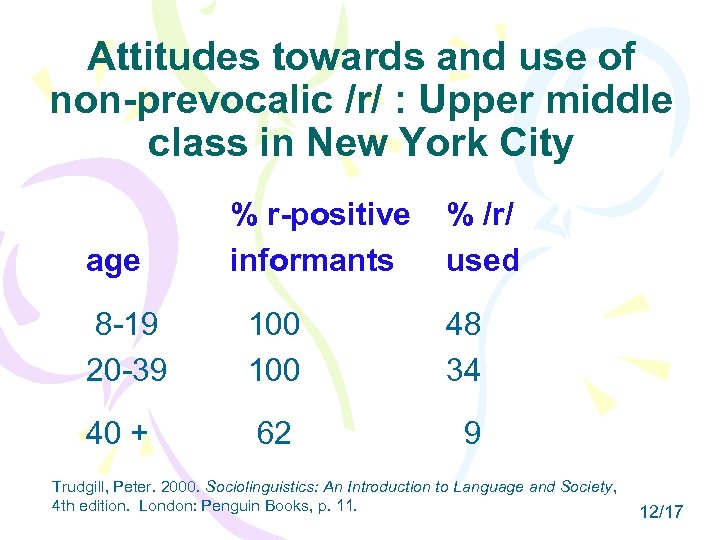
Attitudes towards and use of non-prevocalic /r/ : Upper middle class in New York City age % r-positive informants % /r/ used 8 -19 20 -39 100 48 34 40 + 62 9 Trudgill, Peter. 2000. Sociolinguistics: An Introduction to Language and Society, 4 th edition. London: Penguin Books, p. 11. 12/17
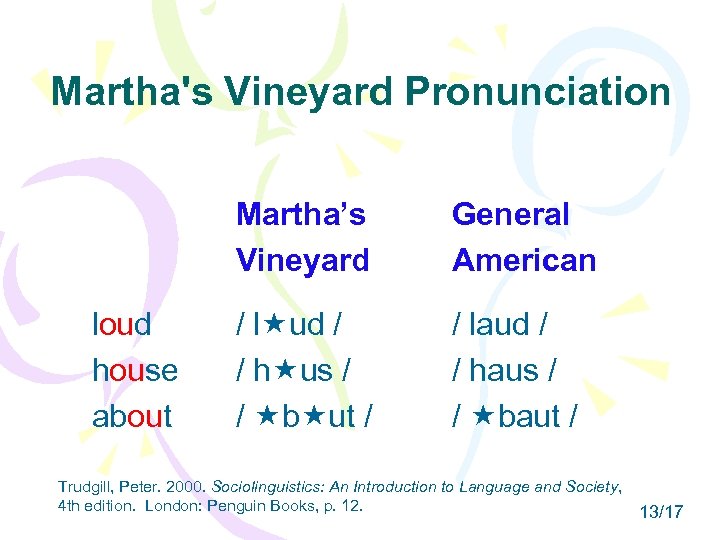
Martha's Vineyard Pronunciation Martha’s Vineyard loud house about General American / l ud / / h us / / b ut / / laud / / haus / / baut / Trudgill, Peter. 2000. Sociolinguistics: An Introduction to Language and Society, 4 th edition. London: Penguin Books, p. 12. 13/17
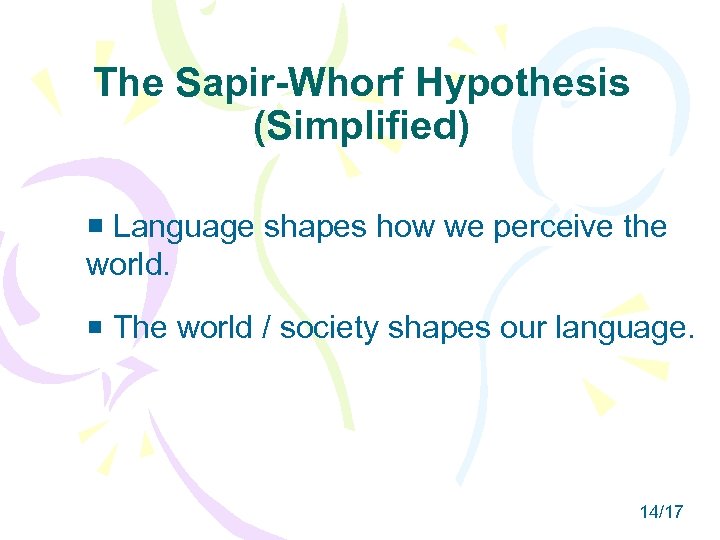
The Sapir-Whorf Hypothesis (Simplified) Language shapes how we perceive the world. The world / society shapes our language. 14/17
Sapir-Whorf Hypothesis and Influences on Language Physical Environment Social Environment or Structure Values of Society Trudgill, Peter. 2000. Sociolinguistics: An Introduction to Language and Society, 4 th edition. London: Penguin Books, pp. 15 -20. 15/17
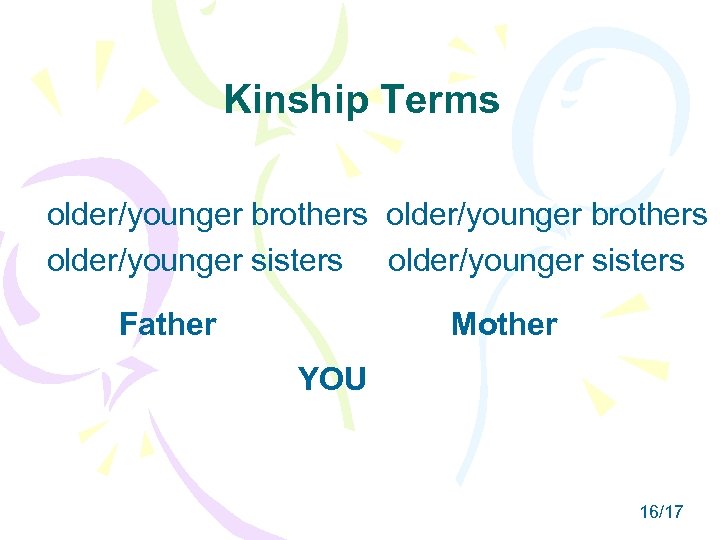
Kinship Terms older/younger brothers older/younger sisters Father Mother YOU 16/17
Taboo Subjects or Words Sex Excretion Christian Religion Race Dying Trudgill, Peter. 2000. Sociolinguistics: An Introduction to Language and Society, 4 th edition. London: Penguin Books, pp. 18 -20. 17/17
Скачать презентацию Safest Small Talk Topics Traveling Weather Accommodation Hobbies
56738337e149aa7eca160b4583fe4746.ppt