


 Скачать презентацию Safeguarding Children Whole School Child Protection Awareness Training
f7531840b8ecda496c8bcc524efa1ab0.ppt
- Количество слайдов: 59
 Safeguarding Children Whole School Child Protection Awareness Training July 2014 1
 Aim To develop your awareness of and the ability to act on, concerns about the safety and welfare of children and young people. 2
 Learning Objectives § To ensure you are aware of your responsibilities to safeguard and protect children § What to do if you have concerns § What will happen once you have shared these § What else might you be expected to do / contribute § Basic legislation / framework 3
 Ground Rules · Talking about child abuse can be upsetting – take space and time if you need it. · Mobile phones/blackberries – on silent. · You decide what personal information you want to share, which is confidential to this group. · Everyone’s experience and opinion is both valued and valid. · Be open and honest, respecting each other’s differences. · In feedback sessions, only one person speaking at a time. 4
 Some Definitions 5
 Safeguarding and Promoting Children’s Welfare 6
 What is “Safeguarding & Promoting the Welfare of Pupils”? § § § § § Child Protection; procedures, training, support, curriculum Communication Attendance and Welfare, inclusion, SEN, EOTAS, EHE, Children Missing Education, Honour Based Violence, Child Sexual Exploitation awareness including, Female Genital Mutilation, Forced Marriage and Trafficked Children Common Assessment Framework (CAF) & Team around the Child (TAC) Safer Recruiting and Selection: safe staff and HR policies including volunteers Robust recording and transfer of records Specific circumstances guidance; Conduct of Staff & Pupils, Images of children, Children presenting a risk to others, etc Health & Safety – Risk Assessments Transport, safe use of contractors Capital programmes 7
 Common Assessment Framework § The Common Assessment Framework (CAF) is used by all agencies with significant contact with children. § Lead agencies include: – Health – Education – Early years 8
 Safeguarding & Promoting Children’s Welfare- School Responsibility § Local Authorities & the Governing Bodies of all Schools & Colleges, have a statutory responsibility to safeguard & promote the welfare of children (Education Act 2002 s. 157 & 175). § Other agencies have this responsibility under the Children Act 2004. § It is everybody’s responsibility to look after children but it is Social Care’s responsibility to investigate abuse. 9
 Safeguarding & Promoting Children’s Welfare § Protecting children from maltreatment § Preventing impairment of health or development § Ensuring children grow up in circumstances consistent with the provision of safe and effective care § Taking action to enable all children to have the best outcomes. Working Together to Safeguard Children 2013 10
 Who Abuses? 11
 Child Abuse A form of maltreatment of a child. Somebody may abuse or neglect a child by inflicting harm, or by failing to act to prevent harm. Children may be abused in a family or in an institutional or community setting, by those known to them or, more rarely, by others (e. g. via the internet). They may be abused by an adult or adults, or another child or children. HM Government (2013) Working Together to Safeguard Children, page 85 12
 Internet Pornography/Exploitation § The internet provides individuals with greater opportunities to reach & abuse Children § In 2002 operation Ore identified 6500 people in the UK who accessed sites with their credit cards § In 2010 an ex-hospital porter from Sussex was found to be in possession of 53, 000 indecent images of children and a teaching assistant admitted 34 offences of making and distributing indecent images of children. § One in three people arrested in the USA, in 2003, for possession of indecent images also had contact offences 13
 Activity - What do Children need? § Please consider what children & young people need to safeguard them from harm and promote their welfare, and what factors can help or hinder a young persons development. § Think about children’s physical, emotional and learning needs. § Also consider any specific needs for disabled children or those from black or ethnic minority families 14
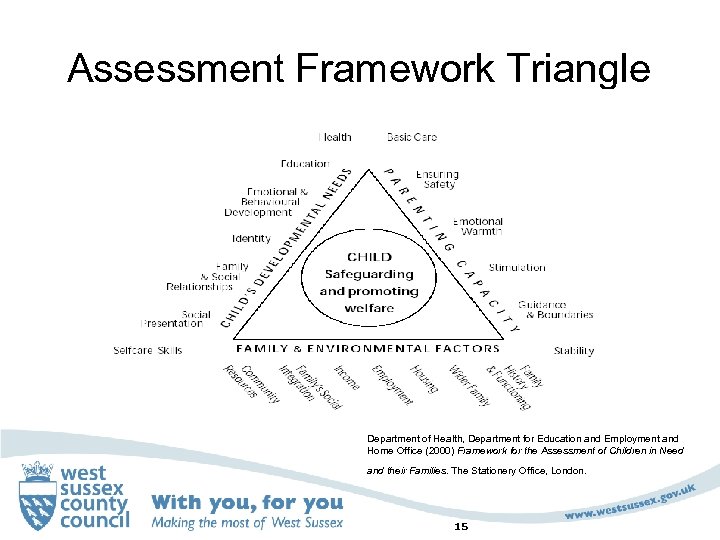 Assessment Framework Triangle Department of Health, Department for Education and Employment and Home Office (2000) Framework for the Assessment of Children in Need and their Families. The Stationery Office, London. 15
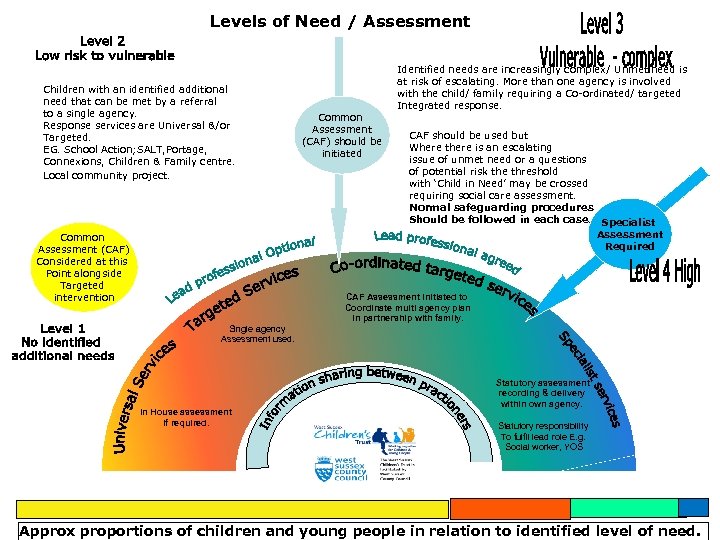 Levels of Need / Assessment Children with an identified additional need that can be met by a referral to a single agency. Response services are Universal &/or Targeted. EG. School Action; SALT, Portage, Connexions, Children & Family centre. Local community project. Common Assessment (CAF) Considered at this Point alongside Targeted intervention Common Assessment (CAF) should be initiated Identified needs are increasingly complex/ Unmet need is at risk of escalating. More than one agency is involved with the child/ family requiring a Co-ordinated/ targeted Integrated response. CAF should be used but Where there is an escalating issue of unmet need or a questions of potential risk the threshold with ‘Child in Need’ may be crossed requiring social care assessment. Normal safeguarding procedures Should be followed in each case. Specialist Assessment Required CAF Assessment initiated to Coordinate multi agency plan In partnership with family. Single agency Assessment used. In House assessment If required. Statutory assessment recording & delivery within own agency. Statutory responsibility To fulfil lead role E. g. Social worker, YOS 16 Approx proportions of children and young people in relation to identified level of need.
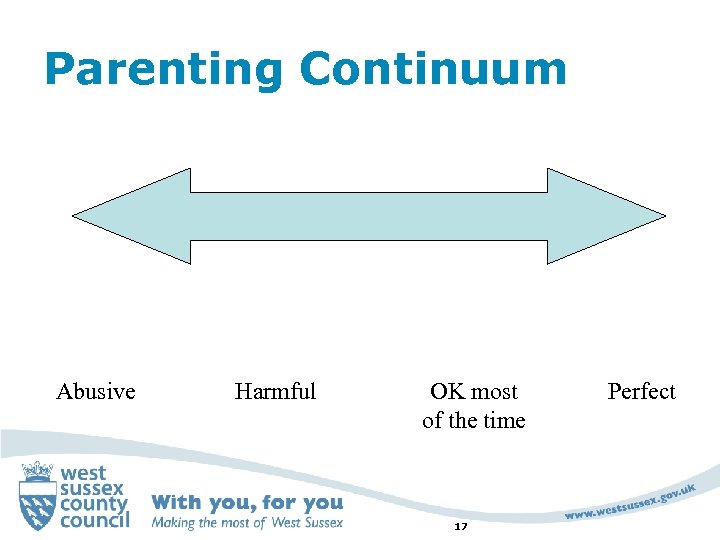 Parenting Continuum Abusive Harmful OK most of the time 17 Perfect
 Activity § What are the kind of things that worry us about the children and families we work with? § Think about appearance, behaviour and relationships in your role. 18
 Categories of Abuse § § Physical Sexual Emotional Neglect – tools to aid identification are being implemented shortly: – the Neglect Identification and Measurement Tool (NIMT) for all workers – and the Graded Care Profile – core group members to contribute (for children under 11) 19
 Further information on Signs and Symptoms Sussex Child Protection and Safeguarding Procedures: § Section 3. 1 – Recognition of Abuse and Neglect § Section 3. 2 – Making a Referral Link: http: //pansussexscb. proceduresonline. com/index. htm 20
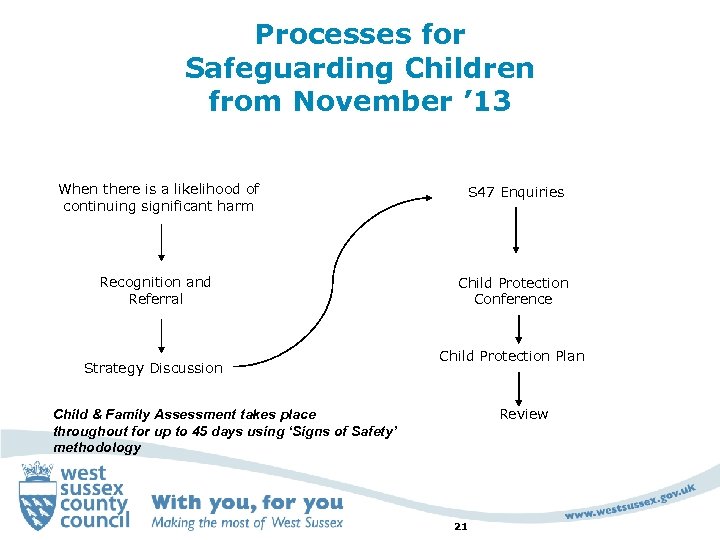 Processes for Safeguarding Children from November ’ 13 When there is a likelihood of continuing significant harm S 47 Enquiries Recognition and Referral Child Protection Conference Strategy Discussion Child Protection Plan Review Child & Family Assessment takes place throughout for up to 45 days using ‘Signs of Safety’ methodology 21
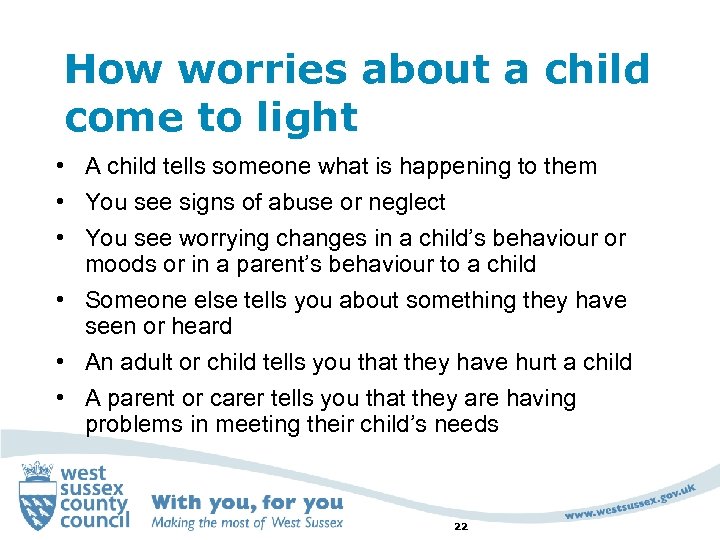 How worries about a child come to light • A child tells someone what is happening to them • You see signs of abuse or neglect • You see worrying changes in a child’s behaviour or moods or in a parent’s behaviour to a child • Someone else tells you about something they have seen or heard • An adult or child tells you that they have hurt a child • A parent or carer tells you that they are having problems in meeting their child’s needs 22
 Making Judgements 23
 Key Guidance and Legislation § § § § § United Nations Convention on the Rights of the Children Act 1989 Human Rights Act 1998 Framework for the Assessment of Children in Need and their Families (2000) What To Do If You’re Worried A Child Is Being Abused (2003); Summary (2006) Education Act 2002 Children Act 2004 Working Together to Safeguard Children (2013) Guidance for Safer Working Practice for Adults who work with Children & Young People in Education Settings (2009) Keeping Children Safe in Education, Statutory Guidance for Schools & FE Colleges (April 2014) 24
 Child in Need Children Act 1989 s 17(10) A child shall be taken to be in need if: § he is unlikely to achieve or maintain, or have the opportunity of achieving or maintaining, a reasonable standard of health or development without the provision for him of services by a local authority under this Part § his health or development is likely to be significantly impaired, or further impaired, without the provision of such services § he is disabled 25
 Learning from Serious Case Review on Child G § The need for effective engagement of families in the assessment process, making sure that any men in the household are included. § The need for improved Child in Need planning processes. (The LSCB has produced CIN & CAF Standards and Principles which each agency should be working to. ) § The need for challenge and support for professionals working with children on CIN plans or CAFs to enable them to review their work effectively. (For many agencies this will be through supervision. ) 26
 Examples of Learning from SCR on ‘John’ § Need for better knowledge of the Sussex Child Protection and Safeguarding Procedures for example S 8. 7, Children who harm other Children and S 8. 31, Sexually Active Children § Better understanding for all agencies of risk management in external situations. 27
 Harm is defined in the Children Act 1989 section 31(9) as: § ill-treatment (including sexual abuse and physical abuse) § impairment of health (physical or mental) or development (physical, intellectual, emotional, social or behavioural) as compared to a similar child Note: Harm now includes the impairment of a child’s health or development as a result of witnessing the ill-treatment of another person (Adoption and Children Act 2002). 28
 Significant Harm – 1 § The Children Act 1989 uses the concept of significant harm to justify compulsory intervention in family life § The local authority has a duty to make enquiries where it has reasonable cause to suspect a child is suffering significant harm 29
 Significant Harm – 2 There are no absolute criteria for identifying significant harm. The severity of ill-treatment depends on: § the degree and extent of physical harm § the duration and frequency of abuse and neglect Department of Health, Home Office and the Department for Education and Employment (2006) Working Together to Safeguard Children: a guide to inter-agency working to safeguard and promote the welfare of children. The Stationery Office, London. 30
 Significant Harm – 3 § the extent of premeditation § the degree of threat and coercion, sadism and/or unusual elements In each case consider ill-treatment alongside the family’s strengths and supports. Department of Health, Home Office and the Department for Education and Employment (2006) Working Together to Safeguard Children: a guide to inter-agency working to safeguard and promote the welfare of children. The Stationery Office, London. 31
 Significant Harm § Compilation of significant events, both acute and long-standing, which interact with the child’s ongoing development and interrupt, alter, or impair physical and psychological development. § Being the victim of significant harm is likely to have a profound effect on a child’s view of themselves as a person and on their future life. § Significant harm represents a major symptom of failure of adaptation by parents to their role, and also involves both the family and society. Bentovim, A. , 1998, ‘Significant Harm in Context’ in Adcock & White (eds), 1998, ‘Significant Harm: Its Management and Outcome’ 32
 Activity – Making Judgements § There are five scenarios on the next slide. Read through each scenario (on your own) § Rank each scenario between 1 & 10 in terms of the concerns/seriousness it raises. (10 indicates the highest level of concern) § Return to your group and agree on one scenario to discuss. – Do you all agree on the level of concern? – Note the reasons for different levels of concern – Try to reach an agreement about the ranking § Think about what informs your answer ? For example, is it from your own experiences, something you have come across at work, your reading, or something you have seen or heard? 33
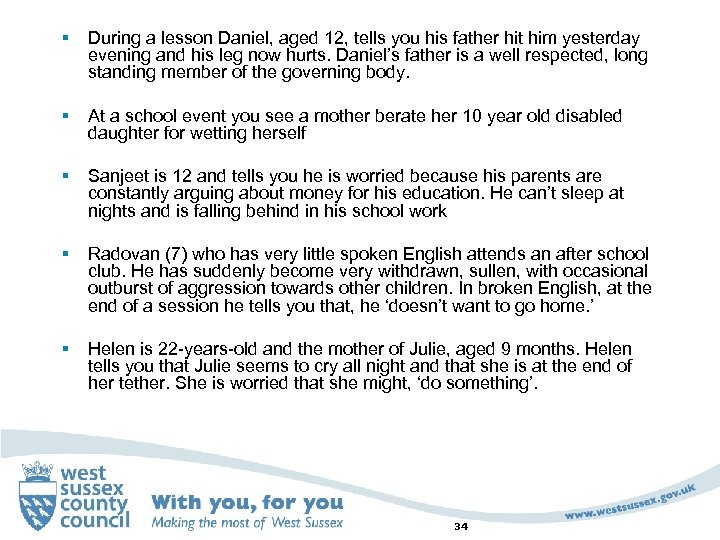 § During a lesson Daniel, aged 12, tells you his father hit him yesterday evening and his leg now hurts. Daniel’s father is a well respected, long standing member of the governing body. § At a school event you see a mother berate her 10 year old disabled daughter for wetting herself § Sanjeet is 12 and tells you he is worried because his parents are constantly arguing about money for his education. He can’t sleep at nights and is falling behind in his school work § Radovan (7) who has very little spoken English attends an after school club. He has suddenly become very withdrawn, sullen, with occasional outburst of aggression towards other children. In broken English, at the end of a session he tells you that, he ‘doesn’t want to go home. ’ § Helen is 22 -years-old and the mother of Julie, aged 9 months. Helen tells you that Julie seems to cry all night and that she is at the end of her tether. She is worried that she might, ‘do something’. 34
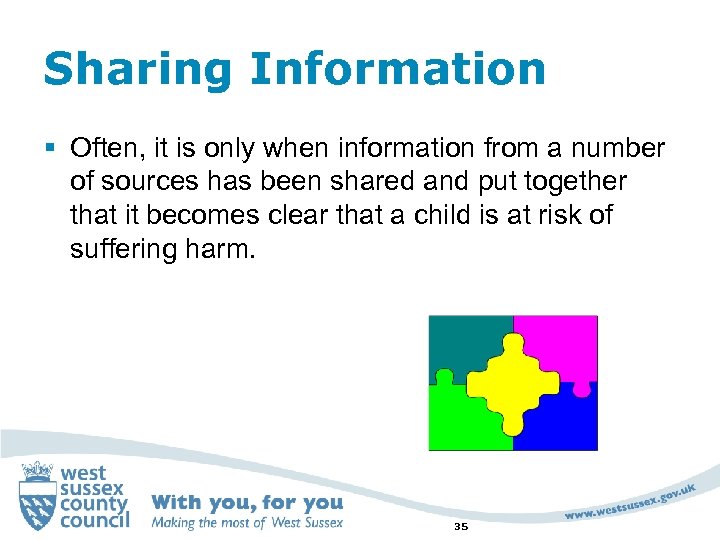 Sharing Information § Often, it is only when information from a number of sources has been shared and put together that it becomes clear that a child is at risk of suffering harm. 35
 What can make children more likely to suffer harm? Children may be more vulnerable to being harmed if they are: • • • disabled children who are picked on as being different (eg asylum seeking/refugee children; children from ethnic minorities) children who are already thought of as a problem (eg children in care; children in secure accommodation) 36
 Vulnerability of disabled children UK evidence suggests that disabled children are more at risk of abuse because they are: § more likely to be socially isolated with fewer outside contacts; § be dependent on parents or carers for practical assistance in daily living, including intimate personal care which increases the risk of exposure to abusive behaviour; § have impaired capacity to resist or avoid abuse; § may have speech, language and communication needs which makes it difficult for them to tell others what is happening; § they often do not have access to someone they can trust to disclose that they have been abused; and/or § they are especially vulnerable to bullying and intimidation. Working Together to Safeguard Children 2010 37
 Additional indicators for disabled children § Force feeding § Unjustified or excessive restraint § Rough handling § Extreme behaviour modification (deprivation of liquid, food or clothing) § Misuse of medication; sedation & tranquilisation 38
 What helps? Children are usually less badly affected by difficult events if they have: • families who support them • people around who care and help them feel good about themselves • adults who take what they say seriously • good school experiences • friendly community groups that help them feel that they are all right Daniel B and Wassell S (2002) Assessing and Promoting Resilience in Vulnerable Children. Jessica Kingsley, London. Gilligan R (2001) Promoting Resilience: a resource guide on working with children in the care system. British Agencies for Adopting and Fostering, London. 39
 What can get in the way of worries being shared? 40
 Activity – What can get in the way of worries being shared? § Why children may not tell? § Why parents may not tell? § Why adults may not hear? 41
 Barriers to sharing worries – 1 • Feeling there is no one to talk to (who will listen and can be trusted) • Fear of not being listened to, understood, taken seriously or being believed • A belief in self-reliance • A sense of futility about sharing problems and a belief that nothing will change • Embarrassment 42
 Barriers to sharing worries – 2 • Not wanting to burden others • Fear of getting oneself or someone else into trouble • Adults trivialising or over-reacting and making matters worse • Fear of lack of control • Limited knowledge of formal helping services and what they do • Stigma of involvement with formal agencies Featherston B and Evans H (2004) Children Experiencing Maltreatment: who do they turn to? NSPCC, London. 43
 Silencing factors • • Fear you may be wrong Doubts about the child’s truthfulness Anger and distress Child’s attempts to bind you to secrecy Uncertainty of procedures and consequences Unresolved feelings There may be other reasons for the child’s behaviour Not wanting to interfere in family life 44
 Who are Children likely to turn to? 45
 Who are Children likely to turn to? ‘The majority of children and young people identify at least one person they can talk to…. A significant minority of children do not feel they have anyone they can trust to share their worries with. ’ § § Friends Mothers Fathers Other trusted adult Featherstone B and Evans H (2004) Children Experiencing Maltreatment: who do they turn to? NSPCC, London. Page 24. 46
 Adults, Children can trust Four main characteristics 47
 Adults, Children can trust Four main characteristics § Being there: children and young people having the general feeling that an adult is there for them § Proving themselves: taking the time to listen, acting appropriately and keeping promises § Having the right attitude: not losing their temper or trying to take over § Knowing what they’re talking about: sharing relevant experience, and not acting as if they know more than they do. Children’s Rights Alliance for England the NSPCC (2003) Let Them Have Their Childhood Again: a report from a young people’s consultation weekend, September 27 th and 28 th 2003. Unpublished. 48
 Identification of need Try to sort out in your mind why you are worried, based on: • what you have seen • what you have heard from others • what has been said to you directly Try to be as clear as you can about why you are worried but do not be afraid to listen to your instinct that something just does not seem to be right. 49
 Dealing with disclosures § Receive – Listen to the child. If you are shocked by what they tell you, try not to show it. Take what they say seriously. Children rarely lie about abuse and to be disbelieved adds to the traumatic nature of disclosing. Children may retract what they have said if they meet with revulsion or disbelief. – Accept what the child says. Be careful not to burden them with guilt by asking “Why didn’t you tell me before? ” 50
 Dealing with disclosures § Reassure – Stay calm and reassure the child that they have done the right thing in talking to you. It’s essential to be honest with the child, so don’t make promises you may not be able to keep , like “I’ll stay with you” or “Everything will be all right now”. – Don’t promise confidentiality: you have a duty to refer a child who is at risk. – Try to alleviate any feelings of guilt that the child displays. For example, you could say: “You’re not to blame” or “You’re not alone, you’re not the only one this sort of thing has happened to”. – Acknowledge how hard it must have been for the child to tell you what happened. – Empathise with the child - don’t tell them what they should be feeling. 51
 Dealing with disclosures § React – React to the pupil only as far as is necessary for you to establish whether or not you need to refer this matter; but do not “interrogate” them for full details. – Do not ask “leading” questions such as: “What did he do next? ” (this assumes that he did!) or “Did he touch your private parts? ”. Such questions may invalidate your evidence (and the child’s) in any later prosecution in court. Instead ask open questions like “Anything else to tell me? ”, “Yes? ” or “And. . . ? ”. – Do not criticise the alleged perpetrator: the pupil may love him/her and reconciliation may be possible. – Do not ask the pupil to repeat everything to another member of staff. – Explain what you have to do next and to whom you have to talk. – Inform the designated teacher for child protection. – Try to see the matter through yourself and keep in contact the pupil. – Ensure that if a Social Care Interview is to follow, the pupil has a “support person” present if they wish (possibly yourself). 52
 Dealing with disclosures § Record – Make some very brief notes at the time on any paper which comes to hand write them up as soon as possible. – Do not destroy your original notes in case they are required by a court. – Record the date, time, place, and who else was around; any noticeable non-verbal behaviour and the words used by the child. If the family uses their family’s own private sexual words, record the actual words use, rather than translating them into “proper” words. – Draw a diagram to indicate the position of any bruising. – Be objective in your recording: include statements and observable things, rather than your interpretations or assumptions. 53
 Dealing with disclosures § Support – Make sure that you continue to support the child, providing time and a safe space throughout the process of investigation and afterwards. – Get some support for yourself, without disclosing confidential information about the child to colleagues. 54
 Support Organisations § Right Management – Confidential Counselling Service for WS Employees Some Examples of External Services taken from the Internet within West Sussex § The Samaritans § West Sussex Counselling § In Touch Counselling 55
 Why talk/refer? – 1 • Children have a right to be safe and well • Adults have a responsibility to safeguard children • You have one piece of the jigsaw • Abuse and neglect are damaging • If children and families are given help it can stop a child from being harmed 56
 Why talk/refer? – 2 § Child abuse and neglect continue because of the secrecy and silence that surround them § Children rarely lie about abuse § An abuser may abuse many other children who also have a right to protection 57
 In Summary § “Safeguarding & Promoting the Welfare of Pupils” is not just about reacting when facing serious or significant injuries. § It is the proactive engagement with children, parents, carers, as well as colleagues to make sure children are safe and are achieving their potential. 58
 Finally § It is the responsibility of professionals to report concerns, NOT to decide whether it is or is not child abuse. § Child protection is a multi‑disciplinary activity. No individual should ever feel the sole responsibility of identifying abuse rests with them. The worst thing you can do is to do nothing 59