 Скачать презентацию Safe quality medicines 1 WHO Technical Briefing
31b8f7194da470cf00d22a48b85f0be8.ppt
- Количество слайдов: 50



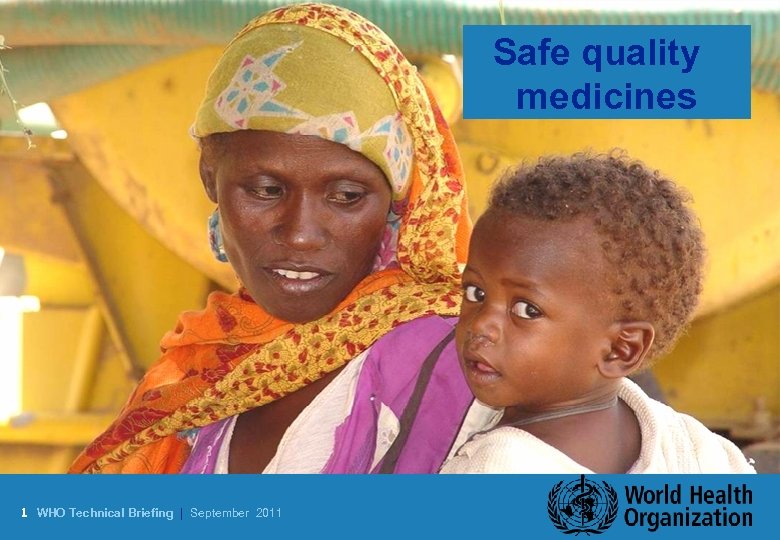
Safe quality medicines 1 WHO Technical Briefing | September 2011
Medicines quality assurance: WHO Expert Committee on Specifications for Pharmaceutical Preparations Sabine Kopp, Ph. D Quality Assurance and Safety: Medicines Department of Essential Medicines and Pharmaceutical Policies
Main points addressed n n Who is WHO? How does WHO set standards? Which WHO guidelines, standards and norms exist in the area of quality assurance? What's new ? 3 WHO Technical Briefing | September 2011
Who is WHO? Governing bodies n World Health Assembly (WHA) Delegations from 193 Member States Meeting yearly in May n Executive Board (EB) Representatives from 34 Member States + Meeting biannually in January and May 4 WHO Technical Briefing | September 2011
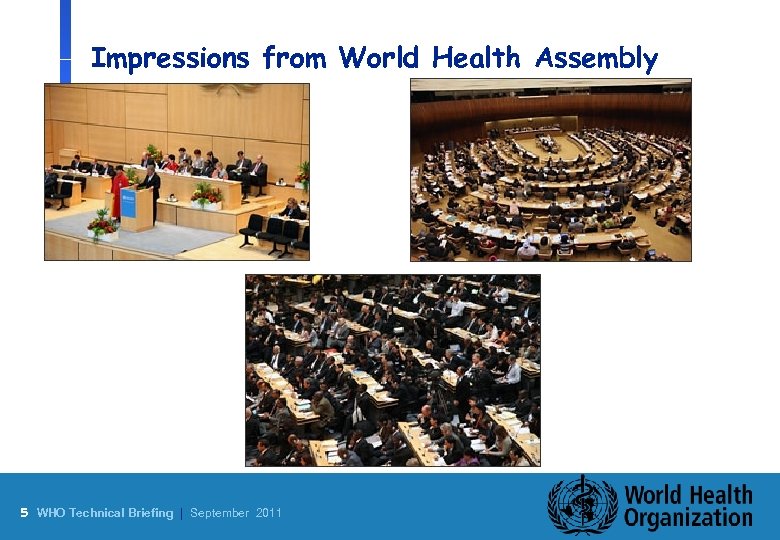
Impressions from World Health Assembly n - SSFFC 5 WHO Technical Briefing | September 2011
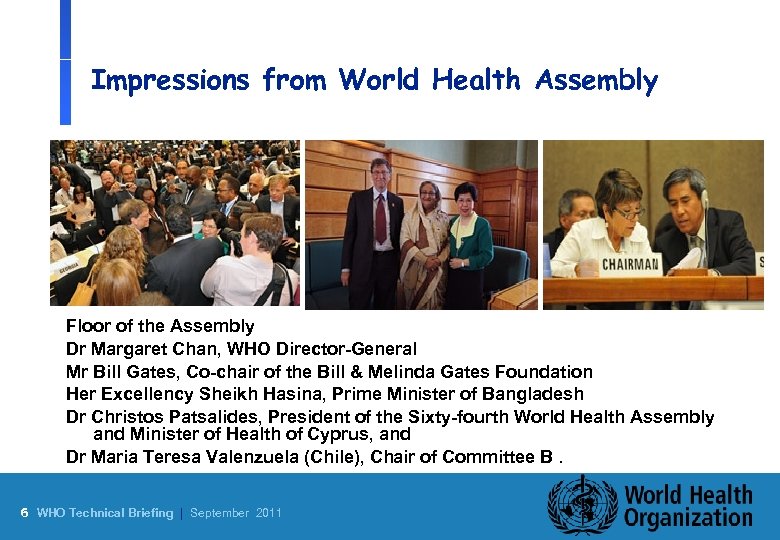
Impressions from World Health Assembly Floor of the Assembly Dr Margaret Chan, WHO Director-General Mr Bill Gates, Co-chair of the Bill & Melinda Gates Foundation Her Excellency Sheikh Hasina, Prime Minister of Bangladesh Dr Christos Patsalides, President of the Sixty-fourth World Health Assembly and Minister of Health of Cyprus, and Dr Maria Teresa Valenzuela (Chile), Chair of Committee B. 6 WHO Technical Briefing | September 2011
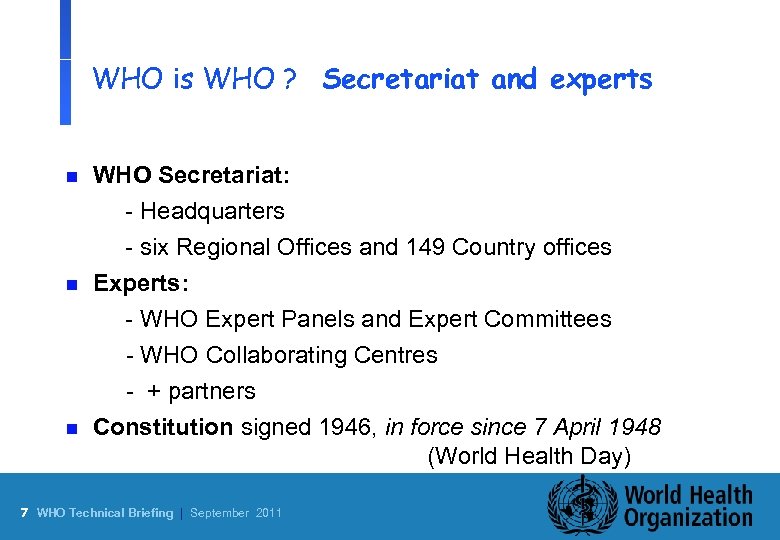
WHO is WHO ? Secretariat and experts n n n WHO Secretariat: - Headquarters - six Regional Offices and 149 Country offices Experts: - WHO Expert Panels and Expert Committees - WHO Collaborating Centres - + partners Constitution signed 1946, in force since 7 April 1948 (World Health Day) 7 WHO Technical Briefing | September 2011
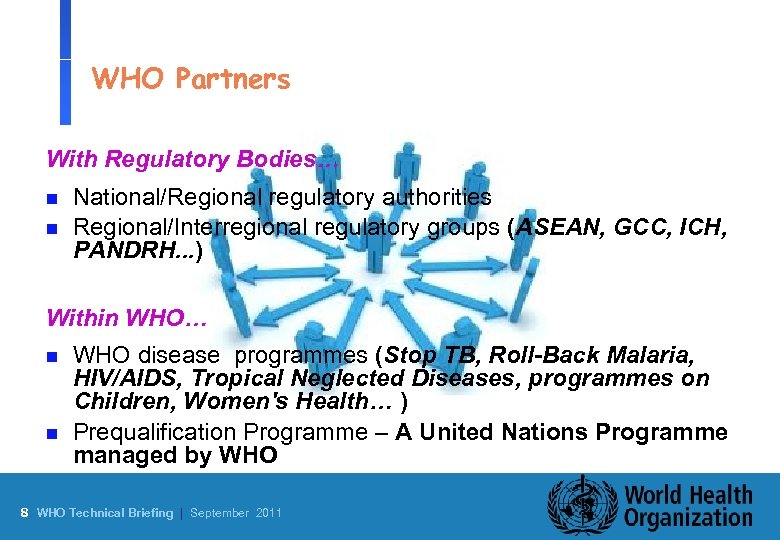
WHO Partners With Regulatory Bodies… n n National/Regional regulatory authorities Regional/Interregional regulatory groups (ASEAN, GCC, ICH, PANDRH. . . ) Within WHO… n n WHO disease programmes (Stop TB, Roll-Back Malaria, HIV/AIDS, Tropical Neglected Diseases, programmes on Children, Women's Health… ) Prequalification Programme – A United Nations Programme managed by WHO 8 WHO Technical Briefing | September 2011
WHO Partners (2) With Organizations and Associations… n International organizations (UNAIDS, UNICEF, IAEA, Global Fund, World Bank…) n International professional and other associations, NGOs (incl. industry, consumer associations: IFPMA, IGPA, WSMI, IPEC, FIP, WMA, MSF…) With Standard-setting Bodies, such as … n Pharmacopoeia Commissions and Secretariats (e. g. British Brazilian, Chinese, European, Indian, Korean, Japanese, USP, . . ) 9 WHO Technical Briefing | September 2011
WHO Partners (3) With "recognized" Experts… n WHO Expert Panel on The International Pharmacopoeia and Pharmaceutical Preparations (official nomination process) n Specialists from all areas for specific projects (regulatory, university, industry…) With "recognized" Laboratories… n National/Regional Quality control laboratories n WHO Collaborating Centres (official nomination process) 10 WHO Technical Briefing | September 2011
How to become a "WHO Expert"? n Official nomination process n Upon proposal to WHO in consultation with: l Member State/national government (citizenship)+ l WHO Regional Office (in accordance with Member State) + l WHO Headquarters Period of maximum 4 years Possibility to renew n n 11 WHO Technical Briefing | September 2011
What is the WHO Expert Committee? n n n Official Advisory Body to Director-General of WHO Governed though rules and procedures (Ref. WHO Manual) Participation in Expert Committee (EC) meetings: ä Members ("Expert") selected from WHO Panel of Experts ä Technical advisers ä Observers: - international organizations, - NGOs, - professional associations… 12 WHO Technical Briefing | September 2011
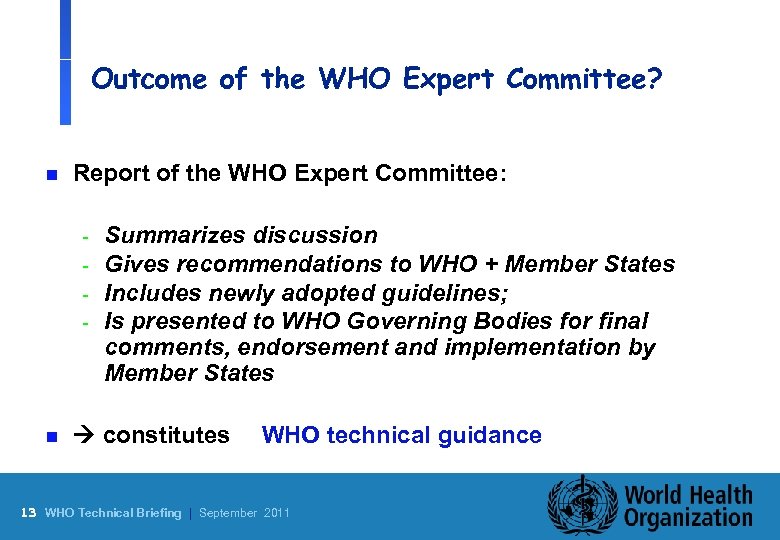
Outcome of the WHO Expert Committee? n Report of the WHO Expert Committee: - n Summarizes discussion Gives recommendations to WHO + Member States Includes newly adopted guidelines; Is presented to WHO Governing Bodies for final comments, endorsement and implementation by Member States constitutes WHO technical guidance 13 WHO Technical Briefing | September 2011
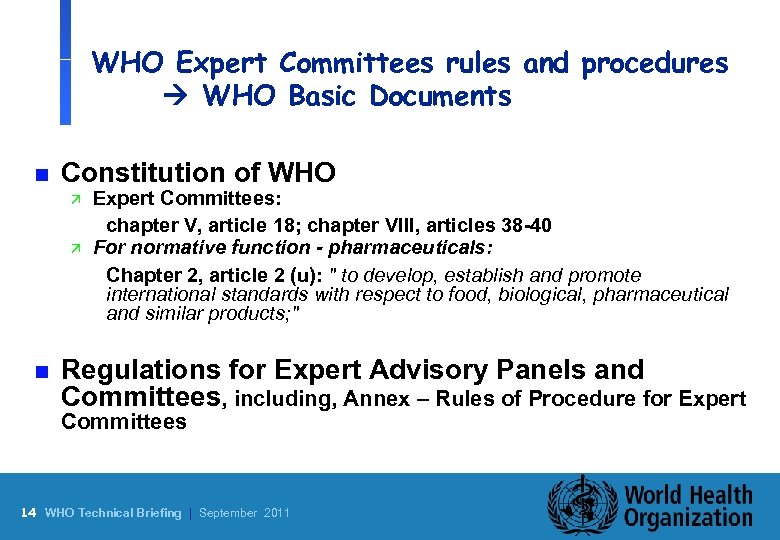
WHO Expert Committees rules and procedures WHO Basic Documents n Constitution of WHO ä ä n Expert Committees: chapter V, article 18; chapter VIII, articles 38 -40 For normative function - pharmaceuticals: Chapter 2, article 2 (u): " to develop, establish and promote international standards with respect to food, biological, pharmaceutical and similar products; " Regulations for Expert Advisory Panels and Committees, including, Annex – Rules of Procedure for Expert Committees 14 WHO Technical Briefing | September 2011
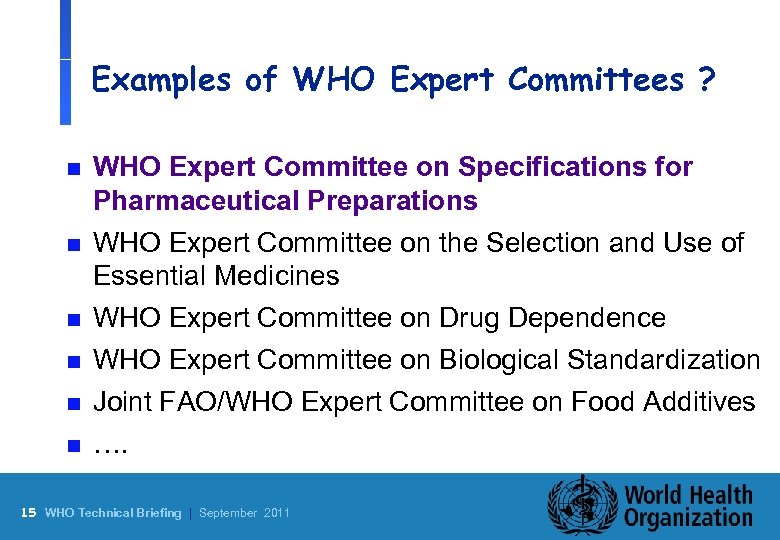
Examples of WHO Expert Committees ? n WHO Expert Committee on Specifications for Pharmaceutical Preparations n WHO Expert Committee on the Selection and Use of Essential Medicines WHO Expert Committee on Drug Dependence WHO Expert Committee on Biological Standardization n n Joint FAO/WHO Expert Committee on Food Additives …. 15 WHO Technical Briefing | September 2011
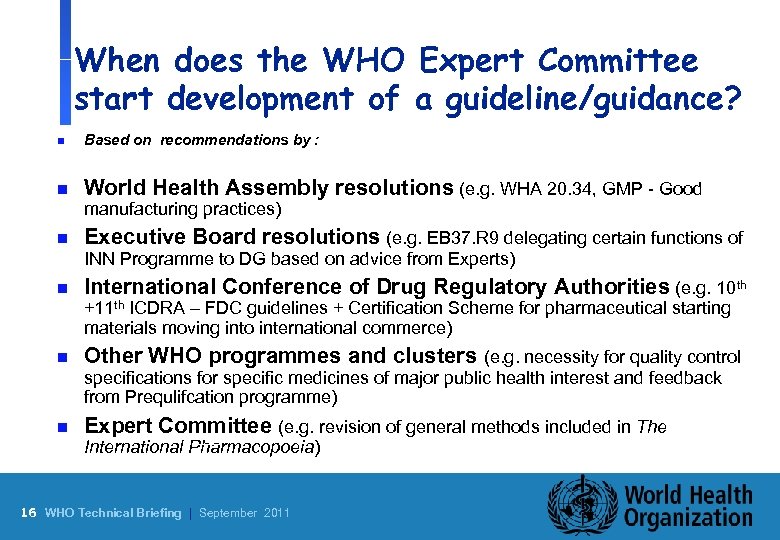
When does the WHO Expert Committee start development of a guideline/guidance? n Based on recommendations by : n World Health Assembly resolutions (e. g. WHA 20. 34, GMP - Good manufacturing practices) n Executive Board resolutions (e. g. EB 37. R 9 delegating certain functions of INN Programme to DG based on advice from Experts) n International Conference of Drug Regulatory Authorities (e. g. 10 th +11 th ICDRA – FDC guidelines + Certification Scheme for pharmaceutical starting materials moving into international commerce) n Other WHO programmes and clusters (e. g. necessity for quality control specifications for specific medicines of major public health interest and feedback from Prequlifcation programme) n Expert Committee (e. g. revision of general methods included in The International Pharmacopoeia) 16 WHO Technical Briefing | September 2011
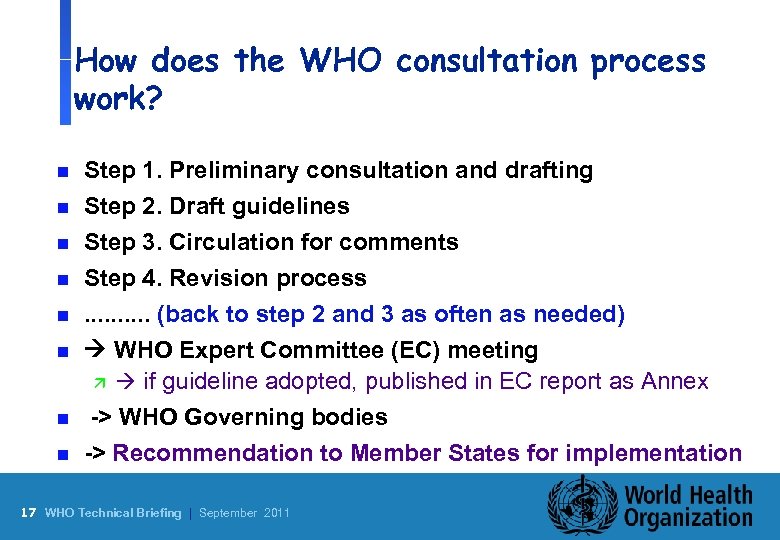
How does the WHO consultation process work? n n n n Step 1. Preliminary consultation and drafting Step 2. Draft guidelines Step 3. Circulation for comments Step 4. Revision process. . (back to step 2 and 3 as often as needed) WHO Expert Committee (EC) meeting ä if guideline adopted, published in EC report as Annex -> WHO Governing bodies -> Recommendation to Member States for implementation 17 WHO Technical Briefing | September 2011
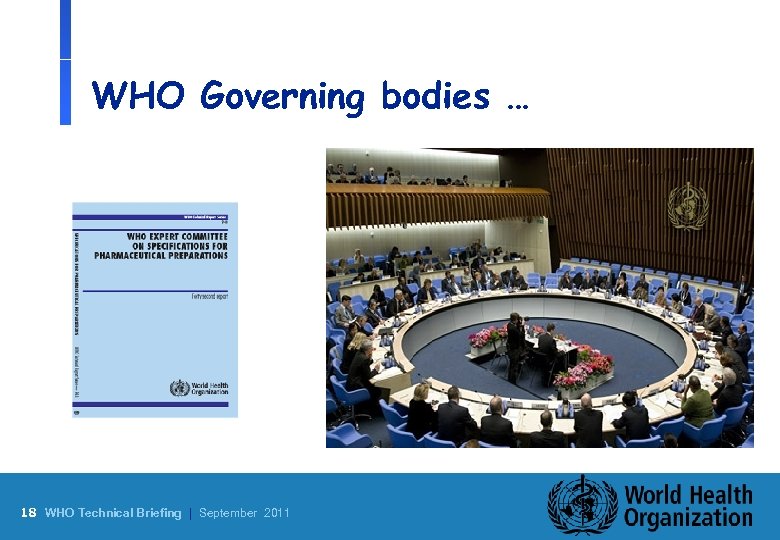
WHO Governing bodies … 18 WHO Technical Briefing | September 2011
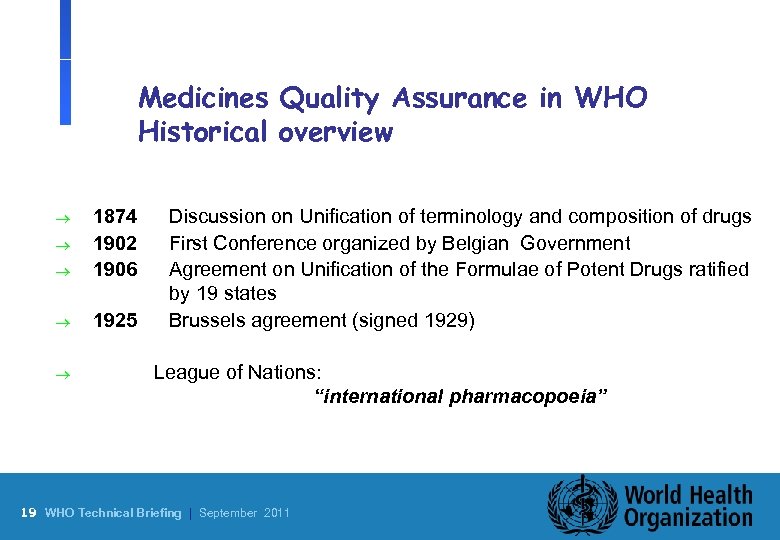
Medicines Quality Assurance in WHO Historical overview ® 1874 1902 1906 ® 1925 ® ® ® Discussion on Unification of terminology and composition of drugs First Conference organized by Belgian Government Agreement on Unification of the Formulae of Potent Drugs ratified by 19 states Brussels agreement (signed 1929) League of Nations: “international pharmacopoeia” 19 WHO Technical Briefing | September 2011
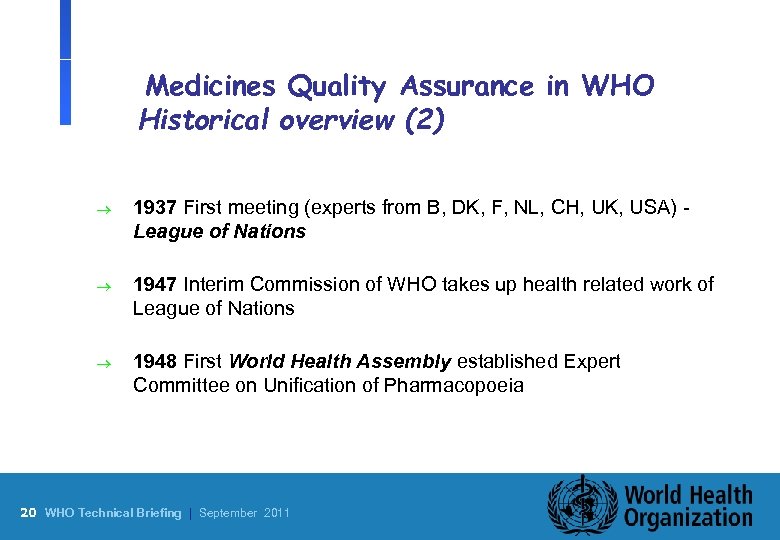
Medicines Quality Assurance in WHO Historical overview (2) ® 1937 First meeting (experts from B, DK, F, NL, CH, UK, USA) League of Nations ® 1947 Interim Commission of WHO takes up health related work of League of Nations ® 1948 First World Health Assembly established Expert Committee on Unification of Pharmacopoeia 20 WHO Technical Briefing | September 2011
Medicines Quality Assurance in WHO Historical overview (3) ® 1 st "WHO Expert Committee on Specifications for Pharmaceutical Preparations" ( ECSPP) meeting held 13 -17 October 1947 ® Report of 1 st ECSPP meeting published in: ® Official Records of WHO, No 8, page 54 ff, 1947 21 WHO Technical Briefing | September 2011
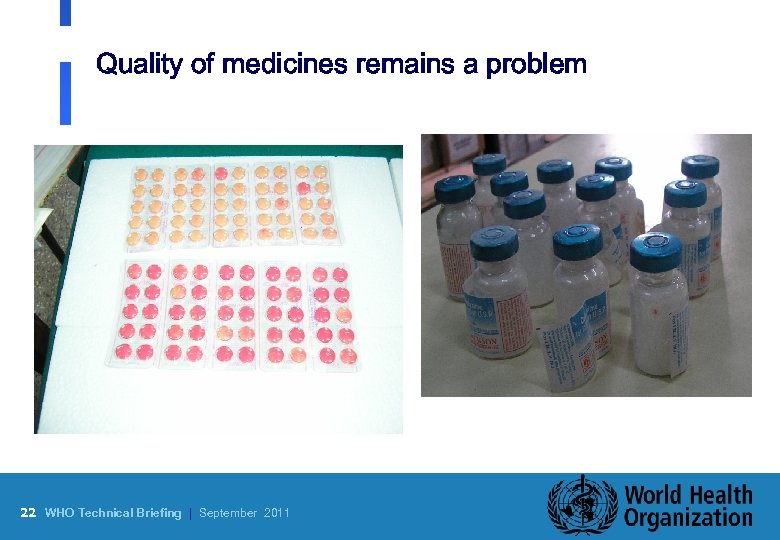
Quality of medicines remains a problem 22 WHO Technical Briefing | September 2011
Challenges: past and present… n Past: ä Manufacture direct from API -> finished product ä Manufacture of API in sites close to or same as product ä Experience and long-standing knowledge of production, product and manufacture of parties involved ä Few intermediates in sales chain ä Usually stable trade and sales connections 23 WHO Technical Briefing | September 2011
Challenges: past and present… n Present: ä Rationalization of drug production ä Contracting-out of many steps in manufacture ä Many intermediates in trade and sales chain ä Trade, shipping, long distances involved ä Increase of risks… ä Increase of requirements and documentation ä Increase of national control mechanisms 24 WHO Technical Briefing | September 2011
WHO’s global guidelines and strategies n n n Requirements for drug registration and model legislation Networking among and with regulatory authorities International alerts Global tools to help ensure that patients receive quality safe quality medicines Global norms and international standards and nomenclature 25 WHO Technical Briefing | September 2011
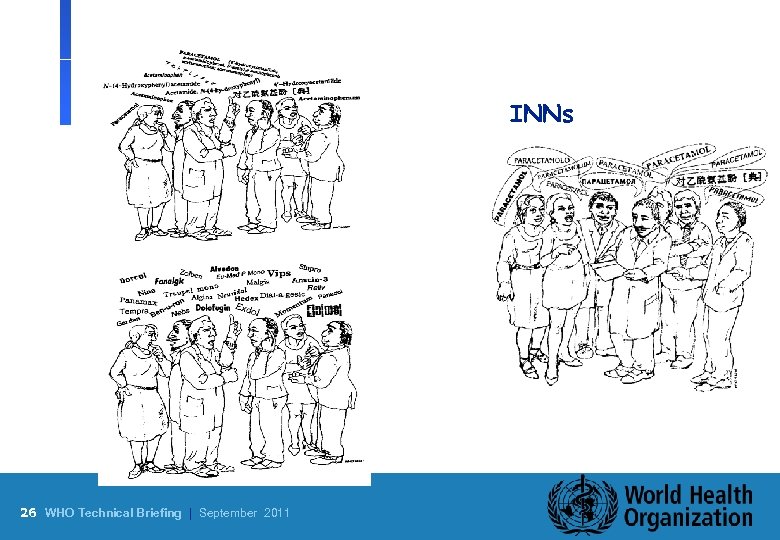
INNs 26 WHO Technical Briefing | September 2011
WHO’s medicines quality assurance guidelines Cover: n n n n Development Production Quality Control Quality related regulatory guidelines Inspection Distribution from manufacture (and before) to delivery to patient 27 WHO Technical Briefing | September 2011
Adopted WHO guidance texts and guidelines in medicines quality assurance (without Ph. Int) Maintain to keep up to date: ä More than 60 CURRENT official WHO guidance texts and guidelines to date, including 15 (8 updates + 7 new adopted 2010) 28 WHO Technical Briefing | September 2011
Quality Control http: //www. who. int/medicines/areas/quality_safety/quality_assurance/contr ol/ More than 10 guidance documents and guidelines, including - Good laboratory practices + training materials - Guidelines for establishment of chemical reference standards - Model certificate of analysis - International Pharmacopoeia + Basic tests 29 WHO Technical Briefing | September 2011
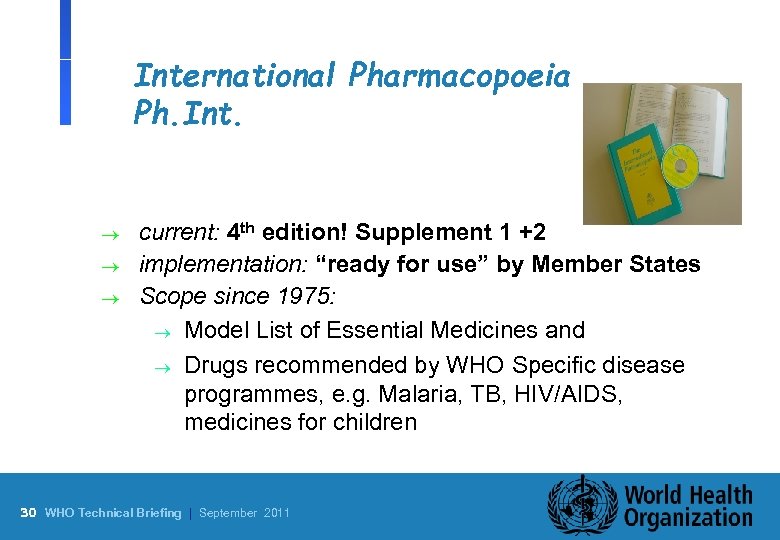
International Pharmacopoeia Ph. Int. ® ® ® current: 4 th edition! Supplement 1 +2 implementation: “ready for use” by Member States Scope since 1975: ® Model List of Essential Medicines and ® Drugs recommended by WHO Specific disease programmes, e. g. Malaria, TB, HIV/AIDS, medicines for children 30 WHO Technical Briefing | September 2011
External Quality Assessment Scheme for National Drug Quality Control Laboratories n Phase 5 (01/2010 - 12/2012) - 60 laboratories participate - Studies: ä ä ä ä - Assay by titration Water content by Karl-Fischer Dissolution test Related substances by HPLC Related substances by TLC Assay by HPLC Dissolution test 31 WHO Technical Briefing | September 2011
Distribution http: //www. who. int/medicines/areas/quality_safety/quality_ass urance/distribution Some 10 guidance documents and guidelines, e. g. : - Certification schemes (CPP and SMACS) - Quality system for Procurement - Good distribution practices for starting materials and finished products - Good storage practices 32 WHO Technical Briefing | September 2011
Production - http: //www. who. int/medicines/areas/quality_safety/quality_assurance/production/ Some 20 guidance documents and guidelines, including: - Good Manufacturing Practices (GMP) …. . Consisting of more than 10 major "guideline" texts (regularly updated, new texts added as needs are identified) - …. . Training materials (slides, video, GMP text) Risk analysis (HACCP) – moving to "quality risk management" - 33 WHO Technical Briefing | September 2011
WHO’s global guidelines - production n Good Manufacturing Practices (GMP) …. . n 1. Main principles for pharmaceutical products ä ä n Requirement for the sampling of starting materials (amendment) Water for pharmaceutical use Heating, ventilation and air-conditioning (HVAC) systems Validation 2. … for starting materials, including ä ä Active pharmaceutical ingredients Pharmaceutical excipients 34 WHO Technical Briefing | September 2011
WHO’s global guidelines - production (2) n 3. … for specific pharmaceutical products: ä ä ä Sterile pharmaceutical products Biological products (rev in progress) Investigational pharmaceutical products for clinical trials in humans Herbal medicines Radiopharmaceuticals Blood establishments 35 WHO Technical Briefing | September 2011
WHO’s global guidelines - inspection http: //www. who. int/medicines/areas/quality_safety/qual ity_assurance/inspections/en/index. html n Inspection of…. . n pharmaceutical manufacturers ä drug distribution channels (products) Guidelines for pre-approval inspection Quality systems requirements for national GMP inspectorates ä n n n Model GMP certificate Model report for inspections 36 WHO Technical Briefing | September 2011
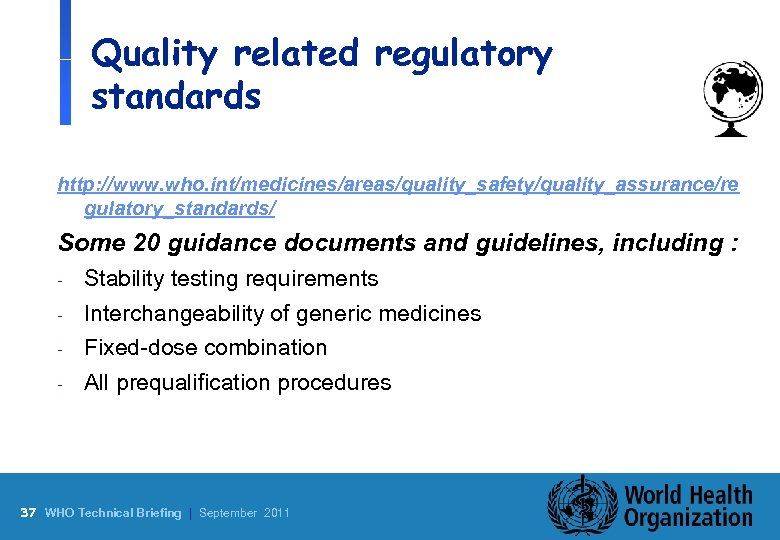
Quality related regulatory standards http: //www. who. int/medicines/areas/quality_safety/quality_assurance/re gulatory_standards/ Some 20 guidance documents and guidelines, including : - Stability testing requirements Interchangeability of generic medicines Fixed-dose combination All prequalification procedures 37 WHO Technical Briefing | September 2011
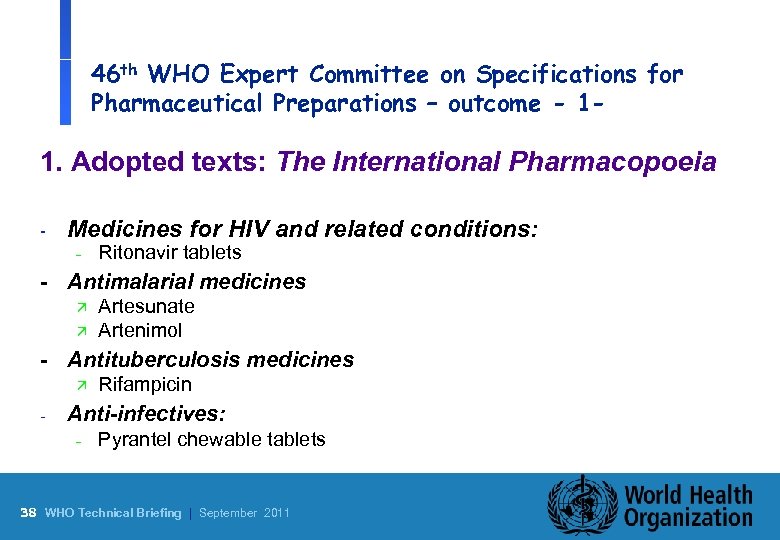
46 th WHO Expert Committee on Specifications for Pharmaceutical Preparations – outcome - 1 - 1. Adopted texts: The International Pharmacopoeia - Medicines for HIV and related conditions: - Ritonavir tablets - Antimalarial medicines ä ä Artesunate Artenimol - Antituberculosis medicines ä - Rifampicin Anti-infectives: - Pyrantel chewable tablets 38 WHO Technical Briefing | September 2011
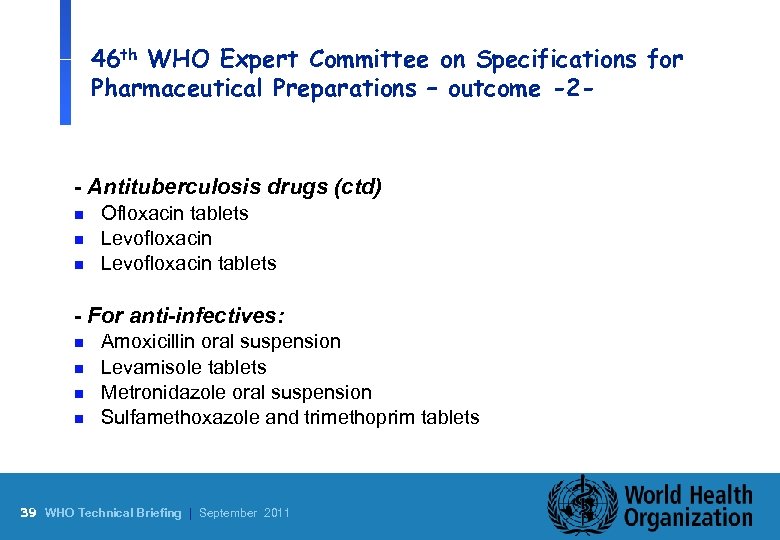
46 th WHO Expert Committee on Specifications for Pharmaceutical Preparations – outcome -2 - - Antituberculosis drugs (ctd) n n n Ofloxacin tablets Levofloxacin tablets - For anti-infectives: n n Amoxicillin oral suspension Levamisole tablets Metronidazole oral suspension Sulfamethoxazole and trimethoprim tablets 39 WHO Technical Briefing | September 2011
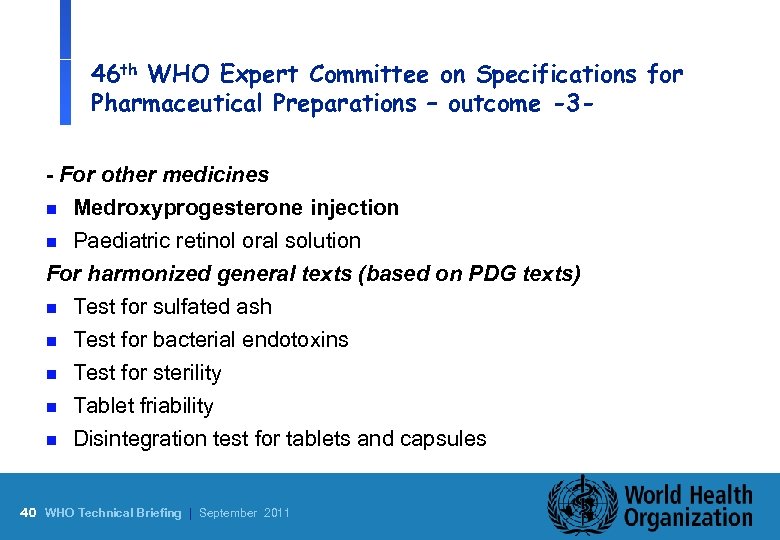
46 th WHO Expert Committee on Specifications for Pharmaceutical Preparations – outcome -3 - For other medicines n Medroxyprogesterone injection n Paediatric retinol oral solution For harmonized general texts (based on PDG texts) n n n Test for sulfated ash Test for bacterial endotoxins Test for sterility Tablet friability Disintegration test for tablets and capsules 40 WHO Technical Briefing | September 2011
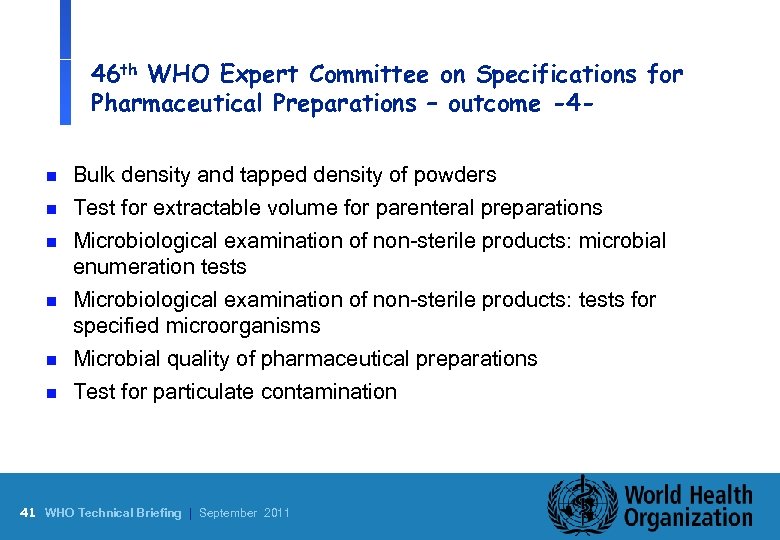
46 th WHO Expert Committee on Specifications for Pharmaceutical Preparations – outcome -4 n n n Bulk density and tapped density of powders Test for extractable volume for parenteral preparations Microbiological examination of non-sterile products: microbial enumeration tests Microbiological examination of non-sterile products: tests for specified microorganisms Microbial quality of pharmaceutical preparations Test for particulate contamination 41 WHO Technical Briefing | September 2011
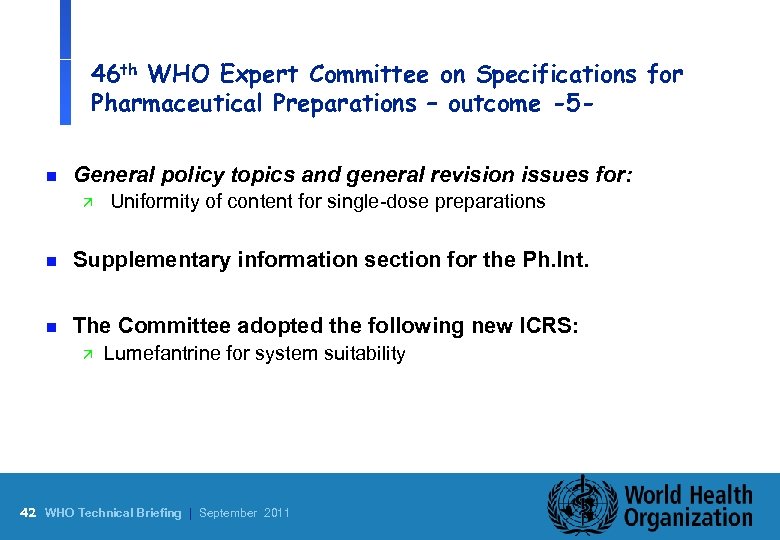
46 th WHO Expert Committee on Specifications for Pharmaceutical Preparations – outcome -5 n General policy topics and general revision issues for: ä Uniformity of content for single-dose preparations n Supplementary information section for the Ph. Int. n The Committee adopted the following new ICRS: ä Lumefantrine for system suitability 42 WHO Technical Briefing | September 2011
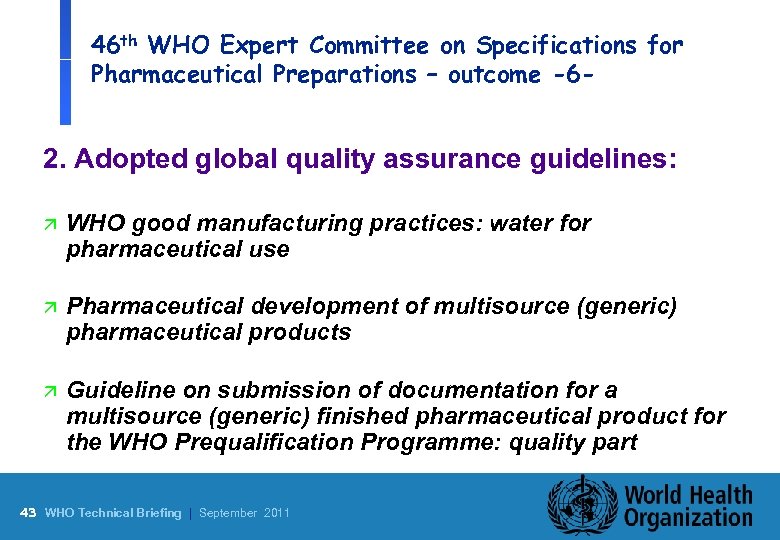
46 th WHO Expert Committee on Specifications for Pharmaceutical Preparations – outcome -6 - 2. Adopted global quality assurance guidelines: ä WHO good manufacturing practices: water for pharmaceutical use ä Pharmaceutical development of multisource (generic) pharmaceutical products ä Guideline on submission of documentation for a multisource (generic) finished pharmaceutical product for the WHO Prequalification Programme: quality part 43 WHO Technical Briefing | September 2011
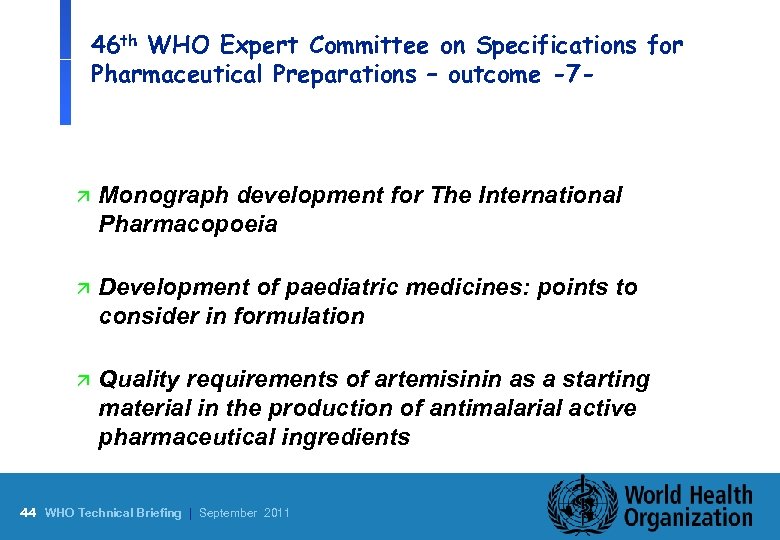
46 th WHO Expert Committee on Specifications for Pharmaceutical Preparations – outcome -7 - ä Monograph development for The International Pharmacopoeia ä Development of paediatric medicines: points to consider in formulation ä Quality requirements of artemisinin as a starting material in the production of antimalarial active pharmaceutical ingredients 44 WHO Technical Briefing | September 2011
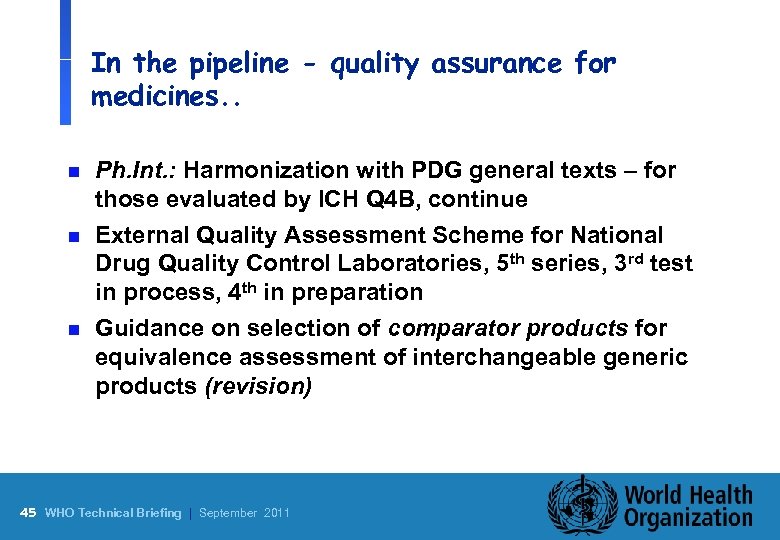
In the pipeline - quality assurance for medicines. . n n n Ph. Int. : Harmonization with PDG general texts – for those evaluated by ICH Q 4 B, continue External Quality Assessment Scheme for National Drug Quality Control Laboratories, 5 th series, 3 rd test in process, 4 th in preparation Guidance on selection of comparator products for equivalence assessment of interchangeable generic products (revision) 45 WHO Technical Briefing | September 2011
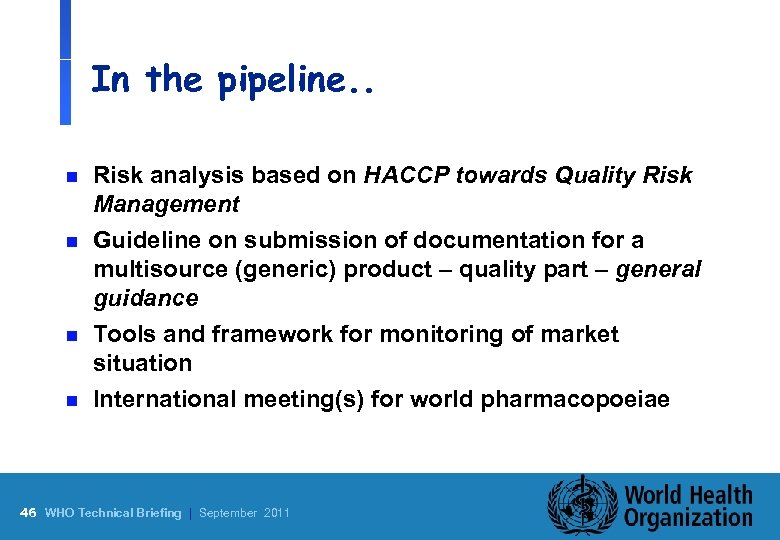
In the pipeline. . n n Risk analysis based on HACCP towards Quality Risk Management Guideline on submission of documentation for a multisource (generic) product – quality part – general guidance Tools and framework for monitoring of market situation International meeting(s) for world pharmacopoeiae 46 WHO Technical Briefing | September 2011
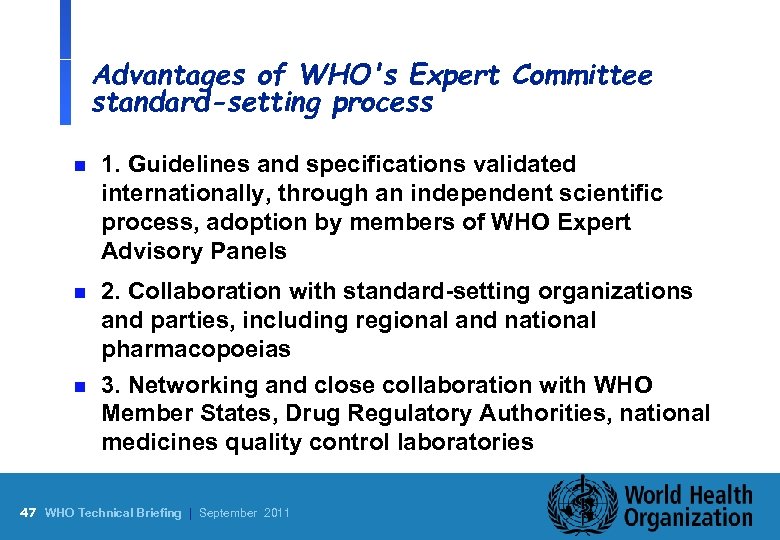
Advantages of WHO's Expert Committee standard-setting process n 1. Guidelines and specifications validated internationally, through an independent scientific process, adoption by members of WHO Expert Advisory Panels n 2. Collaboration with standard-setting organizations and parties, including regional and national pharmacopoeias 3. Networking and close collaboration with WHO Member States, Drug Regulatory Authorities, national medicines quality control laboratories n 47 WHO Technical Briefing | September 2011
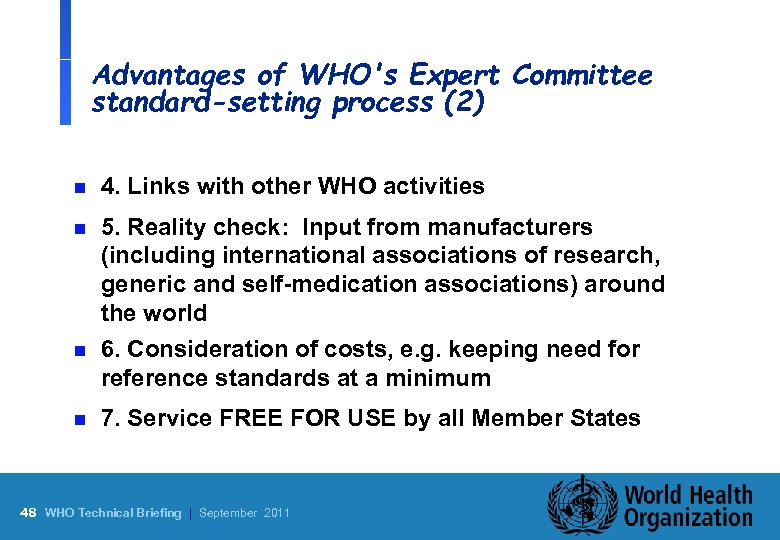
Advantages of WHO's Expert Committee standard-setting process (2) n 4. Links with other WHO activities n 5. Reality check: Input from manufacturers (including international associations of research, generic and self-medication associations) around the world 6. Consideration of costs, e. g. keeping need for reference standards at a minimum n n 7. Service FREE FOR USE by all Member States 48 WHO Technical Briefing | September 2011
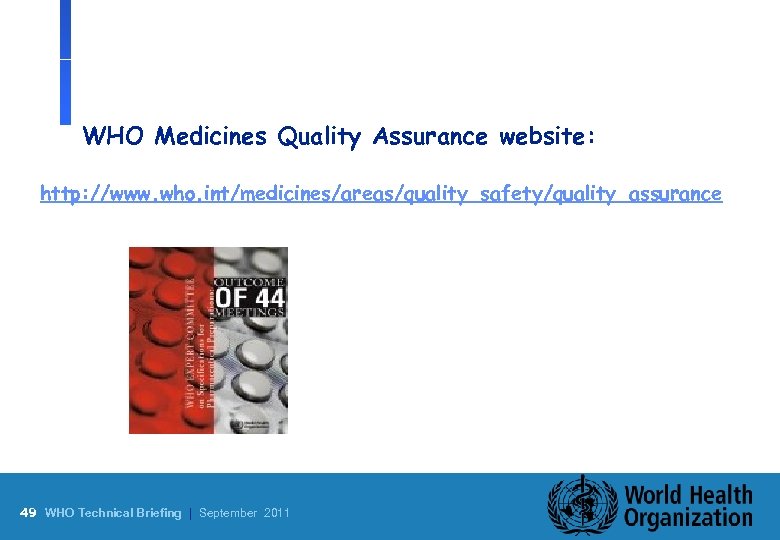
WHO Medicines Quality Assurance website: http: //www. who. int/medicines/areas/quality_safety/quality_assurance 49 WHO Technical Briefing | September 2011
Safe quality medicines 50 WHO Technical Briefing | September 2011
Скачать презентацию Safe quality medicines 1 WHO Technical Briefing
31b8f7194da470cf00d22a48b85f0be8.ppt