


 Скачать презентацию SADC Rules of Origin and regional trade issues
c194fab98a9497182a1b058db4562aec.ppt
- Количество слайдов: 15
 SADC Rules of Origin and regional trade issues Niel Joubert tralac researcher Clothing and Textiles Workshop 8 October 2004
 Introduction § What are Rules of Origin? § § § Origin of a product (economic nationality) Globalisation, manufacturing processes Why are Ro. O important? § Discriminating policies e. g. § § Preferential tariffs § Trade remedies § 2 Quotas Statistics
 Ro. O in PTAs § § Authentication function § Prevents trade deflection / transhipment § Protective function (intended or unintended) § 3 Ensures that only members to a PTA benefit from preferences Stricter authentication normally leads to higher protection
 SADC Trade Protocol § § Trade Protocol entered into force 1 st of Jan 2000 § Amendment Trade Protocol § Being implemented by 12 of the 14 SADC members § Objective to liberalise intra-regional trade in goods and services and to establish a Free Trade Area (FTA) for the SADC region § FTA by 2008, Customs Union by 2010 § 4 SADC: Angola, Lesotho, Malawi, Mozambique, Tanzania, Zambia, Botswana, Mauritius, Namibia, South Africa, Swaziland, Zimbabwe, DRC, (Madagascar) Asymmetry in tariff phase down schedules of Member States: § SACU (front-loaded) v rest of SADC (back-loaded) § Special access to SACU for MMTZ
 SADC Ro. O § § Originally agreed Ro. O very simple; similar to COMESA § Lengthy process of negotiating highly sector- and product specific Ro. O § Varies widely across chapters, headings and subheadings § More restrictive: CTH replaced with multiple transformation rules and/or descriptions of required production processes § VA requirements increased, import content decreased § 5 Annex 1 to the Protocol as replaced by Amendment Protocol on Trade Similar to SA-EU (TDCA) and EU-ACP agreements
 SADC Ro. O – Textiles and Clothing § Textiles and clothing of particular interest for SADC § Significant production in number of member states § Took roughly 2 years to agree on Ro. O for textiles and clothing § For some other sensitive products like wheat flour Ro. O are still outstanding – means no preferential trade § double transformation requirement § § yarn – fabric + fabric - clothing § Only few exceptions e. g. yarn § 6 E. g. garment must be made from regionally produced textiles; fabrics must be made from regionally produced yarns MMTZ Agreement aims to mitigate this requirement for LDC member states
 MMTZ Agreement § § Malawi, Mozambique, Tanzania, Zambia (MMTZ) § Subject to small quotas, expires July 2006 § new quotas levels were suggested during review in first quarter of 2003 § Dependent on MMTZ giving SACU certain preferences § Agreement on changes still outstanding § 7 Waiver of double transformation rule for 4 poorest member states Currently being reassessed as part of mid-term review of the Trade Protocol
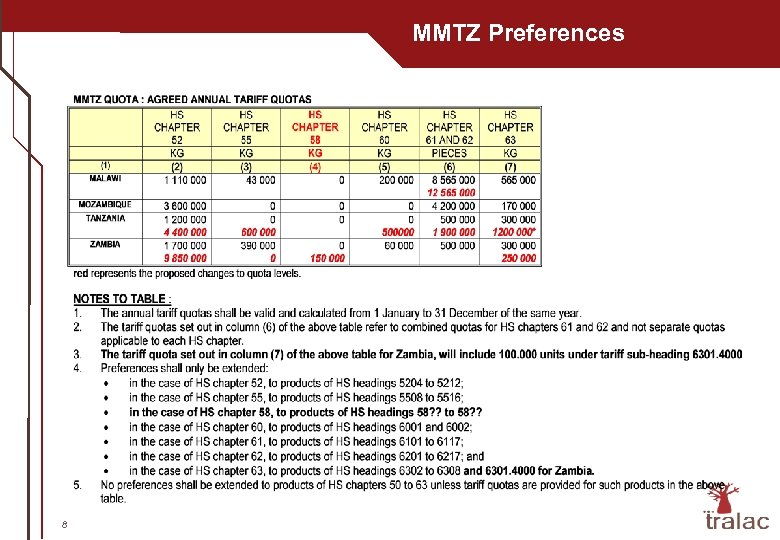 MMTZ Preferences 8
 Mid-term Review of Trade Protocol § § official justification for product specific Ro. O is that they encourage regional producers to make use of regional raw materials and improve backward and forward linkages in the various production chains in the region § SADC industries however cannot be globally competitive if they are constrained by restrictive rules of origin from sourcing inputs from the most competitive source § 9 Includes review of Ro. O Most regional producers, including SA cannot meet the current Ro. O
 Mid-term Review of Trade Protocol § Vertical regional integration did not realise § Movement towards more simple and unrestrictive Ro. O § General suggestions are that goods should qualify for SADC preferences if they: § § Contain 35% VA § 10 Undergo a CTH (some exception) § § Are wholly produced in the region Goods that have not undergone sufficient processing are disqualified (screwdriver operations) Effectively means a single-stage transformation for clothing and textiles
 SACU–US FTA talks § § US AGOA covered imports from SACU 2002 – $1, 7 billion § Talks currently deadlocked – differences on issues for negotiation § SACU wants to continue talks on market access, but wants to exclude Investment, Government Procurement, IP and Labour § 11 Lock in unilateral AGOA preferences September meeting cancelled
 Ro. O in other US FTAs § US-Aus CTH § US-Morocco VA (35%) and CTH § Textile and Apparel – both CTH with specific rules § Special safeguard mechanism § Yarn-forward rule § § 12 Fibre and yarn from parties to the FTA 7% de minimus
 Ro. O in other US FTAs § Morocco has limited 3 rd country allowance § § < 1% of total US imports § Allowance: use of cotton fibres from LDC SSA countries § § 30 million sq meters for first 4 years, eliminated after 10 year period Both US and Moroccan producers NAFTA, Singapore, Chile § § 13 Limited allowances; NAFTA not time bound Israel, Jordan allowed unlimited 3 rd country yarn and fabric inputs
 Ro. O in other US FTAs § Market access for textiles and apparel – US-Morocco § Fully reciprocal and symmetric § Tariffs for most textile products eliminated over 6 years § Duty-free treatment for designated quantities of products § § 14 "…The increase in total U. S. textile and apparel imports from the world is likely to be very small [under this FTA] and the impact on U. S. production and employment in the textile and apparel sector is likely to be negligible. Any increase in shipments from Morocco as a result of the FTA is likely to displace imports from other high-cost exporting countries…" -U. S. International Trade Commission www. ustr. gov Office of the United States Trade Representative
 Future impact of SADC FTA § § EU-ACP EPAs negotiations § Traditional high cost producers producing for the tariff protected domestic markets stand to lose § 15 simpler Ro. O will help promote regional trade and international competitiveness of member states Ro. O should be used to authenticate imports and not for protection