


 Скачать презентацию SADC REGIONAL RESPONSE TO HIV AIDS
ea75236e4fdee28e77cbc3abe3afd44a.ppt
- Количество слайдов: 20
 SADC REGIONAL RESPONSE TO HIV & AIDS & MOBILITY 16 th International Conference on AIDS & STI in Africa Doreen Sanje SADC Secretariat 3/16/2018 1
 Outline of the Presentation Background Situation Analysis Provisions to support responding The Response – Policy Framework for mobile pop and CD – The SADC HIV and AIDS Cross Border Initiative • Lessons Learns • Conclusion • • 3/16/2018 2
 Background • SADC is comprised of 15 MS, secretariat in Botswana • It thrives to promote economic integration with eventual free movement of capital, labour, goods and services in the region. • The region is faced by the burden of HIV and TB • The region considered as epicenter • Mobile population is at high risk of contracting CD 3/16/2018 3
 Situational Analysis • Trends in population Mobility – Historical linked to labour – Women are also mobile – Increased movement of skilled professionals including Health workers – High proportion of undocumented – Multiple reasons for migration 3/16/2018 4
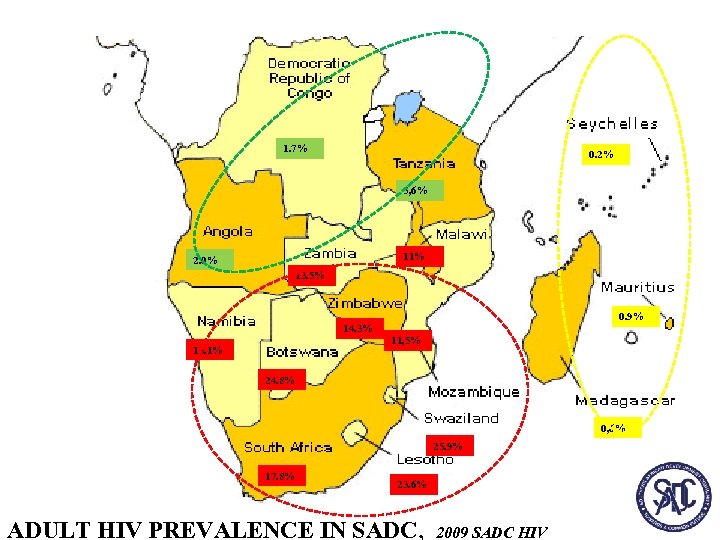 1. 7% 0. 2% 5, 6% 11% 2. 0% 13. 5% 14. 3% 13. 1% 0. 9% 11, 5% 24. 8% 0, 6% 25. 9% 17. 8% 23. 6% ADULT HIV PREVALENCE IN SADC, 2009 SADC HIV
 Challenges the response to mobile populations • Inadequate harmonization and coordination • Difficulty in accessing health services • Inadequate disease surveillance and epidemic preparedness • Inadequate info, education and participation by mobile population • Inadequate operations research and sharing of info • Legal and administrative barriers 3/16/2018 6
 Provisions to support the response • Founding Charter of SADC - article 6 stresses nondiscrimination. • Maseru Declaration on HIV and AIDS in 2003 - a reconfirmation of the international commitments • SADC Protocol on Health • SADC Protocol on Gender and Development • SADC HIV and AIDS Strategic Framework -20102015 • All MS demonstrate a 50% reduction in the rate of new infections to half of the 2008 levels and mitigate impacts by 2015 3/16/2018 7
 The response: Policy Framework for mobile pop • Purpose – Guidance on the protection of the health of cross-border mobile population in the face of CD – Guidance on the control of CD in the face of movement of people across borders in the region • Scope – Aimed at policy makers and managers – Applicable to all CD – Compliments work on harmonization • Who are the beneficiaries? – Voluntary and involuntary – Legal or undocumented regardless of duration of stay 3/16/2018 8
 Policy Guidelines for Programming for Pop Mobility and CD • Regional harmonization and Coordination • Equitable Access to Health Services by Cross-border mobile populations. • Coordinated regional public health surveillance and epidemic preparedness. • Information, Education and Health Promotion for Mobile Populations • Operational Research and Strategic Information • Legal, Regulatory and Administrative Reforms 3/16/2018 9
 Status of Framework • Developing a financing mechanism that clearly articulates the roles and responsibilities of different stakeholders in financing the implementation of the framework. 3/16/2018 10
 Translating Policy into Practice: The HIV & AIDS Cross Border Initiative • SADC HIV and AIDS Initiative to implement HIV and AIDS programs for mobile populations financed by GF • The broad aim: to contribute towards the reduction in incidence and morbidity associated with HIV in member states. • This is aligned with the SADC goal for HIV&AIDS framework & implementation of framework on mobile pop
 Objectives • To further harmonise policies, frameworks, , guidelines and related tools regarding mobile populations & and to improve coordination and collaboration • To strengthen HIV and AIDS mainstreaming • To strengthen monitoring and evaluation systems as they pertain to mobile populations in the context of HIV and AIDS 12
 Objectives cont’d • To coordinate and enable sub-regional interventions designed to strengthen commitment to a sustainable regional response – Objective 4 interventions in 32 cross border sites 13
 Program Beneficiaries • SADC Member States – Public, private, and civil society actors involved in HIV/AIDS response • Target populations – Long distance truck drivers (LDTDs) – Commercial sex workers (CSWs) – Communities within a radius of 50 KMS of the 32 cross border sites 14
 Summary: Policy related activities • Guidelines – Standard case detection – Protocol for patient follow up and referral mechanisms – Waste management – In addition to all harmonized policies • Documentation of good practices
 Activities cont’d • Facilitate agreements of cooperation amongst health facilities at border sites for mobile populations • Sero Behavioural Survey in selected sites by WHO • MS providing drugs, land & assurance of sustainability • Site and country assessments -area mapping within a 50 km radius of the of identified border posts
 Activities at site • 32 cross border sites • Adjacent sites separated by the border – HIV testing and Counseling – STI diagnosis and treatment – Condom distribution – Referral – PHC – BCC outreach activities 17
 Implementation thr partnership • SADC SEC. responsible for policy harmonization and M and E • Sub recipients - NSA &WBG implementing programmes in 32 sites • Work closes with MOH • MS providing, land, drugs and medical commodities MOUs between SADC Sec and SRs • RCM overall oversight of initiative • Initiative founded on a strong partnership
 Lessons learnt • Policy changes necessary to facilitate access to health for mobile population • Harmonisation of protocols critical for access to treatment for mobile populations • Cross border referral and follow up • Importance of partnership involving government, CSOs and private sector in delivery of health services to mobile pop 3/16/2018 19
 Conclusion • It is possible to provide services to mobile pop. • Mobile pop interact with general pop. as such all commitments will not be attained if services are not provided mobile pop 3/16/2018 20