


 Скачать презентацию SADC Postal Courier Services Sector Forum Supported
99467b4b5b132d3af56888c4a9420400.ppt
- Количество слайдов: 12
 SADC Postal & Courier Services Sector Forum Supported by the SADC/GIZ Project on Trade in Services POSTAL REFORM, TRADE IN SERVICES AND EFFECTIVE ACCESS: CONSIDERING POLICY OPTIONS FOR MUTUAL REINFORCEMENT SESSION 2: MAPPING THE ISSUES Swakopmund, 19 April 2013 Hannes Schloemann, Director, WTI Advisors hannes. schloemann@wtiadvisors. com W T I advisors
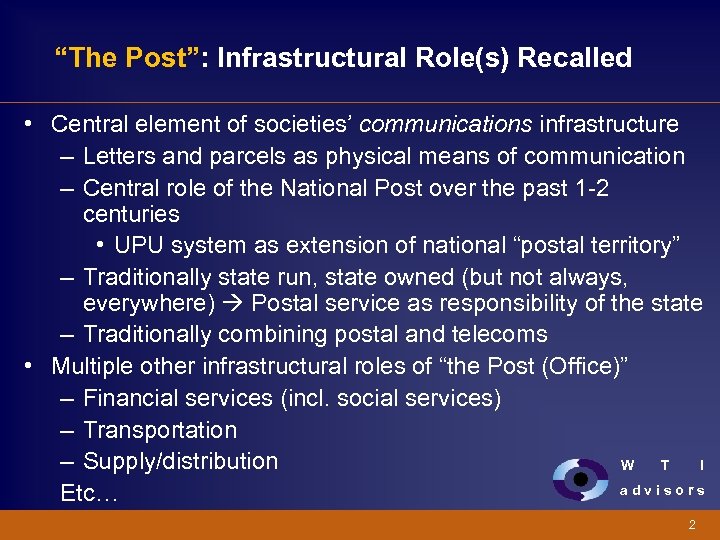 “The Post”: Infrastructural Role(s) Recalled • Central element of societies’ communications infrastructure – Letters and parcels as physical means of communication – Central role of the National Post over the past 1 -2 centuries • UPU system as extension of national “postal territory” – Traditionally state run, state owned (but not always, everywhere) Postal service as responsibility of the state – Traditionally combining postal and telecoms • Multiple other infrastructural roles of “the Post (Office)” – Financial services (incl. social services) – Transportation – Supply/distribution W T I advisors Etc… 2
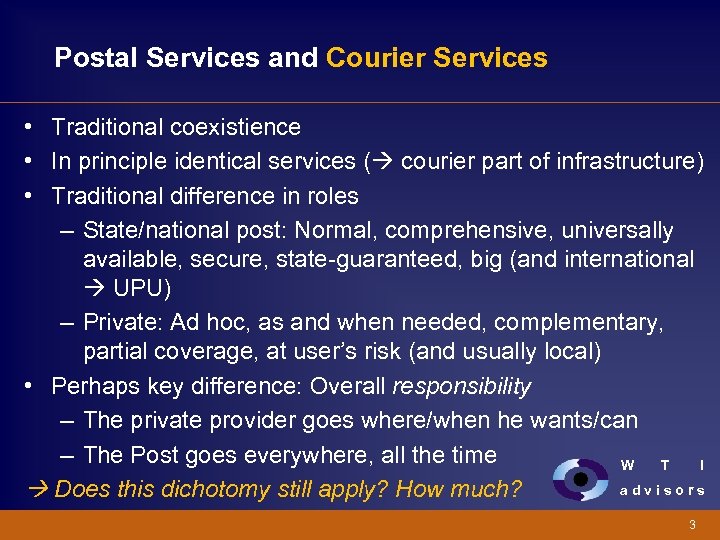 Postal Services and Courier Services • Traditional coexistience • In principle identical services ( courier part of infrastructure) • Traditional difference in roles – State/national post: Normal, comprehensive, universally available, secure, state-guaranteed, big (and international UPU) – Private: Ad hoc, as and when needed, complementary, partial coverage, at user’s risk (and usually local) • Perhaps key difference: Overall responsibility – The private provider goes where/when he wants/can – The Post goes everywhere, all the time W T I advisors Does this dichotomy still apply? How much? 3
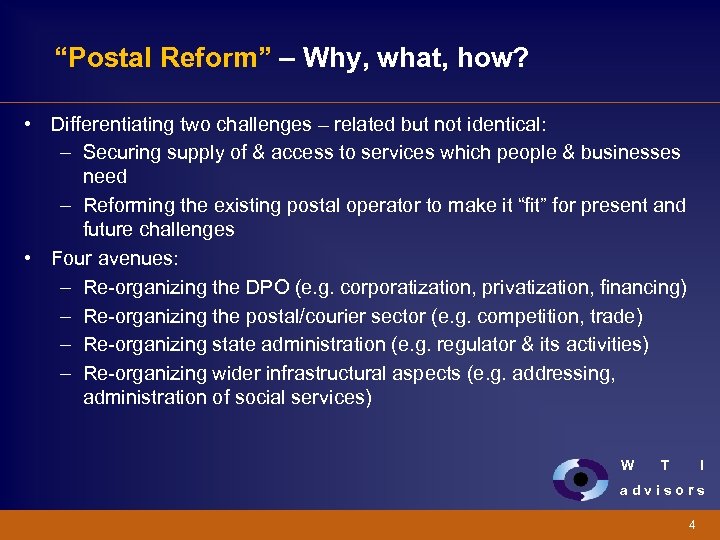 “Postal Reform” – Why, what, how? • Differentiating two challenges – related but not identical: – Securing supply of & access to services which people & businesses need – Reforming the existing postal operator to make it “fit” for present and future challenges • Four avenues: – Re-organizing the DPO (e. g. corporatization, privatization, financing) – Re-organizing the postal/courier sector (e. g. competition, trade) – Re-organizing state administration (e. g. regulator & its activities) – Re-organizing wider infrastructural aspects (e. g. addressing, administration of social services) W T I advisors 4
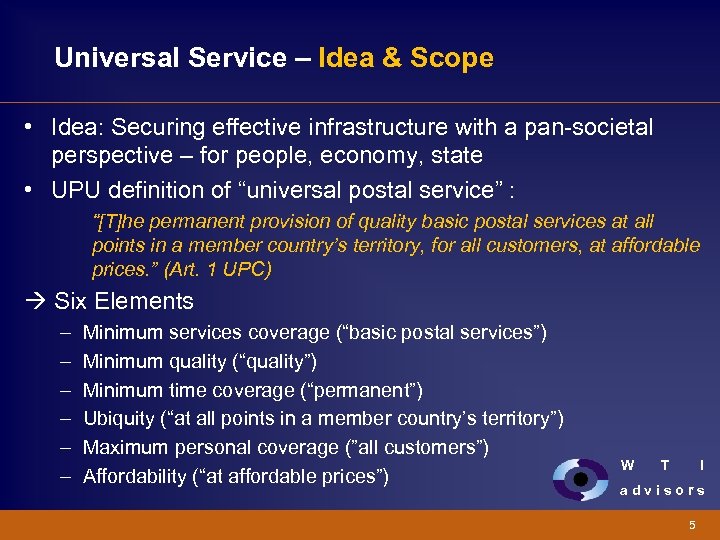 Universal Service – Idea & Scope • Idea: Securing effective infrastructure with a pan-societal perspective – for people, economy, state • UPU definition of “universal postal service” : “[T]he permanent provision of quality basic postal services at all points in a member country’s territory, for all customers, at affordable prices. ” (Art. 1 UPC) Six Elements – – – Minimum services coverage (“basic postal services”) Minimum quality (“quality”) Minimum time coverage (“permanent”) Ubiquity (“at all points in a member country’s territory”) Maximum personal coverage (”all customers”) Affordability (“at affordable prices”) W T I advisors 5
 Universal Service – The Economic/Business Challenge • Ubiquity, time coverage and affordability for all may (but not always has to) make commercial service provision non-viable • Depending e. g. on – geography – population density – population structure (poverty) – economic structure – transportation infrastructure Universal service may need additional financing to be viable (requires analysis of additional costs not covered by fees collected for) W T I advisors 6
 Universal Service – Financing Mechanisms • 4 main avenues: 1. Postal monopoly/reserved services (internal/external crosssubsidization from monopoly rents) 2. Universal Service Fund (external subsidization from within sector) 3. Direct subsidies/other support (external subsidization from taxes) 4. Other business (internal cross-subsidization from profits elsewhere) All four are subsidies: someone else pays (other than beneficiary) In view of financing (1 -3) it may be attractive to provide US • Sometimes no financing needed at all (e. g. UK) – universal service finances itself – how? – Original endowment of DPO with assets (arguably an initial subsidy) – Or geographical etc. factors simply make US good business W T I advisors 7
 Postal Monopoly / Reserved Services • Coverage not to be confused with universal service scope • Financing mechanism for a societal cause (universal service), not natural attribute of The Post • Advantages – inter alia less risk of corruption • Disadvantages – i. a. costs hidden, risk of inefficiencies Risk of a paradox outcome: If reserved services are within universal services, the inefficiencies may affect precisely those services which the monopoly is meant to promote W T I advisors 8
 Competition & Trade • Main factor: The postal monopoly Main dividing line: DOP v. other providers (competition) (Apparently) less of an issue: Domestic v. foreign (trade) • Main technical challenge: Defining exactly the coverage of the monopoly – Differentiating clearly and explicitly reserved and nonreserved (competitive) services (ideally positive definition) – Related/overlapping: Differentiating categories of services the “classification issue” (or “classification debate”) in GATS and elsewhere W T I advisors 9
 Competition & Trade: The “Classification Issue” • Traditional distinction between postal & courier relies on who provides service (“postal administration” or other) Outdated and technically odd (for purposes of trade regulation) Effect: Excludes from coverage of “courier” everything the National Post does (even if not reserved or USO) Also: Does not account for complexity of express delivery services • WTO debate about solutions – proposals: – Merge postal/courier, define services, exclude explicitly reserved services (EU, Switzerland, New Zealand) – Separate category “express delivery services” (US) W T I advisors 10
 Trade in Postal/Courier Services: Other Issues • Main Trade Barriers include: – (Monopoly/ies) – Local incorporation requirements/nationality requirements – Customs regulations • Main Regulatory issues include: – Anti-competitive practices of powerful incumbents – Unclear and/or burdensome USOs – Independence of regulator from postal operator not complete/effective – Burdensome licensing W T I • Taxes & fees advisors 11
 Discussion Hannes. Schloemann@wtiadvisors. com 12