


 Скачать презентацию Sacred Secular Religion and Politics Worldwide Pippa
726e6251cb6309fd16b411e24afa5329.ppt
- Количество слайдов: 36
 Sacred & Secular Religion and Politics Worldwide Pippa Norris and Ronald Inglehart
 Structure I. Theories of secularization n II. IV. Religiosity & existential security Research design Evidence Conclusions n n Advanced industrial societies have become steadily more secular during the last 50 years Yet the world as a whole has more people with traditional religious beliefs than ever before
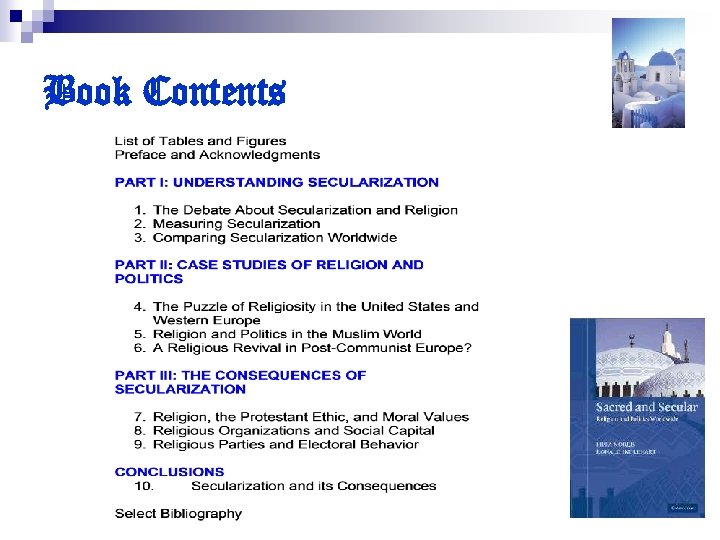 Book Contents
 I: Theories of secularization n Max Weber – Enlightenment Rationality n n Emile Durkheim - Functionalism n n The loss of faith The loss of purpose due to functional differentiation Stark and Finke - Religious market theory n n n “After nearly three centuries of utterly failed prophesies and misrepresentations of both present and past, it seems time to carry the secularization doctrine to the graveyard of failed theories, and there to whisper ‘requiescat in pace’” Stark and Finke. 2000. Acts of Faith. Public ‘demand’ for religion is constant Supply-side competition among clergy energizes religiosity Established churches dampen competition Religious participation explained by religious pluralism and freedom of religion
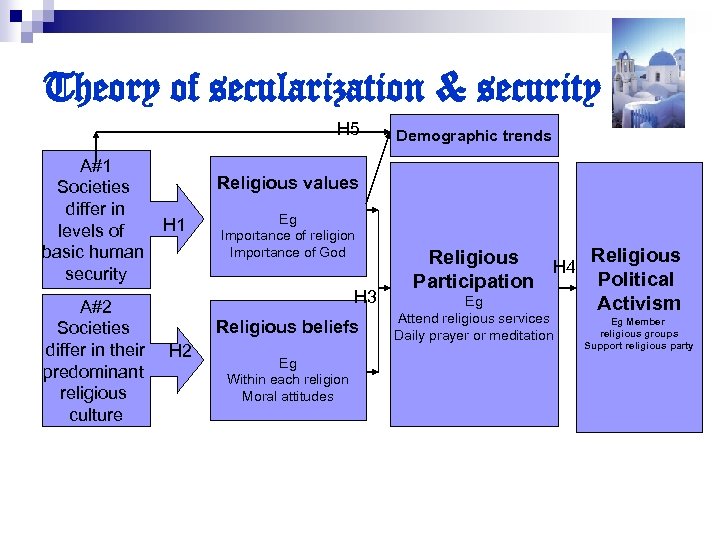 Theory of secularization & security H 5 A#1 Societies differ in levels of basic human security A#2 Societies differ in their predominant religious culture Demographic trends Religious values H 1 Eg Importance of religion Importance of God H 3 Religious beliefs H 2 Eg Within each religion Moral attitudes Religious H 4 Political Participation Eg Activism Attend religious services Daily prayer or meditation Eg Member religious groups Support religious party
 II. Research design?
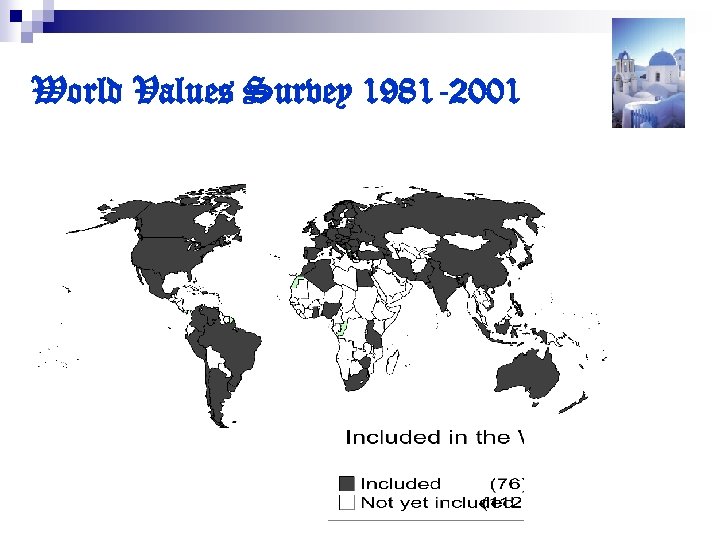 World Values Survey 1981 -2001
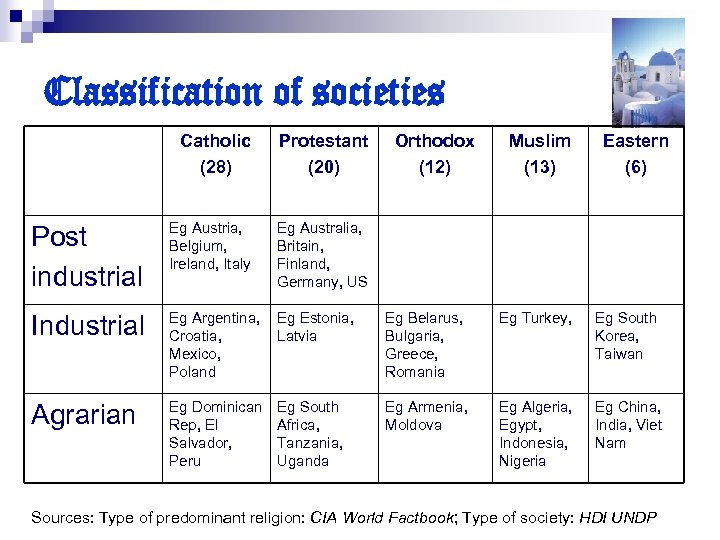 Classification of societies Catholic (28) Protestant (20) Orthodox (12) Muslim (13) Eastern (6) Post industrial Eg Austria, Belgium, Ireland, Italy Eg Australia, Britain, Finland, Germany, US Industrial Eg Argentina, Croatia, Mexico, Poland Eg Estonia, Latvia Eg Belarus, Bulgaria, Greece, Romania Eg Turkey, Eg South Korea, Taiwan Agrarian Eg Dominican Rep, El Salvador, Peru Eg South Africa, Tanzania, Uganda Eg Armenia, Moldova Eg Algeria, Egypt, Indonesia, Nigeria Eg China, India, Viet Nam Sources: Type of predominant religion: CIA World Factbook; Type of society: HDI UNDP
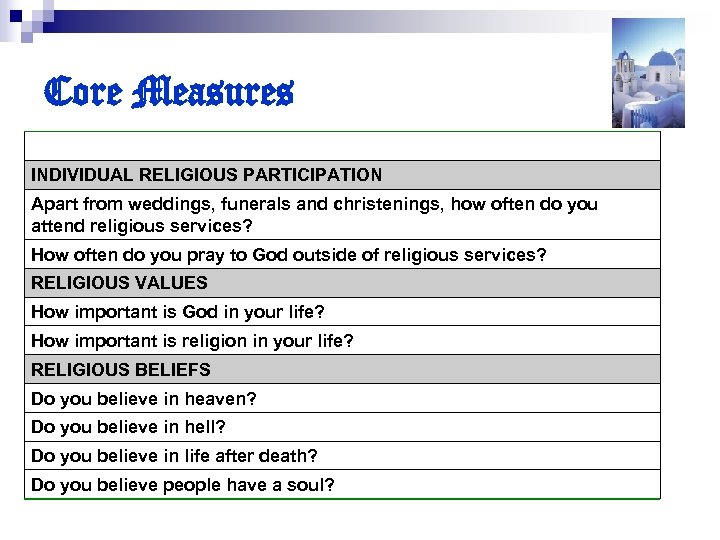 Core Measures INDIVIDUAL RELIGIOUS PARTICIPATION Apart from weddings, funerals and christenings, how often do you attend religious services? How often do you pray to God outside of religious services? RELIGIOUS VALUES How important is God in your life? How important is religion in your life? RELIGIOUS BELIEFS Do you believe in heaven? Do you believe in hell? Do you believe in life after death? Do you believe people have a soul?
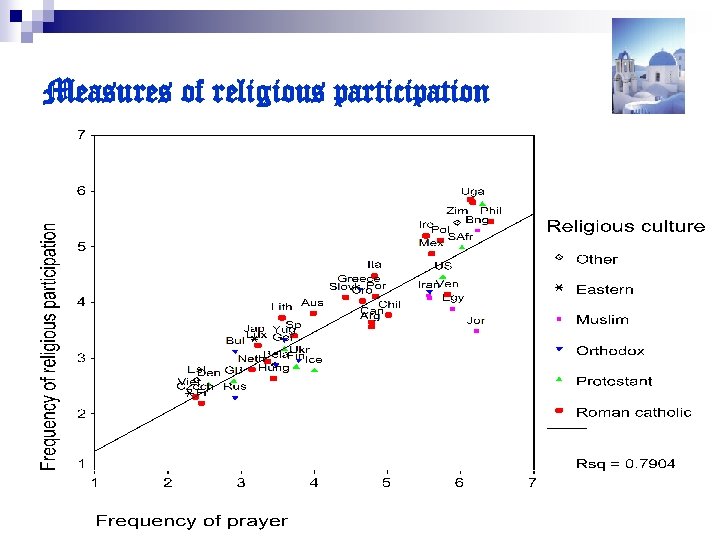 Measures of religious participation
 Evidence n Cross-national ¨ Comparisons n Time-series ¨ Trends n in survey data (WVS, Gallup, EB) Generational comparisons ¨ By n by type of society birth cohort Sectoral comparisons ¨ Individual-level within societies
 III: Evidence
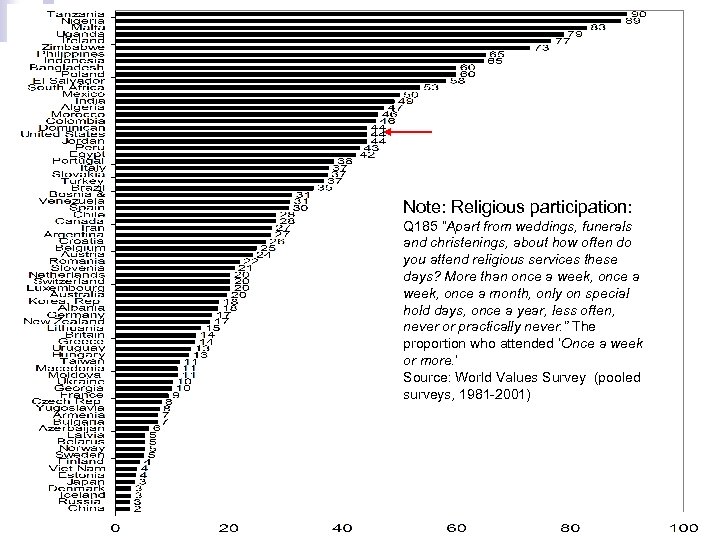 Note: Religious participation: Q 185 “Apart from weddings, funerals and christenings, about how often do you attend religious services these days? More than once a week, once a month, only on special hold days, once a year, less often, never or practically never. ” The proportion who attended ‘Once a week or more. ’ Source: World Values Survey (pooled surveys, 1981 -2001)
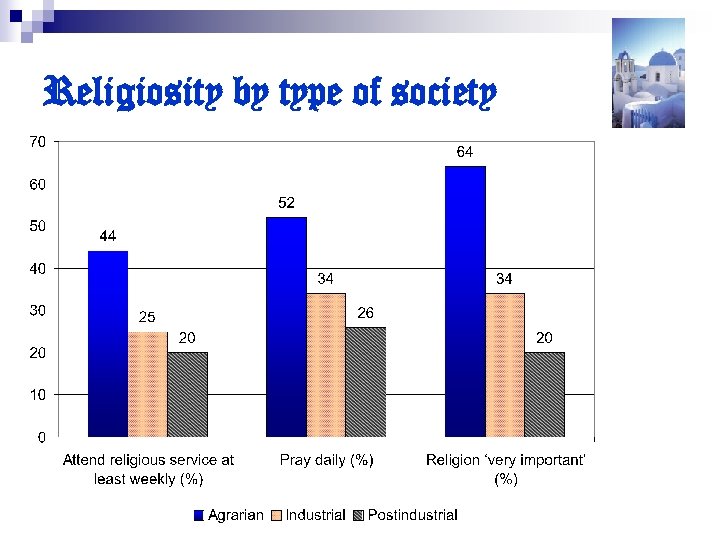 Religiosity by type of society
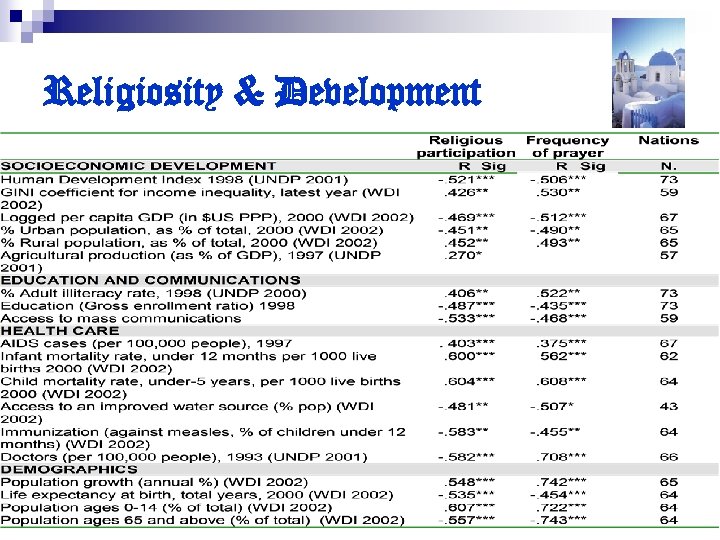 Religiosity & Development
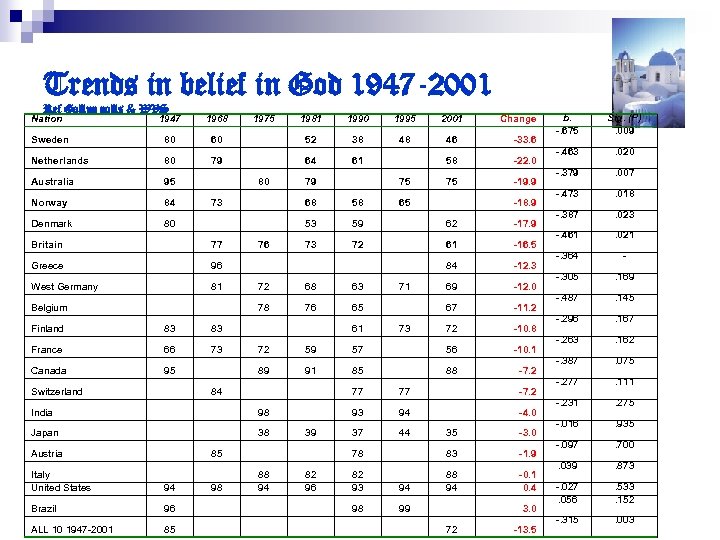 Trends in belief in God 1947 -2001 Ref Gallup polls & WVS Nation 1947 1968 Sweden 80 Netherlands 80 Australia 95 Norway 84 Denmark 1975 1981 1990 1995 2001 60 52 38 48 46 -33. 6 79 64 61 58 -22. 0 75 -19. 9 80 80 73 79 75 77 Greece 81 59 62 -17. 9 73 72 61 -16. 5 84 76 58 -12. 3 69 -12. 0 67 -11. 2 72 -10. 8 96 West Germany 68 53 Britain 65 Finland 83 66 73 Canada 95 68 63 76 65 83 France 72 78 Belgium Switzerland 61 57 56 -10. 1 89 91 85 88 -7. 2 77 Japan 38 39 Brazil 96 ALL 10 1947 -2001 85 -7. 2 94 -4. 0 37 44 88 94 82 96 35 -3. 0 78 85 98 77 93 98 94 73 59 India Italy United States 71 -18. 9 72 84 Austria Change 83 -1. 9 82 93 94 88 94 -0. 1 0. 4 98 99 3. 0 72 -13. 5 b. -. 675 Sig. (P). 009 -. 463 . 020 -. 379 . 007 -. 473 . 018 -. 387 . 023 -. 461 . 021 -. 364 - -. 305 . 169 -. 487 . 145 -. 296 . 167 -. 263 . 162 -. 387 . 075 -. 277 . 111 -. 231 . 275 -. 016 . 935 -. 097 . 700 . 039 . 873 -. 027. 056 . 533. 152 -. 315 . 003
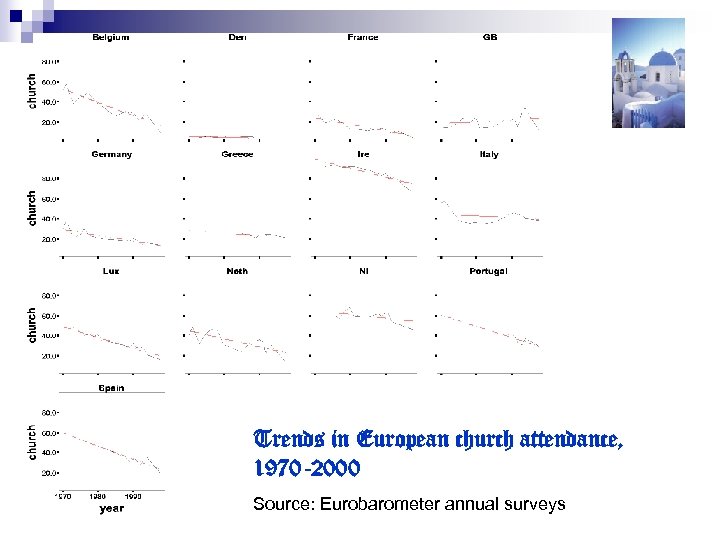 Trends in European church attendance, 1970 -2000 Source: Eurobarometer annual surveys
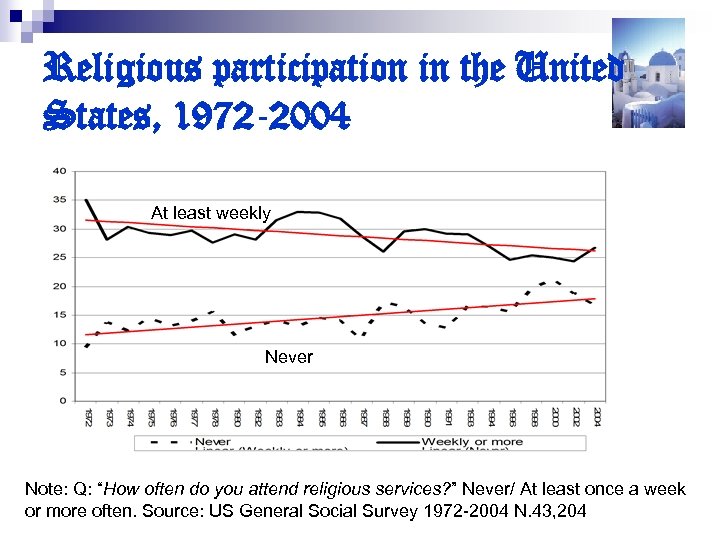 Religious participation in the United States, 1972 -2004 Once a week+ At least weekly Never Note: Q: “How often do you attend religious services? ” Never/ At least once a week or more often. Source: US General Social Survey 1972 -2004 N. 43, 204
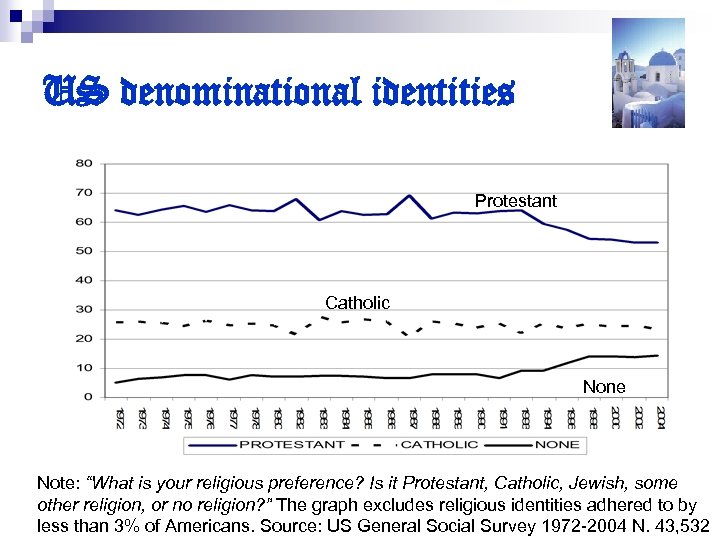 US denominational identities Protestant Catholic None Note: “What is your religious preference? Is it Protestant, Catholic, Jewish, some other religion, or no religion? ” The graph excludes religious identities adhered to by less than 3% of Americans. Source: US General Social Survey 1972 -2004 N. 43, 532
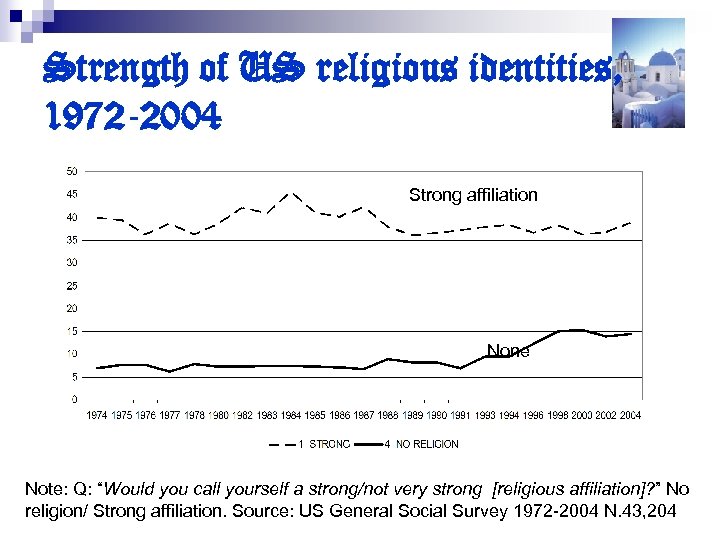 Strength of US religious identities, 1972 -2004 Strong affiliation None Note: Q: “Would you call yourself a strong/not very strong [religious affiliation]? ” No religion/ Strong affiliation. Source: US General Social Survey 1972 -2004 N. 43, 204
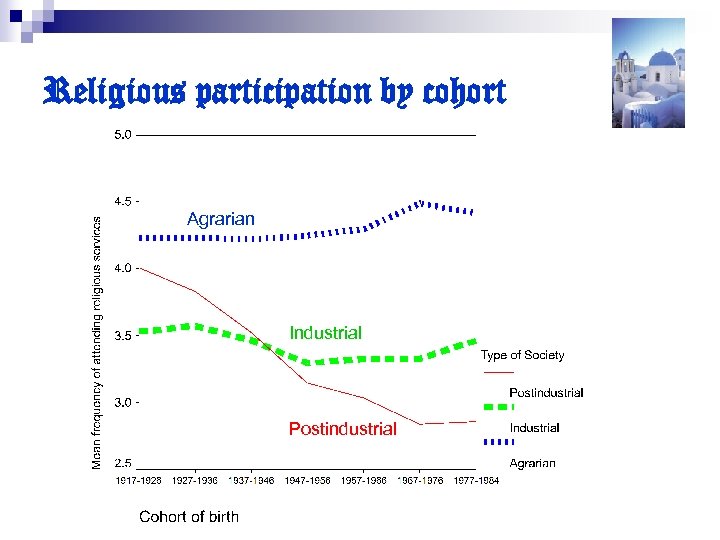 Religious participation by cohort Agrarian Industrial Postindustrial
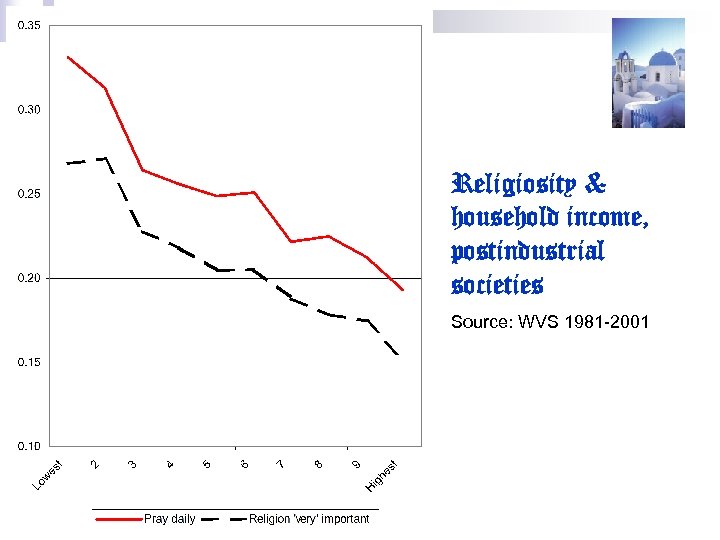 Religiosity & household income, postindustrial societies Source: WVS 1981 -2001
 Supply-side theory?
 Indicators of supply-side n n Religious pluralism: the Herfindahl Index (Alesina 2002) The state regulation of religion: Scale measured by Mark Chaves and David E. Cann (1992). Freedom House religious freedom scale, 2001. www. freedomhouse. org Religious Freedom Index
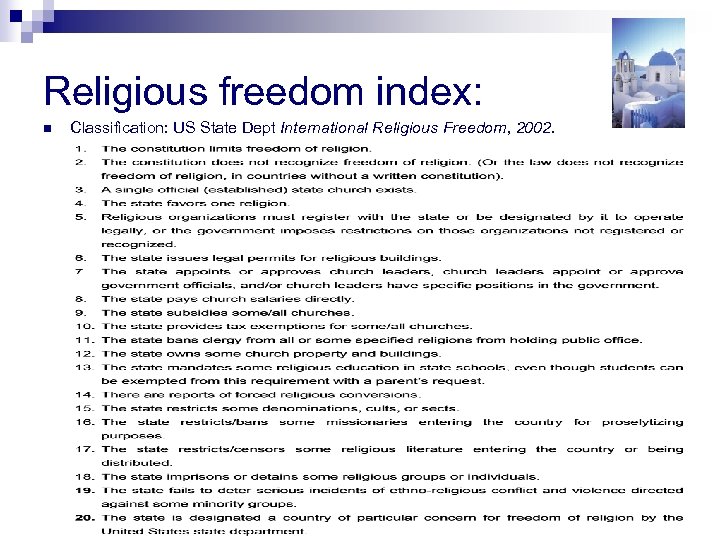 Religious freedom index: n Classification: US State Dept International Religious Freedom, 2002.
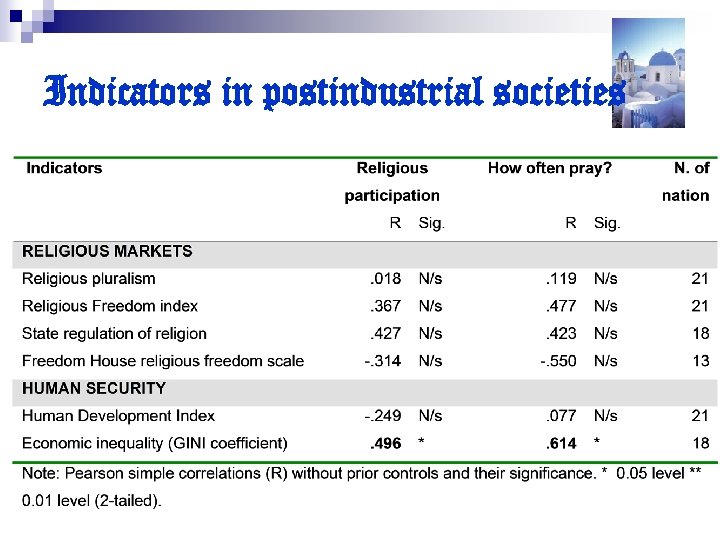 Indicators in postindustrial societies
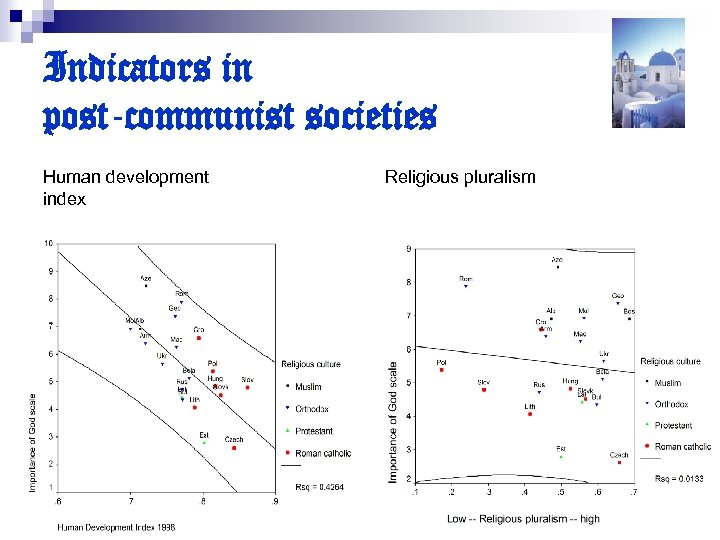 Indicators in post-communist societies Human development index Religious pluralism
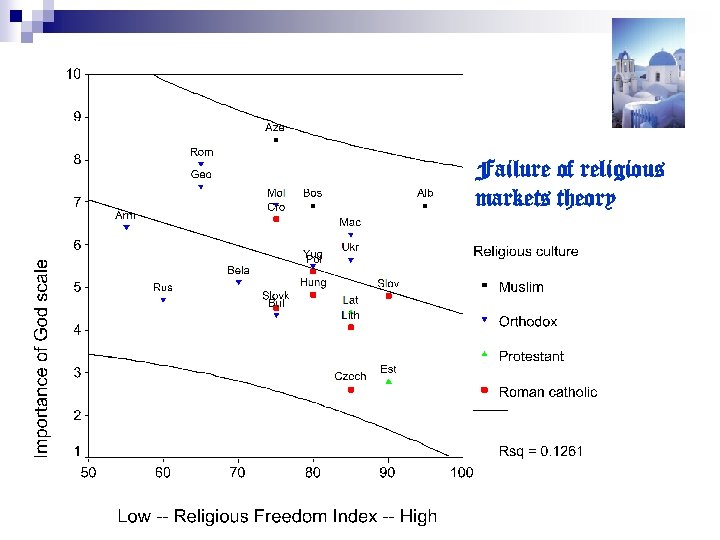 Failure of religious markets theory
 Yet religious population expands
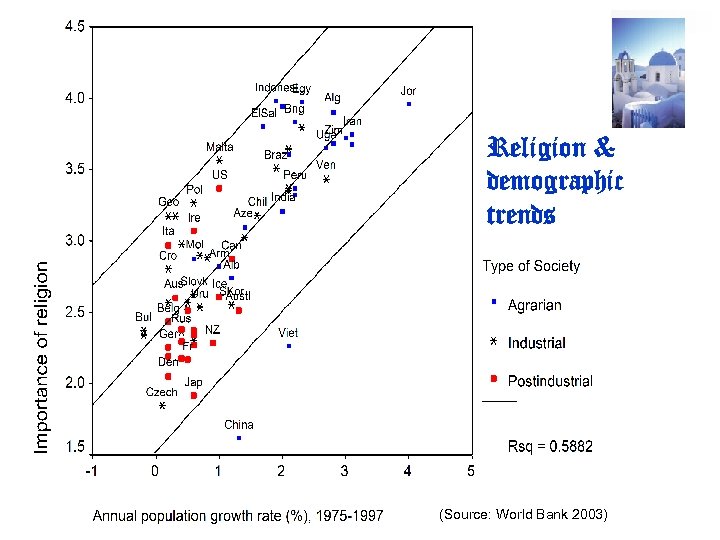 Religion & demographic trends (Source: World Bank 2003)
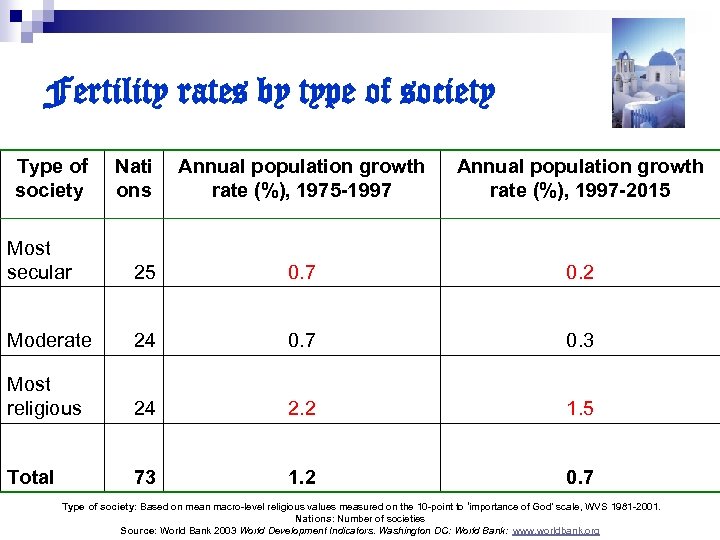 Fertility rates by type of society Type of society Nati ons Annual population growth rate (%), 1975 -1997 Annual population growth rate (%), 1997 -2015 Most secular 25 0. 7 0. 2 Moderate 24 0. 7 0. 3 Most religious 24 2. 2 1. 5 Total 73 1. 2 0. 7 Type of society: Based on mean macro-level religious values measured on the 10 -point to ‘importance of God’ scale, WVS 1981 -2001. Nations: Number of societies Source: World Bank 2003 World Development Indicators. Washington DC: World Bank: www. worldbank. org
 IV: Conclusions
 Conclusions 1. 2. 3. Virtually all advanced industrial societies are moving towards more secular orientations. Yet the world as a whole now has more people with traditional religious beliefs than ever before The religion gap becomes increasingly salient on the global agenda, yet the consequences for international conflict remain unclear. Further details/chapters: www. pippanorris. com
 Details: www. pippanorris. com
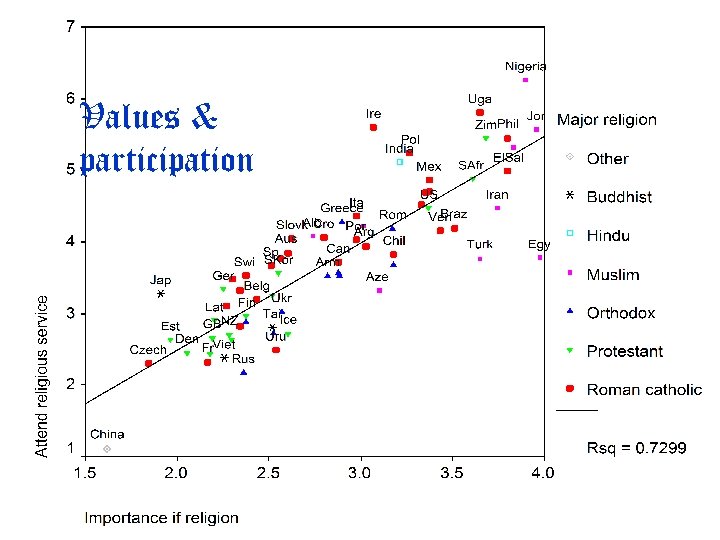 Values & participation
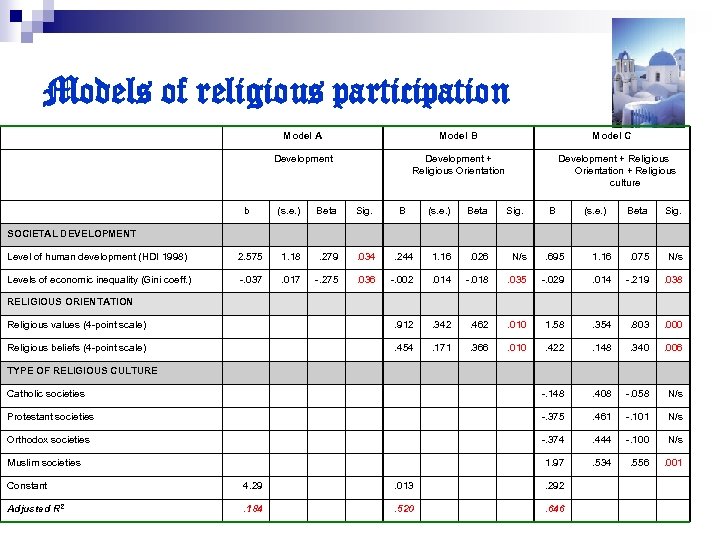 Models of religious participation Model A Development b Model B Development + Religious Orientation (s. e. ) Beta Sig. B (s. e. ) Beta Model C Development + Religious Orientation + Religious culture Sig. B (s. e. ) Beta Sig. SOCIETAL DEVELOPMENT Level of human development (HDI 1998) 2. 575 1. 18 . 279 . 034 . 244 1. 16 . 026 N/s . 695 1. 16 . 075 N/s Levels of economic inequality (Gini coeff. ) -. 037 . 017 -. 275 . 036 -. 002 . 014 -. 018 . 035 -. 029 . 014 -. 219 . 038 Religious values (4 -point scale) . 912 . 342 . 462 . 010 1. 58 . 354 . 803 . 000 Religious beliefs (4 -point scale) . 454 . 171 . 366 . 010 . 422 . 148 . 340 . 006 Catholic societies -. 148 . 408 -. 058 N/s Protestant societies -. 375 . 461 -. 101 N/s Orthodox societies -. 374 . 444 -. 100 N/s 1. 97 . 534 . 556 . 001 RELIGIOUS ORIENTATION TYPE OF RELIGIOUS CULTURE Muslim societies Constant 4. 29 . 013 . 292 Adjusted R 2 . 184 . 520 . 646