


 Скачать презентацию SAARC Training Program on Climate Change Adaptation and
1c1e776610a484ae3e1e4ec44312989d.ppt
- Количество слайдов: 43
 SAARC Training Program on Climate Change Adaptation and Disaster Risk Reduction in South Asia Global Climate Change Scenario Dr. A. K. M. Saiful Islam Associate Professor, IWFM Coordinator , Climate Change Study Cell Bangladesh University of Engineering and Technology
 Outline § Introduction to Climatic System § Green House Effect and Global Warming § Status of Global Climate Change § Climate Change Predictions § Climate Change Scenarios for Bangladesh § Overview of the Impact of Climate Change Copy right @ Dr. A. K. M. Saiful Islam, IWFM, BUET
 Climate Systems • The complicated system consisting of various components, including the dynamics and composition of the atmosphere, the ocean, the ice and snow cover, the land surface and its features, the many mutual interactions between them, and the large variety of physical, chemical and biological processes taking place in and among these components. • Climate refers to the state of the climate system as a whole, including a statistical description of its variations. § Atmosphere – 78% nitrogen, 21% oxygen, and 1% other gases. – Carbon dioxide accounts for just 0. 03 - 0. 04%. – Water vapor 0 to 2% Copy right @ Dr. A. K. M. Saiful Islam, IWFM, BUET
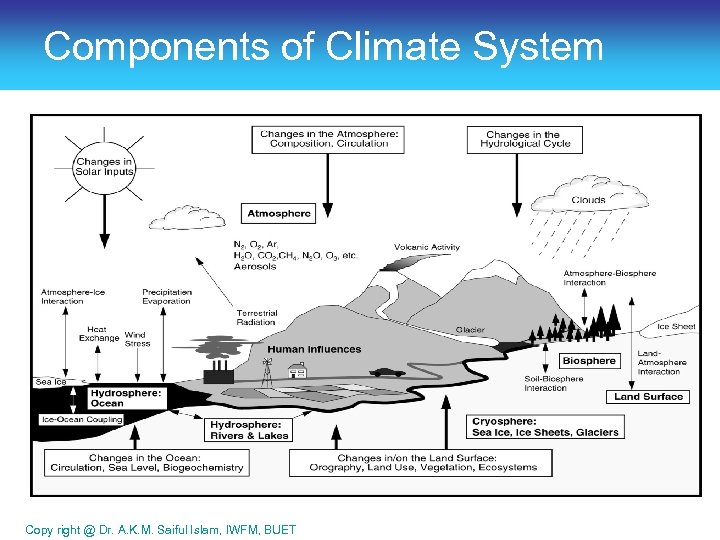 Components of Climate System Copy right @ Dr. A. K. M. Saiful Islam, IWFM, BUET
 Green house gases § CO 2 and some other minor gases 1. Absorb some of thermal radiation leaving the surface of the earth. 2. Emit radiation from much higher and colder levels out to space. § These radiatively active gases are known as greenhouse gases. – They act as a partial blanket for thermal radiation from the surface which enables it to be substantially warmer than it would otherwise be, analogous to the effect of a greenhouse. Copy right @ Dr. A. K. M. Saiful Islam, IWFM, BUET
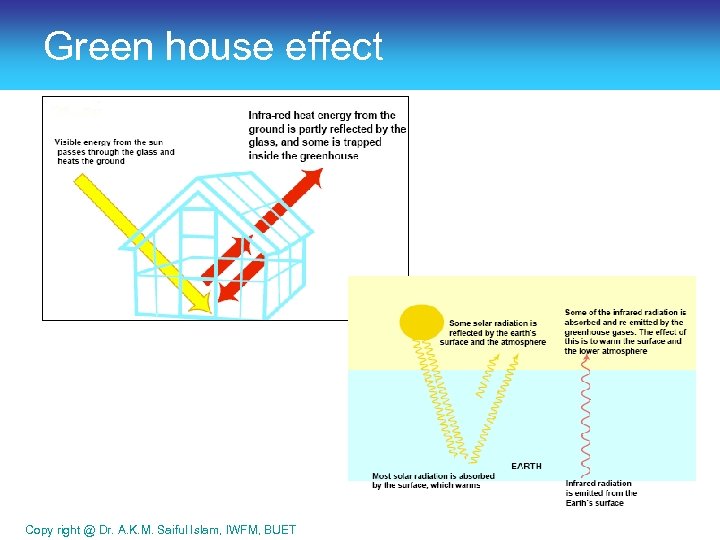 Green house effect Copy right @ Dr. A. K. M. Saiful Islam, IWFM, BUET
 Human induced climate variation § Perturbations of the atmospheric composition – the enhanced greenhouse effect § Effect of aerosols: – direct effect (scattering of incoming solar radiation) – indirect effect (affecting the radiative properties of clouds) § Land-use change (agriculture, deforestation, reforestation, afforestation, urbanisation, traffic, …) Copy right @ Dr. A. K. M. Saiful Islam, IWFM, BUET
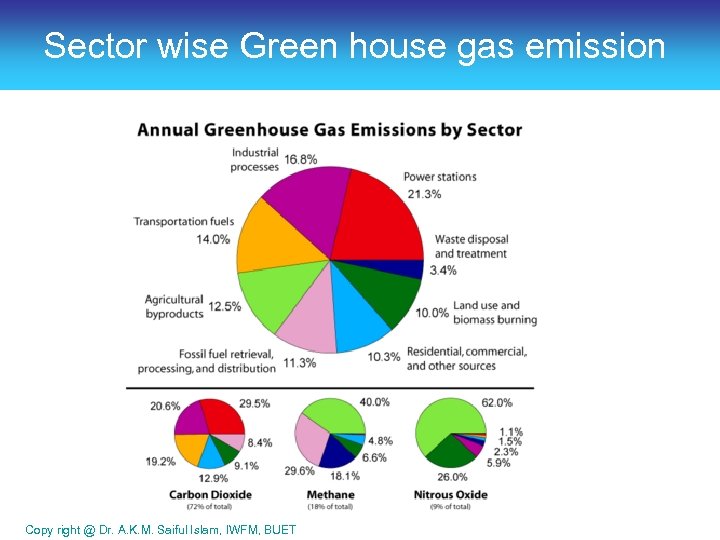 Sector wise Green house gas emission Copy right @ Dr. A. K. M. Saiful Islam, IWFM, BUET
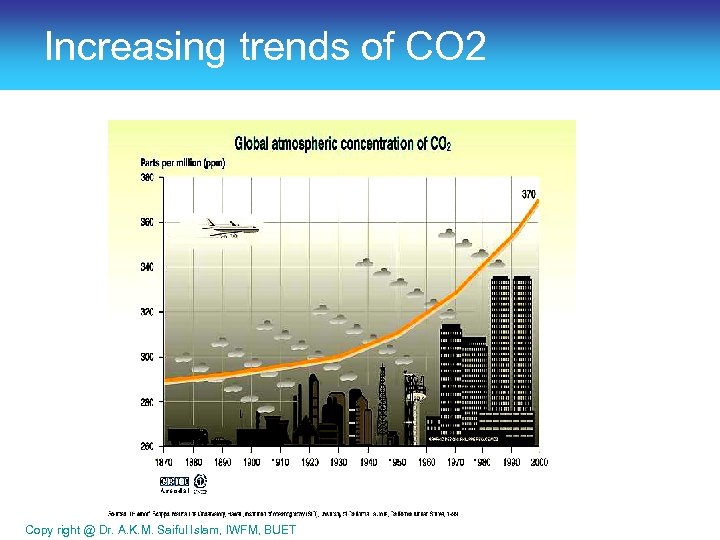 Increasing trends of CO 2 Copy right @ Dr. A. K. M. Saiful Islam, IWFM, BUET
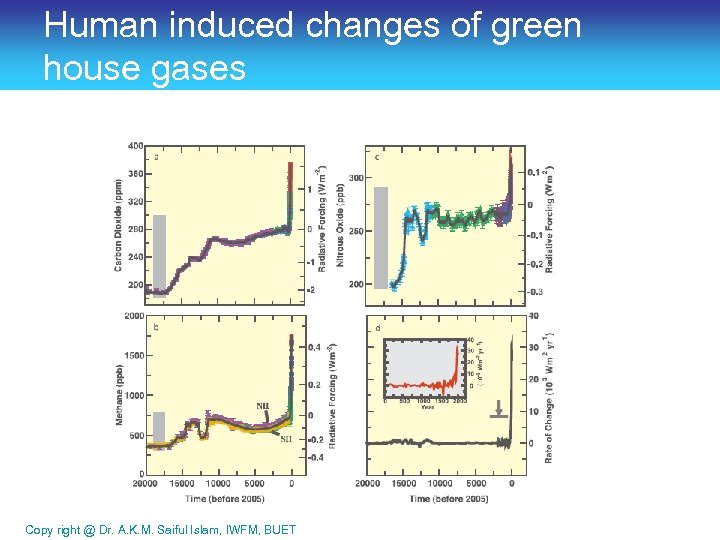 Human induced changes of green house gases Copy right @ Dr. A. K. M. Saiful Islam, IWFM, BUET
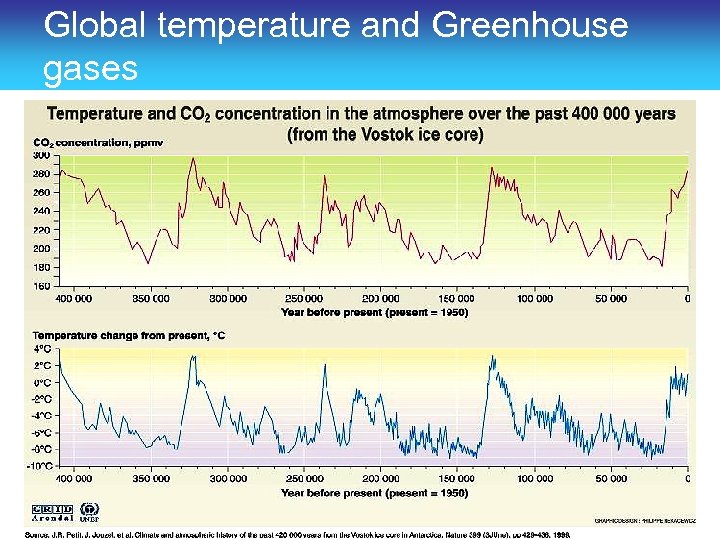 Global temperature and Greenhouse gases Copy right @ Dr. A. K. M. Saiful Islam, IWFM, BUET
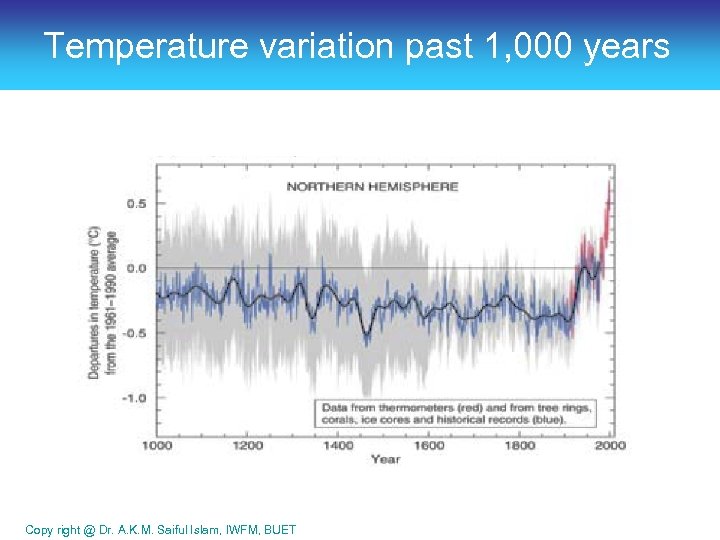 Temperature variation past 1, 000 years Copy right @ Dr. A. K. M. Saiful Islam, IWFM, BUET
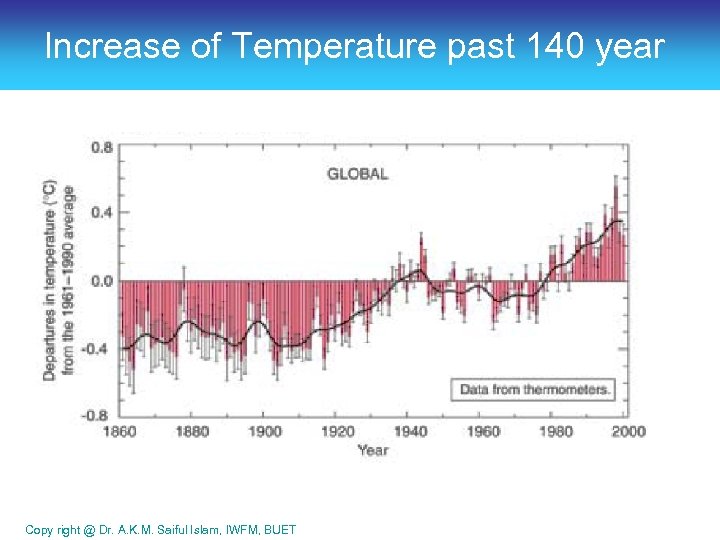 Increase of Temperature past 140 year Copy right @ Dr. A. K. M. Saiful Islam, IWFM, BUET
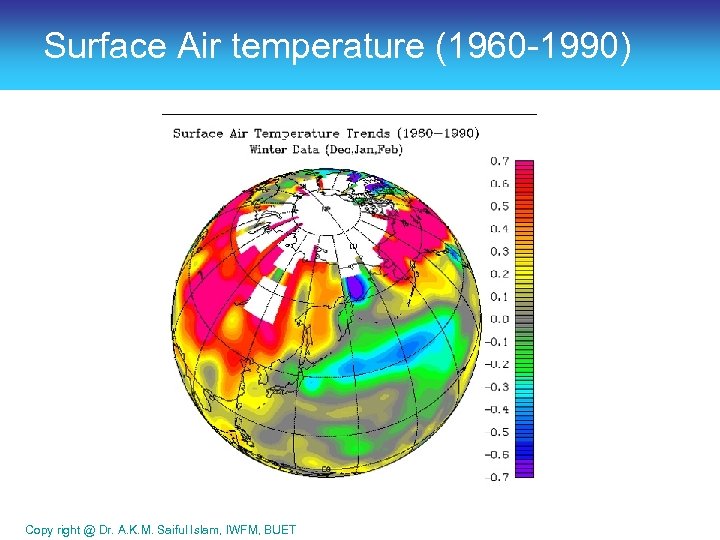 Surface Air temperature (1960 -1990) Copy right @ Dr. A. K. M. Saiful Islam, IWFM, BUET
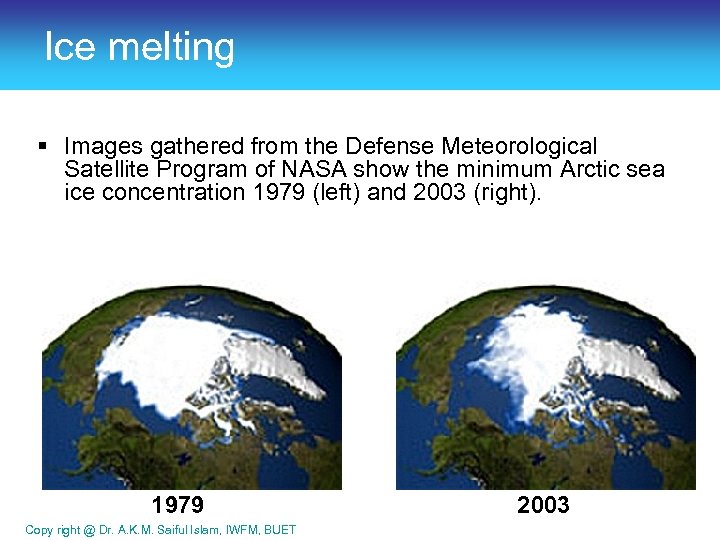 Ice melting § Images gathered from the Defense Meteorological Satellite Program of NASA show the minimum Arctic sea ice concentration 1979 (left) and 2003 (right). 1979 Copy right @ Dr. A. K. M. Saiful Islam, IWFM, BUET 2003
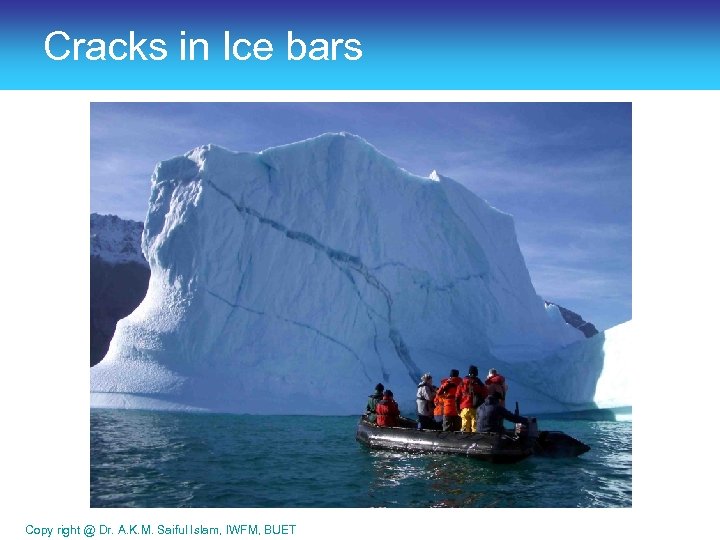 Cracks in Ice bars Copy right @ Dr. A. K. M. Saiful Islam, IWFM, BUET
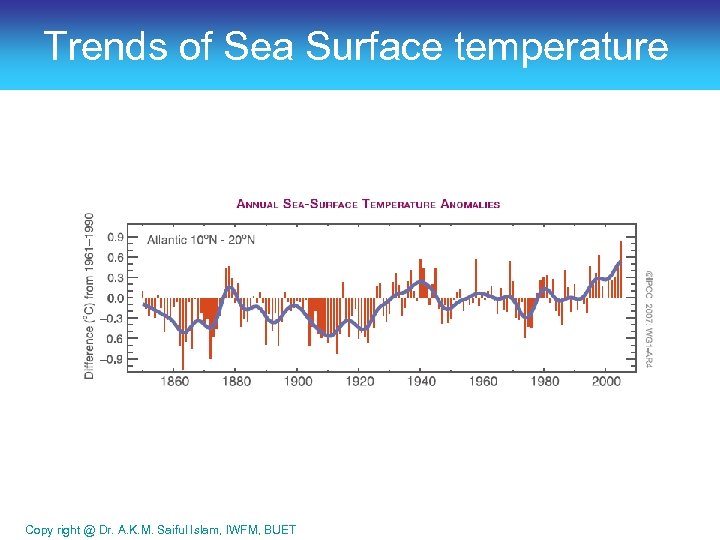 Trends of Sea Surface temperature Copy right @ Dr. A. K. M. Saiful Islam, IWFM, BUET
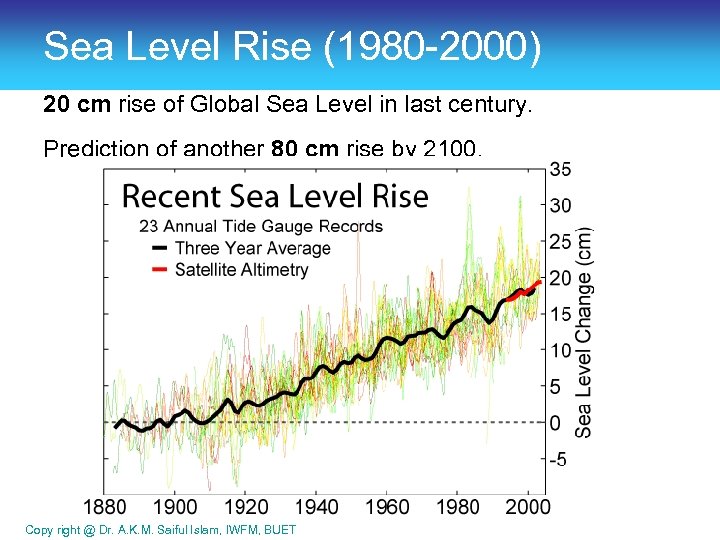 Sea Level Rise (1980 -2000) 20 cm rise of Global Sea Level in last century. Prediction of another 80 cm rise by 2100. Copy right @ Dr. A. K. M. Saiful Islam, IWFM, BUET
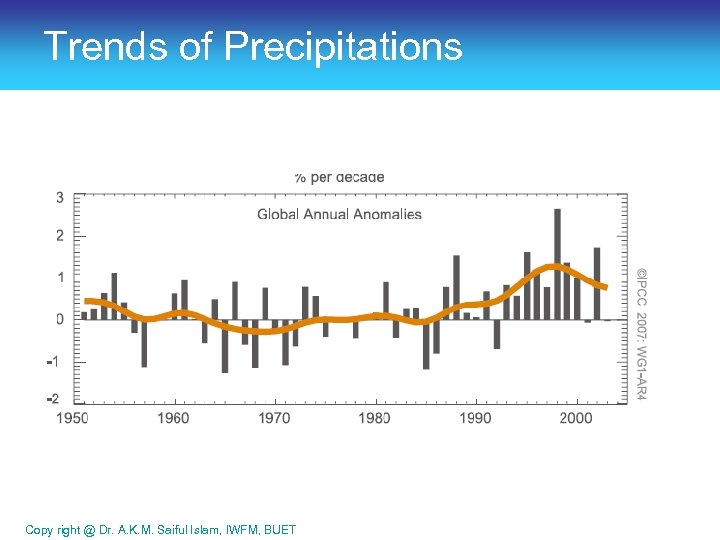 Trends of Precipitations Copy right @ Dr. A. K. M. Saiful Islam, IWFM, BUET
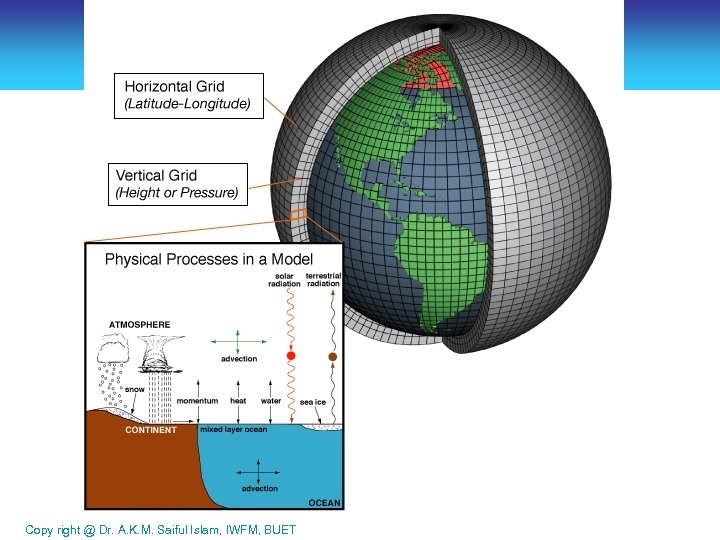
 Climate Models to predict climate change § Climate models are computer-based simulations that use mathematical formulas to re-create the chemical and physical processes that drive Earth’s climate. § To “run” a model, scientists divide the planet into a 3 dimensional grid, apply the basic equations, and evaluate the results. § Atmospheric models calculate winds, heat transfer, radiation, relative humidity, and surface hydrology within each grid and evaluate interactions with neighboring points. § Climate models use quantitative methods to simulate the interactions of the atmosphere, oceans, land surface, and ice. Copy right @ Dr. A. K. M. Saiful Islam, IWFM, BUET
 Copy right @ Dr. A. K. M. Saiful Islam, IWFM, BUET
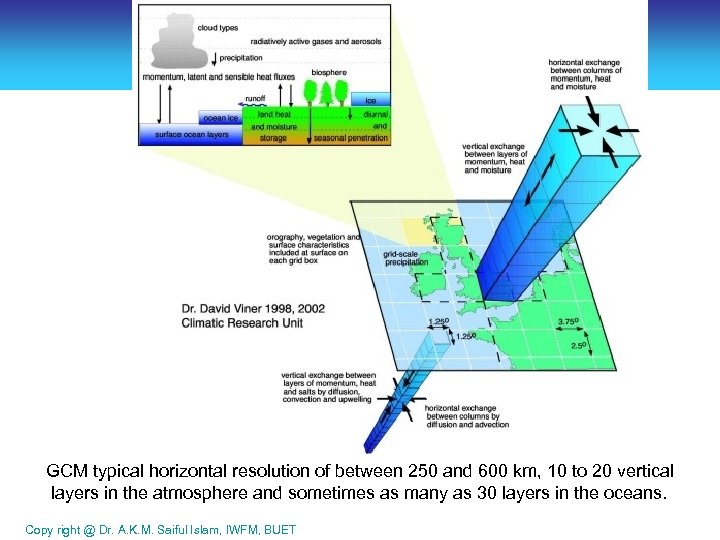 GCM typical horizontal resolution of between 250 and 600 km, 10 to 20 vertical layers in the atmosphere and sometimes as many as 30 layers in the oceans. Copy right @ Dr. A. K. M. Saiful Islam, IWFM, BUET
 Special Report on Emissions Scenarios (SRES) § The Special Report on Emissions Scenarios (SRES) was a report prepared by the Intergovernmental Panel on Climate Change (IPCC) for the Third Assessment Report (TAR) in 2001, on future emission scenarios to be used for driving global circulation models to develop climate change scenarios. § It was used to replace the IS 92 scenarios used for the IPCC Second Assessment Report of 1995. The SRES Scenarios were also used for the Fourth Assessment Report (AR 4) in 2007. Copy right @ Dr. A. K. M. Saiful Islam, IWFM, BUET
 SERS Emission Scenarios § A 1 - a future world of very rapid economic growth, global population that peaks in mid-century and declines thereafter, and the rapid introduction of new and more efficient technologies. Three sub groups: fossil intensive (A 1 FI), non-fossil energy sources (A 1 T), or a balance across all sources (A 1 B). § A 2 - A very heterogeneous world. The underlying theme is that of strengthening regional cultural identities, with an emphasis on family values and local traditions, high population growth, and less concern for rapid economic development. § B 1 - a convergent world with the same global population, that peaks in mid-century and declines thereafter, as in the A 1 storyline. § B 2 - a world in which the emphasis is on local solutions to economic, social and environmental sustainability. Copy right @ Dr. A. K. M. Saiful Islam, IWFM, BUET
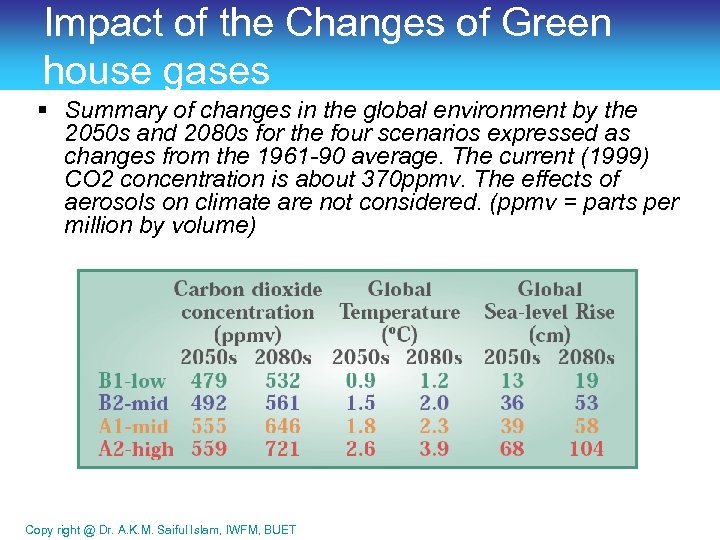 Impact of the Changes of Green house gases § Summary of changes in the global environment by the 2050 s and 2080 s for the four scenarios expressed as changes from the 1961 -90 average. The current (1999) CO 2 concentration is about 370 ppmv. The effects of aerosols on climate are not considered. (ppmv = parts per million by volume) Copy right @ Dr. A. K. M. Saiful Islam, IWFM, BUET
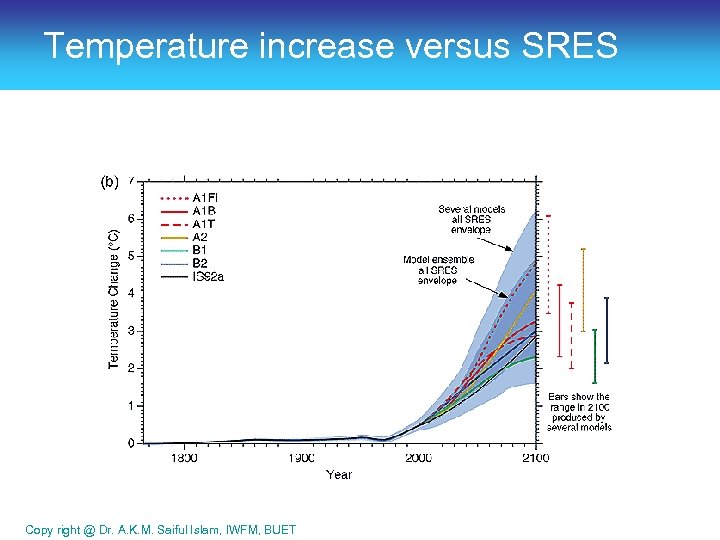 Temperature increase versus SRES Copy right @ Dr. A. K. M. Saiful Islam, IWFM, BUET
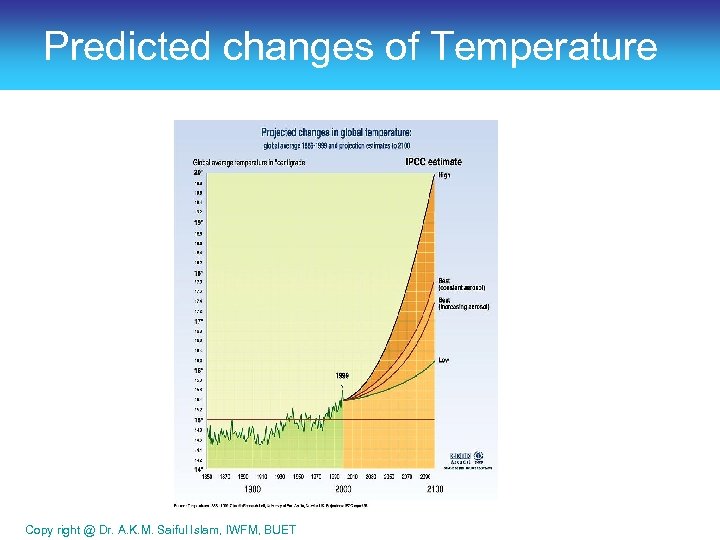 Predicted changes of Temperature Copy right @ Dr. A. K. M. Saiful Islam, IWFM, BUET
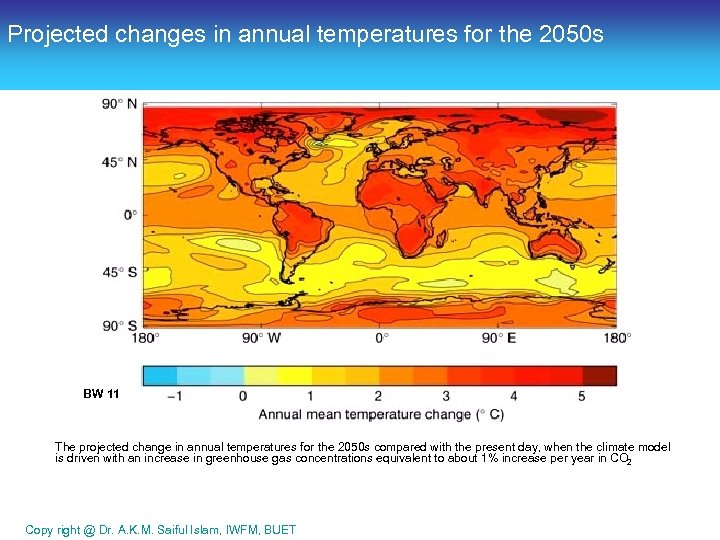 Projected changes in annual temperatures for the 2050 s BW 11 The projected change in annual temperatures for the 2050 s compared with the present day, when the climate model is driven with an increase in greenhouse gas concentrations equivalent to about 1% increase per year in CO 2 Copy right @ Dr. A. K. M. Saiful Islam, IWFM, BUET
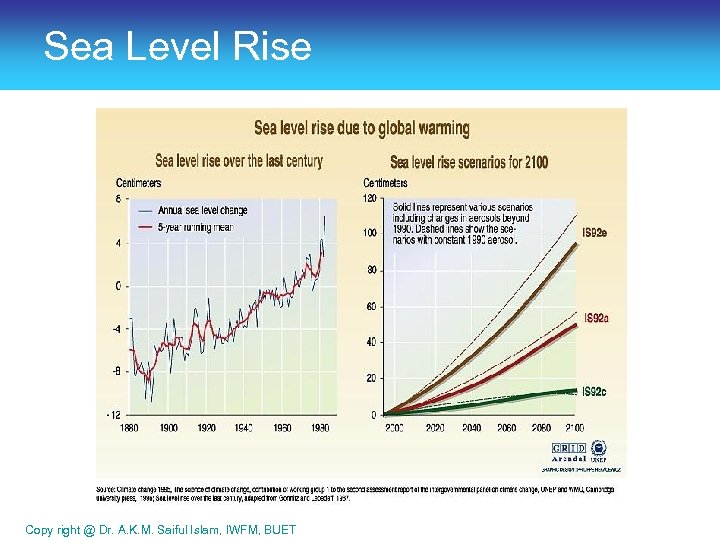 Sea Level Rise Copy right @ Dr. A. K. M. Saiful Islam, IWFM, BUET
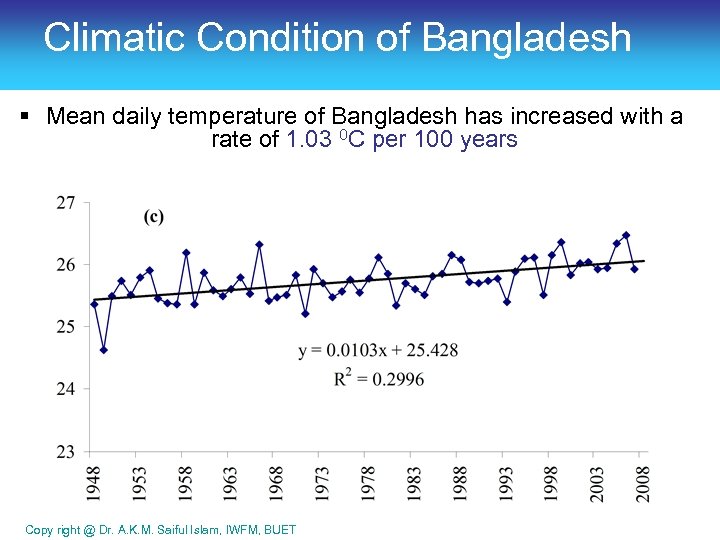 Climatic Condition of Bangladesh § Mean daily temperature of Bangladesh has increased with a rate of 1. 03 0 C per 100 years Copy right @ Dr. A. K. M. Saiful Islam, IWFM, BUET
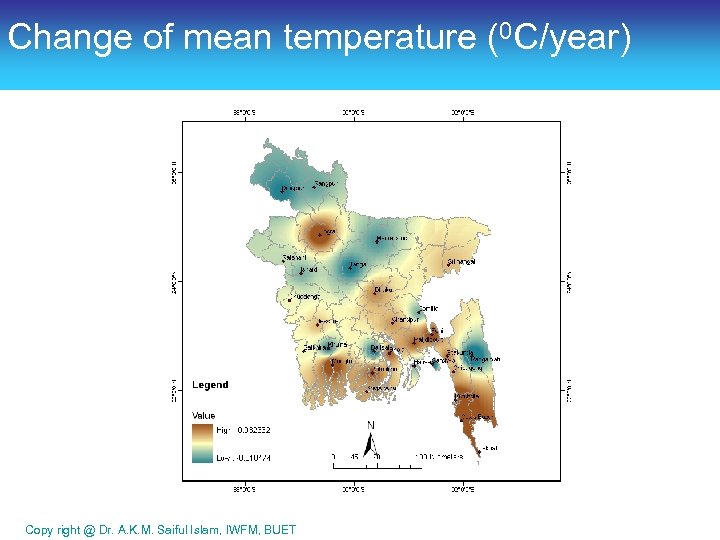 Change of mean temperature (0 C/year) Copy right @ Dr. A. K. M. Saiful Islam, IWFM, BUET
![Predicting Rainfall [Output of PRECIS model using SRES A 2 scenario] Copy right @](https://present5.com/presentation/1c1e776610a484ae3e1e4ec44312989d/image-32.jpg "Predicting Rainfall [Output of PRECIS model using SRES A 2 scenario] Copy right @") Predicting Rainfall [Output of PRECIS model using SRES A 2 scenario] Copy right @ Dr. A. K. M. Saiful Islam, IWFM, BUET
Predicting Rainfall [Output of PRECIS model using SRES A 2 scenario] Copy right @ Dr. A. K. M. Saiful Islam, IWFM, BUET
![Predicting Maximum Temperature [Output of PRECIS model using SRES A 2 scenario] Copy right](https://present5.com/presentation/1c1e776610a484ae3e1e4ec44312989d/image-33.jpg "Predicting Maximum Temperature [Output of PRECIS model using SRES A 2 scenario] Copy right") Predicting Maximum Temperature [Output of PRECIS model using SRES A 2 scenario] Copy right @ Dr. A. K. M. Saiful Islam, IWFM, BUET
Predicting Maximum Temperature [Output of PRECIS model using SRES A 2 scenario] Copy right @ Dr. A. K. M. Saiful Islam, IWFM, BUET
![Predicting Minimum Temperature [Output of PRECIS model using SRES A 2 scenario] Copy right](https://present5.com/presentation/1c1e776610a484ae3e1e4ec44312989d/image-34.jpg "Predicting Minimum Temperature [Output of PRECIS model using SRES A 2 scenario] Copy right") Predicting Minimum Temperature [Output of PRECIS model using SRES A 2 scenario] Copy right @ Dr. A. K. M. Saiful Islam, IWFM, BUET
Predicting Minimum Temperature [Output of PRECIS model using SRES A 2 scenario] Copy right @ Dr. A. K. M. Saiful Islam, IWFM, BUET
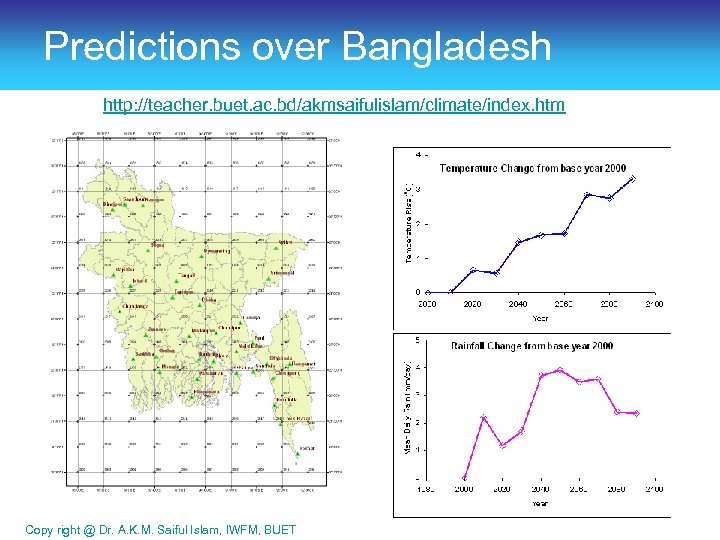 Predictions over Bangladesh http: //teacher. buet. ac. bd/akmsaifulislam/climate/index. htm Copy right @ Dr. A. K. M. Saiful Islam, IWFM, BUET
 Overview of the Impacts of climate change § Human Health impacts § Ecosystem Impacts § Agriculture Impacts § Water Resources Impacts § Market Impacts Copy right @ Dr. A. K. M. Saiful Islam, IWFM, BUET
 Human Health impacts § Expansion of the areas of potential transmission of malaria and dengue fever (medium-to-high confidence); roughly 300 million more people at risk of malaria § Increased heat-related deaths and illness, affecting particularly the elderly, sick, and those without access to air conditioning § Increased risks to human life, risk of infectious disease epidemics and many other health risks where floods, droughts or storms increase in frequency and/or intensity § Decreased winter deaths in some temperate regions Copy right @ Dr. A. K. M. Saiful Islam, IWFM, BUET
 Ecosystem Impacts § Coral death from exposure to 3 -4 ºC higher seasonal maximum seasurface temperatures for 6 months or more § Substantial reduction in glacier and ice-cap volume; tropical glaciers particularly vulnerable to elimination § Loss of unique vegetation systems and their endemic species (e. g. vegetation of Cape region of South Africa and some cloud forests) § Extensive reduction in Arctic summer sea-ice extent with benefits for shipping but adverse effects on sea-ice dependent animals (e. g. polar bears, seals, walrus) § Coastal wetland loss from sea level rise (up to 10% globally for 20 cm rise, higher percentages in some areas) § Increased disturbances of ecosystems by fire and insect pests § Increase net primary productivity of many mid- and high-latitude forests § Extinction of some critically-endangered and endangered species Copy right @ Dr. A. K. M. Saiful Islam, IWFM, BUET
 Agriculture Impacts § General decrease in cereal crop yields in mid-latitudes § Decreased crop yields in areas of increased drought § Food prices increase relative to projections that exclude climate change § Decreased cereal crop yields in most tropical and subtropical regions § Increased heat stress in livestock and crop damage from heat waves § Decreased frost damage for some crops Copy right @ Dr. A. K. M. Saiful Islam, IWFM, BUET
 Water Resources Impacts § Decreased water quantity and quality in some areas of increased drought § Increased flood damage due to more intense precipitation events § Decreased water supply in many water stressed countries (half-billion people in central Asia, southern Africa, and countries surrounding the Mediterranean affected) § Increased water supply in some other water stressed countries (e. g. parts of Asia) Copy right @ Dr. A. K. M. Saiful Islam, IWFM, BUET
 Market Impacts § Net market sector losses most regions and for global aggregate § Increased insurance prices and reduced insurance availability in response to increased frequency and intensity of some extreme climate events § Decreased energy demand for heating buildings in winter and increased energy demand for cooling buildings in summer § Net market sector losses in many developing countries Copy right @ Dr. A. K. M. Saiful Islam, IWFM, BUET
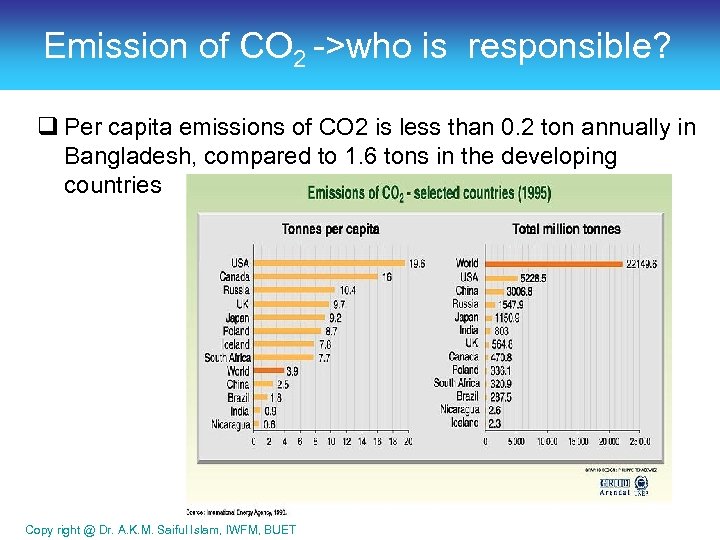 Emission of CO 2 ->who is responsible? q Per capita emissions of CO 2 is less than 0. 2 ton annually in Bangladesh, compared to 1. 6 tons in the developing countries Copy right @ Dr. A. K. M. Saiful Islam, IWFM, BUET
 Thank you Copy right @ Dr. A. K. M. Saiful Islam, IWFM, BUET