 Скачать презентацию SA 475 Trends in Technology Presented for Blue
fb174fe666c1687ac64541cc54694555.ppt
- Количество слайдов: 131



SA 475: Trends in Technology Presented for Blue. Cross Blue. Shield of South Carolina By The Rushing Center Furman University 1
Key Learning Outcomes When you complete this course you will be able to: 1) Contrast the evolutionary versus the revolutionary approach to technological innovation. 2) Distinguish between sustaining and disruptive technologies and innovations 3) Discuss the elements of an innovation strategy. 4) Give a brief description of the following emerging technologies/innovations: Grid (distributed/utility) computing Virtualization The Cloud Crowdsourcing Social Networking and Social Analytics Context Aware Computing Data mining Nanotechnology Quantum computing Bio Technology in computing 3 -D Printing Google’s Project Loon Advanced Robotics Big Data and Hadoop The Internet of Things 2
CONTENTS n n n Module 1: Evolutionary vs. Revolutionary Change Module 2: Sustaining vs. Disruptive Innovations Module 3: Some Emerging Technologies/Innovations Module 4: The Innovators Dilemma Module 5: Elements of an Innovation Strategy References 3
MODULE 1 Evolutionary vs. Revolutionary Change Blue. Cross and Blue. Shield of South Carolina The Rushing Center Furman University 4
Organizational Agility Kathy Harris, Vice President and Distinguished Analyst in Gartner's Executive Leadership and Innovation team, recently made the following observation: “Agility is an organization’s ability to sense changes and to respond efficiently and effectively to them. In 2009, if there’s one thing that organizations need, it’s agility. Our economy and the business environment are a steady stream of ups, downs and rapid change; in such an environment, the ability to sense, respond and react are true survival skills! … Aim to make your organization agile throughout – this means ensuring that people, processes and technology are flexible and adaptable to change. ” 5
Being a Change Leader Peter Drucker, who has written extensively about innovation and change, declares that it is “a central 21 st-century challenge that [organizations] become change leaders. ” He further asserts that change leader organizations will see change as opportunity, and hence will actively seek out the right kind of change for the organization. While we might be tempted to assume that such organizations would embrace bold and daring steps to establish themselves as change leaders, the process Drucker describes for doing this is an evolutionary as opposed to a revolutionary one. He advocates an analytical and systematic approach focused on creating continuous improvement as the primary basis for becoming a change leader. 6
Good to Great In his book, Good to Great, Jim Collins also finds evidence of the value of an evolutionary approach to change. In his study of companies that rose from good to great he found no pattern of singularly identifiable, transforming moments to which they could attribute their remarkable success. He writes, “revolutionary leaps in (company) results were evident, but not by revolutionary process. ” In other words, he found that, consistent with Drucker’s assertions, evolutionary, not revolutionary, processes were at work. 7
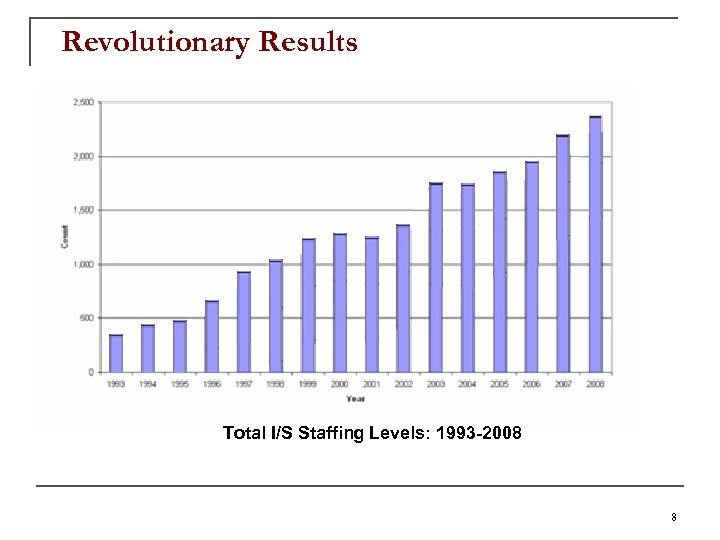
Revolutionary Results Total I/S Staffing Levels: 1993 -2008 8
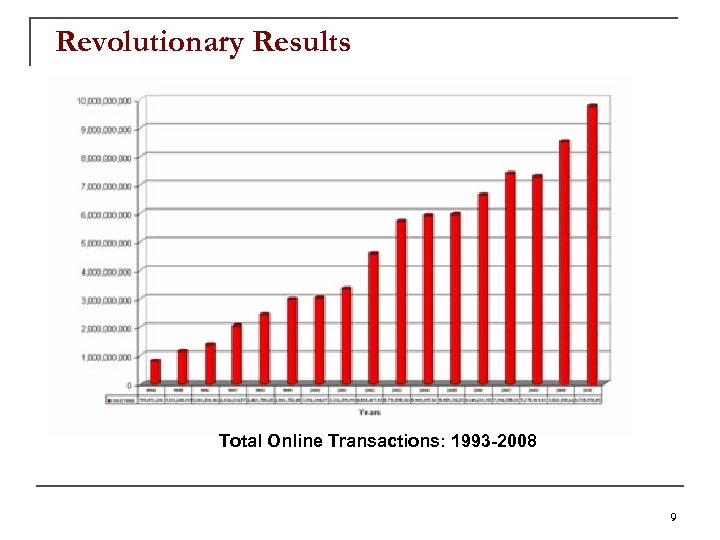
Revolutionary Results Total Online Transactions: 1993 -2008 9
Evolution, Not Revolution in I/S The BCBSSC Information System Division has taken a unique, evolutionary, and systematic approach in the development and implementation of its administrative and operational practices over the past 20 years. I/S Management Practices Manual 10
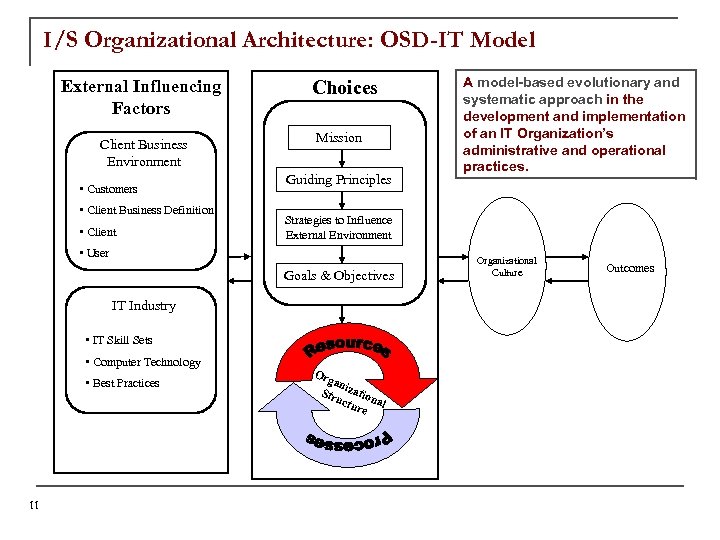
I/S Organizational Architecture: OSD-IT Model External Influencing Factors Client Business Environment • Customers • Client Business Definition • Client Choices Mission Guiding Principles Strategies to Influence External Environment • User Goals & Objectives IT Industry • IT Skill Sets • Computer Technology • Best Practices 11 A model-based evolutionary and systematic approach in the development and implementation of an IT Organization’s administrative and operational practices. Org an Str izatio n uct ure al Organizational Culture Outcomes
Advantages of the Evolutionary Approach - Balancing Change and Continuity n n n This approach has resulted in the creation of innovative, functionrich, and award-winning healthcare administrative systems based on a standard, yet flexible systems architecture which incorporates current and future business requirements that can be leveraged across various business segments. It has also provided the benefits of increased technological economies of scale by leveraging technical capabilities within an effective IT Service Management framework across various business segments to efficiently handle increased operational volumes. And most importantly, it has provided the ability to integrate IT staff as required while ensuring management philosophies and administrative and operational practices remain intact. I/S Management Practices Manual 12
The Nature of Innovation Sustained improvements over time lead naturally to process and product innovations. Drucker has advocated that innovation is much more the product of systematic hard work – what he calls the practice of innovation – than of flashes of insight and genius. He expresses it as follows. “To be effective, an innovation has to be simple, and it has to be focused. The greatest praise an innovation can receive is for people to say, ‘This is obvious! Why didn’t I think of it? It’s so simple!’ By contrast, grandiose ideas for things that will ‘revolutionize an industry’ are unlikely to work. ” 13
The Practice of Innovation n The process of systematically anticipating and proactively responding to change is very closely aligned with the practice of innovation. An innovation is more than a brilliant new idea. An innovation is accomplished by creating something new that also proves to be appropriate and useful for some purpose. 14
Technology Brokering n n Andrew Hargadon explores the idea of innovation as systematic work in his book How Breakthroughs Happen. Based on ten years of study into the origins of historic inventions and modern innovations the book’s findings reinforce that innovations do not usually result from flashes of brilliance. Instead, innovations are much more likely to come about from the creative combination of ideas, concepts, and products from existing technologies in ways that spark new technological initiatives. Hargadon calls this process technology brokering. 15
Hargadon’s “Rules” n The future is already here q In other words, organizations that seek to anticipate and exploit change will do well to consider carefully the activities, products, and services they and others are focused on in the present. q It is almost always the baseline of present activities that allows organizations to make the insightful moves that position them as change leaders in their industry. 16
Hargadon’s “Rules” n Analogy trumps invention q q q Instead of searching for insights and flashes of brilliance that no one else has thought about or considered, a more promising approach is to look for successful ideas and inventions in other areas and think creatively about how to combine them, modify them, and apply them to the opportunity or problem you have at hand. This approach has more promise simply because it is much easier to recognize the similarities between two situations than to come up with something neither you nor anyone else has ever thought of before. In this approach, you attempt to think inside other boxes, to use Hargadon’s phrase, instead of trying to follow the more common advice of thinking “outside the box. ” 17
I/S Guiding Principles Technology itself is never a primary cause of either greatness or decline in a business. Avoid technology fads and bandwagons. Recognize that you cannot make good use of technology until you know which technology is relevant to the business it supports. Technology can accelerate business momentum, but not create it. Therefore, you need the discipline to say no to the use of technology. Crawl, walk, run is a very effective approach to technology change! 18
I/S Guiding Principles Keep your eye on the goal. Inventing the “Next Big Thing” is not the goal. Building the “Current Big Thing” better than anyone else is the goal. We are not Alpha inventors, we are Beta improvers! 19
I/S Guiding Principles If you start with a blank sheet of paper, you’re dead. “Thinking outside the box” has come to mean thinking of a solution that is somehow outside of what you already know and do, and coming up with something wholly new. Pushing people to think outside the box doesn’t work. Instead, our approach to innovation is to take an idea or solution that has been used somewhere else, combine a number of existing ideas or solutions, and introduce them as a solution never seen before. 20
I/S Guiding Principles Maintain an attitude of healthy discontent. Sound management requires a probing, inquiring mind. Satisfaction with the status quo should be avoided. As you carry out your responsibilities as a manager, intelligently question existing practices and procedures. Ensure the most effective, up-to-date methods are being used. Actions based on the rationale, “that's the way we've always done it" should be examined closely. As a manager, you must not be afraid to challenge precedent. Be alert for antiquated or improper practices, which must be changed. 21
Team Exercise 1) 2) Can you identify some examples of evolutionary innovations that the I/S Division has implemented? Can you identify some examples of attempted revolutionary change in the IT industry that didn’t work out so well? 22
MODULE 2 Sustaining vs. Disruptive Innovations Blue. Cross and Blue. Shield of South Carolina The Rushing Center Furman University 23
Group Exercise: Case Study of DEC n n n Listen to the first part of the lecture by Clayton Christensen. What happened to DEC? How did this happen? Could it have been avoided? What would it have taken to do this? 24
Sustaining Technology/Innovation A sustaining technology/innovation is a technology or innovation employed to improve a company’s product or service to better meet their customers’ needs. Sustaining innovations can be: • evolutionary • revolutionary • incremental and gradual • discontinuous and dramatic The distinction is not about the innovation itself but rather what it is used to do. 25
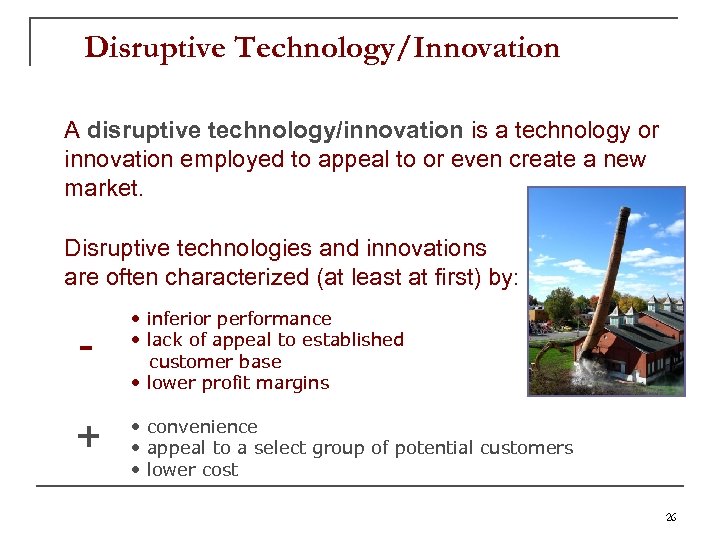
Disruptive Technology/Innovation A disruptive technology/innovation is a technology or innovation employed to appeal to or even create a new market. Disruptive technologies and innovations are often characterized (at least at first) by: + • inferior performance • lack of appeal to established customer base • lower profit margins • convenience • appeal to a select group of potential customers • lower cost 26
Sustaining or Disruptive? n n n n n Microsoft’s development of Internet Explorer Open-source software (like Linux) More fuel-efficient cars Sustaining vs. Electric cars disruptive can depend on your The personal computer perspective Selling computers via the Internet Selling stocks via the Internet Education via the Internet Online banking Insurance claims processing via the Internet 27
Market for Disruptive Innovations? n n n n n The personal computer (in the early 1980 s) PDAs Electric cars Buying computers via the Internet Buying stocks via the Internet Open-source software (like Linux) Online banking Digital goods (books, music, movies, newspapers) via the Internet Books & travel via the Internet How can such markets change over time? How might the rate of potential change differ for these examples? 28
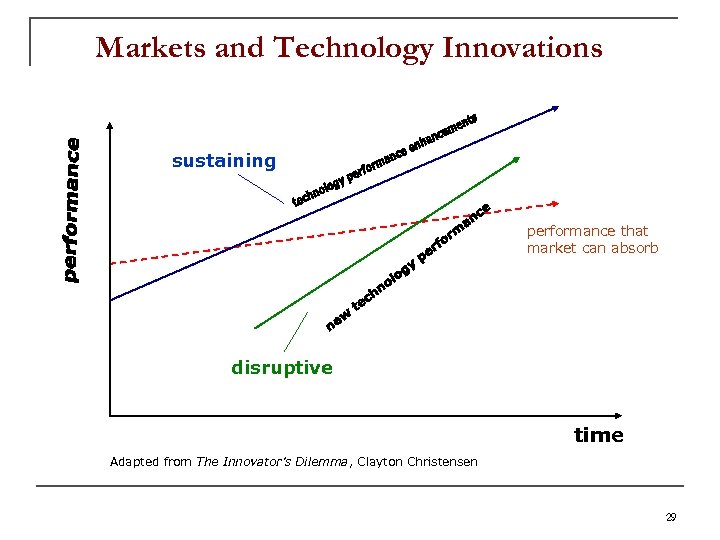
Markets and Technology Innovations sustaining performance that market can absorb disruptive time Adapted from The Innovator’s Dilemma, Clayton Christensen 29
Group Exercise 1) 2) 3) Identify some sustaining technologies or innovations that BCBS of SC has implemented. Would you classify any of these as potentially disruptive technologies/innovations for others? Can you identify potential future disruptive technologies or innovations for the company? 30
MODULE 3 Some Emerging Technologies/Innovations Blue. Cross and Blue. Shield of South Carolina The Rushing Center Furman University 31
Some Emerging Technologies Grid (distributed/utility) computing q Virtualization q The Cloud q Crowdsourcing q Social Networking and Social Analytics q Context Aware Computing q Data mining q Nanotechnology q Quantum computing q Ambient Devices q Bio Technology in computing q 3 -D Printing q Google’s Project Loon q Advanced Robotics q Big Data and Hadoop q The Internet of Things q Photo by Randall Schwanke Emerging Technologies, MIT Technology Review 32
The Cloud What is Cloud Computing Why Cloud Computing n The latest state of grid computing commercialization is often referred to as cloud computing, or simply the cloud. n The name derives from the fact that cloud computing involves software that resides in the “clouds” of the Internet. n According to Vinton Cerf (one of the creators of the Internet and VP and Chief Internet Evangelist at Google): “At Google we operate a number of data centers around the world, each of which contains a large number of computers linked to one another in clusters. In turn, the data centers are linked through a highspeed private network. The data centers support applications and services that users can access over the Internet to tap into virtually unlimited computing power on demand, a process known as cloud computing. ” 33
The Cloud (cont’d) n Conceptually a cloud operates by creating virtual machines (VMs) on servers. These VMs can be created and configured in an instant, and disappear just as fast when no longer needed. n These dynamically allocated VMs give users access to essentially as much computing power as they need for a very low price, compared to what it would cost for them to provide the same computing power on their own. n In addition to a low price, the user is relieved of all maintenance issues. n The analogy with the electric grid captures the concept very closely. 34
The Cloud (cont’d) n For example, Gmail, Twitter and Facebook are all cloud applications. n The load and performance demands of each of these are unpredictable and vary considerably over time. n The almost-immediate expansion capabilities of the cloud makes applications like these robust at a reasonable cost. 35
The Cloud (cont’d) n Amazon, IBM, Microsoft, Sun, Salesforce and others are implementing and experimenting with systems similar to the one that Google has developed. n Currently, all these clouds operate in isolation communicating only with their users. n Cerf suggests that one of the great challenges for cloud computing is to create ways for the clouds to communicate with each other, giving users the option of moving data form one cloud to another without first downloading it and then uploading it again to another cloud. n Cloud computing service providers offer server space and processing and often operate these servers for many businesses 36
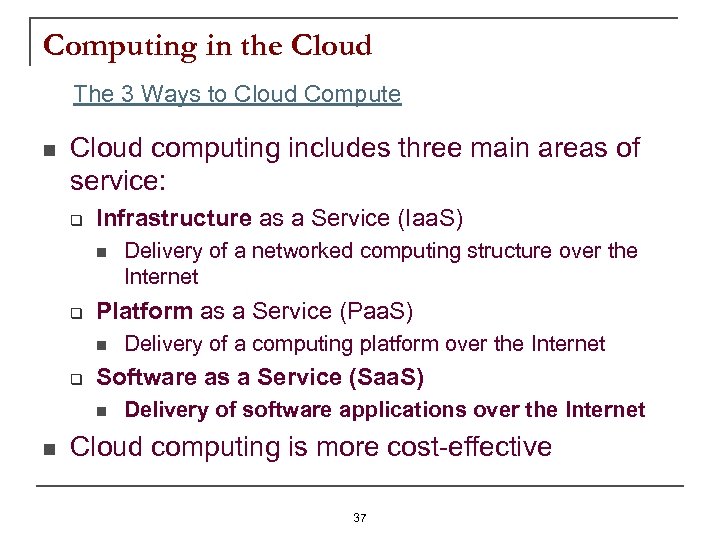
Computing in the Cloud The 3 Ways to Cloud Compute n Cloud computing includes three main areas of service: q Infrastructure as a Service (Iaa. S) n q Platform as a Service (Paa. S) n q Delivery of a computing platform over the Internet Software as a Service (Saa. S) n n Delivery of a networked computing structure over the Internet Delivery of software applications over the Internet Cloud computing is more cost-effective 37
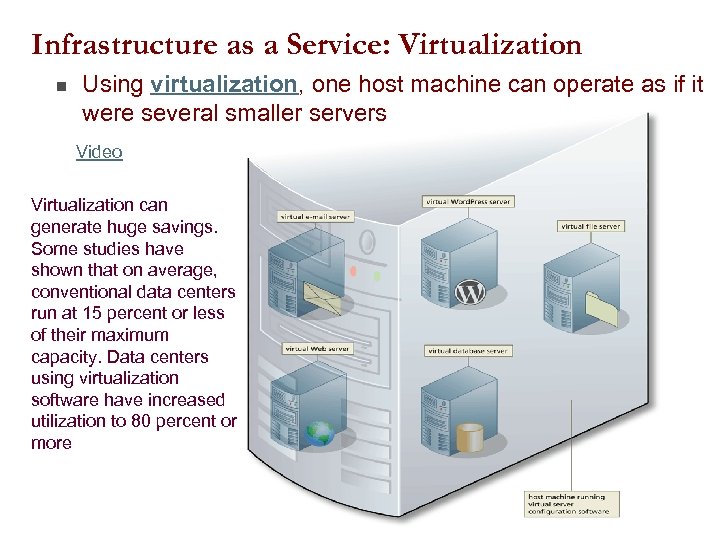
Infrastructure as a Service: Virtualization n Using virtualization, one host machine can operate as if it were several smaller servers Video Virtualization can generate huge savings. Some studies have shown that on average, conventional data centers run at 15 percent or less of their maximum capacity. Data centers using virtualization software have increased utilization to 80 percent or more 38
Software-as-a-Service n Software-as-a-service (Saa. S) – delivery model for software in which you pay for software on a pay-per-use basis instead of buying the software outright q q Use any device anywhere to do anything Pay a small fee and store files on the Web Access those files later with your “regular” computer Makes use of an application service provider Force. com video dashboards 9 -39
Consumer Applications in the Cloud n Cloud computing makes it possible for companies to offer Web-based versions of popular personal computer programs • Top Free Cloud Computing Software 40
Creating New Applications from Data in the Cloud n n n n n Mashups are Web applications that combine content or data from multiple online sources into new Web applications Contents are continually updated Content for mashups often comes from Web feeds and Web services Amazon uses mashup technologies to aggregate product descriptions with partner sites and user profiles, commentaries, and images. Travel sites, such as Travelocity, Kayak, Matador, and Travature, integrate standard content (such as airfare search engines, travel guides, maps, and hotel reviews) with comments, ratings, and images from users. Creating mashups usually requires significant Web development experience Mapping mashups are the most popular type of mashup Housing. Maps. com Spot. Crime. com q Spot. Crime displays the locations of criminal incident reports on a Google Map to illustrate where crime takes place in a neighborhood. 41
The Cloud – Security Issues n In cloud computing, thousands of different clients use the same hardware on a large scale – the key to the efficiency of the cloud in providing such low cost services. n However, security researchers have demonstrated that when two programs are running simultaneously on the same operating system, an attacker can steal data by using an eavesdropping program to analyze the way those programs share memory space. n Could this same technique be used in clouds when different virtual machines (VMs) run on the same server? n Several researchers recently demonstrated that this could in fact happen utilizing Amazon’s Elastic Compute Cloud. 42
The Cloud – Security Issues (cont’d) n In 2008, a single corrupted bit in messages between servers used by Amazon’s Simple Storage Service which provides online data storage by the gigabyte, forced the system to shut down for several hours. n In 2009, a hacker who correctly guessed the answer to a Twitter employee’s email security question was able to grab all the documents in the Google Apps account the employee used. n Also in 2009, a bug comprised the sharing restrictions placed on some users’ documents in Google Docs. Distinctions were erased: anyone with whom you shared document access could also see documents you shared with anyone else. n Late in 2009, a million T-Mobile Sidekick smart phones lost data after a server failure at Danger, a subsidiary of Microsoft that provided the storage. 43
The Future of the Cloud § § § According to the Gartner Group: § “By 2011, early technology adopters will forgo capital expenditures and instead purchase 40 percent of their IT infrastructure as a service, ” § “Increased high-speed bandwidth makes it practical to locate infrastructure at other sites and still receive the same response times. " 69 % of America’s Internet users are using some form of Internet-based computing, such as web-based e-mail or photo storage, according to a study by Pew Research Center. By 2013, 12 % of the world software market will be Internet based forms of Saa. S and cloud computing, according to Merrill Lynch. What impact will a long-term, global recession have on cloud computing? § A survey by Scan. Safe, a Saa. S provider of security services, revealed that 78% of IT managers believe economic uncertainty makes Saa. S more appealing. "A move towards clouds signals a fundamental shift in how we handle information, " writes Stephen Baker in Business Week. "At the most basic level, it's the computing equivalent of the evolution in electricity a century ago when farms and businesses shut down their own generators and bought power instead from efficient. industrial utilities. " 44
The Future of the Cloud (cont’d) The focus of IT innovation has shifted from hardware to software applications. Many of these applications are going on at a blistering pace, and cloud computing is going to be a great facilitative technology for a lot of these people. Dale Jorgenson, Harvard Economist and expert on the role of IT in national productivity Clouds are systems. And with systems, you have to think hard and know how to deal with issues in that environment. The scale is so much bigger, and you don’t have the physical control. But we think people should be optimistic about what we can do here. If we are clever about deploying cloud computing with a clear-eyed notion of what the risk models are, maybe we can actually save the economy through technology. Peter Mell, Leader Cloud Security Team National Institute of Standards and Technology (NIST) 45
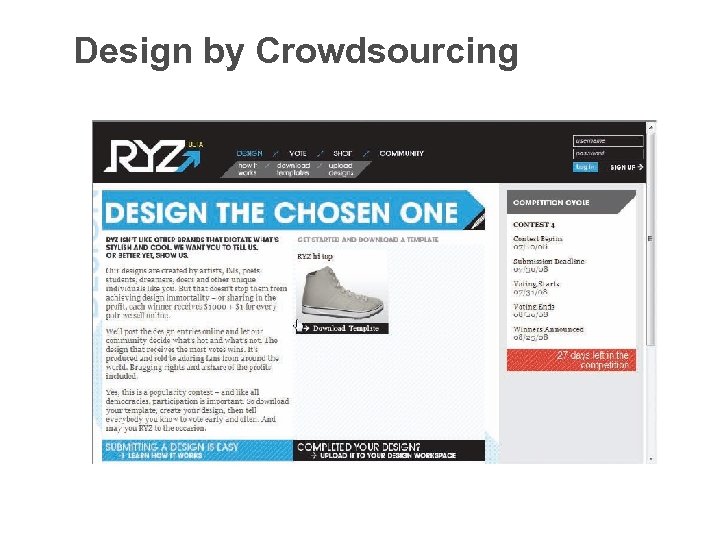
Crowdsourcing n n • n n n Crowdsourcing organizations (involve their users in the design and marketing of their products. Shoe startup company RYZ (see next slide) sponsors shoe design contests to help it understand which shoes to create and how to market those designs. Example: Netflix announcement of reward for technology solution to its movie recommendation Crowdsourcing combines social networking, viral marketing, and open-source design, saving considerable cost while cultivating customers. With crowdsourcing, the crowd performs classic in-house market research and development and does so in such a way that customers are being set up to buy. Video
Design by Crowdsourcing
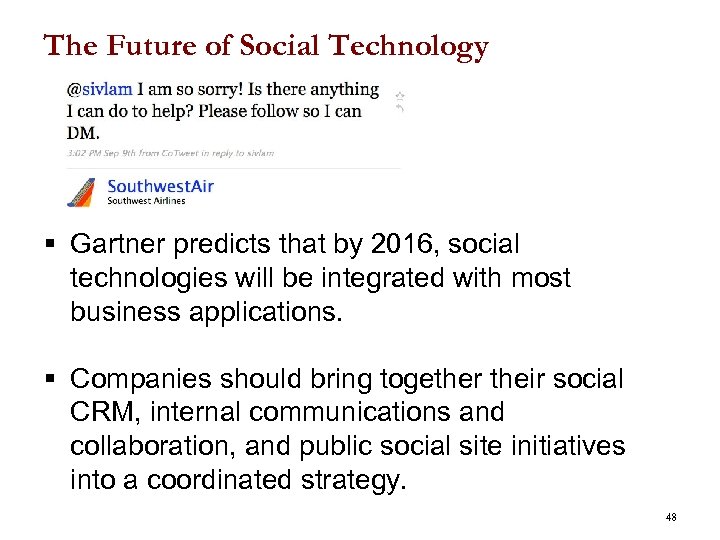
The Future of Social Technology § Gartner predicts that by 2016, social technologies will be integrated with most business applications. § Companies should bring together their social CRM, internal communications and collaboration, and public social site initiatives into a coordinated strategy. 48
Social Networking in Business • Businesses can use these tools to reach out and market to potential new customers. • Many businesses have Facebook sites to market their product to specific groups on Facebook. • They can use these tools to support and give added value to existing customers. • A software company could have a blog that discusses indepth use of a software product. • Businesses can use these tools within their company to communicate between departments and share knowledge. • Wiki – allows you (as a visitor) to create, edit, change, and often eliminate content • A company wiki could be set up as a repository of expert information.
How Can Businesses Utilize Social Networking Applications? Social networking application § § A computer program that interacts with and processes information in a social network Examples: n Survey Hurricane, a Facebook application created by Infinistorm (www. infinistorm. com). § n Users who install that application on their page can survey their friends on topics of interest. Applications for buying and selling items, comparing movies, and so on
Social Analytics n n § Social analytics describes the process of measuring, analyzing and interpreting the results of interactions and associations among people, topics and ideas These interactions may occur on social software applications used in the workplace, or on the social Web. Social analytics is an umbrella term that includes a number of specialized analysis techniques such as: q social filtering, n n q q q n n techniques that identify information a user might be interested in used to create "recommendation systems" that can, for example, enhance your experience on a Web site by suggesting music or movies that you might like social-network analysis, sentiment analysis social-media analytics. Social network analysis tools are useful for examining social structure and interdependencies as well as the work patterns of individuals, groups or organizations. Social network analysis involves collecting data from multiple sources, identifying relationships, and evaluating the impact, quality or effectiveness of a relationship.
Sentiment Analysis n n Web Site Video Wikipedia defines sentiment analysis as the process that “aims to determine the attitude of a speaker or a writer with respect to some topic. ” Automated sentiment analysis is the process of training a computer to identify sentiment within content through Natural Language Processing (NLP). (Google Translate) Various sentiment measurement platforms employ different techniques and statistical methodologies to evaluate sentiment across the web. Some rely 100% on automated sentiment, some employ humans to analyze sentiment, and some use a hybrid system. The social media health of a brand is how it’s public sentiment compares to that of its competitors. q q If your sentiment is 20% negative, is that bad? The answer is, it depends. However, if you see your competitors with a roughly 50% positive and 10% negative sentiment, while yours is 20% negative, that probably merits investigation to understand the drivers of these opinions.
Context Aware Computing Video § Using information about an end user’s environment, activities, connections and preferences to improve the quality of interaction with that end user. n The end user may be a customer, business partner or employee. n A contextually aware system anticipates the user's needs and proactively serves up the most appropriate and customized content, product or service. n Gartner predicts that by 2013, more than half of Fortune 500 companies will have context-aware computing initiatives, and by 2016, one-third of worldwide mobile consumer marketing will be context-awareness-based Context aware computing discussion Context aware computing in the future For instance, sensors attached to a TV remote control can collect data on how the remote is held by different users and build profiles based on that. Such a remote, of which Intel showed a prototype at the conference, could identify who’s holding the remote and offer recommendations for TV shows based on that
Web 3. 0 • Web 3. 0 is the vision of the next generation of the Web in which all of the information available on the Web is woven together into a single experience. • The related movement called the Semantic Web is a collaborative effort to add a layer of meaning to existing information to reduce the amount of human time spent in searching and processing that information. • This potentially could have huge effects on businesses as simple analysis becomes mechanized, requiring fewer humans to perform this basic task.
Linking Data in Context: A Prelude to Web 3. 0 and Beyond n Web 3. 0 is the name that is being used to describe emerging trends that allow people and machines to link information in new way q n Personal Web assistants called Agents can make decisions and take actions based on a user’s preferences Many describe Web 3. 0 as the rise of the Semantic Web q Intelligent software tools can read Web pages and discern useful information from them. 55
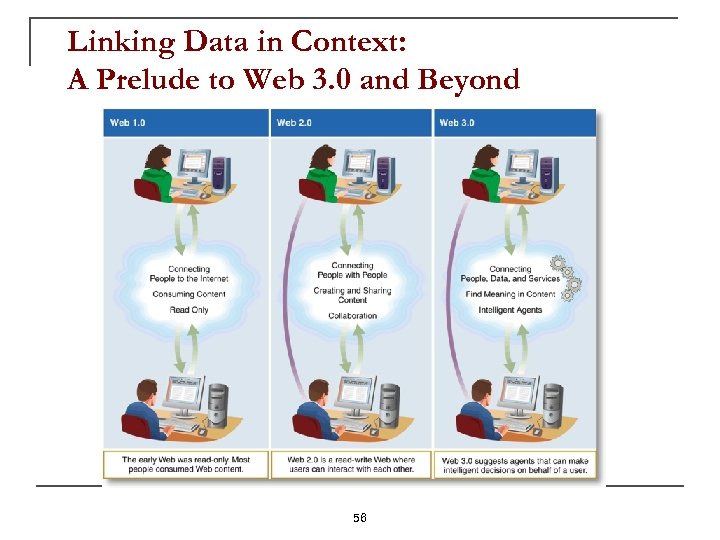
Linking Data in Context: A Prelude to Web 3. 0 and Beyond 56
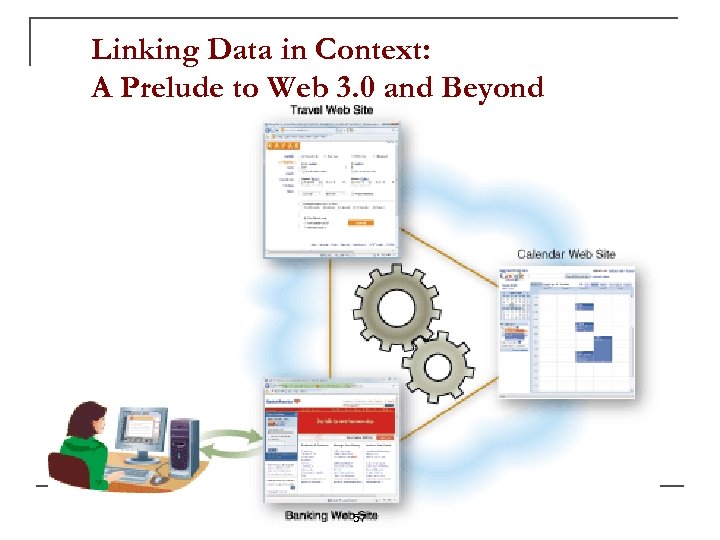
Linking Data in Context: A Prelude to Web 3. 0 and Beyond 57
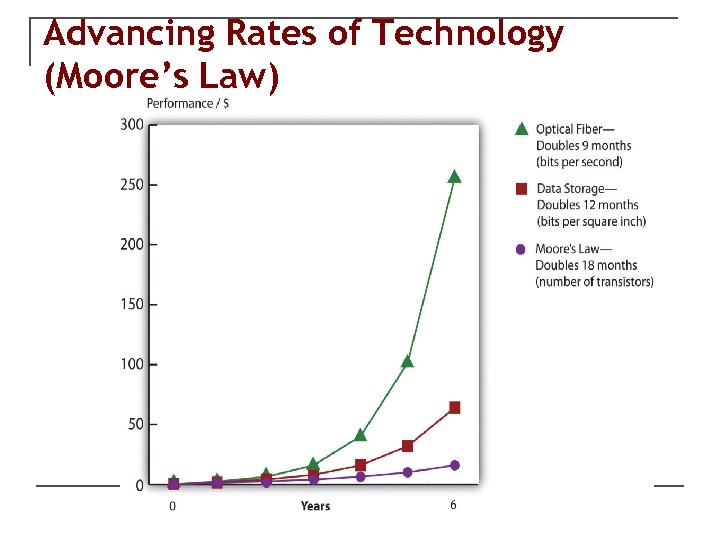
Advancing Rates of Technology (Moore’s Law) 5 -58
Get Out Your Crystal Ball n n When technology gets cheap, price elasticity kicks in The five waves of computing over the previous five decades: q q q 1960 s – Mainframe computers 1970 s – Minicomputers 1980 s – PCs 1990 s – Internet computing Present – Ubiquitous computing 5 -59
Ambient Devices and the Fifth Wave n n Ambient Devices is a “fifth wave” firm that’s embedding computing and communications devices into everyday products to make them more useful and smarter Ambient’s ability to pull off this miracle is evidence of how quickly new markets, spawned by Moore’s Law, can come into being Ambient has expanded the product line to several low -cost appliances designed to provide information at a glance Their products include: q q q An umbrella that checks the weather and warns the owner, via a blinking handle, of impending rain conditions. The Orb, a lamp that changes color in response to changes in factors including pollen count A refrigerator that offers reminders of important events 5 -60
Moore’s Law in Medicine n The Glow. Cap from Vitality, Inc. is a “smart” pill bottle that will flash when you’re supposed to take your medicine and alert the pharmacy when it’s time to refill q n Tests show that Glow. Cap users reported a 98 % medication adherence rate. Proteus, a Novartis- backed venture, has developed a sensor made of food and vitamin material that can be swallowed in medicine. q q Once inside you, the chip sends a signal with vitals such as heart rate, body angle, temperature, sleep, and more. Proteus then compiles a report from the data and sends it to your mobile device, email account, or your doctor. Can help people guard against counterfeit drugs – serious worldwide concern Help in bringing health care to hard to reach rural populations
Genomic Diagnostics n n Using DNA sequencing to help doctors and pharmaceutical companies personalize treatments for disease has netted a South Carolina startup a small seed round of capital. Translating genomic data into meaningful information is a cutting edge technology in medicine right now Read more: http: //medcitynews. com/2013/06/molecular-genomic-diagnosticservice-lab-raising-900 k-to-enable-personalized-medicine/#ixzz 2 W 9 Nonpu 4 Read more: http: //medcitynews. com/2013/06/molecular-genomic-diagnosticservice-lab-raising-900 k-to-enable-personalized-medicine/#ixzz 2 W 9 Mz 7 Z 3 o 62

Bytes Defined 5 -63
The Death of Moore’s Law? n Moore’s Law is possible because the distance between the pathways inside silicon chips gets smaller with each successive generation q q n Since the pathways are closer together, electrons travel shorter distances If electrons travel half the distance to make a calculation, that means the chip is twice as fast This shrinking can’t go on forever q q q Three interrelated forces—size, heat, and power—threaten to slow down Moore’s Law’s advance As chips get smaller and more powerful, they get hotter and present power-management challenges At some point Moore’s Law will stop because we will no longer be able to shrink the spaces between components on a chip. 5 -64
The Death of Moore’s Law? n Microsoft, Yahoo!, and Google have all built massive data centers in the Pacific Northwest in order to benefit from cheap hydroelectric power q q n The chief eco officer at Sun Microsystems has claimed that computers draw four to five percent of the world’s power Google’s chief technology officer has said that the firm spends more to power its servers than the cost of the servers themselves Chips can’t get smaller forever because chip pathways can’t be shorter than a single molecule and actual physical limit may be higher 5 -65
Buying Time n Multicore microprocessors: Microprocessors with two or more (typically lower power) calculating processor cores on the same piece of silicon q n For many applications, the multicore chips will outperform a single speedy chip, while running cooler and drawing less power Multicore processors are now mainstream q q Today, most PCs and laptops sold have at least a two-core (dual-core) processor Intel has demonstrated chips with upwards of fifty cores 5 -66
Buying Time n Multicore processors can run older software written for single-brain chips q n n They usually do this by using only one core at a time In order to take full advantage of multicore chips, applications need to be rewritten to split up tasks so that smaller portions of a problem are executed simultaneously inside each core Writing code for execution in a multicore environment is challenging 5 -67
Buying Time n n Another approach moves chips from being paper -flat devices to built-up 3 -D affairs By building up as well as out, firms are radically boosting speed and efficiency of chips 5 -68
Bringing Brains Together: and Grid Computing n n n Supercomputing Supercomputers: Computers that are among the fastest of any in the world at the time of their introduction Supercomputing was once the domain of governments and high-end research labs Modern supercomputing is done via massively parallel processing q Massively parallel: Computers designed with many microprocessors that work together, simultaneously, to solve problems 5 -69
Bringing Brains Together: Supercomputing and Grid Computing n n Grid computing: A type of computing that uses special software to enable several computers to work together on a common problem as if they were a massively parallel supercomputer Multicore, massively parallel, and grid computing are all related in that each attempts to lash together multiple computing devices so that they can work together to solve problems 5 -70
Grid (Distributed/Utility) Computing continued n n n Computing grids pool together and manage resources from isolated systems to form a new type of low-cost supercomputer Makes supercomputing available where economics would otherwise prevent this Grids remained a bit of an oddity in the domain of researchers for many years Sustaining or disruptive? 71
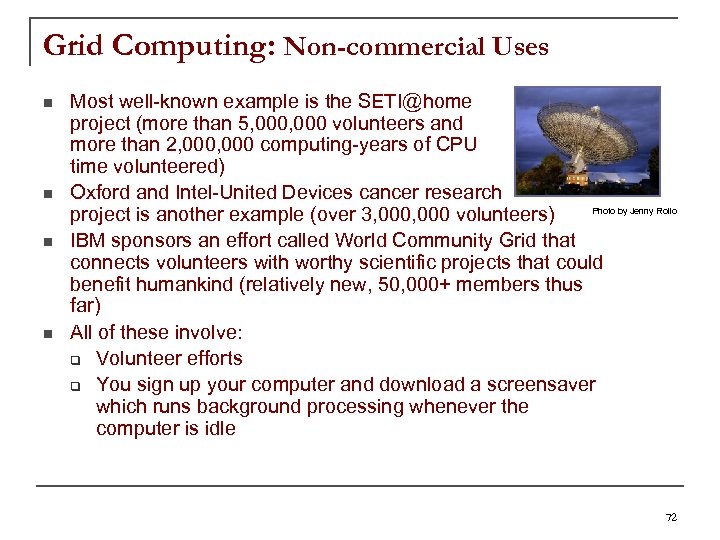
Grid Computing: Non-commercial Uses n n Most well-known example is the SETI@home project (more than 5, 000 volunteers and more than 2, 000 computing-years of CPU time volunteered) Oxford and Intel-United Devices cancer research Photo by Jenny Rollo project is another example (over 3, 000 volunteers) IBM sponsors an effort called World Community Grid that connects volunteers with worthy scientific projects that could benefit humankind (relatively new, 50, 000+ members thus far) All of these involve: q Volunteer efforts q You sign up your computer and download a screensaver which runs background processing whenever the computer is idle 72
Grid Computing: Commercialization n Sun President, Jonathan Schwartz, compared grid computing to history of the electric power industry: “The world does not need 5, 000 different custom electrical generators with 5 million electricians customizing the distribution of electricity. . The industry around IT will likely go through the same transformation that the electric industry did about a hundred years ago. “ n Bill Gates told Information. Week six years ago that grid computing is “the holy grail of computing. ” 73
Grid Computing: An Example Video Burlington Coat Factory Warehouse Corporation has deployed an enterprise Grid computing infrastructure utilizing Oracle 10 g software. The retailer's adoption of an Oracle Grid computing solution has begun the enablement to deliver higher application service levels, improve Information Technology (IT) resource utilization, and allow for scalability of IT systems to support future growth. "Grid computing is viable with Oracle 10 g, " said Michael Prince, CTO, Burlington Coat Factory. "Oracle 10 g does away with the complexity related to deploying and managing a grid. Our grid is automated, redundant, and delivers a pool of IT resources large enough to deal with the spikes in demand that occur. " "Our Grid infrastructure allows us to maximize the use of our hardware and software infrastructure which is key to our ability to support mixed workloads, " said Brad Friedman, CIO, Burlington Coat Factory. "With a grid at our disposal, we can run transactional, decision support and administrative operations simultaneously while maintaining high levels of system availability and performance. " 74
Data Mining n We hear a lot about information overload n Information overload is often more accurately data overload n Utilizing vast amounts of data requires smarter methods for extracting information from data n Bioinformatics and the human genome project is a prime example n Data mining is the technology developed to attack such problems Photo by Elvis Santana 75
Data Mining n Data mining relies on advances in machine learning n The goal is to create a program that can automatically analyze large data sets and decide what information is most relevant for a particular problem domain This distilled information can then be used to automatically make predictions or to help people make decisions faster and more accurately n 76
Data Mining: Two Models n Predictive models can be used to forecast unknown or unseen values, based on patterns determined from known results n Also called supervised data mining q Model developed before analysis n For example, from a database of customers who have already responded to a particular offer, a model can be built that predicts which prospects are likeliest to respond to the same offer n Statistical techniques used to estimate parameters n Examples q q Regression analysis – measures impact of set of variables on one another Used for making predictions 77
Data Mining: Two Models n n Descriptive models describe patterns or underlying processes in existing data, and are generally used to create meaningful subgroups such as demographic clusters Also called unsupervised data mining q q Apply data mining techniques and observe results Analysts create hypotheses after analysis to explain patterns found n n No prior model about the patterns and relationships that might exist Common statistical technique used: q Cluster analysis to find groups of similar customers from customer order and demographic data. 78
Data Mining: Sampling of Business Applications Video n n n n Market segmentation Error detection Evaluation of sales patterns Credit risk analysis Ad revenue forecasting Claims processing Credit risk analysis Cross-marketing Customer profiling Customer retention Electronic commerce Exception reports Food-service menu analysis n n n n Fraud detection Government policy setting Hiring profiles Market basket analysis Medical management Member enrollment New product development Pharmaceutical research Process control Quality control Shelf management Targeted marketing Warranty analysis 79
Data Mining and Privacy/Ethics Data Mining for Terrorists and Innocents Big Brother (NSA) is Copying Everything on the Internet n n Through data mining, companies, known as “data aggregators”, will know more about your purchasing psyche than you, your mother, or your analyst. If you use your card to purchase “secondhand clothing, retread tires, bail bond services, massages, casino gambling or betting” you alert the credit card company of potential financial problems and, as a result, it may cancel your card or reduce your credit limit. Absent laws to the contrary, by 2020 your credit card data will be fully integrated with personal and family data maintained by the data aggregators (like Acxiom and Choice. Point). By 2020, some online retailers will know a lot more about you, data aggregators, and most consumer’s purchases than we’ll know ourselves.
Neural Networks NN Video Neural networks n n n Popular supervised data-mining technique used to predict values and make classifications such as “good prospect” or “poor prospect” customers Complicated set of nonlinear equations See kdnuggets. com to learn more
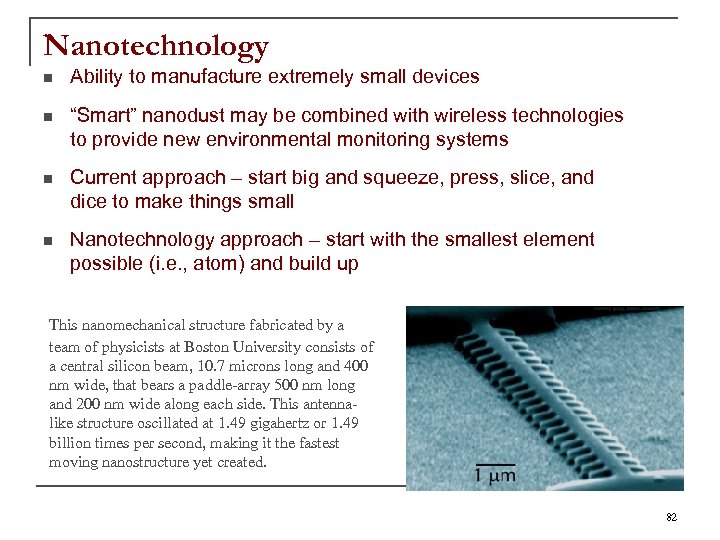
Nanotechnology n Ability to manufacture extremely small devices n “Smart” nanodust may be combined with wireless technologies to provide new environmental monitoring systems n Current approach – start big and squeeze, press, slice, and dice to make things small n Nanotechnology approach – start with the smallest element possible (i. e. , atom) and build up This nanomechanical structure fabricated by a team of physicists at Boston University consists of a central silicon beam, 10. 7 microns long and 400 nm wide, that bears a paddle-array 500 nm long and 200 nm wide along each side. This antennalike structure oscillated at 1. 49 gigahertz or 1. 49 billion times per second, making it the fastest moving nanostructure yet created. 82
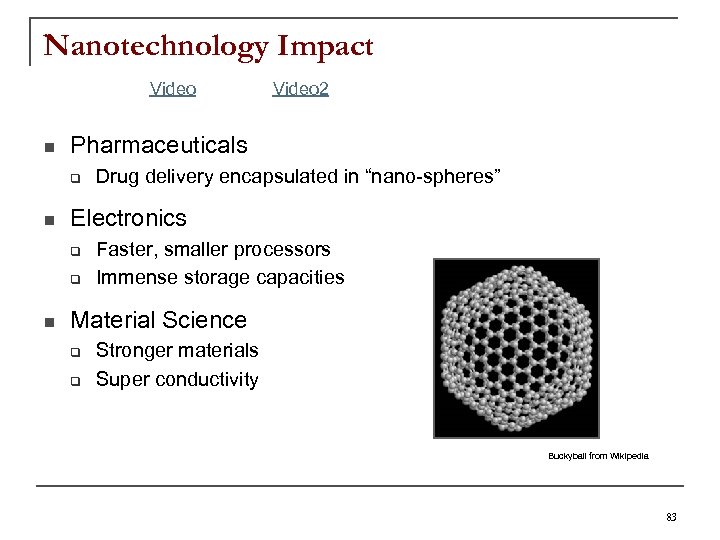
Nanotechnology Impact Video n Pharmaceuticals q n Drug delivery encapsulated in “nano-spheres” Electronics q q n Video 2 Faster, smaller processors Immense storage capacities Material Science q q Stronger materials Super conductivity Buckyball from Wikipedia 83
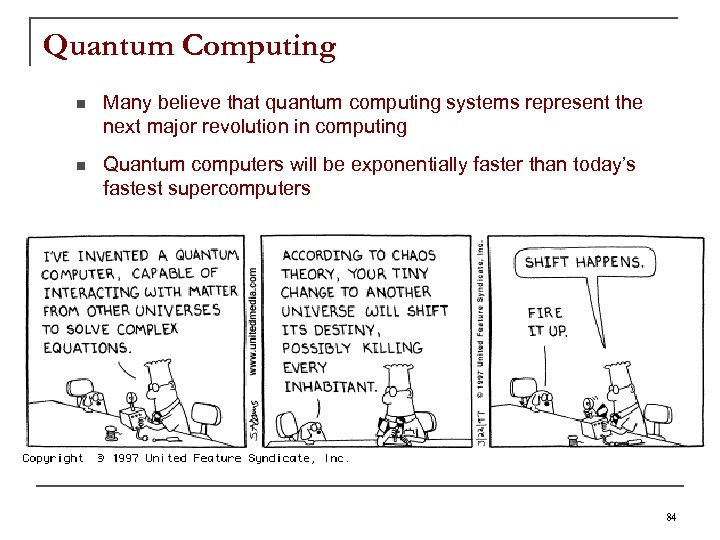
Quantum Computing n Many believe that quantum computing systems represent the next major revolution in computing n Quantum computers will be exponentially faster than today’s fastest supercomputers 84
Quantum Computing Video - CNN Video n Quantum computing uses qubits instead of transistors (bits) n A single qubit (utilizing particle spin) stores and processes twice as much information as a regular bit. n Combining qubits delivers exponential improvement Two qubits are four times more powerful than two bits q A 64 -qubit computer would theoretically be 264 (=18 billion trillion) times more powerful than the latest 64 -bit computers! The first prototype quantum computer (with two qubits) was created in 1998 q n n In 2001, Almaden Research Center demonstrated a 7 -qubit machine (using 10 billion atoms) that could factor the number 15 n In early February 2007, D-Wave Systems, Inc. , a privately-held Canadian firm headquartered near Vancouver, announced: “the world’s first commercially viable quantum computer” 85
Quantum Computing and Security n RSA (public key) encryption is the basis for securing data across networks today n The integrity of RSA encryption systems depends on the practical difficulty of factoring the product of two large primes n The incredible speed of quantum computers could render this defense against unauthorized decryption useless n But the news isn’t all bad, some researchers believe new encryption methods depending on characteristics of quantum computing could provide the solution 86
Biometric Security n Best security is 3 -step 1. 2. 3. n n What you know (password) What you have (card of some sort) Who you are (biometric) Today’s systems (ATMs for example) use only the first two One reason why identity theft is so high 9 -87
Integrating Biometrics with Transaction Processing n n TPS – captures events of a transaction Video Biometric processing system – captures information about you, perhaps… q q q Weight loss Pregnancy Use of drugs Alcohol level Vitamin deficiencies 9 -88
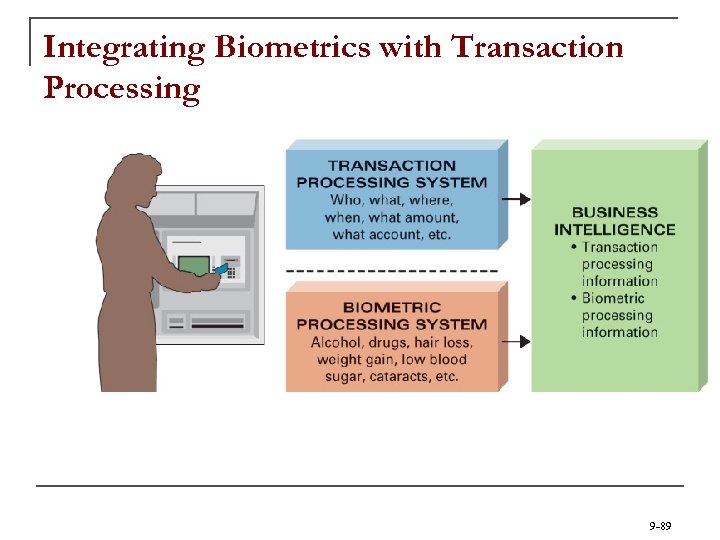
Integrating Biometrics with Transaction Processing 9 -89
Integrating Biometrics with Transaction Processing n n n Is this ethical? Can banks use ATMs and determine if you’ve been drinking? How will businesses of the future use biometric information? n n Ethically? Or otherwise? 9 -90
Biometric Self Tracking Tools n n Monitoring tools now used in hospital ICU’s will be wearable gadgets Automatically send data to wearer’s cell phone or computer around the clock. q q q n Compared to doctor office visit. q n Blood pressure Hear rhythms Mood Could reveal a person’s health in context Currently available to track q q REM sleep patterns Diet - diabetes 91
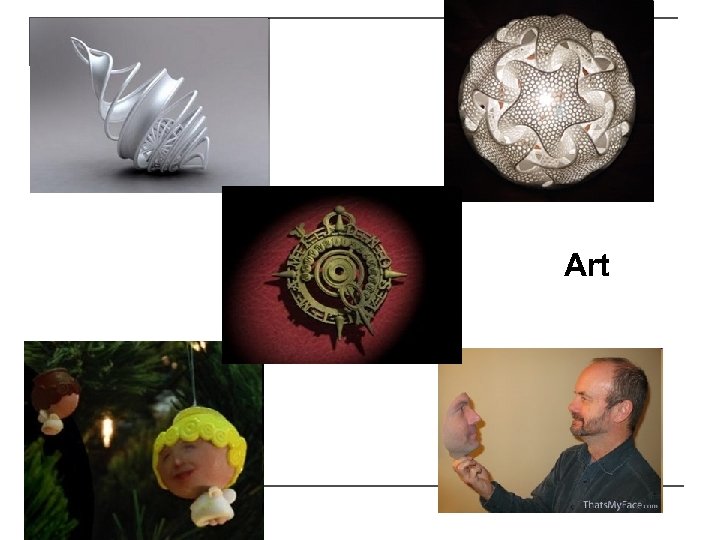
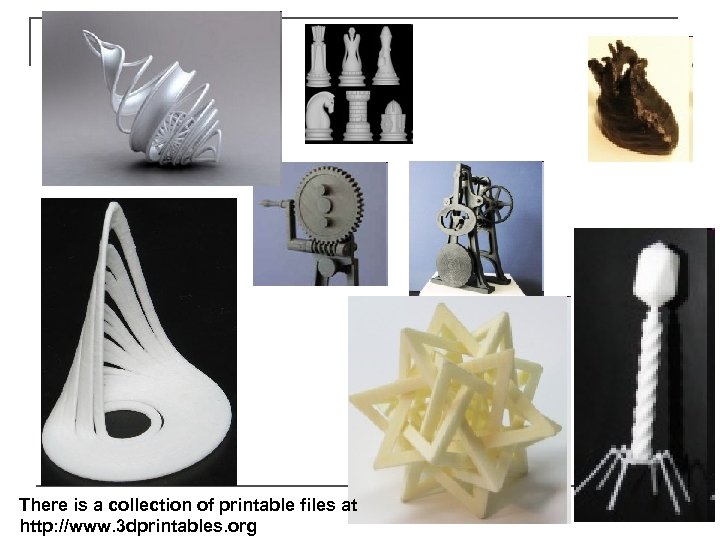
3 -D Printing n n This emerging technique, also referred to as additive manufacturing, will change the way many consumers acquire goods, and where they are made. Economic impact: $230 billion to $550 billion annually by 2025, mainly from consumer uses and direct manufacturing Video 2
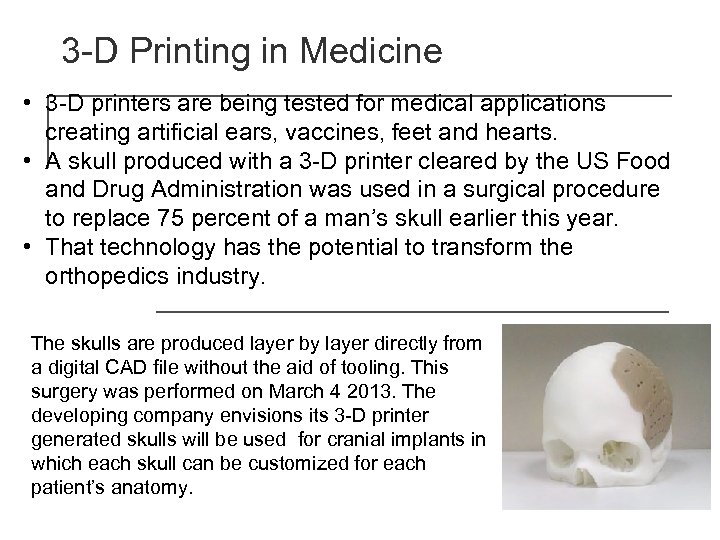
3 -D Printing in Medicine • 3 -D printers are being tested for medical applications creating artificial ears, vaccines, feet and hearts. • A skull produced with a 3 -D printer cleared by the US Food and Drug Administration was used in a surgical procedure to replace 75 percent of a man’s skull earlier this year. • That technology has the potential to transform the orthopedics industry. The skulls are produced layer by layer directly from a digital CAD file without the aid of tooling. This surgery was performed on March 4 2013. The developing company envisions its 3 -D printer generated skulls will be used for cranial implants in which each skull can be customized for each patient’s anatomy.
Slices, Not Dices n n n If you can slice an object You can glue the slices back together 3 D printing builds 3 D objects layer by layer 100 -200 layers per inch And it is slow--a Lego block can take an hour to make But it’s getting better—rapidly!
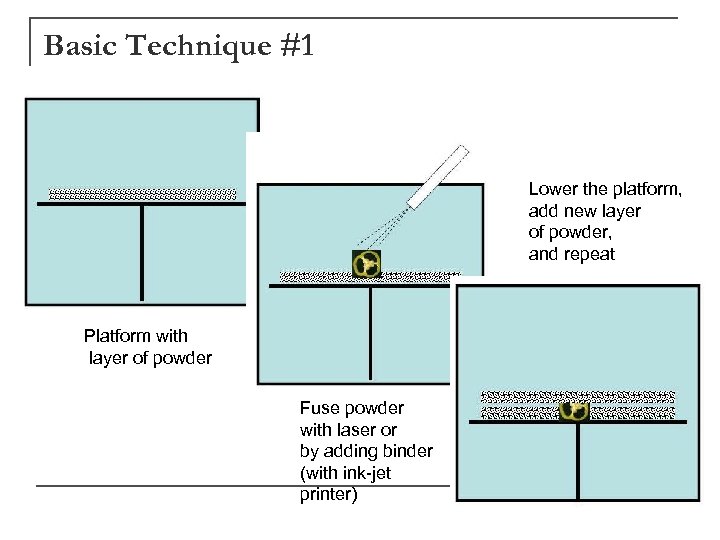
Basic Technique #1 Lower the platform, add new layer of powder, and repeat Platform with layer of powder Fuse powder with laser or by adding binder (with ink-jet printer)
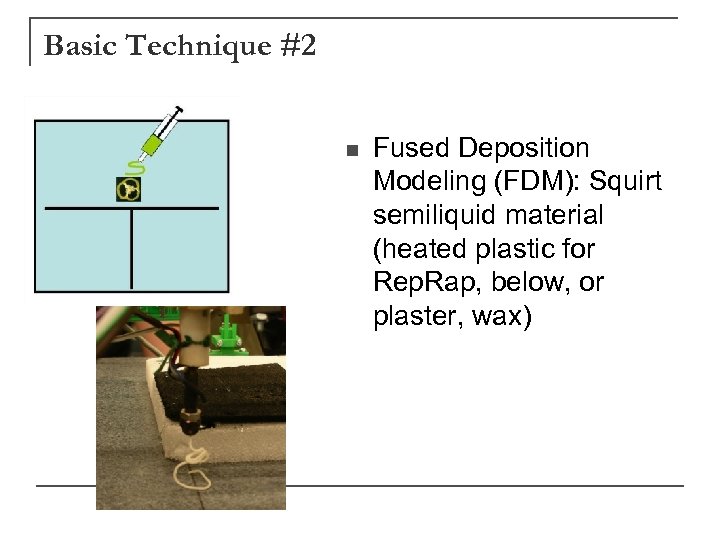
Basic Technique #2 n Fused Deposition Modeling (FDM): Squirt semiliquid material (heated plastic for Rep. Rap, below, or plaster, wax)
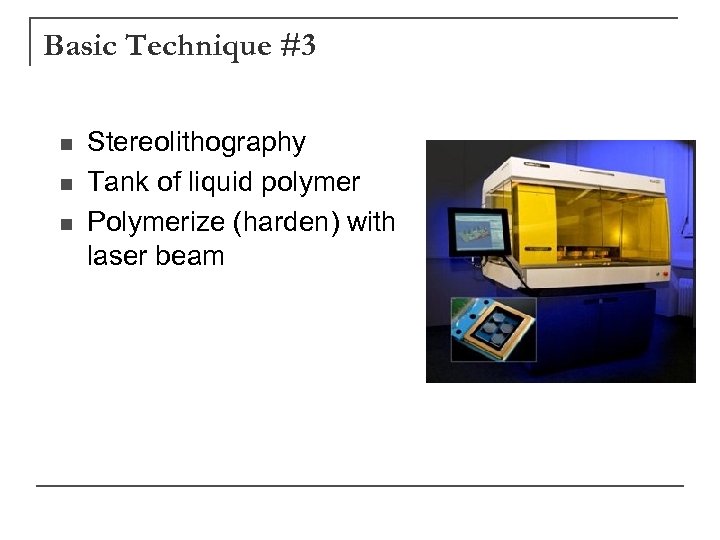
Basic Technique #3 n n n Stereolithography Tank of liquid polymer Polymerize (harden) with laser beam
Art
There is a collection of printable files at http: //www. 3 dprintables. org
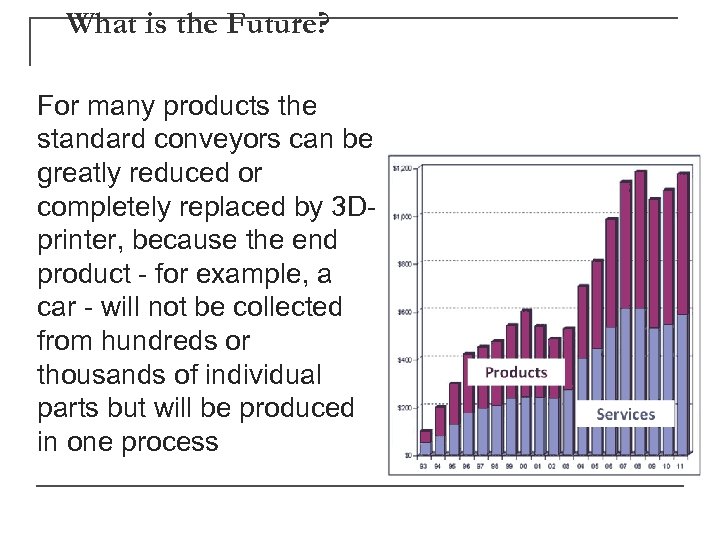
What is the Future? For many products the standard conveyors can be greatly reduced or completely replaced by 3 Dprinter, because the end product - for example, a car - will not be collected from hundreds or thousands of individual parts but will be produced in one process
Google’s Project Loon n Google announced the first test of Project Loon, an effort to build a balloon-based network that would beam the Internet down like sunshine, making it available to anyone, anywhere. “Project Loon is the idea that we can could create a network of high-altitude balloons that float about twenty kilometers up, and through this network, we can give the Internet to the entire world, ” Rich De. Vaul, the chief technical architect, explains in this video The launch of balloon-based Internet access is a classic move from the playbook of disruptive technologies. Skybased Internet will be cheaper and slower than the highspeed broadband, but it will be plenty powerful enough for plain vanilla Internet Protocol-based communications.
Advanced Robotics n n i. Robot Corporation and Cisco introduced the first autonomous telepresence robot, the Ava™ 500 The Ava 500 was designed to enable mobile visual access to manufacturing facilities, laboratories, customer experience centers and other remote facilitates in a supply chain.
Advanced Robotics continued n n n The Ava 500 can move in any direction, like a human. She can safely self-navigate real-world enterprise environments on her way to a meeting (having already mapped out the floor plan of the building). She can adjust her height to accommodate who she is meeting with (seated or standing) She thinks on the spot and can moderate her speed and alter her path if she senses humans in the environment (to get to the meeting on time) and return to her charging station after the meeting is over. The Ava 500 also requires very little training to operate which is key because the primary focus here is the communications, not the technology. Video
Big Data, Data Analytics and Hadoop n What is Big Data n What is Hadoop More about Hadoop n 104
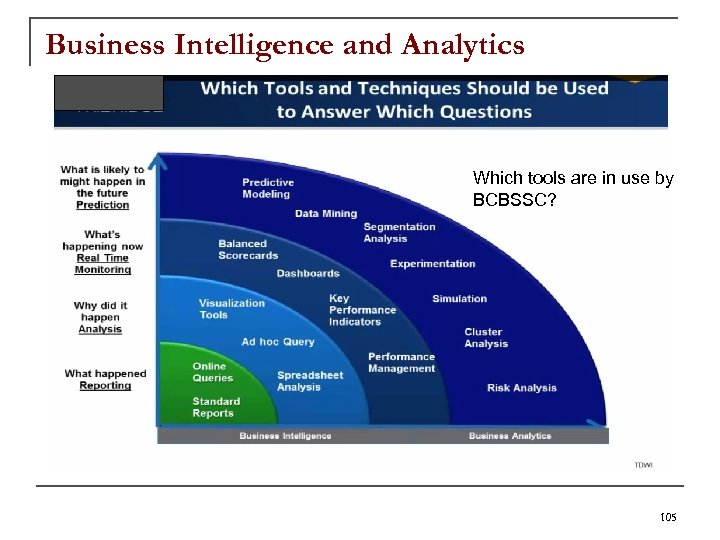
Business Intelligence and Analytics Which tools are in use by BCBSSC? 105
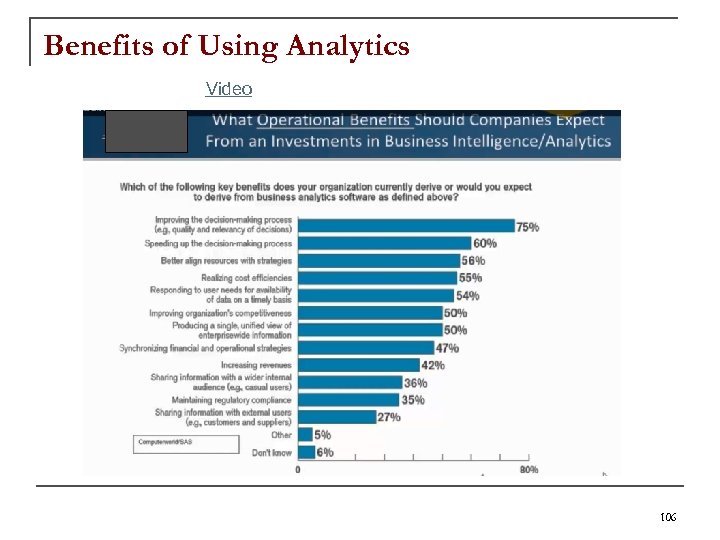
Benefits of Using Analytics Video 106
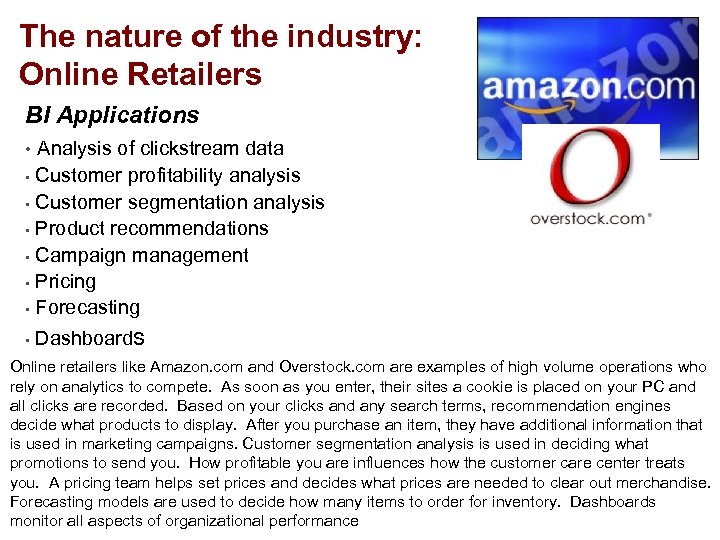
The nature of the industry: Online Retailers BI Applications • Analysis of clickstream data • Customer profitability analysis • Customer segmentation analysis • Product recommendations • Campaign management • Pricing • Forecasting • Dashboard s Online retailers like Amazon. com and Overstock. com are examples of high volume operations who rely on analytics to compete. As soon as you enter, their sites a cookie is placed on your PC and all clicks are recorded. Based on your clicks and any search terms, recommendation engines decide what products to display. After you purchase an item, they have additional information that is used in marketing campaigns. Customer segmentation analysis is used in deciding what promotions to send you. How profitable you are influences how the customer care center treats you. A pricing team helps set prices and decides what prices are needed to clear out merchandise. Forecasting models are used to decide how many items to order for inventory. Dashboards monitor all aspects of organizational performance
The Internet of Things (Io. T)
What is the Internet of Things? § Definition (1) The Internet of Things, also called The Internet of Objects, refers to a wireless network between objects, usually the network will be wireless and selfconfiguring, such as household appliances. ------Wikipedia (2) By embedding short-range mobile transceivers into a wide array of additional gadgets and everyday items, enabling new forms of communication between people and things, and between things themselves. ------World Summit on the Information Society 2005
What is the Internet of Things? continued § Definition (3) The term "Internet of Things" has come to describe a number of technologies and research disciplines that enable the Internet to reach out into the real world of physical objects. ------Io. T 2008 (4) “Things having identities and virtual personalities operating in smart spaces using intelligent interfaces to connect and communicate within social, environmental, and user contexts”. -------Io. T in 2020
Predictions for The Internet of Things n n n According to Gartner there will be nearly 26 billion devices on the Internet of Things by 2020 According to ABI Research more than 30 billion devices will be wirelessly connected to the Internet of Things (Internet of Everything) by 2020 Cisco created a dynamic "connections counter" to track the estimated number of connected things from July 2013 until July 2020
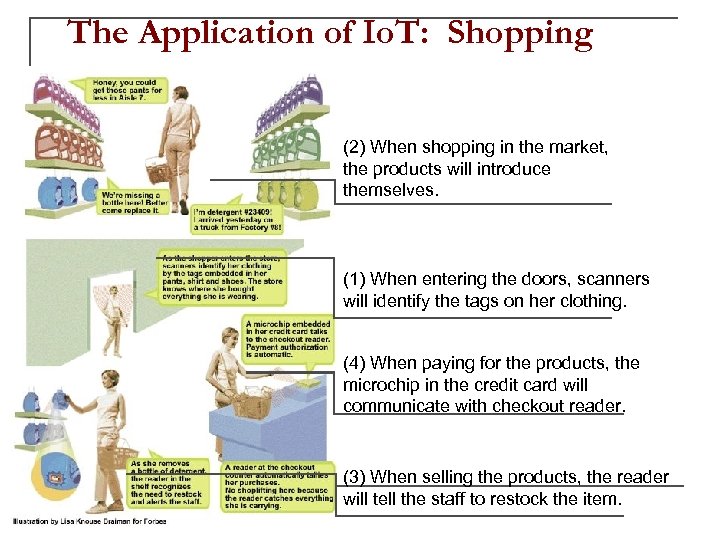
The Application of Io. T: Shopping (2) When shopping in the market, the products will introduce themselves. (1) When entering the doors, scanners will identify the tags on her clothing. (4) When paying for the products, the microchip in the credit card will communicate with checkout reader. (3) When selling the products, the reader will tell the staff to restock the item.
The Application of Io. T: Health Care • New efficient diagnostics combined with nanotechnology enabled lab-on-a-chip technologies open a complete range of novel opportunities for new treatments and prevention of serious diseases. • In-vivo equipment will assist in drug dosage closer to the affected organs thus reducing the amount of reagents needed and diminish the risk of adverse effects. • Several serious common illnesses such as breast cancer, cardio-vascular diseases and Alzheimer's disease have genetic components. • It is also known that successful treatment depends on early detection.
The Application of Io. T: Health Care - continued • Biodegradable materials will offer the possibility to place temporary sensors and lab-on-a-chip equipment on the patient, or in the patient. • Temperature and humidity can be measured inside a cast to prevent skin problems. Antigens may be detected on transplanted organs to help prevent rejection. • Intelligent micro-robots may be guided to bring drugs to the infected areas by ex-vivo remote guidance, and assist in the diagnosis providing located measurements of vital parameters. • This new type of personal medical equipment will enable the patient to stay longer and more safely at home since the equipment itself can alarm the hospital in case of critical situations • The patient can be relieved from the annoyance of routine checks when there is nothing wrong. • Medical research will advance on data from patients living normal lives- not like guinea pigs in hospitals. • Telemedicine may replace costly travel and reduce patient stress.
The Application of Io. T: Intelligent Home • Maintaining a comfortable temperature and heating water are the most energy consuming tasks in the house with huge potentials for energy conservation, and as a consequence a significant positive impact on the environment. • These activities will be controlled autonomously by house sensors • There will be robots taking care of the house, performing routine works such as cleaning or maintenance. • These will collaborate autonomously with the house sensors, and the house control. • The intelligent appliances will collaborate to conserve energy, and signa need for new supplies of food, detergents, maintenance, etc. • Some of which may be satisfied automatically by the maintenance robot. • This will eliminate some of today’s tedious housekeeping activities.
The Application of Io. T: Transportation • When there is a logjam, the first cars may tell the cars behind that there is an accident or just too much traffic. • This will eventually make intelligent navigation systems re-plan the route of cars programmed to travel already saturated roads. • The car may help the driver keep a safe distance from the car in front, and may refuse dangerous actions such as speeding if the weather conditions are unsafe or overtaking if the oncoming car travels too fast. • Cars will travel by autopilot on highways reducing the risk of fatigue related accidents. • The car will also be able to maintain itself, calling for the appropriate service based on the self diagnosis of the problem and ensuring that the right replacement parts are in stock. • The car will plan the time of service according to the diaries and preferences of the usual driver and ensure that there is a substitute car available if there would be a need for it.
Challenges in the Future of Io. T n n n Io. T will inherit the drawbacks of the current Internet on an infinitely larger, but more invisible scale Privacy – will be a huge issue when implementing Io. T Identity - Online Fragmentation of Identity Efficiency – speed - person loses identity and is an IP address Decisions – do we want to delegate our decision making and freedom of choice to things and machines?
Will Io. T Benefit the World? (or NOT) n “A world where ‘things’ can automatically communicate to computers and each other, providing services for the benefit of human kind” q Ian Smith (President AIM [formerly the Alternative Investment Market] UK) n Peter-Paul Verbeek, professor of philosophy of technology at the University of Twente, Netherlands, writes that technology already influences our moral decision making, which in turns affects human agency, privacy and autonomy q He cautions against viewing technology merely as a human tool and advocates instead to consider it as an active agent.
MODULE 4 The Innovators Dilemma Blue. Cross and Blue. Shield of South Carolina The Rushing Center Furman University 119
View the Lecture The Opportunity and Threat of Disruptive Technologies Professor Clayton Christensen Harvard Business School 120
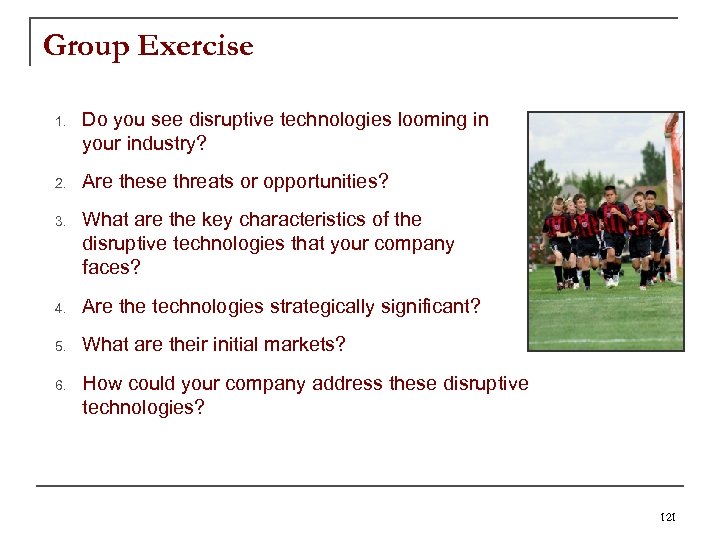
Group Exercise 1. Do you see disruptive technologies looming in your industry? 2. Are these threats or opportunities? 3. What are the key characteristics of the disruptive technologies that your company faces? 4. Are the technologies strategically significant? 5. What are their initial markets? 6. How could your company address these disruptive technologies? 121
MODULE 5 Innovation Strategy Blue. Cross and Blue. Shield of South Carolina The Rushing Center Furman University 122
Elements of an Innovation Strategy I n Look for growth outside of, but not too far from, your core business q What jobs can existing customers not do? q Who are your worst customers? q Where are the barriers that constrain consumption? 123
Elements of an Innovation Strategy II n How can we serve this market? q Existing solutions are too expensive, too complicated or do not quite do the job q The solution is good enough along traditional dimensions, but superior in dimensions that matter more to the customer q The business model has low overhead and high asset utilization, and therefore allows lower prices or smaller markets q Powerful incumbents are not interested in pursuing the strategy initially 124
Elements of an Innovation Strategy III n Pursue innovative opportunities q Create specific opportunities q Focus on patterns rather than numbers n n Make “number of zeros” estimates – Guess at impact Execute and adapt q Good enough can be great q Step, don’t leap q The right kind of failure is success. Video 125
Group Exercise: Innovation and Organization 1. Does having an organization that utilizes specialists contribute to innovation? 2. Do you think a company could better promote innovation if it had a group specifically devoted to innovation? 3. What are some of the pros and cons of having such a group? 126
Key Learning Outcomes When you complete this course you will be able to: 1) Contrast the evolutionary versus the revolutionary approach to technological innovation. 2) Distinguish between sustaining and disruptive technologies and innovations 3) Discuss the elements of an innovation strategy. 4) Give a brief description of the following emerging technologies/innovations: q q q q Grid (distributed/utility) computing Virtualization The Cloud Crowdsourcing Social Networking and Social Analytics Context Aware Computing Data mining Nanotechnology Quantum computing Bio Technology in computing 3 -D Printing Google’s Project Loon Advanced Robotics Big Data and Hadoop The Internet of Things 127
WRAPPING UP! § Review of our original key learning outcomes § Questions? 128

References 129
n n n How Breakthroughs Happen, Andrew Hargadon, Harvard Business School Press, 2003. “The Change Leader, ” Chapter 3 in Management Challenges for the 21 st Century, Peter Drucker, Harper Business, New York, 2001. Andrew Hargadon, an interview with the ACM online journal Ubiquity, at http: //www. acm. org/ubiquity/interviews/v 4 i 30_hargadon. html n Kathy Harris, Article on Gartner Blog found at: http: //blogs. gartner. com/kathy_harris/2009/04/28/innovation-andagility-two-do%E 2%80%99 s/ n “Security in the Ether, " David Talbot, MIT Technology Review, February 2010. 130
n n The Innovators Dilemma, Clayton Christensen, Harper. Business Essentials, 2002 (originally published in 1997 by the Harvard Business School Press). The Innovators Solution, Clayton Christensen and Michael Raynor, Harvard Business School Press, 2003. "The Rules of Innovation, " Clayton Christensen, MIT Technology Review, June 2002. "Disruptive Innovation: A New Diagnosis for Health Care's 'Financial Flu'. " Healthcare Financial Management, John Kenagy and Clayton Christensen, May 2002. 131
Скачать презентацию SA 475 Trends in Technology Presented for Blue
fb174fe666c1687ac64541cc54694555.ppt