 Скачать презентацию SA 1 All Activity Meeting 13 September 2004
6477937f9da538a9d16f0da57edd5812.ppt
- Количество слайдов: 21



SA 1 All Activity Meeting 13 September 2004 • Ian Bird, Cristina Vistoli, • and input from ROC managers EGEE is a project funded by the European Union under contract INFSO-RI-508833
Accomplishments since last AAM • Production service is fully operational and continues to grow § Currently (10 September) 75 sites, 7800 cpu • ROCs are set up and starting to take up their support responsibilities: § This must become fully developed during the rest of the year § Effort started in developing common support infrastructures • CICs § Nick Thackray is coordinating – developing planning for CICs to evolve § Lyon CIC and Italian CIC are supporting bio-med • LHC experiment data challenges have been running for past 6 months § Required very high operational maintenance load
CERN • Completed Execution Plan (DSA 1. 1) § Of course with regional contributions and help • Completed 1 st quarterly report • Most (huge!) effort has been fully devoted to running operations during the ongoing LHC data challenges § This load must be picked up by the ROCs and CICs now – this will be a key test for EGEE operations • § § Issue – How can we provide 24 x 7 operations with staff hired for 8 x 5 (true for all federations) This load will remain and we will start to see new VOs also Most new sites have so far been supported directly from CERN • ROCs must pick up this load • Operational security group – led by Ian Neilson § Planning better incident response and daily security procedures § Provided assistance for new VOs, registration procedures, etc § 1 new project associate to support SEE-grid started August • VO management • Provided staff to help with training courses • Staffing is complete
UK • ROC § § The Grid. PP Grid is now 14 sites (end August) running LCG 2 software. The National Grid Service sites have not yet been certified. • • § Grid. Ireland running LCG-2_2_0 internally on testbed including national servers (RB/BDII/My. Proxy/RLS) • • § § • Site security requirements were collected and fed into the JRA 3 requirements analysis. Training – A course on installing LCG 2 for sysadmins was run at Oxford in July. This will be repeated later in the year. LCG-2 dissemination, planned 3 -day workshop in Ireland September 20 th-22 nd 2004 CIC § Monitoring • • § Development of regional monitoring. Tailored maps for each of the ROC showing. Extend with other info (inc accounting) Replaced manual daily reports (sent to LCG Rollout) by an automated process involving RSS feeds Accounting • • Set to deploy LCG_2_2_0 on Grid-Ireland infrastructure this week (Week start 6 -Sept-04) Ongoing porting effort to IRIX and AIX in Ireland(unfunded by EGEE) Staff from the UK helpdesk have been part of the SA 1 work with GGUS at Karlsruhe. Security The LCG Security Group Joint Security Group (JSG); JSG is led by UK/I ROC. • § They are running VDT, the GLUE schema and have a BDII and tests with RB Need to get all running on RHEL LCG Accounting package has been sent to C&T team and we are in email discussions with them to resolve any problems/issues. Staffing § § The UK is almost up to strength but there will still be recruitment of some extra unfunded effort. Ireland operating at full staff levels since 26 th July 2004.
Italy • ROC § § 18 sites (~ 1200 CPU’s) running INFN-GRID (LCG 2 based) middleware participate to the INFN-GRID infrastructure The National Grid Service • INFN-GRID Release: – 15 VO’s supported (alice, atlas, babar, bio, cms, cdf, enea, gridit, inaf, infngrid, ingv, lhcb, theophys, virgo, zeus) – Full VOMS features – Resource usage metering and job monitoring available • 3 Resource Brokers/BDII with visibility of the all the national grid resources • 1 Grid. Ice server for monitoring services, resources and jobs • 1 Replica Location Server for non-LHC VO’s • VOMS and VO-LDAP server for national VO’s • Certification service: test zone for site certification Plan to add Resource Centers of italian EGEE partners Operation and Support • Support to LCG Data challenges: LHCB, ATLAS … • Web-based tool to manage downtime advices and inform users and site managers about scheduled maintenance activities for sites and services Scripts for ‘on demand’ site certification to verify site behaviour Remote control for partially unattended sites Ticketing system: 495 Tickets in 6 months time, mainly used during upgrade phase to exchange info between site managers and ROC • • CIC § § • EGEE-wide Grid services • EGEE Resource Broker and BDII used by LHCB and Biomed VO • ATLAS VO-specific Resource Broker and BDII with sites list managed by CIC people and controlled by • VOMS and RLS server for EGEE generic application VO Monitoring/Accounting • Grid. ICE development and integration in the LCG release • Job monitoring and usage metering graph per VO and site Staffing: almost complete experiment people
France • Resource Centres: § § § Lyon (full function, not all machines yet). Clermont (full function, not all machines yet). CGG (Compagnie Générale de Géophysique) operational. • § § LAL Orsay coming up, partially functional (UI, BDII). IPSL site coming up at Paris (Earth Science Research). • • VO server at Lyon. RB at CNAF, 2 nd RB in setup at Lyon, 3 rd RB in setup at Barcelone RLS in setup at Lyon additional sites in Israël and Spain (Madrid). CIC activity: § § • Assisted in installing and configuring the majority of the RCs mentioned. Participates in GGUS task force Provides a contact for NA 3 in France for future user training events Biomed VO basically operational: § § § • Requesting addition of VO ESR. VO server is at the moment situated at SARA (NL). ROC: § § § • Will probably request addition of VO ESI (Earth Science Research for the Industry) at some time. VO integration: draft paper available. Is part of larger subject: VO administration, under work on CIC level. Staff situation: § § The number of FTEs was erroneously 26 in the last AAM report, should have been 24, is now 25. About 50 people involved to some degree in SA 1. The additional FTE is due to the recruitment of one person for the CIC activity in Lyon.
South East • Status § § Successfully started to set up the organizational and operational infrastructure. The operational issues tackled in this period include: • • • § supporting the 3 production clusters (2 in IL and 1 in GR) and preparing the clusters in BG, CY, GR, IL and RO; setting up pre-production and test clusters; Defining technical solutions for helpdesk and monitoring, running the SEE portal; running the CAs, etc. Most of these were preparation activities. In the period from now until the end of the year SEE should see production sites supporting various EGEE VOs. SEE should have more production and pre-production clusters joining the infrastructure, as specified in the Execution Plan, and prototype monitoring and helpdesk solutions will be under development. • Issues The partners in the region find that the reporting procedures, such as quarterly reports, timesheets, etc, have proven to be very heavy-handed and time-consuming. § We hope that these procedures will be relaxed § • Staffing: § § People Total (F+U): 45 People Total (F): 33 FTEs total (F+U): 15. 68 FTEs total (F): 12. 49
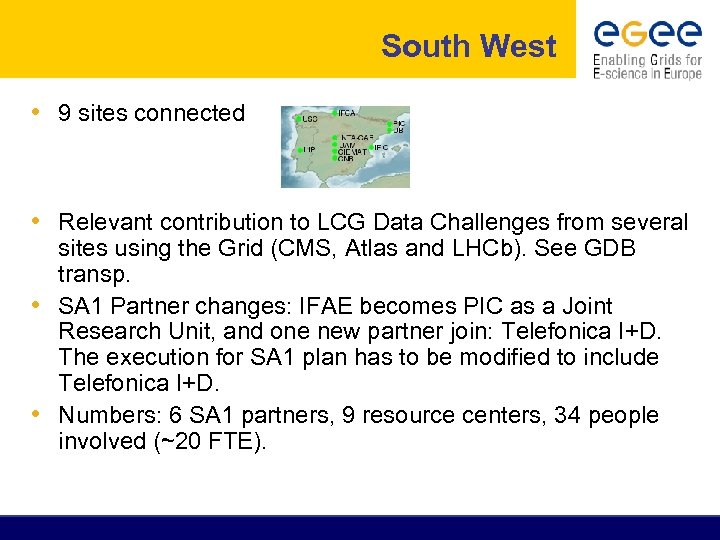
South West • 9 sites connected • Relevant contribution to LCG Data Challenges from several sites using the Grid (CMS, Atlas and LHCb). See GDB transp. • SA 1 Partner changes: IFAE becomes PIC as a Joint Research Unit, and one new partner join: Telefonica I+D. The execution for SA 1 plan has to be modified to include Telefonica I+D. • Numbers: 6 SA 1 partners, 9 resource centers, 34 people involved (~20 FTE).
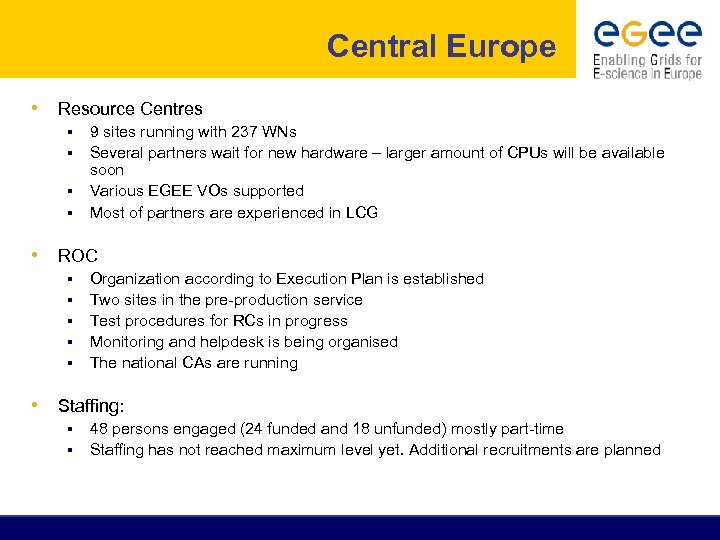
Central Europe • Resource Centres 9 sites running with 237 WNs Several partners wait for new hardware – larger amount of CPUs will be available soon § Various EGEE VOs supported § Most of partners are experienced in LCG § § • ROC § § § Organization according to Execution Plan is established Two sites in the pre-production service Test procedures for RCs in progress Monitoring and helpdesk is being organised The national CAs are running • Staffing: § § 48 persons engaged (24 funded and 18 unfunded) mostly part-time Staffing has not reached maximum level yet. Additional recruitments are planned
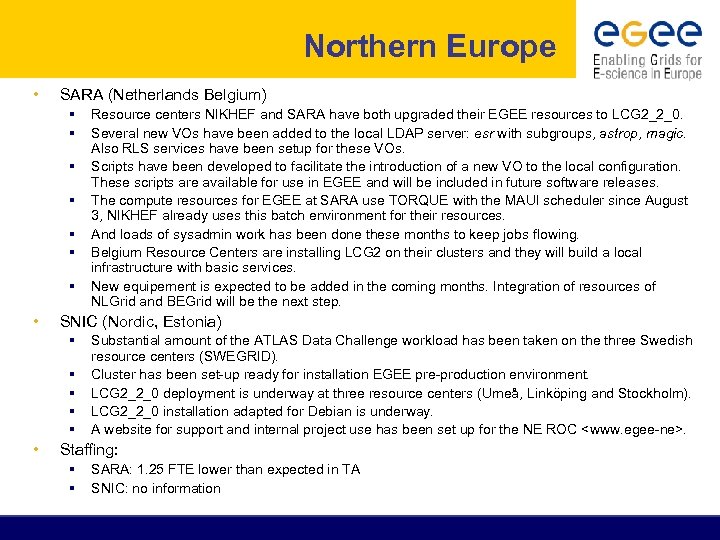
Northern Europe • SARA (Netherlands Belgium) § § § § • SNIC (Nordic, Estonia) § § § • Resource centers NIKHEF and SARA have both upgraded their EGEE resources to LCG 2_2_0. Several new VOs have been added to the local LDAP server: esr with subgroups, astrop, magic. Also RLS services have been setup for these VOs. Scripts have been developed to facilitate the introduction of a new VO to the local configuration. These scripts are available for use in EGEE and will be included in future software releases. The compute resources for EGEE at SARA use TORQUE with the MAUI scheduler since August 3, NIKHEF already uses this batch environment for their resources. And loads of sysadmin work has been done these months to keep jobs flowing. Belgium Resource Centers are installing LCG 2 on their clusters and they will build a local infrastructure with basic services. New equipement is expected to be added in the coming months. Integration of resources of NLGrid and BEGrid will be the next step. Substantial amount of the ATLAS Data Challenge workload has been taken on the three Swedish resource centers (SWEGRID). Cluster has been set-up ready for installation EGEE pre-production environment. LCG 2_2_0 deployment is underway at three resource centers (Umeå, Linköping and Stockholm). LCG 2_2_0 installation adapted for Debian is underway. A website for support and internal project use has been set up for the NE ROC <www. egee-ne>. Staffing: § § SARA: 1. 25 FTE lower than expected in TA SNIC: no information
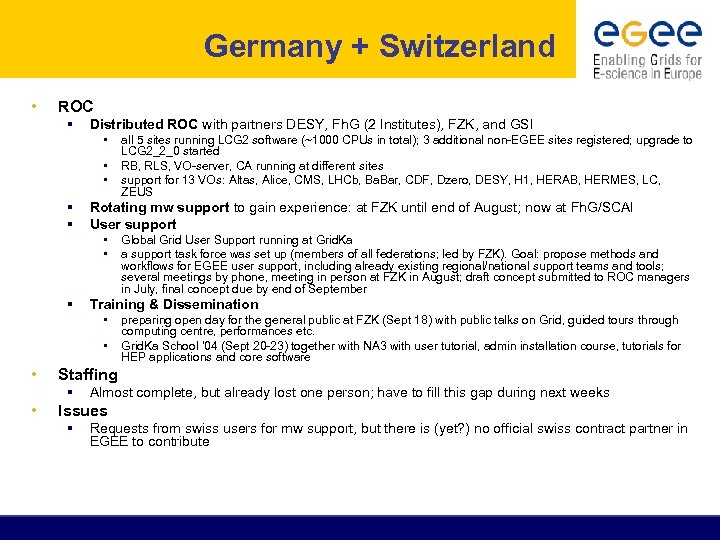
Germany + Switzerland • ROC § Distributed ROC with partners DESY, Fh. G (2 Institutes), FZK, and GSI • • • § § Rotating mw support to gain experience: at FZK until end of August; now at Fh. G/SCAI User support • • § • • Global Grid User Support running at Grid. Ka a support task force was set up (members of all federations; led by FZK). Goal: propose methods and workflows for EGEE user support, including already existing regional/national support teams and tools; several meetings by phone, meeting in person at FZK in August; draft concept submitted to ROC managers in July, final concept due by end of September Training & Dissemination • • all 5 sites running LCG 2 software (~1000 CPUs in total); 3 additional non-EGEE sites registered; upgrade to LCG 2_2_0 started RB, RLS, VO-server, CA running at different sites support for 13 VOs: Altas, Alice, CMS, LHCb, Ba. Bar, CDF, Dzero, DESY, H 1, HERAB, HERMES, LC, ZEUS preparing open day for the general public at FZK (Sept 18) with public talks on Grid, guided tours through computing centre, performances etc. Grid. Ka School ’ 04 (Sept 20 -23) together with NA 3 with user tutorial, admin installation course, tutorials for HEP applications and core software Staffing § Almost complete, but already lost one person; have to fill this gap during next weeks Issues § Requests from swiss users for mw support, but there is (yet? ) no official swiss contract partner in EGEE to contribute
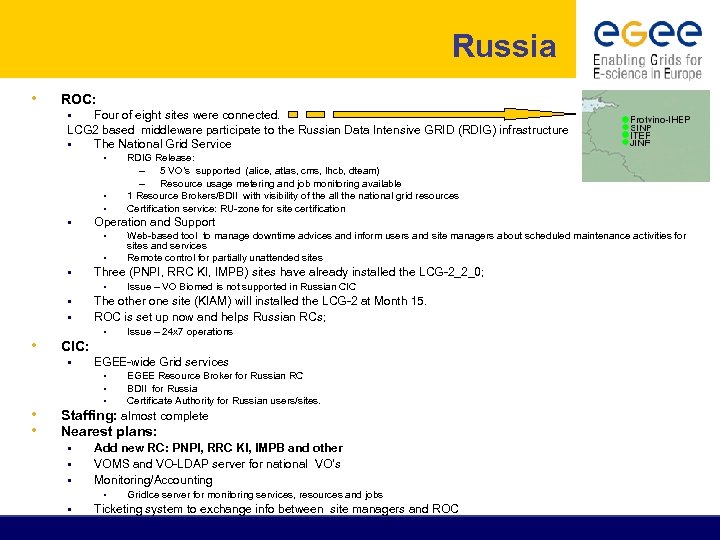
Russia • ROC: Four of eight sites were connected. LCG 2 based middleware participate to the Russian Data Intensive GRID (RDIG) infrastructure § The National Grid Service § • • • § Operation and Support • • § Issue – 24 x 7 operations CIC: § • • Issue – VO Biomed is not supported in Russian CIC The other one site (KIAM) will installed the LCG-2 at Month 15. ROC is set up now and helps Russian RCs; • • Web-based tool to manage downtime advices and inform users and site managers about scheduled maintenance activities for sites and services Remote control for partially unattended sites Three (PNPI, RRC KI, IMPB) sites have already installed the LCG-2_2_0; • § § RDIG Release: – 5 VO’s supported (alice, atlas, cms, lhcb, dteam) – Resource usage metering and job monitoring available 1 Resource Brokers/BDII with visibility of the all the national grid resources Certification service: RU-zone for site certification EGEE-wide Grid services • • • EGEE Resource Broker for Russian RC BDII for Russia Certificate Authority for Russian users/sites. Staffing: almost complete Nearest plans: § § § Add new RC: PNPI, RRC KI, IMPB and other VOMS and VO-LDAP server for national VO’s Monitoring/Accounting • § Grid. Ice server for monitoring services, resources and jobs Ticketing system to exchange info between site managers and ROC
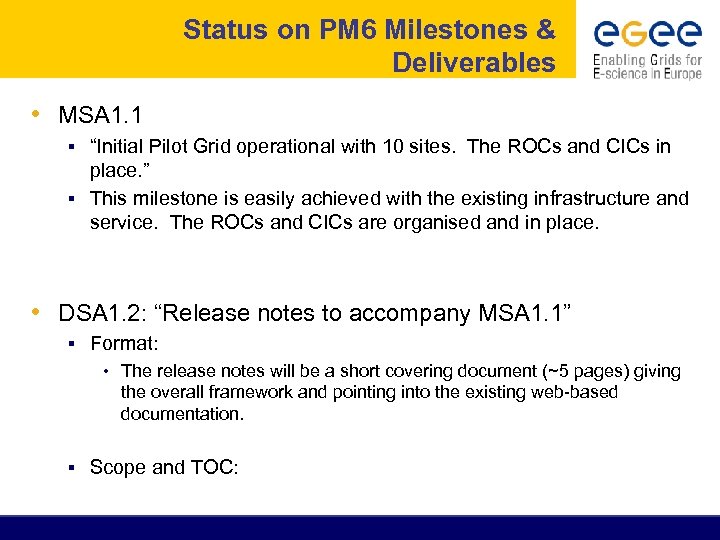
Status on PM 6 Milestones & Deliverables • MSA 1. 1 § “Initial Pilot Grid operational with 10 sites. The ROCs and CICs in place. ” § This milestone is easily achieved with the existing infrastructure and service. The ROCs and CICs are organised and in place. • DSA 1. 2: “Release notes to accompany MSA 1. 1” § Format: • The release notes will be a short covering document (~5 pages) giving the overall framework and pointing into the existing web-based documentation. § Scope and TOC:
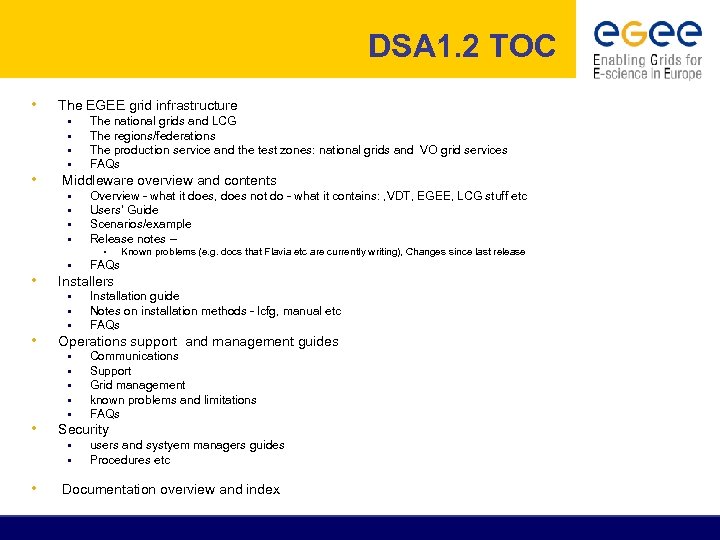
DSA 1. 2 TOC • • The EGEE grid infrastructure § § The national grids and LCG The regions/federations The production service and the test zones: national grids and VO grid services FAQs Middleware overview and contents § § Overview - what it does, does not do - what it contains: , VDT, EGEE, LCG stuff etc Users' Guide Scenarios/example Release notes – • • § FAQs Installers § § § Installation guide Notes on installation methods - lcfg, manual etc FAQs Operations support and management guides § § § Communications Support Grid management known problems and limitations FAQs Security § § • Known problems (e. g. docs that Flavia etc are currently writing), Changes since last release users and systyem managers guides Procedures etc Documentation overview and index
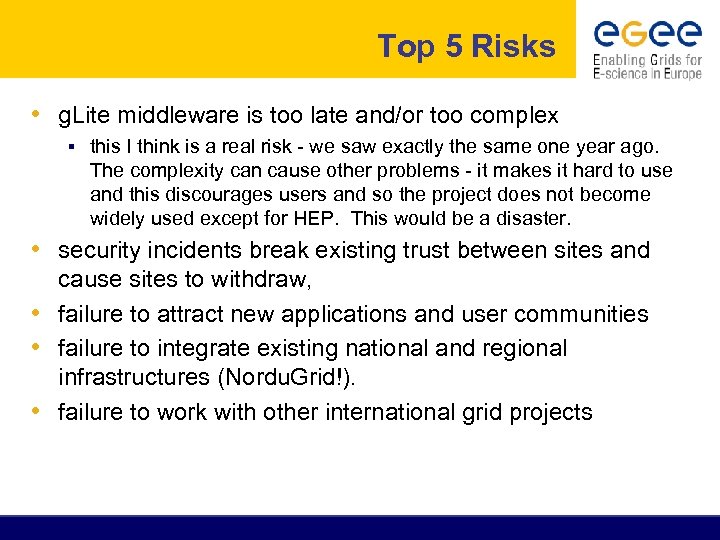
Top 5 Risks • g. Lite middleware is too late and/or too complex § this I think is a real risk - we saw exactly the same one year ago. The complexity can cause other problems - it makes it hard to use and this discourages users and so the project does not become widely used except for HEP. This would be a disaster. • security incidents break existing trust between sites and cause sites to withdraw, • failure to attract new applications and user communities • failure to integrate existing national and regional infrastructures (Nordu. Grid!). • failure to work with other international grid projects
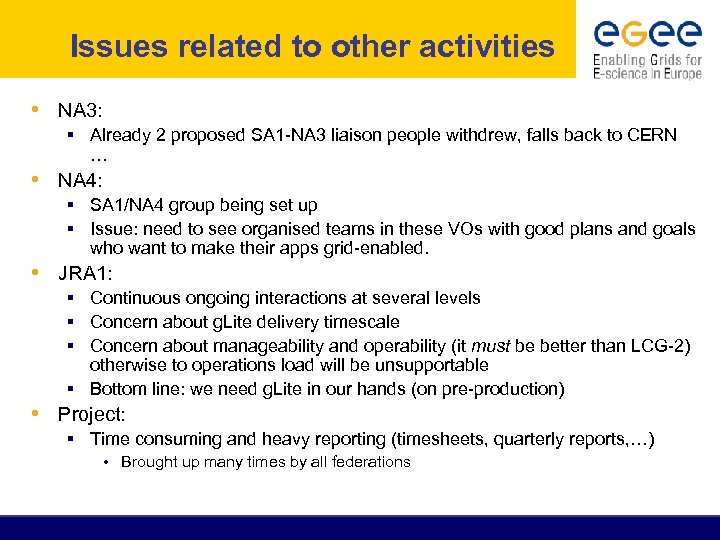
Issues related to other activities • NA 3: § Already 2 proposed SA 1 -NA 3 liaison people withdrew, falls back to CERN … • NA 4: § SA 1/NA 4 group being set up § Issue: need to see organised teams in these VOs with good plans and goals who want to make their apps grid-enabled. • JRA 1: § Continuous ongoing interactions at several levels § Concern about g. Lite delivery timescale § Concern about manageability and operability (it must be better than LCG-2) otherwise to operations load will be unsupportable § Bottom line: we need g. Lite in our hands (on pre-production) • Project: § Time consuming and heavy reporting (timesheets, quarterly reports, …) • Brought up many times by all federations
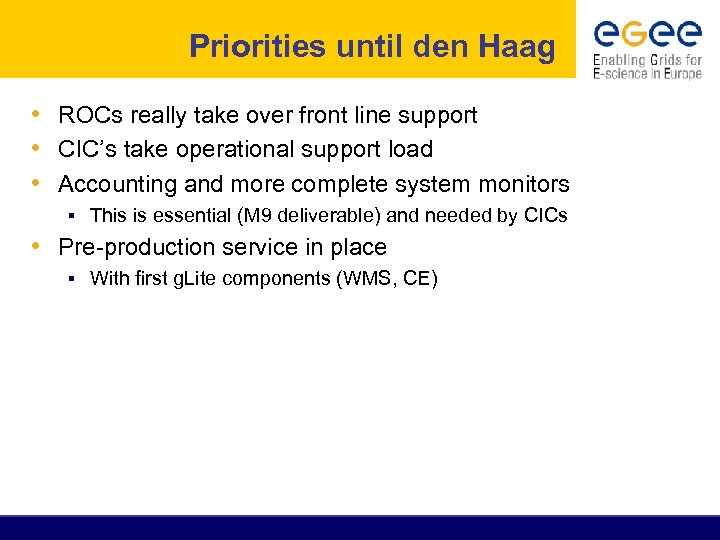
Priorities until den Haag • ROCs really take over front line support • CIC’s take operational support load • Accounting and more complete system monitors § This is essential (M 9 deliverable) and needed by CICs • Pre-production service in place § With first g. Lite components (WMS, CE)
Pre-production service • Nick’s talk
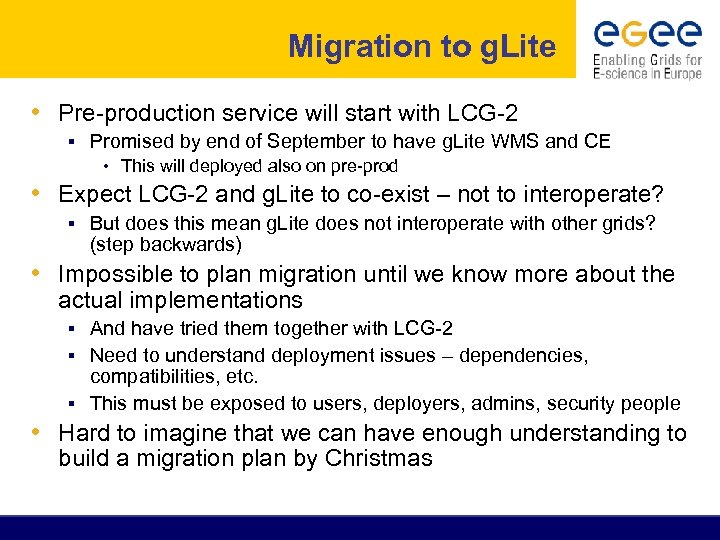
Migration to g. Lite • Pre-production service will start with LCG-2 § Promised by end of September to have g. Lite WMS and CE • This will deployed also on pre-prod • Expect LCG-2 and g. Lite to co-exist – not to interoperate? § But does this mean g. Lite does not interoperate with other grids? (step backwards) • Impossible to plan migration until we know more about the actual implementations § And have tried them together with LCG-2 § Need to understand deployment issues – dependencies, compatibilities, etc. § This must be exposed to users, deployers, admins, security people • Hard to imagine that we can have enough understanding to build a migration plan by Christmas
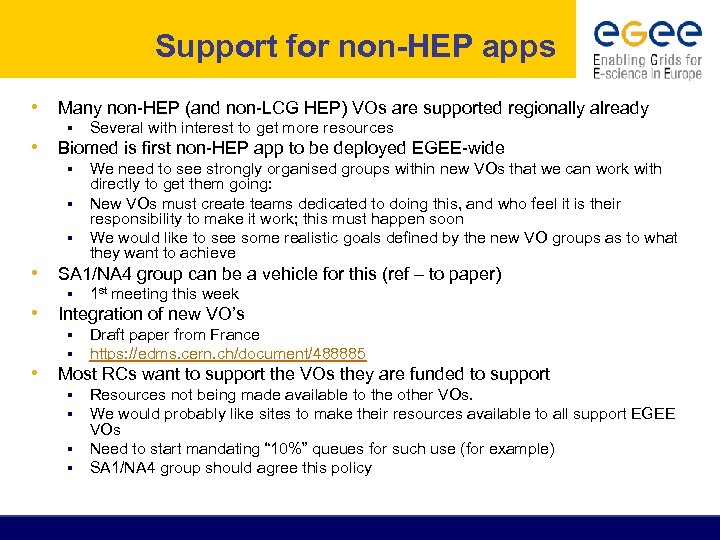
Support for non-HEP apps • Many non-HEP (and non-LCG HEP) VOs are supported regionally already § Several with interest to get more resources • Biomed is first non-HEP app to be deployed EGEE-wide We need to see strongly organised groups within new VOs that we can work with directly to get them going: § New VOs must create teams dedicated to doing this, and who feel it is their responsibility to make it work; this must happen soon § We would like to see some realistic goals defined by the new VO groups as to what they want to achieve § • SA 1/NA 4 group can be a vehicle for this (ref – to paper) § 1 st meeting this week § § Draft paper from France https: //edms. cern. ch/document/488885 • Integration of new VO’s • Most RCs want to support the VOs they are funded to support Resources not being made available to the other VOs. We would probably like sites to make their resources available to all support EGEE VOs § Need to start mandating “ 10%” queues for such use (for example) § SA 1/NA 4 group should agree this policy § §
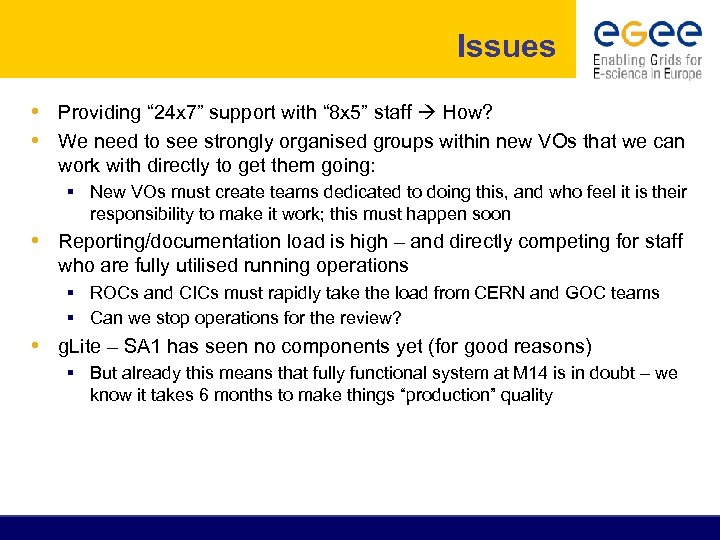
Issues • Providing “ 24 x 7” support with “ 8 x 5” staff How? • We need to see strongly organised groups within new VOs that we can work with directly to get them going: § New VOs must create teams dedicated to doing this, and who feel it is their responsibility to make it work; this must happen soon • Reporting/documentation load is high – and directly competing for staff who are fully utilised running operations § ROCs and CICs must rapidly take the load from CERN and GOC teams § Can we stop operations for the review? • g. Lite – SA 1 has seen no components yet (for good reasons) § But already this means that fully functional system at M 14 is in doubt – we know it takes 6 months to make things “production” quality
Скачать презентацию SA 1 All Activity Meeting 13 September 2004
6477937f9da538a9d16f0da57edd5812.ppt