


 Скачать презентацию s tem chn Sys Te l ica Operational
de09049d9934b58bebdeef0fedbcfe0e.ppt
- Количество слайдов: 38
 s tem chn Sys Te l ica Operational Do. D Architecture Framework Overview Alessio Mosto May, 2004 Alessio Mosto Do. D Architectural Framework
 Outline DODAF Definitions and Purpose n DODAF Products n DODAF Documents Overview n Future Evolution of DODAF n n Q&A Alessio Mosto Do. D Architectural Framework 2
 Do. D Architecture Framework 1. 0 n The Department of Defense (Do. D) Architecture Framework (DODAF) Defines a common approach for describing, presenting, and comparing Do. D enterprise architectures ¨ Facilitates the use of common principles, assumptions and terminology ¨ n The principal objective is to ¨ Ensure that architecture descriptions can be compared and related across organizational boundaries, including Joint and multi-national boundaries Alessio Mosto Do. D Architectural Framework 3
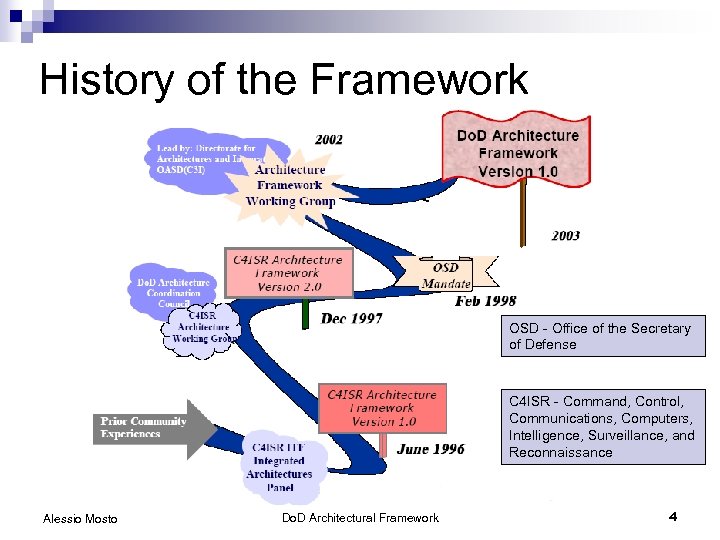 History of the Framework OSD - Office of the Secretary of Defense C 4 ISR - Command, Control, Communications, Computers, Intelligence, Surveillance, and Reconnaissance Alessio Mosto Do. D Architectural Framework 4
 Do. D Policy n Recent Do. D policy highlights use of architectures for: ¨ Understanding the Do. D as an enterprise ¨ Identification of operational requirements ¨ Rationalization of IT investment decisions ¨ Improvements to interoperability among various systems Alessio Mosto Do. D Architectural Framework 5
 Architecture Definition n “The structure of components, their relationships, and the principles and guidelines governing their design and evolution over time. ” Do. D Integrated Architecture Panel, 1995, based on IEEE STD 610. 12 n “An architecture is the fundamental organization of a system embodied in its components, their relationships to each other, and to the environment, and the principles guiding its design and evolution. ” IEEE STD 1471 -2000 Alessio Mosto Do. D Architectural Framework 6
 Architecture vs. Design n System Architecture is used to: ¨ Make buy decisions ¨ Discriminate between options ¨ “Discover” the true requirements ¨ Drive one or more systems to a common “use” or purpose n System Design is used to: ¨ Develop system components ¨ Build the system ¨ Understand configuration changes as the system is modified Alessio Mosto Do. D Architectural Framework 7
 Enterprise competitive edge n n n An enterprise’s competitive edge and ultimate success are enabled by its ability to rapidly respond to changing business strategies, governance, and technologies The Do. D environment spells this competitive edge as victory The competitive edge translates into higher levels of customer satisfaction, shorter work cycles, and reductions in schedules, maintenance costs, and development time, all resulting in lower overall cost of ownership Alessio Mosto Do. D Architectural Framework 8
 Enterprise Architecture n n Enterprise Architecture is the key facilitating ingredient providing a holistic view and a mechanism for enabling the design and development as well as the communication and understanding of the enterprise The overarching goals of enterprise architecture are to manage the complexity of the enterprise, align business strategies and implementations, and facilitate rapid change in order to maintain business and technical advantages Alessio Mosto Do. D Architectural Framework 9
 Enterprise vs. System n System Architecture is like blueprints for a building n Enterprise Architecture is like urban planning Alessio Mosto Do. D Architectural Framework 10
 Architecture Framework n “An architecture framework is a tool… It should describe a method for designing an information system in terms of a set of building blocks, and for showing how the building blocks fit together. It should contain a set of tools and provide a common vocabulary. It should also include a list of recommended standards and compliant products that can be used to implement the building blocks. ” [TOGAF 8, Open. Group] Alessio Mosto Do. D Architectural Framework 11
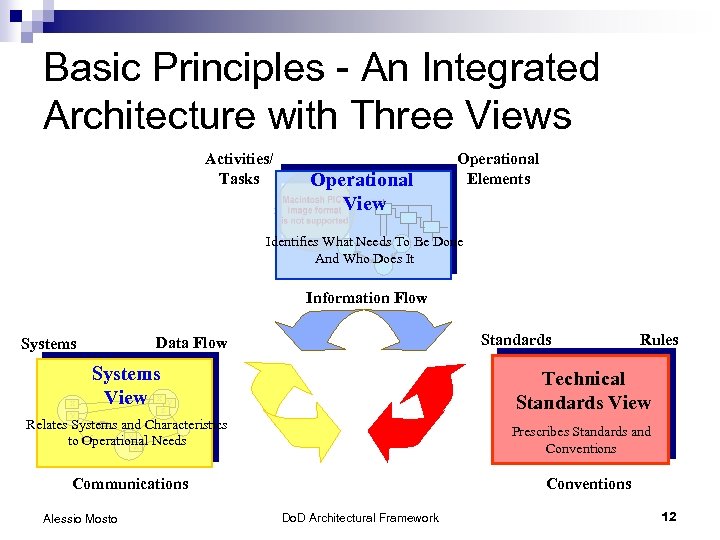 Basic Principles - An Integrated Architecture with Three Views Activities/ Tasks Operational View Operational Elements Identifies What Needs To Be Done And Who Does It Information Flow X Standards Data Flow Systems View Y X Z Technical Standards View Y Relates Systems and Characteristics Y to Operational Needs X Prescribes Standards and Conventions Communications Alessio Mosto Rules Conventions Do. D Architectural Framework 12
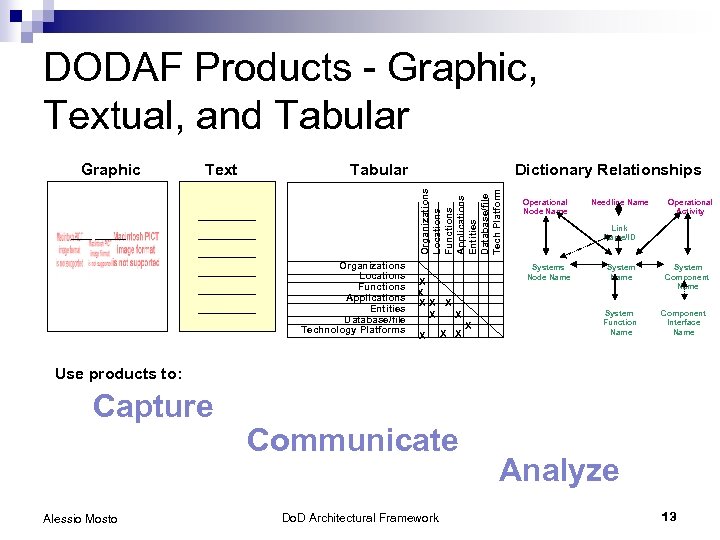 DODAF Products - Graphic, Textual, and Tabular Text Tabular Dictionary Relationships Organizations Locations Functions Applications Entities Database/file Tech Platform Graphic Organizations Locations Functions Applications Entities Database/file Technology Platforms X X X X X Operational Node Name Operational Activity Link Name/ID Systems Node Name X Needline Name System Function Name System Component Name Component Interface Name Use products to: Capture Alessio Mosto Communicate Do. D Architectural Framework Analyze 13
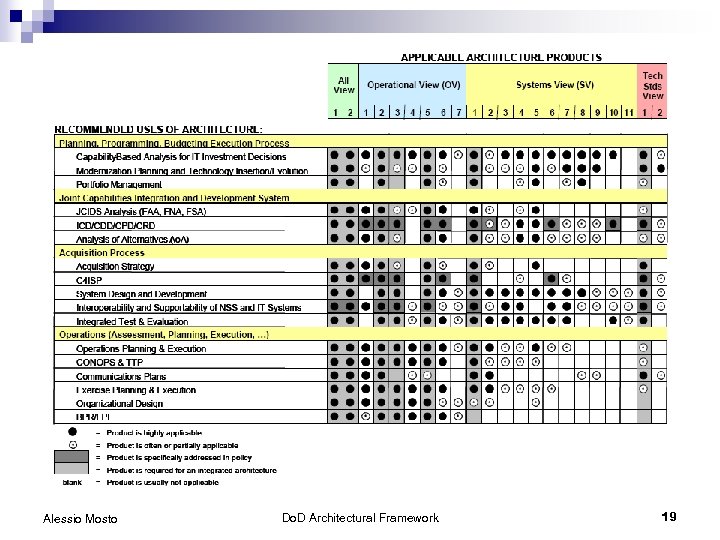
 DODAF Products The DODAF describes a set of 26 work products to ensure uniformity and standardization in the documentation and communication of architecture n The 26 DODAF views are designed to document the entire architecture, from requirements to implementation n Alessio Mosto Do. D Architectural Framework 14
 DODAF Products - Views n The list of products is refined into four views: ¨ All Views (AV): is the overarching information describing the architecture plans, scope, and definitions ¨ Operational View (OV): focuses on the behaviours and functions describing the enterprise mission aspects ¨ System View (SV): describes the system and applications supporting the mission functions ¨ Technical Standards View (TV): describes the policies, standards and constraints Alessio Mosto Do. D Architectural Framework 15
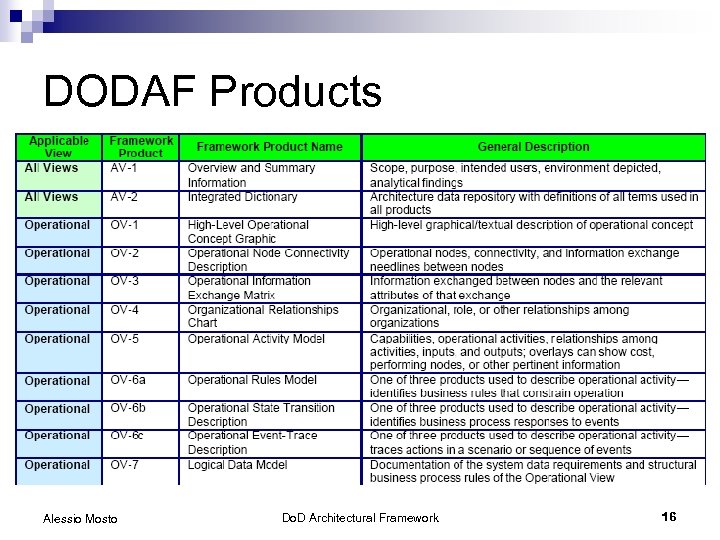 DODAF Products Alessio Mosto Do. D Architectural Framework 16
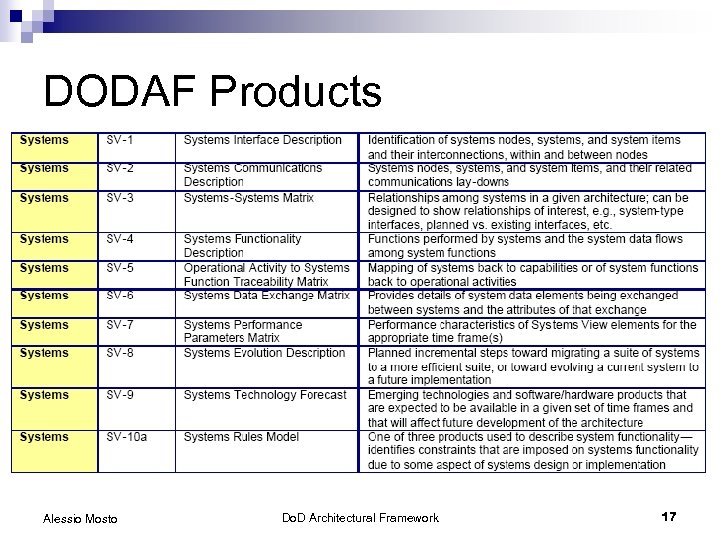 DODAF Products Alessio Mosto Do. D Architectural Framework 17
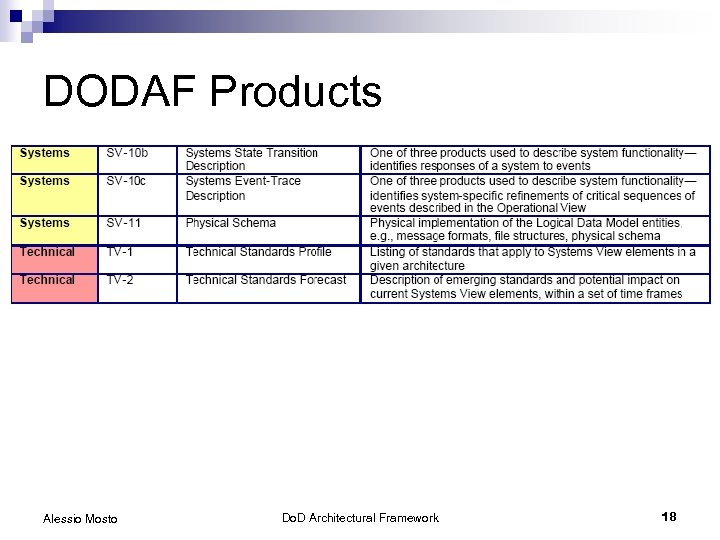 DODAF Products Alessio Mosto Do. D Architectural Framework 18
 Alessio Mosto Do. D Architectural Framework 19
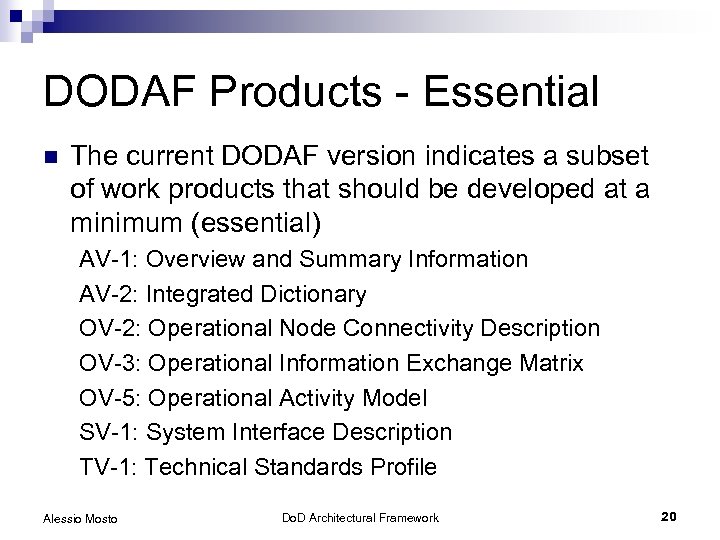 DODAF Products - Essential n The current DODAF version indicates a subset of work products that should be developed at a minimum (essential) AV-1: Overview and Summary Information AV-2: Integrated Dictionary OV-2: Operational Node Connectivity Description OV-3: Operational Information Exchange Matrix OV-5: Operational Activity Model SV-1: System Interface Description TV-1: Technical Standards Profile Alessio Mosto Do. D Architectural Framework 20
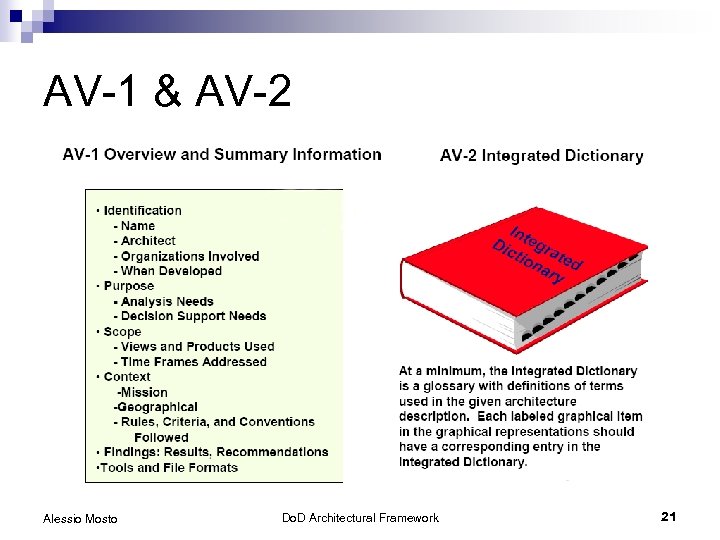 AV-1 & AV-2 Alessio Mosto Do. D Architectural Framework 21
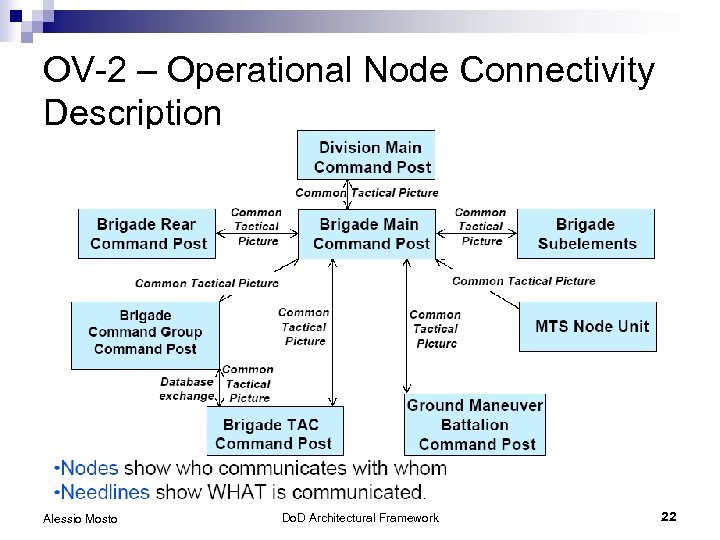 OV-2 – Operational Node Connectivity Description Alessio Mosto Do. D Architectural Framework 22
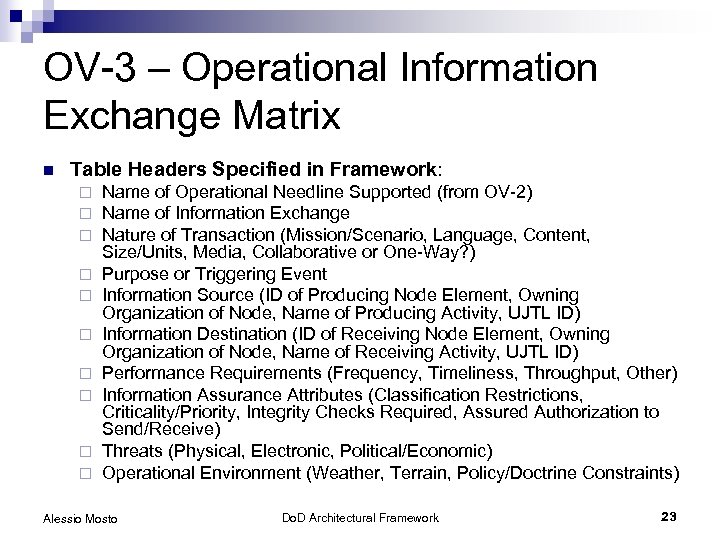 OV-3 – Operational Information Exchange Matrix n Table Headers Specified in Framework: ¨ ¨ ¨ ¨ ¨ Name of Operational Needline Supported (from OV-2) Name of Information Exchange Nature of Transaction (Mission/Scenario, Language, Content, Size/Units, Media, Collaborative or One-Way? ) Purpose or Triggering Event Information Source (ID of Producing Node Element, Owning Organization of Node, Name of Producing Activity, UJTL ID) Information Destination (ID of Receiving Node Element, Owning Organization of Node, Name of Receiving Activity, UJTL ID) Performance Requirements (Frequency, Timeliness, Throughput, Other) Information Assurance Attributes (Classification Restrictions, Criticality/Priority, Integrity Checks Required, Assured Authorization to Send/Receive) Threats (Physical, Electronic, Political/Economic) Operational Environment (Weather, Terrain, Policy/Doctrine Constraints) Alessio Mosto Do. D Architectural Framework 23
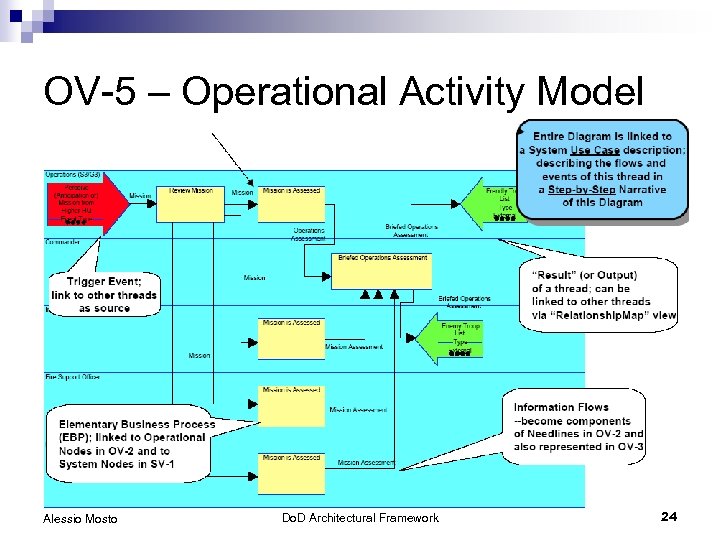 OV-5 – Operational Activity Model Alessio Mosto Do. D Architectural Framework 24
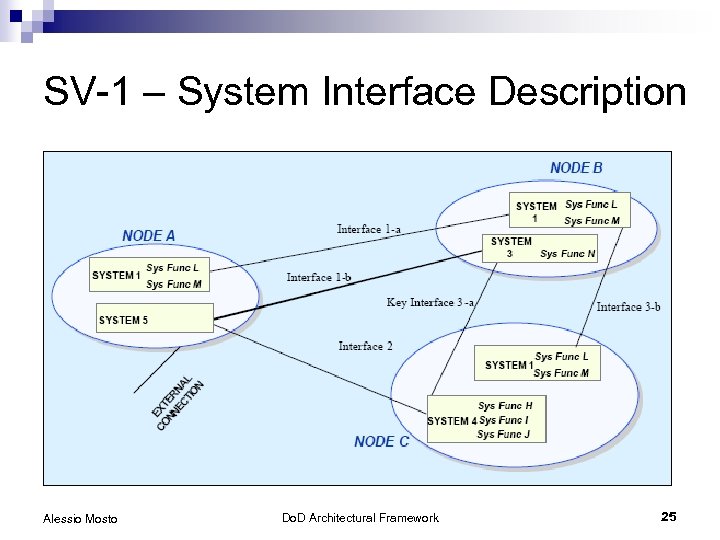 SV-1 – System Interface Description Alessio Mosto Do. D Architectural Framework 25
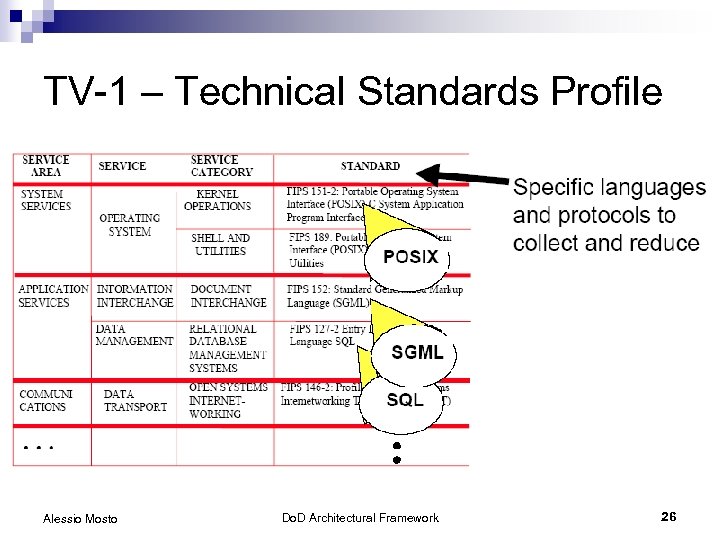 TV-1 – Technical Standards Profile Alessio Mosto Do. D Architectural Framework 26
 Problems n Conspicuously absent are the all-important business, financial, and technical analysis of alternatives – information needed to drive enterprise architectural decisions Alessio Mosto Do. D Architectural Framework 27
 Do. D Architecture Framework ¨ Volume n Covers value of architectures, measures, use in Do. D processes ¨ Volume n I: Definitions, Guidelines , and Background II: Product Descriptions Covers Structured Analysis and UML Representations ¨ Deskbook: n Architecture Guidance Provides guidance on development, use, incorporating security into the architecture ¨ Release Date – November 2003 ¨ Web Site: http: //aitcnet. org/dodaf/ Alessio Mosto Do. D Architectural Framework 28
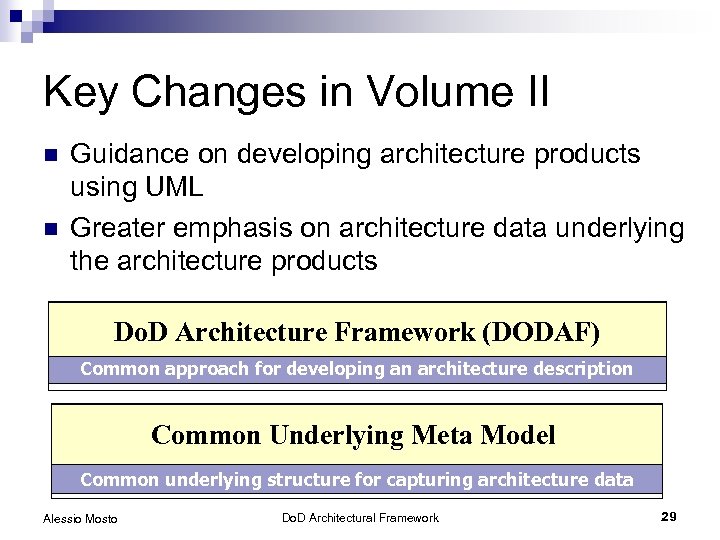 Key Changes in Volume II n n Guidance on developing architecture products using UML Greater emphasis on architecture data underlying the architecture products Do. D Architecture Framework (DODAF) Common approach for developing an architecture description Common Underlying Meta Model Common underlying structure for capturing architecture data Alessio Mosto Do. D Architectural Framework 29
 Future Evolution Areas Define a DODAF Object Model to: n Validate and Clarify the information definitions provided by the DODAF To capture the architecture data elements (object and relationships) described by DODAF ¨ Use DODAF definitions to define an object model ¨ n Validate and Clarify the notation definitions intended by DODAF ¨ n Adjust the object and relationship definitions to include graphics (e. g. , modeling notation) and/or formatting characteristics that are required to be common Facilitate the common usage of such a model Define an ontology: identify the generalizations / specializations (supertypes / subtypes) that are appropriate ¨ Provide clear, concise descriptions for all the data elements ¨ Alessio Mosto Do. D Architectural Framework 30
 Future Evolution Areas (Cont’d) n Benefits - A DODAF object model will: ¨ Provide a common set of objects and relationship definitions (requirements) that can be used by tool vendors to supply software tools that support the development of DODAF-Compliant architectures ¨ Provide a common set of objects and relationship definitions against which a standard interface can be defined to: n n Alessio Mosto Enable the sharing of architecture model / products between different tools Enable the implementation of a common repository for architecture data Do. D Architectural Framework 31
 Future Evolution Areas (Cont’d) Define a common ontology of architecture elements n Address baseline (current) and objective (target) architectures n Address use of architectures to measure mission effectiveness (capabilities and measures of effectiveness) n Alessio Mosto Do. D Architectural Framework 32
 DODAF prospect n February 9, 2004. Department of Defense CIO John P. Stenbit approved Version 1. 0 of the Department of Defense Architectural Framework (DODAF) for immediate use. All architectures developed or approved after December 1, 2003 must comply with the new framework. Architectures developed prior to that date must be converted upon any version updates n Not only for “military mission” and for Do. D Also for civilian enterprise n Alessio Mosto Do. D Architectural Framework 33
 Q&A n … Alessio Mosto Do. D Architectural Framework 34
 References n Department of Defense Architecture Framework Working Group. “Do. D Architecture Framework Ver. 1. 0. ” Washington, D. C. : Department of Defense, Nov. 2003 http: //aitcnet. org/dodaf n Do. D Architecture Framework Overview – Dr. Fatma Dandashi – October 2003 http: //www. opengroup. org/public/member/ proceedings/q 403/dandashi. pdf n Enterprise Do. D Architecture Framework and the Motivational View – D. B. Robi – Open Forum, April 2004 http: //www. stsc. hill. af. mil/crosstalk/2004/04/0404 Robi. ht ml Alessio Mosto Do. D Architectural Framework 35
 References n Leveraging Do. D/C 4 ISR Architecture Framework Products for Developmental and Operational Testing – Annette Ensing (The MITRE Corporation) and LTC Phil Hallenbeck (USA Operational Test Command) – The Software Technology Conference, May 2002 http: //www. stc-online. org/stc 2002 proceedings/ Spkr. PDFS/Thr. Tracs/p 728. pdf n Do. D Architecture Framework and Software Architecture Workshop Report – March 2003 http: //www. ichnet. org/DODAF%20 SEI%20 report. pdf n Breakout Session 10 B Outbriefing – James Martin – Ground System Architectures Workshop, 2004 http: //sunset. usc. edu/gsaw 2004/s 14/10 b_outbrief. pdf n Sotware Productivity Consortium http: //www. software. org/ Alessio Mosto Do. D Architectural Framework 36
 Thanks Alessio Mosto Do. D Architectural Framework
 Open Group n Open Group is an international vendor and technology-neutral consortium n TOGAF, The Open Group Architecture Framework, is an industry standard architecture framework that may be used freely by any organization wishing to develop an information systems architecture for use within that organization Alessio Mosto Do. D Architectural Framework 38