


 Скачать презентацию S O D A Start Of Day Activity
1e7d871f271231ec08c6117bc6cf5d4f.ppt
- Количество слайдов: 14
 S. O. D. A. Start Of Day Activity Morning registration mathematics activity Aligned to the Renewed Framework for Mathematics Stoke-on-Trent Primary Maths Team
 S. O. D. A. Start Of Day Activity WHAT IS IT? 10 mathematics questions per day based on the Renewed Framework for Mathematics. Questions 1 -5 consolidate maths from the previous unit. Questions 6 -10 are based on the previous year’s coverage of the next unit (following Block sequence A B C D E). This will support you in pitching the learning appropriately for the next unit and gathering evidence for APP. WHAT IS IT NOT? SODA is NOT intended to be used during any part of the daily mathematics lesson. It is an ADDITIONAL resource to support the CONSOLIDATION of learning which has taken place previously.
 S. O. D. A. Start Of Day Activity WHEN? During the registration period at the start of the day. Pupils could record their answers in a ‘SODA’ book. Go through the questions and discuss strategies the children used with the pupils during registration. Ensure that you model the correct mathematical vocabulary and always encourage the children to use it correctly. HOW? Use SODA as it stands or personalise the questions for your pupils by adapting / replacing them.
 Year 6, Block C, Unit 2 Questions 1 - 5 based on Year 6, Block B, Unit 2 Questions 6 -10 based on Year 5, Block D Unit 2
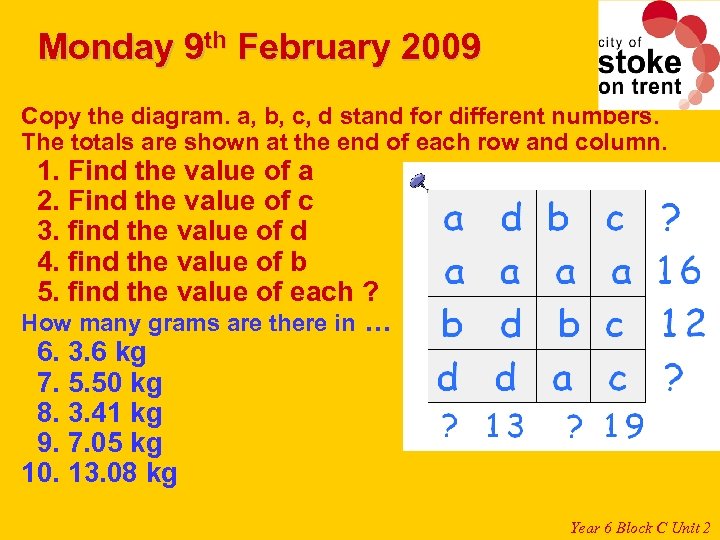 Monday 9 th February 2009 Copy the diagram. a, b, c, d stand for different numbers. The totals are shown at the end of each row and column. 1. Find the value of a 2. Find the value of c 3. find the value of d 4. find the value of b 5. find the value of each ? How many grams are there in … 6. 3. 6 kg 7. 5. 50 kg 8. 3. 41 kg 9. 7. 05 kg 10. 13. 08 kg Year 6 Block C Unit 2
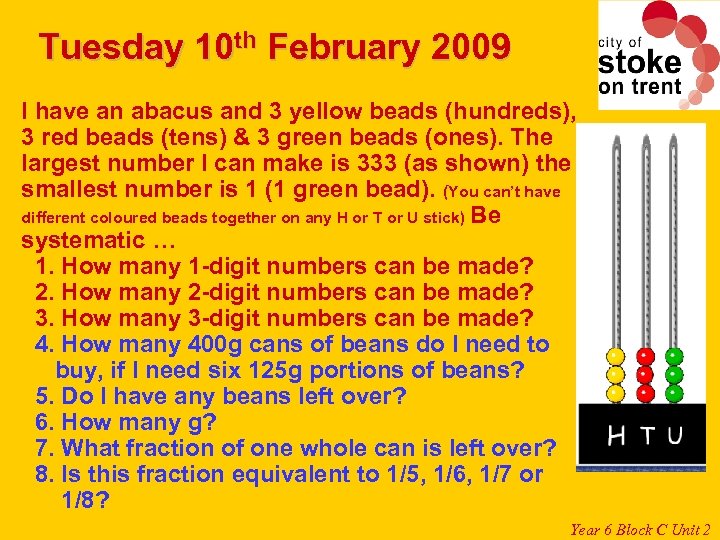 Tuesday 10 th February 2009 I have an abacus and 3 yellow beads (hundreds), 3 red beads (tens) & 3 green beads (ones). The largest number I can make is 333 (as shown) the smallest number is 1 (1 green bead). (You can’t have different coloured beads together on any H or T or U stick) Be systematic … 1. How many 1 -digit numbers can be made? 2. How many 2 -digit numbers can be made? 3. How many 3 -digit numbers can be made? 4. How many 400 g cans of beans do I need to buy, if I need six 125 g portions of beans? 5. Do I have any beans left over? 6. How many g? 7. What fraction of one whole can is left over? 8. Is this fraction equivalent to 1/5, 1/6, 1/7 or 1/8? Year 6 Block C Unit 2
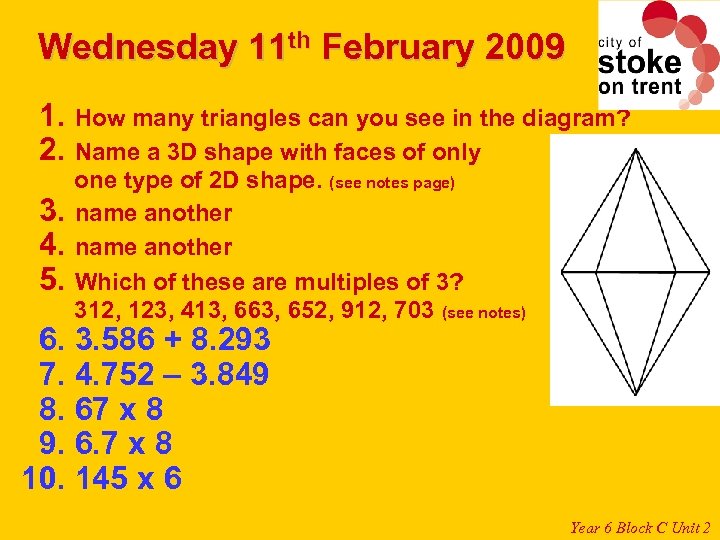 Wednesday 11 th February 2009 1. How many triangles can you see in the diagram? 2. Name a 3 D shape with faces of only 3. 4. 5. one type of 2 D shape. (see notes page) name another Which of these are multiples of 3? 312, 123, 413, 663, 652, 912, 703 (see notes) 6. 3. 586 + 8. 293 7. 4. 752 – 3. 849 8. 67 x 8 9. 6. 7 x 8 10. 145 x 6 Year 6 Block C Unit 2
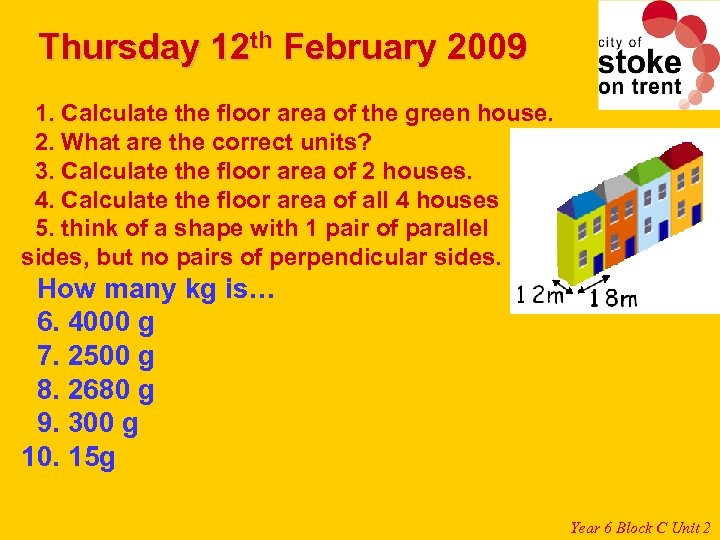 Thursday 12 th February 2009 1. Calculate the floor area of the green house. 2. What are the correct units? 3. Calculate the floor area of 2 houses. 4. Calculate the floor area of all 4 houses 5. think of a shape with 1 pair of parallel sides, but no pairs of perpendicular sides. How many kg is… 6. 4000 g 7. 2500 g 8. 2680 g 9. 300 g 10. 15 g Year 6 Block C Unit 2
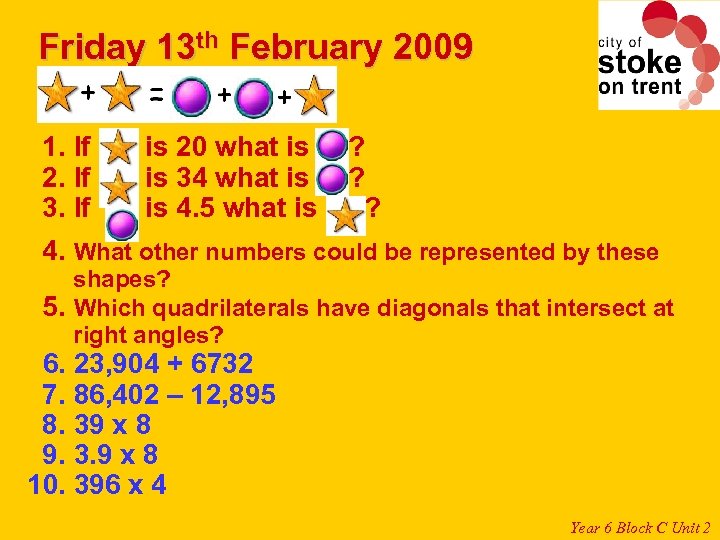 Friday 13 th February 2009 1. If 2. If 3. If is 20 what is is 34 what is is 4. 5 what is ? ? ? 4. What other numbers could be represented by these shapes? 5. Which quadrilaterals have diagonals that intersect at right angles? 6. 23, 904 + 6732 7. 86, 402 – 12, 895 8. 39 x 8 9. 3. 9 x 8 10. 396 x 4 Year 6 Block C Unit 2
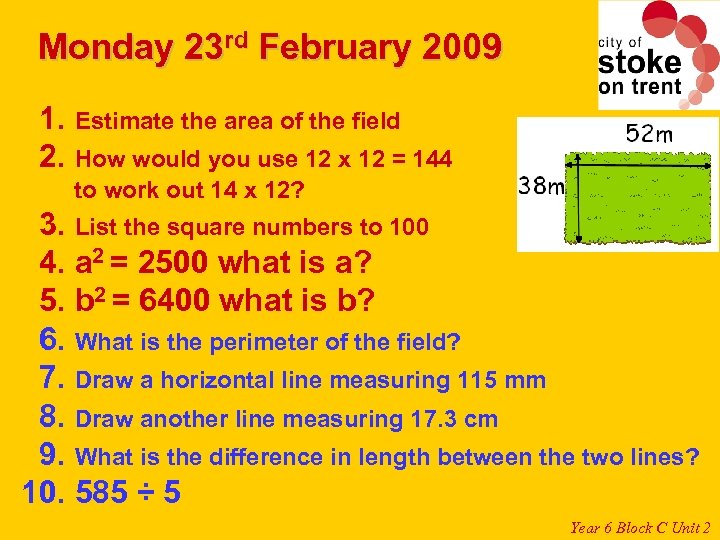 Monday 23 rd February 2009 1. Estimate the area of the field 2. How would you use 12 x 12 = 144 to work out 14 x 12? 3. List the square numbers to 100 4. a 2 = 2500 what is a? 5. b 2 = 6400 what is b? 6. What is the perimeter of the field? 7. Draw a horizontal line measuring 115 mm 8. Draw another line measuring 17. 3 cm 9. What is the difference in length between the two lines? 10. 585 ÷ 5 Year 6 Block C Unit 2
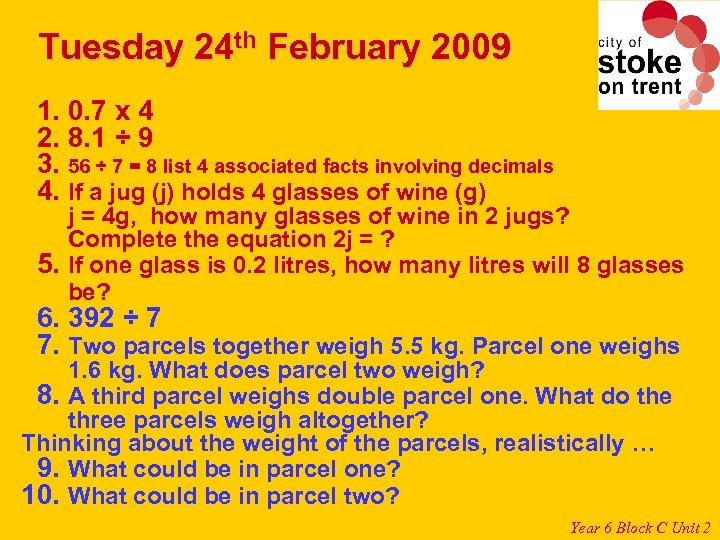 Tuesday 24 th February 2009 1. 0. 7 x 4 2. 8. 1 ÷ 9 3. 56 ÷ 7 = 8 list 4 associated facts involving decimals 4. If a jug (j) holds 4 glasses of wine (g) j = 4 g, how many glasses of wine in 2 jugs? Complete the equation 2 j = ? 5. If one glass is 0. 2 litres, how many litres will 8 glasses be? 6. 392 ÷ 7 7. Two parcels together weigh 5. 5 kg. Parcel one weighs 1. 6 kg. What does parcel two weigh? 8. A third parcel weighs double parcel one. What do the three parcels weigh altogether? Thinking about the weight of the parcels, realistically … 9. What could be in parcel one? 10. What could be in parcel two? Year 6 Block C Unit 2
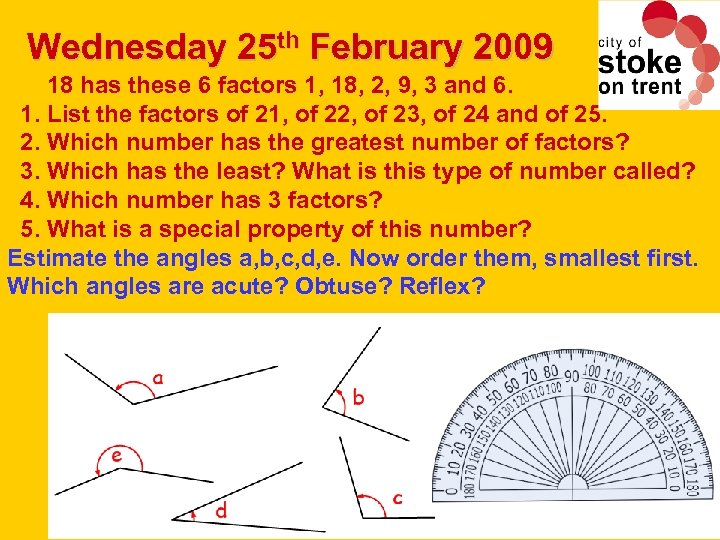 Wednesday 25 th February 2009 18 has these 6 factors 1, 18, 2, 9, 3 and 6. 1. List the factors of 21, of 22, of 23, of 24 and of 25. 2. Which number has the greatest number of factors? 3. Which has the least? What is this type of number called? 4. Which number has 3 factors? 5. What is a special property of this number? Estimate the angles a, b, c, d, e. Now order them, smallest first. Which angles are acute? Obtuse? Reflex? Year 6 Block C Unit 2
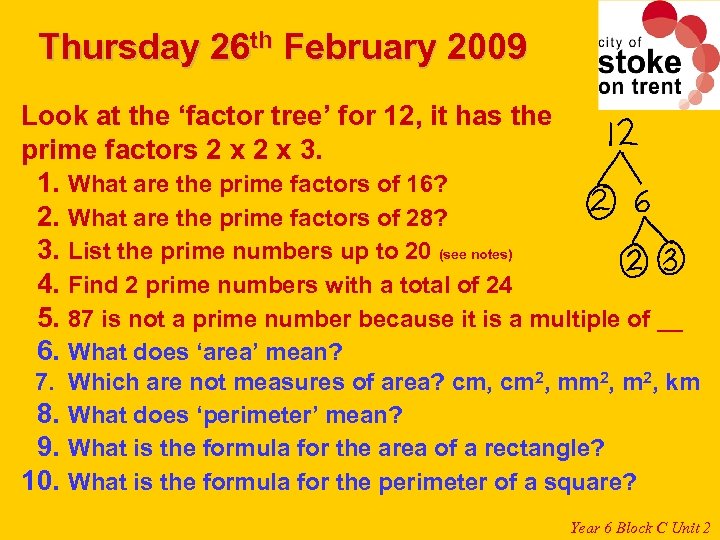 Thursday 26 th February 2009 Look at the ‘factor tree’ for 12, it has the prime factors 2 x 3. 1. What are the prime factors of 16? 2. What are the prime factors of 28? 3. List the prime numbers up to 20 (see notes) 4. Find 2 prime numbers with a total of 24 5. 87 is not a prime number because it is a multiple of __ 6. What does ‘area’ mean? 7. Which are not measures of area? cm, cm 2, km 8. What does ‘perimeter’ mean? 9. What is the formula for the area of a rectangle? 10. What is the formula for the perimeter of a square? Year 6 Block C Unit 2
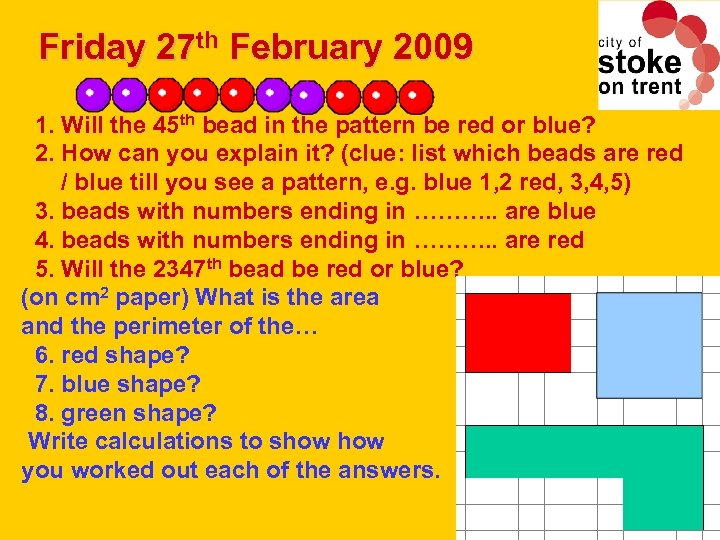 Friday 27 th February 2009 1. Will the 45 th bead in the pattern be red or blue? 2. How can you explain it? (clue: list which beads are red / blue till you see a pattern, e. g. blue 1, 2 red, 3, 4, 5) 3. beads with numbers ending in ………. . are blue 4. beads with numbers ending in ………. . are red 5. Will the 2347 th bead be red or blue? (on cm 2 paper) What is the area and the perimeter of the… 6. red shape? 7. blue shape? 8. green shape? Write calculations to show you worked out each of the answers. Year 6 Block C Unit 2