 Скачать презентацию S B 740 The College and Career Readiness
df3fc0616c25c4b37f7f211d757a13de.ppt
- Количество слайдов: 12



S. B. 740 The College and Career Readiness and College Completion Act Of 2013 Senator Paul Pinsky Education Subcommittee Chair
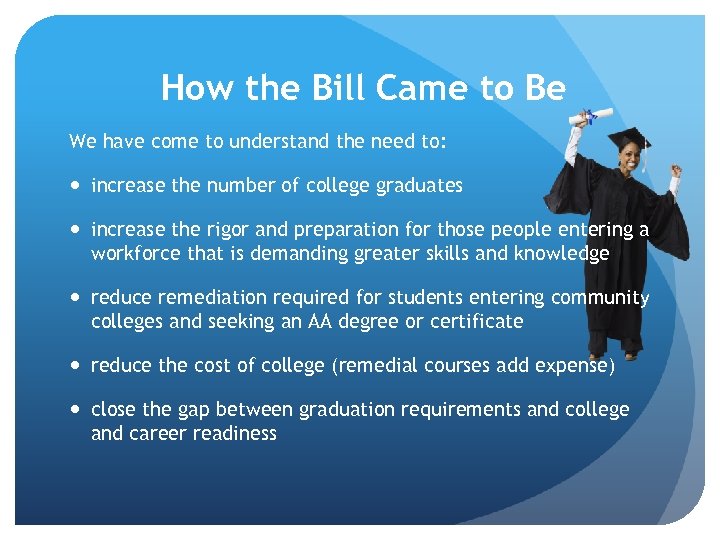
How the Bill Came to Be We have come to understand the need to: increase the number of college graduates increase the rigor and preparation for those people entering a workforce that is demanding greater skills and knowledge reduce remediation required for students entering community colleges and seeking an AA degree or certificate reduce the cost of college (remedial courses add expense) close the gap between graduation requirements and college and career readiness
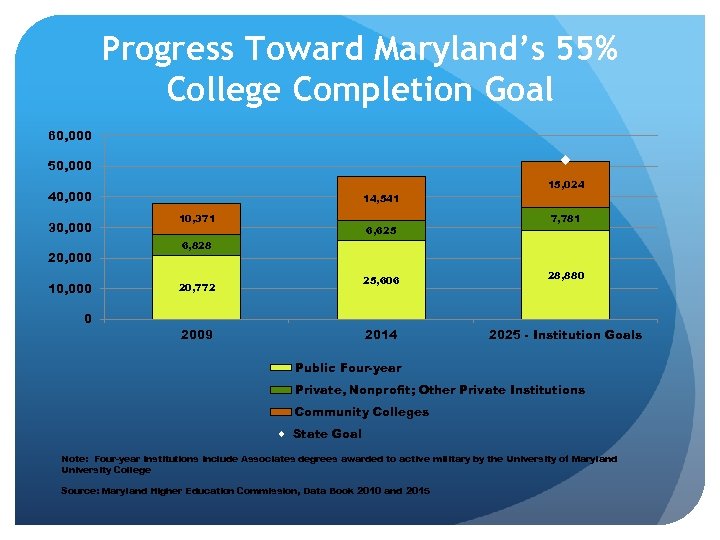
Progress Toward Maryland’s 55% College Completion Goal 60, 000 50, 000 15, 024 40, 000 30, 000 20, 000 10, 000 0 14, 541 10, 371 6, 625 7, 781 6, 828 25, 606 20, 772 2009 2014 28, 880 2025 - Institution Goals Public Four-year Private, Nonprofit; Other Private Institutions Community Colleges State Goal Note: Four-year institutions include Associates degrees awarded to active military by the University of Maryland University College Source: Maryland Higher Education Commission, Data Book 2010 and 2015
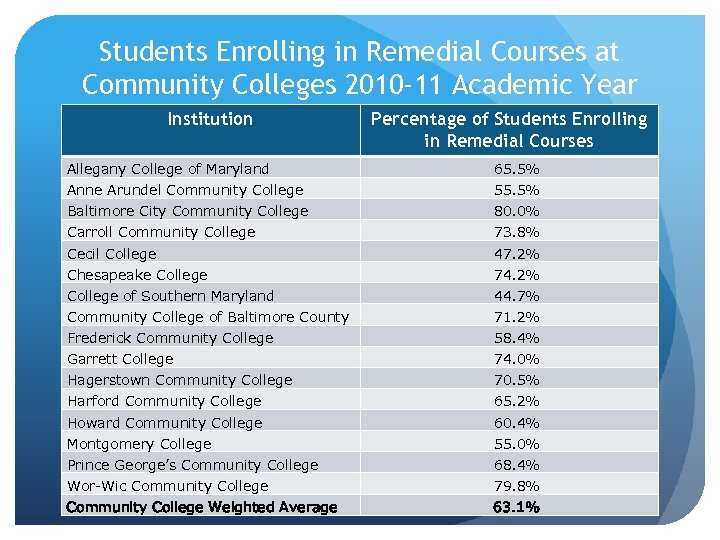
Students Enrolling in Remedial Courses at Community Colleges 2010 -11 Academic Year Institution Percentage of Students Enrolling in Remedial Courses Allegany College of Maryland 65. 5% Anne Arundel Community College 55. 5% Baltimore City Community College 80. 0% Carroll Community College 73. 8% Cecil College 47. 2% Chesapeake College 74. 2% College of Southern Maryland 44. 7% Community College of Baltimore County 71. 2% Frederick Community College 58. 4% Garrett College 74. 0% Hagerstown Community College 70. 5% Harford Community College 65. 2% Howard Community College 60. 4% Montgomery College 55. 0% Prince George’s Community College 68. 4% Wor-Wic Community College 79. 8% Community College Weighted Average 63. 1%
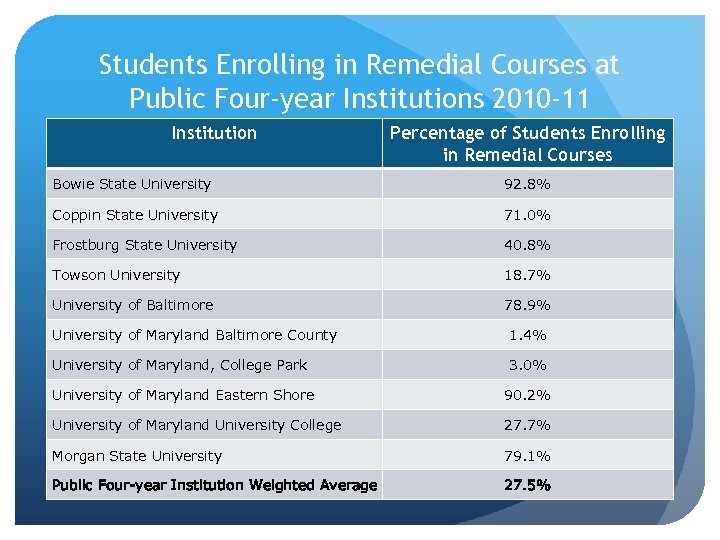
Students Enrolling in Remedial Courses at Public Four-year Institutions 2010 -11 Institution Percentage of Students Enrolling in Remedial Courses Bowie State University 92. 8% Coppin State University 71. 0% Frostburg State University 40. 8% Towson University 18. 7% University of Baltimore 78. 9% University of Maryland Baltimore County 1. 4% University of Maryland, College Park 3. 0% University of Maryland Eastern Shore 90. 2% University of Maryland University College 27. 7% Morgan State University 79. 1% Public Four-year Institution Weighted Average 27. 5%
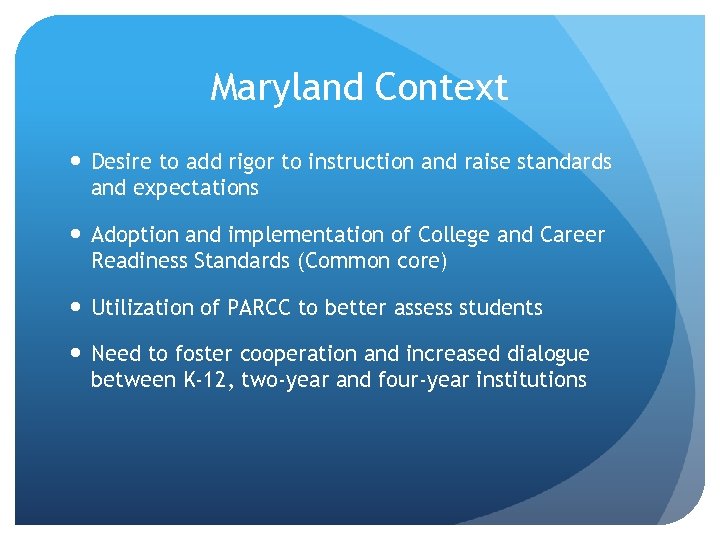
Maryland Context Desire to add rigor to instruction and raise standards and expectations Adoption and implementation of College and Career Readiness Standards (Common core) Utilization of PARCC to better assess students Need to foster cooperation and increased dialogue between K-12, two-year and four-year institutions
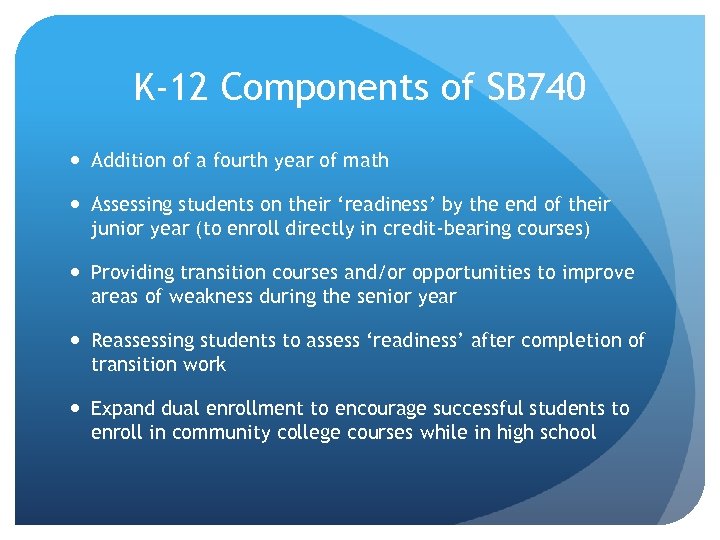
K-12 Components of SB 740 Addition of a fourth year of math Assessing students on their ‘readiness’ by the end of their junior year (to enroll directly in credit-bearing courses) Providing transition courses and/or opportunities to improve areas of weakness during the senior year Reassessing students to assess ‘readiness’ after completion of transition work Expand dual enrollment to encourage successful students to enroll in community college courses while in high school
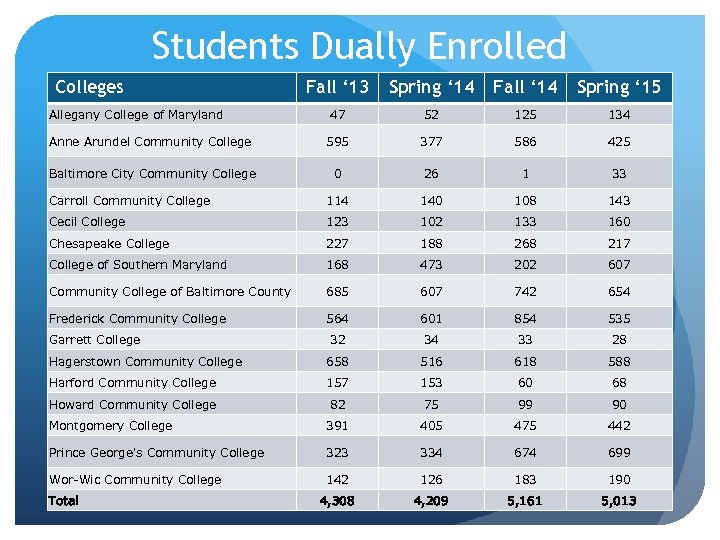
Students Dually Enrolled Colleges Fall ‘ 13 Spring ‘ 14 Fall ‘ 14 Spring ‘ 15 47 52 125 134 Anne Arundel Community College 595 377 586 425 Baltimore City Community College 0 26 1 33 Carroll Community College 114 140 108 143 Cecil College 123 102 133 160 Chesapeake College 227 188 268 217 College of Southern Maryland 168 473 202 607 Community College of Baltimore County 685 607 742 654 Frederick Community College 564 601 854 535 32 34 33 28 Hagerstown Community College 658 516 618 588 Harford Community College 157 153 60 68 Howard Community College 82 75 99 90 Montgomery College 391 405 475 442 Prince George's Community College 323 334 674 699 Wor-Wic Community College 142 126 183 190 4, 308 4, 209 5, 161 5, 013 Allegany College of Maryland Garrett College Total
Community College Components Encourage the use of new remediation models Require pathways/degree plans upon enrollment Cap the number of credits needed to earn an AA degree Codify the goal that students earn an AA before transferring to a four-year institution Require MHEC to implement a statewide reverse transfer agreement ensuring at least 30 credits transfer
Four-year Institution Components Require pathways and degree plans in place by accumulation of 45 credits Limit the number of credits needed to achieve a BA/BS degree except for unique programs Require MHEC to develop and implement a statewide transfer agreement whereby at least 60 credits of general education, elective, and major courses transfer Require institutions to dedicate institutional-based financial aid for students that transfer with an AA
Near Completers Component Create a publicity campaign to recruit ‘near completers’ to return and complete college for either a 2 or 4 year degree Create a single point of entry for students wishing more information about completing college Create a fund to assist those students whose only barrier was limited ability to afford tuition
What’s Next? Implement those parts of SB 740 not yet completed Systemize transfer policy with common course numbers Continue to demand rigor in instruction at all levels Integrate and build on new state standards to close the gap between graduation requirements and college and career readiness
Скачать презентацию S B 740 The College and Career Readiness
df3fc0616c25c4b37f7f211d757a13de.ppt