


 Скачать презентацию S 106 Agreements Development Control User Panel
1f356bc8283345ae659130ddb5e2adb9.ppt
- Количество слайдов: 18
 S 106 Agreements Development Control User Panel
 s 106 agreements • What are s 106 agreements? • How are they managed? • The future: Community Infrastructure Levy
 What are s 106 agreements? • Established by 1990 Town and Country Planning Act (as amended) Planning Obligations are: • Legal Agreements(or “s 106 agreement”)between a developer and local planning authority or • Unilateral Undertaking offered by the developer • A means by which unacceptable development can be made acceptable in planning terms
 Legal basis and framework • Government Circular 05/2005, legislation and case law - must meet relevant tests • Strong Policy basis - UDP and London Plan • Specific Guidance - Camden Planning Guidance • Type and scale of proposals • Consultation • Impact mitigation – other ways?
 Circular 05/2005 Tests Planning obligations must meet all of the following tests: • Relevant to Planning • Necessary to make a proposed development acceptable in planning terms • Directly related • Fairly and reasonably related in scale and kind and • Reasonable in all other respects
 Examples of the Use of Planning Obligations • Prescribing the nature of development e. g. securing the inclusion of affordable housing or restricting uses • Mitigating the impact of development e. g. community infrastructure, highways works, managing construction • Compensating for loss or damage e. g. restoring or replacing open space or facility
 Key features • Not a tax – most agreements do not involve financial contributions • Negotiated legal agreement between local authority and landowner/developer • Based on fundamental principle that planning permission my not be bought or sold • Must be supported by policy • However perceived by many as opaque, complex, slow, unfair, etc.
 London Plan and UDP Policy • London Plan priorities(Policy 6 A. 4)affordable housing and public transport improvements • UDP policy (SD 2) - “Where existing and planned provision of infrastructure, facilities and services is not adequate to meet the needs generated by a proposal, the Council will use planning obligations to secure measures directly related in scale or kind to the proposal to meet those needs”.
 Potential Requirements • • • Affordable housing Transport improvements and initiatives Education, health and other community facilities Car free housing Environmental sustainability and improvements Public realm and open space Biodiversity and conservation Town Centre and regeneration initiatives Regulation e. g. phasing, construction/servicing plans, mix of uses
 Camden Planning Guidance (December 2006) • Emphasises legal and policy basis • Indicates priorities e. g. affordable housing, transport initiatives, public realm • Procedures • Thresholds and criteria • Formula
 Camden Approach • Impacts and implications of development are anticipated and considered early on • Identified requirements are proportionate, relevant and justifiable • Process does not unduly delay the determination of planning applications • Appropriate measures identified through consultation • Works/projects are scoped and costed accurately enough to provide confidence in future delivery • “Pooling” arrangements • Monitoring and implementation
 Some facts and figures • 515 agreements signed between 2003/04 and 2006/07(128 in 2006/07) • 316 do not involve a financial contribution (199 do-mainly highways related works) • c. 40% of all funds held relate to site specific highways works [15% off site affordable housing(c. £ 2. 5 m) and 15% school places(c. £ 2. 5 m)] • Receipts variable: £ 3. 24 m in 2002/03, £ 0. 8 m in 2003/04, £ 3. 01 m in 2006/07 • Expenditure variable: £ 0. 43 m, £ 1. 4 m and £ 1. 5 m respectively
 Consultation and Information • Policy - consultations on UDP/Local Development Framework and supplementary guidance • Schemes – DC Forum, developers consultation events, planning applications, input from other services and agencies, Development Control Committee reports, statutory register, S 106 officer • Projects – depends on how, where and when….
 S 106 agreements : the future • Number of previous Government proposals : common objectives - speed, reducing uncertainty , transparency, “capturing value”, meeting infrastructure needs • Planning Bill(November 2007) – introduces Community Infrastructure Levy – only enabling powers at this stage • Regulations will empower but not require authorities to introduce CIL • DCLG publication (January 2008)
 Community Infrastructure Levy 1 • Underpinned by infrastructure needs generated by new development and “capturing value”(without stifling development) • A standard charge (eg £/dwelling or £/sqm) • Not just transport and strategic infrastructure but local – schools, parks, health centres • Address cumulative impact of small and medium sized schemes (current s 106 contributions tend to be limited to the most major of schemes) • S 106 agreements scaled back
 Community Infrastructure Levy 2 • How will it be set? • Councils need to identify what infrastructure is needed and how much it will cost • Through plan-making process-need to have robust methodology- which will be tested • Take viability into account • Take other funding sources into account • A published charging schedule – with flexibility to respond to changing market conditions • Levied on most types of development – a few exemptions (e. g. householder type) and de minimis threshold
 Community Infrastructure Levy 3 • What will it be for? • May be applied retrospectively…but not a replacement for general Council funding, nor to remedy pre-existing deficiencies • For new or improved/refurbished infrastructure (“infrastructure” needs to be defined) • Clear monitoring and accountability • Can be assigned to sub-regional or regional infrastructure • S 106 agreements limited to affordable housing, nonfinancial/technical matters and mitigating site specific impacts
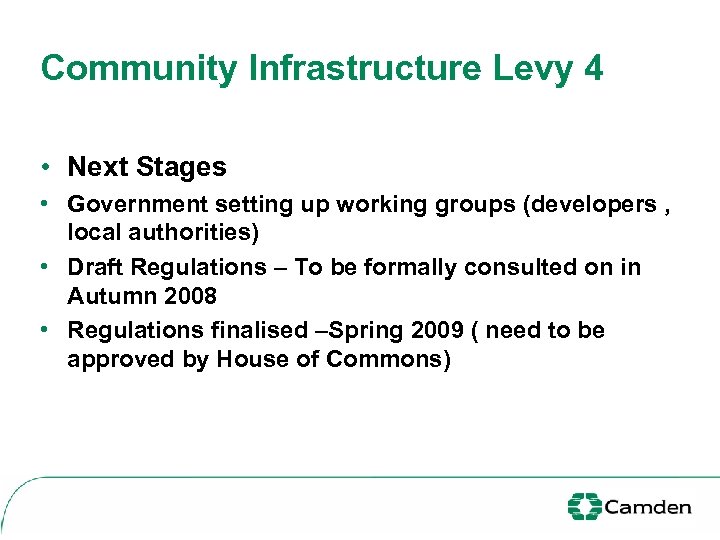 Community Infrastructure Levy 4 • Next Stages • Government setting up working groups (developers , local authorities) • Draft Regulations – To be formally consulted on in Autumn 2008 • Regulations finalised –Spring 2009 ( need to be approved by House of Commons)