 Скачать презентацию S 1 2013 MGT 3001 Global Management 7
Week 11 lecture plus exam info slides.pptx
- Количество слайдов: 37



S 1 2013 MGT 3001 Global Management 7) Module 5: International management competencies & the exam (Module 5 study materials) Course examiner: Joe Zhou Peng MGT 3001 Global Management
Topics to be covered 1. 2. 3. 4. 5. Career turbulence in international & local organisations Developing a global mindset Discovering your readiness for a global career Management development in international, multinational and global companies Overview of the examination 1
Overview of the Module n n This module completes the MGT 3001 journey by confronting your own interests in an international career & your multinational mindset. You will also need to reflect on the implications of your career aspirations on yourself, as well as your spouse, family & company. 2
1. Career turbulence in international & local organisations n New ways of looking at careers includes an emphasis on change & learning n A career is therefore defined as: ‘the unfolding sequence of a person’s work experience over time, which involves a life long series of identity changes & continuous learning, that is subject to frequent selfevaluation. ’ (Marchant 1998; see also Marchant 1999) 3
Career turbulence As organisational structures change, the key organising principles that differ between career types also have to adjust. There are differences between what is expected of you as an individual and what rewards are offered to you. 4
Career transition (change) In some societies managers change jobs in relatively short cycles & the description of a career transition cycle copy the description of some of the information on culture shock. 5
4 stages in the career transition cycle Marchant (1998) proposes four stages in the career transition cycle are preparation, encounter, adjustment & stabilisation. 1. Preparation or anticipation is about getting ready for change. 2. The encounter phase is concerned with the shocks & surprises of the first contact with the new situation, & the emotional coping that is required. 6
4 stages in the career transition cycle (cont. ) 3. Adjustment involves evaluating & minimising any amount of misfit by the person between themselves & the job, either through role innovation or personal change. 4. Stabilisation involves a period of settling in & involves preparation for the next round of transitions. This stage leads directly into another round of preparation. You have short periods of time to stabilise before preparation for the next job change. 7
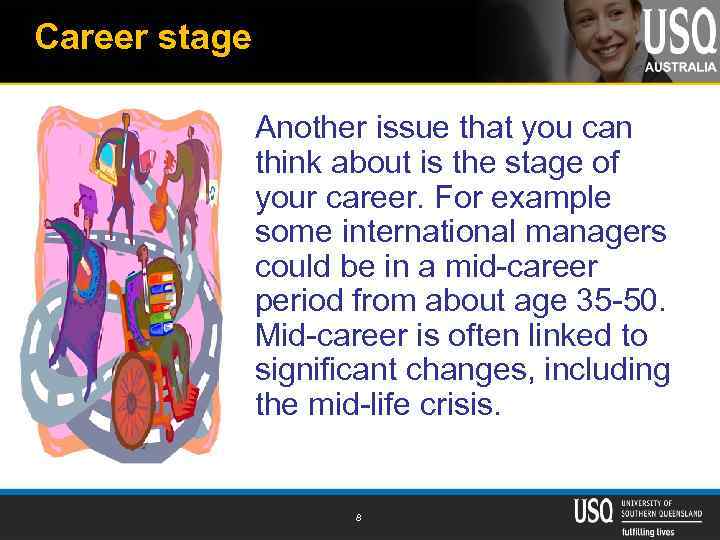
Career stage Another issue that you can think about is the stage of your career. For example some international managers could be in a mid-career period from about age 35 -50. Mid-career is often linked to significant changes, including the mid-life crisis. 8
Personal career planning n You need to take two types of action in a personal career planning program. n The first is an internal or subjective focus, in which you assess yourself, your competencies, your likes & dislikes. (This includes developing a global mindset). 9
Personal career planning (cont. ) n The second strand is to have an external or objective focus, where you investigate the external world, the opportunities available for example an international career, likely obstacles (for example culture shock or requirements for a dual career couple). 10
Personal career planning (cont. ) n At some point these two streams intersect, & this is where you match up yourself with available & suitable opportunities. Decisions need to be made at this stage for example if you wish to proceed with finding & exploring an international career. Following this, the usual career search activities for international opportunities take place. 11
2. Developing a global mindset n n Appropriately skilled managers who have developed a global mindset, will be essential to ensuring that their companies can become internationally competitive. As an international manager you need to reconceptualise your role in the global economy and redefine what skills you will need if you manage a global orgnisation. 12
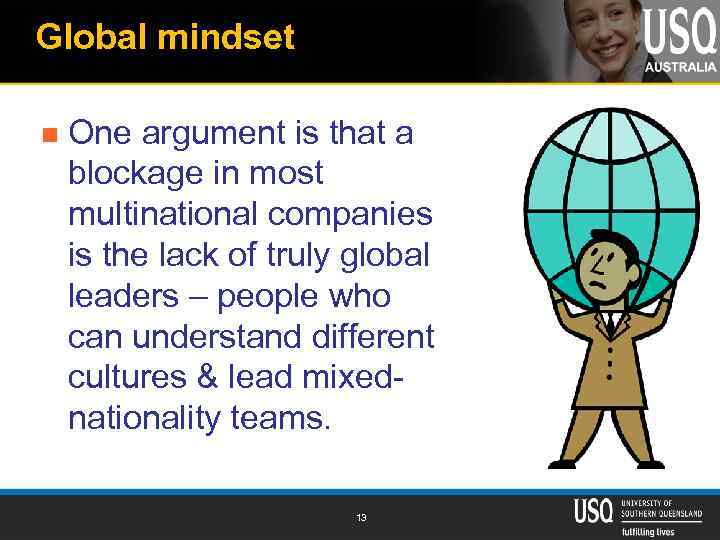
Global mindset n One argument is that a blockage in most multinational companies is the lack of truly global leaders – people who can understand different cultures & lead mixednationality teams. 13
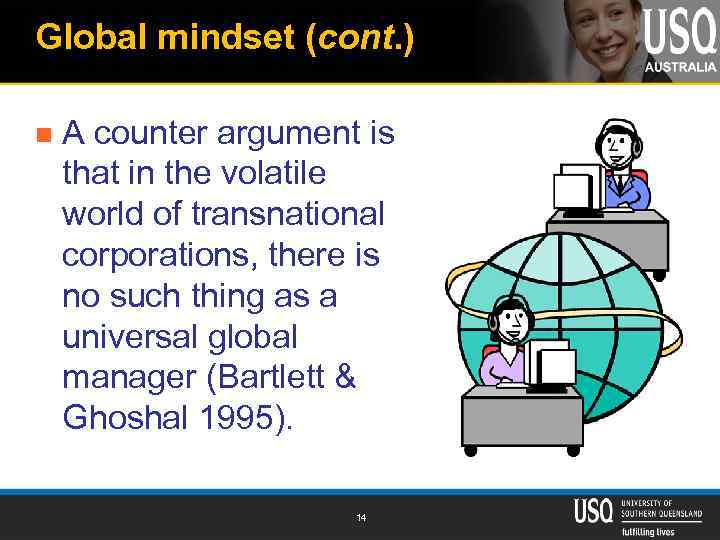
Global mindset (cont. ) n A counter argument is that in the volatile world of transnational corporations, there is no such thing as a universal global manager (Bartlett & Ghoshal 1995). 14
Global thinking means that you understand: n the varied environments that may be encountered around the world, n the complexity associated with operating across national boundaries, n the impact of ethical issues cross-nationally & cross-culturally, and n how international strategic & operations management differ from domestic management. 15
Global business manager A global business manager in a transnational corporation needs to have a set of specialised roles: n n n strategist – to formulate an overall strategy to co-ordinate & integrate dispersed operations architect – to build a configuration of its world-wide assets & resources co-ordinator of transactions across national borders. 16
Global mindset competencies Another comprehensive perspective on the individual competencies that are necessary to develop a global mindset is provided by Rhinesmith (1993). These involve managing: 1. 2. 3. 4. 5. 6. the competitive process complexity organisational adaptability multicultural teams uncertainty personal & organisational learning 17
Competency activity n Test your own current competencies against the six stage framework provided in the Study Book n Which global competencies did you develop while working on your written assignment? n Which global competencies do you wish to develop this year? 18
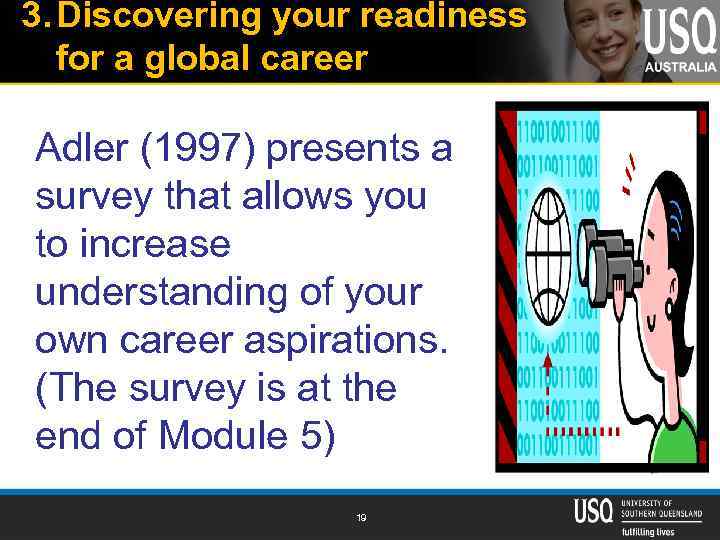
3. Discovering your readiness for a global career Adler (1997) presents a survey that allows you to increase understanding of your own career aspirations. (The survey is at the end of Module 5) 19
The Adler survey assists potential international managers to: n analyse how prepared they are, n what their career plans are, n what reasons they have to accept or reject international assignments & n what their expectations are about expatriate success n Adler also includes discussions of why young managers would accept or reject international assignments. 20
The Adler survey (cont. ) n Complete the survey from Adler (1997) at the end of this module to gain insight into your perspectives on an international career. n How do your findings compare to Saee’s (2005, p. 276) ‘Best Practice Model of Intercultural Communication Competence’ & Saee’s ‘Model of Managerial Excellence in Global Management: Cross-Cultural Dimensions’ (pp. 278 -281)? 21
4. Management development in international, multinational & global companies n Multinational companies help to develop managerial and technological skills for the local staff in the host countries. n In IBM, Shell, Phillips and Unilever such priority is placed on the identification and developing of management talent, that is has become a board responsibility. 22
Dual career couples n Loss of structure and continuity is a major problem that spouses experience when their partners accept an international job. n This source of dissatisfaction, as well as the family’s inability to adjust to a foreign environment is some of the most important factors leading to failure and early return for international managers. n Companies need to make a distinction between the pressures that single career couples face and those of a dual career couple. 23
Dual career couples (cont. ) n The reasons that there are fewer women international managers are due to bias and stereotyping in the parent country and company about the foreign acceptance of women in managerial roles than to actual prejudice in the host country. n Statistics indicate that the prevalence of dual career couples is increasing in Australia and interest in international careers may come from the dual career group. 24
Major problems dual career couples have with international appointment n Many dual-career international managers express dissatisfaction with the lack of support, especially to spouse and family, provided by multinational corporations during their international experience. n Many dual-career couples also question to what extent there is a balance between work and lifestyle especially in an international career phase. 25
5. Overview of the examination n All exam questions will be based on content of the study book and the prescribed text. n It will be 2 hours + perusal n During the 10 minutes perusal time & you can write on the blue exam paper only, but not the exam booklet or answer sheet. 26
Restricted exam – what is that? n It is a Restricted exam so you will only be able to take a non-marked language translation dictionary & writing implements (pens etc) into the exam room n NO electronic devices (including i. Pods, phones, tablets etc) are to be taken into the examination room. 27
Restricted exam – what is that? (cont. ) n Communication of any kind about any matter between students by any means whatsoever is strictly prohibited from the time that students enter the examination room until they exit at the completion of the examination. This includes any temporary absence from the examination room during the examination. Any such communication will be deemed to be cheating and treated as serious academic misconduct under University Regulation 5. 10. 28
Structure of the exam The exam is in 3 parts & will be marked out of 60: n n n Part A (10 marks) is 20 Multiple Choice questions taken from all 5 modules Part B (40 marks) is 2 short essay questions relating to Modules 4 & 5 (1 from each module) Part C (10 marks) is 10 True/False questions with a brief explanation mainly taken from Modules 3&4 but may have two or three from other modules. 29
Part A – Multiple Choice 20 questions with 4 choices similar to those in the online assessments n To be answered on the multiple choice answer sheet attached to the exam paper n Questions will be taken from all five modules of the course n 30
Part B – Short Essays n n 2 short essays of 1½ -2 pages each (that is, you need to write roughly 400 to 500 words to answer each question properly) Taken from Modules 4 & 5 (need to answer one from each) There will be an Either/Or choice of question from each Module Each essay is worth 20 marks 31
How to prepare for the essay questions Focus on those learning objectives outlined below: Module 4 n n the significance of cross-cultural negotiation and conflict resolution; the impact of business etiquette and business ethics on global management and leadership. Module 5 n n analyse your global mindset and your competencies; discuss aspects affecting dual career couples 32
Sample essay question Here is a sample question from an earlier semester of the course: n Conflict is always present in organisations and managing it has important implications for those organisations operating in a culturally diverse business environment. Discuss how low-context and high-context cultures differ from one another in their approaches to conflict and describe the four different styles that may be used to resolve conflict. 33
Part C – True/False with explanations n There will be 10 questions taken mainly from Modules 3 & 4 but may also have two or three questions from the other modules n You need to answer whether the statement is either True or False, and n You need to provide an brief explanation of why the answer is either True or False DO NOT REPEAT THE STATEMENT THAT IS THE QUESTION 34
Example True False Question & Answer Q. Underperformance involves both nonperformance & unsatisfactory performance. True / False (circle your response) Explanation/rationale: The answer is False because it is unsatisfactory performance that involves both underperformance as well as nonperformance. 35

Best wishes That’s all for this semester!! Good luck with the exam & your future endeavours!! 36
Скачать презентацию S 1 2013 MGT 3001 Global Management 7
Week 11 lecture plus exam info slides.pptx