


 Скачать презентацию Rzeszow University of Technology Faculty of Electrical and
011b5043ec08ef0fb50cc212e8225f1d.ppt
- Количество слайдов: 29
 Rzeszow University of Technology Faculty of Electrical and Computer Engineering, Poland Tadeusz Bewszko A MULTICRITERIA ANALYSIS OF ENERGY SUPPLY OPTIONS FOR MUNICIPAL AND RESIDENTIAL CUSTOMERS ____________________________________ The 20 th Workshop on Complex Systems Modeling, IIASA, August 28 -30, 2006. 1
 CONTENTS: 1. Energy planning as a multicriteria problem. 2. Literature review of application of multi-criteria methods to energy supply of residential customers. 3. Problem formulation. 4. New method of selecting energy supplying option for residential customers. 5. Application of new method to real life problems. 6. Results, future work. 2
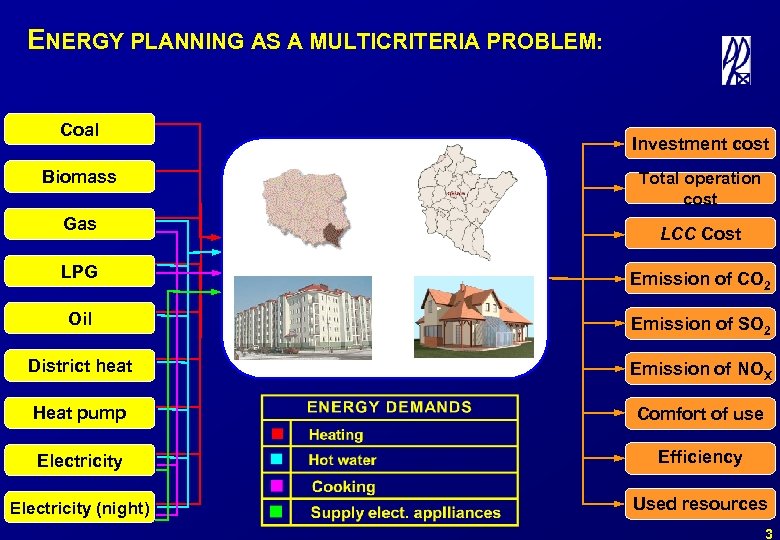 ENERGY PLANNING AS A MULTICRITERIA PROBLEM: Coal Biomass Gas Investment cost Total operation cost LCC Cost LPG Emission of CO 2 Oil Emission of SO 2 District heat Emission of NOX Heat pump Comfort of use Electricity Efficiency Electricity (night) Used resources 3
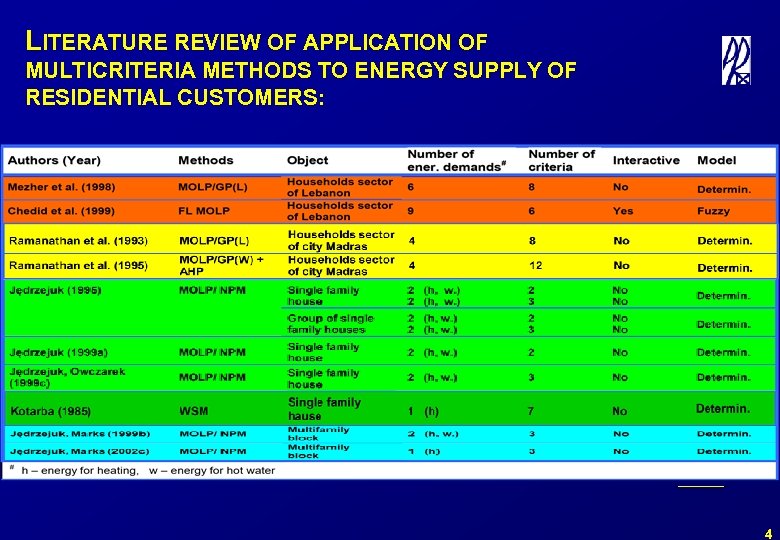 LITERATURE REVIEW OF APPLICATION OF MULTICRITERIA METHODS TO ENERGY SUPPLY OF RESIDENTIAL CUSTOMERS: 4
 CONCLUSIONS AFTER LITERATURE REVIEW: · Modern, friendly for DM, interactive multi-objective decision making methods have not been used so far to solve decision-making problem of selecting optimal energy supplying option for municipal and residential customers. · All energy demands for residential customers have not been taken into account. 5
 PROBLEM FORMULATION: Examination of possibility of application and effectiveness of interactive multi-objective decision making methods to solve decision-making problem of selecting optimal energy supplying option for municipal and residential customers. AIM OF WORK: - to build mathematical model of decision problem of selecting optimal energy supplying option for municipal and residential customers, - to make multicriteria analyses with different sets of decision criteria by using existing software implementation of interactive multiobjective decision making method 6
 CHOOSING INTERACTIVE MULTI-OBJECTIVE DECISION MAKING METHOD · There exist a lot of interactive multi-objective decision making methods · A few of existing software implementation of interactive multi-objective decision making methods 7
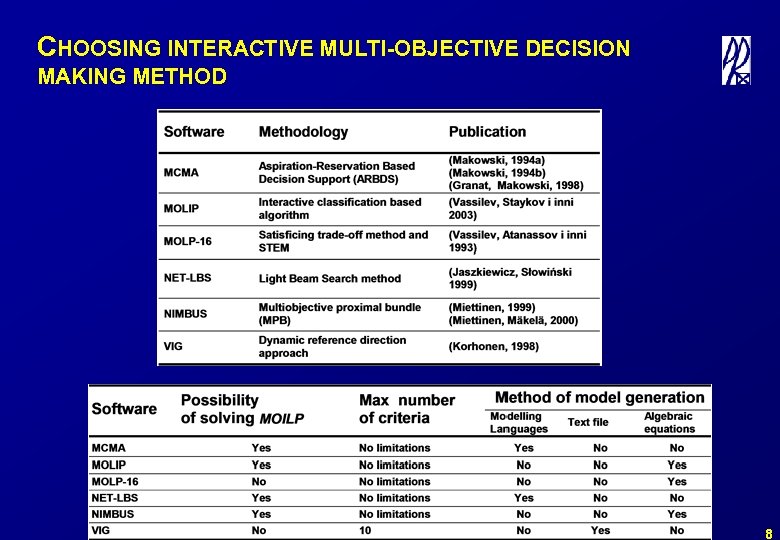 CHOOSING INTERACTIVE MULTI-OBJECTIVE DECISION MAKING METHOD 8
 METHOD OF SELECTING ENERGY SUPPLYING OPTION FOR MUNICIPAL AND RESIDENTIAL CUSTOMERS 1. Building a multicriteria model of decision problem of supplying energy to a selected customer. 2. Making multicriteria analyses with different sets of decision criteria. 3. The use of a scenario analysis for supporting decision–making process which involves uncertainty. 9
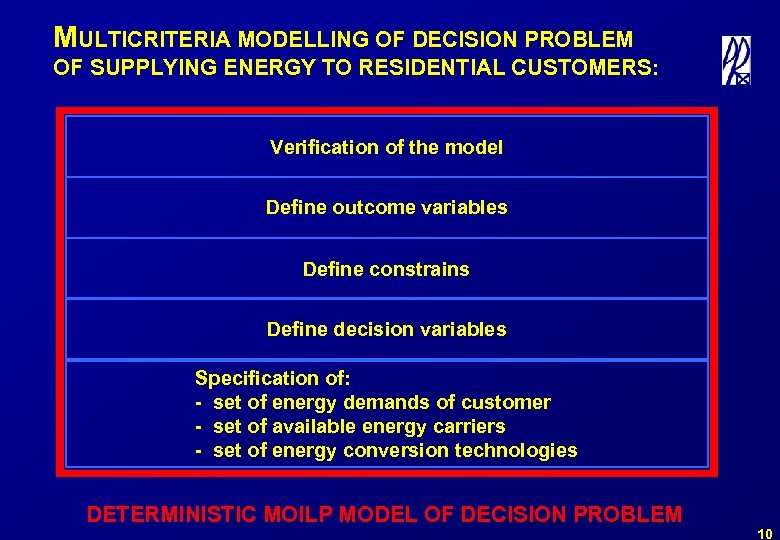 MULTICRITERIA MODELLING OF DECISION PROBLEM OF SUPPLYING ENERGY TO RESIDENTIAL CUSTOMERS: Verification of the model Define outcome variables Define constrains Define decision variables Specification of: - set of energy demands of customer - set of available energy carriers - set of energy conversion technologies DETERMINISTIC MOILP MODEL OF DECISION PROBLEM 10
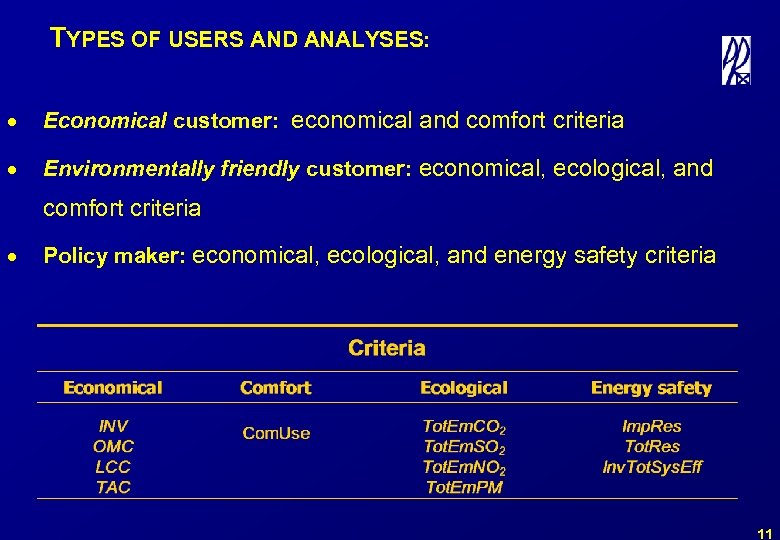 TYPES OF USERS AND ANALYSES: · Economical customer: economical and comfort criteria · Environmentally friendly customer: economical, ecological, and comfort criteria · Policy maker: economical, ecological, and energy safety criteria 11
 A SCENARIO ANALYSIS FOR SUPPORTING DECISION– MAKING PROBLEM WHICH INVOLVES UNCERTAINTY: · Uncertainty - possibility changes of parameters of the mathematical model (prices of energy carriers, energy demands). · A SCENARIO ANALYSIS – one of the methods of coping with uncertainty. · A scenario analysis includes: u an evaluation of scenarios of changes in future of values of some model parameters, u examination of changes of values of some outcome variables for some solutions taken from multi-criteria analyses. 12
 APPLICATION OF THE METHOD TO REAL LIFE PROBLEMS: · Selecting energy supplying option for: · a single family house (two users: B 1, B 2), · a flat in multifamily block (two users: M 1, M 2). · For each decision making problem: · multicriteria model of problem has been built · and used for multicriteria analyses · and scenario analysis. 13
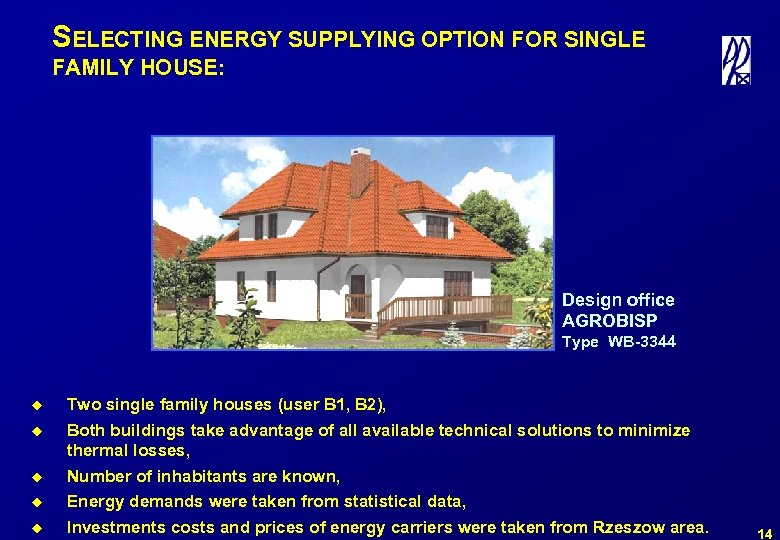 SELECTING ENERGY SUPPLYING OPTION FOR SINGLE FAMILY HOUSE: Design office AGROBISP Type WB-3344 u Two single family houses (user B 1, B 2), Both buildings take advantage of all available technical solutions to minimize thermal losses, Number of inhabitants are known, Energy demands were taken from statistical data, u Investments costs and prices of energy carriers were taken from Rzeszow area. u u u 14
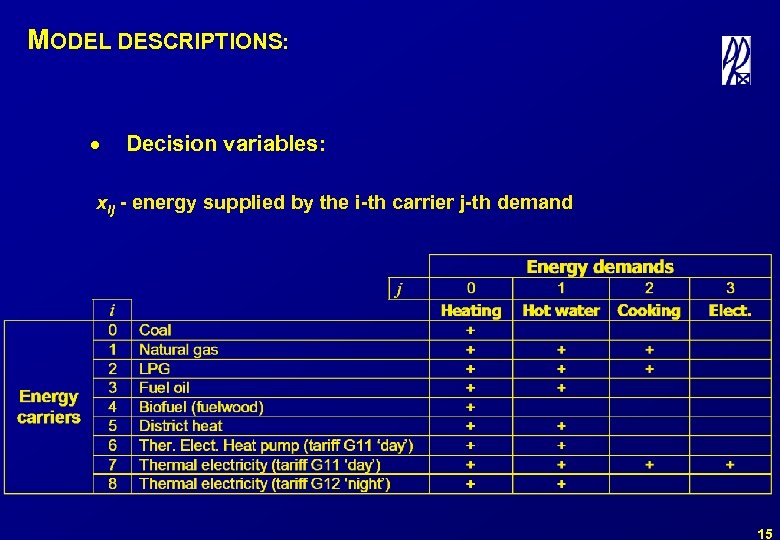 MODEL DESCRIPTIONS: · Decision variables: xij - energy supplied by the i-th carrier j-th demand 15
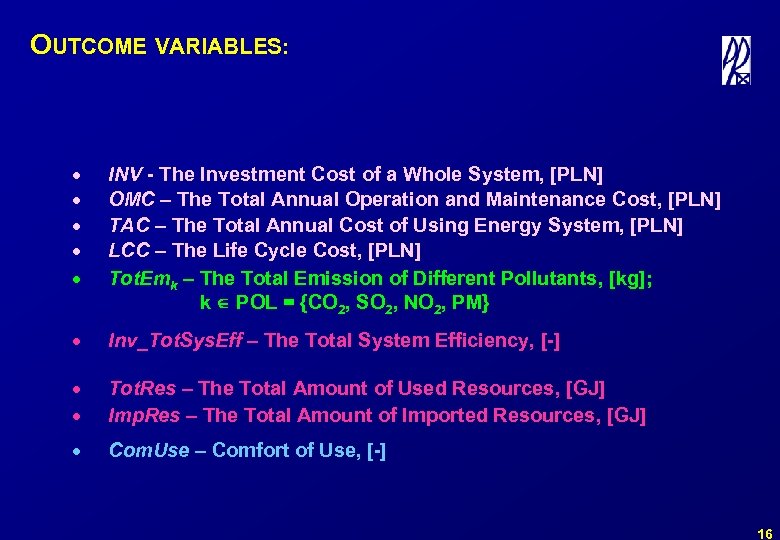 OUTCOME VARIABLES: · · · INV - The Investment Cost of a Whole System, [PLN] OMC – The Total Annual Operation and Maintenance Cost, [PLN] TAC – The Total Annual Cost of Using Energy System, [PLN] LCC – The Life Cycle Cost, [PLN] Tot. Emk – The Total Emission of Different Pollutants, [kg]; k POL = {CO 2, SO 2, NO 2, PM} · Inv_Tot. Sys. Eff – The Total System Efficiency, [-] · · Tot. Res – The Total Amount of Used Resources, [GJ] Imp. Res – The Total Amount of Imported Resources, [GJ] · Com. Use – Comfort of Use, [-] 16
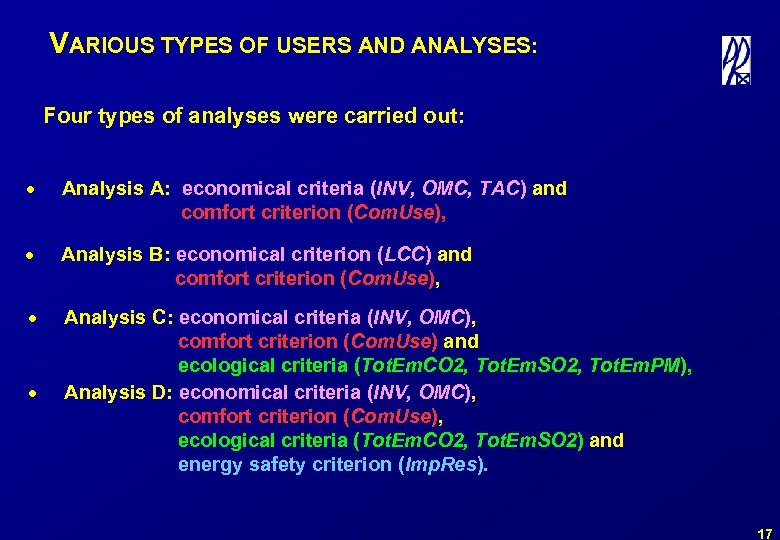 VARIOUS TYPES OF USERS AND ANALYSES: Four types of analyses were carried out: · Analysis A: economical criteria (INV, OMC, TAC) and comfort criterion (Com. Use), · Analysis B: economical criterion (LCC) and comfort criterion (Com. Use), · Analysis C: economical criteria (INV, OMC), comfort criterion (Com. Use) and ecological criteria (Tot. Em. CO 2, Tot. Em. SO 2, Tot. Em. PM), Analysis D: economical criteria (INV, OMC), comfort criterion (Com. Use), ecological criteria (Tot. Em. CO 2, Tot. Em. SO 2) and energy safety criterion (Imp. Res). · 17
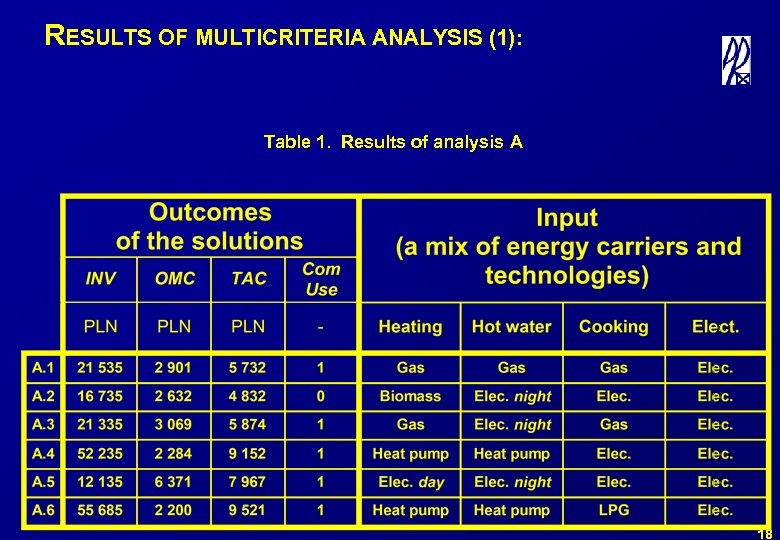 RESULTS OF MULTICRITERIA ANALYSIS (1): Table 1. Results of analysis A 18
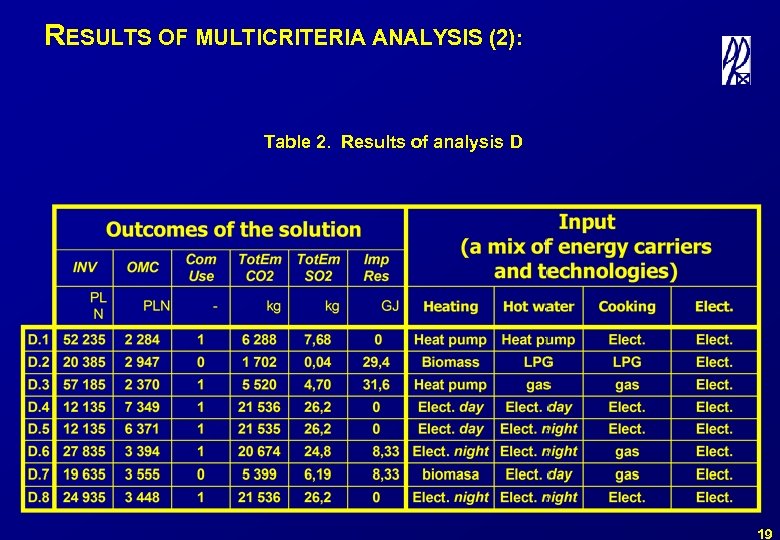 RESULTS OF MULTICRITERIA ANALYSIS (2): Table 2. Results of analysis D 19
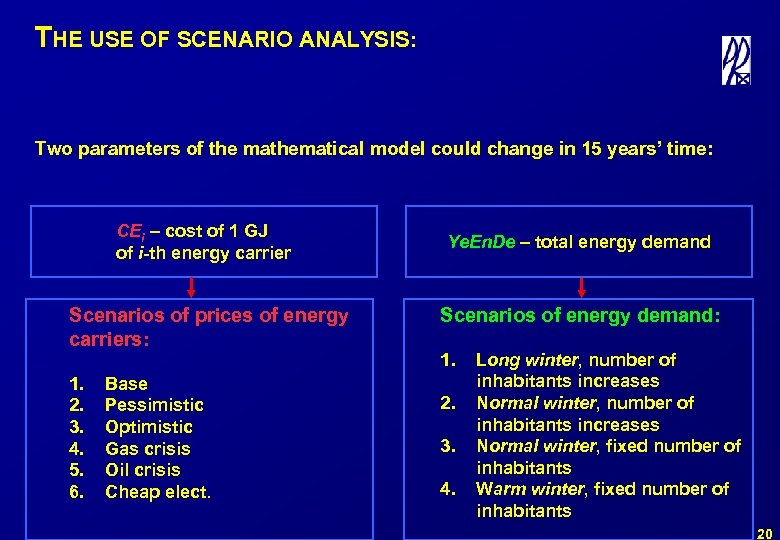 THE USE OF SCENARIO ANALYSIS: Two parameters of the mathematical model could change in 15 years’ time: CEi – cost of 1 GJ of i-th energy carrier Scenarios of prices of energy carriers: 1. 2. 3. 4. 5. 6. Base Pessimistic Optimistic Gas crisis Oil crisis Cheap elect. Ye. En. De – total energy demand Scenarios of energy demand: 1. 2. 3. 4. Long winter, number of inhabitants increases Normal winter, fixed number of inhabitants Warm winter, fixed number of inhabitants 20
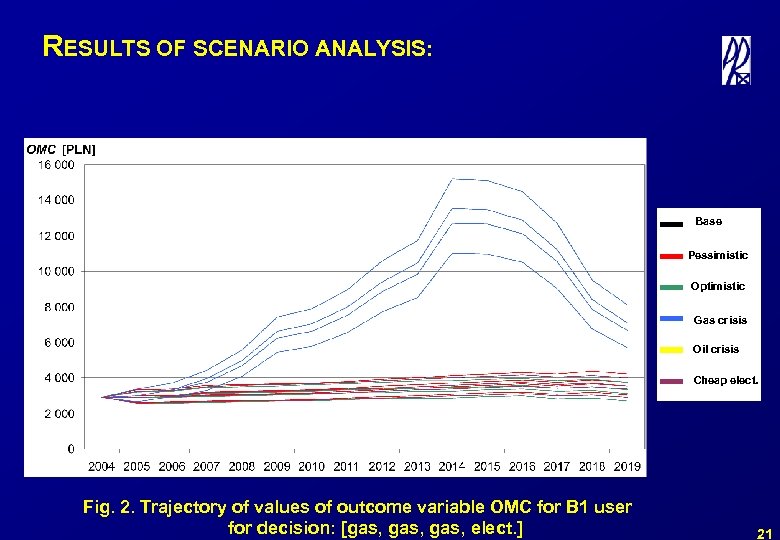 RESULTS OF SCENARIO ANALYSIS: Base Pessimistic Optimistic Gas crisis Oil crisis Cheap elect. Fig. 2. Trajectory of values of outcome variable OMC for B 1 user for decision: [gas, elect. ] 21
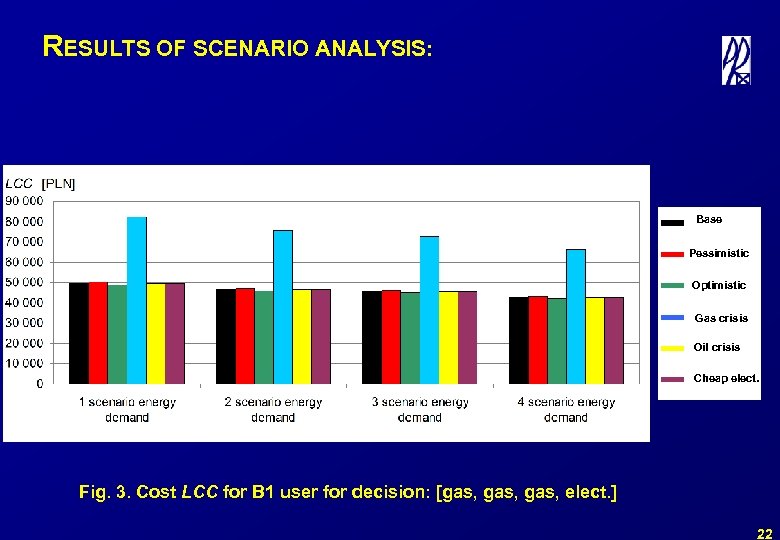 RESULTS OF SCENARIO ANALYSIS: Base Pessimistic Optimistic Gas crisis Oil crisis Cheap elect. Fig. 3. Cost LCC for B 1 user for decision: [gas, elect. ] 22
 CONCLUSIONS: · Interactive multi-objective decision making methods could be effectively used to solve decision-making problem of selecting energy supplying option for municipal and residential customers. · Decision-making process is friendly for DM. · Problem of selecting energy supplying option for municipal and residential customers is a part of much broader subject: local energy planning. 23
 FUTURE: · Multicriteria modelling and analyses of many heterogeneous energy users · Planning energy supply for municipal systems. · Regional energy planning: - heterogeneity (across temporal and spatial scales) energy users - uncertainty (price of energy carriers and energy demands) - apply new technologies - apply locally available renewable energy resources - model based decision support systems. 24
 25
25
 MULTI CRITERIA MODEL ANALYSIS: · Various trade-offs criteria · Analysis of various Pareto solutions 26
 VARIOUS TYPES OF ANALYSES: · economical and comfort · economical, ecological, and energy safety 27
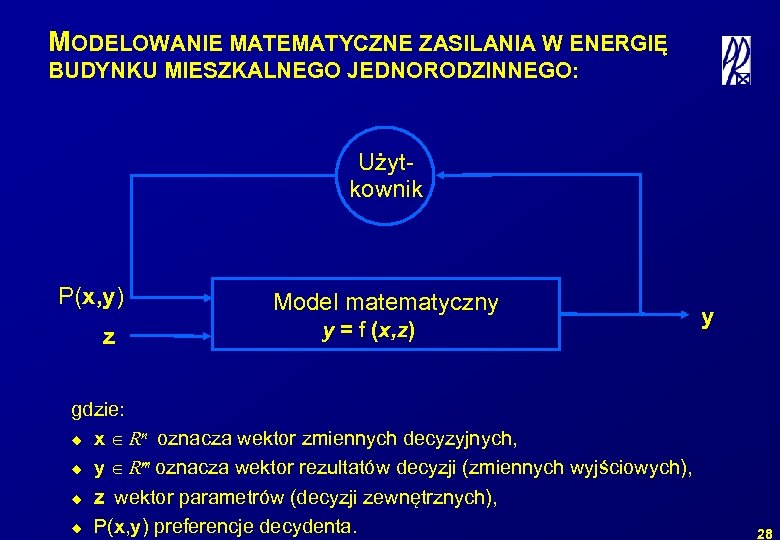 MODELOWANIE MATEMATYCZNE ZASILANIA W ENERGIĘ BUDYNKU MIESZKALNEGO JEDNORODZINNEGO: Użytkownik P(x, y) z Model matematyczny y = f (x, z) y gdzie: n u x R oznacza wektor zmiennych decyzyjnych, m u y R oznacza wektor rezultatów decyzji (zmiennych wyjściowych), u u z wektor parametrów (decyzji zewnętrznych), P(x, y) preferencje decydenta. 28
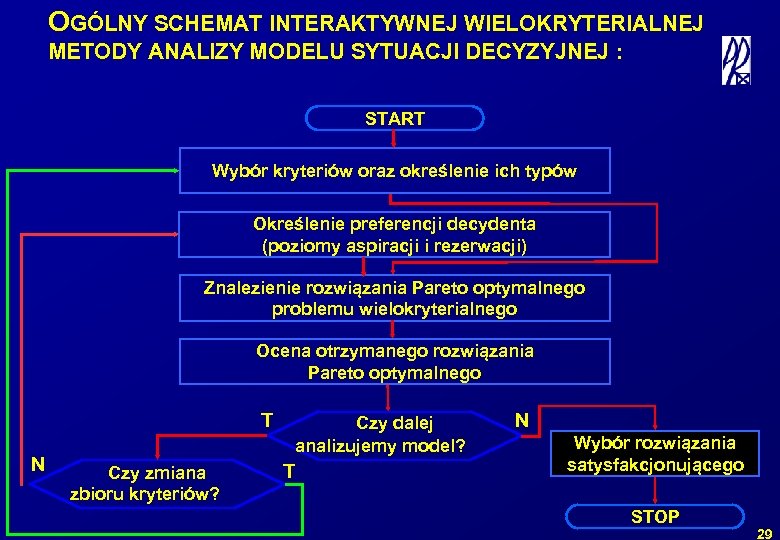 OGÓLNY SCHEMAT INTERAKTYWNEJ WIELOKRYTERIALNEJ METODY ANALIZY MODELU SYTUACJI DECYZYJNEJ : START Wybór kryteriów oraz określenie ich typów Określenie preferencji decydenta (poziomy aspiracji i rezerwacji) Znalezienie rozwiązania Pareto optymalnego problemu wielokryterialnego Ocena otrzymanego rozwiązania Pareto optymalnego T N Czy zmiana zbioru kryteriów? Czy dalej analizujemy model? T N Wybór rozwiązania satysfakcjonującego STOP 29