


 Скачать презентацию RVS First Look WP 6200 J -M Désert
daa1260e00cc4134e85c057fc2da5b17.ppt
- Количество слайдов: 18
 RVS First Look (WP 6200) J. -M. Désert, G. Hébrard , A. Lecavelier, R. Ferlet, A. Vidal-Madjar Institut d’astrophysique de Paris (IAP) Workshop RVS Calibration IAP-November 24 th, 2005
 Plan 1. GAIA First Look 2. Overall RVS First Look 3. Details of each RVS First Look steps
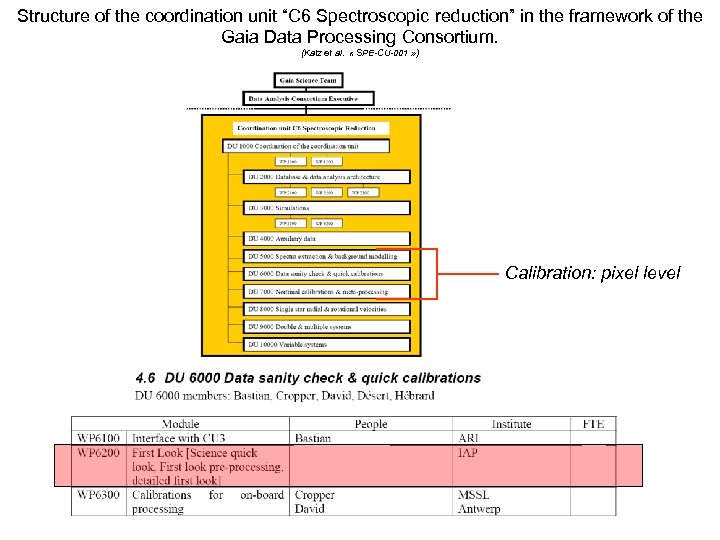 Structure of the coordination unit “C 6 Spectroscopic reduction” in the framework of the Gaia Data Processing Consortium. (Katz et al. « SPE-CU-001 » ) Calibration: pixel level
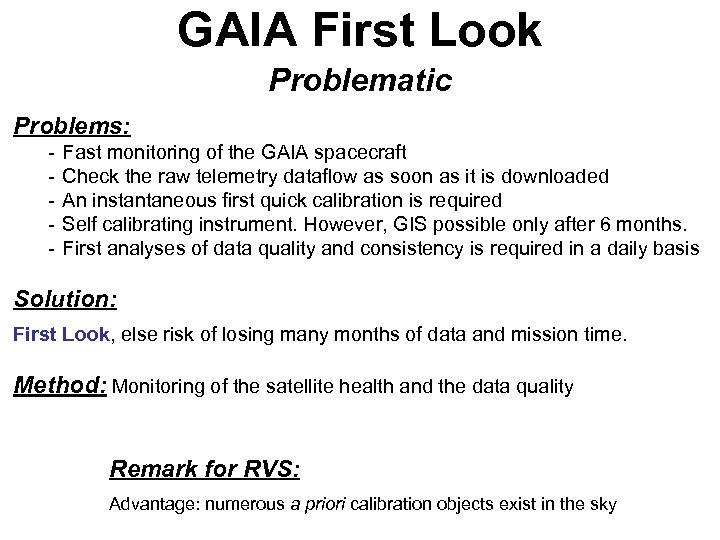 GAIA First Look Problematic Problems: - Fast monitoring of the GAIA spacecraft Check the raw telemetry dataflow as soon as it is downloaded An instantaneous first quick calibration is required Self calibrating instrument. However, GIS possible only after 6 months. First analyses of data quality and consistency is required in a daily basis Solution: First Look, else risk of losing many months of data and mission time. Method: Monitoring of the satellite health and the data quality Remark for RVS: Advantage: numerous a priori calibration objects exist in the sky
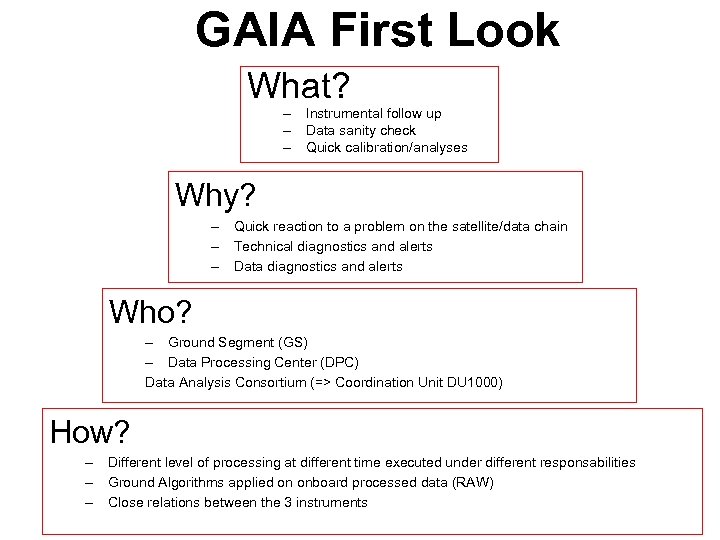 GAIA First Look What? – Instrumental follow up – Data sanity check – Quick calibration/analyses Why? – Quick reaction to a problem on the satellite/data chain – Technical diagnostics and alerts – Data diagnostics and alerts Who? – Ground Segment (GS) – Data Processing Center (DPC) Data Analysis Consortium (=> Coordination Unit DU 1000) How? – Different level of processing at different time executed under different responsabilities – Ground Algorithms applied on onboard processed data (RAW) – Close relations between the 3 instruments
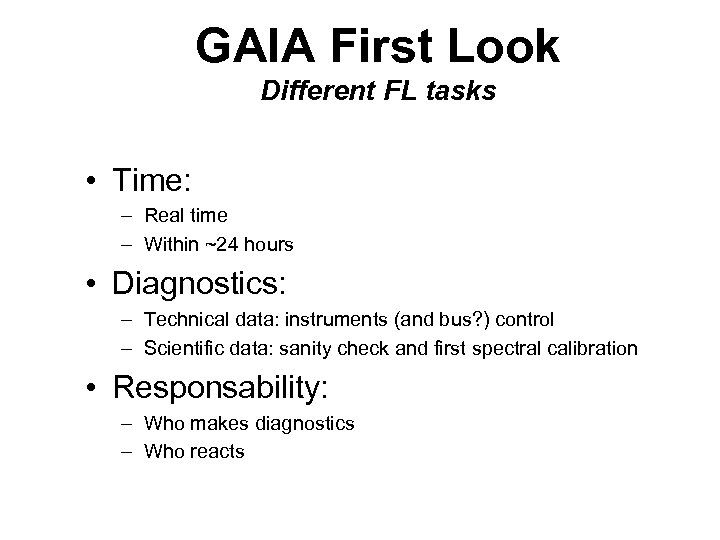 GAIA First Look Different FL tasks • Time: – Real time – Within ~24 hours • Diagnostics: – Technical data: instruments (and bus? ) control – Scientific data: sanity check and first spectral calibration • Responsability: – Who makes diagnostics – Who reacts
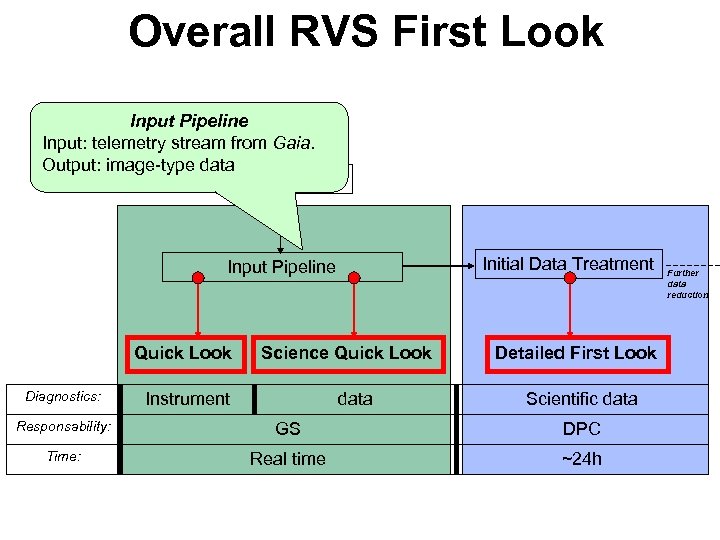 Overall RVS First Look Input Pipeline Satellite Input: telemetry stream from Gaia. Output: image-type data Raw Telemetry Initial Data Treatment Input Pipeline Quick Look Diagnostics: Science Quick Look Instrument data Detailed First Look Scientific data Responsability: GS DPC Time: Real time ~24 h Further data reduction
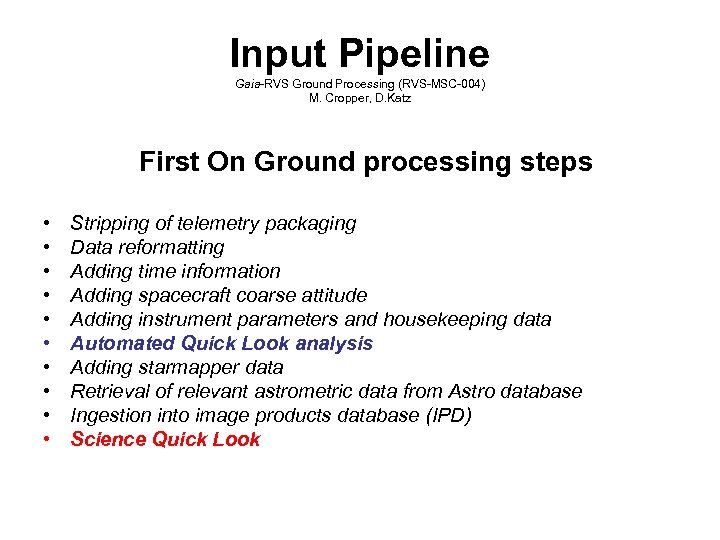 Input Pipeline Gaia-RVS Ground Processing (RVS-MSC-004) M. Cropper, D. Katz First On Ground processing steps • • • Stripping of telemetry packaging Data reformatting Adding time information Adding spacecraft coarse attitude Adding instrument parameters and housekeeping data Automated Quick Look analysis Adding starmapper data Retrieval of relevant astrometric data from Astro database Ingestion into image products database (IPD) Science Quick Look
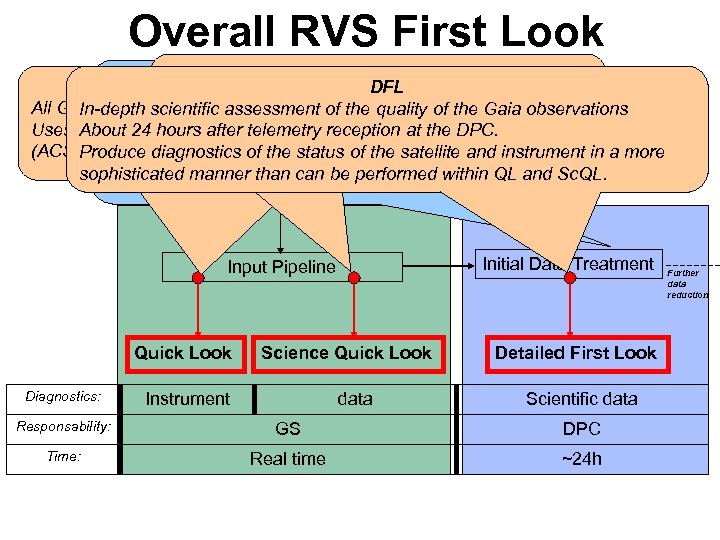 Overall RVS First Look IDT Sc. QL QLDFL All activities concerning scientific data health. First part of the scientic data reduction chain performed All GS activities concerning satellite health (i. e. bus and instrument). In-depth scientific assessment of the quality of the Gaia observations Satellite Simple and not precise to safe observation time. • Data ingestion Uses telemetry stream from GAIA (housekeeping (HK), attitude control system About 24 hours after telemetry reception at the DPC. Generates telecommanding or alerts the scientific. • Cross Matching (ACS) data, etc…) Produce diagnostics of the status of the satellite and instrument in a more • Generation of elementary data sophisticated manner than can be performed within QL and Sc. QL. Raw Telemetry Initial Data Treatment Input Pipeline Quick Look Diagnostics: Science Quick Look Instrument data Detailed First Look Scientific data Responsability: GS DPC Time: Real time ~24 h Further data reduction
 QL, Sc. QL & DFL in more details…
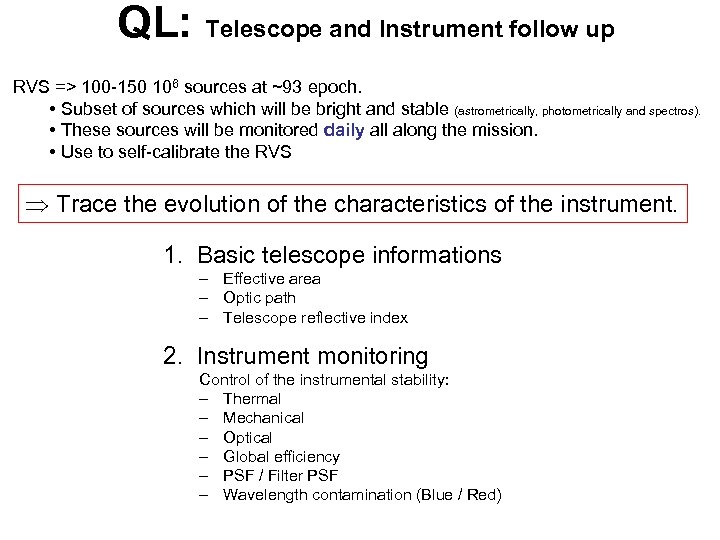 QL: Telescope and Instrument follow up RVS => 100 -150 106 sources at ~93 epoch. • Subset of sources which will be bright and stable (astrometrically, photometrically and spectros). • These sources will be monitored daily all along the mission. • Use to self-calibrate the RVS Þ Trace the evolution of the characteristics of the instrument. 1. Basic telescope informations – Effective area – Optic path – Telescope reflective index 2. Instrument monitoring Control of the instrumental stability: – Thermal – Mechanical – Optical – Global efficiency – PSF / Filter PSF – Wavelength contamination (Blue / Red)
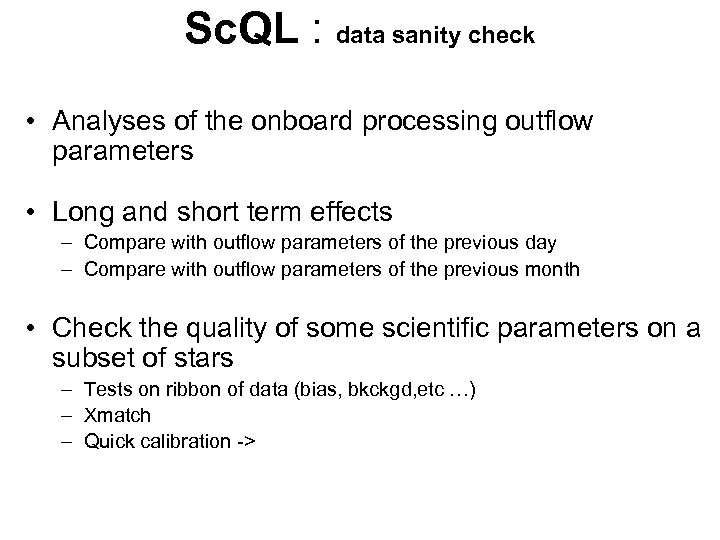 Sc. QL : data sanity check • Analyses of the onboard processing outflow parameters • Long and short term effects – Compare with outflow parameters of the previous day – Compare with outflow parameters of the previous month • Check the quality of some scientific parameters on a subset of stars – Tests on ribbon of data (bias, bkckgd, etc …) – Xmatch – Quick calibration ->
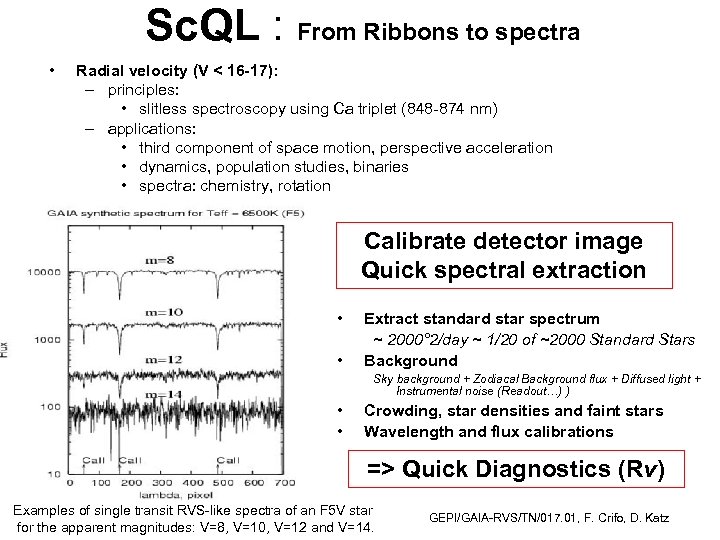 Sc. QL : From Ribbons to spectra • Radial velocity (V < 16 -17): – principles: • slitless spectroscopy using Ca triplet (848 -874 nm) – applications: • third component of space motion, perspective acceleration • dynamics, population studies, binaries • spectra: chemistry, rotation Calibrate detector image Quick spectral extraction • • Extract standard star spectrum ~ 2000° 2/day ~ 1/20 of ~2000 Standard Stars Background Sky background + Zodiacal Background flux + Diffused light + Instrumental noise (Readout…) ) • • Crowding, star densities and faint stars Wavelength and flux calibrations => Quick Diagnostics (Rv) Examples of single transit RVS-like spectra of an F 5 V star for the apparent magnitudes: V=8, V=10, V=12 and V=14. GEPI/GAIA-RVS/TN/017. 01, F. Crifo, D. Katz
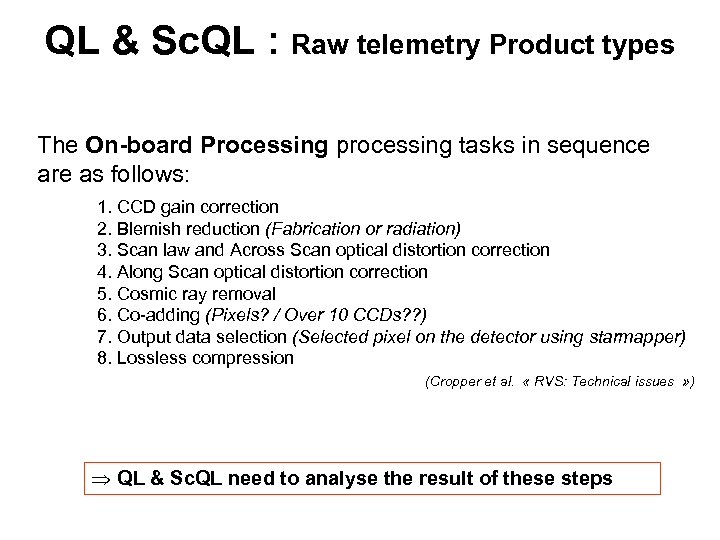 QL & Sc. QL : Raw telemetry Product types The On-board Processing processing tasks in sequence are as follows: 1. CCD gain correction 2. Blemish reduction (Fabrication or radiation) 3. Scan law and Across Scan optical distortion correction 4. Along Scan optical distortion correction 5. Cosmic ray removal 6. Co-adding (Pixels? / Over 10 CCDs? ? ) 7. Output data selection (Selected pixel on the detector using starmapper) 8. Lossless compression (Cropper et al. « RVS: Technical issues » ) Þ QL & Sc. QL need to analyse the result of these steps
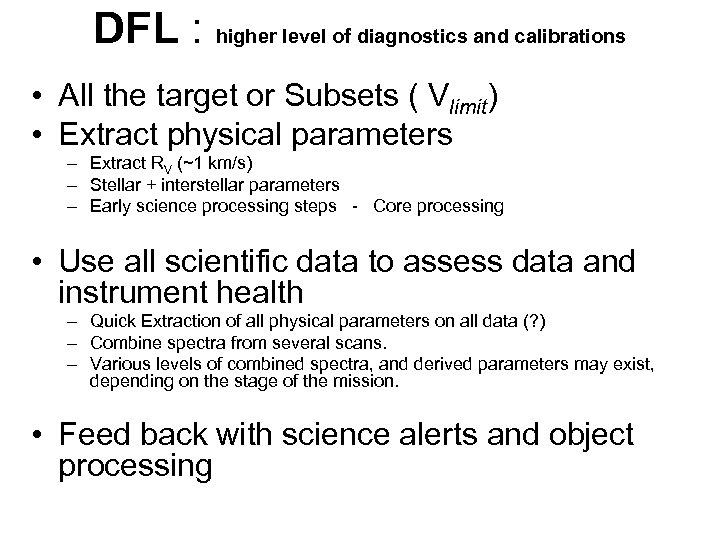 DFL : higher level of diagnostics and calibrations • All the target or Subsets ( Vlimit) • Extract physical parameters – Extract RV (~1 km/s) – Stellar + interstellar parameters – Early science processing steps - Core processing • Use all scientific data to assess data and instrument health – Quick Extraction of all physical parameters on all data (? ) – Combine spectra from several scans. – Various levels of combined spectra, and derived parameters may exist, depending on the stage of the mission. • Feed back with science alerts and object processing
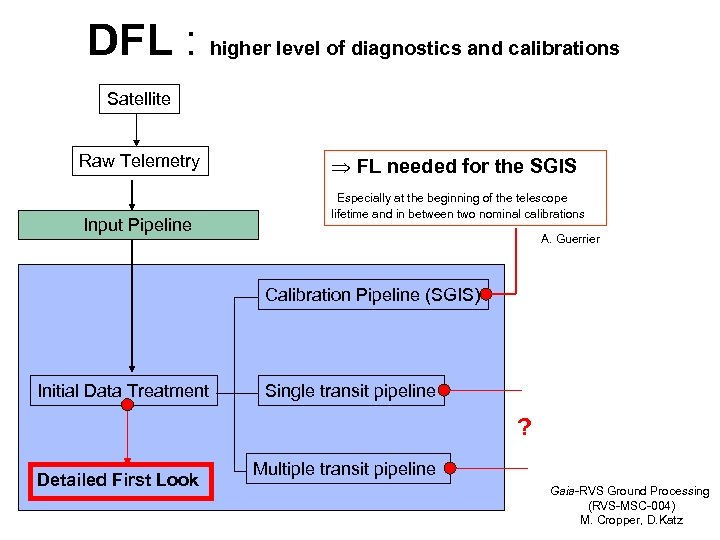 DFL : higher level of diagnostics and calibrations Satellite Raw Telemetry Input Pipeline Þ FL needed for the SGIS Especially at the beginning of the telescope lifetime and in between two nominal calibrations A. Guerrier Calibration Pipeline (SGIS) Initial Data Treatment Single transit pipeline ? Detailed First Look Multiple transit pipeline Gaia-RVS Ground Processing (RVS-MSC-004) M. Cropper, D. Katz
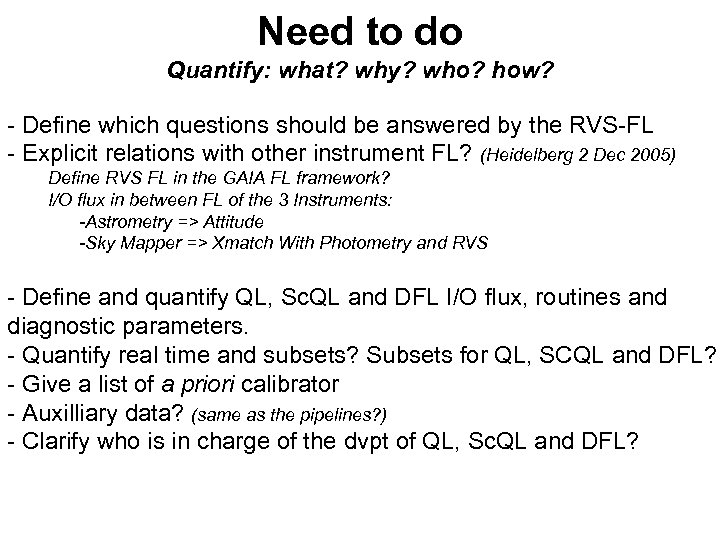 Need to do Quantify: what? why? who? how? - Define which questions should be answered by the RVS-FL - Explicit relations with other instrument FL? (Heidelberg 2 Dec 2005) Define RVS FL in the GAIA FL framework? I/O flux in between FL of the 3 Instruments: -Astrometry => Attitude -Sky Mapper => Xmatch With Photometry and RVS - Define and quantify QL, Sc. QL and DFL I/O flux, routines and diagnostic parameters. - Quantify real time and subsets? Subsets for QL, SCQL and DFL? - Give a list of a priori calibrator - Auxilliary data? (same as the pipelines? ) - Clarify who is in charge of the dvpt of QL, Sc. QL and DFL?
 To be continued…