


 Скачать презентацию Russian Tax Law taxation of international trade and
27405ae48ff0b62428af32ab5330f661.ppt
- Количество слайдов: 65
 “Russian Tax Law: taxation of international trade and investments” Prof. Dr. Danil V. Vinnitsky Department of Tax and Financial Law, Urals State Academy of Law (Yekaterinburg, Russia) University of Lapland Finland (ROVANIEMI) 21 -23 October 2008
 Prerequisites of the RF and the EU cooperation in the sphere of taxation • The EU is one of the most important RF trade partners (more than 50% of turnover, that was 87. 642 million US dollars in January – March 2008) • Russia takes the third place in the EU trade (after the US and China). • The Partnership Agreement concluded between the RF and the EU in 1994 (ratified in 1997) has provided the possibility of harmonising the legislation of the Parties.
 Structure of the course • I. Overview of the Russian tax system and Russian tax law, including its legal sources, history of development, main concepts and procedures, constitutional background; • • • II. Tax on incomes of natural persons; III. Corporate tax in Russia (tax on profit of organisations); IV. Overview of tax treaties on direct taxation concluded by the RF; V. Indirect taxation in Russia, in particular Value added tax, including peculiarities of import and export taxation; VI. Tax procedures under Russian tax law; VII. Guaranties and incentives for investors and application of the Partnership Agreement between Russia and the EU.
 Development of the Russian taxation system in recent years (First stage) • Main legal sources of Russian tax Law: • - The RF Law of 27 December 1991 “On the basics of the tax system in the Russian Federation” (had been in force until 1 January 1999, some provisions have remained in force for a transitional period); The RF Law of 6 December 1991 “On value added tax” (had been in force until 1 January 2001, some provisions have remained in force for a transitional period); The RF Law of 7 December 1991 “On individual income tax” (had been in force until 1 January 2001); The RF Law of 27 December 1991 “On tax on profit of organizations and enterprises” (had been in force until 1 January 2002 , some provisions have remained in force for a transitional period); The RF Law of 9 December 1991 “On taxes on property of natural persons” (still in force) The RF Law of 31 December 1991 “On tax on assets of companies” (had been in force until 1 January 2004) • • • The most significant defects: • • 1) Lacunas in tax regulation; 2) Uncertainty of concepts, terms and definitions; 3) Wide discretion of power of tax authorities (including power of official interpretation of uncertain tax laws); 4) High tax rates (heavy tax burden).
 Development of the Russian taxation system in recent years (Second stage) • • RF Tax Code, First Part (came into force - 1 January 1999). RF Tax Code, Second Part Chapters 21 – 24 (came into force - 1 January 2001) Chapters 25, 25. 1 – 25. 3, 26. 1 – 26. 4, 28 – 31 (came into force later) The main principles of the reform were: • 1) Tax Code must be comprehensive (Tax Code provisions must have a direct effect: tax rulings and instructions are not regarded as indispensable for legal regulation); • 2) Tax Code must be autonomous (The obligations for taxpayers and powers for tax authorities can be established exclusively by the Tax Code and by tax laws adopted in accordance with it); • 3) No tax whatever can be introduced, if it is not explicitly mentioned in the RF Tax Code list of taxes; • 4) The system of taxation must be centralized and provide united economic space.
 The Constitutional background of taxation in Russia • Article 57 of the RF Constitution: “Each person must pay legally established taxes and charges”; • Articles 34 and 35 of the RF Constitution: provide freedom of economic activities and guarantee security of the right of property; The RF Constitutional Court considers these articles as a basis for finding the compromise or balance between: • public interests (that is the necessity of taxes and revenue for budget); • and private interests (that is freedom of economic activities and right of property).
 Concept of “tax” in Russian Tax Law • Para. 1 art. 8 RF Tax Code: “Tax is an obligatory, individually uncompensated payment recovered from organizations or natural persons in the form of an alienation of monetary means belonging to them by right of ownership, economic jurisdiction, or operative management for the purposes of the financial provision of the activities of the State and / or municipal formation. • Four legal features of a tax under Russian legislation: 1. Tax is an obligatory and individually uncompensated payment. 2. Tax is recovered from organizations or natural persons. 3. Tax is recovered in the form of an alienation of monetary means belonging by right of ownership, economic jurisdiction (for State enterprises), or operative management (for State agencies). 4. Tax is recovered for the purposes of financing the activity of the State and / or local authorities. • Example of the influence of tax definition on the RF court practice: Contributions for the development of local infrastructure had features characteristic of a tax, but they had not been introduced according to the RF Tax Code (under the procedure established by the Code for local taxes). Courts considered these contributions as a tax, which is illegal.
 Concept of “charge” in Russian Tax Law • Para 2 of Article 8 RF TC: charge is an obligatory contribution recovered from organizations and natural persons, the payment of which is one of the conditions for performance with respect to the payers of charges by State agencies, agencies of local selfgovernment, and other empowered agencies and officials of legally significant actions, including the granting of determined rights or issuance of authorizations (or licenses). • Two specific legal features of a charge (different from tax): 1. Payment of charge is one of the conditions for performance of legally significant actions, including issuance of licenses 2. The performance of the above-mentioned actions (with respect to the payers of charges) is produced by State or local agencies.
 Legal nature of charge (state duty) under Russian tax law Cases when the state duty is imposed are listed in Chapter 25. 3 of the RF TC. These include: • when applications are submitted to the RF Constitutional Court (Art. 333. 23 of the RF TC), RF Arbitration courts (Art. 333. 21333. 22 of the RF TC), courts of general jurisdiction (Art. 333. 19333. 20 of the RF TC); • when applications are submitted for notarisation (Art. 333. 24 -333. 25 of the RF TC); • when applications are submitted for an apostil (Art. 333. 33 (1) (41), 333. 18 (1) (5) of the RF TC); • when applications are submitted for performance of other legally relevant (or significant) actions (mostly in the framework of different registration procedures) (Art. 333. 26 -333. 34 of the RF TC).
 Examples of charge (state duty) rates under Russian tax law. • - The state duty shall be paid at the rate of 2, 000 Roubles (about 57 EUR) for state registration of legal entity (Art. 333. 33 (1) of the RF TC); • - The state duty for accrediting foreign company subdivisions (or branches) established on the territory of the RF is 60, 000 Roubles (about 1. 700 EUR) for each subdivision (Art. 333. 33 (1) (4) of the RF TC); • - The state duty for registration of a foreign citizen (who lives on the territory of the RF) at place of his residence in Russia is 100 Roubles (about 3 EUR) (Art. 333. 33 (1) (15) of the RF TC); • - The state duty for considering an application for state registration of a securities issue (for example, issue of shares in a joint stock company) is 1, 000 Roubles (about 28 EUR), for state registration of a security issue is 0. 2% of the nominal amount of the issue up to a maximum of 100, 000 Roubles (2, 850 EUR) (Art. 333. 33 (1) (44) of the RF TC).
 System of legal sources of Russian Tax Law (part I) I. Main (traditional) legal sources 1) Federal and international level 1. 1) RF Constitution and Federal constitutional laws 1. 2) International treaties 1. 3) Federal laws (RF Tax Code) 1. 4) (A) Decrees of the RF President (B) Regulations of the RF Government (C) Orders or instructions of the RF Ministries (RF Ministry of Finance) 2) Regional Level 2. 1) Laws of Subjects of the Russian Federation (Laws of Oblast’, Kray, Respublika) 2. 2) Decrees or Regulations of the highest executive body of Subject of the Russian Federation (Governor or Government) 2. 3) Regulations or orders of other executive bodies of Subjects of the Russian Federation 3) Local (or municipal) level 3. 1) Legal normative acts of the municipal representative bodies 3. 2) Legal normative acts of the municipal executive bodies
 System of legal sources of Russian Tax Law (part II) II. Subsidiary legal sources 1) Decisions of the RF Constitutional Court, Decisions of the European Court of Human rights and other international courts 2) Rulings of the RF Supreme Court and the RF Supreme Arbitration Court 3) Decisions of Statute (Charter) Courts of Subjects of the Russian Federation 4) Methodological Recommendations of executive state bodies (Russian Federal Tax Service – in our case)
 System of legal sources of Russian Tax Law (part III) The most important Court Rulings on tax matters in Russia are the following: 1) - Decision of the Plenum of the RF Supreme Arbitration Court of 12 October 2006 No 53 “On evaluation of unjustified tax benefit of a taxpayer” 2) - Decision of the Plenum of the RF Supreme Arbitration Court of 28 February 2001 No 5 “On some issues of applying the RF Tax Code (Part One)” 3) - Decision of the Plenum of the RF Supreme Arbitration Court No 9 and the Plenum of the RF Supreme Court No 41 of 11 June 1999 “On some issues connected with introduction of the RF Tax Code (Part One)” 4) - Recommendation of the Plenum of the RF Supreme Arbitration Court of 22 December 2005 No 98 “On practice of settlement of disputes connected with applying certain provisions of Chapter 25 of the RF Tax Code”
 Russian system of taxation: main features I. Federal taxes and charges: • • • (1) Value-Added Tax (Chapter 21 RF TC); (2) Excises on goods or services (Chapter 22 RF TC); (3) Tax on income of natural persons (Chapter 23 RF TC); (4) Unified Social Tax (Chapter 24 RF TC); (5) Tax on profit of organizations (Chapter 25 RF TC); (6) Tax on the extraction of mineral resources (Chapter 25 RF TC); (7) Charge for the right of using of objects of fauna and aquatic biological resources (Chapter 25. 1 RF TC); (8) Water tax (Chapter 25. 2 RF TC); (9) State duty (Chapter 25. 3 RF TC); II. Regional taxes • • • (1) Tax on property of organisations (Chapter 30 RF TC); (2) Transport Tax (Chapter 28 RF TC); (3) Tax on gambling business (Chapter 29 RF TC); III. Local (municipal) taxes • • (1) Land Tax (Chapter 31 RF TC); (2) Tax on property of natural persons (RF Law of 9 December 1991 “On taxes on property of natural persons”).
 General conditions for establishment of a tax in the RF RF Tax Code states some general conditions for establishment and introduction of any tax in the Russian Federation. According to Article 17 RF TC tax can be considered to be established only when the legislator determined and described its taxpayers and the following elements of taxation: 1) object of taxation 2) tax base 3) tax period 4) tax rate 5) procedure for the calculation of the tax 6) procedure and periods for the payment of the tax. Tax privileges (including tax exemptions and tax allowance) can also be established, but they are not obligatory elements of taxation. In general, the legislator is not obliged to establish any privilege; it is left to his discretion (para. 2 Art 17 RF TC, Art. 56 RF TC).
 Special Tax Regimes in Russian Tax Law Special Tax Regimes are special procedures for the calculation and payment of taxes (Art 18 RF TC). The following special tax regimes exist in Russian tax law: 1) System of taxation for agriculture producers (unified agricultural tax) – Chapter 26. 1 RF TC; 2) Simplified system of taxation (for small business) – Chapter 26. 2 RF TC; 3) System of taxation in the form of unified tax on presumed income for certain kinds of business activity – Chapter 26. 3 RF TC; 4) System of taxation when fulfilling production sharing agreements – Chapter 26. 4 RF TC
 Tax on incomes of natural persons (introduction) Tax on incomes of natural persons is a direct federal tax. It is imposed on the incomes of any kind derived from different sources. The importance of the tax is connected with the fact that it concerns all citizens who take part in economic relations in the country. The most important features of the Russian tax on incomes of natural persons are the following: • • 1. Flat tax rate instead of the previous progressive rate system. The standard tax rate is 13%; 2. All incomes, received in monetary form or in kind, are taxable by unified income tax. There is no separate taxation of capital gains, gifts, dividends, interests, incomes of businessmen and employees. All incomes are taxable in the framework of income tax on natural persons; 3. Tax base must be determined separately for each type of income for which a different tax rate is established. It is the rule provided for by Art. 210 (2) of the RF TC. 4. As a rule, tax on incomes of natural persons is payable by the way of withholding The most important exemption is provided for business incomes.
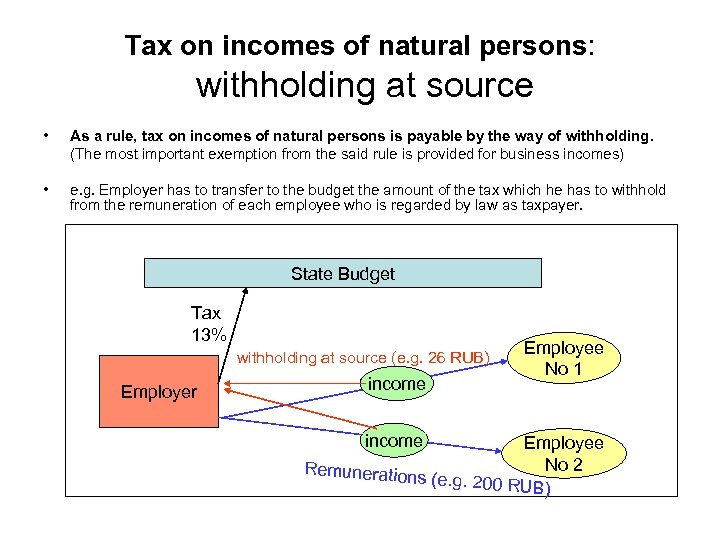 Tax on incomes of natural persons: withholding at source • As a rule, tax on incomes of natural persons is payable by the way of withholding. (The most important exemption from the said rule is provided for business incomes) • e. g. Employer has to transfer to the budget the amount of the tax which he has to withhold from the remuneration of each employee who is regarded by law as taxpayer. State Budget Tax 13% withholding at source (e. g. 26 RUB) Employer income Employee No 1 Employee No 2 Remuneration s (e. g. 200 RU B)
 Tax on incomes of natural persons: tax rates The Russian Tax Code (Art. 224) provides for different tax rates: • • • 13% - general tax rate which applies in all cases unless otherwise specified; 9% - special rate for dividends received by Russian residents; 15% - special tax rate for dividends received by non-residents; 30%, - rate applying to all incomes (with the exception of dividends) received by a non-resident; 35% - rate applies to the following incomes: • (1) – winnings of all kinds and prizes received in certain competitions if the cost of winnings and prizes exceeds 4. 000 rubbles for the tax period (Art. 217 of the RF TC). Below this, income from winnings and prizes is exempt; • (2) – interest from bank deposits in Russian rubbles insofar as it exceeds the amount corresponding to an interest rate of the Central Bank refinancing rate during the period for which the income accrued (Art. 214. 2 of the RF TC). Below this, interest income is exempt; (Current Central Bank refinancing rate is 11%. It is applied since 14 th of July 2008. ) (the rule is applied until 01. 2009) • (3) – interest from bank deposits in foreign currency insofar as it exceeds the amount corresponding to an annual interest rate 9% (Art. 214. 2 of the RF TC). Below this, interest income is exempt; • (4) benefit of low-interest or interest-free loans (calculated with reference to three quarters of central bank rate for Russian rubbles loans and 9% foreign exchange loans – Art. 212(2) of the RF TC).
 Tax on incomes of natural persons: deductibility of expenses and allowances (Part I) Principles of deductibility of expenses and allowances are the following: 1. The distinction between the types of income is not only relevant for the applicable tax rate but also for deductibility of expenses and allowances; 2. Personal (Art. 218), social (Art. 219) and property-related (Art. 220) allowances, as well as expenses incurred in obtaining the income (Art. 221 of the RF TC) are only deductible from income subject to the 13% rate. (non-residents cannot deduct any expenses incurred in obtaining income in Russia but are taxed on gross income from Russian sources); 3. If (in the case of income subject to the general rate of 13%) the expenses and allowances exceed the amount of income, the difference, as a rule, cannot be carried forward.
 Tax on incomes of natural persons: deductibility of expenses and allowances (Part II) • According to Russian tax law an individual may generally not deduct expenses. This rule does not apply to the following taxpayers: • 1) who derive business income; • 2) who perform services under a civil law contract (as opposed to an employment contract); and • 3) who receive royalty income. • These categories of taxpayers may deduct expenses actually incurred and associated with deriving the income (Art. 221 RF TC). • In case where no documentary proof on the expenses is given, the taxpayer may deduct a so-called lump sum (or fixed share of income) corresponding to 20% of the total amount of business income.
 Tax on incomes of natural persons: deductibility of expenses and allowances (Part III) Russian tax law provides for different kinds of allowances: • 1) - Standard allowances are a form of tax relief under which an individual taxpayer may deduct a certain amount fixed by law. For instance, a standard allowance for a individual, who earned during fiscal year less than 20. 000 Rubbles, is 400 Rubbles per month. • 2) - Property-related allowances E. g. income from the sale of houses or apartments which do not belong to a business is not taxable if the seller has owned it for at least three years before the sale. If this minimum holding period is not fulfilled, only the excess of income over 1 million rubbles is subject to tax. With respect to other property the limit is 125. 000 rubbles. • 3) - Social allowances are granted for some educational or medical purposes. They are usually granted up to the limits established by the RF TC (namely Art. 219).
 Tax on incomes of natural persons: residence and source rules I. Residence rules: • Russian tax legislation distinguishes resident and non-resident taxpayers: 1) - Russian resident is a natural person, who actually stays on the Russian territory not less than 183 days during 12 months running (in succession). If a person does not meet the residence requirement he is to be considered as Non-resident. 2) - Resident taxpayers are subject to tax on their worldwide income Non-residents are subject to tax only on their Russian-sources income (Art. 209 RF TC). II. Source rules: • 1) The RF Tax Code in Art. 208 describes source rules in detail. The rules definitely show when a particular income is considered to have a source in Russia or abroad. 2) The general rule is that Russian-source incomes are received by taxpayers in connection with their activity on the territory of the Russian Federation. It is important where an income was earned; where a payment was made usually is not relevant. III. RF TC provides for a procedure which is applicable in cases of doubts in applying source rules. • The RF Ministry of Finance authorized to determine whether, and which portion of, the income has its sources in Russia or abroad.
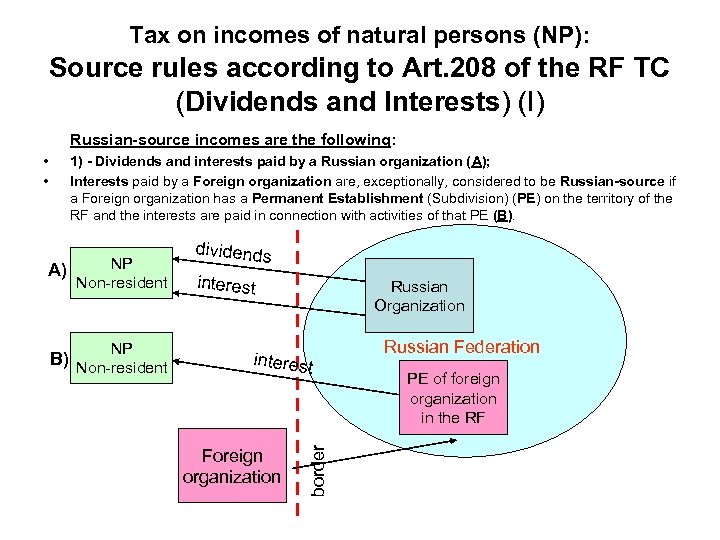 Tax on incomes of natural persons (NP): Source rules according to Art. 208 of the RF TC (Dividends and Interests) (I) Russian-source incomes are the following: • • 1) - Dividends and interests paid by a Russian organization (A); Interests paid by a Foreign organization are, exceptionally, considered to be Russian-source if a Foreign organization has a Permanent Establishment (Subdivision) (PE) on the territory of the RF and the interests are paid in connection with activities of that PE (B). NP Non-resident NP B) Non-resident interest Russian Organization interest Foreign organization border A) dividends Russian Federation PE of foreign organization in the RF
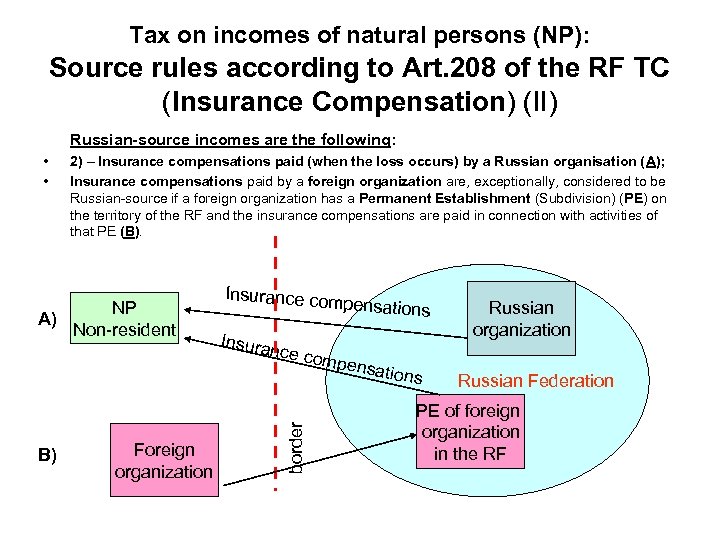 Tax on incomes of natural persons (NP): Source rules according to Art. 208 of the RF TC (Insurance Compensation) (II) Russian-source incomes are the following: • • 2) – Insurance compensations paid (when the loss occurs) by a Russian organisation (A); Insurance compensations paid by a foreign organization are, exceptionally, considered to be Russian-source if a foreign organization has a Permanent Establishment (Subdivision) (PE) on the territory of the RF and the insurance compensations are paid in connection with activities of that PE (B). NP A) Non-resident Insurance com pensations Insura nce co mpens B) Foreign organization border ations Russian organization Russian Federation PE of foreign organization in the RF
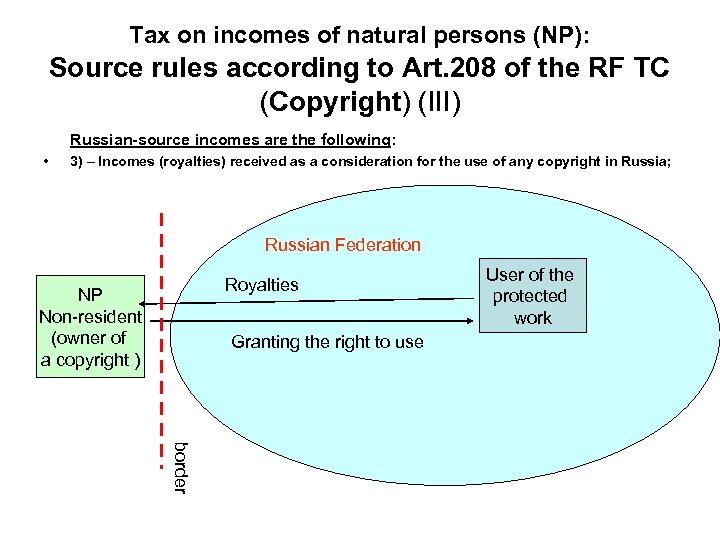 Tax on incomes of natural persons (NP): Source rules according to Art. 208 of the RF TC (Copyright) (III) Russian-source incomes are the following: • 3) – Incomes (royalties) received as a consideration for the use of any copyright in Russia; Russian Federation Royalties NP Non-resident (owner of a copyright ) Granting the right to use User of the protected work border
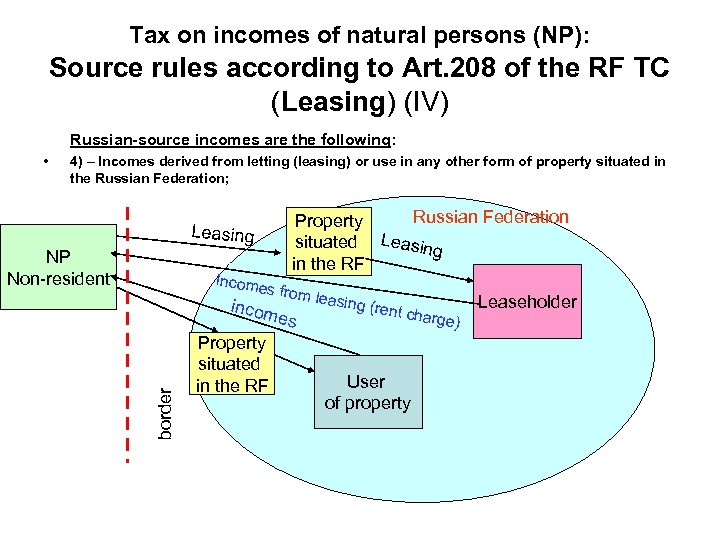 Tax on incomes of natural persons (NP): Source rules according to Art. 208 of the RF TC (Leasing) (IV) Russian-source incomes are the following: • 4) – Incomes derived from letting (leasing) or use in any other form of property situated in the Russian Federation; Leasing Russian Federation Property situated Leasing in the RF NP Non-resident Income s from incom border es Property situated in the RF leasing (rent c harge) User of property Leaseholder
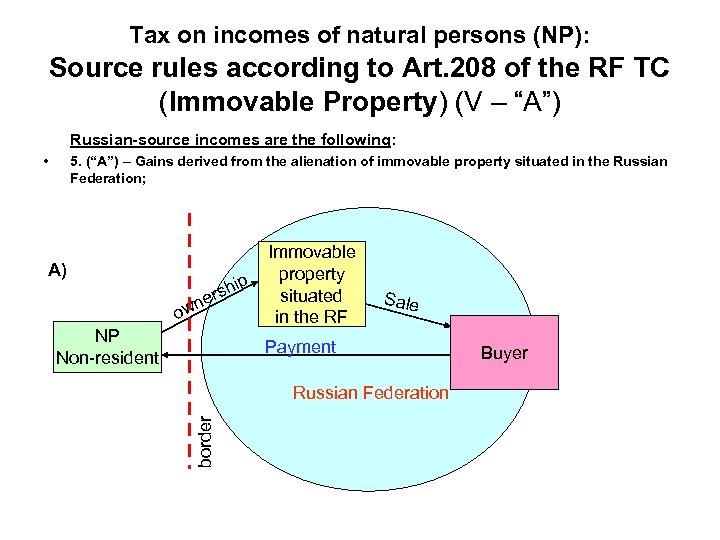 Tax on incomes of natural persons (NP): Source rules according to Art. 208 of the RF TC (Immovable Property) (V – “A”) Russian-source incomes are the following: • 5. (“A”) – Gains derived from the alienation of immovable property situated in the Russian Federation; A) ip h ers n ow NP Non-resident Immovable property situated in the RF Sale Payment border Russian Federation Buyer
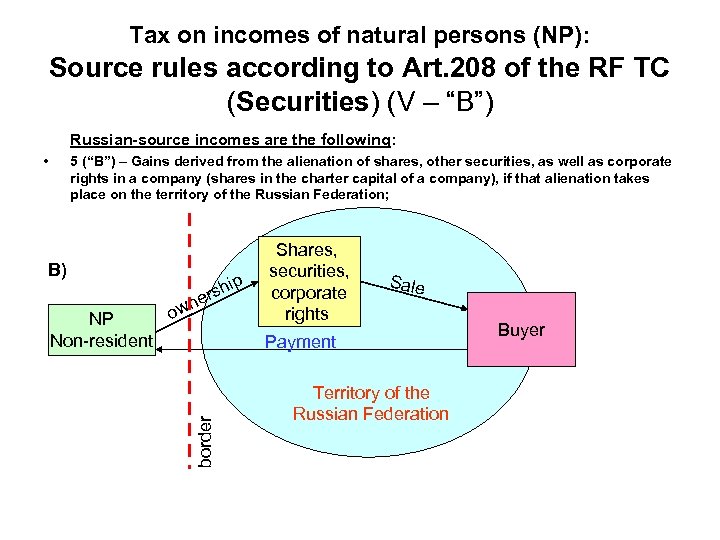 Tax on incomes of natural persons (NP): Source rules according to Art. 208 of the RF TC (Securities) (V – “B”) Russian-source incomes are the following: • 5 (“B”) – Gains derived from the alienation of shares, other securities, as well as corporate rights in a company (shares in the charter capital of a company), if that alienation takes place on the territory of the Russian Federation; B) n ow Sale Payment border NP Non-resident p i rsh e Shares, securities, corporate rights Territory of the Russian Federation Buyer
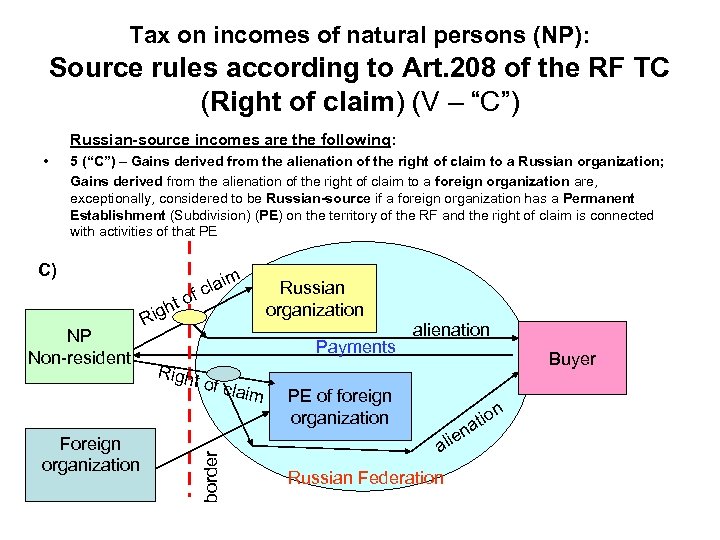 Tax on incomes of natural persons (NP): Source rules according to Art. 208 of the RF TC (Right of claim) (V – “C”) Russian-source incomes are the following: • 5 (“C”) – Gains derived from the alienation of the right of claim to a Russian organization; Gains derived from the alienation of the right of claim to a foreign organization are, exceptionally, considered to be Russian-source if a foreign organization has a Permanent Establishment (Subdivision) (PE) on the territory of the RF and the right of claim is connected with activities of that PE C) NP Non-resident im h Rig a f cl o t Payments Right of cl aim border Foreign organization Russian organization alienation Buyer PE of foreign organization n a o ati n lie Russian Federation
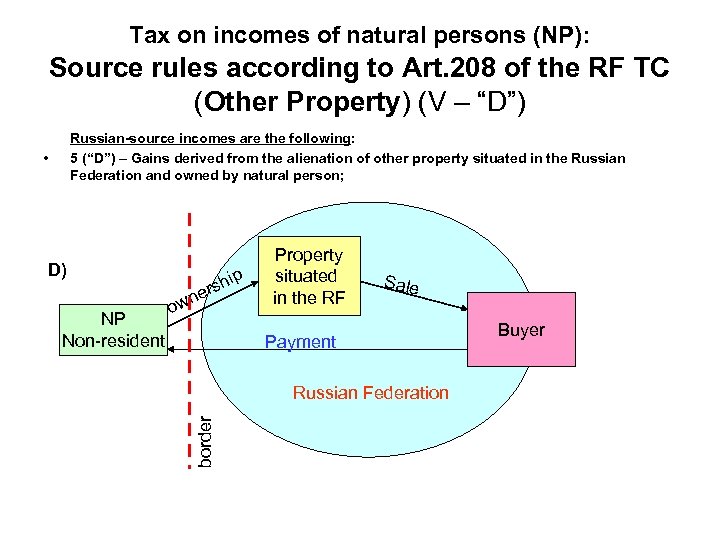 Tax on incomes of natural persons (NP): Source rules according to Art. 208 of the RF TC (Other Property) (V – “D”) Russian-source incomes are the following: 5 (“D”) – Gains derived from the alienation of other property situated in the Russian Federation and owned by natural person; D) NP Non-resident ip sh ner ow Property situated in the RF Sale Payment Russian Federation border • Buyer
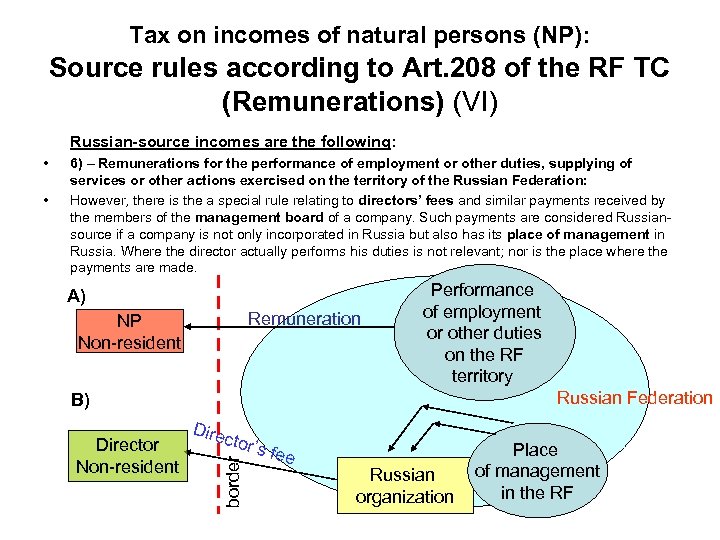 Tax on incomes of natural persons (NP): Source rules according to Art. 208 of the RF TC (Remunerations) (VI) Russian-source incomes are the following: • 6) – Remunerations for the performance of employment or other duties, supplying of services or other actions exercised on the territory of the Russian Federation: However, there is the a special rule relating to directors’ fees and similar payments received by the members of the management board of a company. Such payments are considered Russiansource if a company is not only incorporated in Russia but also has its place of management in Russia. Where the director actually performs his duties is not relevant; nor is the place where the payments are made. A) Remuneration NP Non-resident Performance of employment or other duties on the RF territory Russian Federation B) Director Non-resident Dire ct or’s fee border • Russian organization Place of management in the RF
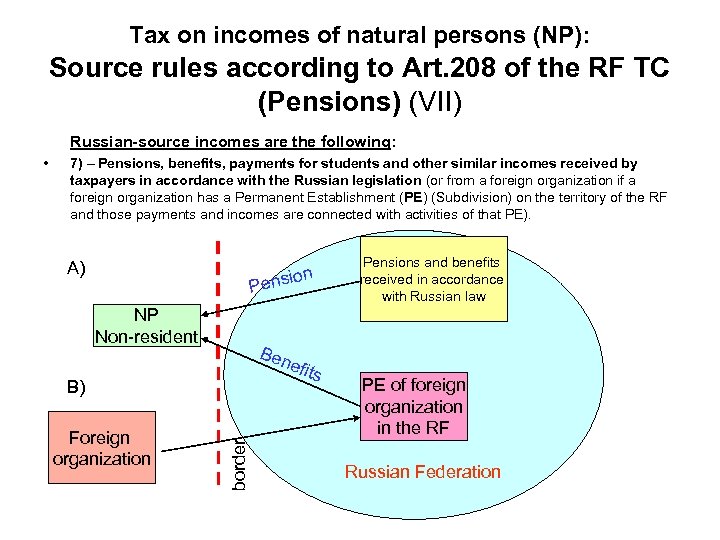 Tax on incomes of natural persons (NP): Source rules according to Art. 208 of the RF TC (Pensions) (VII) Russian-source incomes are the following: 7) – Pensions, benefits, payments for students and other similar incomes received by taxpayers in accordance with the Russian legislation (or from a foreign organization if a foreign organization has a Permanent Establishment (PE) (Subdivision) on the territory of the RF and those payments and incomes are connected with activities of that PE). A) ion Pens NP Non-resident Ben efits B) Foreign organization border • Pensions and benefits received in accordance with Russian law PE of foreign organization in the RF Russian Federation
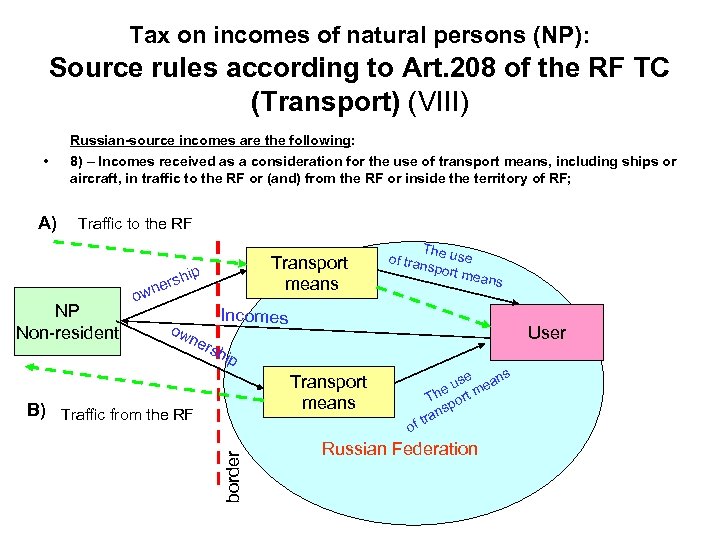 Tax on incomes of natural persons (NP): Source rules according to Art. 208 of the RF TC (Transport) (VIII) • A) Russian-source incomes are the following: 8) – Incomes received as a consideration for the use of transport means, including ships or aircraft, in traffic to the RF or (and) from the RF or inside the territory of RF; Traffic to the RF Transport means hip ers n NP Non-resident ow Th of tran e use sport mean s Incomes ow ne User rsh ip e ns us mea e Th ort sp ran f t Transport means B) Traffic from the RF border o Russian Federation
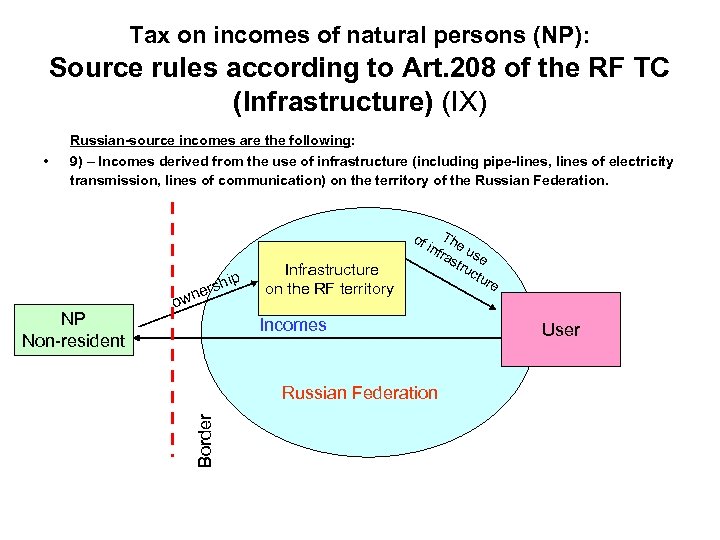 Tax on incomes of natural persons (NP): Source rules according to Art. 208 of the RF TC (Infrastructure) (IX) • Russian-source incomes are the following: 9) – Incomes derived from the use of infrastructure (including pipe-lines, lines of electricity transmission, lines of communication) on the territory of the Russian Federation. T inf he u ras se tru ctu re of hip ers n Incomes Russian Federation Border NP Non-resident ow Infrastructure on the RF territory User
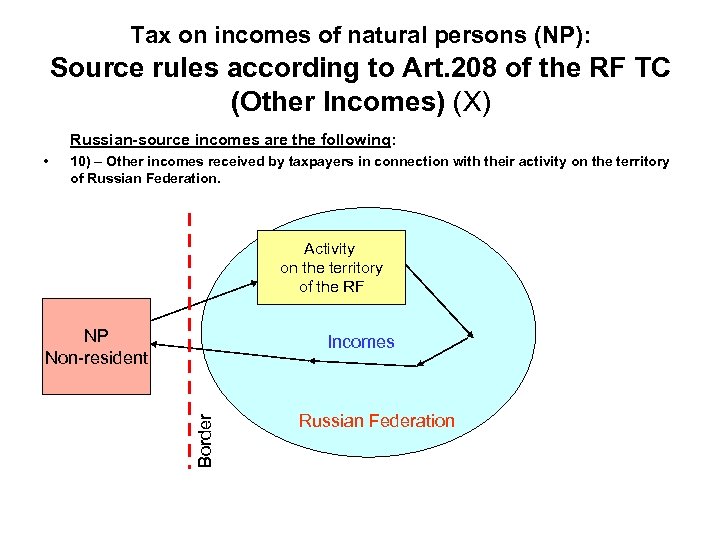 Tax on incomes of natural persons (NP): Source rules according to Art. 208 of the RF TC (Other Incomes) (X) Russian-source incomes are the following: • 10) – Other incomes received by taxpayers in connection with their activity on the territory of Russian Federation. Activity on the territory of the RF NP Non-resident Border Incomes Russian Federation
 Tax on incomes of natural persons: Compliance and administrative matters I. Most of the types of incomes received by individuals are subject to tax by way of withholding. II. Taxpayers who receive business income (and also income under civil law contracts, rental income and capital gains and income from foreign sources) have to submit a tax return: 1) Tax returns have to be filed by the 30 th of April of the year following the tax period; 2) In general, tax is payable by the 15 th of July of the year following the tax period; 3) Taxpayers who received business income have to make advance payments on the basis of estimated income which is determined by the tax authorities. Advance payments must be made: - by the 15 th of July (one half of the estimated tax liability), - the 15 th of October (one quarter), and - the 15 thof January (one quarter).
 Tax on incomes of natural persons: Impact of tax treaties Russia concluded 82 tax treaties on direct taxation with different countries of the world. 68 tax treaties are in force (including 2 treaties concluded by the USSR). The impact of tax treaties on income tax liability in Russia is the following: • 1) - There is no unilateral credit according to Russian tax law that may be granted for a foreign-source income from a country which does not have a tax treaty. That’s why a taxpayer who derives income from foreign sources situated in a country, which does not have a tax treaty in force with Russia, is in a worse situation, than that who derives income from a country which has such a treaty. • 2) - In the case of a treaty Russian resident, having received incomes from foreign country, has the right to offset tax paid in that foreign state against the Russian income tax. That is a tax credit and a way to avoid international double taxation. • 3) - Art. 232 of the RF TC provides for the requirement for non-residents to submit a confirmation that they are residents of a country which has a tax treaty in force with Russia in order to obtain an exemption from Russian tax or a tax credit.
 Corporate tax (tax on profit of organisations) is regulated by chapter 25 of the RF Tax Code: • (1) On the 6 th of July 2001 the Russian Parliament (Duma) approved of the Law implementing new provisions about the tax on profit of organizations (corporate tax) into the RF Tax Code. • (2) The law was signed by the President on the 6 th of August 2001 and entered into force and became effective on the 1 of January 2002.
 Corporate tax: types of taxpayers and their tax liability (Part I) • (1) - In Russian Tax Law the worldwide income principle applies to taxing the corporate profits of resident companies According to the general rule, profits of a Russian company (that is a resident company) will be taxed in Russia. There is no difference from what sources these profits are derived and in what part of the world it could happen (Art. 247 (1) of the RF TC). • (2) - Non-resident legal entities are taxed only on their Russiansources income and income derived through a permanent establishment situated in Russia. Thus, It is necessary to prove a connection between a non-resident company (as a taxpayer) and Russian tax jurisdiction (Articles 247 (2 and 3), 306, 309 of the RF TC).
 Corporate tax: the definition of taxpayers (Part II) • • Articles 11 (2) and 246 of the RF TC provides for the definition of taxpayer of corporate tax, that is Russian and foreign organizations. According to Art. 11 (2) of the RF TC: (1) - the term “Russian organization” refers to legal entities formed in accordance with the Russian legislation. (2) the term “foreign organization” includes: (2. 1) - foreign legal entities and their branches and representatives established in Russia; (2. 2) - companies and other corporate bodies having legal personality under the law of the corresponding foreign state; (2. 3) - international organizations and their branches and representatives established in Russia. Although the RF TC does not contain a definition of the concept of residence (in regard to companies), the wording of chapter 25 of the RF TC makes it clear that residence is linked to the principle of incorporation.
 Corporate tax: legal forms of companies (Part III) • 1. 2. Incorporation (registration) of legal entities in Russia is usually exercised by territorial bodies of tax authorities. The procedure of registration is regulated by the Federal law of 8 August 2001 “On state registration of legal entities” (revised on 19 July 2007). • 2. According to the Russian legislation, namely Russian Civil Code (Art. 50), there are: – (1) commercial legal entities (profit organization); – (2) non-commercial legal entities (non-profit organizations). • 3. The RF Civil Code (Part One) provides for the following legal forms of commercial companies: (1) partnership with unlimited liability (Art. 69 -81 RF Civil Code); (2) limited partnership (Art. 82 -86 RF Civil Code); (3) limited liability company (Art. 87 -94 RF Civil Code); (4) joint-stock company (Art. 96 -104 Civil Code); (5) state or municipal enterprises (Art. 113 -115 RF Civil Code); (6) some others. • • 4. Articles 116 -123 of the RF Civil Code and the Federal Law of 12 January 2002 (with latest amendments, revised on 19 July 2007) “On non-commercial organizations” state different legal forms of non-commercial (non-profit) legal entities. • 5. In general, RF TC establishes the same taxation rules and procedures for all kinds of Russian legal entities (irrespectively of their legal forms).
 Corporate tax: tax rates (Part IV) • I. The general rate of the corporate tax is 24% consisting of: - 6. 5% to the federal budget; - 17. 5% to the regional budget (the regional governments are authorized to reduce their portion of the corporate tax rate maximum to 13. 5%). (Art. 284 (1) of the RF TC) • II. Different rates are provided for the following profits: (1) 20% - foreign organizations profits which are received from Russian sources; (2) 10% - for profits from the use, maintenance or rent of ships, aircraft or other transport means in international traffic; (3) 9% - for incomes of Russian organizations from the dividends paid by a Russian or foreign organization; (4) 15% - for incomes of a foreign organization from the dividends paid by a Russian organization (residence criteria); (5) 0% rate is for incomes of a Russian organization from dividends under the certain conditions: - a) the organization-receiver of dividends has been holding 50% of shares of the organization, which pays the dividends, for not less than 365 days; - b) the price of the purchase of those shares was not less than 500 million Rubbles; (6) different tax rates (15%, 9% and 0%) are, exceptionally, provided for interest income on state and municipal securities (tax rate depends on the kind and the issuance date of the securities). (Art. 284 (2, 3 and 4) of the RF TC)
 Corporate tax: tax base (Part V) • (1) - The taxable income of a resident company (and a permanent establishment of a foreign company) is the sum of business income, income from the alienation of property of any kind and non-sale or extraordinary income less business or extraordinary expenses (Art. 247 RF TC). • (2) The RF TC contains a closed list of incomes that are not deemed to be an income for tax purpose (Art. 251 of the RF TC). (For instance, property received free of charge from a parent company would not be treated as profit provided the parent company owns more than 50% of the carter (authorized) capital of the subsidiary. ) • (3) Article 252 (1) of the RF TC allows a taxpayer to deduct all justifiable expenses subject to documentary proof. Expenses must be closely related to the activities carried on in earning income. • (4) There are two types of non-deductible expenses: - expenses that are not documented and (or) economically justified; - expenses listed in Art. 270 of the RF TC and explicitly mentioned as not-deductible expenses.
 Corporate tax: peculiarities of deductibility of interests (Part VI) • As a general rule, interest payments are tax-deductible expenses. However, a resident taxpayer or a foreign legal entity carrying on business activities through a Russian permanent establishment has to consider the restrictions stated by Art. 269 of the RF TC. They are the following: • (1) Special rules are applied if the interest paid by the company deviates by more than 20% from the average interest rate on similar loans. • (2) In accordance with international practice, Art. 269 of the RF TC introduces, socalled, “thin capitalisation” rules as a further restriction on the deductibility of interest: Rules of “thin capitalisation” are applied with respect to interest to be paid by a local company to a non resident under the following conditions: • - the foreign company, directly or indirectly, owns over 20% of the charter (or authorized capital) of the Russian debtor-company; - the amount of debt (so-called, “controlled debt”) is more than three times higher than the difference between the sum of assets and the amount of liabilities of the Russian debtor-company. • If this is the case, only the limited sum could be included in expenses by a Russian borrower. The sum in excess of this is deemed to be a dividend of the foreign company, not interest.
 Corporate tax: computing and paying (Part VII) • 1. The accounting method to be used in computing the corporate income tax base is generally the accrual method. Income from sales and from the alienation of property is taxed at the time such income is earned. That is defined as the time of delivery of goods, supply of works or services or the passing of title to the property. When a taxpayer actually receives money as consideration for delivering and supplying is not very important for tax purpose. (Articles 271 -272 of the RF TC) The cash method of accounting can only be used by small business taxpayers. (Art. 273 of the RF TC). • ` 2. Corporate tax is payable on or prior to 28 of March of the year following the tax period (that is calendar year). During the year all taxpayers pay advance payments. There are two types of advance payments: (a) monthly advance payments (calculated from estimated proceeds); (b) advance payments for reporting period - first quarter, half year and nine months. (calculated on the basis of the real profit tax base). (Articles 287, 289 of the RF TC)
 Corporate tax: the concept of permanent establishment (Part VIII – “A”) • (1) The profit deriving from a Russian permanent establishment of a foreign company is taxable in Russia. • (2) According to Art. 306 (2) of the RF TC, a permanent establishment is defined as a branch, an office, an agency, a store or any other fixed place of business or place of management through which the foreign company regularly carries on business activities related to: (1) exploitation or extraction of natural resources; (2) building and construction works; (3) assembly or installation projects; (4) sale of goods located in Russia; (5) supply of services or rendering pf works; or (6) any other types of activities, unless the activities are considered preparatory or auxiliary (Art. 306 (4) of the RF TC). • • • These provisions are very similar to those of Article 5 of the OECD Model Tax Convention.
 Corporate tax: when permanent establishment does not exist (Part VIII – “A”) • • The legislator has made it clear that a permanent establishment of a foreign company on the Russian territory does not exist in the following situations: (1) A mere act of signing a sales contract according to the written instruction of a foreign company does not result in the existence of a permanent establishment of the non-resident company; (2) The acquisition and holding of participation in a Russian company or other securities, as well as the ownership of property of any kind, does not result in a shareholder or owner having a permanent establishment; (3) A permanent establishment does not exist under tax law where a foreign company is a partner in a simple partnership or any other joint venture that is deemed to be a transparent entity for Russian tax purposes; (4) In some other cases. Thus, the above-mentioned situations and operations can not be considered as a basis for their qualification as the form of activity of appearing permanent establishment.
 Corporate tax: taxation of incomes attributed to permanent establishment (Part VIII – “A”) • • • I. The taxable income of a foreign company operating through a permanent establishment will be the following: - (1) income received as a result of operating in Russia through a permanent establishment reduced by expenses incurred by the permanent establishment; - (2) income from possession, use or disposal of the assets of the permanent establishment, reduced by costs connected with receiving this income; - (3) other incomes from Russian sources (for instance, interest, royalty and others) attributed to the permanent establishment. II. Rules regulating taxation of permanent establishments of foreign companies are generally the same as those applied to domestic Russian companies. But there are some specific rules for permanent establishments: (1) If a foreign company has a branch because it engages in “preparatory and auxiliary” activities for the benefit of third parties and does not receive any remuneration, the foreign company is deemed to have taxable income equal to 20% of the branches expenses; (2) The tax base and the tax are calculated separately by each branch of a foreign company and, as a rule, cannot be consolidated. On the contrary, all branches of Russian companies in any case are considered as a consolidated taxpayer and are taxed jointly without any exception. (3) Permanent establishments pay only in quarterly advance payments. They do not pay in monthly advance payments. On the contrary, Russian companies usually pay both in monthly and quarterly advance payments.
 Corporate tax: taxation of source income (Part IX) • • • The RF TC provides for the taxation of certain items of income derived by foreign companies from Russian sources ( art. 309 (1) of the RF TC) : (1) - Interest is deemed taxable income if it is paid by a Russian legal entity or in respect of state or municipal securities; (2) - Profits distributed or liquidation proceeds paid by a company incorporated under Russian law are defined as Russian-source income; (3) - Income from the operation of transport means in international traffics is subject to tax if the transportation is linked to the territory of Russia; (4) - Royalties are taxed if a particular right of property (for instance patent, knowhow, literary or artistic property) is used in Russia; (5) - Income from the alienation of immovable property situated in Russia is subject to Russian income tax. The general principle of calculating the corporate tax on source income is that the gross amount of income is subject to tax by way of withholding. (However, in respect of the tax base, an exception is made for income from the alienation of immovable property, as the taxpayer is eligible for a deduction in respect of expenses incurred due to the acquisition or alienation of such a property, provided that documentary proof is submitted before payment of the income).
 Indirect taxation in Russia: Value Added Tax (VAT) The basic principles of VAT: • VAT is an indirect federal tax; • VAT is included and hidden in the prices of goods or services; • In general, seller of goods is obliged to pay VAT, but actually, the burden of VAT is transferred on the buyer (that is consumer).
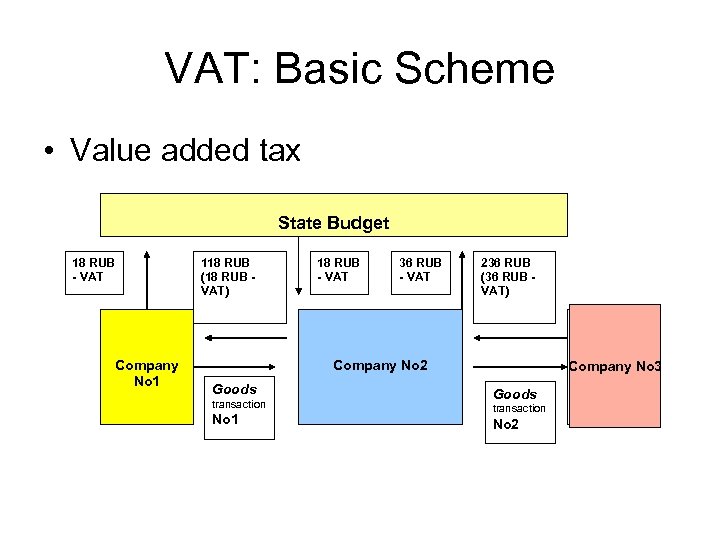 VAT: Basic Scheme • Value added tax State Budget 18 RUB - VAT Company No 1 118 RUB (18 RUB VAT) 18 RUB - VAT 36 RUB - VAT 236 RUB (36 RUB VAT) Company No 2 Goods transaction No 1 Company No 3 Goods transaction No 2
 Value Added Tax: tax rates I. The rates of VAT are determined in Art. 164 RF TC and are the following: • 1) The standard rate is 18% (previously, until 1 January 2004, the standard rate was 20% - Federal law of 7 July 2003 No 117 -ФЗ) • 2) The reduced rate is 10%. This is applicable to operations with certain goods mentioned in Art. 164 (2) of the RF TC). There are four categories of goods in respect to which the reduced tax rate is applicable: - certain food-stuffs which are the most important for population; - certain goods for children; - certain periodicals and books; - some types of goods for medical purposes. • 3) There is a 0% rate. Taxation is imposed at the 0% rate on the export of goods, on the provision of certain exportrelated works and services, including transportation services, and in some other cases. • • II. Main rules of applying VAT rates: - Taxpayer does not have a right to apply higher rates than required, as this could entail a risk of purchasers’ tax deductions being rejected. - On the other hand, Art. 173 (5) of the RF TC states that if a taxpayer wrongly includes the sum of VAT in the invoice to the purchaser, the taxpayer must pay this sum of VAT to the budget.
 Value Added Tax: object of taxation The main objects taxable by VAT are: • (1) The sale of goods; • (2) The sale of works and services; • (3) The import of goods to the Russian customs territory. It should be noted that: The transfer of goods on a free of charge basis is usually deemed as a sale (the same rules apply to works and services). In these cases the prices of goods, works and services are determined on the basis of their market prices (Art. 40 of the RF TC).
 Value Added Tax: exemption • There are several groups of exemptions from VAT: • 1. The place of sale of goods (works, services) is not the Russian Federation. Such a sale that is not on the territory of Russia is not taxable according to VAT rules. Articles 147 – 148 of the RF TC provide for special rules devoted to “the place of sale of goods” (Art. 147) and “the place of sale of works (services)” (Art. 148). • II. The place of sale of goods (works, services) is the Russian Federation, but the operation is not recognised as being subject to taxation (Art. 39 of the RF TC) or exempted from taxation (Art. 149 of the RF TC). • III. Release (deliverance) from taxpayer obligations. Organizations and individual businessmen have the right to relief, if the sum of their proceeds does not exceed a total of 2 million rubbles for the three preceding calendar months in a line (Art. 145 (1) of the RF TC). (This relief does not apply to the import of goods to the Russian customs territory (Art. 145 (3) of the RF TC)). • IV. Organizations and persons are not taxpayers of VAT (in principle). For instance, organizations and individual businessmen who apply a simplified system of taxation (for small business) are not VAT taxpayers (Art. 346. 11 (2 and 3) of the RF TC). (This privilege does not apply to import of goods to the Russian customs territory).
 Value Added Tax: computing and deducting (Part I) The taxpayer has the right to reduce the total amount of tax (Art. 171172 of the RF TC). The main rules are: • (1) The sum of deduction is estimated as the amount of VAT: – (a) presented to the taxpayer when purchasing goods, works or services; or – (b) paid by the taxpayers when importing goods to the Russian customs territory. • ( 2) Previously, the deduction was allowed only when the taxpayer had paid for the goods (works, services); since the 1 January 2006 the tax deduction has been based on the VAT-invoice. • (3) Previously, the taxpayer could choose the computation method (“cash method” or ”accrual method”); since 1 January 2006, the earlier date – either the day of shipment of goods or the day of payment – is used to compute the tax base.
 Value Added Tax: computing and deducting (Part II) • • • I. There is a list of situations when the RF TC prohibits tax deductions: (1) When the organisations or businessmen who buy goods (works, services) are not VAT-payers; (2) If goods (works or services) are acquired for the purpose of carrying out activities that are not subject to VAT. (3) In some other cases. II. Besides, the additional reason for refusing taxpayers the right to deduct taxes is now the following. When suppliers did not pay VAT or disappeared, taxpayer is considered, even if he was not suspected of any fraud, as not having the right for VAT – deduction. On the 12 October 2006 the Supreme Arbitration Court issued a guideline using the concept of “unjustified tax benefits”. The Court ruled: (1) The taxpayer’s transactions should be for business purposes and a tax benefit itself must not be its independent purpose; (2) There should be real, not imaginary, transactions; (3) The taxpayer is not responsible for the actions of the supplier, unless the tax authority proves that the taxpayer knew about the infringements.
 Tax procedures: Recovery of Taxes • • I. Articles 46 – 47 of RF TC provide for the procedure of recovery of tax in regard to companies and businessmen: (1) In the event of the failure to pay or incomplete payment of a tax the amount of a tax shall be recovered against monetary means of the taxpayer in bank accounts. (decision of tax authority shall be sent directly to the bank). (2) In the event of the insufficiency or absence of monetary means in the bank accounts of the taxpayer, tax authority has the right to recover a tax against other kinds of property. II. In some cases tax authorities do not have the right to recover a tax directly, they must claim to the Court: (1) tax authorities claim the amount of a tax on the basis of the legal re-qualification of a transaction concluded by a taxpayer with third persons (Art. 45); (2) tax authorities claim the amount of tax on the basis of the legal re-qualification of the legal status of a taxpayer (Art. 45); (3) tax authorities fail limitation period (normally, two months) for making a decision on recovering the tax against monetary means of the taxpayer in bank accounts (Art. 46 (3)); (4) tax authorities claim the amount of tax from a budgetary financed organization (Art. 45); (5) tax authorities claim the amount of tax from a number of taxpayers-companies which appeared in the result of the reorganization of a company, that is in the result of dividing a legal entity or separating from a legal entity another legal entity (Art. 50) • III. If a natural person does not pay a tax, tax authorities shall claim to the Court in all cases in order to recover the tax.
 Tax procedures: Powers of tax authorities The RF TC and the RF Law “On the tax authorities in the Russian federation” provided for the powers of tax authorities. In Particular, special procedures are established for the verification (inspection) of the economic activity of taxpayers. • • I. There are two kinds of verification according to the RF TC: 1) On-site verification (in the place of taxpayer) – Art. 89 of the RF TC; 2) Chamber verification (in the office of tax authority) – Art. 88 of the RF TC. II. Chamber verification (in the office of tax authority) is exercised on the basis of a tax return (declaration), documents submitted by the taxpayer and other documents available at the tax authority; III. On-site verification (in the place of taxpayer) is exercised on the basis of decisions of the Head (or his deputy) of a certain tax authority. An on-site verification with respect to one taxpayer may be exercised with regard to one or several taxes. • • • However, there are certain procedural limits in respect to tax authorities: (1) not more than two months; (2) not two or more in one calendar year; (3) not two or more of the same taxes for the same period.
 Tax procedures: Transfer pricing rules • Control of prices under the contract for tax purposes is an important remedy (means) against tax avoidance and evasion (“transfer pricing rules”). The RF Tax Code contains rules on adjusting prices applied by contracting parties to the market prices. The tax authorities have the right to correct the price under the contract and calculate additional tax and a penalty when the price applied by the parties to a transaction deviates upwards or downwards by more than 20% from the market price. The tax authorities can, however, check and correct the price under the contract solely in a limited number of cases (see Art. 40 RF TC) : I. In the event of a transaction between inter-dependent persons. • II. In the event of barter transactions; • III. In the event of cross-border operations; • IV. In the event when within a short period of time the taxpayer applies a price differing by more than 20% from the prices applied by that taxpayer to identical goods (works, services).
 Guaranties for investors according to the Federal law “On foreign investments in the RF” • Art. 9 of the Federal law 9 July 1999 “On foreign investments in the RF” (revised of the 3 June 2006) provides the stability of legal regime foreign investors in case of some unfavorable changes in Russian tax legislation. I. According to the Law the term “foreign investor” includes: • • (1) - Foreign organizations directly operating on the Russian market; (2) - Russian commercial organizations with foreign investments (the share of the foreign investments must be more than 25%); (3) - Foreign citizens, permanently living outside the RF, (4) - International organizations and foreign states. • • II. According to Art. 9 (1) of the Law the rule concerns only the activities of a foreign investor dealing with the implementation of the priority investment projects, III. A priority investment project is the one: • • • (1) in which the total amount of foreign investments is not less than 1 billion rubles; or (2) in which the minimum share of foreign investors in the charter capital of a commercial organization is not less then 100 million rubles; and (3) which is on the government list. The Ruling of the RF Supreme Arbitration Court (Para. 8) of 18 January 2001 № 58 makes the sphere of application of this guarantee wider. See also: Rulings of the FAC of the North-Western district оf April 3, 2006, №А 56 -3834/2005 and April 28, 2005 №А 21 -8096/04 -С 1.
 Status of the investor according to the Federal law “On special economic areas” There is the Federal law of 22 July 2005 “On special economic areas” (revised on 18 December 2006). • • • The objectives of establishing special economic areas are: (1) development of new industries of national economy; (2) high technology development; (3) development of transport infrastructure; (4) development of tourism industries. Subsidiaries with the participation of a foreign company according to Art. 9 of the above-mentioned law can be the residents of special economic areas. I. Art. 36: the residents of a special economic area are taxed in accordance with the ordinary provisions of Russian tax law (the RF TC). Art. 37: of the Law establishes free customs regime for the residents of a special economic area. II. The regime of stability of investments, established by Federal law “On special economic areas” is applied in regard to all kinds of activities and projects.
 Partnership Agreement concluded between Russia and the EC (Part I) I. The Agreement on Partnership and Cooperation between the European Community and the Russian Federation (the APC) was signed in 1994. II. The APS sometimes influences economic relations on the whole and in particular taxation of cross-border operations and investments. (For instance, the Decision of the European Court of Justice on the case of the Russian football player Simutenkov). It follows from the ECJ case-law that when an agreement establishes cooperation between the parties, some of the provisions of that agreement may directly govern the legal position of individuals. III. There are many other APC provisions which can also have direct effect. Thus Russian and European citizens and companies may correspondently be able to realize their right for equal treatment in - such areas as: establishment new business (Art. 28); - cross-border supply of services (Art. 36); -movement of capital (Art. 52);
 Application of the Partnership Agreement concluded between Russia and the EC (Part II) • 1. The ECJ Judgment of April 12, 2005 on case № 265/03 on the case of the Russian football player J. Simutenkov • 2. Practice of the RF Courts • A – The APC in the RF legal system Decision of Federal Arbitrage Court (FAC) of Volgo-Vyatsiy district of January 19, 2005, case №Ф 17 -151 А/5 -2004; • • B – The APC (Art. 28) impact on the regime of the subsidiaries established by the EU investors Decision of the FAC of the North-Western district of December 11, 2003, case № 44 -1814 / 03 -С 9 Decision of the FAC of the Moscow district of October 5, 2001, case №КА-А 40/5556 -01 the EU C – The impact of the APC (Art. 36) on export-import operations between the RF and The court practice concerns mainly indirect taxes and customs duties. • D – The impact of the APC (Art. 98) on the fundamental freedoms of the RF and EU citizens and organizations Decision of the FAC of the Moscow district of March 2, 2006, case № КГ-А 40/698 -06 -П
 Lecture test • 1. Can tax treaties concluded by the Russian Federation be overridden by any rules of domestic tax law? • 2. What is a “special tax regime” according to Russian tax law? What kinds of special tax regimes are provided for by the RF Tax Code? • 3. What can you say about Russian Tax on Income of Natural Persons: Is its main rate progressive, flat or regressive? What rates of the income tax are established by the RF Tax Code? • 4. When could a foreign company (non-resident) be taxed in Russia according to the provisions of Russian tax law? (Mention the main conditions in respect to corporate tax and VAT) • • 5. What is your impression of Russian tax system and the existing tax burden? (give your arguments)