 Скачать презентацию Russian Rates Derivatives 2012 New Environment EBRD NFEA
9bd2114bd9c2ca341fa80eb049034102.ppt
- Количество слайдов: 12



Russian Rates Derivatives 2012: New Environment? EBRD, NFEA, ISDA Conference London, 14 th March 2012 Eugene Belin Head of Fixed Income, Currencies and Commodities for Russia, CIS and Israel, Citi
Review of Current Situation Main drivers of customer demand for Derivatives in Russian Market Review of benchmarks Conclusions
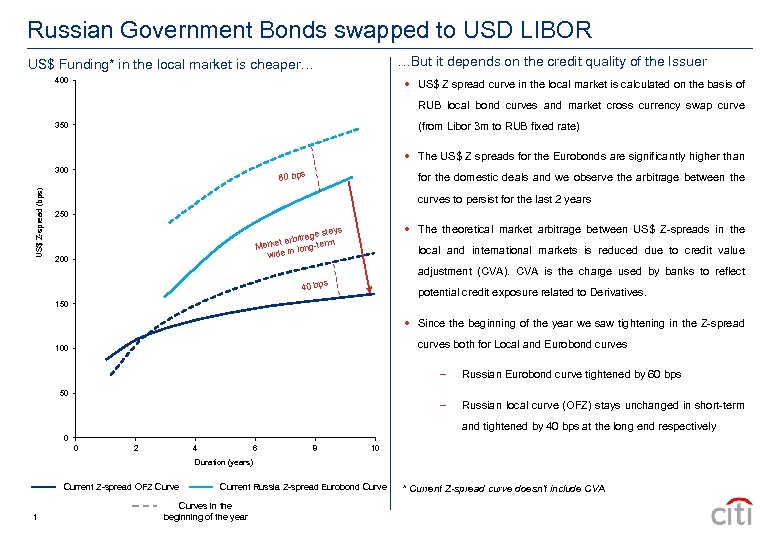
Russian Government Bonds swapped to USD LIBOR …But it depends on the credit quality of the Issuer US$ Funding* in the local market is cheaper… 400 US$ Z spread curve in the local market is calculated on the basis of RUB local bond curves and market cross currency swap curve (from Libor 3 m to RUB fixed rate) 350 The US$ Z spreads for the Eurobonds are significantly higher than US$ Z-spread (bps) 300 60 bps for the domestic deals and we observe the arbitrage between the curves to persist for the last 2 years 250 The theoretical market arbitrage between US$ Z-spreads in the s e stay rbitrag rm rket a te Ma longwide in 200 local and international markets is reduced due to credit value adjustment (CVA). CVA is the charge used by banks to reflect s 40 bp potential credit exposure related to Derivatives. 150 Since the beginning of the year we saw tightening in the Z-spread curves both for Local and Eurobond curves 100 – Russian Eurobond curve tightened by 60 bps – Russian local curve (OFZ) stays unchanged in short-term 50 and tightened by 40 bps at the long end respectively 0 0 2 4 6 8 10 Duration (years) Current Z-spread OFZ Curve 1 Current Russia Z-spread Eurobond Curves in the beginning of the year * Current Z-spread curve doesn’t include CVA
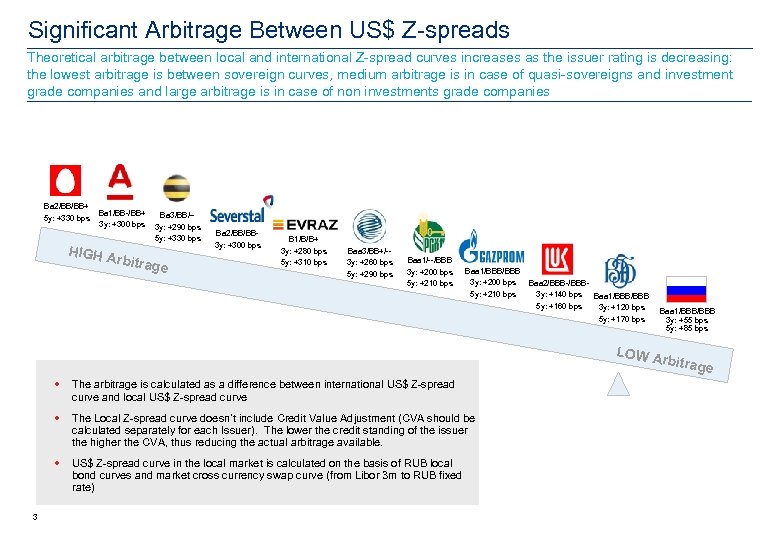
Significant Arbitrage Between US$ Z-spreads Theoretical arbitrage between local and international Z-spread curves increases as the issuer rating is decreasing: the lowest arbitrage is between sovereign curves, medium arbitrage is in case of quasi-sovereigns and investment grade companies and large arbitrage is in case of non investments grade companies Ba 2/BB/BB+ 5 y: +330 bps Ba 1/BB-/BB+ 3 y: +300 bps HIGH A Ba 3/BB/-3 y: +290 bps 5 y: +330 bps rbitrag e Ba 2/BB/BB 3 y: +300 bps B 1/B/B+ 3 y: +280 bps 5 y: +310 bps Baa 3/BB+/-3 y: +260 bps 5 y: +290 bps Baa 1/--/BBB 3 y: +200 bps 5 y: +210 bps Baa 1/BBB 3 y: +200 bps 5 y: +210 bps Baa 2/BBB-/BBB 3 y: +140 bps Baa 1/BBB 5 y: +160 bps 3 y: +120 bps 5 y: +170 bps Baa 1/BBB 3 y: +55 bps 5 y: +85 bps LOW A rbitrag e The Local Z-spread curve doesn’t include Credit Value Adjustment (CVA should be calculated separately for each Issuer). The lower the credit standing of the issuer the higher the CVA, thus reducing the actual arbitrage available. 3 The arbitrage is calculated as a difference between international US$ Z-spread curve and local US$ Z-spread curve in the local market is calculated on the basis of RUB local bond curves and market cross currency swap curve (from Libor 3 m to RUB fixed rate)
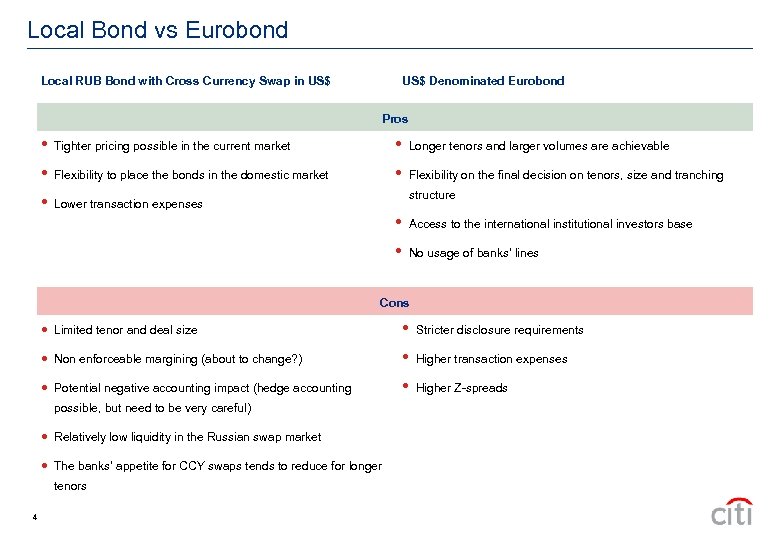
Local Bond vs Eurobond Local RUB Bond with Cross Currency Swap in US$ Denominated Eurobond Pros • Tighter pricing possible in the current market • Longer tenors and larger volumes are achievable • Flexibility to place the bonds in the domestic market • Flexibility on the final decision on tenors, size and tranching • Lower transaction expenses structure • Access to the international institutional investors base • No usage of banks’ lines Cons Limited tenor and deal size • Stricter disclosure requirements Non enforceable margining (about to change? ) • Higher transaction expenses Potential negative accounting impact (hedge accounting • Higher Z-spreads possible, but need to be very careful) Relatively low liquidity in the Russian swap market The banks’ appetite for CCY swaps tends to reduce for longer tenors 4
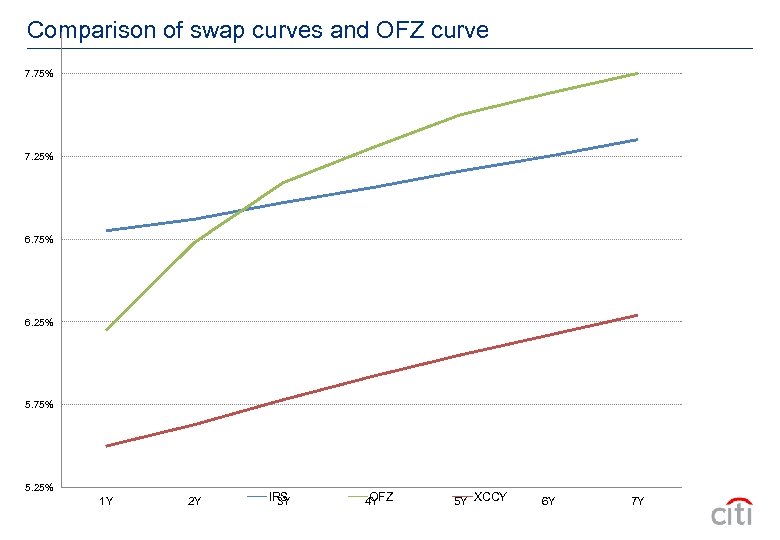
Comparison of swap curves and OFZ curve 7. 75% 7. 25% 6. 75% 6. 25% 5. 75% 5. 25% 1 Y 2 Y IRS 3 Y OFZ 4 Y 5 Y XCCY 6 Y 7 Y
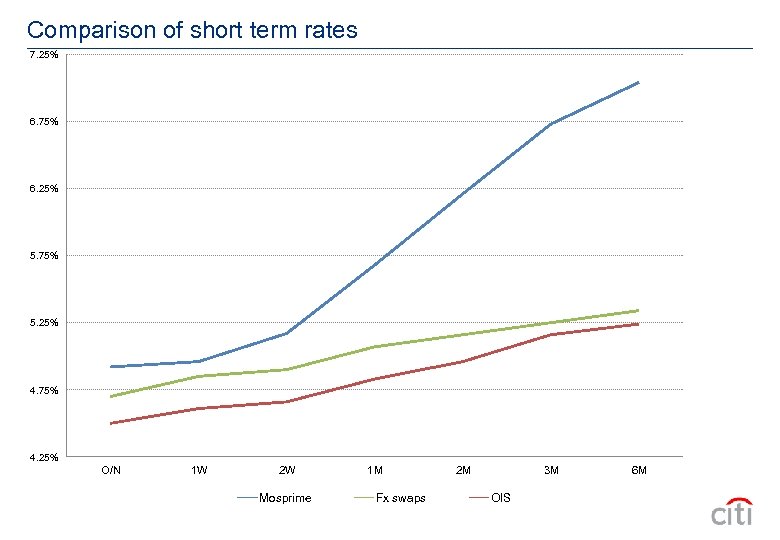
Comparison of short term rates 7. 25% 6. 75% 6. 25% 5. 75% 5. 25% 4. 75% 4. 25% O/N 1 W 2 W Mosprime 1 M Fx swaps 2 M 3 M OIS 6 M
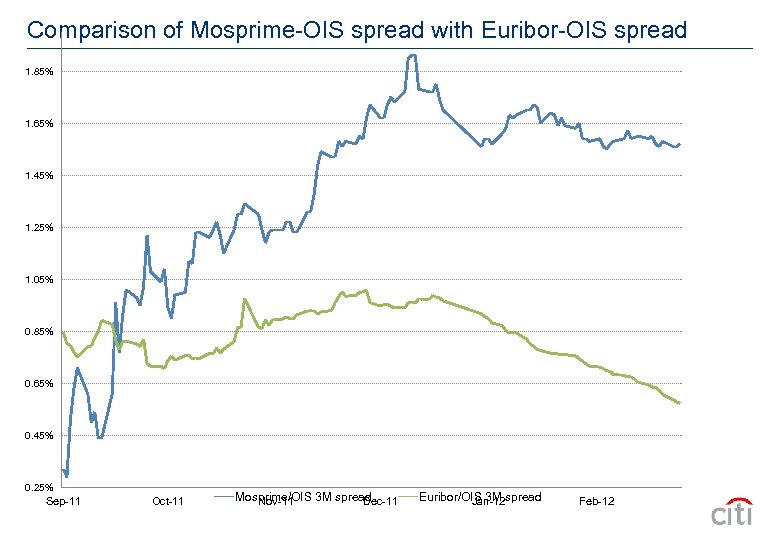
Comparison of Mosprime-OIS spread with Euribor-OIS spread 1. 85% 1. 65% 1. 45% 1. 25% 1. 05% 0. 85% 0. 65% 0. 45% 0. 25% Sep-11 Oct-11 Mosprime/OIS 3 M spread Nov-11 Dec-11 Euribor/OIS 3 M spread Jan-12 Feb-12
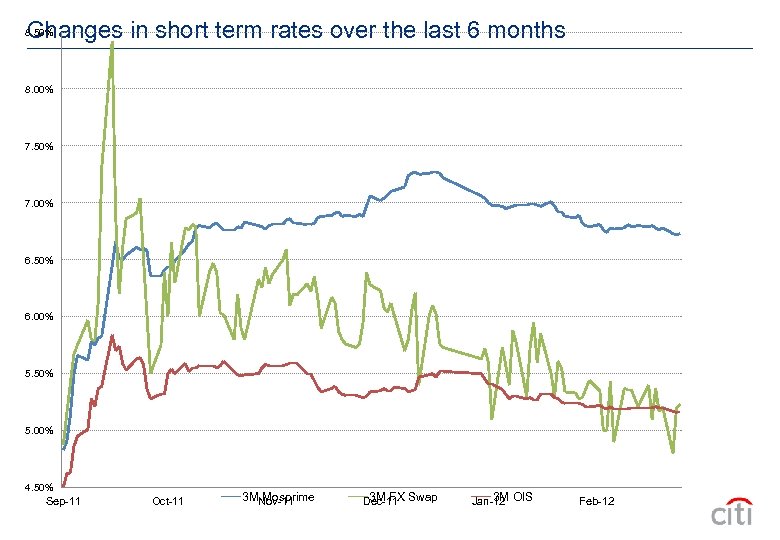
Changes in short term rates over the last 6 months 8. 50% 8. 00% 7. 50% 7. 00% 6. 50% 6. 00% 5. 50% 5. 00% 4. 50% Sep-11 Oct-11 3 MNov-11 Mosprime 3 M FX Dec-11 Swap 3 M Jan-12 OIS Feb-12
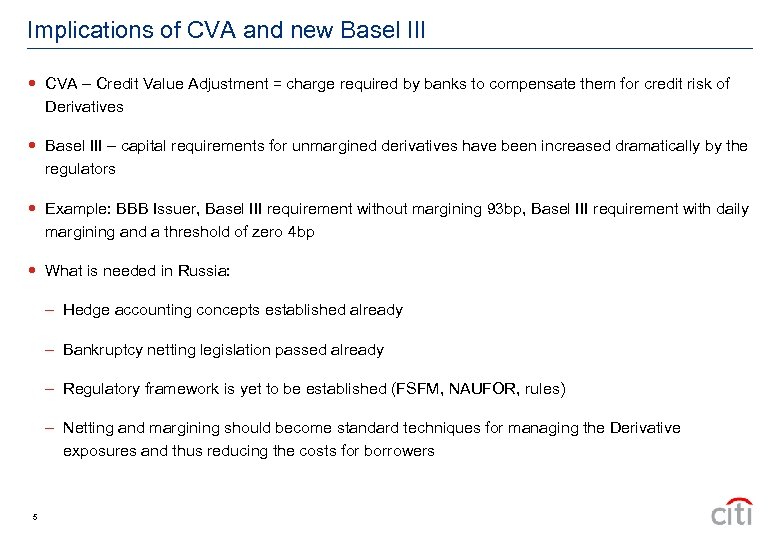
Implications of CVA and new Basel III CVA – Credit Value Adjustment = charge required by banks to compensate them for credit risk of Derivatives Basel III – capital requirements for unmargined derivatives have been increased dramatically by the regulators Example: BBB Issuer, Basel III requirement without margining 93 bp, Basel III requirement with daily margining and a threshold of zero 4 bp What is needed in Russia: – Hedge accounting concepts established already – Bankruptcy netting legislation passed already – Regulatory framework is yet to be established (FSFM, NAUFOR, rules) – Netting and margining should become standard techniques for managing the Derivative exposures and thus reducing the costs for borrowers 5
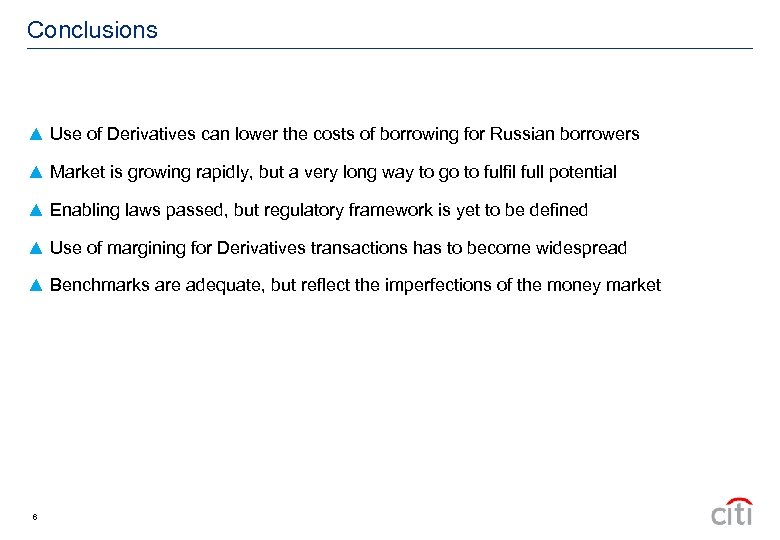
Conclusions ▲ Use of Derivatives can lower the costs of borrowing for Russian borrowers ▲ Market is growing rapidly, but a very long way to go to fulfil full potential ▲ Enabling laws passed, but regulatory framework is yet to be defined ▲ Use of margining for Derivatives transactions has to become widespread ▲ Benchmarks are adequate, but reflect the imperfections of the money market 6
![[TRADEMARK SIGNOFF: add the appropriate signoff for the relevant legal vehicle] © 2010 Citigroup](https://present5.com/presentation/9bd2114bd9c2ca341fa80eb049034102/image-12.jpg "[TRADEMARK SIGNOFF: add the appropriate signoff for the relevant legal vehicle] © 2010 Citigroup")
[TRADEMARK SIGNOFF: add the appropriate signoff for the relevant legal vehicle] © 2010 Citigroup Global Markets Inc. Member SIPC. All rights reserved. Citi and Arc Design are trademarks and service marks of Citigroup Inc. or its affiliates and are used and registered throughout the world. © 2010 Citigroup Global Markets Limited. Authorized and regulated by the Financial Services Authority. All rights reserved. Citi and Arc Design are trademarks and service marks of Citigroup Inc. or its affiliates and are used and registered throughout the world. © 2010 Citibank, N. A. All rights reserved. Citi and Arc Design are trademarks and service marks of Citigroup Inc. or its affiliates and are used and registered throughout the world. © 2010 Citigroup Inc. All rights reserved. Citi and Arc Design are trademarks and service marks of Citigroup Inc. or its affiliates and are used and registered throughout the world. © 2010 [Name of Legal Vehicle] [Name of regulatory body. ] All rights reserved. Citi and Arc Design are trademarks and service marks of Citigroup Inc. or its affiliates and are used and registered throughout the world. Citi believes that sustainability is good business practice. We work closely with our clients, peer financial institutions, NGOs and other partners to finance solutions to climate change, develop industry standards, reduce our own environmental footprint, and engage with stakeholders to advance shared learning and solutions. Highlights of Citi’s unique role in promoting sustainability include: (a) releasing in 2007 a Climate Change Position Statement, the first US financial institution to do so; (b) targeting $50 billion over 10 years to address global climate change: includes significant increases in investment and financing of renewable energy, clean technology, and other carbon-emission reduction activities; (c) committing to an absolute reduction in GHG emissions of all Citi owned and leased properties around the world by 10% by 2011; (d) purchasing more than 234, 000 MWh of carbon neutral power for our operations over the last three years; (e) establishing in 2008 the Carbon Principles; a framework for banks and their U. S. power clients to evaluate and address carbon risks in the financing of electric power projects; (f) producing equity research related to climate issues that helps to inform investors on risks and opportunities associated with the issue; and (g) engaging with a broad range of stakeholders on the issue of climate change to help advance understanding and solutions. Citi works with its clients in greenhouse gas intensive industries to evaluate emerging risks from climate change and, where appropriate, to mitigate those risks.
Скачать презентацию Russian Rates Derivatives 2012 New Environment EBRD NFEA
9bd2114bd9c2ca341fa80eb049034102.ppt