 Скачать презентацию Russian environmental legislation Britcyna Ekaterina Researcher University of
ff440a57e7c265d454bf62313385028c.ppt
- Количество слайдов: 29



Russian environmental legislation Britcyna Ekaterina Researcher, University of Lapland 2016
https: //www. youtube. com/watch? v=LZje. Fk. EV o. Dk
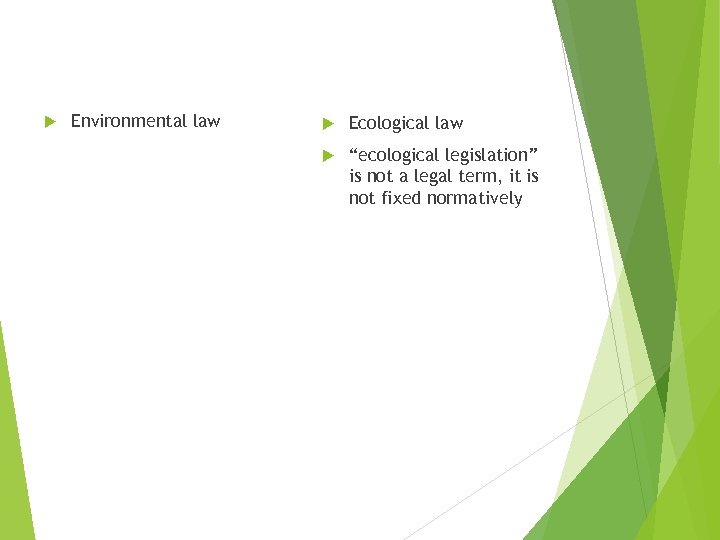
Environmental law Ecological law “ecological legislation” is not a legal term, it is not fixed normatively
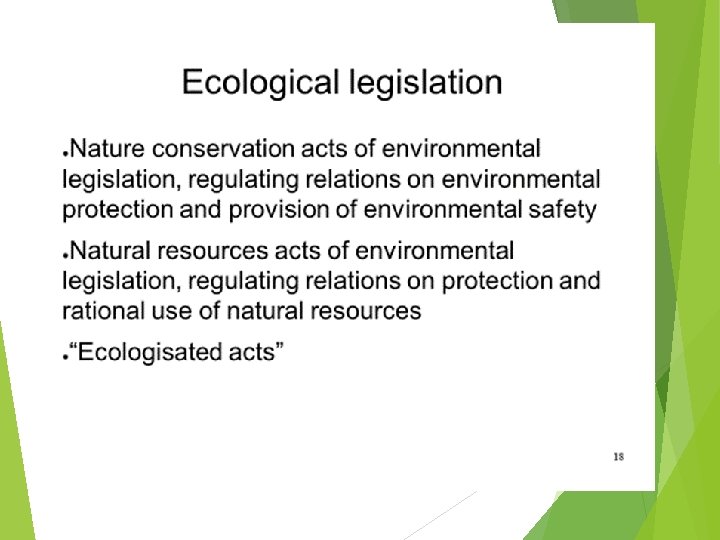
It's difficult to find another branch of law, which in any extent has not been operating environmental law (Bogolubov)
Laws in the Soviet Union Communist party > law E. g. telephone law Strict environmental norms since 1970 Laws in Russia Gorbatsov emphasized ‘pravovoe gosudarstvo’ (rule of law) Putin 2000: Diktatura zakona Medvedev 2008: we must overcome law-nihilism Law works, but for whom and how?
Some facts of the Russian Federation A federal state The Constitutions was accepted in 1993 after a referendum
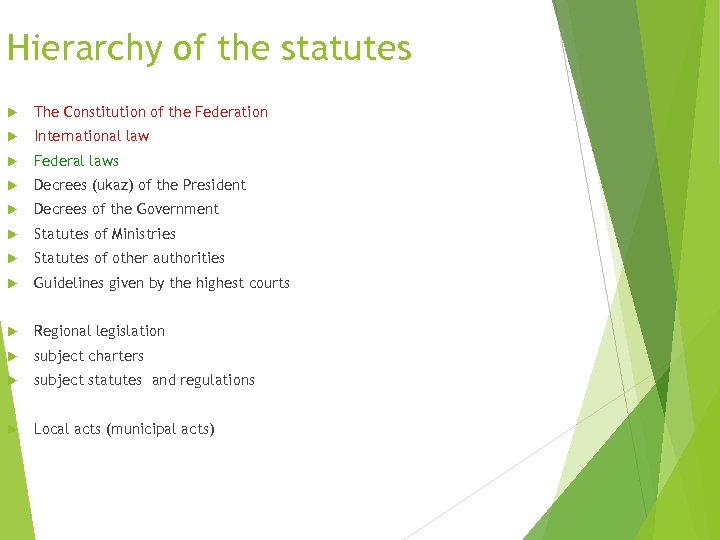
Hierarchy of the statutes The Constitution of the Federation International law Federal laws Decrees (ukaz) of the President Decrees of the Government Statutes of Ministries Statutes of other authorities Guidelines given by the highest courts Regional legislation subject charters subject statutes and regulations Local acts (municipal acts)
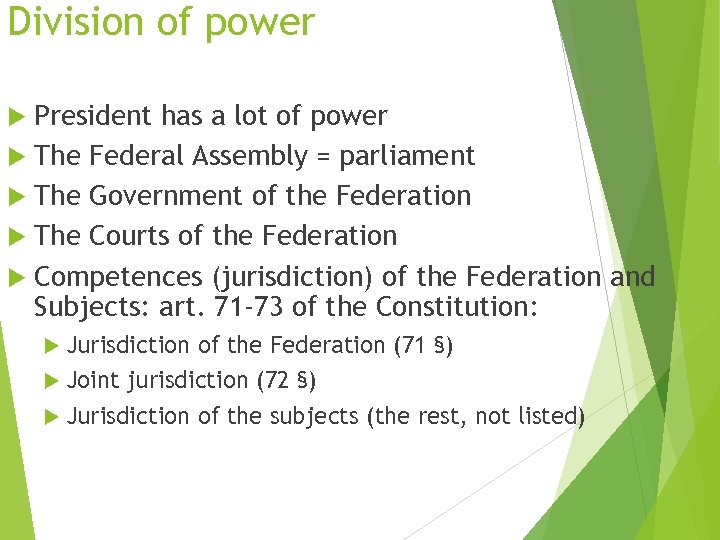
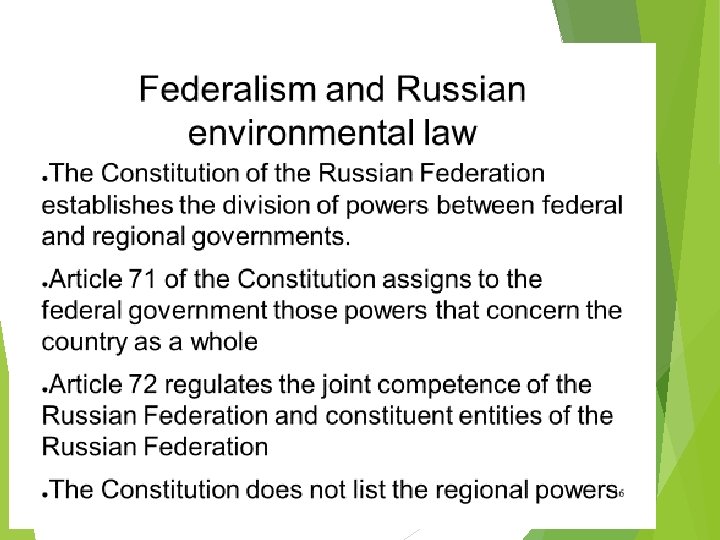
Division of power President has a lot of power The Federal Assembly = parliament The Government of the Federation The Courts of the Federation Competences (jurisdiction) of the Federation and Subjects: art. 71 -73 of the Constitution: Jurisdiction of the Federation (71 §) Joint jurisdiction (72 §) Jurisdiction of the subjects (the rest, not listed)
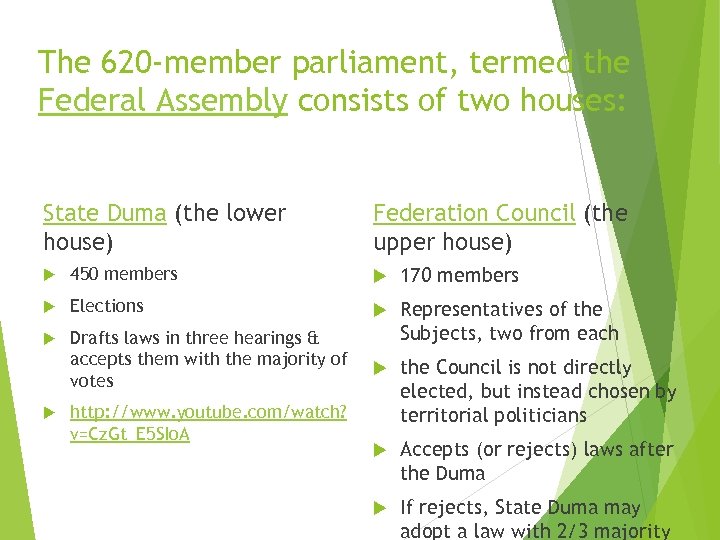
The 620 -member parliament, termed the Federal Assembly consists of two houses: State Duma (the lower house) Federation Council (the upper house) 450 members 170 members Elections Drafts laws in three hearings & accepts them with the majority of votes Representatives of the Subjects, two from each the Council is not directly elected, but instead chosen by territorial politicians Accepts (or rejects) laws after the Duma If rejects, State Duma may adopt a law with 2/3 majority http: //www. youtube. com/watch? v=Cz. Gt_E 5 SIo. A
The State Duma Elections: 450 members United Russia + Communist Party of Russia + Just Russia + Liberal Democratic Party The election system does not support the choice of local or independent candidates => votes to biggest parties Parties must cross the 7 % threshold + it’s difficult to establish a new party
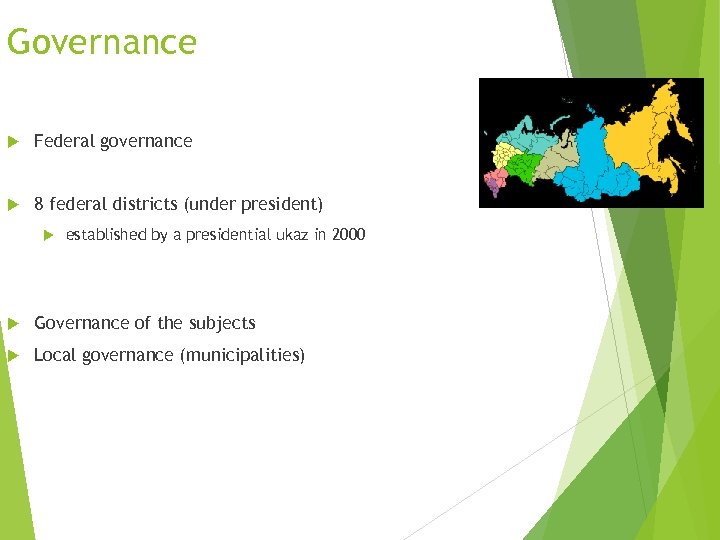
Governance Federal governance 8 federal districts (under president) established by a presidential ukaz in 2000 Governance of the subjects Local governance (municipalities)
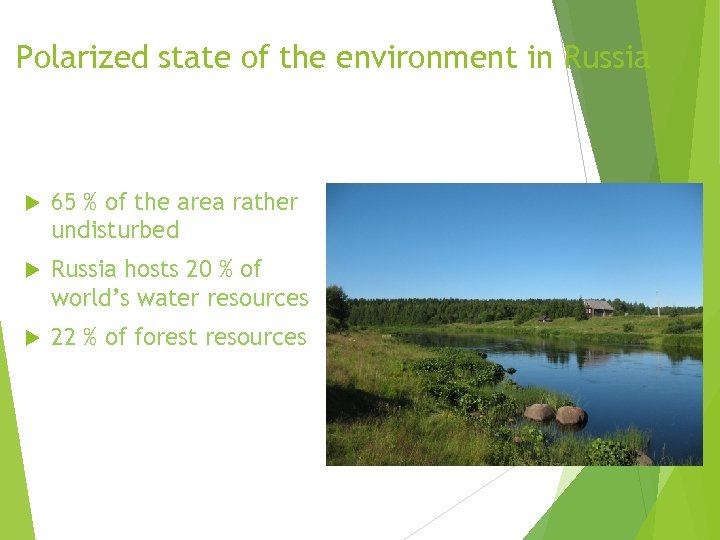
Polarized state of the environment in Russia 65 % of the area rather undisturbed Russia hosts 20 % of world’s water resources 22 % of forest resources
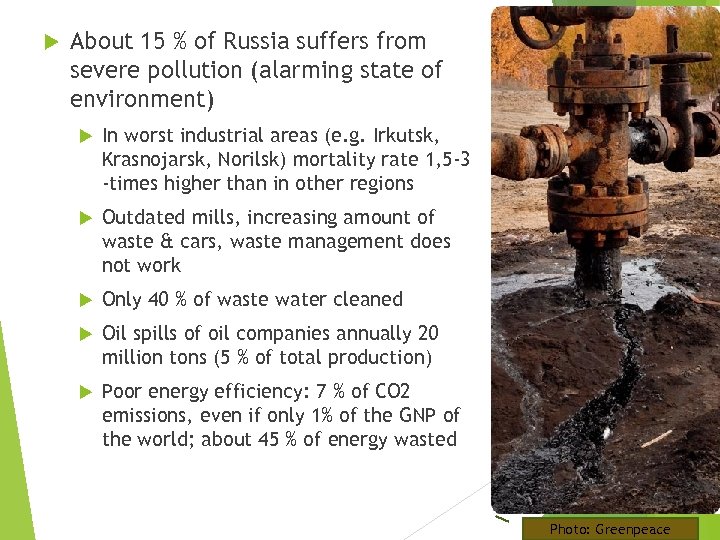
About 15 % of Russia suffers from severe pollution (alarming state of environment) In worst industrial areas (e. g. Irkutsk, Krasnojarsk, Norilsk) mortality rate 1, 5 -3 -times higher than in other regions Outdated mills, increasing amount of waste & cars, waste management does not work Only 40 % of waste water cleaned Oil spills of oil companies annually 20 million tons (5 % of total production) Poor energy efficiency: 7 % of CO 2 emissions, even if only 1% of the GNP of the world; about 45 % of energy wasted Photo: Greenpeace
Ecological rights and obligations Rights right to a favourable environment right to reliable information about the state of environment right for a restitution of damage inflicted on his health and property by ecological transgressions Obligation everyone shall be obliged to preserve nature and the environment, carefully treat the natural wealth.
Attitudes n Political weight of environmental issues is low, was higher in early 1990 s Superpower & ecological superpower Control of nature, huge projects Economy > human health> environment n In 2007 Russia used 0, 024 % of the budget to environmental protection, still in 1995 Russia used 0, 085 % (e. g. Germany used 0, 5 % and Great-Britain 0, 7 % in 2007) People worry about pollution
Environment & Constitution of RF Land other natural resources shall be utilized and protected in the Russian Federation as the basis of life and activity of the people living in corresponding territories. (9. 1 §) Everyone shall have the right to favorable environment, reliable information about its state and for a restitution of damage inflicted on his health and property by ecological transgressions. (42§)
Environmental administration In SU: Environmental Committee in 1988 Ministry of Environment in 1991 3 levels of env. admin. : federal, regional, local => Environmental Committee (Goskomekologiia) in 1996 In 2000 Putin’s reforms: Environmental Committee & Federal Forest Service were closed down = new Ministry of Natural Resources Structural changes also afterwards => weak env. admin. => in 2008 the name was changed: the Ministry of Natural Resources and Environment Министерство природных ресурсов и экологии Российской Федерации http: //www. mnr. gov. ru
Compliance monitoring Environmental supervision has been diminished continously since 1990 s Continuous changes in administration makes work difficult as well Unclear competences among authorities Local supervision authorities have sometimes too close connections to local industry State supervision, self-supervision by enterprises, public supervision
Rosprirodnadzor The Federal Supervisory Natural Resources Management Service http: //rpn. gov. ru/ Organizes the state environmental expert review (‘EIA’) Regional offices grant licenses in the field of use and protection of natural resources Controls and supervises (compliance monitoring) e. g. : in the field of preservation, use, and reproduction of wildlife and wildlife habitat (except hunting and fishing resources); rational management, and conservation of the subsoil; the condition, use, conservation, and protection of forest reserves, and of reforestation; the use and protection of water bodies;
Federal Environmental, Industrial and Nuclear Supervision Service – Rostechnadzor www. gosnadzor. ru Permitting air emissions, waste disposals, waste handling Supervising safe conduct of work connected with the use of subsoil, industrial safety, safety in atomic energy uses (except activities on development, manufacture, testing, operation and disposal of nuclear weapon and military nuclear power installations), safety of electrical and thermal installations and networks (except household installations and networks), safety of hydraulic engineering structures safety of production, storage and application of industrial explosives
Instruments for environmental regulation Administrative-legal instruments Economic instruments Informational instruments Other instruments
Administrative-legal tools Planning Environmental review (EIA), land use planning Agreements E. g. lease agreements Advance surveillance: licenses E. g. law on licensing cerain activities, 2001, governemnt’s decree on hazardous wastes, 2002 Afterwards surveillance + sanctions
Economic means Payment on the use of natural resources E. g. water, land, forest, subsoil resources, hunting Payments for polluting (immissions) Discharges to air, water, soil + noise, heat, radiation that causes pollution Payments for 214 kinds of air pollutants, 197 water pollutants, different kinds of waste Environmental insurances Does not function
Other means Soft law Information Recommendations Persuasion Voluntary certification ISO 14001, FSC, PEFC Informing consumers; ecolabels etc. Environmental education Federal State of the environment reports
Environmental legislation declarative, fragmented, inadequate and inconsistent, sometimes unrealistic Problems with implementation Both federal and regional legislation Regional legislation is sometimes more progressive The quality of regional legislation has improved in 2000 s Environmental acts, e. g. : Act on environmental protection Water code, land code, forest code Act on environmental expert review Act on protected nature areas
Russian legislation can be found at http: //www. consultant. ru http: //www. priroda. ru/law/ http: //www. mnr. gov. ru www. idanmetsatieto. info (forest legislation in Finnish)
Скачать презентацию Russian environmental legislation Britcyna Ekaterina Researcher University of
ff440a57e7c265d454bf62313385028c.ppt