 Скачать презентацию Russian Academy of Sciences Institute of Medicobiologic
36 Конференция в Коста-Рике. 2004 год..ppt
- Количество слайдов: 27



Russian Academy of Sciences Institute of Medicobiologic Problems Russian Federation State Scientific Research Center (RAS IMBP RF SSRC) (Moscow) V. K. Ilyin, S. S. Yesiev, I. G. Ogorodnikov, D. A. Tyurina, Z. O. Solovyova and E. A. Deshevaya Study on the effects of water treated with different doses of ultraviolet light on cultural properties of bifidobacteria, lactobacilli and bakery yeast 2004
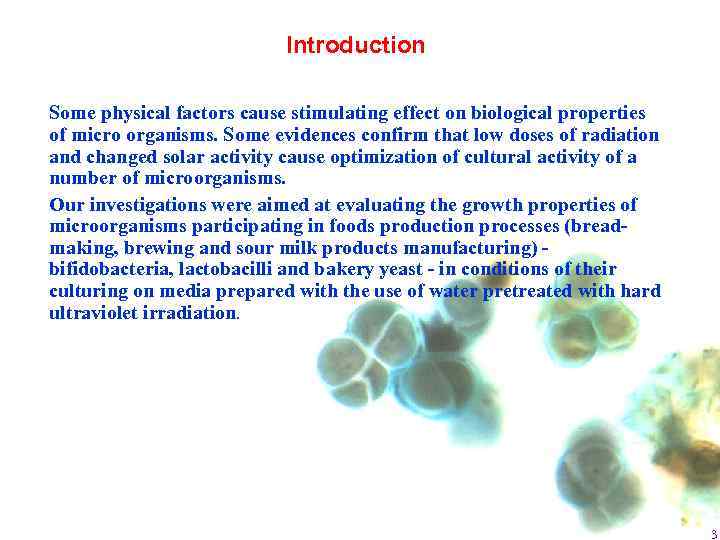
Introduction Some physical factors cause stimulating effect on biological properties of micro organisms. Some evidences confirm that low doses of radiation and changed solar activity cause optimization of cultural activity of a number of microorganisms. Our investigations were aimed at evaluating the growth properties of microorganisms participating in foods production processes (breadmaking, brewing and sour milk products manufacturing) - bifidobacteria, lactobacilli and bakery yeast - in conditions of their culturing on media prepared with the use of water pretreated with hard ultraviolet irradiation. 3
Materials and methods Water treatment with ultraviolet The necessary amount of water was treated with non-filtered light produced by a source of ultraviolet radiation (DRT-400) with a radiant flux that contained no less than 30 % of ultraviolet quanta with a wavelength range of 190 to 250 nm. The luminous flux with a power of 0. 4 W/cm 2 was modeled with the use of electromagnetic field of an auxiliary device. Water processing had been carried out until the internal energy of water increased, according to viscometer readings, two fold. The following standard culture media were prepared with the use of water treated with ultraviolet light: - MRS medium for culturing lactobacilli; - Bactofoc medium for culturing bifidobacteria; - LB medium for culturing aerobic test cultures; - meat infusion broth for determining the frequency of plasmids transfer during conjugation and wort agar for yeast culturing. Similar culture media containing water, which had not been treated with ultraviolet light, served as control. 4
Materials and methods Strains of microorganisms Collection strains: Lactobacillus casei, Bifidobacterium longum, Pseudomonas aeruginosa, Escherichia coli, Staphylococcus aureus, Saccharomyces cerevisiae The strains, obtained from RAS IMBP RF SSRC collection were used in the study.
Materials and methods Study of lactobacilli and bifidobacteria cultures survival in culture media containing water treated with ultraviolet light Initially, the cultures being tested had been in lyophilized condition. The cultures were rehydrated, 10 -fold titrated in culture media and incubated for 48 hours at 37 °C. Cultures survival was evaluated based on the number of grown colonies. 5
Materials and methods Study of microbial antagonism in culture media containing UV- treated water Culture of the test strain of lactobacilli was grown on the surface of nutrient agar in the form of a macro colony for 24 hours at 37 °C. After incubation, the macro colony was sterilized with chloroform vapor and covered with semi-liquid agar containing the following cultures: - Staphylococcus aureus; - Pseudomonas aeruginosa (blue pus bacillus); - Escherichia coli (colon bacillus); The inoculated media were incubated for 24 hours. After incubation, the antagonistic activity was evaluated based on the diameter of the zone of growth inhibition around the macro colony of the lactobacillus strain being tested.
Materials and methods Evaluation of viable cell counts in the colonies of lactobacilli and bifidobacteria grown on the culture media containing water treated with ultraviolet light Colonies of micro organisms grown in agar were isolated, diluted in sterile physiologic salt solution and titrated in test tubes containing the standard growth medium. Inoculated media were incubated in a thermostat at 37 °C for 24 hours; then, counting of the grown colonies was carried out.
Materials and methods Study of the frequency of genetic material transfer with liquid culture medium prepared with the use of water treated with ultraviolet light Fresh agarized cultures of Strain J 5 -3 E. coli containing p. Rl plasmids bearing the determinants of resistance to broadspectrum antibiotics belonging to various chemical groups (ampicillin, carbenicillin, kanamycin), as well as a fresh agarized culture of Strain C-600 E. coli sensitive to all antibiotics excluding nalidixic acid, were incubated in water treated with ultraviolet light at a temperature of 37 °C. Incubation in ordinary media at a temperature of 37 °C was used as a control. After incubation, the cultures were re-inoculated on broth and placed in conditions corresponding to preincubation ones for 24 hours. After incubation, conjugation mixtures were prepared as follows: 1 ml of donor culture containing 1 x 10⁹ CFU/ml were mixed with 1 ml of recipient culture in the same concentration. 6
Materials and methods Determination of hemolysin activity. Staphylococcus aureus cultures with hemolytic properties were placed on the surface of 5 % blood agar prepared with the use of water treated with ultraviolet light. Blood agar prepared with using the ordinary water served as control. The inoculated medium was incubated for 24 hours at 37 °C. After incubation, activity of hemolysin production was evaluated. 7
Materials and methods Evaluation of Saccharomyces cerevisiae cultural properties A strain of bakery yeast Saccharomyces cerevisiae was used in the experiments. A 0. 5 g weight of dry yeast was subjected to suspending in 10 ml of physiologic salt solution for 5 to 10 minutes. Then, plating was carried out on culture dishes with Saburo and wort agar nutrient media prepared with the use of distilled water and water treated with ultraviolet light. Inoculated media were incubated in a thermostat at 29 °C for two days. Simultaneously, number of yeast cells in the original suspension was counted. Counting the yeast spores in the suspension was carried out using Goryaev's counting chamber. 8
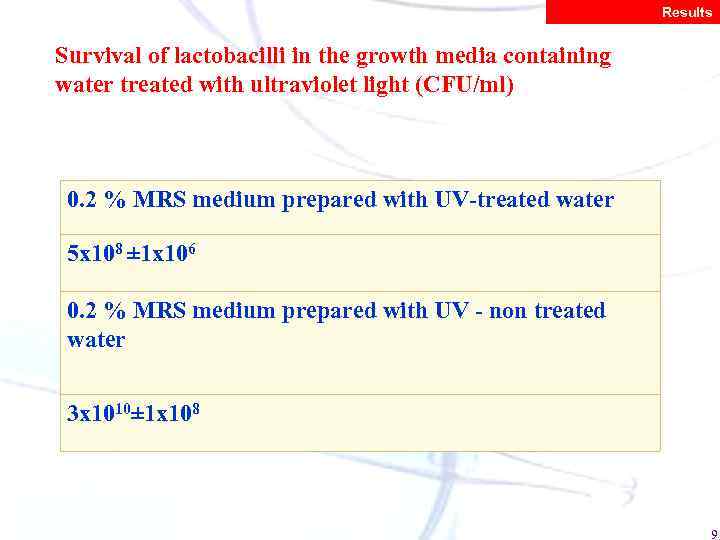
Results Survival of lactobacilli in the growth media containing water treated with ultraviolet light (CFU/ml) 0. 2 % MRS medium prepared with UV-treated water 5 х108 ± 1 х106 0. 2 % MRS medium prepared with UV - non treated water 3 х1010± 1 х108 9
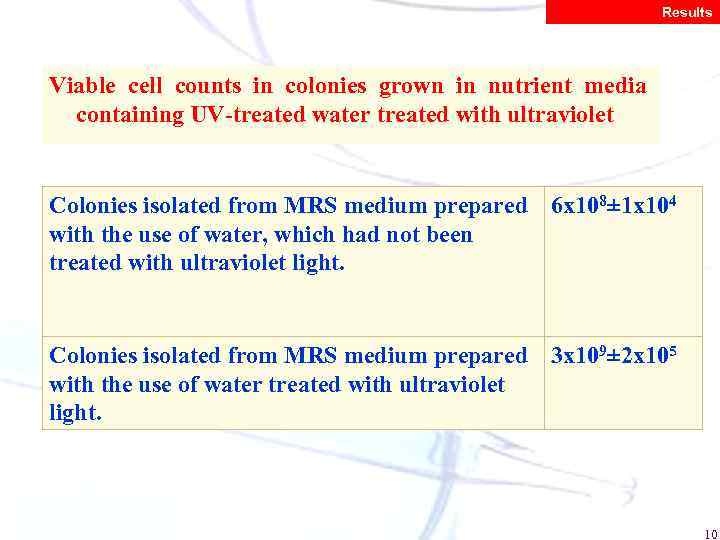
Results Viable cell counts in colonies grown in nutrient media containing UV-treated water treated with ultraviolet Colonies isolated from MRS medium prepared 6 х108± 1 х104 with the use of water, which had not been treated with ultraviolet light. Colonies isolated from MRS medium prepared 3 х109± 2 х105 with the use of water treated with ultraviolet light. 10
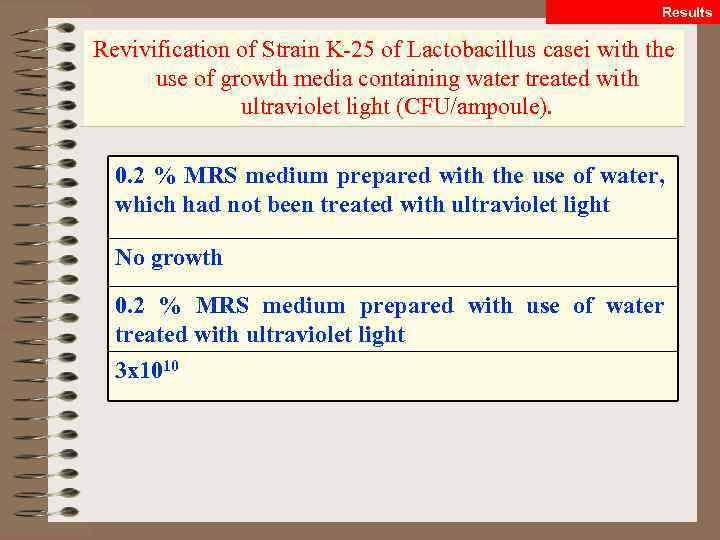
Results Revivification of Strain K-25 of Lactobacillus casei with the use of growth media containing water treated with ultraviolet light (CFU/ampoule). 0. 2 % MRS medium prepared with the use of water, which had not been treated with ultraviolet light No growth 0. 2 % MRS medium prepared with use of water treated with ultraviolet light 3 х1010
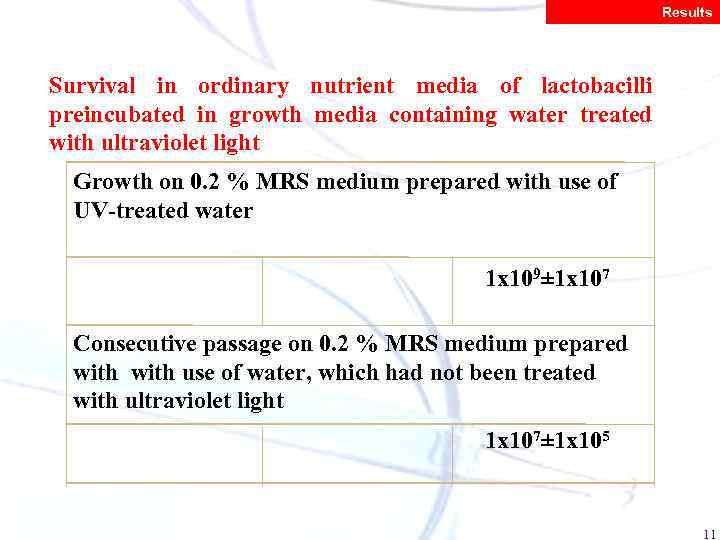
Results Survival in ordinary nutrient media of lactobacilli preincubated in growth media containing water treated with ultraviolet light Growth on 0. 2 % MRS medium prepared with use of UV-treated water 1 х109± 1 х107 Consecutive passage on 0. 2 % MRS medium prepared with use of water, which had not been treated with ultraviolet light 1 х107± 1 х105 11
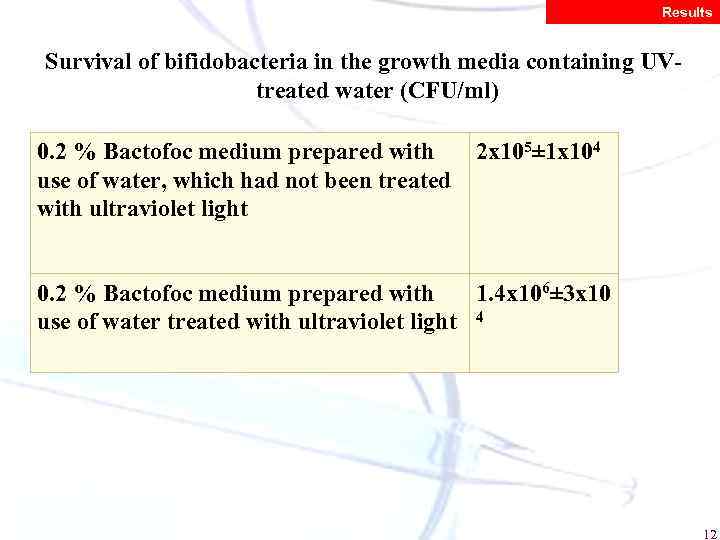
Results Survival of bifidobacteria in the growth media containing UVtreated water (CFU/ml) 0. 2 % Bactofoc medium prepared with 2 х105± 1 х104 use of water, which had not been treated with ultraviolet light 0. 2 % Васtofoc medium prepared with 1. 4 х106± 3 х10 use of water treated with ultraviolet light 4 12
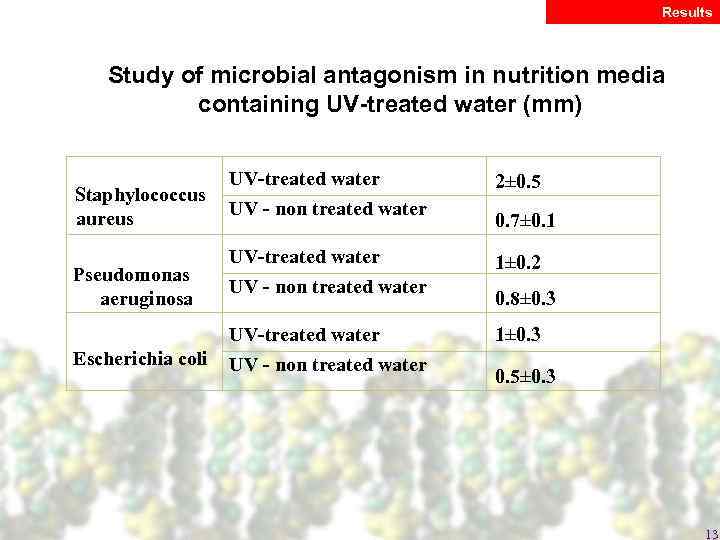
Results Study of microbial antagonism in nutrition media containing UV-treated water (mm) UV-treated water Staphylococcus UV - non treated water aureus Pseudomonas aeruginosa Escherichia coli UV-treated water UV - non treated water 2± 0. 5 0. 7± 0. 1 1± 0. 2 0. 8± 0. 3 1± 0. 3 0. 5± 0. 3 13
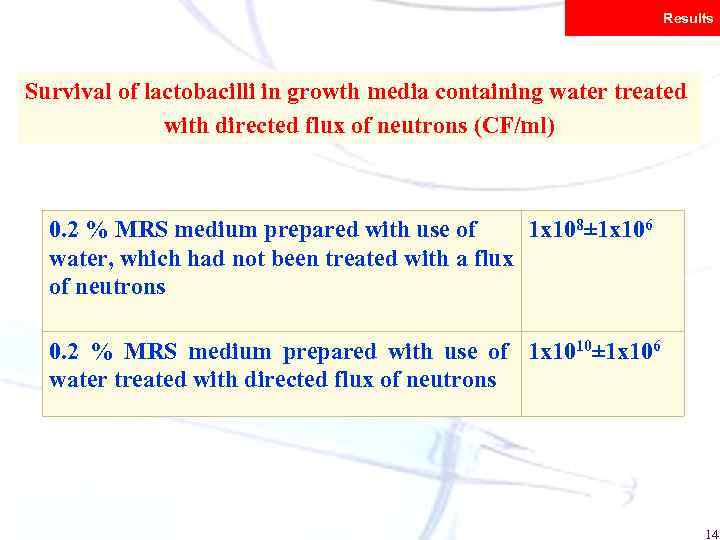
Results Survival of lactobacilli in growth media containing water treated with directed flux of neutrons (CF/ml) 0. 2 % MRS medium prepared with use of 1 х108± 1 х106 water, which had not been treated with a flux of neutrons 0. 2 % MRS medium prepared with use of 1 х1010± 1 х106 water treated with directed flux of neutrons 14
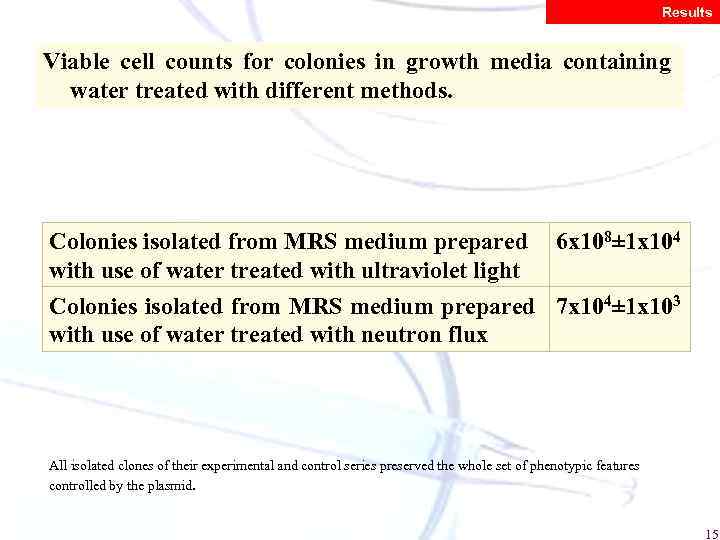
Results Viable cell counts for colonies in growth media containing water treated with different methods. Colonies isolated from MRS medium prepared 6 х108± 1 х104 with use of water treated with ultraviolet light Colonies isolated from MRS medium prepared 7 х104± 1 х103 with use of water treated with neutron flux All isolated clones of their experimental and control series preserved the whole set of phenotypic features controlled by the plasmid. 15
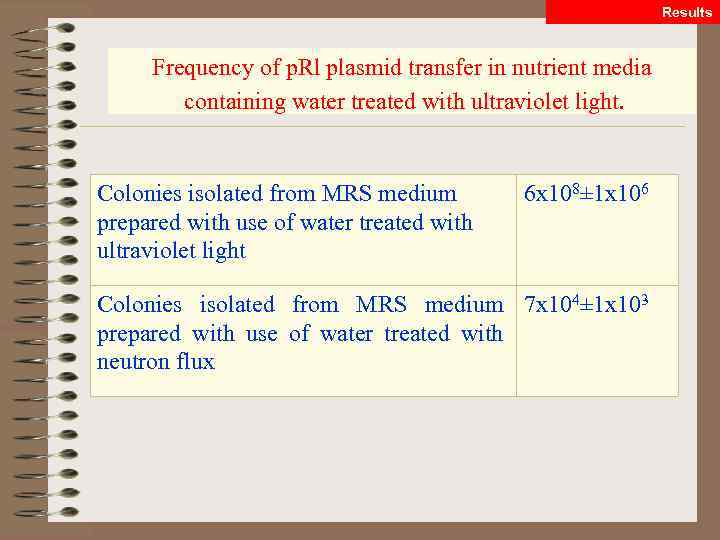
Results Frequency of p. Rl plasmid transfer in nutrient media containing water treated with ultraviolet light. Colonies isolated from MRS medium prepared with use of water treated with ultraviolet light 6 х108± 1 х106 Colonies isolated from MRS medium 7 х104± 1 х103 prepared with use of water treated with neutron flux
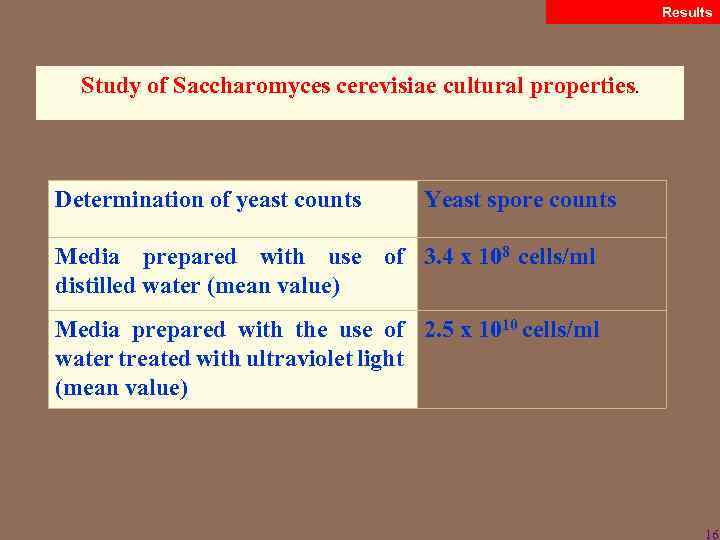
Results Study of Saccharomyces cerevisiae cultural properties. Determination of yeast counts Yeast spore counts Media prepared with use of 3. 4 х 108 cells/ml distilled water (mean value) Media prepared with the use of 2. 5 х 1010 cells/ml water treated with ultraviolet light (mean value) 16
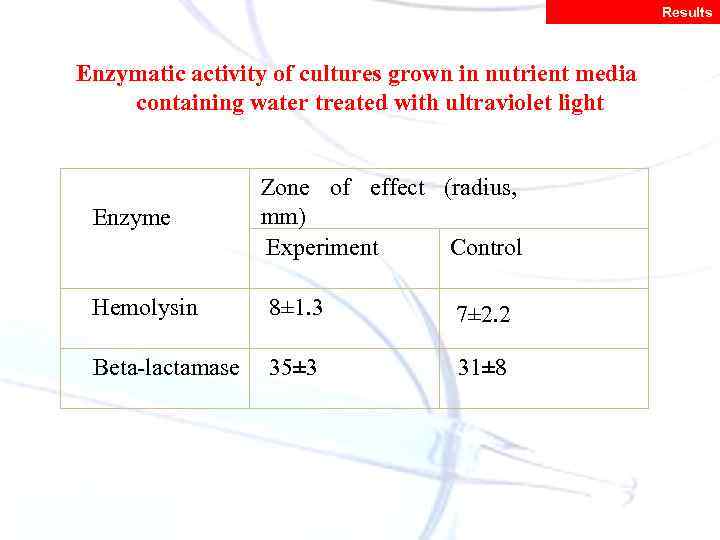
Results Enzymatic activity of cultures grown in nutrient media containing water treated with ultraviolet light Enzyme Zone of effect (radius, mm) Experiment Control Hemolysin 8± 1. 3 7± 2. 2 Beta-lactamase 35± 3 31± 8
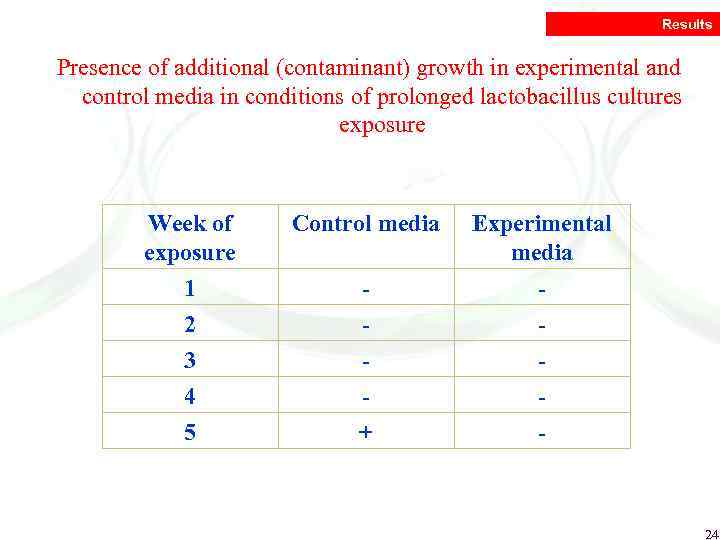
Results Presence of additional (contaminant) growth in experimental and control media in conditions of prolonged lactobacillus cultures exposure Week of exposure Control media Experimental media 1 2 3 4 5 + - 24
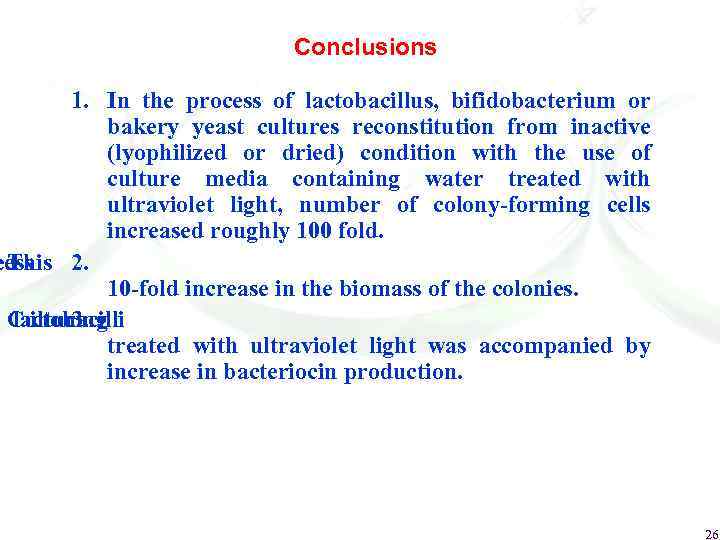
Conclusions 1. In the process of lactobacillus, bifidobacterium or bakery yeast cultures reconstitution from inactive (lyophilized or dried) condition with the use of culture media containing water treated with ultraviolet light, number of colony-forming cells increased roughly 100 fold. cess 2. ed This 10 -fold increase in the biomass of the colonies. Culturing lactobacilli in 3. treated with ultraviolet light was accompanied by increase in bacteriocin production. 26
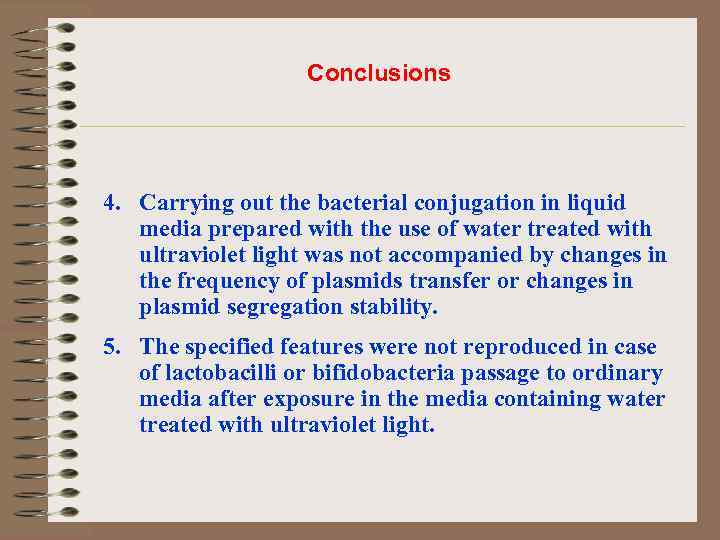
Conclusions 4. Carrying out the bacterial conjugation in liquid media prepared with the use of water treated with ultraviolet light was not accompanied by changes in the frequency of plasmids transfer or changes in plasmid segregation stability. 5. The specified features were not reproduced in case of lactobacilli or bifidobacteria passage to ordinary media after exposure in the media containing water treated with ultraviolet light.
The following possible installation of the units related to the use of culture media and biologic objects for implementing the process being studied can be proposed: A. Sour milk products manufacturing 1. Block of reconstitution of industrial strains of micro organisms from lyophilized condition; 2. Barm preparing block; 3. Sour milk products preparing block. B. Bread-making 1. Block of reconstitution of industrial strains of micro organisms from lyophilized condition; 2. Barm preparing block; 3. Dough preparing block.
The following possible installation of the units related to the use of culture media and biologic objects for implementing the process being studied can be proposed: C. Preparing the beer yeast 1. Block of reconstitution of industrial strains of micro organisms from lyophilized condition; 2. Beer yeast preparing block; 3. Beer preparing block. D. Preparing the inoculum for biological degradation of food products and physiologic waste 1. Block of reconstituting strains and micro organism associations from lyophilized condition; 2. Block of preparing the inoculum; 3. Fermentation block.
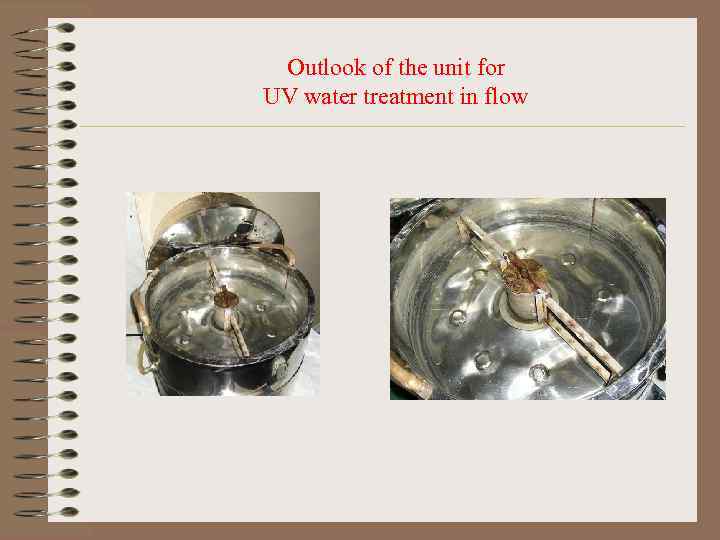
Outlook of the unit for UV water treatment in flow
Скачать презентацию Russian Academy of Sciences Institute of Medicobiologic
36 Конференция в Коста-Рике. 2004 год..ppt