 Скачать презентацию RUSSIA S INTERACTION WITH INTERNATIONAL ENERGY ORGANIZATIONS Alexandra Skobeleva
9 - Russia's interaction with international energy organizations .pptx
- Количество слайдов: 12



RUSSIA'S INTERACTION WITH INTERNATIONAL ENERGY ORGANIZATIONS Alexandra Skobeleva
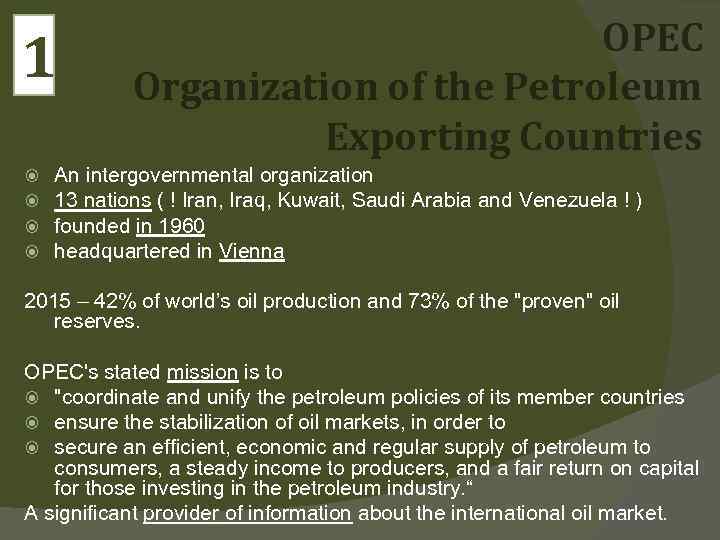
1 OPEC Organization of the Petroleum Exporting Countries An intergovernmental organization 13 nations ( ! Iran, Iraq, Kuwait, Saudi Arabia and Venezuela ! ) founded in 1960 headquartered in Vienna 2015 – 42% of world’s oil production and 73% of the "proven" oil reserves. OPEC's stated mission is to "coordinate and unify the petroleum policies of its member countries ensure the stabilization of oil markets, in order to secure an efficient, economic and regular supply of petroleum to consumers, a steady income to producers, and a fair return on capital for those investing in the petroleum industry. “ A significant provider of information about the international oil market.
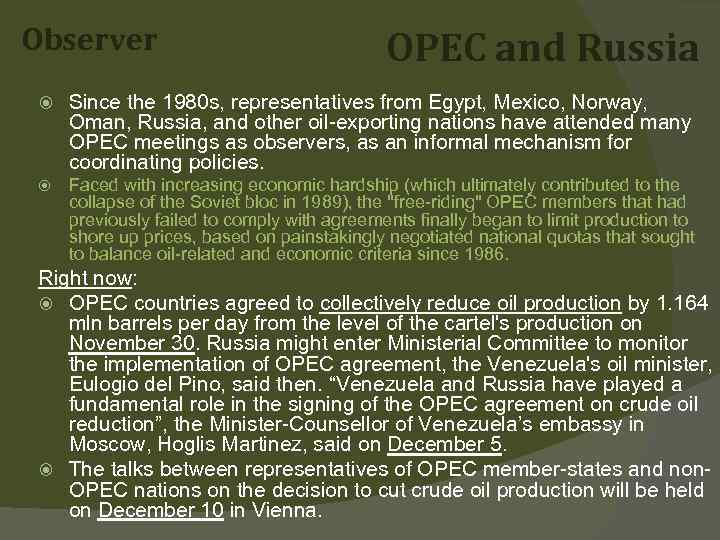
Observer OPEC and Russia Since the 1980 s, representatives from Egypt, Mexico, Norway, Oman, Russia, and other oil-exporting nations have attended many OPEC meetings as observers, as an informal mechanism for coordinating policies. Faced with increasing economic hardship (which ultimately contributed to the collapse of the Soviet bloc in 1989), the "free-riding" OPEC members that had previously failed to comply with agreements finally began to limit production to shore up prices, based on painstakingly negotiated national quotas that sought to balance oil-related and economic criteria since 1986. Right now: OPEC countries agreed to collectively reduce oil production by 1. 164 mln barrels per day from the level of the cartel's production on November 30. Russia might enter Ministerial Committee to monitor the implementation of OPEC agreement, the Venezuela's oil minister, Eulogio del Pino, said then. “Venezuela and Russia have played a fundamental role in the signing of the OPEC agreement on crude oil reduction”, the Minister-Counsellor of Venezuela’s embassy in Moscow, Hoglis Martinez, said on December 5. The talks between representatives of OPEC member-states and non. OPEC nations on the decision to cut crude oil production will be held on December 10 in Vienna.
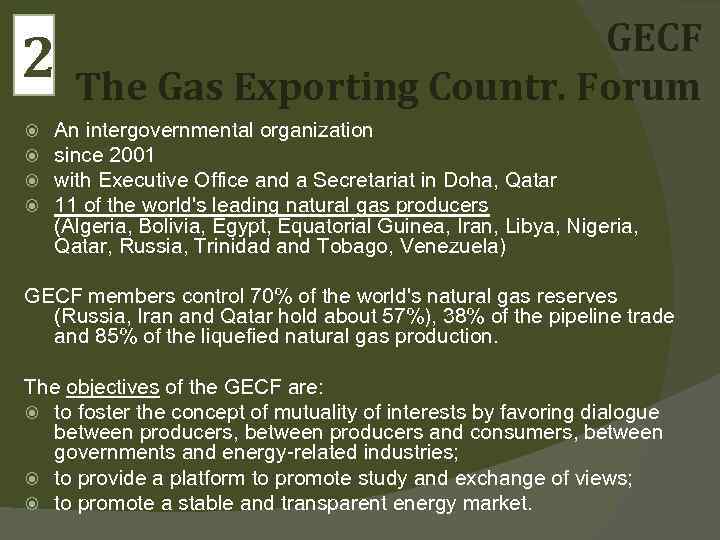
2 GECF The Gas Exporting Countr. Forum An intergovernmental organization since 2001 with Executive Office and a Secretariat in Doha, Qatar 11 of the world's leading natural gas producers (Algeria, Bolivia, Egypt, Equatorial Guinea, Iran, Libya, Nigeria, Qatar, Russia, Trinidad and Tobago, Venezuela) GECF members control 70% of the world's natural gas reserves (Russia, Iran and Qatar hold about 57%), 38% of the pipeline trade and 85% of the liquefied natural gas production. The objectives of the GECF are: to foster the concept of mutuality of interests by favoring dialogue between producers, between producers and consumers, between governments and energy-related industries; to provide a platform to promote study and exchange of views; to promote a stable and transparent energy market.
Main member The GECF and Russia The idea of a gas OPEC was first floated by Vladimir Putin and backed by Kazakh President Nursultan Nazarbaev in 2002. Iranian officials have explicitly expressed strong support for a gas cartel and held official talks with Russia. In May 2006 Gazprom deputy chairman Alexander Medvedev threatened that Russia would create "an alliance of gas suppliers that will be more influential than OPEC" if Russia did not get its way in energy negotiations with Europe. The 6 th Ministerial Meeting of the GECF established an expert group, chaired by Russia, to study how to strengthen the GECF. On the 9 th ministerial meeting (December 2009) the vicepresident of Russian energy engineering and construction company Stroytransgaz Leonid Bokhanovsky was elected as Secretary-General. Russia's Energy Minister Sergey Shmatko stated: "Today we can speak about gas OPEC as a fully fledged international organization. By a unanimous decision a Russian national was elected its secretary general. This is to show that member countries expect Russia to use its political weight to promote it. “ Bokhanovsky was re- elected at the 13 th ministerial meeting in December 2011. His term ended in 2014.
IAEA 3 The International Atomic Energy An international organization Agency 168 member states established on 29 July 1957 headquartered in Vienna (2 liaison offices in NY and Geneva, 3 reports to both the UN GA and SC laboratories in Vienna, Seibersdorf and Monaco) The IAEA objectives are: to promote the peaceful use of nuclear energy to inhibit its use for any military purpose Three main pillars are: Safety and Security; Science and Technology; Safeguards and Verification
Member The IAEA and Russia The Treaty on the Non-Proliferation of Nuclear Weapons: Signed – July 1, 1968 Effective – March 5, 1970 Crucial point – January 1, 1967 Military aspect Russia is recognized as a legal nuclear-weapon state (along with the United States, the United Kingdom, France, and China). These 5 UN SC permanent members do not subordinate their nuclear arsenals to the IAEA. Peaceful aspect By the IAEA bodies the group of 5 prevent other countries from creating nuclear weaponry And the 5 assist others while developing peaceful atomic infrastructure (nuclear power plants building and renovating) *in 2014 Japanese government chose Rosatom as a partner for a project to refine Fukushima radioactive water from isotope tritium
4 NSG Nuclear Suppliers Group A group of nuclear supplier countries 48 members (Canada, West Germany, France, Japan, the Soviet Union, the United Kingdom, and the United States) founded in response to the Indian nuclear test in May 1974 and first met in November 1975 "London Club" due to the series of meetings there The NSG objectives are: to prevent nuclear proliferation by controlling the export of materials, equipment and technology that can be used to manufacture nuclear weapons Framework – IAEA informational circular INFCIRC/254 1978 – guidelines for nuclear Transfers 1991 – guidelines for transfers of nuclear-related dual-use equipment, materials, software, and related technology
Member The NSG and Russia Though membership is based on free will and there are no joint positions on the international arena or permission for nuclear trade, the NSG states coordinate their nuclear transfers. The NSG has been critically considering Indian nuclear program since 20 th century what has limited Russian-Indian nuclear partnership: Russia exported uranium for Indian plant Tarapur in 2001 and then there was a 5 -year break till 2006 when Russia restarted supply only after having co-ordinated it with the USA. The NSG members exchange information on export refusals, so potential distributors cannot address several suppliers in hope to get one’s assent for a supply. Russia offers unconditional support to India's entry into NSG since 2015.
5 IEA The International Energy Agency Paris-based autonomous intergovernmental organization 29 states established in the framework of the Organisation for Economic Co-operation and Development (OECD) in 1974 in the wake of the 1973 oil crisis The IEA was initially dedicated to responding to physical disruptions in the supply of oil, serving as an information source on statistics about the international oil market and other energy sectors. Now it promotes "3 Es" of effectual energy policy: energy security, economic development, and environmental protection.
Partner The IEA and Russia A policy adviser to member states, also works with non-member countries – China, India, and Russia. Co-operation since 1994 due to the shared objectives of improving global energy security and efficiency, and tackling energy statistics, energy policy reviews and energy technologies. Relations involve a broad range of public and private stakeholders in Russia. June 2014 – launch of Energy Policies Beyond IEA Countries: Russia 2014. This review analyses the energy policy challenges facing Russia and provides critiques and recommendation for further policy improvements. It is intended to help guide the country towards a more sustainable energy future. Russia’s liquids production reached historical highs in 2014, but major additional upstream investments and technology upgrades will be needed to sustain these levels in the medium to long term. The modernization of the Russian energy sector depends to a large extent on energy efficiency deployment and infrastructure investments especially in the industrial, residential, transport sectors as well as the district heating and power generation sectors. In addition, there is much scope to limit CO 2 emissions. “The IEA and Russia see further co-operation perspectives, notably in the fields of energy efficiency and clean coal technologies, and welcome opportunities for a dialogue on energy market developments. ”
The IEA and Russia The Energy Charter Treaty An international agreement legally binding (including dispute resolution procedures) establishing a multilateral framework for cross-border cooperation in the energy industry An intergovernmental organization based on the idea that international flows of investments and technologies in the energy sector are mutually beneficial, With the core principle of national sovereignty over energy resources headquartered in Brussels 52 states (Australia, Belarus, Norway, the Russian Federation have not ratified the ECT) + the EU and the Euratom Formation steps: 1991 – the European Energy Charter declaration 1994 – the Energy Charter Treaty Since 2003 – the Energy Charter Transit Protocol – a draft protocol which negotiations are not finalized yet
Скачать презентацию RUSSIA S INTERACTION WITH INTERNATIONAL ENERGY ORGANIZATIONS Alexandra Skobeleva
9 - Russia's interaction with international energy organizations .pptx