


 Скачать презентацию Russia s District Heating Experience from the Transition and
e775b48b001a94bb8da547493f1598c8.ppt
- Количество слайдов: 16
 Russia’s District Heating: Experience from the Transition and Future Directions Igor Bashmakov Center for Energy Efficiency, Moscow, Russia CHP/DHC Roundtable, International Energy Agency Paris, October 10 -11, 2007
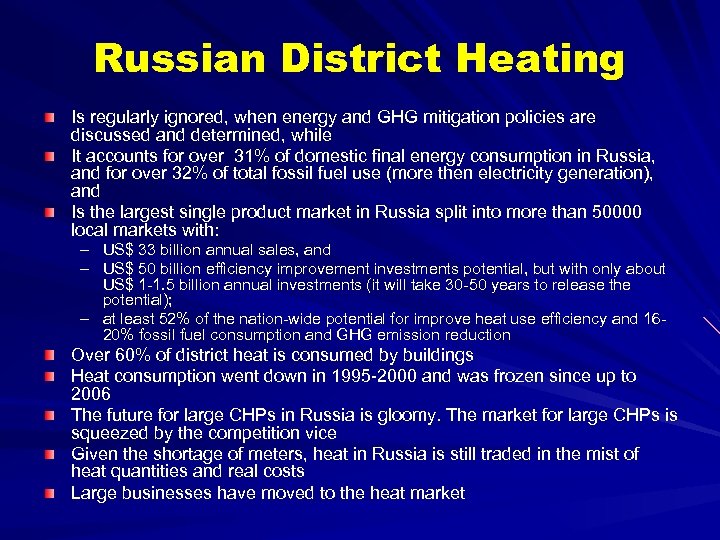 Russian District Heating Is regularly ignored, when energy and GHG mitigation policies are discussed and determined, while It accounts for over 31% of domestic final energy consumption in Russia, and for over 32% of total fossil fuel use (more then electricity generation), and Is the largest single product market in Russia split into more than 50000 local markets with: – US$ 33 billion annual sales, and – US$ 50 billion efficiency improvement investments potential, but with only about US$ 1 -1. 5 billion annual investments (it will take 30 -50 years to release the potential); – at least 52% of the nation-wide potential for improve heat use efficiency and 1620% fossil fuel consumption and GHG emission reduction Over 60% of district heat is consumed by buildings Heat consumption went down in 1995 -2000 and was frozen since up to 2006 The future for large CHPs in Russia is gloomy. The market for large CHPs is squeezed by the competition vice Given the shortage of meters, heat in Russia is still traded in the mist of heat quantities and real costs Large businesses have moved to the heat market
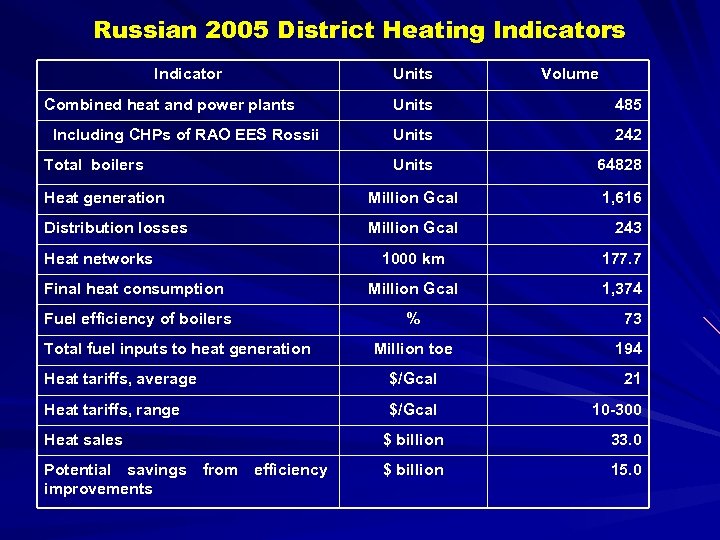 Russian 2005 District Heating Indicators Indicator Units Volume Combined heat and power plants Units 485 Including CHPs of RAO EES Rossii Units 242 Total boilers Units 64828 Heat generation Million Gcal 1, 616 Distribution losses Million Gcal 243 Heat networks 1000 km 177. 7 Final heat consumption Million Gcal 1, 374 Fuel efficiency of boilers % 73 Million toe 194 Heat tariffs, average $/Gcal 21 Heat tariffs, range $/Gcal 10 -300 Total fuel inputs to heat generation Heat sales $ billion 33. 0 Potential savings from efficiency improvements $ billion 15. 0
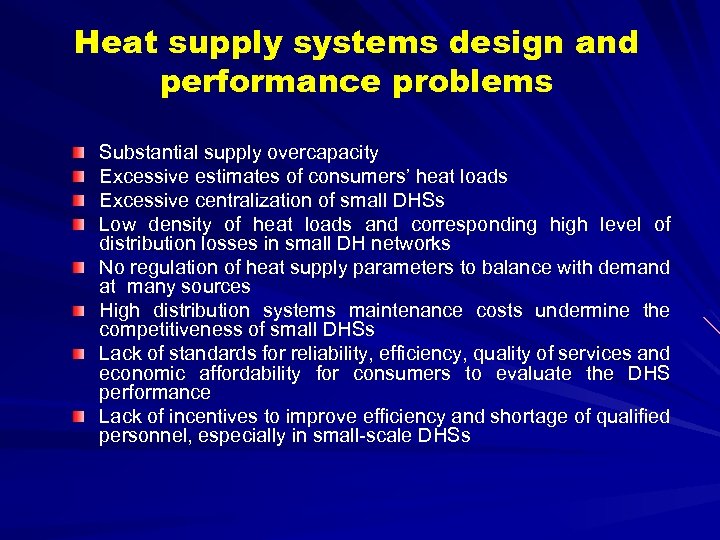 Heat supply systems design and performance problems Substantial supply overcapacity Excessive estimates of consumers’ heat loads Excessive centralization of small DHSs Low density of heat loads and corresponding high level of distribution losses in small DH networks No regulation of heat supply parameters to balance with demand at many sources High distribution systems maintenance costs undermine the competitiveness of small DHSs Lack of standards for reliability, efficiency, quality of services and economic affordability for consumers to evaluate the DHS performance Lack of incentives to improve efficiency and shortage of qualified personnel, especially in small-scale DHSs
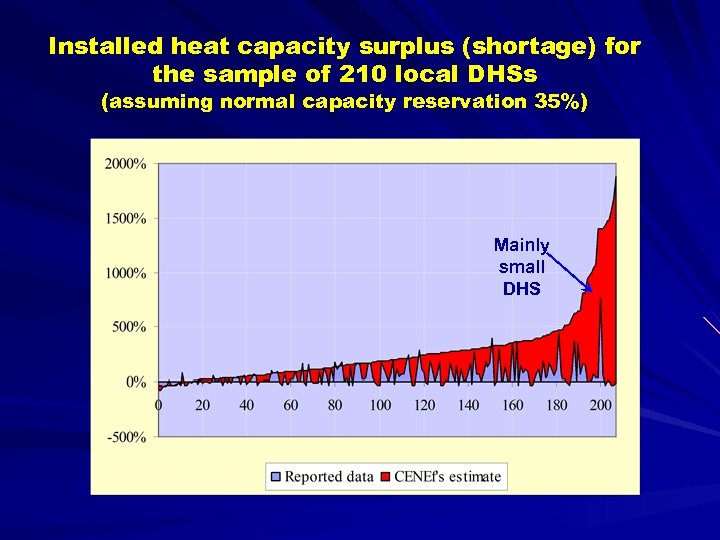 Installed heat capacity surplus (shortage) for the sample of 210 local DHSs (assuming normal capacity reservation 35%) Mainly small DHS
 Operation of obsolete heat generators faces a long list of problems High specific fuel consumption Unsatisfactory metering of fuel consumption and heat generation Low remaining lifetime of equipment Lack of regular boilers tuning Low quality of fuel leading to failures of burners Insufficient possibilities to regulate heat supply parameters Lack or poor quality of water preparation systems High fuel costs Shortage and low qualifications of personnel
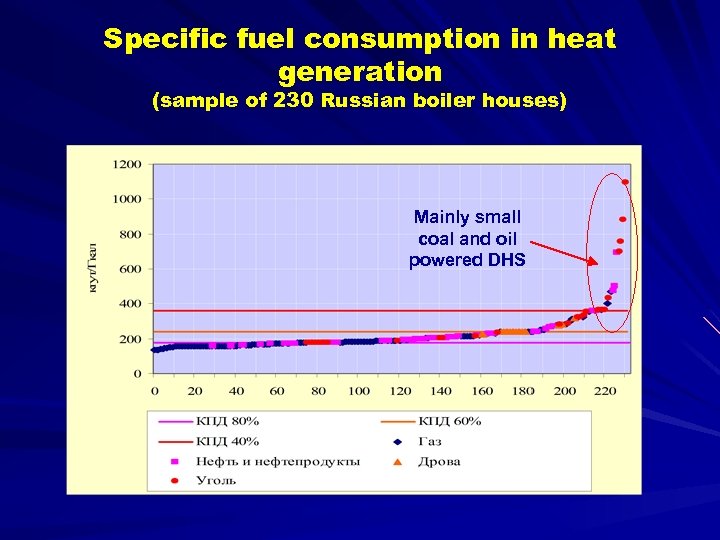 Specific fuel consumption in heat generation (sample of 230 Russian boiler houses) Mainly small coal and oil powered DHS
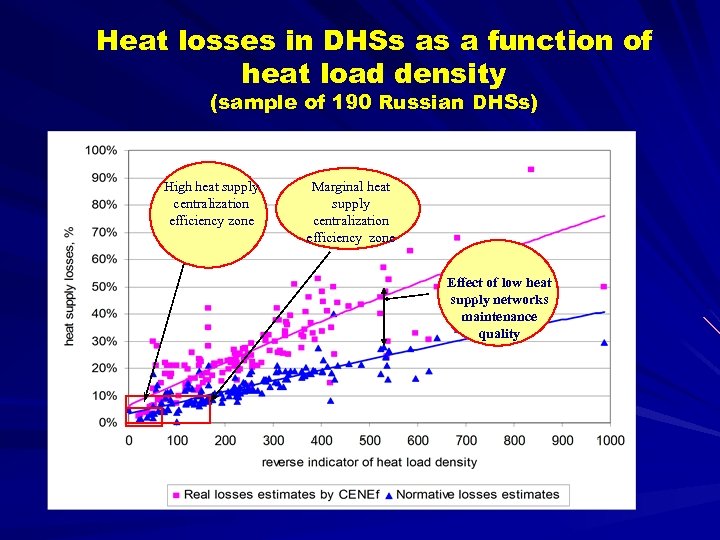 Heat losses in DHSs as a function of heat load density (sample of 190 Russian DHSs) High heat supply centralization efficiency zone Marginal heat supply centralization efficiency zone Effect of low heat supply networks maintenance quality
 Consumers’ behavior in the heat market is poorly known Uncertainty with the product on sale Deprivation of households’ “market rights” to determine the quality and quantity of product they buy and to negotiate the price Substantial overbilling for heat, which was never delivered Low heat meters and regulation devices saturation rate (below 15%) Low flat-level water consumption meters saturation rate (below 15%) Minor behavioral change in terms of hot water consumption even after flow meters are installed and heat tariffs are growing Poor insulation of buildings and insufficient development of housing weatherization services Lack of energy efficiency incentives where consumption is not metered, or there are weak budget limitations Limited ability and willingness to cover escalating energy costs and strong opposition to any price increase
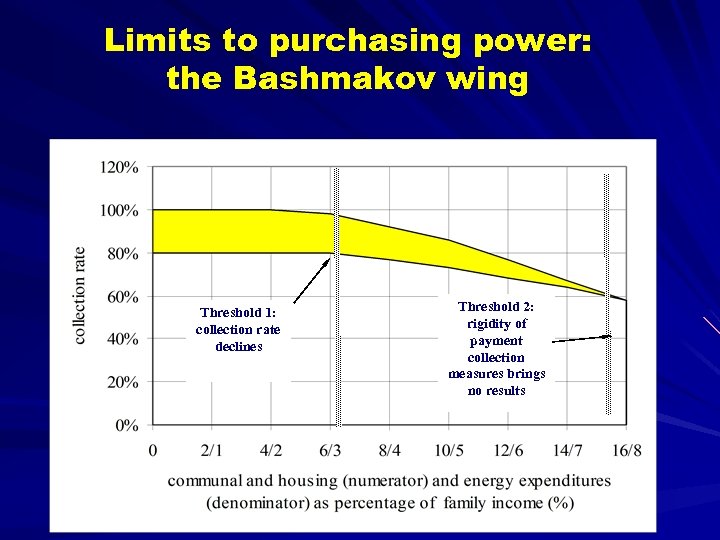 Limits to purchasing power: the Bashmakov wing Threshold 1: collection rate declines Threshold 2: rigidity of payment collection measures brings no results
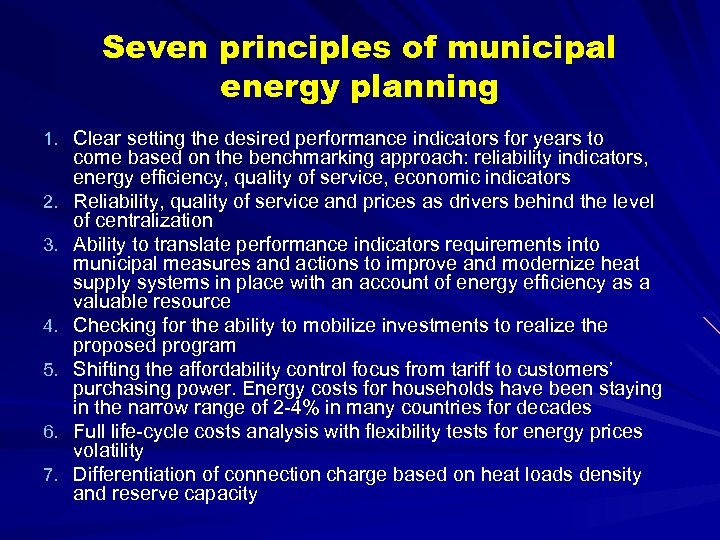 Seven principles of municipal energy planning 1. Clear setting the desired performance indicators for years to 2. 3. 4. 5. 6. 7. come based on the benchmarking approach: reliability indicators, energy efficiency, quality of service, economic indicators Reliability, quality of service and prices as drivers behind the level of centralization Ability to translate performance indicators requirements into municipal measures and actions to improve and modernize heat supply systems in place with an account of energy efficiency as a valuable resource Checking for the ability to mobilize investments to realize the proposed program Shifting the affordability control focus from tariff to customers’ purchasing power. Energy costs for households have been staying in the narrow range of 2 -4% in many countries for decades Full life-cycle costs analysis with flexibility tests for energy prices volatility Differentiation of connection charge based on heat loads density and reserve capacity
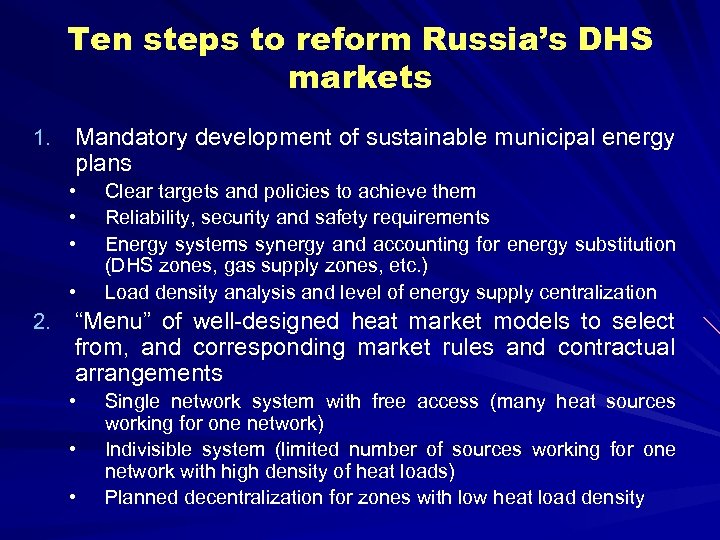 Ten steps to reform Russia’s DHS markets 1. Mandatory development of sustainable municipal energy plans • • 2. Clear targets and policies to achieve them Reliability, security and safety requirements Energy systems synergy and accounting for energy substitution (DHS zones, gas supply zones, etc. ) Load density analysis and level of energy supply centralization “Menu” of well-designed heat market models to select from, and corresponding market rules and contractual arrangements • • • Single network system with free access (many heat sources working for one network) Indivisible system (limited number of sources working for one network with high density of heat loads) Planned decentralization for zones with low heat load density
 Ten steps to reform Russia’s DHS markets Mandatory development of sustainable municipal energy plans 3. • • Clear targets and policies to achieve them Reliability, security and safety requirements Energy systems synergy and accounting for energy substitution (DHS zones, gas supply zones, etc. ) Load density analysis and level of energy supply centralization “Menu” of well-designed heat market models to select from, and corresponding market rules and contractual arrangements 4. • • • Single network system with free access (many heat sources working for one network) Indivisible system (limited number of sources working for one network with high density of heat loads) Planned decentralization for zones with low heat load density
 Ten steps to reform Russia’s DHS markets Regional and municipal heat supply reliability and efficiency standards 3. • for municipal indicative planning • • • Base year Target year Performance monitoring and heat system operator evaluation Separation of DHS products: heat supply and comfort supply services 4. • • Metering and billing system Customer – energy service company or final consumer Organization of collective consumer (especially in multi-family buildings) Turning the heat consumer into heat buyer by setting association of communal services payers (ACSe. Ps) and attracting ESCOs on the competitive basis to provide leastcost heat comfort to ACSe. Ps
 Ten steps to reform Russian DHS markets 5. 6. 7. 8. Energy efficiency improvements as an important resource for municipal energy planning and launching “profits-from-savings” mechanisms to generate revenue source to repay DHS rehabilitation investments Transition, where necessary, to accounting for really consumed and metered heat or comfort service, to more accurate norms for consumers who are not equipped with meters Providing more operational freedom to DHS companies and new system of interaction with municipality Clear evaluation of consumers’ purchasing power to stay within the limits of affordability
 Ten steps to reform Russian DHS markets Make heat pricing flexible 9. • • Seasonal heat prices Fuel allocation methods at CHPs Elimination of cross-subsidies and setting right price signals to inspire the rational level of DHS centralization Transition from the “cost plus” principle to sustainable “upper limits” tariffs given transparent correction rules set by “pricing formula” 10. Development of powerful information instruments and “IKEA-like” pre-fabricated technical and managerial guidelines • • Tales on lost heat for kids Plus 20 From A to Z in housing communal services Manuals for DHSs maintenance experts