 Скачать презентацию RUSSIA IS A PARLIAMENTARY REPUBLIC The head of
Презентация Gov of Russia.pptx
- Количество слайдов: 10



RUSSIA IS A PARLIAMENTARY REPUBLIC The head of the state is the President. The first president of the Russian Federation was Boris N. El’tsin. The second president of the Russian Federation was V. V. Putin. The third president of the Russian Federation is D. A. Medvedev. .
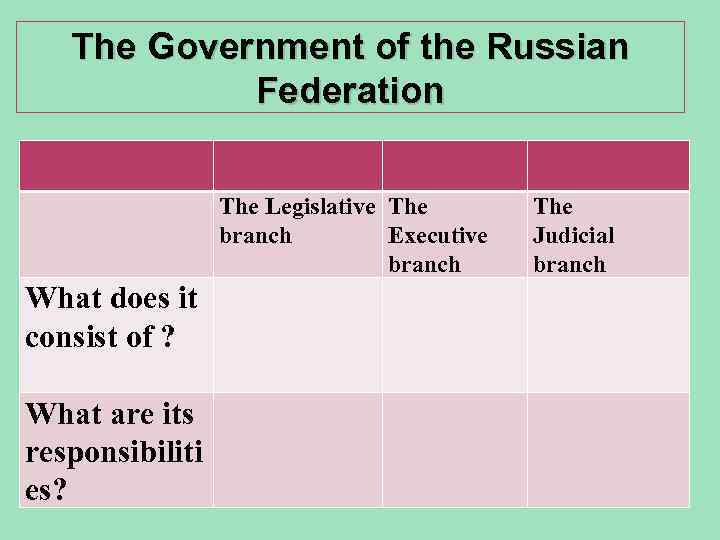
The Government of the Russian Federation The Legislative The branch Executive branch What does it consist of ? What are its responsibiliti es? The Judicial branch
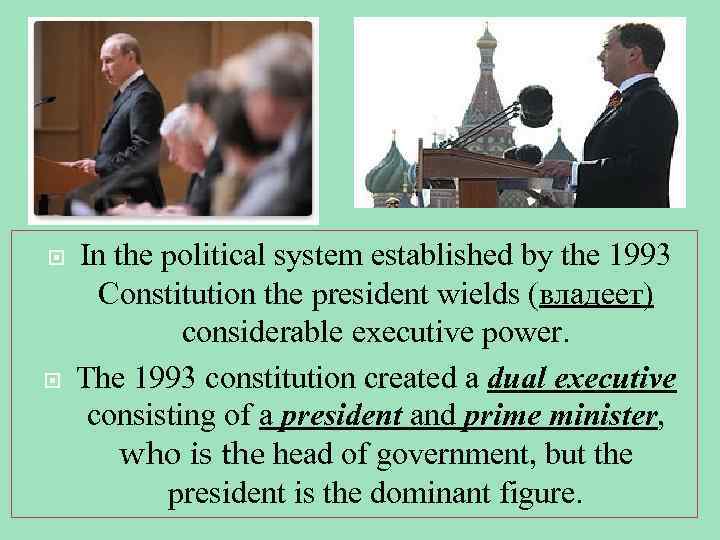
In the political system established by the 1993 Сonstitution the president wields (владеет) considerable executive power. The 1993 constitution created a dual executive consisting of a president and prime minister, who is the head of government, but the president is the dominant figure.
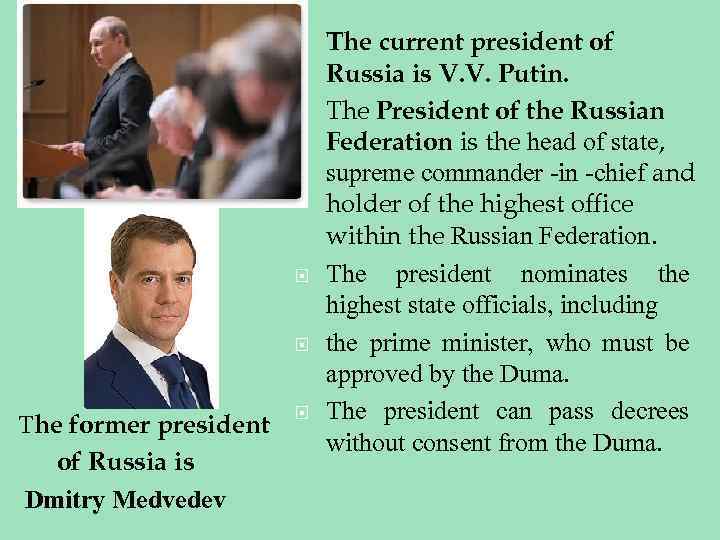
The former president of Russia is Dmitry Medvedev The current president of Russia is V. V. Putin. The President of the Russian Federation is the head of state, supreme commander -in -chief and holder of the highest office within the Russian Federation. The president nominates the highest state officials, including the prime minister, who must be approved by the Duma. The president can pass decrees without consent from the Duma.
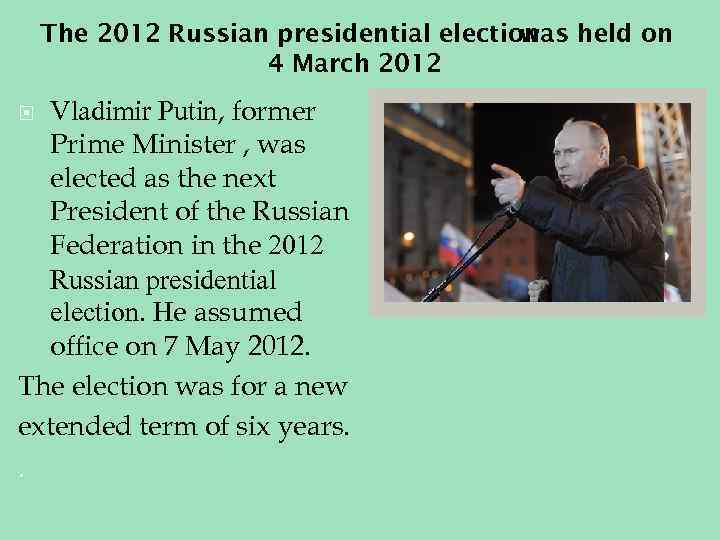
The 2012 Russian presidential election held on was 4 March 2012 Vladimir Putin, former Prime Minister , was elected as the next President of the Russian Federation in the 2012 Russian presidential election. He assumed office on 7 May 2012. The election was for a new extended term of six years. .
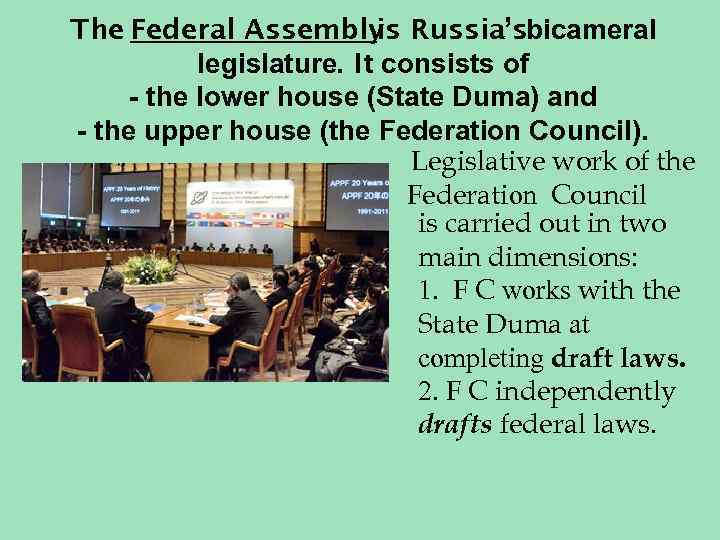
The Federal Assembly Russia’sbicameral is legislature. It consists of - the lower house (State Duma) and - the upper house (the Federation Council). Legislative work of the Federation Council is carried out in two main dimensions: 1. F C works with the State Duma at completing draft laws. 2. F C independently drafts federal laws.
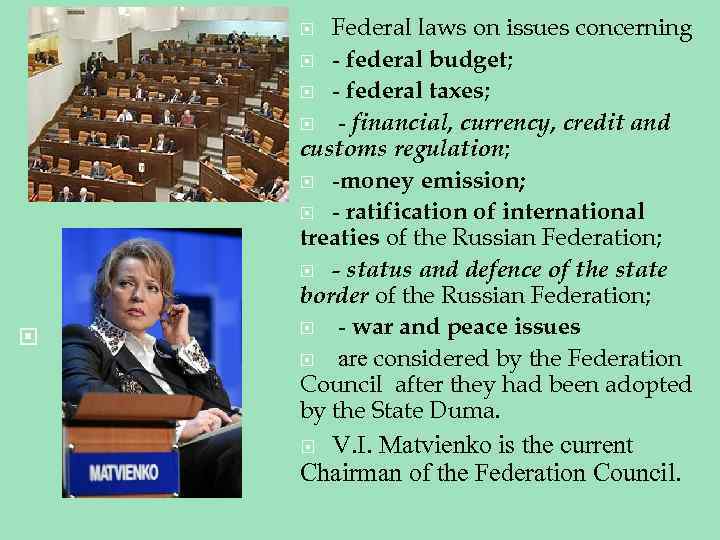
Federal laws on issues concerning - federal budget; - federal taxes; - financial, currency, credit and customs regulation; -money emission; - ratification of international treaties of the Russian Federation; - status and defence of the state border of the Russian Federation; - war and peace issues are considered by the Federation Council after they had been adopted by the State Duma. V. I. Matvienko is the current Chairman of the Federation Council.
The Russian judicial system consists of - The Constitutional Court which arbitrates disputes between the executive and legislative branches; - - The System of General Jurisdiction Courts (The Supreme Court, regional level courts, justices of the peace) The Supreme Court rules on civil criminal and administrative law. -- The System of Arbitration Courts (The Supreme Arbitration Court), that handles economic suits.
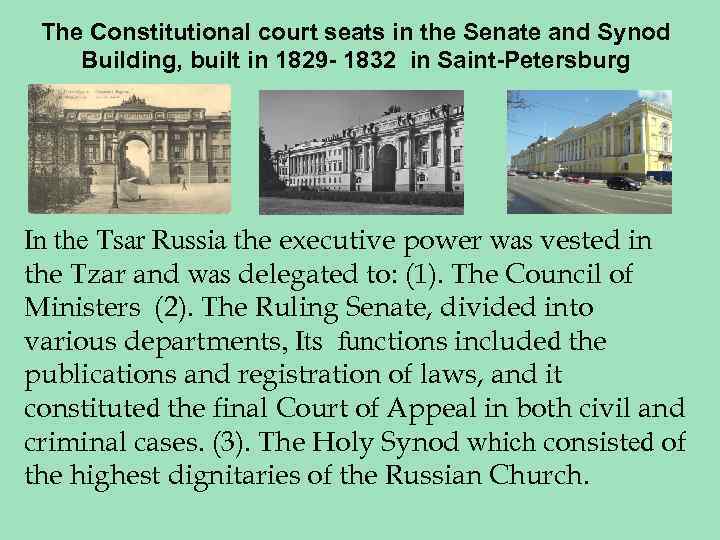
The Constitutional court seats in the Senate and Synod Building, built in 1829 - 1832 in Saint-Petersburg In the Tsar Russia the executive power was vested in the Tzar and was delegated to: (1). The Council of Ministers (2). The Ruling Senate, divided into various departments, Its functions included the publications and registration of laws, and it constituted the final Court of Appeal in both civil and criminal cases. (3). The Holy Synod which consisted of the highest dignitaries of the Russian Church.
The Constitutonal Court also is authorized -to rule on violations of constitutional rights, - to examine appeals from various bodies, and - - to participate in impeachment proceedings against the president. The Constitutional Court of the Russian Federation is a court of limited subject matter jurisdiction. The July 1994 Law on the Constitutional Court prohibits the court from examining cases on its own initiative and limits the scope of issues the court can hear.
Скачать презентацию RUSSIA IS A PARLIAMENTARY REPUBLIC The head of
Презентация Gov of Russia.pptx