


 Скачать презентацию Russia Chapter 9 Rowntree et al Modified
6323791ccafe436c70fb50fb970c4895.ppt
- Количество слайдов: 46
 Russia – Chapter 9 Rowntree, et. al. Modified by Joe Naumann, UMSL
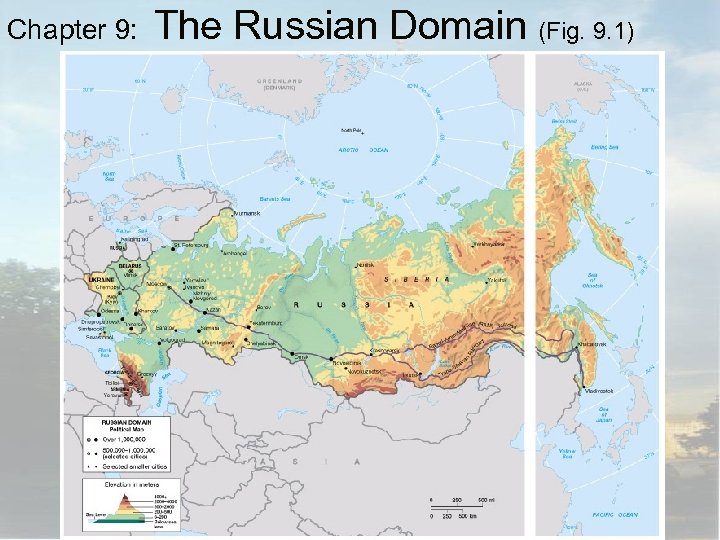 Chapter 9: The Russian Domain (Fig. 9. 1) Globalization & Diversity: Rowntree, Lewis, Price, Wyckoff 2
 Learning Objectives • Understand the challenges of cold, northern climate that affects this region • Learn about the cold war between the U. S. and U. S. S. R. /Russia (1945 -1990) • Know the difference between a political system and an economic system • Students should become familiar with the physical, demographic, cultural, political, and economic characteristics of the Russian Domain • Understand these concepts and models: -Centralized economic -Glasnost and planning Perestroika -Cold War -Russification Globalization & Diversity: Rowntree, 3 -Permafrost -Denuclearization Lewis, Price, Wyckoff -Autonomous areas
 Introduction • Russian Domain includes Russia, Belarus, Ukraine, Georgia, and Armenia (all were part of the U. S. S. R. ) • Russia is the largest country (in land area) on Earth; it spans 11 time zones – Rich in resources, but has one of the harshest climates • The Russian Domain has had extremely rapid political and economic change since 1990 – From centrally planned economy to capitalism – From authoritarian dictatorship to democracy – Region’s economy is weak; commitment to democracy uncertain, nationalist movements threaten stability – Ukraine, Belarus, Georgia, Armenia must build global relationships Globalization & Diversity: Rowntree, 4 Lewis, Price, Wyckoff
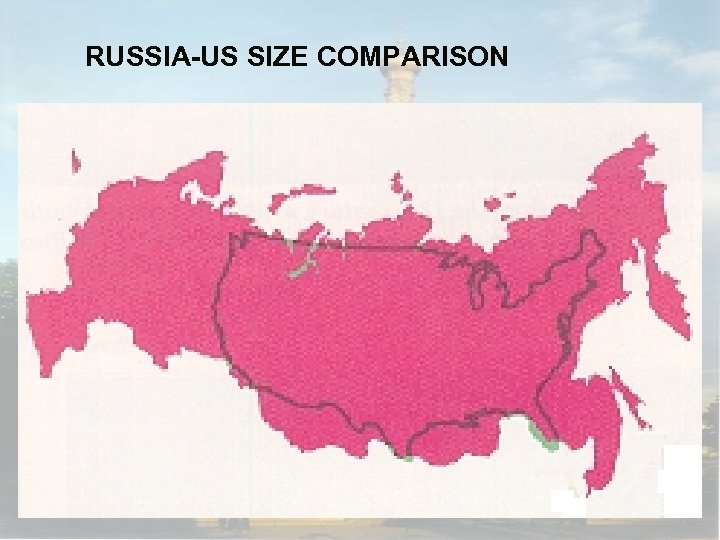 RUSSIA-US SIZE COMPARISON Globalization & Diversity: Rowntree, Lewis, Price, Wyckoff 5
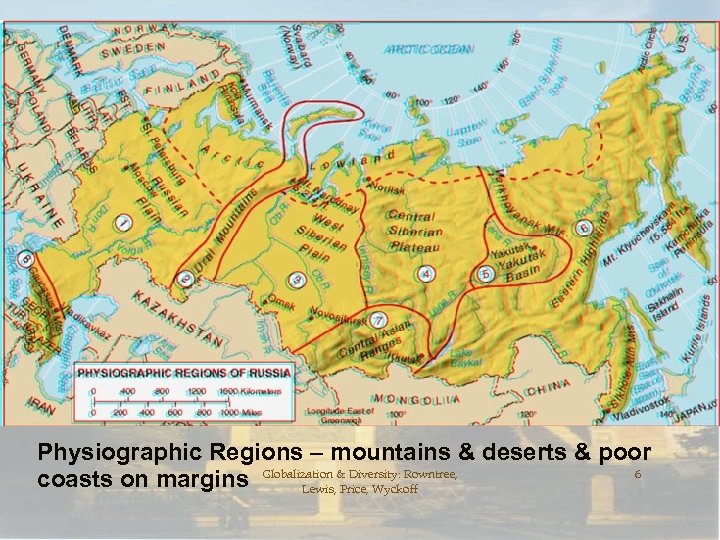 Physiographic Regions – mountains & deserts & poor 6 coasts on margins Globalization & Diversity: Rowntree, Lewis, Price, Wyckoff
 Environmental Geography: Vast & Challenging Land • Russian Domain has “good farmlands, ” metal, petroleum, natural gas, and coal resources • High latitude, continental climate, temperature extremes • Cold climate and rugged terrain limit human settlement and agriculture • Sturgeon (caviar-producing fish) nearly gone – Few domestic regulations to protect them – Poaching adds. Globalization & Diversity: Rowntree, to the problem Lewis, Price, Wyckoff 7
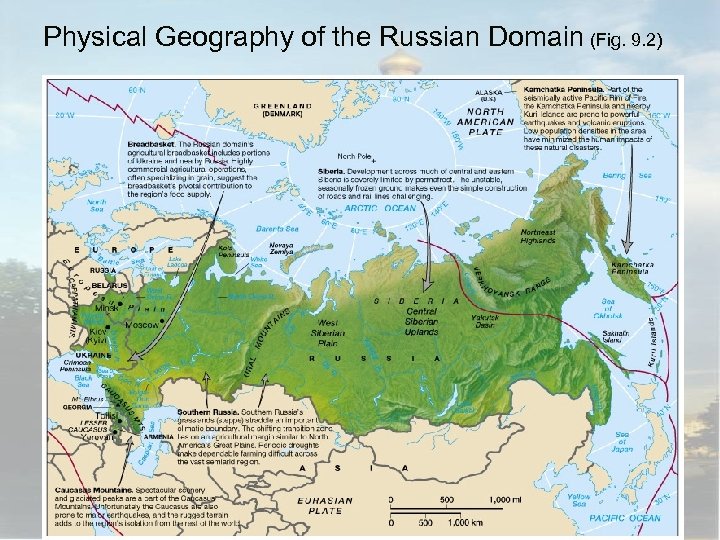 Physical Geography of the Russian Domain (Fig. 9. 2) Globalization & Diversity: Rowntree, Lewis, Price, Wyckoff 8
 • The European West – European Russia, Ukraine and Belarus on eastern European Plain • 3 environments influence agriculture in this region – Poor soils, cold temps, forests N. of Moscow & St. Petersburg – Belarus and central European Russia have longer growing season, but acidic podzol soils limit farm output – South of 50 N Latitude, grassland fertile soils support commercial wheat, corn, sugar, beets, meat production Globalization & Diversity: Rowntree, Lewis, Price, Wyckoff 9
 • The Ural Mountains and Siberia – Urals separate European Russia from Siberia: low mountains with cold, dry climates – Siberia extends thousands of miles, cold climate, little precipitation • Lake Baikal (largest freshwater reserve in the world – 400 miles long, nearly a mile deep, with unique species) • Tundra (mosses, lichens) north; Taiga (coniferous forest zone) south • Farming possible only in southwest Siberia • Permafrost in Eastern Siberia – cold climate with unstable, seasonally frozen ground limiting farming and construction Globalization & Diversity: Rowntree, Lewis, Price, Wyckoff 10
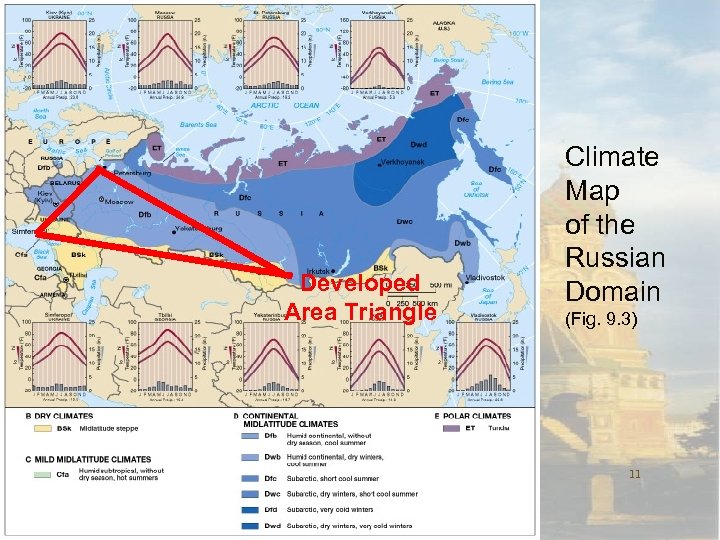 Developed Area Triangle Globalization & Diversity: Rowntree, Lewis, Price, Wyckoff Climate Map of the Russian Domain (Fig. 9. 3) 11
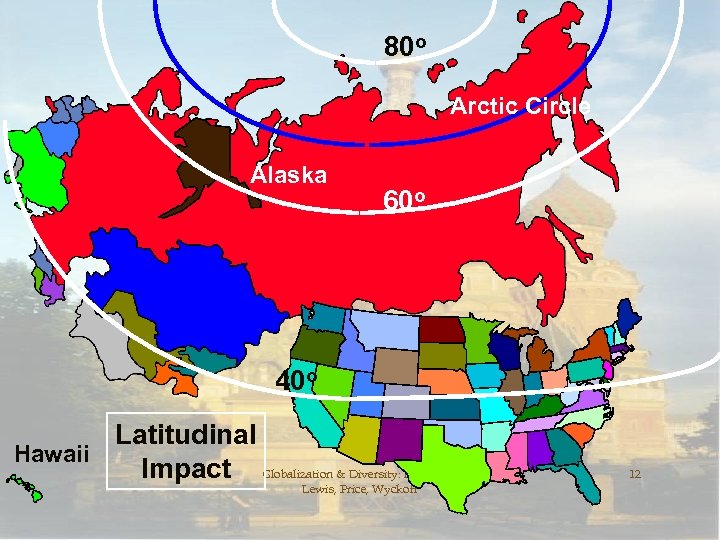 80 o Arctic Circle Alaska 60 o 40 o Latitudinal Hawaii Impact Globalization & Diversity: Rowntree, Lewis, Price, Wyckoff 12
 RUSSIAN CLIMATE • Affected by 3 natural conditions: -- Latitudinal Position -- Continental Position Globalization & Diversity: Rowntree, 13 -- Location. Wyckoff major mountains of Lewis, Price,
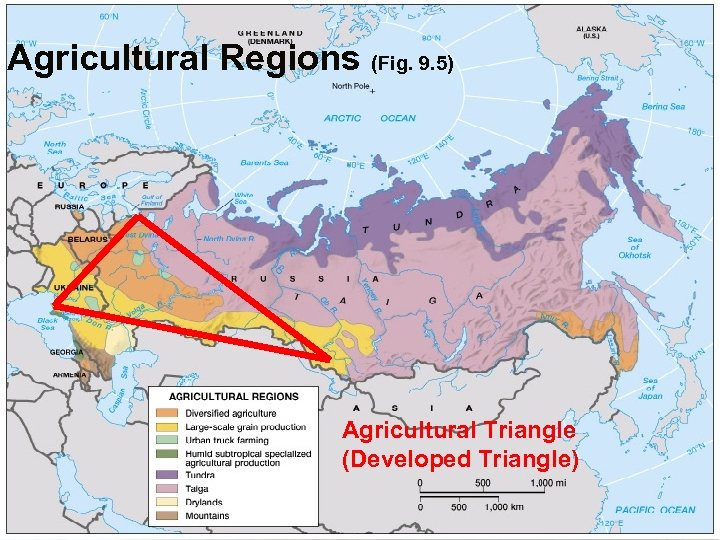 Agricultural Regions (Fig. 9. 5) Agricultural Triangle (Developed Triangle) Globalization & Diversity: Rowntree, Lewis, Price, Wyckoff 14
 Environmental Geography: A Vast and Challenging Land (cont. ) • The Russian Far East – Near Vladivostok, about same latitude as New England (in N. America) – Longer growing seasons and milder climates than Siberia, seismically active – Ussuri and Amur River Valleys have mixed crop and livestock farming – Vegetation includes conifers, taiga, Asian hardwoods • The Caucasus and Transcaucasia – In extreme south of European Russia, forms Russia’s southern boundary, between the Black and Caspian seas – Highest peak is Mt. Elbrus (18, 000 feet) – Georgia and Armenia are in Transcaucasia; Lesser Caucasus Mountains form border between Armenia and Azerbaijan – Climate: high rainfall in west, arid or semi-arid in east; good soils and farming Globalization & Diversity: Rowntree, Lewis, Price, Wyckoff 15
 • A Devastated Environment (cont. ) – Air and Water Pollution • Extreme environmental pollution, from industrialization, urbanization, careless mining, nuclear energy production; legacy of U. S. S. R. • Air pollution caused by clustered factories, few environmental controls, reliance on low quality coal • Water pollution caused by industrial waste, raw sewage, oil spills; pulp and paper factories polluted Lake Baikal (1950 s-60 s) – The Nuclear Threat • Former U. S. S. R. nuclear weapons, energy production caused pollution – Above-ground testing made radioactive fallout; nuclear waste dumped – Nuclear weapons used for seismic experiments, oil exploration, dam building – Russia has many old nuclear reactors; major nuclear accidents: 1986 meltdown in Chernobyl (Belarus); another in 1956 • Construction of new nuclear plants • Possibility of warehousing of international nuclear wastes Globalization & Diversity: Rowntree, Lewis, Price, Wyckoff 16
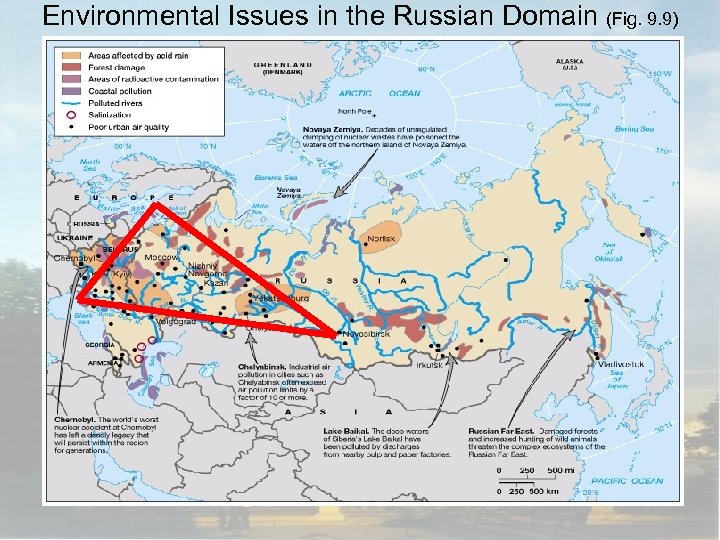 Environmental Issues in the Russian Domain (Fig. 9. 9) Globalization & Diversity: Rowntree, Lewis, Price, Wyckoff 17
 Population & Settlement: An Urban Domain • Overview of the Russian Domain – More than 200 million residents, most in cities • Population Distribution – Most people in best farmlands • European Russia; 110 mil. ; Siberia: 35 mil. ; Belarus & Ukraine: 60 mil – The European Core (Belarus; Western Russia; Ukraine) • Contains the Russian Domain’s largest cities, biggest industrial complexes, most productive farms, higher population densities – Siberian Hinterlands • Relatively sparse settlement, with two zones influenced by transportation – Industrial cities along Trans-Siberian Railroad (1904) – Thinner settlement along the Baikal-Amur Mainline (BAM) Railroad -- newer (1984) Globalization & Diversity: Rowntree, Lewis, Price, Wyckoff 18
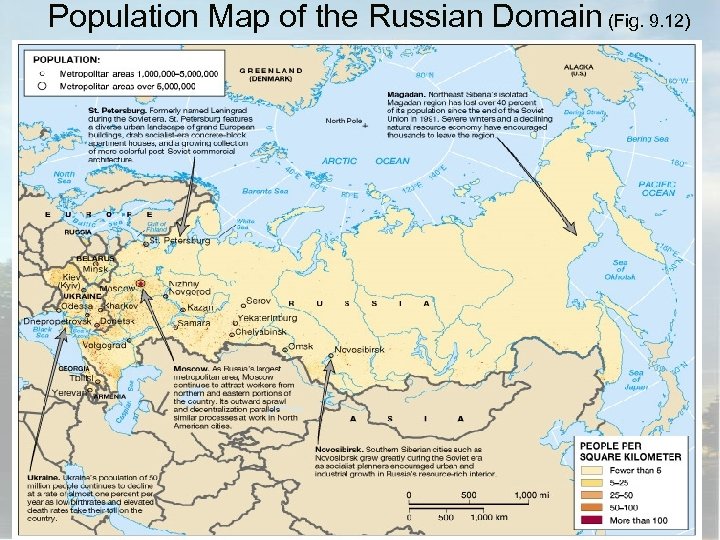 Population Map of the Russian Domain (Fig. 9. 12) Globalization & Diversity: Rowntree, Lewis, Price, Wyckoff 19
 • Regional Migration Patterns – Eastward Movement (1860 -1914) • Trans-Siberian Railroad speeded eastward movement • Almost 1 mil. settlers lured by farming opportunities in southern Siberia, more political freedom away from Tsars » Tsars – czars; authoritarian leaders who dominated politics of pre 1917 Russian Empire (comes from “Caesar”) – Political Motives • Infill in Siberia has economic and political benefits • Political dissidents sent to Siberia (Gulags Archipelago) • Russification: Soviet policy moved Russians into non. Russian portions of U. S. S. R to increase Russian dominance in those areas; Russians are a significant minority in former Soviet republics Globalization & Diversity: Rowntree, Lewis, Price, Wyckoff 20
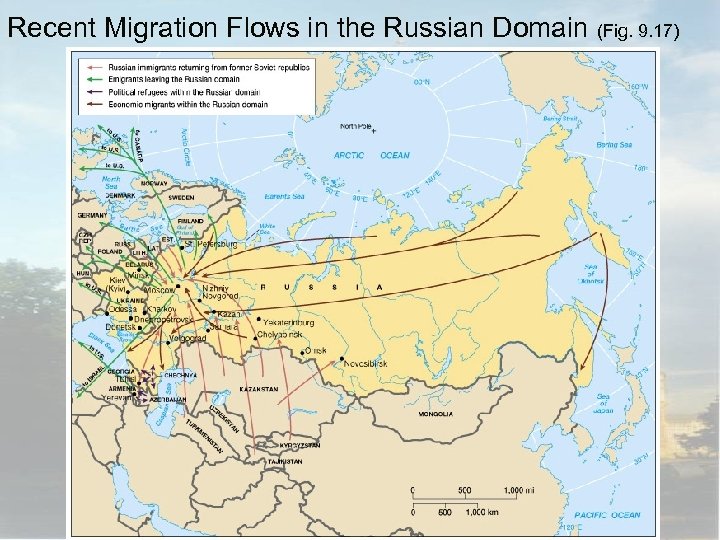 Recent Migration Flows in the Russian Domain (Fig. 9. 17) Globalization & Diversity: Rowntree, Lewis, Price, Wyckoff 21
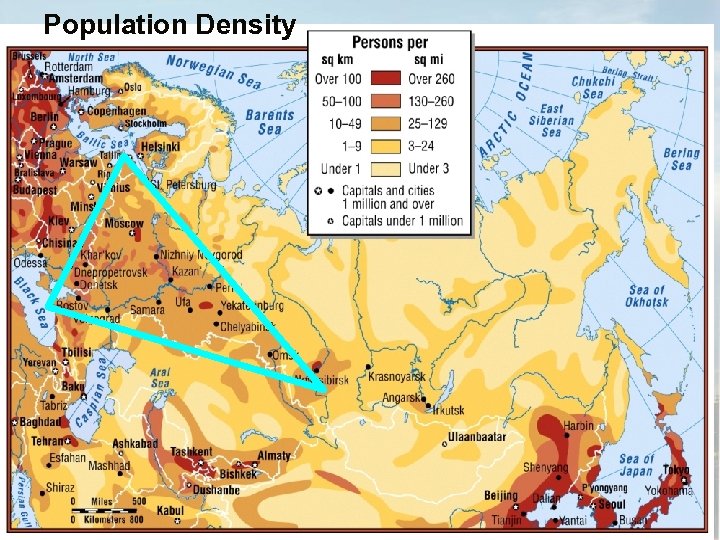 Population Density Globalization & Diversity: Rowntree, Lewis, Price, Wyckoff 22
 • Regional Migration Patterns (cont. ) – New International Movements • Russification often reversed in post-Soviet era – Citizenship, language requirements encourage Russians to go • Movement to other regions – “Brain drain” to other countries – Jewish Russians move to Israel or U. S. – Mail-order Ukrainian brides to the U. S. – The Urban Attraction • Soviet planners’ encouraged migration to cities • Soviets planned cities, limited population levels and regulated migration • Post-Soviet era, citizens have greater freedom to move; many older industrial areas are now losing population Globalization & Diversity: Rowntree, Lewis, Price, Wyckoff 23
 • Inside the Russian City • Russian cities carefully in planned form and function, with circular land-use zones –Core has superior transportation, best stores and housing » Core predates Soviets era » Sotzgorods: work-linked housing (including dorms) » Chermoyuski: apartment blocks from 1950 s/60 s » Mikrorayons: Self-contained housing projects of 1970 s/80 s » Dachas: country houses available only to the elite. Globalization & Diversity: Rowntree, 24 Lewis, Price, Wyckoff
 • The Demographic Crisis • General population decline caused by low birth rates and rising death (mortality) rates, especially among middle-aged males – Causes » » » fraying social fabric economic uncertainty declining health among women of child-bearing age stress-related diseases rising murder and suicide toxic environments • Russia’s population could fall by 3 million to 25 million by 2030 Globalization & Diversity: Rowntree, Lewis, Price, Wyckoff 25
 The Legacy of Slavic Dominance • The Heritage of the Russian Empire – Growth of the Russian Empire • Slavic “Rus” in power from 900 AD around Kiev • Eastern Orthodox Christianity came in 1000 AD • By 1400 s, new and expanding Russian state after Tatar and Mongol rule • Expansion eastward in 16 th & 17 th centuries; westward expansion slow • Final expansion of Russian Empire in 19 th Century in Central Asia – The Significance of Empire • 1900, Russians ruled from St. Petersburg to Vladivostok Globalization & Diversity: Rowntree, Lewis, Price, Wyckoff 26
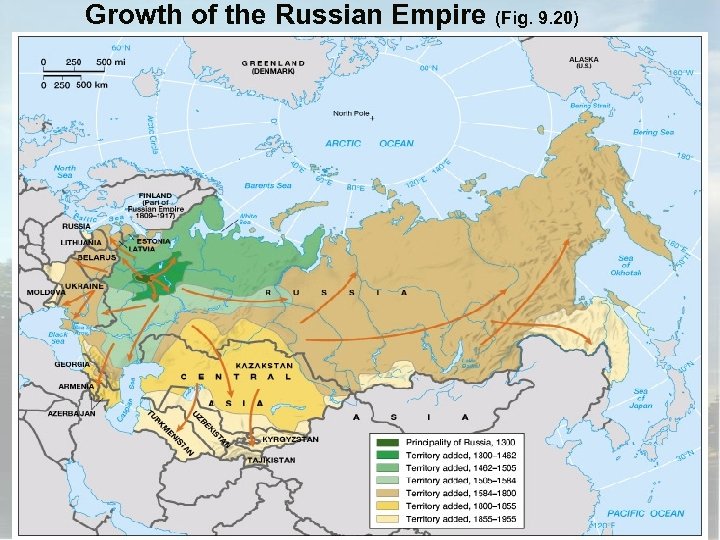 Growth of the Russian Empire Globalization & Diversity: Rowntree, Lewis, Price, Wyckoff (Fig. 9. 20) 27
 • Geographies of Language – Slavic languages dominate in the Russian Domain • 80% of Russia’s people are ethnic Russians • There are other language groups – Finno-Ugric (Finnish) in the north – Altaic (Tatars & Turkic peoples) middle Volga – Transcaucasia has many languages – Yakut (Turkic) in Siberia; Buryats near Lake Baikal » Similar treatment to indigenous in U. S. , Canada, Australia Globalization & Diversity: Rowntree, Lewis, Price, Wyckoff 28
 • Geographies of Religion – Soviets prohibited religion, religious revival underway now – Eastern Orthodox Christianity most common • Other forms of Western Christianity practiced – Non-Christian religions • 20 -25 million Sunni Muslims live in the North Caucasus • Over 1 million Jews, mostly in larger western cities Globalization & Diversity: Rowntree, Lewis, Price, Wyckoff 29
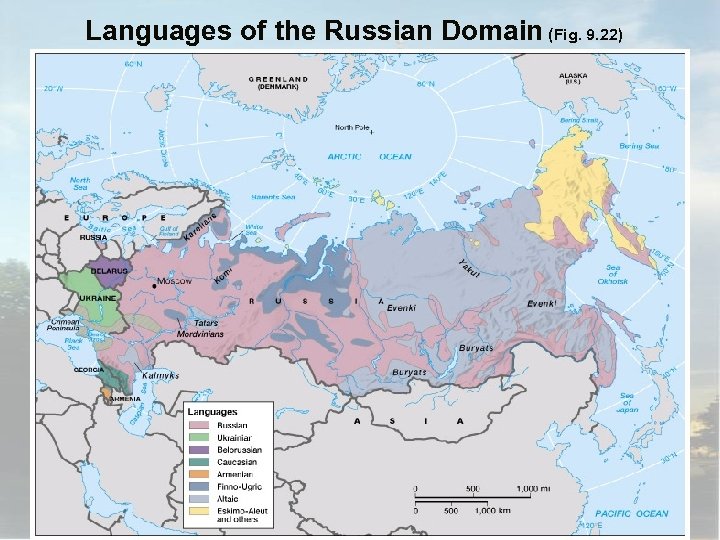 Languages of the Russian Domain (Fig. 9. 22) Globalization & Diversity: Rowntree, Lewis, Price, Wyckoff 30
 • Russian Culture in Global Context – Strong traditions, influenced by Western Europe – Soviet Days • Soviets promoted social realism: a style devoted to the realistic depiction of workers harnessing the forces of nature or struggling against capitalism – Turn to the West • Young Russians adopted consumer culture in 1980 s • In post-Soviet era, globalism and consumerism came to Russia from the West and elsewhere (India, Hong Kong, Latin America) – The Music Scene • American and European popular music gaining fans • Home-grown music industry is evolving Globalization & Diversity: Rowntree, Lewis, Price, Wyckoff 31
 The Remnants of a Global Superpower • Geopolitical Structure of Former Soviet Union – Russian Empire collapsed abruptly in 1917 • Briefly, a broad-based coalition of business people, workers, and peasants replaced tsars • Soon, Bolsheviks (faction of Russian Communists representing the interests of the industrial workers), led by Lenin, centralized power and introduced communism The Soviet Republics and Autonomous Areas • Soviet leaders designed a geopolitical solution to maintain the country’s territorial boundaries, and theoretically acknowledged the rights of non-Russian citizens by creating Union Republics – Autonomous areas: minor political sub-units designed to recognize special status of minority groups within existing republics Globalization & Diversity: Rowntree, Lewis, Price, Wyckoff 32
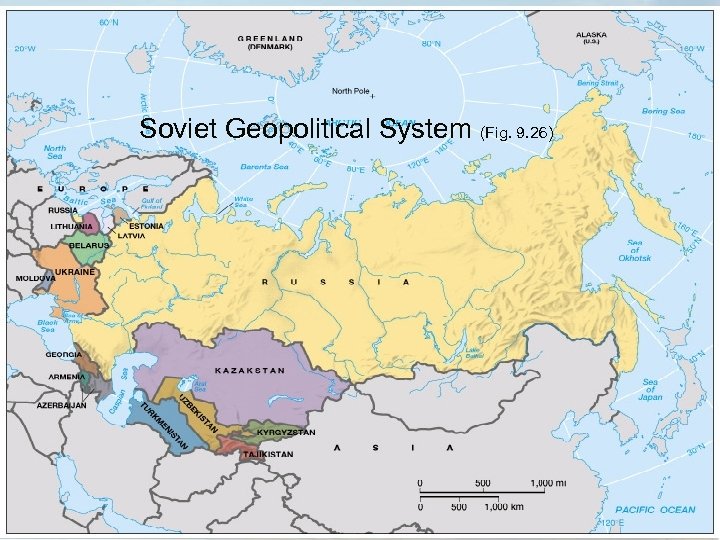 Soviet Geopolitical System (Fig. 9. 26) Globalization & Diversity: Rowntree, Lewis, Price, Wyckoff 33
 Geopolitical Framework: The Remnants of a Global Superpower – Centralization and Expansion of the Soviet State • Communism did not eliminate ethnic differences • In 1930, Soviet leader Stalin centralized power in Moscow, limiting national autonomy • Land added – Sakhalin, Kuril Islands from Japan; Baltic republics – Occupation of Poland, Romania, Czechoslovakia – Exclave (outside Russia’s contiguous land) added from Germany – End of the Soviet System • Union republics encouraged ethnic identification • Glasnost: greater openness; Perestroika: economic restructuring • 1991: all 15 Union Republics gained independence Globalization & Diversity: Rowntree, Lewis, Price, Wyckoff 34
 Geopolitical Framework: The Remnants of a Global Superpower • Current Geopolitical Setting (1992 -present) (Fig. 9. 30) – Russia and the Former Soviet Republics • Formed Commonwealth of Independent States (CIS) – a looser political union that included all but three of the former republics; has no power, and is mostly a forum for discussion • Denuclearization (the return and partial dismantling of nuclear weapons from outlying republics to Russian control completed in 1990 s; tactical nuclear weapons moved to Kaliningrad exclave • Military, political and ethnic tensions remain in parts of the region – Devolution and the Russian Federation • Devolution: more localized political control in Russia • Russian leaders fear other areas will secede Globalization & Diversity: Rowntree, Lewis, Price, Wyckoff 35
 – Regional Tensions • Chechnyan Republic seeking independence – Russians sent military – Chechnya has metals and oil – The Shifting Global Setting • Boundary issues between Russia and China • Dispute with Japan over Kuril Islands • Expansion of NATO concerns Russian leaders • Russia recently joined the “Group of Seven” (G-7) – Other members: U. S. , Canada, Japan, Germany, Great Britain, France, Italy) Globalization & Diversity: Rowntree, Lewis, Price, Wyckoff 36
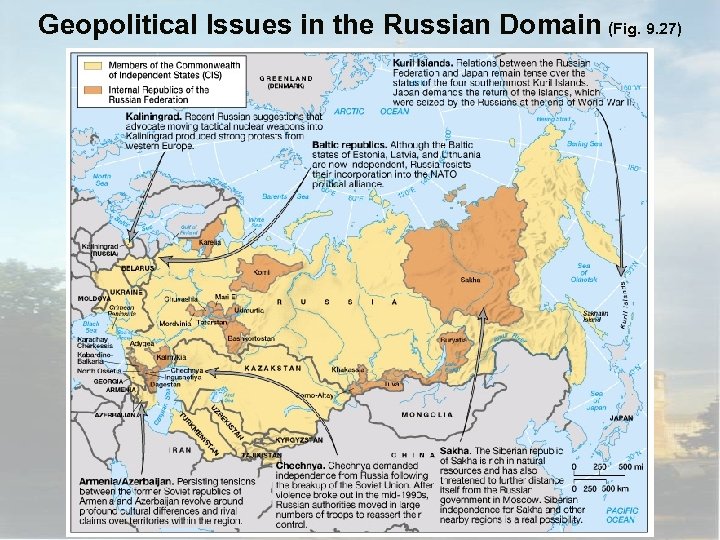 Geopolitical Issues in the Russian Domain (Fig. 9. 27) Globalization & Diversity: Rowntree, Lewis, Price, Wyckoff 37
 An Era of Ongoing Adjustment • After economic decline of 40% in the 1990 s, Russia’s economy stabilized in 2000 and 2004 • The Legacy of the Soviet Economy – Communists came to power in 1917, and instituted centralized economic planning: a situation in which the state controls production targets and industrial output – Soviets nationalized agriculture, but it was inefficient – Soviets expanded industrialization and transportation • Industrialization more successful than collectivized agriculture • Trans-Siberian Railroad, canal system – Improvements in housing and education after WWII • Literacy near 100% – But economic and social problems increased in 1970 s-’ 80 s Globalization & Diversity: Rowntree, Lewis, Price, Wyckoff 38
 – Soviet industry more successful than agriculture • Soviets added major industrial zones (Fig. 9. 31), many near energy sources and metals • Moscow had fewer raw materials, but had some of Russia’s best infrastructure, large pool of skilled labor, and demand for industrial products – Soviets developed a good transportation and communication infrastructure – Soviets had a massive housing campaign in the 1960 s – Soviets made literacy virtually universal, and health care readily available; eliminated the worst of the poverty Globalization & Diversity: Rowntree, Lewis, Price, Wyckoff 39
 • The Post-Soviet Economy • The region has replaced its communist system with a mix of state-run operations and private enterprise – Redefining Regional Economic Ties • Independent republics negotiate for needed resources with Russia and each other rather than accept centralized control • Russia continues to dominate the region’s economy – Privatization and Economic Uncertainty • Russia removed price controls in 1992; sold state-owned business to private investors in 1993 – Higher prices, lack of legal safeguards created problems • Agriculture still struggles, in part due to harsh climate, landforms • Many people see little economic gain from changes Globalization & Diversity: Rowntree, Lewis, Price, Wyckoff 40
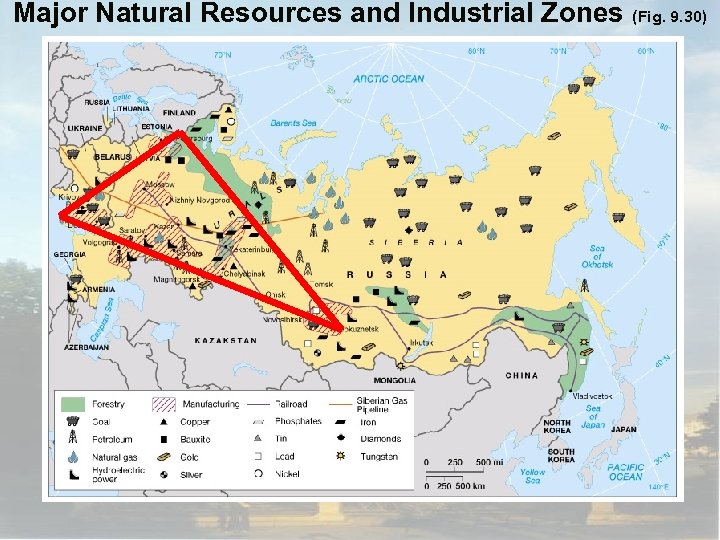 Major Natural Resources and Industrial Zones (Fig. 9. 30) Globalization & Diversity: Rowntree, Lewis, Price, Wyckoff 41
 – The Russian Mafia • Russia Interior Ministry estimates that Russian mafia controls 40% of the private economy & 60% of the state-run enterprises; 80% of banks in Russia may be under mafia influence – Protection money, corruption result • Russian mafia has gone global – Money laundering (Russia, U. K. , U. S. ); gambling (Sri Lanka); drugs (Colombia); legitimate Israeli high tech companies Globalization & Diversity: Rowntree, Lewis, Price, Wyckoff 42
 • Social Problems – High unemployment, rising housing costs; lower welfare spending – Divorce and domestic violence increasing; prostitution increasing – Health care spending dropping • Vaccine shortages allow disease to return • Chronic and stress-related illnesses on the rise Globalization & Diversity: Rowntree, Lewis, Price, Wyckoff 43
 • Growing Economic Globalization – Starting in 1970 s, Soviets exported fossil fuels, imported food; ties now stronger – A New Day for the Consumer • Western consumer goods available (e. g. , Mc. Donald’s, Calvin Klein; even some luxury items) – Attracting Foreign Investment • Region struggles to attract foreign investment • Most investment from U. S. , western Europe (esp. Germany, U. K. ) – Fossil fuels, food, telecommunications, consumer goods – Foreign investment growing by more than 14% Globalization & Diversity: Rowntree, 44 annually Lewis, Price, Wyckoff
 – Globalization and Russia’s Petroleum Economy • Russia has 35% of the world’s natural gas reserves – Mostly in Siberia – World’s largest gas exporter • Primary destination for Russian petroleum products is western Europe – Former U. S. S. R. republics depend on Russia’s energy – Foreign investment in new pipelines, other technology – Local impacts of globalization • Vary from place to place – Investment in Moscow, Siberia (oil) – Pro-business Nizhny Novgorod and Samara attract investment – Local economic declines in older, uncompetitive industrial areas Globalization & Diversity: Rowntree, Lewis, Price, Wyckoff 45
 Conclusions • Russian Domain has seen great change, from empire, through revolution and break-up • Ethnic & cultural differences continue to shape the region • Russian Domain is rich in natural resources, but has limited agricultural potential and lingering economic difficulties • Massive readjustments growing from the political and economic upheavals of the 1990 s continue to affect the area • Environmental devastation in the region and its effects continue to cause social and health problems • More uncertainty lies ahead for the people of the Russian Globalization & Diversity: Rowntree, 46 Domain. Lewis, Price, Wyckoff End of Chapter 9: The Russian Domain